






Abstract
microRNAs (miRNAs) are a class of endogenous small RNAs (sRNAs) that play pivotal roles in plant development, abiotic stress response, and pathogen response. miRNAs have been extensively studied in plants, but rarely in Nicotiana benthamiana, despite its wide use in plant virology studies, particularly for studying N protein-tobacco mosaic virus (TMV) interactions. We report an efficient method using high-throughput sequencing and bioinformatics to identify genome-wide miRNAs in N. benthamiana. A total of 30 conserved miRNA families and 113 novel miRNAs belonging to 93 families were identified. Some miRNAs were clustered on chromosomes, and some were embedded in host gene introns. The predicted miRNA targets were involved in diverse biological processes, such as metabolism, signaling, and responses to stimuli. miRNA expression profiling revealed that most of them were differentially expressed during N-mediated immunity to TMV. This study provides a framework for further analysis of miRNA functions in plant immunity.
Introduction
MicroRNA (miRNA) is a pivotal category of small RNA (sRNA) used in the regulation of gene expression in eukaryotes. 1 miRNAs are approximately 21 nt endogenous non-coding RNAs that negatively regulate gene expression at the post-transcriptional level, by either repressing gene translation or cleaving target mRNAs. 2 Unlike animals, plants use Dicer-like (DCL) proteins to generate stem-loop precursor mRNA (pre-miRNA) and process the miRNA:miRNA star (miRNA:miRNA*) duplex with two-nucleotide 3’ overhangs, 3 which is then transported from the nucleus into the cytoplasm by HASTY (HST). 4 Once 2'O-methylated by Hua Enhancer 1 (HEN1), the mature miRNA strand is predominantly incorporated into argonaute-1 (AGO1) or argonaute-10 (AGO10) containing RNA-induced silencing complexes (RISCs) that inhibit gene expression by perfect or near-perfect complement to target transcripts.5,6 Many miRNA sequences are highly conserved within the same kingdom, 7 whereas others are species specific. These non-conserved miRNAs are difficult to identify by conventional methods. However, recently established high-throughput sequencing technologies together with powerful bioinformatics tools have allowed efficient identification of not only conserved miRNAs but also low-abundance miRNAs in several plant species.8–10
In plants, miRNAs are involved in diverse processes such as development11,12 and responses to nutrient, 13 and environmental stresses. 14 They also play critical roles in resistance to bacterial pathogens and viruses. For example, Arabidopsis treatment with flg22, a flagellin-derived peptide, increases the transcriptional level of miR393, which then negatively regulates auxin receptors TIR1, AFB2, and AFB3 in bacterial resistance mechanisms. 15 In Arabidopsis, miR160a, miR398b, and miR773 participate in plant innate immunity against Pseudomonas syringae by regulating Pathogen-associated molecular pattern (PAMP)-induced callose deposition. 16 In diverse plant species, miR482/2118 superfamily members target the P-loop motif coding sequence of resistance genes with nucleotide binding site (NBS) and leucine-rich repeat (LRR) motifs, which leads to RNA-dependent RNA polymerase 6 (RDR6)-dependent mRNA degradation and production of secondary small interfering RNAs (siRNAs). 17 Similarly, nta-miR6019 and nta-miR6020 from tobacco guide the cleavage of the mRNA of the immune receptor N's TIR domain, which also leads to RDR6- and DCL4- dependent production of secondary siRNAs. 18 In accordance with the function of miRNAs in plant immunity, genes required for miRNA biogenesis are also required for resistance against bacterial pathogens. For example, both HEN1 and DCL1 are required for PAMP-triggered immunity (PTI). 19
The tobacco N gene belongs to the TIR-NB-LRR class of resistance (R) genes that confer resistance to tobacco mosaic virus (TMV). 20 When TMV attacks tobacco cells, p50, the TMV replicase fragment, is recognized by N protein through direct interaction. This triggers a series of signal transduction cascades, which initiate a hypersensitive response (HR), inhibit TMV spread, and induce systemic acquired resistance (SAR). Interestingly, N protein's function is temperature sensitive and reversible. 21 At temperature above 28 °C, N-mediated HR is restricted and TMV spreads throughout the plants. When temperature is below 28 °C, N protein reactivated, resulting in HR in TMV-containing tissues. In recent decades, many proteins have been identified by virus-induced gene silencing (VIGS) technology as participating in N-mediated signaling pathways. Like other TIR-NB-LRR proteins, N protein requires enhanced disease susceptibility 1 (EDS1) for its function. 22 The jasmonic acid (JA) and ethylene signaling pathways have been implicated in the resistance response to TMV through their respective hormone receptors, COI1 and CTR1. N protein occurs in a large complex with Rar1/SGT1, COP9 signalosome (CSN), and HSP90, suggesting that ubiquitin-mediated protein degradation and molecular chaperones play key roles in the N-mediated signaling pathway.22–24 Two MAPK cascades, MEK1 MAPKK and NRK1 MAPK, function downstream of the recognition step. The transcription factors WRKY1–3 and MYB1 might function downstream of the MAPK cascades. 25
Although miRNAs have been implicated in plant immunity, whether miRNAs are involved in the N-mediated resistance pathway is still unknown. To address this question, we constructed three sRNA libraries of TMV-infected Nicotiana benthamiana plants from the selected time points after N gene activation. Through library sequencing and analysis, we identified 30 families of conserved miRNAs and 93 families of N. benthamiana-specific miRNAs. Furthermore, we identified numerous candidate miRNAs and their putative targets that may participate in regulating N-mediated resistance to TMV. This is the first large-scale survey of miRNAs in N. benthamiana, and has revealed putative miRNAs and targets that participate in the N-mediated resistance pathway.
Results
High-throughput sequencing of sRNAs in N. benthamiana
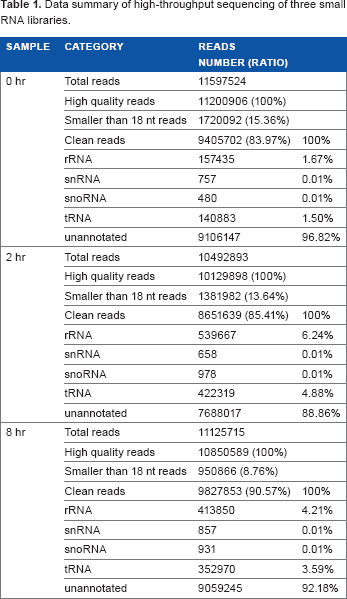
Data summary of high-throughput sequencing of three small RNA libraries.
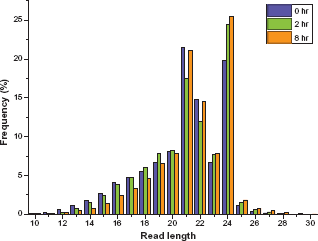
The length distribution of sRNAs in zero-hr, two-hr, and eight-hr libraries (hr, hour).
To identify putative miRNA in the pool of sRNA reads, we first removed other sRNA categories (rRNA, snRNA, snoRNA, tRNA) from our analysis. We identified the other sRNA categories by comparing the cleaned reads (see Materials and Methods) to entries in annotated sRNA databases of GenBank (http://www.ncbi.nlm.nih.gov/genbank/) and Rfam (http://rfam.sanger.ac.uk). The remaining unannotated reads were mapped to the N. benthamiana genome (version 0.4.4). Next, all mapped reads were analyzed to identify candidate miRNAs. Although we excluded the other sRNA categories from further analysis, we note here that rRNA levels clearly increased from zero hour (1.67%) to two hours (6.24%), but had decreased slightly by eight hours (4.21%). A similar pattern was also found for tRNA, indicating that many functional genes are expressed immediately after N gene activation and their expression peaked around two hours after the transfer to normal growth conditions.
Conserved N. benthamiana miRNAs
To identify conserved N. benthamiana miRNAs, we used a computational protocol similar to Mackowiak et al. 26 with modifications for plant miRNA identification 27 to align excised mapped reads to Nicotiana tabacum miRNAs and miRNA*s deposited in miRBase and a recent database reported by Frazier et al. 28 We identified 95 miRNAs previously described in N. tabacum. With the remaining excised precursors, we used other plants’ miRNAs in miRBase as a reference and identified 17 N. benthamiana miRNAs to be similar to other plant species’ miRNAs. In total, 112 conserved miRNAs were identified, 100 of which were expressed in at least one of our sRNA libraries (97, 96, and 98 miRNA genes in the zero-, two-, and eight-hour samples, respectively; Table S1). The miRNA names, mature sequences, star sequences, the corresponding read numbers, and reference miRNAs from other plants with the same seed and pre-miRNAs’ position on the scaffolds are presented in Table S1. Furthermore, the partner miRNA* was identified for over 90% (102/112) of novel N. benthamiana miRNA genes. We also detected 16 sequences within the loop structure of miRNA genes. miRNA* and loop RNA are generally short lived, indicating that the high-throughput sequencing technology was very sensitive for identifying miRNA.
We found nearly equal numbers of reads from two arms of stem-loop precursors for 5 of the 112 known miRNAs (nbt-miR169a, nbt-miR160e, nbt-miR398, nbt-miR396b, and nbt-miR396a) and even more reads of the star strand than the miRNA strand annotated by miRBase for 3 miRNAs (nbt-miR319a, nbt-miR319b, nbt-miR482b) (Table S1). These results indicate that the biogenesis of mature miRNA is highly complex in N. benthamiana.
Mature plant miRNAs preferentially have a U at the first position from the 5‘-end according to a previous study.
6
We constructed position-weight-matrices (PWMs) in WebLogo
29
for all conserved 18–22 nt mature N. benthamiana miRNA sequences. The results confirmed the reported findings. The extreme 5‘-end of the miRNAs we examined had a 60% U bias based on the graphed nucleotide composition per position (Fig. 2A). There were also other positions that showed biased base conservations. For example, position 3 had more G, positions 5 and 15 more A/U, and position 11 more G/C than random expectations (Fig. 2A).
Position-specific nucleotide preference in known miRNA (A) and novel miRNA (B) in N. benthamiana.
summary of conserved N. benthamiana miRNA families and number of member in each family.

Novel N. benthamiana miRNAs
We identified novel N. benthamiana miRNAs with a computational protocol similar to that of Sebastian et al. 26 with modifications for plant miRNA identification 27 (the same program used for predicting conserved miRNAs) using a probabilistic method to score the compatibility of the miRNA position and the frequency of sRNA within the secondary structure of the miRNA precursors. 30 A total of 113 unique sequences were identified as potential miRNA genes with a true possibility of over 71% (Table S2). Since we excluded miRNAs that had high similarity with the miRNA of the reference plants, these miRNAs are believed to be N. benthamiana specific.
Comparison of mature miRNA length between conserved and novel miRNA in N. benthamiana.

We also inspected the nucleotide bias of the novel miRNA mature sequences by WebLogo. 29 As expected, U was mostly preferred at the first position, albeit with a lower frequency (50%) than that of conserved miRNAs. Unlike conserved miRNAs, there was no obvious nucleotide bias at the other sites, indicating that the novel miRNAs in N. benthamiana are highly variable (Fig. 2).
Based on sequence similarity (identity >90%), the 113 novel N. benthamiana miRNAs were grouped into 93 families. The largest families were miRN3 and miRN10 with four members. Only 15 families had more than one member (Table S3). Of the 112 novel miRNAs, 50 had a very high confidence score (over 100) with a corresponding predicted true possibility higher than 94% (Table S2).
Clustered N. benthamiana miRNAs
Clustered miRNAs have been reported in both animal and plant genomes,31,32 but have not yet been described in tobacco. Since assembled chromosome data are not available for N. benthamiana, we mapped pre-miRNAs onto N. benthamiana genome scaffolds and contigs. We found 11 pre-miRNAs from five families distributed in five clusters (Table S4). After filtering out candidates who did not meet high stringency criteria, we identified two pre-miRNA clusters containing two nbt-miR399 and three nbt-miRN41 members (Fig. 3). The two nbt-miRN41 family members (nbt-miRN41a and nbt-miRN41b) on the scaffold Niben044Scf00014276 are separated by less than 400 bp. The closeness of nbt-miRN41a and nbt-miRN41b suggests that the two miRNAs are transcribed as a single primary transcript. However, the other clustered miRNAs are separated by much longer distances of 6–8 kb. Interestingly, members of the clustered pre-miRNAs belong to the same miRNA family. Moreover, both miRNA clusters are located in intergenic regions according to the current genome annotation.
Clustered miRNAs in N. benthamiana.
Intronic miRNAs in N. benthamiana
Intronic miRNAs are a type of miRNAs located in the introns of host genes and were first identified in fruit flies and worms, and then in mammals. In animals, about 80% of the miRNAs are embedded in gene introns.
33
Recently, they have also been detected in the genomes of plants, including rice, Arabidopsis, and Populus.34–37 However, their possible presence in the Solanaceae has not been previously explored. Therefore, we exploited our sRNA data to address this possibility. By mapping pre-miRNAs onto N. benthamiana intron sequences, we identified eight intronic miRNAs with high confidence in the genome sequence assembly. Information including the structures of genes that harbor intronic miRNAs, the positions in host genes, transcriptional directions, and folding structures of the pre-miRNAs is presented in Figure 4.
Intronic miRNAs in N. benthamiana.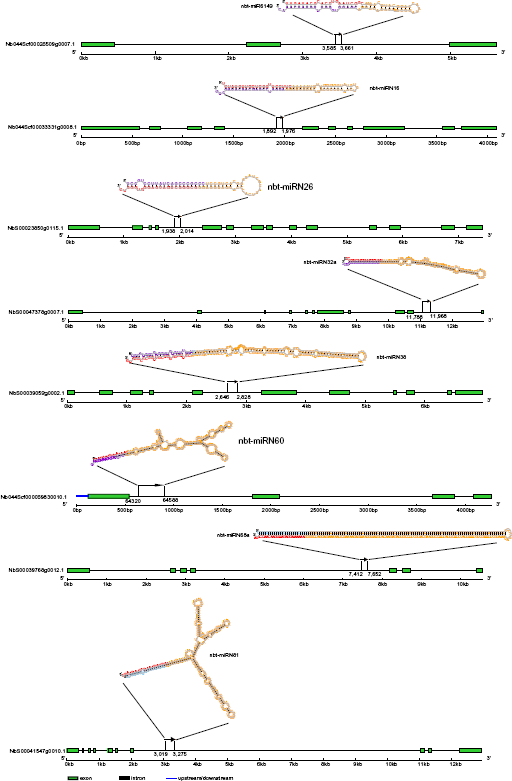
Conserved and novel miRNA expressions during N gene-mediated immunity to TMV. To test this hypothesis, we investigated the expression profiles of all the miRNAs at different time points of the N gene activation process using the quantifier module of the miRDeep2 26 algorithm. To increase the quantification's fidelity, miRNAs with less than 100 total reads were excluded. Conserved and novel miRNAs were quantified separately, and each family member was quantified individually.
Most of the conserved miRNAs were differentially expressed; however, few displayed a dramatic change in pattern across the sampling time points (Fig. 5A). Most of the novel N. benthamiana-specific miRNAs were also differentially regulated during N gene activation (Fig. 5B). The dynamic N. benthamiana miRNA expression during N gene activation suggests a complex regulation of miRNAs in N gene-activated defense against TMV and indicates that the miRNAs identified in our study may be involved in this crucial immune pathway.
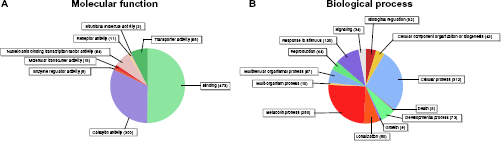
Expression pattern of known miRNAs (A) and novel miRNAs (B) at different time points after N gene was activated in N gene transgenic plants. GO analysis of predicted target transcripts of miRNAs in N. benthamiana. (
Prediction of miRNAs’ candidate target genes
miRNAs associate with their target transcripts by base-pair complementarity, which ultimately leads to modulation of target gene expression by mRNA cleavage or translation inhibition. 38 Thus, predicting potential targets helps to infer a miRNA's function. We computationally predicted potential N. benthamiana targets using predicted cDNAs from the N. benthamiana genome v0.4.4 (http://solgenomics.net/) of the plant miRNA target analysis tools on the psRNATarget server .(http://plantgrn.noble.org/psRNATarget/). 39
The predicted cDNAs contain about 48,342 non-overlapping gene models with annotations and comprise the longest representative transcripts. Using the default parameters’ setting, we identified 315 unique potential targets for 98 conserved miRNAs from 28 families and 609 unique potential targets for 104 novel miRNAs from 85 families. The miRNA ID, matched sequence, corresponding target transcript ID, inhibition target, and annotation of conserved and novel miRNAs are presented in Tables S5 and S6, respectively.
GO analysis of predicted miRNA target functions
A total of 924 putative target transcripts of both conserved and novel miRNAs were assigned GO terms based on a BLAST search of transcripts with known functions using the Blast2GO program (false discovery rate (FDR) cutoff of P < 0.05). 40 Each transcript was assigned a molecular function and biological process. The molecular function of most transcripts fell into either the binding (50.2%) or catalytic activity (31.8%) categories (Fig. 6A). The two predominant binding activities were protein binding (35.1%) and nucleic acid binding (30.7%) (Table S7). These results suggest that to a large extent N. benthamiana miRNAs regulate transcription by modulating transcription factors. Among the GO biological processes assigned to the putative target transcripts, cellular (27.6%) and metabolic processes (24.8%) were the largest categories.
Discussion
Characterization of N. benthamiana miRNAs
N. benthamiana is widely used as a host in plant-virus studies. Its susceptibility to a large number of pathogens, such as bacteria, fungi, and oomycetes, demonstrates its utility as a model in plant-pathogen research. To date, 21,516 mature miRNAs have been identified in plant species and deposited in miRBase (release 18). 41 However, no N. benthamiana miRNA has been annotated in this database. Next-generation technologies have been instrumental in finding conserved as well as novel miRNAs in Arabidopsis, rice, Populus, and several non-model species.10,42–47 Through high-throughput sequencing, we identified 30 miRNA families conserved in N. benthamiana and other species. Most (95) of the conserved miRNAs (112 in total) are found in N. tabacum (Table S1) and show high homology of mature miRNA sequences, suggesting these two species share many common miRNA pathway features and might have only recently split in evolutionary history. We also identified 93 novel families, possibly N. benthamiana-specific miRNA families, which showed no sequence conservation with miRNAs from other plant species in the miRBase. By comparing miRNAs between N. tabacum and N. benthamiana, we found that only 28 miRNA families existed in N. tabacum, whereas 98 miRNAs are specific to N. benthamiana (Table S7). The differences in miRNAs between these two close species may account for their difference in response to TMV, and further studies are needed to prove this hypothesis. The abundance of novel miRNAs was lower than that of conserved miRNAs. Possibly, as previously proposed, 48 conserved miRNAs are responsible for regulating basic cellular and developmental processes common to many eukaryotes, while species-specific miRNAs are involved in regulating unique pathways. The conserved N. benthamiana miRNAs tended to form multimember families (Table 2), whereas no novel miRNA family contained more than four members (only 2 families contained four members and 11 families contained two members; Table S3). This is consistent with observations from other species, such as Arabidopsis 49 and Populus, 50 and supports the hypothesis that conserved miRNA families have expanded by duplication.51–53 However, the exact frequency of birth and death needs to be further investigated by comparison on the basis of genomes of distantly related species. In accordance with observations of genomes of other plant species, 49 the majority of both conserved and novel N. benthamiana 21 nt mature miRNA sequences contained a 5’ U, whereas 5’ A was overrepresented in 24 nt mature miRNA sequences (Fig. S1).
When miRNA was discovered, numerous observations suggested that only one strand of the miRNA duplex could be the effector sRNA and that the other strand, termed miRNA*, is degraded. However, traditional miRNA cloning methods and recently developed high-throughput sequencing technologies have increasingly revealed equal or close to equal miRNA/miRNA* ratios in vivo. In mouse, both strands of miR-30c and miR-142 have been cloned. 54 In fruit fly, there are even more miRNA genes that yield close to equal miRNA*/miRNA ratios in vivo, most of which are relatively abundant in the total RNA transcriptome. 55 Recently, nine miRNAs (ptc-miR160f, ptc-miR169b, ptc-miR169l, ptc-miR171h, ptc-miR171m, ptc-miR172h, ptc-miR393a, ptc-miR393b, and ptc-miR403c) with high miRNA* levels have been found in Populus euphratica from searches of cDNA libraries prepared from plants under drought stress and controls. 35 Here, we identified five miRNA (nbt-miR169a, nbt-miR160e, nbt-miR398, nbt-miR396b, nbt-miR396a) genes that yielded nearly equal numbers of miRNA* and miRNA reads. Interestingly, two of these miRNAs (nbt-miR169a and nbt-miR160e) are similar to some of the abovementioned P. euphratica miRNAs with high miRNA* levels (ptc-miR160f, ptc-miR169b, and ptc-miR169l). We also identified three miRNA genes (miR319a, miR319b, and miR482b) with slightly more reads for the miRNA* than for the annotated miRNA. Since the sRNAs we measured were at the steady stage, these miRNA* sequences may be involved in particular biological processes in cells. In Drosophila, miRNA* preferentially associates with AGO2; thus, independent sorting of miRNA/miRNA* strands is a general character of Drosophila miRNA genes. 55 In Arabidopsis, miR393* also binds AGO2, thereby downregulating a Golgi-localized SNARE gene (MEMB12) by translational inhibition. 56 Because miR393 is bound by AGO1, a possible mechanism of independent sorting of duplex strands via distinct AGOs is suggested. Whether the abundant miRNA*s identified here are also bound by AGO2 is unknown and requires further investigation by coimmuno-precipitation with different AGOs.
Polycistronic miRNA
miRNAs are often clustered together in animal and plant genomes. They may share a common primary mRNA (pri-miRNA), a precursor subsequently excised by DCL1 into different pre-miRNAs. Clustered miRNAs with the same transcription start site are referred to as polycistronic miRNA. Polycistronic miRNA precursors are more abundant in animals (25–45% of total miRNAs) than in plants (10–20% of total miRNAs). 57 In N. benthamiana, we identified two potentially polycistronic miRNA precursors, one containing known miRNAs and the other containing novel miRNAs. The proportion of potential polycistronic miRNA precursors (<1% of total miRNA genes) appears to be much lower than in other investigated plants, but this may be because of the incomplete sequencing of the N. benthamiana genome. We also identified another six potential polycistronic miRNA genes (Table S4), which were discarded because of consecutive Ns (unsequenced nucleotide positions) between individual miRNA loci. In animals, clustered miRNA genes are often heterogeneous. For example the miR-17 cluster consists of sequences encoding miR-17, miR-18, miR-19a, miR-19b, miR-20, miR-25, miR-92, miR-93, miR-106a, and miR-106b. 67 However, the opinion that plant miRNA gene clusters generally comprise homologous members6,58,59 is consistent with our discovery. The clustered plant miRNAs may have been caused by tandem duplication and suggests a dosage effect of miRNA expression.
miRNA target prediction
We have identified over 100 known miRNAs, some of which are conserved across several model plant species, including Arabidopsis, Populus, and rice. Despite our stringent target prediction criteria, most of the targets of conserved N. benthamiana miRNAs were conserved with targets in other plant species and favored genes encoding transcription factors. For example, nbt-miR156 targets SPL transcription factors 60 ; nbt-miR159 targets MYB domain containing transcription factors 61 ; nbt-miR160 targets the ARF gene family 62 ; nbt-miR165/166 targets the homeodomainleucine zipper (HDZip) gene family 63 ; and nbt-miR172 targets AP2-like transcription factors. 64 These miRNAs are classified as highly conserved in plants. 6 However, for moderately conserved miRNAs, 6 only three (nbt-miR164, nbt-miR169, and nbt-miR397) out of eight N. benthamiana miRNAs target genes from the same family (Table S5). The targeting observed in N. benthamiana of conserved genes by conserved miRNA also occurs in other plants and even animals. 52 For example, miR165/166 is conserved in all plant lineages, including mosses, monocots, and dicots, and the binding site of their targets, which encode the HD-Zip family transcription factors, is also conserved in these taxa. The conservation between miRNAs and their targets implies that regulatory networks involving miRNA-target interactions may have evolved over a very long time and play a pivotal role in key processes during the plant life cycle.
Dynamic miRNA expression programs during N-mediated resistance TMV
Most of the miRNAs we identified, from both conserved and novel miRNA pools, showed dynamic expression patterns during the TMV response, implying that miRNAs are involved in N-mediated resistance to TMV. This observation is in agreement with miRNA expression after bacterial infection in Arabidopsis. 65 Since the predicted targets of these miRNAs have diverse functions, such as binding, catalytic activity, transporter activity, and transcription activity (Fig. 6A); and they are also involved in many biological processes, such as cellular process, metabolic process, developmental process, and stimuli process (Fig. 6B); the miRNAs’ dynamic expression might regulate gene expression systematically at different layers in N-mediated resistance pathway to TMV.
Usually, miRNAs from the same family have similar expression patterns. Interestingly, we identified a miRNA, nbt-miR160e, which displayed an expression pattern distinct from other members of its family. During TMV infection, nbt-miR160a/b/c/d was downregulated, while levels of nbt-miR160e increased (Fig. 5). This distinct expression pattern suggests that nbt-miR160e functions differently from the other members in the resistance pathway. Although miRNAs from the same family have the same or similar mature sequences, and therefore the same or similar target genes, their genomic contexts are different, which might explain the distinct expression patterns of different members. Similar observations for multicopy miRNAs from rice and Arabidopsis have been made. 66
To date, few miRNAs have been shown to regulate plant immunity. miR393 targets TIR/AFB F-box genes, thereby downregulating auxin signaling and contributing to resistance to bacteria DC3000. 15 However, we did not observe any significant changes in nbt-miR393 expression during N gene activation upon infection, suggesting that nbt-miR393 is not involved in the N gene pathway during N. benthamiana's immunity response to TMV. miR160a enhances PTI, while overexpression of miR398b negatively regulates PTI in Arabidopsis. 16 We found that both nbt-miR160e and nbt-miR398 increased rapidly within eight hours of N gene activation in N. benthamiana, indicating that these miRNAs positively regulate immunity to TMV in the N gene pathway. Accordingly, family member nta-miR6019 has been shown to cleave N gene transcripts, thereby attenuating N-mediated resistance to TMV. 18 We also found that expression of the N receptor inhibitor nbt-miR6019a/b was inhibited two hours after N gene activation, suggesting a tight control between miRNAs and the immune receptor-mediated resistance pathway. This result also supports that our miRNA identification and expression profile analyses are reliable.
Materials and Methods
Plant material and growth conditions
Transgenic N-expressing N. benthamiana plants 22 were grown in soil in a controlled climate chamber providing 16 hours light/8 hours dark cycles at 22–25 °C. For high-temperature treatment, sets of plants were transferred to a chamber providing 16 hours light/8 hours dark cycles at 32 °C. After two days of pre-treatment under these conditions, the plants were rub-inoculated with TMV-GFP and immediately moved back to high-temperature conditions for another five days. Leaves with full GFP fluorescence were collected at zero, two, and eight hours after the transfer to 22–25 °C.
Inoculation of TMV-GFP
N. benthamiana leaves were infiltrated with Agrobacterium carrying the TMV-GFP T-DNA construct. At five days post-infiltration (dpi), TMV-GFP infected leaves were homogenized and rub-inoculated onto the leaves of tested plants.
sRNA library construction and high-throughput sequencing
Total RNA was extracted with TRIzol (Invitrogen) following the manufacturer's guide for the plant material. The RNA quality and quantity were determined with an Agilent 2100 Bioanalyzer (Agilent). The RNA was separated by PAGE, and then 16–30 nt sRNA was purified and ligated to 5’ and 3’ RNA adaptors. A reverse transcription reaction was performed with several cycles of PCR, and products were sequenced by Solexa technology.
Bioinformatics analysis of high-throughput sequencing data
The raw Solexa sequencing data were preprocessed by filtering out low-quality reads, trimming adaptors and contaminants formed by adaptors, and removing reads less than 18 nt (both siRNA and miRNA are longer than 18 nt in plants). The clean reads were then compared with entries in the available sRNA databases, Rfam (http://rfam.sanger.ac.uk, Release 9.1) and GenBank (http://www.genbank.com). All the reads that mapped to rRNA, tRNA, snRNA, and snoRNA entries in these two databases were annotated and removed. The remaining reads were first mapped to the N. benthamiana genome (Niben.genome.v0.4.4.scaffolds.nrcontigs) by miRDeep2's mapper module. 30 The arf file and reads file obtained from the mapping procedure together with the genome file were used to identify novel and known miRNAs. Before identification of miRNA using miRDeep2module, we modified several places of PERL script of the module to perform plant miRNA identification as Wen et al did. 27 For conserved miRNA identification, we used mature miRNAs and precursors of miRNAs of the phylogenetically close N. tabacum as the first reference. N. tabacum mature miRNAs and their precursors were obtained from two sources: miRBase (http://www.mirbase.org) and reported miRNAs predicted using Expressed Sequence Tag (EST) sequences. 28 Then we used all plant-derived mature miRNAs (from miRBase, http://www.mirbase.org) except N. tabacum as the second reference. After excluding reads mapped to the conserved miRNAs, the remaining reads were subjected to novel miRNA identification. We grouped mature miRNAs (both conserved and novel) with identical and near identical (>90% identity) sequences into the same family. miRNA expression across distinct samples was profiled using the quantifier module of miRDeep2. 30
For intronic miRNA identification, first, we obtained the 5’ and 3’ sites’ information in the genome of each miRNA's precursor; second, we compared their location with the corresponding gene information in the gff file of the genome. If miRNA's precursor's 5’ and 3’ sites lay in an intron, we defined the miRNA as intronic miRNA. In addition, only genes with length more than 500 bp and intron length less than 10 kb were considered.
Author Contributions
Conceived and designed the experiments : KY, YT. Analyzed the data: KY. Wrote the first draft of the manuscript: KY. Contributed to the writing of the manuscript: KY, JZ. Agree with the manuscript results and conclusions: KY, YT, JZ. Jointly developed the structure and arguments for the paper: KY, JZ. Made critical revisions and approved final version: KY, YT, JZ. All authors reviewed and approved final version.
Supplementary Material
Supplementary Table 1
conserved miRNAs.
Supplementary Table 2
novel miRNAs.
Supplementary Table 3
number of member in each novel miRNA family.
Supplementary Table 4
clustered miRNAs.
Supplementary Table 5
target prediction of conserved miRNAs.
Supplementary Table 6
target prediction of novel miRNAs.
Supplementary Table 7
Nicotiana tabacum-specific and Nicotiana benthamiana-specific miRNAs.
Supplementary Table 8
comparison of length distribution of sRNA.
Supplementary Figure 1
nucleotide preference of 24nt novel miRNAs.
Supplementary Figure 2
read length comparison by ANOVA.
Footnotes
Acknowledgments
We thank Prof. Yule Liu's suggestions on experimental design and critical reading of the manuscript. We also thank Jiapei Yuan's help on bioinformatics analysis.