






Abstract
Background
Phytoestrogens consumption is targeted as a possible way to achieve hormonal permeation in postmenopausal women. However, their health effect could depend on their bioavailability.
Objectives
As phytoestrogens bioavailability could be improved by modulating intestinal microflora, the present study was undertaken to investigate whether isoflavones and pre-or probiotics may improve bone markers.
Design
An intervention trial (2 months) was carried out on 39 postmenopausal women receiving 100 mg of IF aglycon equivalents daily, incorporated in two jelly milk and two cereal bars. After the first month, the participants were randomised into three treatment groups: soy (control group), soy + fructooligosaccharides (prebiotics group) and soy + yoghurt cultures (probiotics group).
Results
Level of isoflavone intake was associated with a significant increase in plasma isoflavone levels from baseline to day 15 which was maintained until day 60. Probiotics consumption was associated with increased plasma equol levels at day 60. A 5% increase of bone alkaline phosphatase was elicited on day 30, compared to initial values. Pre- or probiotics did not modulate this parameter. Urinary deoxypyridinoline excretion was slightly increased at day 60. Prebiotics and probiotics consumption improved this parameter. The effect of prebiotics was exacerbated in early compared to late postmenopausal women.
Conclusion
Addition of prebiotics or probiotics to a diet providing isoflavones is able to improve parameters of bone turnover in early menopause.
Introduction
Most observational studies have provided evidence that postmenopausal women consuming the highest amounts of soya foods (and hence isoflavones) have the highest bone mineral density (BMD) (Setchell and Lydeking-Olsen, 2003). The effects on bone markers are conflicting (Alekel et al. 2000; Scheiber et al. 2001). In fact, Setchell et al. (2002) have hypothesised that intestinal metabolism of isoflavones could be the most important clue to the clinical efficacy of soya foods in preventing osteopenia.
Almost all phytoestrogens in food exist predominantly as glycosides, such as genistin and daidzin. This glycoside bond has to be hydrolysed for intestinal absorption to occur (Murkies et al. 1998). Hydrolysis is extremely efficient and occurs along entire length of the intestinal tract by the action of both the brush border membrane and the bacterials β-glucosidases, wich are active from relatively early in life. Glucosidases of intestinal bacteria such as lactobacilli, bifidobacteria and bacteroides (Xu et al. 1995) were involved in this process. After deglycosylation, the isoflavonoid aglycons can undergo further fermentation by colonic microflora to produce a number of metabolites prior to absorption (Setchell, 1998). Chang and Nair (1995) have shown conversion of daidzein to dihydrodaidzein and equol by human faecal bacteria. The clinical effectiveness of soy proteins in general health is believed to be a function of the ability to biotransform soy isoflavones to the more potent estrogenic isoflavone, equol (Setchell et al. 2002). This metabolite has a longer half life and a much higher affinity for the estrogen receptor, than other isoflavones and has the highest antioxidant capacity among isoflavones (Setchell et al. 2002). However, because of a great inter-individual variation in the ability of the bacteria to produce equol, about 30%–50% of the adult population does not excrete this metabolite in urine, when challenged daily with soy foods (Rowland et al. 1999; Lampe et al. 1998). In a 2-year study carried out in post-menopausal women drinking 500 ml of soymilk either with or without isoflavones, greater effects on bone health were elicited when volunteers were able to produce equol (Lydeking-Olsen et al. 2002).
In addition, it has been established that dietary fiber intake may exert a major influence on isoflavones metabolism, by modulating intestinal microflora (Xu et al. 1995). In this light, prebiotics (short-chain fructo-oligosaccharides (scFOSs)), a mixture of indigestible and fermentable carbohydrates known to stimulate growth of beneficial intestinal bacteria such as bifidobacteria, are very interesting (Bouhnik et al. 1996). They may increase β-glucosidase activity in the large intestine, leading to enhancement absorption of these compounds (Uehara et al. 2001). The clearance of isoflavones is thus prolonged.
As phytoestrogens bioavailability could be improved by modulating intestinal microflora, the present study was undertaken to investigate whether isoflavones associated with pre-or probiotics may prevent the increase bone turnover in postmenopausal women. We evaluate this potential effect on specific biochemical markers of bone formation (bone specific alkaline phosphatise) phosphatase and bone resorption (Deoxypyridinoline) which are useful in monitoring the progression of disease in an individual because the response to therapy is earlier and more pronounced than changes in BMD (Delmas, 2000).
Subjects and Methods
Volunteers
This randomised, double-blind, placebo-control study (n°: AU429) was approved by the local ethical committee from Auvergne (CCPPRB, Comité Consultatif de Protection des Personnes dans la Recherche Biomédicale).
Thirty-nine healthy postmenopausal women aged 47 to 73 years old (60.4 ± 7.1) (Fig. 1) were recruited for the study, menstrual bleeding within 12 months (shown by LH levels and FSH levels between 25.8 and 134.8 UI/L). Among these, twelve were in early menopause, less than 7 years.
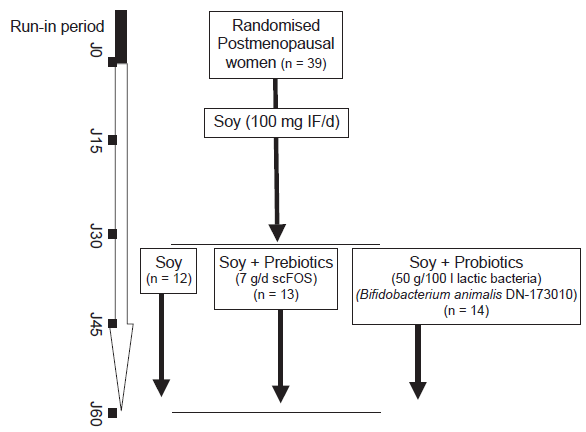
Study design. Isoflavones, prebiotics, and probiotics were supplied in cereal bars and gelified milk, as described in the Material and Methods.
Subjects were selected after a phone questionnaire, interviews, and health screen. Exclusion criteria included strict vegetarian and vegan, high fibre and high soy diets, antibiotics or hormonal replacement therapy within 3 months, menstrual bleeding within 12 months, history of chronic digestive disorders, allergy for milk protein or soy, laxatives taken and severe constipation. Selected volunteers had not undergone surgically induced menopause or surgery of digestive tract. Subjects did not take nutritional supplements the 3 months prior to the study or any medication known to affect bone metabolism. The participants were willing to take dairy products and have not been involved in any clinical trial 6 months before entering this study.
Volunteers underwent a screening visit that included a health history questionnaire, electrocardiogram and routine blood chemistry. At this visit, they were given 5 d food record forms to complete at home. The records were subsequently analysed using a software program, Geni version 6.0 (société micro 6, Les Villers Nancy, France). Daily mineral calcium intakes (mg/d) were 848 ± 90 and 896 ± 60 in early and later postmenopausal women, respectively. Daily vitamin D intakes (μg/j) were 1.87 ± 0.50 and 1.32 ± 0.20 in early and later postmenopausal women, respectively.
Experimental design and diet (Fig. 1)
At recruitment, women were asked not to eat soy or soy products for 2 wk (run-in period) before the study started and for the whole duration of the study. Except for this restriction, all women maintained their usual feeding habits. After the run-in period and throughout the 2-month challenge, they received 1 gelified milk (Danone Vitapole) and 1 cereal bar (Nutrition and Santé), twice a day, which provided together 100 mg/d of isoflavones aglycon equivalents (Prevastein®HC, Eridania Béghin-Say). Isoflavones (genistin 55%–75%, daidzin 20%–40%, glycitin 1%–5%) were incorporated in jelly milks and cereal bars, supplying 25 mg of isoflavones each. After this first experimental period (d0 to d30), the participants were randomised according to their urinary equol production levels, measured in blood and urine samples using immunological methods at d5 (Molis et al. 1996) into three groups: soy, soy + prebiotics or soy + probiotics. So, each group included high (>9 μmol/24 h, n = 16), low (<5 μmol/24 h, n = 8) and non-producers of equol (100 μmol/24 h, n = 15). During this second month (d30 to 60), gelified milk and cereal bars provided 100 mg/d of isoflavones alone for the control group (n = 12), 100 mg of isoflavones combined with 125 mg of yogurt cultures (Streptococcus thermophilus, Lactobacillus bulgaricus, and ~10 9 viable cells of the probiotic strain Bifidobacterium animalis DN-173 010) for the probiotic group (n = 14), or 100 mg of isoflavones combined with 7 g of short-chain fructooligosaccharides (scFOS) (95% ± 2% sc-FOS and 5% ± 2% glucose, fructose and saccharose; Actilight, Béghin-Meiji Industries, Thumeries, France) for the prebiotic group (n = 13). During this second month, the soy group was considered as the control group.
Blood sampling was performed in the morning, after an over-night fasting, at d0 and every 15 days thereafter to assess bone specific alkaline phosphatase (bALP) (Garnero and Delmas, 1999) and isoflavones (daidzein, genistein and equol) (Bennetau-Pelissero et al. 2000). Twenty-four hour urine samples were obtained from the volunteers at the same time points, during the study to analyse deoxypyridinoline (DPD) (Robins, 1994). In addition, a 24 h urine collection was organised at d5 and urine samples were analysed for equol production.
Biochemical analysis
Plasma phytoestrogen concentrations plasma genistein, daidzein and equol concentrations were measured by ELISA (Bennetau-Pelissero et al. 2000). The sensitivity of the method was 35, 40 and 10 nmoles for genistein, daidzein and equol, respectively. The intra and inter assay variations measured on ten different assays were 4.8 and 13.1% for genistein, 5 and 12.8% for daidzein, then 5 and 13.6%, for equol.
Marker for osteoblastic activity
Serum bone specific alkaline phosphatase (bALP) was measured by the Tandem-R Ostase immunoradiometric assay (IRMA, Beckman Coulter Inc., Fullerton, CA, U.S.A) The intra- and interassay variations were less than 6.7 and 8.1%, respectively, across the working range (0–120 μg/l).
Marker of bone resorption
Deoxypyridinoline (DPD) in urine was assessed by a radioimmunoassay kit (Pyrilinks-D RIA kit, Metra Biosystems Inc., Mountain view, CA, U.S.A). The intra- and interassay variations were 6% and 7.5%, respectively. Results are expressed as nmoles DPD per mmoles of creatinine (Robins, 1994).
The urinary creatinine assay (Kit Bio MERIEUX SA, Marcy-l'Etoile, France) is based on a modified Jaffe's method, in which picric acid forms a coloured solution in the presence of creatinine (Cook, 1975).
Statistical analysis
The sample size has been calculated to detect differences in plasma levels of total IF between groups consuming different food matrixes equal to 1/2 SD (0.15 μmol/L), observed in 12 adult women after a single dose of 126 mg IF administered as soy milk (Xu et al. 1994). A total of 35 subjects is required to detect differences between groups with 80% power, significance level set at 0.05. Assuming a 10% drop out rate, 39 volunteers have been involved in the study.
Results are expressed as means ± SEM for continuous data and as count (n) and frequencies (%) for qualitative data. All data were analysed using the Graphpad Instat software (Microsoft, San Diego, CA, U.S.A). Statistical tests have been chosen according to the data distribution (Kolmorogov-Smirnov test). ANOVA was first performed to test for any significant differences among groups. When significant (P < 0.05), the Student-Newman-Keul's multiple comparison test was applied to determine the specific differences between means. If not, nonparametric analyses were performed as a Kruskall-Wallis test. If it indicated a significant difference among groups (P < 0.05), the Mann-Whitney U test was used to determine specific differences. The significant level was set at P < 0.05 for all statistical analysis.
Results
Body weight (g) and body mass index (BMI; g/cm2) did not change significantly during the study (data no shown). Those parameters were not clinically modulated by experimental diets.
Plasma IF levels
As shown in Figure 2, plasma concentration profiles of genistein, daidzein and equol, over the experimental period (d0 to 60) allowed validation of isoflavones consumption. In the control group, values (ng/ml) were undetectable at baseline and reached, a plateau as soon as 15 days (426 ± 50.3) and stayed relatively unchanged at d60. Moreover, among volunteers, 56.4% were equol producers, although only 50% of them reached levels higher than 200 ng/ml.
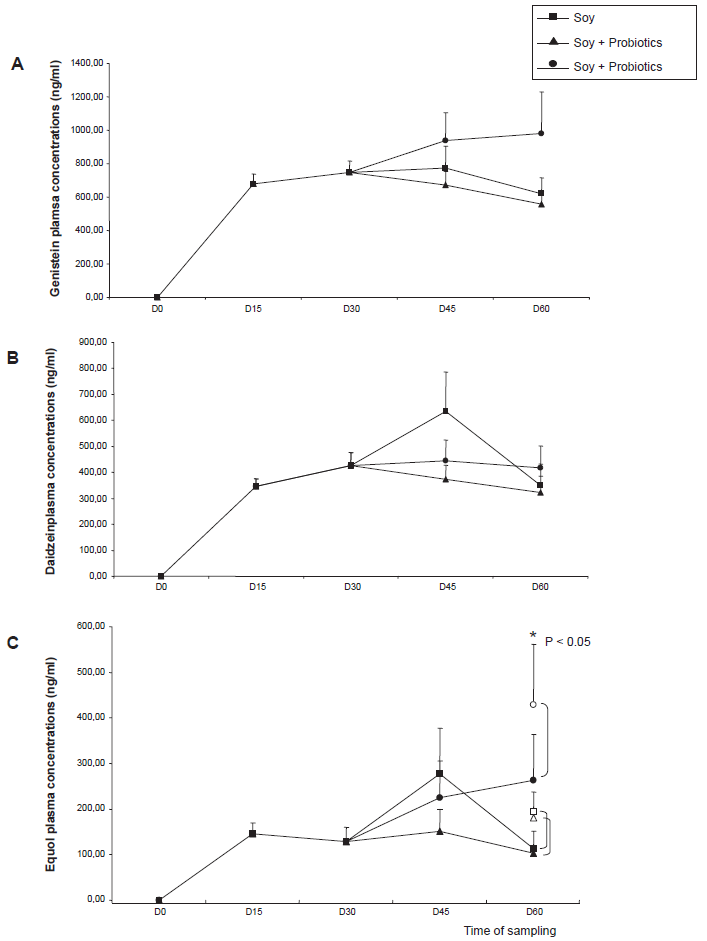
Plasma A) genistein, B) daidzein and C) equol concentrations in postmenopausal women who have been given soy isoflavones for 2 months at the dose of 100 mg aglycones per day, or soy isoflavones at the same dose for 2 months, together with probiotics for the last month (125 mg of yoghurt culture including Streptocccus thermophilus and Lactobacillus bulgaricus and Bifidobacterium animalis), or soy isoflavones at the same dose for 2 months, together with prebiotics for the last month (7 g of short chain Fructooligosaccharides). Signs in white indicate plasma values of equol in women who were considered as equol producers (levels higher than 200 ng/ml). *, P 0.05 compared to the isoflavones group. Values are means ± SEM.
In the prebiotic group (during the second month of the study), plasma concentrations (ng/ml) of genistein, daidzein and equol remained unchanged, compared to the soy group (genistein: 558.56 ± 74.40; daidzein: 322.30 ± 62.64; equol: 181.38 ± 39.11). Regarding the probiotics group, a significantly (p < 0.05) 24% increase in plasma genistein concentrations was demonstrated from d30 to 60. Equol levels even tended to be higher at d60 (263.85 ± 99.6), whereas plasma daidzein stayed unchanged (417.61 ± 84.74).
In the subgroup of equol producers, the trend towards higher equol levels (ng/ml) elicited by probiotics consumption became significant at day 60 (428.88 ± 132.39, P 0.05 compared to 194.14 ± 43.42, in equol producers from the soy group).
Bone turnover biomarkers (Figs. 3 and 4)
For results presentation, we divided the subjects of our study into 2 subgroups, according to menopausal status. It is well known that first 5 years after the onset of menopause are marked predominantly by hormonal disturbances. Moreover the rate of bone loss is most rapid in the early postmenopausal period and subsequently begins to level off by 5 years menopause (Pouilles et al. 1993).
None correlation was observed between the capacity to produce equol and bone markers.
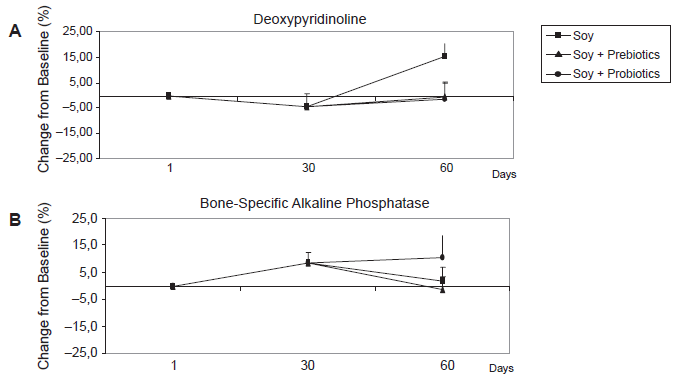
Markers for bone metabolism throughout the experimental period in postmenopausal women given soy isoflavones for 2 months at the dose of 100 mg aglycones per day, or soy isoflavones at the same dose for 2 months, together with probiotics for the last month (125 mg of yoghurt culture including Streptocccus thermophilus and Lactobacillus bulgaricus and Bifidobacterium animalis), or soy isoflavones at the same dose for 2 months, together with prebiotics for the last month (7 g of short chain Fructooligosaccharides). *, P 0.05 compared to the isoflavones group. Results are expressed as a % change from baseline values. Values are means ± SEM. A) Urinary deoxypyridinoline levels, a marker for bone resorption, B) Plasma bone specific alkaline phosphatase values, a marker for bone formation.
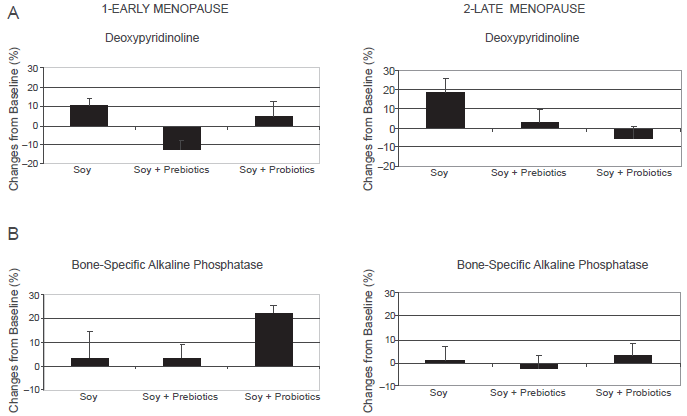
Markers for bone metabolism throughout the experimental period in 1) early postmenopausal women and 2) late postmenopausal women given soy isoflavones for 2 months at the dose of 100 mg aglycones per day, or soy isoflavones at the same dose for 2 months, together with probiotics for the last month (125 mg of yoghurt culture including Streptocccus thermophilus and Lactobacillus bulgaricus and Bifidobacterium animalis), or soy isoflavones at the same dose for 2 months, together with prebiotics for the last month (7 g of short chain Fructooligosaccharides). *, P 0.05 compared to the isoflavones group. Results are expressed as a % change from baseline values at day 60. Values are means ± SEM. A) Urinary deoxypyridinoline levels, a marker for bone resorption, B) Plasma bone specific alkaline phosphatase values, a marker for bone formation.
Bone biomarkers were expressed as means ± SEM changes from baseline (%). An 8 (±5)% increase of bone alkaline phosphatase was elicited on d30, in the control group, compared to initial values, then, return to basal levels (1.76% ± 5.49%) on d60. On d60, this parameter was not significantly modulated by pre- or probiotics (–1.3% ± 4.44% changes in the prebiotics group; 10.3% ± 8.57% changes in the probiotics group). However, when women within early menopause (7 years since last menses) were considered, a trend towards higher levels of ALP with probiotics consumption was observed (22% increase, compared to 3% in the soy group at d60). On the contrary, as far as women within late menopause (7 years since last menses) are concerned, no variation were observed between each group.
In the control group, a –5 (±5)% decrease urinary DPD excretion was observed on d30 and then returned to initial values (%) at d60 (15.5 ± 4.9).
Pre- or probiotics consumption improved this marker. At d60, they respectively elicited a 13% and 12% decrease, compared to control group, even though no variation was observed compared to d0. In women within early menopause, this pattern was similar and a 23% decrease was observed in the prebiotics group compared to the control group (P < 0.02). In late postmenopausal women, the effect of pre- or probiotics was a 25% decrease was reached in the probiotics group compared to the control group (P < 0.05).
Discussion
In the present investigation, doses of phytoestrogens (100 mg/day) given to postmenopausal women have been calculated on estimated dietary isoflavones intakes in the Asian countries where a lower incidence of hip fractures was observed. This level of intake was associated with a significant increase in plasma isoflavones (Fig. 1), indicating complete compliance with soy consumption.
More interestingly, increasing bacteria involved in the metabolism of isoflavones could maximise potential health benefits of those phytoestrogens. Recently, Zafar et al. (2004) have observed in ovx rats that inuline, a prebiotic, could modulate equol production from the daidzein in the soy isoflavones suggesting a shift in metabolism of the isoflavones. In our experimental conditions, plasma equol concentrations were not modified in the prebiotics group, compared to the control group. Actually, results from a population-based family study suggest that the ability to harbour the daidzein-metabolising bacteria, then contributing to the equol-producer phenotype in humans, might be under some degree of genetic control (Frankenfeld et al. 2004). Indeed prevalences of equol producers and o-DMA producers are approximately 30%–50% and 80%–90%, respectively, and limited observations have suggested that these daidzein-metabolising phenotypes are stable within individuals over time (Frankenfeld, 2005). Besides, probiotics, live microbials which beneficially affects the host animal by improving its intestinal microbial balance, can be beneficial to health, as well. In our experimental conditions, plasma genistein and equol levels were significantly higher, after probiotics consumption, compared to the soy group at the end of the supplementation.
Although some dietary intervention trials have shown that phyto-estrogens-rich diets improve BMD (Lydeking-Olsen et al. 2002; Morabito et al. 2002), the effects on bone markers are however less clear. In postmenopausal women, results of studies on isoflavone supplementation with various doses for 1.5 to 3 months were conflicting (Scambia et al. 2000; Scheiber et al. 2001; Uesugi et al. 2002). In the present experiment, only a trend towards a higher osteoblastic activity was observed after 30 days IF daily consumption and resorption activity tended to decrease at d30 and to increase after 60 days of supplementation (Fig. 3). Therefore, in our experimental conditions, it can be ruled out that a two months supplementation of 100 mg of isoflavones in 39 post-menopausal women has no significant effect on bone markers. This lack of effect could be explained by the wide range (1–37 years) in the menopause duration. Actually, if we consider only the volunteers in early menopause (7 years), the bone resorption activity was higher in the soy group at d60 and ALP was lower in early postmenopausal women, compared to all volunteers. Similarly, reduction of bone resorption activity has been shown after 2.5 to 3 months of isoflavone consumption in peri- or postmenopausal women (Uesugi et al. 2002). These results were in agreement with those of Nordin et al. (1990). Bone loss is more rapid in early menopause (11.3%) than in the following decade (2.3% and 1.5%). On another hand, in late postmenopausal women, resorption was more important than that observed in early postmenopausal women. These data are in accordance with these obtained by Garnero et al. (1996) in elderly women, a high bone turnover rate was being associated with a low bone mass. Moreover, Cheong et al. (2007) showed that soy protein containing up to 135.5 mg isoflavones/day for 50 days, did not suppress bone resorption in late postmenopausal women (>6 years since menopause).
Regarding the impact on skeletal metabolism, neither pro- nor prebiotics elicited any significant modulation of bone formation. In postmenopausal women (50–70 aged) Tahiri et al. (2001) have shown not significant changes of bone turnover after 5 weeks scFOS treatment, but, a trend towards a higher activity was observed in women within less than 7 years of menopause. Concerning bone resorption, both pro- and prebiotics were associated with improvement of DPD values and in early postmenopausal women, the effect of sc-FOS was even intensified. Those results (Figs. 3 and 4) are consistent with previous data from animal experiment. In ovariectomised mice (Ohta et al. 2002) or rats (Mathey et al. 2004), oligofructose consumption has been shown to exacerbate the bone sparing effect of isoflavones by slowing down bone resorption. These protective effects cannot be totally explained by equol production, because this parameter was only increased in the probiotics group. Moreover, Frankenfeld et al. (2006) did not observe a difference in BMD in relation to equol-producer phenotype. Of course, a concomitant trend towards an increase in mineral bioavailability and oestrogen mimetic effect cannot be ruled out (Scholtz-Ahrens et al. 2001). Indeed, according to the data published by Abrams et al. (2005), a mixture of chicory long-chain inulin and oligofructose is able to increase calcium absorption in volunteers and to impact markers of bone turnover.
In late postmenopausal women, bone markers were not modified by prebiotics. However, probiotics seemed to elicit a decrease in bone resorption, compared to the control group, without significant variation of formation. Levels of DPD in prebiotics group were decreased compared to control groups. Similarly, Holloway et al. (2007) showed an initial transient decrease of DPD after 3 weeks of supplementation with a mixture of chicory oligofructose and long-chain inulin (synergy 1) in women (10 years past the onset of menopause). Nevertheless, they observed a significant increase in Ca absorption, relative to the group placebo after 6 weeks of treatment, while the markers for bone turnover did not significantly change. Of course, it remains to be demonstrated that the efficacy of these prebiotics on calcium absorption were benefits for bone health.
Our study has several limitations, one, given the small sample of women in each supplemented group and in the early or late postmenopausal subgroup. Secondly, a long-term study in which bone density is the central biomarker may help to validate the potential benefits of pre- or probiotic consumption combined with soy isoflavone intake.
In conclusion, under the conditions of the present study, addition of pre- or probiotic to a diet providing isoflavones is able to improve parameters of bone turnover in early menopause.
Disclosure
The authors report no conflicts of interest.
Footnotes
Acknowledgments
This work was supported in part by The French Ministry of Research (AQS program A01347) and Beghin-Meiji (doctoral fellowship). We are grateful to Eridania Beghin-Say and Beghin-Meiji for kindly supplying respectively the powdered soybean isoflavones concentrate (Prevastein®HC) and short chain-fructooligosaccharides (Actilight®), Danone Vitapole for jelly milk and ferments and Nutrition and Santé for cereal bars. We are grateful to the Centre de Recherche en Nutrition Humaine d'Auvergne for the use of the human metabolic facilities. Special appreciation goes to Marion Brandolini for food records. We also gratefully acknowledge the cooperation of the subjects, who so conscientiously and cheerfully suffered the restriction imposed on them by this study.