






Abstract
Objective
To investigate the relationship between gender differences in fatty acid-binding protein7 (FABP7) and BRN2 (POU class 3 homeobox 2) expression in renal cell carcinoma (RCC) and the prognosis of patients with RCC.
Materials and Methods
immunohistochemical (IHC) staining as well as reverse transcription-polymerase chain reaction (RT-PCR) was performed in renal tissues from 103 patients (83 men, mean age = 63.6 years old; 20 women, mean age = 63.1 years old) underwent radical nephrectomy from January 1, 2001 through December 31, 2010. The probability of overall patient survival was estimated using the Kaplan–Meier method.
Results
FABP7 mRNA expression was more frequent in men (P = 0.07) while BRN2 protein expression was significantly more frequent in women (P = 0.029). In particular, FABP7 was expressed in 100% of G1 renal cell carcinoma both in mRNA and protein levels. In women, FABP7 (–) and BRN2 (+) groups had a worse prognosis both in mRNA level (P = 0.038) and protein level (P = 0.058). BRN2 was expressed 100% of papillary RCC both in mRNA and protein levels.
Conclusions
Our results demonstrated that gender was a key factor in FABP7 and BRN2 expression in RCC, and the combination with FABP7 and BRN2 stratified by gender could be a new potential prognostic factor in patients with RCC.
Introduction
In 2013, a total of 580,350 cancer deaths (306,920 in males and 273,430 in females) are projected to occur in the United States, while in kidney and renal pelvis cancer, 13,680 cancer deaths (8780 in males and 4900 in females) are projected. It is significant that the men to women ratio of patients with projected new occurrence of renal cell carcinoma (RCC) and renal pelvis carcinoma are much higher than carcinoma in general (Pearson chi-square, P < 0.01). Similarly, according to the data from National Cancer Center, Japan, the RCC mortality in men is 3 times higher than in women. It is reported that gender independently influenced disease-specific survival (DSS) and overall survival (OS) with a benefit for women. While men often present with high grade tumors and simultaneous metastasis, estrogen receptor beta (ERβ) was more highly expressed in RCC cell lines than in breast cancer cell lines and played a role as a tumor suppressor in RCC cell lines.
It has been demonstrated that the expression level of fatty acid-binding proteins (FABPs) and POU domain-containing family of transcription factors are influenced by gender. FABPs are abundant 14–16 kDa cytoplasmic proteins expressed in almost all mammalian tissues involved in the uptake and intracellular trafficking of fatty acids. Fatty acid-binding protein 7 (FABP7), also known as brain-type fatty acid-binding protein (B-FABP), mapped to 6q22–23, is a member of FABPs, which was reported to be expressed in the brain, glia cells, retina, and mammary glands. 10 It is demonstrated that the expression of transcript for FABP7 can be in tumors and/or urine of patients with RCC,11–13 though protein expression is not always congruent with mRNA expression in prostate, bladder, and kidney cancer cell lines.14,15 Moreover, it was recently shown that FABP7 may regulate the invasiveness of astrocytoma tumors. 16 Also, the POU domain-containing family of transcription factors contains multiple mammalian members divided into 6 classes, which can be expressed broadly or in a cell-specific manner and involved in regulators of cell fate decisions of many different lineages. BRN2, which is encoded by the POU3F2 gene in humans, 17 is expressed predominantly in the central nervous system (CNS) and has been implicated with tumorigenesis in melanoma and lung cancer.18–22 What's more, the Pbx/POU binding site has been demonstrated to be present in the FABP7 promoter in humans, and Pbx/knotted homeobox 1 (PKNOX1) is bound to the Pbx/POU site at the FABP7 promoter to regulate FABP7 transcription. 23 In a previous study, we found that there was an inverse correlation between FABP7 promoter activity and BRN2 mRNA expression as BRN2 was bound to the FABP7 promoter region in human RCC cell lines. 24
The present investigation was conducted to examine the relationship between clinical and pathological differences, especially focused on the gender difference in FABP7 and BRN2 expression in renal cell carcinoma and the prognosis of patients with RCC.
Material and Methods
Subjects
The samples were surgically removed under radical nephrectomy from 103 RCC patients at Hamamatsu University School of Medicine during the period from January 1, 2001 through December 31, 2010. Cases were selected according to tissue availability without any further stratification for clinical or pathological prognostic factors. Staging and histological classification met the 2009 Union for International Cancer Control criteria and World Health Organization criteria, respectively. The pathologic diagnosis was based on the General Rules for Clinical and Pathological Studies on Renal Cell Carcinoma proposed by the Japanese Urological and Pathological Association 25 (Table 1). This study was approved by the medical ethics committee of the Hamamatsu University Medical School.
Clinicopathological parameters (percentages in brackets) and mRNA and protein expression of FABP7 and BRN2 in renal cell carcinomas.

Immunohistochemistry
Slices with 4-μm thickness were used for immunohistochemical (IHC) staining. Slices were deparaffinized in xylene for 15 minutes, rehydrated using graded ethanol, and steamed for 4 minutes at 121 °C in a buffer with (10 mM sodium citrate, pH 6.0, with 1 mM EDTA) in a pressure boiler. Slides were left in the pressure boiler to cool down to 90 °C and then left for 1 hour at room temperature. The detection was done according to the protocol of Ultra Vision LP Detection System HRP Polymer and DAB Plus Chromogen kit (catalog number TL-015–HD, Thermo Scientific, Fremont, CA). For FABP7, slides were incubated overnight with a 1:100 dilution of the polyclonal antibody for FABP7 (catalog number HPA028825, Sigma-Aldrich, Inc, Stockholm, Sweden) in phosphate-buffered saline at 4 °C. For BRN2, slides were incubated overnight with a 1:300 dilution of the polyclonal antibody for BRN2 (catalog number GTX114650, GeneTex, San Antonio, TX) in phosphate-buffered saline at 4 °C. For controls, formalin-fixed, paraffin-embedded sections of neuroglioma served as a positive control for FABP7, while fixed melanoma was used as a control for BRN2 (materials from Department of Dermatology and Neurosurgery, Hamamatsu University School of Medicine). Negative control slides were processed with each slide run and excluded the primary antibody but included all other steps of the procedure.
Scoring Methods
Positive tumor cells were quantified by 2 independent observers at × 400 magnification under microscope, expressed as the percentage of the total number of tumor cells, and assigned to 1 of 5 categories numbered from 0 to 4: (0) ≤5%; (1) 5% to 25%; (2) 25% to 50%; (3) 50% to 75%; and (4) ≥75%. For both oncoproteins, ≤5% positive cells were used as the cutoff to define negative tumors. The intensity of FABP7 and BRN2 immunostaining was scored as (a) 1+, weak; (b) 2+, moderate; and (c) 3+, intense. The percentage of positivity of tumor cells and staining intensity were multiplied to produce a weighted score for each tumor specimen, and intensity was judged relative to an intensely stained positive control neoplasm. 26 For each slide, at least 4 fields of the cancerous parts were examined and the average value determined. Every slide was rechecked by a veteran doctor. Cases with weighted scores of less than 1 were defined as negative; otherwise, they were defined as positive. We divided the weighted scores of 0 to 2 as negative or low group and marked as ws- and 3 to 12 as moderate and high group and marked as ws+.
Reverse Transcription-Polymerase Chain Reaction (RT-PCR)
Total RNA was isolated from surgically resected tissues using AllPrep DNA/RNA/Protein Mini Kit (catalog number 80004, Qiagen, GmbH, Hilden, Germany). First-strand cDNA was synthesized in a volume of 35 μL containing 1 μg total RNA, 0.7 μL oligo(dT)12–18 primer (catalog number 18418012, Life Technologies, Carlsbad, CA), 1.8 μL ramdom primers (catalog number 48190011, Life Technologies, Carlsbad, CA), and 2.5 μL 10 mM dNTP MIX (catalog number 18427088, Life Technologies, Carlsbad, CA). After 5 minutes at 65 °C, then 2 minutes on ice, this was mixed with a volume of 15 μL reagent of SuperScript III kit (catalog number 18080–044, Life technologies, Carlsbad, CA). A polymerase chain reaction (PCR) was performed using polymerase Ex Taq (Takara Bio Inc, Shiga, Japan) with Gene Amp PCR system 9700 (Life Technologies, CA). The PCR product was analyzed by 2% agarose gel electrophoresis, and β-actin served as an internal control (Table 2). cDNA isolated from a TUHR14TKB cell line (RIKEN, Tsukuba, Ibaraki, Japan) was used as a positive control for FABP7, and HEK 293 (RIKEN, Tsukuba, Ibaraki, Japan) was used as a positive control for BRN2. A negative control was processed with each run and used the same volume of distilled water instead of samples cDNA but included all other steps of the procedure.
Primers used for the PCR-amplification.

Statistical Analysis
Quantitative variables were compared by using chi square test, and the probability of overall patient survival was estimated using the Kaplan–Meier method. Statistical analysis was performed with SPSS, version 19.0 (IBM Japan, Tokyo, Japan). P values <0.05 were considered significant.
Results
Reverse Transcription-Polymerase Chain Reaction (RT-PCR)
In general, there was no relationship in FABP7 mRNA expression (log-rank test, P = 0.55) and BRN2 expression (log-rank test, P = 0.19) with overall survival, respectively. There was FABP7 mRNA expression in 100% of G1 RCC.
By gender, FABP7 expression was more frequent in men (Pearson chi-square, P = 0.07), while BRN2 mRNA expression had no correlation with gender (Pearson chi-square, P = 0.30). FABP7 (–) and BRN2 (+) group in women had a worse prognosis (log-rank test, P = 0.038) (Fig. 2A), and there were only 2 women in high stage (stage 3 or 4), and these 2 women were both FABP7 (–) and BRN2 (+) in mRNA level, while in men, there was no relationship (log-rank test, P = 0.72). In women, 5 were classified as BRN2 (–), and all in low stage (stage 1 or 2), and all have survived until now, while in men, there was no relationship in BRN2 expression with overall survival (log-rank test, P = 0.31).
In all, 100% of papillary RCC could express FABP7 and BRN2, and clear cell RCC (ccRCC) was more frequently BRN2 (–) compared with the other histology type groups(Pearson chi-square, P = 0.019).
We had 89 ccRCC patients, and among these, 5 patients (5/89, 5.6%) were FABP7 (–) and BRN2 (–), and all have survived. However, FABP7 and BRN2 were not significantly associated with overall survival (log-rank test, P = 0.68 and P = 0.36, respectively).
Immunohistochemistry (IHC)
In normal renal tissue, FABP7 showed a weak immunoreactivity in proximal tubuli. Few distal tubuli were also inconsistently positive. No immunoreactivity was observed in glomeruli (Fig. 1A). Among 74 patients with FABP7 expression (71.8%), some carcinoma cells were expressed in the nucleus (57/74, 77.0%), some in the cytoplasmic (53/74, 71.6%), and some in the membrane (48/74, 64.9%) (Fig. 1B).

FABP7 and BRN2 immunohistochemistry.
BRN2 is weakly expressed in the cytoplasmic and membrane of almost all renal tubuli (including proximal tubuli and distal convoluted tubuli), and in the glomeruli, few tubuli can strongly express BRN2 in membrane (3+, intense) in normal tissue (Fig. 1C). Among 72 patients with BRN2 expression (69.9%), some carcinoma cells expressed in nucleus (55/72, 76.4%), some in cytoplasmic (14/72, 19.4%), and some in membrane (15/72, 20.8%) (Fig. 1D).
In general, there was no relationship between overall survival and FABP7 protein expression (log-rank test, P = 0.99) and BRN2 expression (log-rank test, P = 0.81), respectively. There was FABP7 protein expression in 100% of G1 RCC. Of 12 patients with an FABP7 weighted score ≥9, only 1/12 (8.3%) died of RCC, with the remaining 11 patients still surviving; 5 patients with a BRN2 weighted score ≥9 also survived.
By gender, BRN2 was significantly easier to express in women (Pearson chi-square, P = 0.029), while FABP7 expression had no correlation with gender (Pearson chi-square, P = 0.65). Women with FABP7 (–) and BRN2 (+) had a tendency for a worse prognosis (log-rank test, P = 0.058) (Fig. 2B), while men in this group had no correlation with overall survival (log-rank test, P = 0.13).
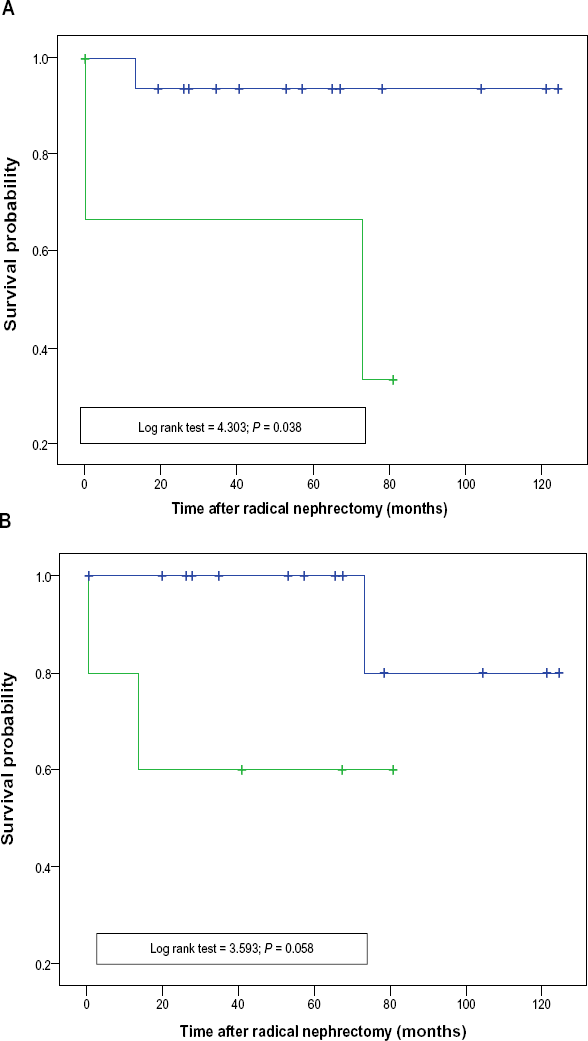
Kaplan–Meier survival curves for FABP7 (–) and BRN2 (+) mRNA and protein expression in women.
In men, there were 10 patients (10/83, 12.0%) with FABP7 (ws–) and BRN2 (ws+), and all survived (Fig. 3A). In women, there were 8 patients (8/20, 40%) with FABP7 (ws+) and BRN2 (ws+) (Fig. 3B), and all survived.
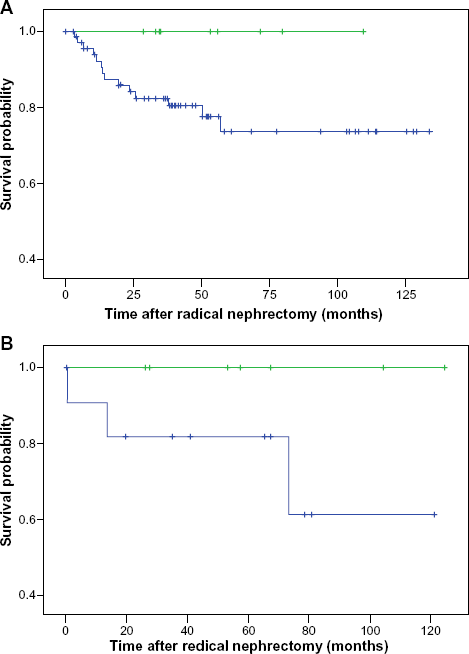
Kaplan–Meier survival curves for patients divided by protein level weighted score.
However, we didn't find any direct relationship with BRN2 protein expression and FABP7 mRNA expression (Pearson chi-square, P = 0.52).
There was no relationship with stage (stages 1 and 2 were recognized as low stages, while stages 3 and 4 were recognized as high stages) and FABP7 mRNA/protein expression (Pearson chi-square, P = 0.51 and P = 0.12, respectively) and also between stage and BRN2 mRNA/protein expression (Pearson chi-square, P = 0.50 and P 0.37, respectively).
In histology, ccRCC had the tendency to be FABP7 (+) more than other histology type groups (Pearson chi-square P = 0.064) and to be BRN2 (–) more than the other histology type groups (Pearson chi-square, P = 0.044). However, we still couldn't find any direct relationship between BRN2 protein expression and FABP7 mRNA expression in ccRCC (Pearson chi-square, P = 0.29). 100% of papillary RCC could express BRN2.
We had 89 ccRCC patients, and among them there were 10 patients (10/89, 11.2%) with FABP7 (ws–) and BRN2 (ws+), and all survived. However, FABP7 and BRN2 were not significantly associated with overall survival (log-rank test, P = 0.77 and P = 0.56, respectively).
Discussion
Our study is the first to analyze the FABP7 and BRN2 mRNA and protein expression in all 103 patients with RCC and found men more frequently had FABP7 mRNA expression, while in women BRN2 protein expression was significantly frequent. So, we have reason to believe FABP7 and BRN2 expression is affected by gender.
It is reported that hepatic removal of long-chain fatty acids from plasma is nearly twice as fast in women's livers as in men's livers. 5 And FABPs are involved in the uptake and intracellular trafficking of fatty acids. Niizeki et al 4 found 1 FABPs member, FABP3, had mean values that were significantly higher in men than in women when they did serum examination of 2099 normal participants in Takahata, Japan. Furthermore, an analysis of human glial astrocytomas and melanoma found that patient survival was inversely correlated with FABP7 expression level when using gender-mixed data,27–30 while there was a positive correlation in women only with breast cancer from 899 primary operable invasive breast carcinoma cases. 6 It is possible that FABPs move into the nucleus and interact with nuclear hormone receptors.10,31 Ilia et al 7 found a POU3 domain transcription factor, Oct-6, had a lower expression level in cortical and cerebellar tissue of male CD1 mice when compared with females and suggested Oct-6 expression takes place in a gender-dependent way. What's more, another POU domain transcription factor, BRN3b can physically interact directly with the estrogen receptor (ER), and enhance its transcriptional effect on an ER element-containing promoter in breast cancer.8,9
Tolle et al 11 found RCC with a high tumor Fuhrman grading (grades 3 and 4) showed significantly lower FABP7 mRNA compared with those with a low grading (grades 1 and 2) when quantitative RT-PCR was performed. In our study, using Japan grading, we found FABP7 expression in 100% of G1 RCC in mRNA and protein levels, and among patients with FABP7 weighted score ≥9, 11/12 (91.7%) survived. It was demonstrated that FABP7 is more frequently expressed in lower nuclear gradings, and high weighted score patients will have a better prognosis.
We found female patients with FABP7 (–) and BRN2 (+) had a worse prognosis both in mRNA, protein level, and mRNA clinical data (there were only 2 women in high stage, and both belong to this group in mRNA level). On the other hand, male patients with FABP7 (ws–) and BRN2 (ws+) all survived. It may be that FABP7 (–) and BRN2 (+) can be a potential prognosis factor in patients with RCC stratified by gender, and the system of these 2 proteins is different by gender in patients with RCC.
In the previous study, we found that there was an inverse correlation between FABP7 promoter activity and BRN2 mRNA expression in an RCC cell line, 24 while we couldn't find the relationship in the 103 RCC patients or in all 89 ccRCC patients. However, ccRCC is more frequently FABP7 (+) than other histology type groups in protein level and BRN2 (–) in both mRNA and protein levels. Thus, some relationship may exist between FABP7 and BRN2 in ccRCC in clinical data, but it may also be influenced by other factors not examined here.
In our study, FABP7 and BRN2 had no relationship with overall survival both in mRNA and protein levels in all 103 patients with RCC or 89 patients with ccRCC respectively, similar to the result of FABP7 expression in patients with RCC in a previous study. 11 However, our study suggests that FABP7 or BRN2 could have a prognostic potential at least in combination with other biomarkers.
It has been demonstrated that there is a method by which FABP7 can be detected in the urine of patients with RCC. 12 If there also will be a method to detect BRN2, FABP7/BRN2 can be used to potentially monitor the prognosis of patients with RCC preoperatively and postoperatively in the near future.
Conclusions
Our results demonstrated gender was a key factor in FABP7 and BRN2 expression in patients with RCC, and FABP7 binding with BRN2 stratified by gender could be a new potential survival predictor in patients with RCC. Our study is the first report on both FABP7 and BRN2 mRNA and protein expression in patients with RCC. Further study is warranted with regard to interpreting the relationship between sex hormones with FABP7 and BRN2 in patients with RCC.
Author Contributions
Conceived and designed the experiments: CT, TT. Analyzed the data: CT. Wrote the first draft of the manuscript: CT. Contributed to the writing of the manuscript: TT, NT, SO. Agree with manuscript results and conclusions: CT, TT, NT, HF, MM, TS, SO. Jointly developed the structure and arguments for the paper: TT, NT, TS. Made critical revisions and approved final version: CT, TT, NT, HF, MM, TS, SO. All authors reviewed and approved of the final manuscript.
Disclosures and Ethics
As a requirement of publication the authors have provided signed confirmation of their compliance with ethical and legal obligations including but not limited to compliance with ICMJE authorship and competing interests guidelines, that the article is neither under consideration for publication nor published elsewhere, of their compliance with legal and ethical guidelines concerning human and animal research participants (if applicable), and that permission has been obtained for reproduction of any copyrighted material. This article was subject to blind, independent, expert peer review. The reviewers reported no competing interests.
Footnotes
Acknowledgment
We thank Mr. Gregory O'Dowd, Integrated Human Sciences (English), Hamamatsu University School of Medicine, for proofreading this paper.