






Abstract
Background
Rhinoplasty is the most common operation performed by our facial plastic surgery unit. Recognition of patients with psychological problems which may result in an unfavourable post-operative outcome is essential. The objective of this study was to evaluate the psychological status of patients seeking rhinoplasty, compared with the general population.
Methods
We prospectively collected the data from patients who requested rhinoplasty in Srinagarind hospital, Thailand and controls. We used the general health questionnaire-28 (GHQ-28) for psychological problems detection.
Results
We included a total of 196 participants, 98 in study group and 98 in control group. The study group has a 5.5 times (95% CI 1.25 to 24.17, P = 0.01) higher risk for poor mental status more than control group.
Conclusions
The patients seeking rhinoplasty group were more likely to have psychological problems when compared with the control group. Surgeons should be aware of the patient's psychological status before performing the operation.
Background
Rhinoplasty is the most common operation performed by our facial plastic surgery unit. This procedure is performed to improve nasal function or for cosmetic reason. During the past ten years, the number of patients requested rhinoplasty in our institute has increased. This may be due to a more positive social attitude towards cosmetic surgery. All patients in this study requested augmentation rhinoplasty due to a low nasal profile. The patients' usual complaint is expressed as a sense of disharmony or inappropriateness of the shape of the nose relative to the rest of the face.
The motivation for seeking rhinoplasty arises from a culturally inspired desire for beauty and attractiveness for their own sake or as a recognized preliminary necessity to make friends and attract the opposite sex. Mayer found that 16 out of 30 patients (53 percent) who seeking rhinoplasty had psychological problems. One patient was diagnosed as psychotic and 2 as severely neurotic, the one having a depressive reaction and the other an obsessive and phobic reaction. 1
Recognition of patients with psychological problems which may result in an unfavorable postoperative outcome is essential. 2 Problems encountered by patients can lead to requests for repeated procedures, depression and adjustment problems, social isolation, familial dysfunction, self-destructive behaviors and anger towards the surgeon and his or her staff. 3 Problems encountered by the surgeon can include distress to themselves and their colleagues, harassment by patients for further surgical procedures, complaints and legal action. 4 The surgical success rate may be increased if we can detect these patients preoperatively and if the patients have enhanced self-knowledge in the postoperative period. 5
There is no consensus about the psychological aspects of rhinoplasty in the literature. Disagreement persists as to whether these patients are psychologically stable or have psychiatric disorders. 6 Some studies found that patients seeking cosmetic surgery do not express greater psychopathological abnormalities than controls,7,8 while the other studies found that this group of patients expresses greater psychopathological abnormalities.9–11
To our knowledge, there are no reports on the psychological aspects of rhinoplasty in patients of Asian ethnicity. The objective of this study was to evaluate the psychological status of patients seeking rhinoplasty, compared with normal population.
Methods
We prospectively collected data from patients presenting themselves for elective rhinoplasty in Srinagarind hospital, Khon Kaen University, Thailand and our private clinics from August to December 2010. All patients who fell into this category were asked to complete a self-administered psychological test questionnaire (GHQ-28) preoperatively.
We assumed that the age range of those seeking rhinoplasty was between adolescence and middle age and that the individuals were physically active. The control group was randomly selected from students and university staff who were comparable in terms of age and physical status.
The Thai General Health Questionnaire is a validated tool for detecting psychiatric disorders in non-psychiatric clinical settings and communities for Thais. 12 We selected the 28 items version of the General Health Questionnaire (GHQ-28), which is the most popular version and has sub-scales to detect the main psychological components (somatic symptoms, anxiety/insomnia, social dysfunction, severe depression). A cut-off point of 6 was suggested for Thai GHQ-28. There was no recommended threshold for individual sub-scales.
Statistical analysis were performed using STATA (version 10, StataCorp LP, Texas, USA). We compared baseline characteristics between the two groups. The mental health status was compared between the study and control group by using relative risk with 95% confidence interval. The Student's T-test and Chi-square test were used as appropriate. A P-value < 0.05 was accepted as statistical significance.
Results
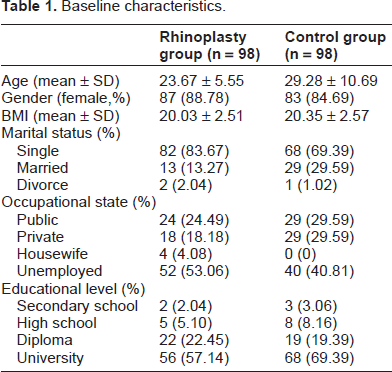
We recruited 196 participants. Of these, 98 were patients seeking rhinoplasty and 98 were controls. The mean ages were 23.69 and 29.28 years for the rhinoplasty group and control group respectively. Most of the participants were single. Public work was the most common occupation in both groups. More than a half of the individuals in both groups had earned a bachelor degree (Table 1).
Baseline characteristics.
Participants seeking rhinoplasty were compared with controls for GHQ-28 scores. The study group had a 5.5 times (95% CI 1.25 to 24.17, P = 0.01) higher risk of poor mental status when compared with controls (Table 2).
Mental status of patients.

We also divided the poor mental status participants into four groups, according to the GHQ-28 scores, and found that participants seeking rhinoplasty were prone to have anxiety, insomnia and social dysfunction 2 times more than controls; this difference is statistically significant (P = 0.03 and 0.04 respectively) (Table 3).
Subgroup of poor mental status.

Discussion
The nose plays a special role in the formation of the body image. It is the most conspicuous structure in the human body and never covered by clothes. At puberty there begins a period of increased nasal growth 13 which continues through adolescence and results in a structure which is capable of being feminine or masculine in its contours and proportions. 10
Augmentation rhinoplasty is the common procedure for non-Caucasian noses.14,15 Asians generally have a shorter, wider and less projecting nose. Reduction rhinoplasty, with dorsal hump reduction and some form of lower lateral cartilage reduction, is more popular in Caucasians.16–18 The dorsum and tip projection are the main area of concern for most patients in our area. 19 The patients usually feel lack of self-esteem when faced with other people.20,21 We conducted this prospective study to evaluate the psychological status in patients seeking a rhinoplasty operation.
It is a general phenomenon that people seeking plastic surgeries are in the higher possibility to have psychological problems. Among patients seeking a consultation for a cosmetic procedure, up to 47.7 percent meet criteria for a mental disorder. 22 However, there is no consensus about the psychological aspects of rhinoplasty in the literature.
To our knowledge, this is the first report in individuals of Asian ethnicity. We found that patients seeking rhinoplasty were statistically more prone to have psychological problems than controls. Our results disagree with those of a previous report that found no statistically significant higher psychological problem in rhinoplasty patients. 8 This may be because our sample size was large enough to detect a clinically important effect. This study may have limited application in western countries, due to differences in anatomical and cultural motivations.
Surgeons should be aware of their patient's psychological status before performing the operation. Patients with psychological abnormalities are more likely to report unfavourable results. 2 Realistic expectations and motivational factors should be sought and thoroughly evaluated by surgeons (eg, checklists, interview) during their initial encounter with the patient. If any doubt exists, it would be propitious to allow a period of reflection and contemplation on the part of the patient, schedule a second interview, or request a psychiatric consultation before any firm decision for surgery is made. 23
Conclusions
Patients seeking rhinoplasty are more prone to have psychological abnormalities than controls. Surgeons should be aware of this risk before performing the operation.
Authors' Contributions
PP designed the study protocol, collected the patient's data, analyzed the data and wrote the first draft of manuscript. SS collected the patient's data and revised the manuscript. SA designed the study protocol and revised the manuscript.
Disclosures
Author(s) have provided signed confirmations to the publisher of their compliance with all applicable legal and ethical obligations in respect to declaration of conflicts of interest, funding, authorship and contributorship, and compliance with ethical requirements in respect to treatment of human and animal test subjects. If this article contains identifiable human subject(s) author(s) were required to supply signed patient consent prior to publication. Author(s) have confirmed that the published article is unique and not under consideration nor published by any other publication and that they have consent to reproduce any copyrighted material. The peer reviewers declared no conflicts of interest.
Footnotes
Acknowledgements
We would like to thanks the patients in this study for provided us the data. Prof Robert Peter Mills and Piyawadee Lertchanaruengrith, MD for English language editing of the manuscript.