






Abstract
Endoscopic image of achalasia usually shows dilated esophageal cavity with retained liquids and foods. Recently, “pinstripe pattern” (PSP) in the case of achalasia patient was reported as an endoscopic image of the indicator for early detection of achalasia. The typical endoscopic image of PSP can be recognized in this case.
A 65-year-old woman was referred to our hospital for dysphagia and body weight loss (-11 kg per year). When she was diagnosed with achalasia a year ago according to the endoscopic view without peristalsis, she was administered proton-pump inhibitors and a calcium blocker. However, dietary intake and body weight fell gradually. A CT scan revealed severe food compaction and dilatation of the esophagus. Esophagogastroduodenoscopy showed a dilated esophageal cavity with a large amount of food residue. A rough, whitish and reddish, and granular mucosa was observed in the middle of the esophagus. Due to obstruction by achalasia, it appeared to be chronic inflammation and mucosal damage. Pinstripe pattern (PSP), which was first reported by Minami et al, was observed in the middle to lower of esophagus. 1 PSP is recognized as the presence of longitudinal superficial wrinkles by conventional white light, staining observation using indigo carmine spraying (Fig. 1A), and narrowband imaging (Fig. 1B). PSP can be a predictor for the early detection of esophageal achalasia, and PSP has a prevalence rate of 60.7% of achalasia patients. For this case, pneumatic dilation was first carried out. Treatment at this time was successful in improving symptoms. If the relapse occurs, additional treatment through peroral endoscopic myotomy is planned in the future.
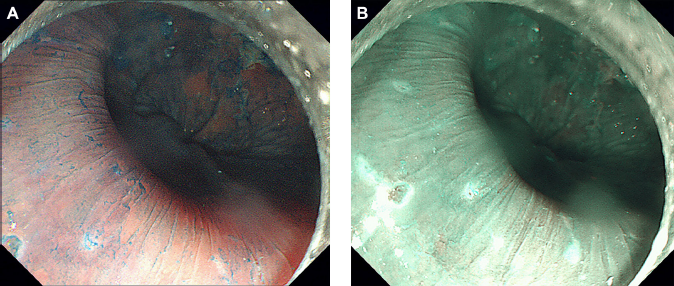
Endoscopic image of close view with Indigo carmine (
Author Contributions
Conceived and designed the experiments: AI. Analyzed the data: AI, KT and KS. Wrote the first draft of the manuscript: AI. Contributed to the writing of the manuscript: AI. Agree with manuscript results and conclusions: AI. Jointly developed the structure and arguments for the paper: AI. Made critical revisions and approved final version: AI. All authors reviewed and approved of the final manuscript.