






Abstract
We describe a rare case of cutaneous TB where cellulitis-like symptoms are presented.
Keywords
Introduction
Tuberculosis (TB) is an infectious disease caused by a bacterium called
The immune response of the patient and the virulence of the mycobacteria determine the type and severity of cutaneous TB.
TB cellulitis is a rare type of cutaneous TB with cellulitis-like symptoms. 3 So far, only seven cases of tuberculous cellulitis have been reported.3–5 We report a case of TB cellulitis with systemic lupus erythematosus (SLE).
Case Report
A 67-year-old woman, receiving oral steroid therapy for SLE, presented to her physician because of fever (>38 °C) and arthralgia. Her steroid dosage was increased with suspicion of SLE exacerbation. Subsequently, she developed redness, swelling, and blistering on the right thumb, and then was referred to our hospital. Clinical examination revealed erythematous swelling on the right thumb with erosion and maceration (Fig. 1A). We diagnosed it as bacterial cellulitis and treated her with antibiotics and antiviral agents, but her symptoms did not improve. Therefore, we performed skin biopsy of the right thumb. Histopathologic examination revealed caseous necrosis surrounded by histiocytes and a positive result was obtained for acid-fast bacilli by Ziehl–Neelsen staining (Fig. 1B–D). In addition, polymerase chain reaction (PCR) assay of the biopsy specimen identified tubercle group bacilli. Based on these results, we made a diagnosis of TB cellulitis and started to treat the patient with isoniazid, ethambutol, rifampicin, and pyrazinamide. Her symptoms completely resolved after the treatment.
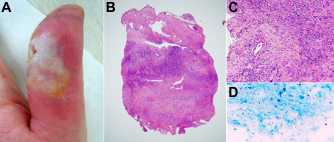
(
Discussion
So far, eight cases of TB cellulitis have been reported, which includes our patient.3–5 Seven of them were on steroid therapy, and thus, immunosuppression may have been a factor in the development of this infection. The positive rate of investigations to detect tubercle bacilli was high, which was 87.5% (7 of 8) for Ziehl–Neelsen staining, 75% (6 of 8) for PCR, and 62.5% (5 of 8) for culture. However, only 50% of patients (4 of 8) showed positive results for all the three tests. Therefore, in order to start treatment in a timely manner, it is important to comprehensively assess test results as well as other examinations and symptoms, and to realize that some tests may be negative. Although culture was not positive in our patient, she responded to treatment with four antituberculous agents.
Although the prevalence of TB has recently decreased in developed countries, it is still important to consider the possibility of TB cellulitis and perform skin biopsy and culture when managing refractory skin lesions especially in elderly people, children, and immunosuppressed patients.
Author Contributions
RT conceived and designed the experiments. RT, TN and TO analyzed the data. TN wrote the first draft of the manuscript. TN, HI and TO contributed to the writing of the manuscript. DT made critical revisions and approved final version. All authors reviewed and approved of the final manuscript.