






Abstract
Several studies have been conducted to elucidate the role of free fatty acids (FFAs) in the pathogenesis of type 2 diabetes, but the exact molecular mechanism by which FFAs alter glucose metabolism in the liver is still not completely understood.1–4 In a recent publication, Ragheb and coworkers have examined the effect of free fatty acid (FFA) treatment on insulin signaling and insulin resistance by using immunoprecipitation and immunoblotting to study the effect of high concentrations of insulin and FFAs on insulin receptor-beta (IR-β) and downstream elements in the PI3K pathway using the fructose-fed hamster model. 5 Their results clearly show that free fatty acids have an insignificant effect on IR-β and supports previous findings that FFAs lead to insulin resistance in the liver via the PKC-NFκB pathway.2,3
Commentary to “Prolonged Treatment with Free Fatty Acids has Post Receptor Effect in Hepatic Insulin Resistance: Evidence that Fatty Acids, Oleate and Palmitate have Insignificant Effect on the Insulin Receptor Beta
Insulin resistance is known to play a pivotal role in the pathogenesis of non-insulin dependent diabetes mellitus (NIDDM). 6 A strong association has been demonstrated between high plasma concentrations of free fatty acids (FFAs) and the development of insulin resistance.7–10 In addition to competing with glucose for oxidation, FFAs interfere with glucose metabolism through a number of other mechanisms.10,11
The signaling pathways affected by high concentrations of FFAs and leading to the development of insulin resistance in the skeletal muscle have been studied in detail.4,12–23 Briefly, an oversupply of FFAs leads to an accumulation of metabolites such as fatty acyl-CoA, diacylglycerol and ceramides. These metabolites activate protein kinase C (PKC) which leads to phosphorylation of serine and threonine residues on the insulin receptor substrate 1 (IRS-1) and subsequent impairment of the insulin signaling cascade and glucose transport.11,13,14,24 Other potential mechanisms leading to insulin resistance in skeletal muscle include changes in gene expression mediated by the binding of FFAs to peroxisome proliferator-activated receptors and activation of a protein phosphatase leading to inhibition of protein kinase B (PKB).11,14,24–26
While the cellular mechanisms by which FFAs lead to the development of insulin resistance in the skeletal muscle have been well studied as described above, understanding of the cellular factors affected by FFAs in the liver is relatively limited.1–4,23,27 The liver plays a critical role in maintaining glucose homeostasis, and disruptions of insulin signaling in hepatocytes have been shown to lead to acute insulin resistance and progressive loss of normal liver function. 28 FFAs have been implicated in the disruption of glucose homeostasis and insulin signaling cascade in the liver.23,29 While one of the mechanisms by which FFAs disrupt glucose homeostatis is competition with glucose for oxidation through the glucose-fatty acid cycle, studies by Oakes and coworkers in fructose-fed rats clearly suggest that other mechanisms are also involved. 4 Boden et al have shown that the NFκB pathway is involved in FFA mediated development of hepatic insulin resistance but the effect of fatty acids on the insulin receptor-beta (IR-β) in hepatocytes has not been well characterized. 3
In their recent publication, Ragheb and coworkers have examined the effect of FFAs on IR-β phosphorylation and its potential role in the development of insulin resistance using the fructose-fed hamster model. 5 Ragheb et al found that treatment with either oleic or palmitic acid (Fig. 1) does not lead to a difference in insulin receptor-beta (IR-β) phosphorylation status following treatment with insulin. Increasing the concentration of insulin or using higher concentrations of oleate or palmitate did not lead to any differences in IR-β phosphorylation. The authors also describe the effect of oleate and palmitate treatment on the phosphorylation status of PKB, a downstream element in the PI3K pathway.
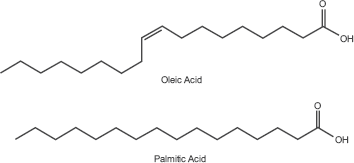
Structures of oleic and palmitic acid–-the free fatty acids utilized for studying the effect of FFAs on IR-β in hamster hepatocytes.
The studies examining the phosphorylation status of IR-β and PKB following FFA treatment clearly show that prolonged treatment with FFAs causes hepatic insulin resistance via a post receptor effect and lend further support to earlier studies demonstrating that FFAs lead to insulin resistance in the liver via the PKC-NFκB pathway.2,3 (13) This is an important study as a thorough characterization of the molecular factors involved in the FFA mediated development of insulin resistance would not only help increase our understanding of the cellular mechanisms by which FFAs lead to the development of hepatic insulin resistance but could allow identification of new molecular targets for the treatment of insulin resistance.
Footnotes
Disclosures
The authors report no conflict of interest.