






Abstract
Na+/Ca2+ exchangers are low-affinity, high-capacity transporters that rapidly transport calcium against a gradient of Na+ ions. Na+/Ca2+ exchangers are divided into three groups based upon substrate specificity: Na+/Ca2+ exchangers (NCX), Na+/Ca2+/K+ exchangers (NCKX), and Ca2+/cation exchangers (NCLX). In mammals, there are three NCX genes, five NCKX genes, and a single NCLX gene. The genome of the nematode
Short Commentary
Maintaining calcium homeostasis is necessary for the development and survival of all animals. In multicellular organisms, calcium ions can enter the cytosol via the voltage-gated calcium channel at a rate of one million ions per second,
1
and from there, they can target hundreds of effector proteins that engage pathways involved in muscular contraction, neurotransmission, cell differentiation, and energy metabolism to name but a few (see Ref. 2 for an excellent discussion of calcium signaling). Many of the target proteins for calcium ions in the cytosol function in a buffering capacity to chelate free calcium in order to prevent activation of pathways including that of apoptotic pathways linked to excessive free calcium. In order to set appropriate calcium levels inside cells, a superfamily of antiporters, called the sodium calcium exchangers, utilize the sodium gradient to transport calcium across various membranes. This superfamily is composed of the Na+/Ca2+ exchangers (NCX), which exchange sodium for calcium, Na+/Ca2+/K+ exchangers (NCKX), which exchange sodium for potassium and calcium, and Ca2+/cation exchangers (also called NCLX), which exchange sodium or lithium for calcium.3–5 In mammals, there are three genes encoding various isoforms of NCX transporters, five NCKX genes, and a single NCLX gene. The mammalian NCX gene products (NCX1-3) are highly expressed in cardiac muscle, skeletal muscle, and the central nervous system6–8; the mammalian NCKX genes (NCKX1-5) are also widely expressed in various cells including photoreceptor cells, retinal ganglion cells, platelets, vascular smooth muscles, uterus, brain tissue, intestine, lungs, thymus, and epidermal cells.9–12 The mammalian NCLX is expressed in all tissues examined including the brain, thymus, heart, skeletal muscles, lungs, kidneys, intestines, and testes and has been shown to localize to the inner membrane of mitochondria.13,14 Disruption of Na+/Ca2+ exchanger activity has been linked to apoptosis due to excessive accumulation of cytosolic calcium: in cardiomyocytes, overstimulation of Gαq protein downregulates NCX causing apoptosis,
15
and in oligodendrocytes, glutamatemediated excitotoxicity can reverse NCX activity, which causes mitochondrial dysfunction and apoptosis.
16
Considering the central role of Na+/Ca2+ exchangers and also the significant conservation between these exchangers in
The nematode
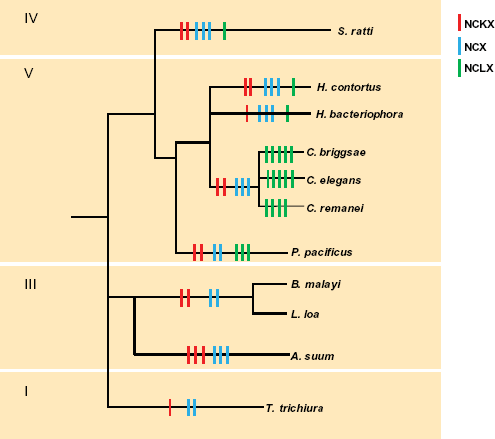
Representative tree of the phylogenetic relationships between nematode species belonging to Clades I, III, IV, and V.
The NCLX is considered to be the primary regulator of mitochondrial Ca2+ efflux, while mitochondrial Ca2+ influx is regulated predominantly by the mitochondrial calcium uniporter (MCU).14,23 MCU is a highly selective ion channel that facilitates the uptake of cytoplasmic Ca2+ ions into mitochondria and does not require adenosine triphosphate (ATP) hydrolysis or the exchange of other ions for conducting Ca2+ transport. Together, calcium handling via NCLX and MCU is critical for shaping intracellular calcium signaling dynamics, mitochondrial ATP production, and regulation of cell death pathways.24–27 We investigated if Clade III nematode taxa contain sequences for the MCU channel. While the Clade III taxa lack NCLX, their genomes contain a putative sequence for the MCU channel (eg, BMA-MICU-1). The presence of MCU but the absence of NCLX in this clade poses a unique challenge to the understanding of how mitochondrial calcium dynamics are regulated in some organisms. It is estimated that steady-state calcium transients are reduced by as much as 36% due to mitochondrial Ca2+ uptake. 28 However, prolonged buildup of Ca2+ in the mitochondria is a trigger for cellular apoptotic pathways, and Ca2+ efflux is consequentially of utmost importance for maintaining cell and organismal health. 29 It is unworkable that mitochondrial Ca2+-clearing mechanisms do not exist in these nematode species lacking the NCLX, but rather it is possible that mitochondrial Ca2+ efflux is regulated entirely by the NCX variants found within these organisms. Members of the NCX subfamily have been recently implicated in mitochondrial Na+/Ca2+ exchange. Human NCX1 is functional in the mitochondria of neuronal and glial cells and colocalizes with the excitatory amino acid carrier 1 to promote glutamate uptake in mitochondria. 30 The human NCX2 and NCX3 localize and function at the mitochondria of dopaminergic neurons. 31 Furthermore, NCX3 activity in the outer mitochondrial membrane is essential for promoting cell survivability in neurons during hypoxic conditions. 32 NCLX exhibits several functional differences to that of NCX, in particular, NCLX exhibits specific sensitivity to the inhibitor CGP 37 1 57 33 and also exhibits substrate specificity to Li+, which is not shared by NCX. However, both NCX and NCLX mediate Na+/Ca2+ exchange, and the Li+ specificity of NCLX is not considered physiological. Therefore, we speculate that in Clade III taxa, a lack of NCLX may be overcome by mitochondrial localization and functioning of the NCX, which may function to handle plasma membrane exchange and also exchange at the mitochondrion.
It is quite striking that within the phylum Nematoda, there exists such remarkable diversity within the number of Na+/Ca2+ exchangers found within each species. This apparent diversity suggests that mechanisms regulating calcium homeostasis are precisely tailored to meet the varying physiological demands of individual species over their lifetime. Yet, the important regulatory domains of these exchangers appear to be highly conserved across nematodes, flies, and humans17,18,34 and even fungi in the case of NCLX. 22 Our observations on the absence of NCLX in Clade III nematodes highlight the importance of studying diverse systems in order to get a deeper understanding of the evolution and regulation of Ca2+ signaling critical for animal biology.
Author Contributions
Conceived the concepts: VS, DMO. Analyzed the data: VS, DMO. Wrote the first draft of the manuscript: VS, DMO. Contributed to the writing of the manuscript: VS, DMO. Agree with manuscript results and conclusions: VS, DMO. Jointly developed the structure and arguments for the paper: VS, DMO. Made critical revisions and approved final version: VS, DMO. Both authors reviewed and approved of the final manuscript.