






Abstract
Chromium(VI) has been found to be one of the toxic metals present in water obtained from industrial effluents. This study deals with the removal of Cr(VI) using used green tea leaves, which is a waste material. The sorption of Cr(VI) was carried out by using a batch method, and its concentration was determined using an ultraviolet visible spectrophotometer at 540 nm. Parameters such as pH, mass of adsorbate, concentration of adsorbent, time of contact, and temperature were optimized. It was observed that, under optimum conditions, the percentage efficiency of removal of Cr(VI) was up to 99%. Adsorption studies were carried out using Langmuir and Freundlich adsorption isotherms. The values of Δ
Introduction
The presence of heavy metals has become a major problem in today's world due to its direct effect on living organisms, be it flora or fauna or even human beings. If present in quantities above a certain permissible limit, they can cause various short and long-term harmful effects, such as shortness of breath, coughing, and wheezing leading to gastrointestinal effects, such as abdominal pain, vomiting, hemorrhage, and neurological effects. Cr(VI) can also act as a carcinogen.1,2 Environmental standards are being set, so that there is a proper check on the amount of heavy metals being discharged into the water bodies and a rigorous control is being monitored on the industrial output. Chromium is widely used in electroplating, leather tanning, metal finishing, and chromate preparation. Chromium exists in mainly two states, Cr(III) and Cr(VI), of which the concentration of the latter is of greater concern, as it is more toxic and its maximum permissible level in drinking water is ~0.1 mg/L as per Indian standard specifications as well as Environmental Protection Agency. Chromium generally reaches the water bodies through effluents from industries, such as paints, inks, electroplating, metal finishing, and leather tanning.
Various methods have been employed for the removal of Cr(VI) from aqueous bodies, such as chemical oxidation and reduction, membrane separation, liquid extraction, carbon adsorption, ion exchange, electrolytic treatment, electroprecipitation, coagulation, flotation, evaporation, crystallization, ultrafiltration, and electrodialysis.3–5 These methods have varying effects and economic considerations. Chemical precipitation, reverse osmosis, and filtration techniques cannot be used for trace analysis, while some of the methods are not economically feasible for large-scale industrial use due to high cost. 6 Thus, there is a need to find other low cost, naturally available adsorbents, so that the toxic metal ions can be effectively removed even at trace levels. Activated carbon has been used as an adsorbent for the removal of chromium, but it is readily soluble under extreme pH conditions and also not cost-effective. 7 Other alternative materials such as carbon fly ash, 8 cork waste, 9 bagasse fly ash, 10 groundnut shell, 11 coconut, 12 neem leaves, 13 papaya seeds, 14 rice husk, 15 and banana peel 16 have also been investigated. The materials are waste products from industries and act as natural adsorbents. Under optimum conditions, they can exhibit up to 99% recovery of chromium. These adsorbents are easily available, economic, and show high adsorption efficiency, and thus are more effective in the removal of heavy metals.
Recent methods reported for the removal of Cr(VI) are based on the use of composites, 17 metal oxide photocatalysts, 18 nanoparticles, 19 etc.
This study deals with the use of waste green tea leaves as natural adsorbents by optimizing various parameters such as pH, concentration of adsorbate, concentration of adsorbent, temperature, and contact time. Based on these studies, the adsorption isotherms have been studied along with the kinetic and thermodynamic parameters.
Materials and Methods
Preparation of adsorbent
The used green tea leaves were obtained after consumption of tea. Milk, sugar, and other impurities were removed by washing a number of times with distilled water. This was then washed with hot water until a colorless filtrate was obtained. The decolorized and cleaned tea waste was dried in an oven at 105°C. About five cycles of washing was required. After drying, the tea leaves were crushed and used in the further adsorption experiments without further modification. Since the adsorption studies were carried out at room temperature (25 ± 1°C), no remarkable interfering color was observed. The dried and crushed tea leaves were stored in polythene bags.
Characterization of tea waste
The standard procedure was used to determine the physicochemical characteristics of tea leaves. The percentage moisture, ash content, and fixed carbon were found to be 5.17%, 4.58%, and 19.54%, respectively.
Batch adsorption studies
A stock solution containing 1000 mL/L of Cr(VI) was prepared using potassium dichromate (K2Cr2O7) in distilled water. All the chemicals used were of analytical grade. The experiments were carried out in 250 mL flasks with a desired amount of adsorbent and Cr(VI) solution. These flasks were then agitated on a shaker at a fixed rpm agitation speed allowing time for equilibrium to be attained. The concentration of chromium was then determined using an ultraviolet visible spectrophotometer at 540 nm. The batch adsorption studies were carried out by varying the experimental conditions such as contact time, adsorbent dosage, initial chromium concentration, and pH. The percentage chromium removal was calculated as:

where
The adsorption isotherm studies and kinetic studies were also carried out, and the calculations were performed to get the appropriate results, as well as the thermodynamic parameters were calculated. The interference of other metal ions was also studied.
Results and Discussion
Effect of adsorbent dosage
The effect of the amount of adsorbent on the adsorption of Cr(VI) is shown in Figure 1. It was observed that the chromium removal efficiency increases with increase in the amount of adsorbent added, after which it becomes nearly constant with 0.8 g adsorbent.

Effect of adsorbent dosage.
After attaining the optimum percentage removal of 95%, it became more or less constant. This can be attributed to the fact that as we increase the adsorbent dosage, more binding sites will be vacant for the complexation of Cr(VI) and there will be an increase in the rate of adsorption. But there will be very slow increase in the % removal after an optimum dose, which may be due to the equilibrium state between the adsorbate and adsorbent. 21 The screening effect of an external layer of a cell at high adsorbent dose blocks the binding sites from metal ions, and thus results in lower metal removal per unit adsorbent. 22
Effect of pH
A given concentration of Cr(VI) ion solution was taken along with a fixed amount of sorbent and the pH was set from 1 to 10 using 0.5 M HNO3 and 0.1 M NaOH. The change in pH was as observed in Figure 2. The maximum adsorption was observed at pH 2.
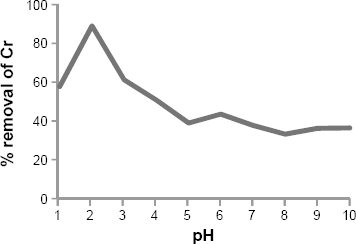
Effect of pH.
At lower pH values, chromium ions are found in the form of HCrO4–, while at higher pH values, it exists in different forms like Cr2O72-, Cr3O102-, and HCrO4–. But HCrO4– is the dominant species at pH 2. When pH increases, the equilibrium shifts from HCrO4– to Cr2O72- and CrO42-. 23 At lower pH values, the adsorbent surface would be surrounded by hydronium ions. This may increase the interaction of Cr(VI) with binding sites of the biosorbent with greater force. But as the pH increases, the total surface charge becomes negative on the biosorbents and therefore adsorption decreases. 24 The equilibrium for Cr(VI) anions that are present in aqueous solution can be written as: 25

pH values of >6 was not significant for the adsorption of Cr(VI) due to dual complexation of CrO4–, Cr2O72-, and OH– anions, which gets adsorbed at the surface and OH–predominates among them.
The adsorption of anions is favored at pH < pHpzc. The zero point of charge was found to be 4.1.
Effect of contact time
The time of contact of the adsorbent with the Cr(VI) ions was changed from 30 to 300 minutes, and the variation observed is as shown in Figure 3. It was observed that as the time increased, the amount of chromium that is adsorbed by the sorbent increases, but after ~180 minutes, the solution attains equilibrium.
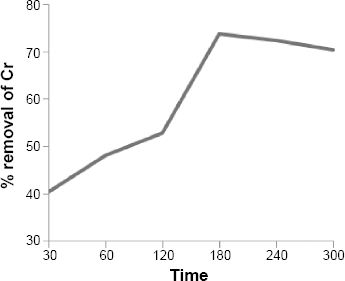
Effect of contact time.
The adsorption process involves two stages. The first adsorption stage was fast, whereas the next stage was a slower adsorption process. This can be explained as follows: in the starting phase, large number of vacant sites may be present, which led to fast adsorption, but afterward, it slows down as the vacant sites may be exhausted. This was due to repulsion between the solute molecules and bulk phase. 26
Effect of Cr(VI) ion concentration
Varying concentrations of 5-500 mg/L of Cr(VI) was taken and keeping the adsorbent dosage fixed, the effect is as given in Figure 4.
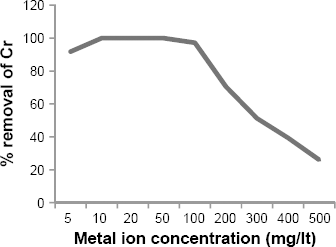
Effect of Cr(VI) ion concentration.
It was observed that the adsorption of Cr(VI) increases as the metal ion concentration increases. At lower concentrations, all the metal ions interact with the binding sites, and thus gives the maximum adsorption at low concentration. But at higher concentrations, metal ions will look for free binding sites, but due to lack of binding sites for complexation, the adsorption lowers at greater concentrations. This is represented graphically as the percentage removal of Cr(VI) decreases with increase in concentration.
Effect of temperature
The variation in adsorption of Cr(VI) ions was studied at three different temperatures (25°C, 40°C, and 50°C). As the temperature increased, the percentage of recovery also increased with a maximum of 90% at 50°C, thus indicating that the adsorption process is a chemisorption process.
Adsorption isotherms
The Langmuir and Freundlich isotherms were obtained as given in Figure 5A and B, respectively.
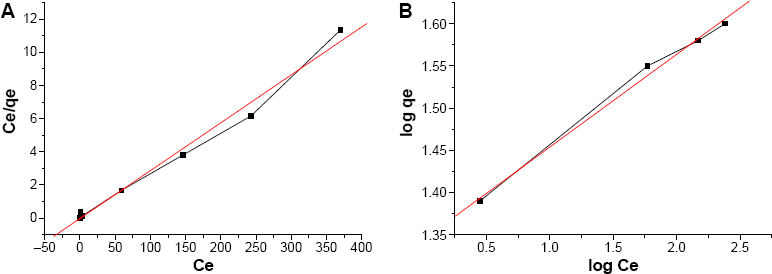
(
The linearity was greater in the case of Freundlich isotherm than in Langmuir (Table 1).
Linear regression data for Langmuir and Freundlich isotherms.

Kinetic studies
The pseudo-first- and pseudo-second-order kinetics were studied and the graphs obtained are as given in Figure 6A and B and Table 2, respectively.

(A) Pseudo-first-order adsorption kinetics. (B) Pseudo-second-order adsorption kinetics.
Linear regression data for pseudo first and pseudo-second-order kinetics.

Effect of other metal ions
The presence of other metal ions such as Zn2+, Ni2+, Cd2+, Cu2+, and Fe2+, which are commonly found in polluted water samples was studied. Ions such as Zn2+ and Cd2+ were found to increase the percentage adsorption of Cr(VI) ions, while ions such as Ni2+, Cu2+, and Fe2+ decreased the amount adsorbed. The increase in adsorption can be attributed to the increase in surface area, due to the other ions getting adsorbed and the decrease could be due to the competition for the adsorption sites available on the adsorbent being used. No specific trend was observed for particular metal ions.
Thermodynamics parameters
The thermodynamic quantities such as Δ
Thermodynamic parameters.

Regeneration and reusability of the adsorbent
Desorption studies were carried out with various solvents, namely, NaOH, NaCl, HCl, and HNO3, of a known concentration of 0.1 N. The desorption efficiency decreased with the increasing number of cycles due to decrease in adsorption capacity. It was observed that 0.1 N HCl was an efficient desorbent. The batch adsorption method has been compared with the column method and nearly similar results were obtained. Depending on the application, at the industrial level, taking cost and other factors into consideration, the method can be used.
Conclusion
From this study, it can be concluded that green tea leaves are a very effective adsorbent for the removal of Cr(VI) ions from a given water sample. It gave a maximum adsorption at pH 2 with a contact time of 180 minutes and adsorbent dosage of 0.8 g/L. The maximum percentage removal of Cr(VI) was found to be 99%. Adsorption studies show that the Freundlich model fits better than the Langmuir model for the experimental data. The pseudo-second-order kinetic adsorption model was applicable. Thermodynamic values showed that the process was spontaneous and exothermic.
Author Contributions
Conceived and designed the experiments: CJ. Analyzed the data: AG. Wrote the first draft of the manuscript: CJ. Contributed to the writing of the manuscript: CJ. Agreed with manuscript results and conclusions: AG. Jointly developed the structure and arguments for the paper: CJ and AG. Made critical revisions and approved the final version: CJ. All the authors reviewed and approved the final manuscript.
Supplementary Material
Efficiency of tea leaves reported in literature.

Footnotes
Acknowledgments
The authors are thankful to Amity University for providing the required infrastructure and facilities for carrying out this study.