






Abstract
The present study describes a simple and highly selective method for separation, preconcentration and spectrophotometric determination of extremely low concentrations of lead. It is based on flotation of a complex of Pb2+ ions and Alizarin yellow between aqueous and
Introduction
The impact of the effects of trace chemical species in the environmental and industrial samples on human health has fostered development of analytical techniques capable of addressing these issues. Accurate and reliable analytical methods possessing high sensitivity and selectivity, coupled with convenience and economy, applicable to real world samples are required. Although some analytical techniques such as AAS, GFAAS, ICP-OES, ICP-MS, or polarographic analysis and atomic spectroscopy with high capability of determination of trace elements have already been used, however, due to their high cost and in some cases low sensitivity and selectivity, demands for more sensitive and less expensive methods are increasing in analytical chemistry.
1
As a heavy metal lead, which produces several diseases, is one of the most important and widely distributed pollutants in the environment. Lead is one of the most toxic elements and has accumulative effects.
2
It can occur as a result of industrialization in the production of pigments, anticorrosion coatings, lead smelters, alloys, and batteries, causing significant contaminations in air, dust, soil, water, sediments, food, etc. The World Health Organization (WHO) and the US Environmental Protection Agency (EPA) have set maximum levels of 50 and 10 μgL-1 of Pb in seawater and drinking water, respectively.
3
Due to these reasons, the determination of lead is becoming increasingly important. However, the number of reagents available for the spectrophotometric determination of lead is relatively small. The main reagents are dithiazone, diethyldithio-carbamate, 4-(2-pyridilazo) resorcinol, diphenylcarbazone, Arsenazo III, 2-(2-thiazolylazo)-
Also, the determination of lead(II) has been widely done in various systems such as in human and artificial teeth blood,5,6–8 urine,8,9 cookies, 10 baker's yeast, 11 ashes, coals, sediments, sludge, soils, freshwaters,2–12 drugs, 13 human hair, 14 wine, 1 seawater and minerals,15–17 using different classical and instrumental techniques.18–26
One of the classical noninstrumental methods of preconcentrating samples which we have applied in our study is floatation. It is a well known technique for selective separation of valuable substances from ores, minerals and ect,27–29 but today this technique is used mainly in other fields of chemical engineering and more rarely in analytical chemistry also. It is a process in which valuable minerals are separated from gangue minerals. It is a complex combination of various physical principles, such as surface chemistry, colloid chemistry, crystallography and physics. The exact manner is not well understood. Various factors influence the performance of a flotation unit including the bubble size, stator and rotor configuration, type and quantity of chemicals added and residence time. 30
Experimental
Materials and Instrumentation
All the reagents were of analytical grade obtained from Merck, Germany. Double distilled fresh water was used in all the experiments. The standard solution of 1000 μgmL-1 Pb (II) was prepared by dissolving the appropriate amount of Pb (NO3)2 in H2O. The required volumes of this solution were used to prepare the working solutions. A sodium tetraborate buffer solution with the concentration of 0.05 M (with addition of NaOH, 1M) was prepared by mixing nearly the appropriate amounts and adjusting to pH = 6 by the addition of a few drops of HCl solution. The solution of 3.23 × 10⁻³ molL-1 Alizarin yellow GG was made by dissolving of Alizarin yellow GG in the appropriate amount of freshwater.
The pure stable Cetyltrimethylamonium bromide (CTAB) solution (0.5 μgmL-1) was prepared by dissolving the appropriate amount in H2O. The 0.1M NaCl solution was prepared by dissolving the appropriate amount of the salt in water. Pure methanol and n-hexane were also used as solvent and extraction organic phase, respectively. A Shimadzu mini UV-Vis model 1245 spectrophotometric was used for all the absorbance measurements with a 10 mm quartz cell. A Jenway model 3505pH meter was used for pH measurements.
Experimental
To a 100 ml volumetric balloon, 1 ml of a solution containing up to 10 μgmL-1, and 12 ml 3.23 × 10⁻³ molL-1 Alizarin yellow GG were added and its pH was adjusted to 6 by the addition of 3 mL of the buffer solution. 1 mL NaCl (0.1M) and 7 mL CTAB solution (0.5 μgmL-1) were also added and the volume reached to 100 ml with freshwater. The solution was maintained for 12 min to form complex and then transferred to a 100 ml separating funnel. 12 mL of n-hexane was added to it. The funnel was stoppered and vigorously shaken for 90 sec, and then left to rest for 5 minutes to give a perfect floated layer in the aqueous/organic interface. The floated layer was adsorbed on the inner walls of the funnel. By slowly opening the stopcock of the funnel, the aqueous phase was released in 5 minutes. To extract the lead content, 2 mL pure methanol was added to the funnel and vigorously shaken again for few minutes. The organic phase containing only the lead–alizarin complex was separated and its absorbance was measured at 364 nm against a reagent blank prepared in the same manner.
Results and Discussion
Overall Procedure
The procedure included two steps as follow:
Influencing Parameters
To obtain reliable results, a number of parameters influencing the steps were optimized. Some of them that related to the flotation step including the type of the organic phase, pH of the solution, concentration of alizarin, surfactant, the electrolyte solution, floatation relaxation time, and complexation time were firstly investigated and reported. The others that related to the extraction and determination of Pb (II) content are discussed as the following. Since almost all the interfering agents were eliminated via the flotation process, no troublesome was observed on the performance of the extraction procedure. There was also no inherent interference due to the presence of alizarin. In this viewpoint, selection of a suitable reagent to extract the Pb (II) content gives emphasis on the following considerations.
The reagent should form a very stable complex with Pb (II). In viewpoint to increase the sensitivity of the determination, the molar absorptivity coefficient of the extracted complex must be inherently much greater than the ion-associate which is in turn justifying the extraction step, evidently. The extraction process of Pb (II) should be carried out using a high selectivity reagent to avoid any interfering element in the extraction process. To assure on quantitative extraction of Pb (II) content in one step, the gain of the extraction process must be very high.
In order to find a favorable reagent for the extraction process, a number of conventional reagents were investigated. It was observed that some of them, such as Alizarin Red (s), methyl thymol blue and Xylenole orange were not able to extract Pb (II) completely in the presence of n-hexane. Alizarin yellow GG is one of the best extractants, which has been recognized as a sensitive reagent for the determination of Pb (II) in acidic media. It is capable to form primary and secondary complexes with Pb (II) in acidic and alkaline media, respectively.31,32 However, due to a higher absorptivity coefficient and solubility in polar organic phase such as methanol, the primary lead–alizarin chelate was preferred in the spectrophotometric determination. To enhance the selectivity of the extraction of the primary lead–alizarin, the process was carried out in acidic medium in the presence of excess alizarin.
Optimization of Reagent (Alizarin) Concentration
Using alizarin with a sufficient high concentration to extract all the Pb (II) content in one step was very important. The effect of alizarin concentration was studied over the concentration range of 1.29 × 10⁻⁴ to 5.17 × 10⁻⁴ molL-1. The maximum absorbance occurs to alizarin concentrations above 3.23 × 10⁻⁴ molL-1. Since, by increasing the concentration of Pb (II) ions, a greater amount of alizarin was required, a solution with 3.88 × 10⁻⁴ molL-1 alizarin was chosen for further investigations (Fig. 1).
The effect of alizarin concentration on determination of Pb (II). The pH of the solution was adjusted to 6, 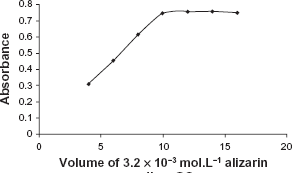
Influence of pH
The influence of pH and the volume of buffer were investigated in the range of between 1 to 9. As shown in Figure 2 an optimum volume of borate buffer with pH = 6 has been obtained.
The effect of pH and volume of buffer on the determination of Pb (II) by the proposed method. The pH of the solution was adjusted to 6, 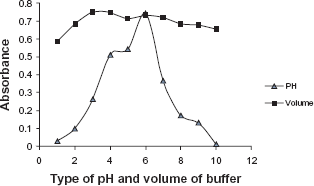
Effect of Surfactant Concentration
The volume of two surfactants (CTAB and CPC) with the concentration of 0.5 ppm was investigated in the range of between 0 to 10 mL. The optimum volume was 7 mL of CTAB (Fig. 3).
The effect of surfactant (CTAB and CPC) concentration on determination of Pb (II). The pH of the solution was adjusted to 6, 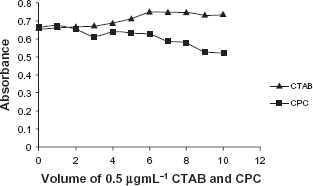
Conformity with Beer's Law and Figures of Merit
Under the optimum conditions, a linear calibration curve was constructed for pb (II) determination over the range of 3.86 × 10⁻⁸ to 8.20 × 10⁻⁷ molL-1 (8-170 ngmL-1). The correlation coefficient was (r = 0.998), showing an acceptable linearity of the calibration curve. The apparent molar absorptivity at 364 nm was 1.33 × 10⁶ molL-1cm-1 for a 100 mL aliquot of the extracted aqueous phase. The RSD obtained (n = 10) for 7.2 × 10⁻⁷ molL-1 (150 ngmL-1) of Pb (II) was 4.36% and the detection limit, defined as the sample concentration giving a signal equal to the blank average signal (10 blank) plus three times the standard deviation of the blanks, was found to be 8.7 × 10⁻⁹ molL-1 (1.0 ngmL-1).
Effect of Foreign Ions
Tolerance limits for diverse ions in 2.41 × 10⁻⁷ mol L-1 (50 ng mL-1) Pb (II) in a 100 mL solution of seawater sample.
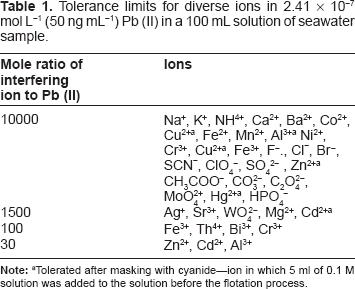
Tolerated after masking with cyanide—ion in which 5 ml of 0.1 M solution was added to the solution before the flotation process.
Applications to Real Samples
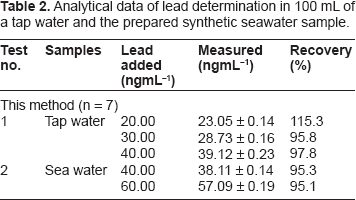
Analytical data of lead determination in 100 mL of a tap water and the prepared synthetic seawater sample.
Conclusions
The developed method offers a good sensitivity and selectivity for the determination of Pb (II) in the range of 8-170 ngmL-1 in various environmental samples. The important feasibility of the method is its simplicity in treatment with the aqueous samples. Results were found not to be significantly different from standard addition. In comparison with the conventionally alizarin extraction method, the detection limit, sensitivity, and selectivity were enhanced considerably due to benefit a high preconcentration factor (100) utilizing the flotation process. The recovery yield and RSD of the measured data denoted that the proposed method can be satisfactorily applied to the determination of trace Pb (II) in real samples.
Footnotes
Acknowledgement
The authors gratefully acknowledge the financial support of this work by the Payame Noor University of Ilam research council.
This manuscript has been read and approved by all authors. This paper is unique and is not under consideration by any other publication and has not been published elsewhere. The authors and peer reviewers of this paper report no conflicts of interest. The authors confirm that they have permission to reproduce any copyrighted material.