






Abstract
This present paper deals with the development and validation of a stability indicating high performance liquid chromatographic method for the quantitative determination of Memantine hydrochloride. Memantine hydrochloride was derivatized with 0.015 M 9-fluorenylmethyl chloroformate (FMOC) and 0.5 M borate buffer solution by keeping it at room temperature for about 20 minutes and the chromatographic separation achieved by injecting 10 μL of the derivatized mixture into a Waters HPLC system with photodiode array detector using a kromasil C18 column (150 × 4.6 mm), 5 μ, The mobile phase consisting of 80% acetonitrile and 20% phosphate buffer solution and a flow rate of 2 milliliter/minute. The Memantine was eluted at approximately 7.5 minutes. The volume of FMOC used in derivatization, concentration of FMOC and derivatization time was optimized and used. Forced degradation studies were performed on bulk sample of Memantine hydrochloride using acid (5.0 Normal (N) hydrochloric acid), base (1.0 N sodium hydroxide), oxidation (30% hydrogen peroxide), thermal (105°C), photolytic and humidity conditions. The developed LC method was validated with respect to specificity, precision (% RSD about 0.70%), linearity (linearity of range about 70-130 μg/mL), ruggedness (Overall % RSD about 0.35%), stability in analytical solution (Cumulative % RSD about 0.11% after 1450 min.) and robustness.
Introduction
Memantine hydrochloride (1-amino3, 5-dimethyladamantane hydrochloride) (Fig. 1) is a tricyclic amine chemically and pharmacologically related to the antiviral prototype amantadine and its α-methyl derivative rimantadine. Amantadine and rimantadine have been approved in the U.S. for the prophylaxis and treatment of influenza. Amantadine is also approved for the treatment of Parkinsonism. Memantine is used in Parkinson's disease and movement disorders.
1
Recently, it has been demonstrated to be useful in dementia syndrome.
2
Memantine is a noncompetitive NMDA antagonist in clinical use for many years in Europe. It produces few side effects, even among the geriatric patients, who are typical candidates for this drug.3,4
Structure of memantine hydrochloride. Molecular formula: C12 H21N-HCl: molecular mass: 215.76 (free base: 179.20): partition coefficient, log(P): 3.28: basicity. pK
a
: 10.42: solubility of the hydrochloride salt: 3.5% in a pH 6.5 aqueous solution at 25 °C.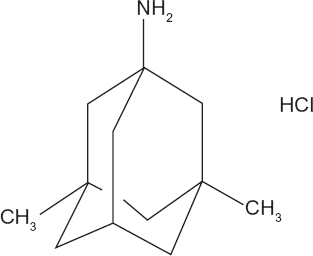
The NMDA receptor, a glutamate receptor subtype, may play a significant role in the development and maintenance of dependence on opoids, nicotine, and cocaine.5,6 In laboratory animals, low doses of NMDA antagonists inhibit the development of opioid tolerance and dependence, 7 and attenuate established morphine (mμ) opioid tolerance. 8 It has been suggested that the development of tolerance, dependence and/or sensitization to virtually all psychoactive drugs can be attenuated or abolished by pretreatment with NMDA antagonist. 9 As such, Memantine is a promising agent for the treatment of substance use disorders. Unlike other noncompetitive NMDA antagonists, such as phencyclidine and ketamine, memantine has rarely been associated with the significant adverse side effects of agitation, confusion, and psychosis.10,11
Memantine free base, which is both highly basic (pKa 10.42) and lipophilic (log P 3.28), suggests that it may show binding to various derivatization agent like FMOC, dansyl chloride etc., due to ionic interaction of its basic primary amine group. Since Memantine lacks useful chromophores, it cannot be readily assayed by HPLC-UV techniques. 12 Consequently, Memantine has to be derivatized for HPLC-fluoresence measurement, 13 15 determined by capillary zone electrophoresis with indirect UV detection, 16 measured by GC without derivatization, 17 20 or for enhanced sensitivity derivatized and analyzed by GC. 21 24 Dansyl chloride and 9-fluorenylmethyl chloroformate react readily with most primary and secondary amines in alkaline buffer, and it is regarded as the derivatizing reagent of choice in the preparation of highly fluorescent compounds.25,26
The purpose of this study was to develop, optimize and validate derivatized method with direct UV-detection for the quantitative determination of Memantine hydrochloride drug substance. This method also has advantages over some literature technique as mentioned above references, 13 20 like here Mementine hydrochloride response is measured by direct UV detection with enhanced sensitivity and method is simpler, highly reproducible, specific and accurate, compare to using complex techniques like use of fluorescence detector, or by using capillary zone electrophoresis technique or GC technique.
Experimental
Reagents and chemicals
Hexylamine (99%) was purchased from Aldrich (USA), 9-fluorenylmethyl chloroformate (98% GR grade) was purchased from Fluka, Acetonitrile (HPLC grade), Potassium dihydrogen orthophosphate (AR grade), Boric acid (AR grade), Potassium chloride (AR grade), Sodium hydroxide (AR grade), Orthophosphoric acid (88% AR grade) were purchased from Qualigens (India) and Memantine hydrochloride was obtained from Ranbaxy Labs. Ltd. (India). All the above materials were used without any further purification. Water (HPLC grade) was used for the preparation of solutions.
Chromatography
The analytical separations were carried out on a Waters HPLC system, equipped with a 2695 separation module and 2996 photodiode array detector. The analytical column was a kromasil C18 (150 × 4.6 mm) 5 μ, (Flexit). The mobile phase consisted of premixed and degassed solution of buffer and acetonitrile in the ratio of [20:80] [v/v]. The mobile phase was filtered through a 0.45 μm membrane filter. The diluent contains premixed and degassed solution of 0.05 Molar (M) borate buffer pH 8.5 and acetonitrile in the ratio of [50:50] (v/v). The flow rate was 2 mL/min and runtime was 12 minute. Column temperature was maintained at 30°C. UV detection was measured at 265 nm and the volume of sample injected was 10 μL. The control of the HPLC system and data collection was by Empower software.
Derivatization process of standard and sample solution
Standard and all sample stock solutions at 1 gram per liter (g/L) were prepared by dissolving Memantine hydrochloride in diluent. The derivatization process was carried out by transferring 5 mL of standard/sample stock solution into 50 mL volumetric flask. Add 4 mL each of 0.015 M FMOC solution and 0.5 M borate buffer solution. Shake well and keep it at room temperature for 20 minutes. Make up the volume with diluent and inject. The final concentration is 0.1 g/L.
Method optimization parameters
Some chromatographic parameters such as derivatization process time optimization, FMOC volume optimization, FMOC concentration optimization were investigated to obtain a good, specific and accurate method.
Derivatization process time optimization for standard and sample solution
Memantine hydrochloride sample solution was treated as procedure given above (under derivatization process of standard and sample solution) by keeping solution at room temperature for 0,5,10,15,20,30 and 60 minutes to optimize it. The optimized reaction time was found by plotting the peak area counts of Memantine versus the reaction time. After 5 minutes the peak area counts observed to be linear with respect to time.
FMOC volume optimization for standard and sample solution
Solution was treated as procedure given above (under derivatization process of standard and sample solution) by adding different volume of FMOC solution i.e. 1 mL, 2 mL, 3 mL, 4 mL, 5 mL and 10 mL to ensure complete reaction of Memantine hydrochloride. The optimized volume was found by plotting the peak area counts of Memantine versus the volume of FMOC added in mL. After 2 mL the peak area counts observed to be linear with respect to added volume.
FMOC concentration optimization for standard and sample solution
Solution was treated as procedure given above (under derivatization process of standard and sample solution) by adding different concentration of FMOC solution i.e. 0.01 M, 0.015 M, 0.02 M, 0.04 M and 0.06 M to ensure complete reaction of Memantine HCL. The optimized concentration was found by plotting the peak area counts of Memantine versus the FMOC concentration in M. Peak area counts observed to be linear with respect to each FMOC concentration.
Results and Discussion
Method optimization parameters
Based on method optimization parameter experiment, it can easily conclude that selected derivatization process time (i.e. 20 minutes), FMOC volume (i.e. 4 mL) and concentration of FMOC (i.e. 0.015 M) were sufficient for derivatization of Memantine hydrochloride drug substance.
Method validation
Specificity
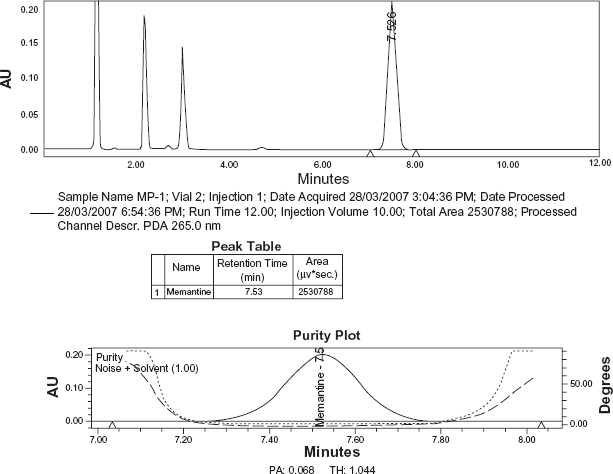
Sample solution was analyzed as per the method and purity of Memantine peak was checked. The purity data of Memantine peak indicates that the peak is homogeneous (Fig. 2).
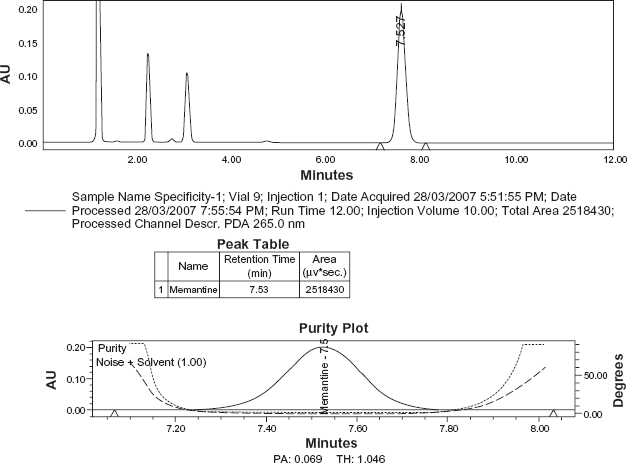
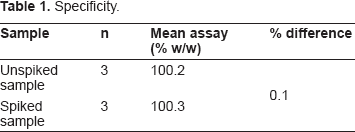
Chromatogram and Peak purity plot of Memantine in sample. Sample solution spiked with the known related substances of Memantine hydrochloride was analyzed in triplicate and the purity of Memantine peak was checked. The purity data of Memantine peak indicates that the peak is homogeneous and has no co eluting peaks indicating specificity of the method (Fig. 3). The specificity of the method is also indicated by % difference of 0.1% between the mean of assay values of unspiked and spiked samples as shown in Table 1. (Acceptance criteria: % Difference should not be more than 1).
Chromatogram and Peak purity plot of Memantine in sample spiked with known related substances of Memantine hydrochloride drug substance. Specificity.
All the above studies indicate that the method is specific.
Forced degradation study
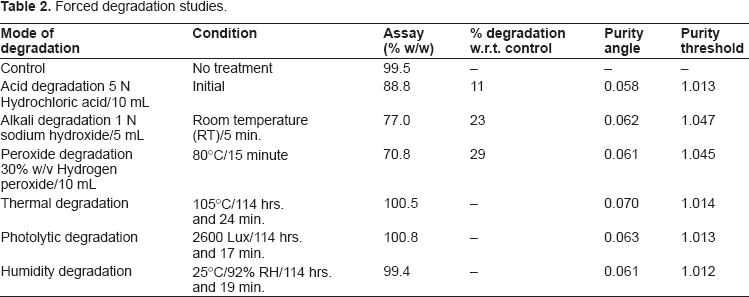
A forced degradation study was carried out on Memantine hydrochloride drug substance according to the following conditions
Hydrolytic and Oxidative degradation
Thermal degradation
Sample was subjected to thermal degradation by keeping at 105°C for 114 h and 24 min., followed by analysis by the proposed method.
Photolytic degradation
Photolytic degradation study was carried out by exposing the sample to light in a photolytic chamber at 2600 Lux for 114 h and 17 min., followed by analysis by the proposed method.
Humidity degradation
Sample was subjected to humidity degradation by keeping at 25°C at 92% RH for 114 h and 19 min., followed by analysis by the proposed method.
Using peak purity test, the purity of Memantine peak was checked at every stage of the above mentioned study. The peak purity data show that the Memantine peak is homogeneous and has no co eluting peaks indicating that the method is stability indicating and specific. Data is summarized in Table 2.
Precision
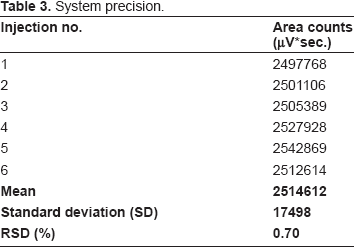
System precision
System precision.
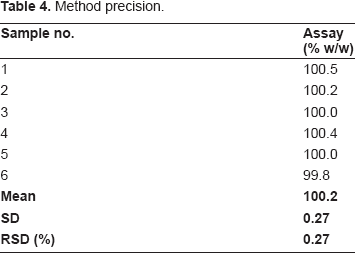
Method precision
Method precision.
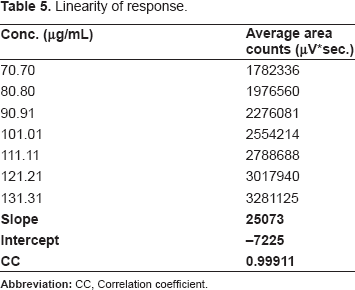
Linearity of response
Linearity of response.
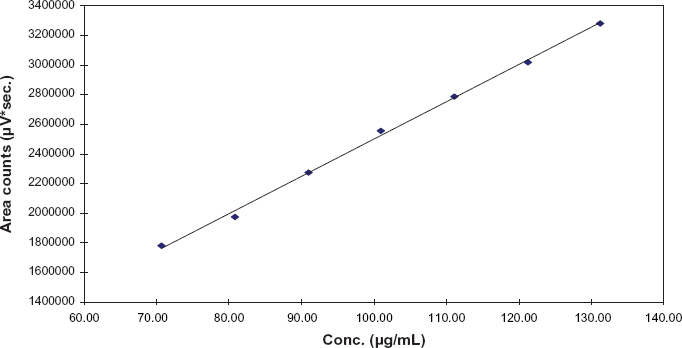
Linearity plot of memantine hydrochloride
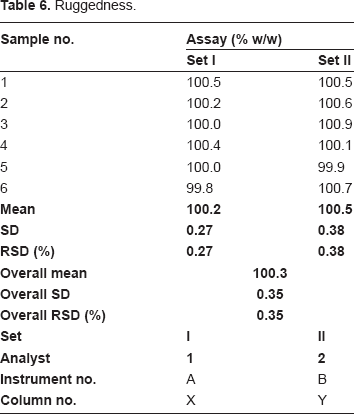
Ruggedness
Ruggedness.
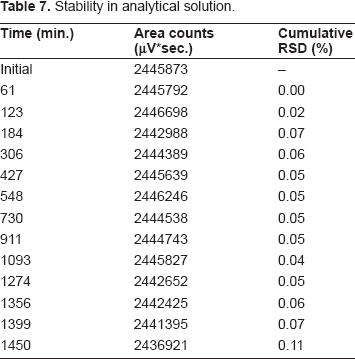
Stability in analytical solution
Stability in analytical solution.
Robustness
Robustness.
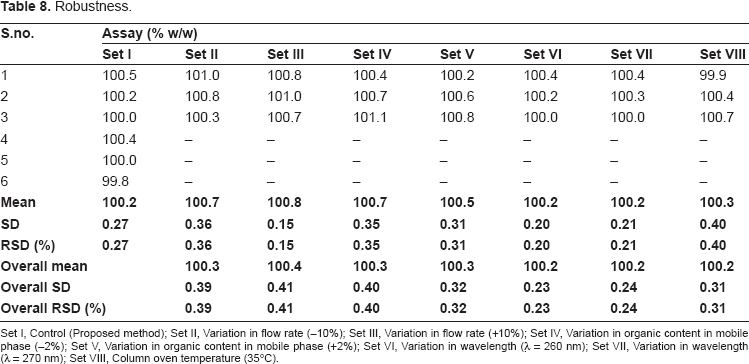
Set I, Control (Proposed method); Set II, Variation in flow rate (-10%); Set III, Variation in flow rate (+10%); Set IV, Variation in organic content in mobile phase (-2%); Set V, Variation in organic content in mobile phase (+2%); Set VI, Variation in wavelength (λ = 260 nm); Set VII, Variation in wavelength (λ = 270 nm); Set VIII, Column oven temperature (35°C).
Conclusion
A simple isocratic reverse phase assay method was optimized and validated. The method is selective, precise and accurate and was successfully applied to the analysis of commercially available Memantine hydrochloride drug substances. Memantine is not easily detected by HPLC using UV detection because of absence of a chromophoric group. Derivatization with FMOC is a simple and very effective means of enhancing the chromatographic detection of the compound.
Disclosures
This manuscript has been read and approved by all authors. This paper is unique and is not under consideration by any other publication and has not been published elsewhere. The authors and peer reviewers of this paper report no conflicts of interest. The authors confirm that they have permission to reproduce any copyrighted material.
Footnotes
Acknowledgment
Authors are thankful to Ranbaxy Research Laboratories for providing necessary facilities and for permission to publish this article.