




Abstract
Introduction:
The present research highlights the promising factors that suggest the possible occurrence of the fourth COVID wave in India. India is among the major victim of this pandemic and has already witnessed the three dangerous COVID waves, and the lives of Indian people are put to a major setback. When it appears as the destruction caused by the third wave seems to getting over and people are trying to return to their normal lives, meanwhile with the mutation of the virus, the new COVID variants (COVID XBB 1.16 or Arcturus, XBB.1.5, and Delta Omicron) are again shaking our universe.
Methods:
Research studies and developed predictive models are suggesting the possible occurrence of the fourth COVID wave in the coming months. Considering the predictions and model developed, a critical insight is provided in the present study, which predicts the prospect of the fourth COVID wave in India.
Results:
Research proposed that the new COVID variants (COVID XBB 1.16, XBB.1.5, and Delta Omicron) are again leading to an increase in the number of active infected cases. Several factors, as mentioned in the research, are responsible for this spread of infection.
Conclusions:
Important factors are highlighted, which portray the probability of the fourth coronavirus wave in India. Important factors are presented in individuals, and an attempt is made to relate them with the occurrence or nonoccurrence of the fourth wave.
Introduction
COVID-19 was caused by a novel coronavirus severe acute respiratory syndrome coronavirus 2 (SARS-CoV-2) outburst in December 2019 in Wuhan, China, and was soon declared a major pandemic.[1] All the developed and developing nations are brought to their knees, and their economy is badly affected.[2] Industrial growth and supply chain management are badly interrupted, and entire industries are deeply affected.[3] The educational sector has also witnessed a major setback, and there is a major shift in the education policy.[4] India has already faced three major COVID waves; as a result, the total COVID cases stand over 4,300,000,000 with more than 5,200,000 deaths updated on March 2022. In the first wave of COVID-19, elderly people over the age of 60 and patients with comorbidities were mainly affected.[5] The second wave of COVID was caused by several mutants of SARS-CoV-2 (B.1.617.1 and B.1.617.2).[6] These two mutants have dominated over 37% of the total COVID-19-positive cases in the second wave. The positivity rate and fatality rate were higher even after the availability of increased testing kits and three available vaccinations.[5] The second wave showed new symptoms related to gastrointestinal in addition to respiratory symptoms available with SARS-CoV-2. The third wave of COVID was caused by Omicron, which was proved to be the most rapidly spread wave, but the severity and mortality rate are lower.[7] Consequently, testing was largely increased, and vaccination drives are boosted up, and after 3–4 months of worry, the virus appeared to become weaker. India was trying to return to normal situation, and a steep decline in COVID cases and fatality rate were recorded. Industries, educational sectors, and manufacturing units are returning to normal platform. As India is lifting all the curbs and people are started feeling normal, again it is being suspected that there may be a possibility for the fourth wave of coronavirus. It is suspected that new variants of coronavirus XBB 1.16 (Arcturus), XBB.1.5, and BA.2 (Deltacron or Stealth) may prove even more dangerous in terms of contaminations and fatality than those caused by Omicron. The WHO has alerted about the possible occurrence of the next coronavirus wave, and they have suspected that the new variant can affect already affected people in the past and even those who have been vaccinated. XBB 1.16 or Arcturus is the recently discovered variant that has an even high transmission rate even with the current preparedness of the public and private sectors. Deltacron and XBB.1.5 are newly identified by scientists and researchers, and they told that the genes-sequence of this virus is completely different from previous viruses and even the spikes-protein is different. Even a scientist from the Indian Institute of Technology (IIT) Kanpur in India and a few health ministers have suggested the possibility of the fourth wave.[8] Considering all these discussions and probabilities, it has become a hot topic of debate whether there will be a next wave of coronavirus or not. In this direction, section 2 of this paper presents an insight on all those possible factors which pointed toward the possibility of the occurrence or nonoccurrence of the fourth coronavirus wave in India. A brief and critical discussion is presented in section 3, and the conclusion is offered in the last section of the paper.
Methods
In this section, all the possible factors which pointed toward the occurrence and nonoccurrence of the fourth wave of coronavirus in India are explained in brief. These possible factors are divided into two categories as presented in [Figure 1]. The factors are listed below.
Possible factors for forecasting of the fourth COVID wave
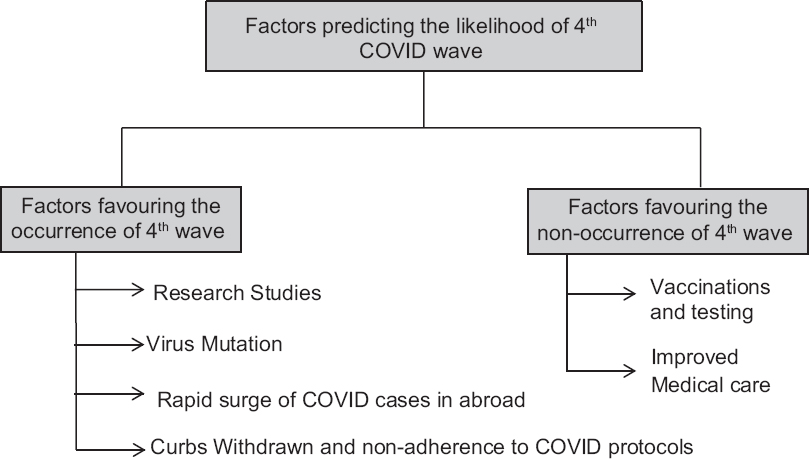
Factors suggesting the occurrence of the fourth wave
Research studies
In accordance with the recently posted article on the repository MedRxiv (preprint), researchers at the IIT-Kanpur (IIT-K) used a statistical model to make the prediction of the possible new wave for 4 months.[8] They suggested the likelihood of the fourth wave of COVID in India. They suggested that the severity of the fourth wave will depend on the emergence of a possible new coronavirus variant. They also proposed that vaccination status across the country will also play an important role in deciding the role of the fourth wave. Dr. John[9] proposed that the fourth COVID wave could hit India if a new coronavirus variant emerges unexpectedly and behaves differently compared to the existing variants. Recent development in researches showed that the genes-sequence of Deltacron (BA.2) is completely different from the existing mutants of the virus, and even the spikes-protein of BA.2 is different making it difficult to suggest the severity. This possible consideration also pointed toward the occurrence of the fourth wave. A recent study also showed that symptoms caused by BA.2 are also different from existing viruses, and it mainly targeted the stomach, gastrointestinal symptoms, and difficulty in breathing, which could cause high fatalities as seen in the second wave.
Mutation of virus
The mutation process is continuous in the virus causing this pandemic. The above discussion also showed that there exist numerous variations in the genes of the viruses which mutate from the initially discovered SARS-CoV-2 virus. The first wave of COVID-19 was believed to be caused by SARS-CoV-2; whereas the viruses responsible for the second wave are several mutants of SARS-CoV-2, among which B.1.617.1 and B.1.617.2 were marked as two notorious virus variants.[6] Similarly, the third wave is dominated by the Omicron virus, which is another mutation from the original virus. Again, the newly developed variant Deltacron or BA.2 (stealth) has completely different genes-sequence and spikes-protein from previous variants. This showed that mutation is continuous, and with the mutation, the virus is not becoming weak as predicted. Every time, there is a change in genomes or spike protein, which makes it difficult to immediately predict the severity of infection. According to Chris Whitty (England's chief medical officer), in coming years, the world could end up with a new variant worse than the variants discovered till now.[10] He also believes that it is still a long way to go before the world is COVID free. Moreover, according to a recent report, Omicron + Delta recombinant cases already started in India and detected in various states of India, including Delhi, Tamil Nadu, Kerala, Karnataka, Maharashtra, Gujarat, and West Bengal.[11] Considering these facts, it cannot be denied that the occurrence of the fourth wave of coronavirus in India is very likely.
Rapid surge of COVID cases in abroad
In many countries, as restrictions lift and freedoms are restored, there is a feeling that COVID is over; however, a significant concern related to the emergence of new variants remains a major worry. Consequently, since mid-March 2022, a sharp increase in COVID cases was recorded in many countries, including China, Germany, the United States, and France. The major symptoms shown by persons affected with BA.2 are different from the existing ones. High fever, short breath, body ache, sore throat, and lack of taste are a few major symptoms as shown by BA.2; however, in addition, it mainly targeted the stomach and gastro-related problem, which is new.[12] In China alone, 3602 COVID cases were recorded on March 14, 2022, which is referred to as the most number of fresh COVID cases since February 2020.[13] Since then, China has seen a surge in COVID cases with Shanghai as the biggest hotspot. Authorities are imposing strict measures to restrict the community spreads. A mini lockdown was also imposed. Similarly, Germany is recording more than 2.500,000 cases/day.[14] In England, one out of 16 people are suspected to be affected by coronavirus. Similarly, South Korea is also recording more than 300,000 on a daily basis. Increases in number of fresh cases were recorded in Italy, France, and other European and Asian countries. In India, the major cities where BA.2 was detected are: Karnataka remains a hotspot with 221, followed by 90 in Tamil Nadu, 66 in Maharashtra, 33 in Gujarat, 32 in West Bengal, and 20 in New Delhi.[11] If we see the trend of the second and third COVID waves, the spike in cases began with these cities only with Maharashtra and Delhi as the hotspots. The record showed that active COVID cases still stand in India, and in accordance, the graph presented in [Figure 2] showed active cases for 10 major states in India highlighted with different colors (as on March 28, 2022). Moreover, fresh cases coming in these states are also higher and even related to BA.2. March 2022. Thus, considering the surge in cases abroad, the detection of the BA.2 variant in major cities, and following the previous trend, it is most likely that the fourth wave can hit India anytime.
Active cases for 10 major states in India

Curbs withdrawn and nonadherence to the COVID protocols
It has been observed that with the decline in COVID-related cases, curbs are continuously withdrawn, and more freedom is being offered as it feels like the country is now COVID free. In the nation capital Delhi, the Department of Delhi Disaster Management Authority (DDMA) has withdrawn the weekly curfew and night curfew. The order issued by the DDMA also asks students to return to physical classes from April 1. In their order, they proposed that although restrictions have been lifted, appropriate COVID-19 behaviors such as wearing masks, maintaining social distancing, testing, and vaccination among others will have to be followed; however, conditions are appearing as they are not following protocol. Similarly, metros are also operating in full capacities, and no protocol is being followed and putting the situation of the state in danger. In Mumbai (also called financial capital), curbs are withdrawn, and the situation seems to returning to normal. Local train, which is a transport hub, is operating at full capacity; restaurants, cinemas, and other places of gathering are appearing as jam-packed. Similarly, all major countries as listed in [Figure 2] are also lifting the restrictions, and despite alertness, people are not following the guidelines: social distancing, wearing N-95 masks, and gathering at places. As the numbers of active cases are still ON, fresh cases are coming on a daily basis, and even cases related to new Deltacron or BA.2 are also coming, it could prove to be dangerous if the COVID protocol and guidelines are not taken seriously.
Factors suggesting against the occurrence of the fourth wave
Vaccinations and testing
COVID-19 pandemic outbreak in India in February 2020, and at that time, all the researchers, scientists, doctors, and health workers are unaware of the virus causing the infection. No one has any idea about the preventive measure and the way to contain the spread of infection. No approved drugs and vaccines are available, which could target the virus to weaken it and stop the outbreak. Now, after more than 2 years of the pandemic, many approved drugs and nine approved vaccinations are available in the country. Major vaccines include Covishield, Covaxin, Moderna, and Sputnik. The fourth COVID wave could be better handled by strictly implementing the COVID protocols such as masks, hand sanitization, and avoiding overcrowding. Getting vaccinated with a booster dose against the disease lowers the risk of getting and spreading the new viruses that may spread further infections. Vaccines can also help prevent serious illness and death. Overall, a total of more than 1,750,000,000 doses of COVID vaccines had been administered in India.[15] [Figure 3] shows the cumulative vaccination administered in major cities of India. [Figure 3] shows that after the second wave, vaccine administration was taken seriously, and more coverage has been done. Fluctuation in vaccines administered [Figure 3] does not mean less vaccination given in the particular state; the data are according to the population density of the given states. In addition to the primary two doses of vaccination, 90,000,000 boosters are also given to health and frontline workers with elderly above 60 years of age. With the new initiative, younger generations between the ages of 12 and 18 years are also receiving the vaccines.
Cumulative vaccinations administered in major Indian states (as on March 28, 2022)

Vaccines have also been developed for children over 5 years, and all steps have been taken to ensure that vaccines are safe and effective for people of ages 5 years and older. An increase in COVID testing is also a major aspect toward the detection and containment of the COVID spread. Reports showed that more than 7,800,000,000 COVID testing have been performed, and on an average, more than 4,300,000 testing are performed per day. Looking at these outstanding data, it is hard to believe that further mutation of the virus can cause more worry, and thus, the severity would be less.
Improved medical care
India has already faced three dangerous COVID waves. The COVID-19 pandemic was a reality check for various aspects of Medicare systems, especially regarding their overall readiness.[16] The severity of the infection was so dangerous that hospitals and health-care centers lack the facilities, especially in terms of number of beds, critical care units, ventilators, and most importantly, the oxygen supply. Oxygen availability was so lacking that people had to stand in line for days to receive the oxygen cylinder. For critical patients, number of critical care units and ventilators were also insufficient. The pandemic acts as a makeover catalyst, accelerating the implementation and adoption of changes in public health interventions. A novel model of health-care delivery emerges with more insight on preventive measures, remote care, and substantial technological dependence.[16] Learning from past experience, there is a significant improvement in medical care and health-care delivery. The facilities in small hospitals and dispensaries are even much improved. Many oxygen plants were laid, and the number of separate beds for COVID patients also increases. Many hospitals have separate wards for COVID patients to keep them isolated from normal patients. Survey and monitoring also showed the scalability of beds, personal protective equipments (PPE) kits, and better availability of COVID tests even in small towns and cities. India now seems to be ready for any other infections of such kind, and there is very less possibility for the rapid spread of infection and lack of medical care. It can be observed that with hybrid immunity in the community, the severity of the cases would be less. A recent systematic review of studies found that people who have been vaccinated against COVID-19 and have had a previous SARS-CoV-2 infection, known as having hybrid immunity, have better protection against the Omicron variant than those with only a previous infection. It is supposed to work with new variants too. Furthermore, it is important to mention that with the continuous mutation of the virus and evolving of new variants, repeated booster dosage is required may be in a new form of the vaccine such as nasal spray vaccine or tablets and capsules to avoid the emergency and visit to hospitals.
Results
COVID-19 was the first outbreak in China, but very soon, it spread to all parts of the world. India is among one, the major country, which is deeply affected by this pandemic.[1] Economic growth, industrial revolution, gross domestic product (GDP), and overall development of the country are put to a major setback.[15] India has already suffered three deadly waves of coronavirus, which has disrupted all its resources. Since the past few months, a steep decline in cases are recorded, and lives are returning to normal; however, again a new variant of COVID-19, i.e., BA.2 or Deltacron is triggering the wave of infection in many Asian and European countries.[11] The possibility of the fourth wave of COVID is a major topic of debate nowadays, and thus, continuous research studies and examinations are followed to investigate the feasibility of the occurrence of the fourth wave. No solid evidence is available which could forecast the occurrence of a new wave, but possibilities are highly likely. In this direction, the current study presented a review on the possible factors which could suggest the likelihood of the fourth COVID wave in India. Factors are categorized into two groups: the first group presented four supporting factors, which favor the occurrence of the fourth COVID wave; whereas in the second group, two crucial factors forecast against the new wave of infection. Learning from past experience and observing previous research studies, no one can doubt the occurrence of reinfection; however, with the strong vaccination coverage, testing facilities, and improved medical care, the chance of a new wave of infection is becoming dull. Every day, a new update is flashing in the newspapers and media reports, and people are living in a dilemma about the new wave of COVID infection.
Conclusions
In the present study, an insightful review is carried out to predict the possibility of the occurrence or nonoccurrence of the fourth COVID wave in India. Factors favoring and nonfavoring the occurrence of the fourth wave of coronavirus in India are categorized into two groups as presented in section 2. There are four solid parameters that favor the occurrence of a new wave of infection; however, two crucial parameters are suggesting against the occurrence of a new wave of infection. Important conclusions drawn from the present study are:
A statistical model developed at the IIT-K predicted the possible fourth wave in mid-June 2022 The rapid surge of COVID cases in other countries such as China, Germany, South Korea, and England is observed, and the lifting of curbs on international communication also favors the occurrence of the fourth COVID wave. Lifting of curbs in Indian states and people not adhering to the COVID guidelines are also major concerns to be noted Deltacron virus is a recombinant virus that has the dangerous traits of Delta and Omicron virus which suggests the possible development of a super-virus of concern Strong coverage of vaccinations and increased testing facilities, however, make the occurrence of reinfection weak and dull The pandemic acts as a promoter for accelerating the implementation and adoption of changes in public health involvement A novel model of health-care delivery emerges with more insight on preventive measures, remote care, and substantial technological dependence.
Footnotes
Conflicts of interest
There are no conflicts of interest.
Funding
Nil.
Author's contribution
Conceptualization, draft, writing, editing, and rechecking were done by Azhar Equbal.