






Abstract
Urachal carcinoma is an uncommon cancer whose rarity has precluded its study and evidence-based management strategies are lacking. This study assessed all urachal carcinomas in Ireland and clinical parameters in order to improve understanding. Urachal carcinomas diagnosed from 1994 to 2011 were identified from the National Cancer Registry in Ireland. Data obtained included patient age, gender, diagnostic year, pathology, tumor stage, patient treatment strategies and survival. Twenty-six urachal carcinomas were identified, the majority being adenocarcinoma. This comprised 0.3% of all invasive bladder tumors. Patients were predominantly male (62%) and over 50 years of age (58%). Twenty-two patients (85%) underwent surgery, with only six (23%) undergoing chemotherapy. On average, median overall survival was 2.6 years (range 0-15.2 yrs). Survival was longer in women (5
Introduction
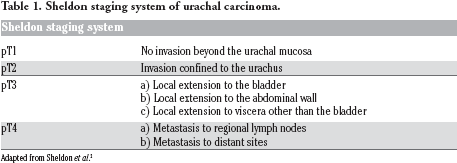
Urachal carcinoma comprises less than 1% of all bladder carcinomas and reportedly affects 0.01-0.02% of total adult cancers.1–3 It was first described in 1863 by Hue and Jacquin 4 and since then, single and joint institutional reviews have increased the understanding of this rare disease.5–10 Urachal carcinomas are predominantly adenocarcinoma (80-90%) and are thought to develop from malignant transformation of columnar metaplastic epithelium of the embryological remnant of the allantois that connects the umbilicus with the fetal bladder, the urachus.2,6 Tumors can be difficult to stage as they arise from the bladder wall. Sheldon and colleagues created the most widely used international staging system for urachal carcinoma (Table 1). 2
The cornerstone of treatment remains surgical excision involving partial or radical cystectomy with en bloc resection including the umbilicus.1,11,12 Urachal tumors have a reported local recurrence rate of 15 to 41% after primary resection within the first two years of follow-up.3,13,14 Clinicopathological risk factors for early relapse and poor outcome include positive surgical margins following resection, advanced tumor stage and grade as well as lymph node involvement and presence of distant metastasis at initial diagnosis.8,13–16 Recurrence is best treated with resection and if complete, a salvage cure rate of up to 50% has been reported.14,17 Distant metastases are most commonly seen in the liver, lymph nodes, lungs and bones and overall signify a very poor survival.8,13,14 Five-year survival depending on pathological stage is up to 49% but this is center-specific.8,14,17 In general, urachal cancers tend to be relatively resistant to radiotherapy.
5
The benefit of adjuvant chemotherapy for urachal carcinoma remains unclear. The rarity of this cancer complicates, if not precludes, the conduct of randomized clinical trials. Chemotherapy is generally reserved for relapsed and recurrent disease that cannot be surgically removed.
5
There are numerous reports in the literature of benefit from chemotherapeutic agents, with response rates around 15%,5,18–21 however the optimal regimens in a first or second line setting have not been definitively established.5,15,22 Treatment strategies have been led by isolated case reports, institutional case series and multicenter reviews that have assessed the outcome of various chemotherapeutic and radiation therapy regimens, including platinum-containing regimens,18,23 5-fluorouracil-based treatment22,24 and the newer biological therapies targeting the oncogene,
Materials and Methods
Patient data was obtained from the prospective National Cancer Registry in Ireland database. This was developed in 1994 for the purpose of collecting accurate cancer information to allow the determination of incidence, prevalence and mortality in Ireland permitting international comparisons. Data available from this resource included patient age, gender, year of diagnosis of urachal cancer, pathologic subtype, confirmed metastasis, patient management including surgery, radiotherapy and chemotherapy and overall survival. Information was obtainable from 1994 to the end of 2011.
Statistical analysis was performed using two tailed students t-test.
Results
Between 1994 and the end of 2011, the National Cancer Registry database identified 26 histopathological confirmed urachal carcinomas in the Republic of Ireland. Figure 1 depicts the numbers of cancers diagnosed per year along with the annual incidence of bladder carcinomas allowing comparison.

Annual incidence of urachal cancer (values on left) and invasive bladder cancer (values on right) diagnosed from 1994-2011.
The overall incidence was 0.3% of all invasive bladder cancers (n=8351). The total number of all invasive cancers diagnosed in Ireland between 1994 and 2011 obtained from the National Cancer Registry was 274,357 cases; therefore urachal carcinomas comprised 0.0095% of all invasive cancers diagnosed in Ireland during this 18-year period. The demographic breakdown is depicted in Table 2.
Demographic data of urachal carcinoma patients, 1994-2011.

F, female; M, male; RT, radiotherapy; chemo, chemotherapy.
Patients were predominantly male (n=16, 62%), with a ratio of male to female patients of 1.6:1. Urachal carcinoma was more common in those over 50 years of age (n=18, 69%). Table 2 also charts the proportional age groups of patients and gender. Females presented at a younger age than men. Overall 7 women (70%) presented before the age of 50 years and 15 men (94%) presented over the age of 50 years, with 9 over 70 years old (56%). Most patients presented with no confirmed identifiable metastatic disease (n=23, 88%). Of the 3 patients with metastatic disease at diagnosis, 2 had pulmonary metastasis and one had hepatic metastasis. Two further patients were known to have developed metastatic disease during the course of the follow-up; one developed cutaneous disease and the other, pulmonary disease.
Histopathologic Subtype
Of the 26 urachal cancers identified, 15 were adenocarcinoma, 7 were transitional cell carcinoma and one squamous cell carcinoma (Table 2). Three tumors were unspecified by the reporting institution. All seven transitional cell carcinomas occurred in patients over the age of 70 years and all were found in men. In comparison, 14 adenocarcinomas were diagnosed in patients aged between 30 and 69 years. Females were more commonly diagnosed with adenocarcinoma (70%).
Treatment Strategies
Twenty-two of the 26 patients (85%) underwent surgical resection (Table 2). The remaining 4 patients only had a biopsy for pathological diagnosis. Most patients underwent a radical cystectomy (n=9) with one additional patient also documented as having a concurrent hysterectomy. Eight patients underwent a partial cystectomy and the four remaining patients had local excision of the bladder lesion alone.
Multidisciplinary treatment combinations are outlined in Table 2. Radiotherapy was administered to four patients only. Chemotherapy was utilized in six patients (23%). One of these six patients is known to have had chemotherapy outside of Ireland. Patients who received chemotherapy were generally younger; on average, patients who received chemotherapy were less than 59 years of age, whereas those who did not receive chemotherapy were older. However there was a wide variation with patients receiving chemotherapy aged between 30 and 74 years of age. Three of the five patients with known metastatic disease received chemotherapy. Three patients received adjuvant chemotherapy in combination with radiotherapy and surgery. The majority of patients who received chemotherapy were alive by the end of 2011 (n=4, 67%) including two patients who had known pulmonary metastasis. The details of the six patients who received chemotherapy are depicted in Table 3.
Details of patients receiving chemotherapy.

Adeno, adenocarcinoma; M, male; Sx, surgery; RT, radiotherapy; chemo, chemotherapy; TCC, transitional cell carcinoma; F, female.
Survival
Full survival data until the end of 2011 revealed that 17 of the 26 patients diagnosed with urachal carcinoma were known to have died (65%). Of these deceased patients, 3 (18%) were known to have confirmed metastatic disease. Overall 13 patients who died underwent a surgical procedure (76%), 3 received radiotherapy (18%) and 3 received chemotherapy (18%). Of the latter, 2 had metastatic disease at diagnosis and the remaining patient received chemotherapy on the development of metastasis. Three patients (18%) received no form of active treatment.
Of the 9 patients who were alive at the end of 2011, the majority was female (n=6, 67%) and diagnosed at less than 50 years of age (n=6, 67%). None were over the age of 65 years. All patients underwent surgical excision of the primary tumor. Two patients received adjuvant chemotherapy and one patient received chemotherapy 3.5 years later upon the diagnosis of lung metastases. One patient also received adjuvant radiotherapy in conjunction with surgery and chemotherapy.
On average, patients with urachal carcinoma survived a median of 2.7 years following diagnosis (range 0-15.2 years). Those that received chemotherapy had a median survival of 3.6 years (range 0.6-10.8 years) as compared with median overall survival of 2.6 years (range 0-15.2 years) in patients who did not receive any chemotherapy. There were only 3 patients who received chemotherapy as adjuvant treatment. Their survival ranged from 4.1 to 10.8 years, with a median of 6.9 years (P=0.92). Table 4 depicts comparative median survival in patients based upon age, gender, year of diagnosis, confirmed metastasis, extent of surgical excision and chemotherapy.
Median survival in years grouping patients according to age, gender, year of diagnosis, presence of metastasis and receipt of chemotherapy.

Discussion
The incidence of urachal carcinoma in the literature has been documented as between 0.01 and 0.02% of all invasive cancers and the Irish national experience reflects this. Over an 18-year period in Ireland, an incidence of 0.01% of all invasive cancers was recorded. As expected in this series, urachal carcinoma had a demographic preponderance of males (69%) and those above the age of 50 (62%). Females tended to present earlier, with 70% diagnosed before the age of 50 years. Furthermore, women were more inclined to live longer than their male counterparts (5
Management strategies hinge upon surgical resection with recommendations encouraging
A recent retrospective review of urachal carcinomas identified seventeen patients over a thirteen-year period in a Chinese University hospital, identified similar age of presentation and male preponderance. 29 Chen and colleagues reported a median overall survival of 57.6 months (4.8 years), which is much greater than this research identified at 2.7 years. In the Chinese study, there was no information on whether any patients received adjuvant or palliative chemotherapy or radiotherapy in the management of this disease.
Limitations of this study include an overall small number of urachal cancers within the whole country and analyzing subgroups. Examining the effect of treatments, such as chemotherapy and radiotherapy, was made difficult by small numbers and the variation in patient outcomes. It was not possible to unblind the data collected to identify particular chemotherapeutic regimes administered in individual cases. The National Cancer Registry is a dedicated independent research institute that collects data on every cancer diagnosed in Ireland. Potential inaccuracies or failures with data collection and/or data reporting to the Registry could result in errors. In order to identify, address and improve this problem, the Registry performs ongoing evaluation. The latest review has revealed the estimated levels of data completeness are satisfactory.
30
Finally, there have been difficulties with the diverse coding and varied definitions of invasive bladder cancer between countries and indeed organizations, with an increasing proportion of bladder tumors being coded as
Conclusions
This paper reports all urachal carcinomas diagnosed in Ireland between 1994 and the end of 2011 as recorded by the national database: the National Cancer Registry. Urachal carcinoma has an incidence comparable to other international series. Epidemiological assessment revealed a younger age of presentation for females and a marked increased survival in this group as compared to men. Furthermore, the data identified a lower five-year survival than that reported in the literature (38
Footnotes
Acknowledgements
The authors would like to thank Dr Mary Coghlan for statistical help and the input of the National Cancer Registry in Ireland.