






Abstract
Background
Poor clean and healthy life behaviours (CHLB) are often found in students (santri) in Islamic boarding schools (pesantren) in Indonesia. Pesantren is a subculture that has derived different cultural values from society, while santri have a habit of borrowing and lending clothes and see scabies as a blessing. This study aimed to identify and describe the correlation between cultural values and CHLB practices among santri.
Design and methods
It used descriptive analytics with a cross-sectional approach. The participants were 100 santri who lived in pesantren and were selected by using stratified random sampling. The cultural values and CHLB practices were assessed using the instruments developed by the writers in the previous study. The statistical analysis using the Spearman correlation test was applied to evaluate the association between cultural values and CHLB practices.
Results
The result shows a significant correlation between cultural values and CHLB practices among santri (p=0.004; r=0.284). Most of the santri had positive cultural values (52%) and poor CHLB practices (54%).
Conclusions
The findings of this study showed that most of the santri adhered to positive cultural values, and most of them had poor CHLB practices. These findings also showed significant correlation between cultural values and CHLB practices among santri. This study is expected to be the basis for school nurses to provide nursing care with a cultural approach to improve CHLB practices among santri.
Introduction
Poor clean and healthy life behaviour (CHLB) practices among students (santri) in Islamic boarding schools (pesantren) is a common occurrence in Indonesia. Pesantren is a place for students (santri) to learn, explore and practice Islamic values daily. 1 However, these values are often misinterpreted because they contradict the CHLB principles. Since food is seen as a gift from God, santri consume modest portions of food without checking the nutritional content. This phenomenon has become a habit and is rooted in their beliefs. Santri tend to ignore their personal hygiene. 2 During this time, they share belongings like clothes, towels and prayer sets. 3 A study conducted by Sofia and Widad showed that most santri showed poor CHLB practices, especially in relation to personal and environmental hygiene, the use of clean water and the utilisation of healthcare facilities. 4
Significance for public health
Poor clean and healthy life behaviour in students (santri) in Islamic boarding schools (pesantren) has been a classic phenomenon in Indonesia that remains to be resolved. This research provides the insights of various parties, such as the government, health workers and pesantren leaders, and demonstrates how the existing phenomenon is caused by a certain cultural perspective. This research can be the basis for community nurses, especially school nurses, to take a sociocultural approach in resolving this problem so that a healthy santri community is formed.
Poor CHLB practices in pesantren caused several diseases in santri. Scabies, diarrhoea, typhus and dyspepsia, caused due to poor hygiene behaviours, were the most frequently found diseases in santri. 5 The high number of santri getting scabies even urges the locution that scabies is a blessing and that santri is not really santri if they never have it. This situation leads to a cognition that getting scabies is a common thing among santri.
Poor hygiene and skin problems not only occurred in pesantren in Indonesia. The research conducted by Tuncel and Erbagci in two boarding schools in Turkey found that the student's poor hygiene habits, such as wearing inappropriate clothes and using the shared bathroom and swimming pool causing a high prevalence of skin disease. 6 Other studies conducted in four boarding schools in Cameroon and a welfare home in Pulau Pinang Malaysia also indicate that poor hygiene practices such as sharing clothes, beddings, and other personal items are factors in the high prevalence of scabies.7,8 In Sarawak, the prevalence of scabies is high due to the culture of shaking hands frequently among Muslim students in the boarding school. 9
Most of the students with skin disease (65%) were unaware of their skin-health condition. Meanwhile, 35% of students who are aware of the disease did not seek medication help. 6 Increasing students’ awareness of skin disease by involving all of educational institution's residents might be a solution to decrease the scabies prevalence. This method aligns with Talukder et al.'s research to control scabies prevalence in Islamic religius school in Bangladesh by involving the teachers, students, and staff. 10
Pesantren is the oldest Islamic educational institution in Indonesia and plays an important role in building santri's social and cultural life. Wahid stated that pesantren is a subculture that has different cultures and points of view than the bigger society, particularly in relation to the health aspect.11 The culture in pesantren can be understood from the values they adhere to. Sincerity, modesty, unconditional acceptance, fraternity and mutual help are the values that will always be adhered to in the pesantren culture.12 These cultural values have triggered varied habits in santri. The value of sincerity makes santri become obedient to pesantren leaders’ (Kyai) commands, including the imperative to have a clean and healthy lifestyle. The value of mutual help builds the community spirit, as proven by the habit of cleaning up together (Ro'an) every week. However, not all of these values create good habits for santri. Borrowing and lending clothes, having meagre meals and sleeping on the floor are habits that are considered unhealthy. Jannah's study explains that sleeping without a mattress is an implementation of the Arabic culture, which is not suitable in Indonesia due to its climate.13
CHLB practices are health behaviours performed by the whole community, including pesantren. Green theory states that health behaviours are influenced by predisposing factors, namely social and cultural norms.14 Culture is the most dominant factor in shaping somebody's behaviours.15 Based on this explanation, the authors were interested in understanding the description of and the correlation between cultural values and CHLB practices among santri.
Design and Methods
This study used a cross-sectional approach and descriptive analysis as the design of the study. The samples were 100 resident santri from a pesantren in Indonesia. They were selected by using stratified random sampling and divided based on educational strata, i.e. junior and senior high school. The research was done in May 2020.
Two instruments were used in this study – cultural values and CHLB practices. First, the cultural values instrument was developed by the writers based on the literature studies and social phenomena. This instrument consisted of 8 items with favourable and non-favourable statements about cultural values in pesantren. These 8 items consist of the potluck culture, sleeping without a mat, borrowing towels and clothes, the assumption that scabies is a blessing, the habit of ro'an, not smoking as a form of obedience to Kyai, taking sick friends to the clinic and self-cleaning every Friday as a Sunnah. Second, the CHLB practices instrument has been developed based on CHLB indicators in educational institutions, especially pesantren, according to the Ministry of Health and the health department in East Java.16,17
These two instruments obtained good validity and reliability scores. All items in the instrument of cultural values were valid with a reliability score of 0.785. The instrument for CHLB practices had 4 items that were not valid, and the reliability score was 0.879. The invalid items were then modified by the writers.
This research passed the ethical test by the Research Ethics Committee, Faculty of Nursing Universitas Indonesia, with number approval SK-14/UN2.F12.D1.2.1/ETIK 2020.
The data analysis was conducted with univariate and bivariate data. The univariate data analysis was conducted using frequency distribution, while the bivariate data analysis was conducted using Spearman correlation to measure the correlation between cultural values and CHLB practices among santri.
Results
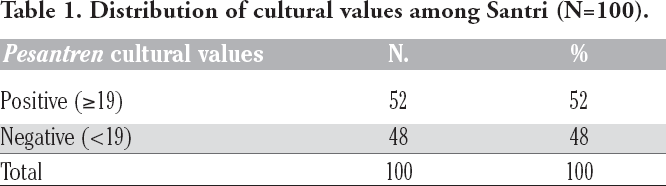
The findings showed that most santri had positive cultural values that were in accordance with the health aspect (52%) (Table 1).
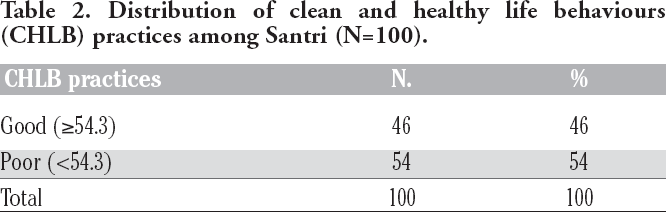
The findings show that most santri had poor CHLB practices (54%) (Table 2).
Table 3 presents the analysis results of the correlation between the cultural values and CHLB practices among santri. The results showed a significant correlation between cultural values and CHLB practices among santri (p=0.004; r=0.284). Most santri with good PHBS practices have positive cultural values (67.4%), while santri with poor PHBS practices mostly have negative cultural values (61.1%). This shows that there are differences between good and bad PHBS practices based on cultural values among santri.
Discussion
Culture and behaviours are two things that are inseparable. Culture is the way of life of a group of people that is complex and hereditary.18,19 As an educational institution that shapes social life, pesantren is strongly related to culture. The culture in pesantren is the manifestation of many things, namely values, perspectives, beliefs and habits. The cultural aspects of pesantren might be in line with and might be opposite to the health aspect.
The cultural values of pesantren showed a positive moderate correlation to CHLB practices among santri. This finding showed that the more positive the cultural values, the better the CHLB practices. This study found that most santri with good CHLB practices had positive cultural values (67.4%), while santri with poor CHLB practices had negative cultural values (61.1%). This finding showed that the different CHLB practices were based on the cultural values. This was in line with a study conducted by Jannah, which stated that poor health behaviours in santri were caused by the wrong implementation of culture among them.13
Distribution of cultural values among Santri (N=100).
Distribution of clean and healthy life behaviours (CHLB) practices among Santri (N=100).
Correlation analysis between cultural values and clean and healthy life behaviours (CHLB) practices (N=100).

Santri's cultural values in this study were mostly positive or in line with the health aspect (52%). The positive cultural values possessed by santri were, namely, offering help for santri who are sick (88%), belief to clean themselves on Friday as the Prophet's sunnah (83%), not breaking the rules as a form of obedience to Kyai (78%) and doing ro'an every week as the representation of mutual help (72%). Meanwhile, the negative cultural values held by the santri were, namely, meagre meals as the representation of modesty (77%), the cognition that scabies was a blessing as a representation of unconditional acceptance (69%), borrowing and lending clothes as a representation of mutual help and fraternity (52%) and sleeping on the floor as a representation of modesty (30%).
Pesantren personality, living in modesty, is commonly applied by the santri as the implementation of Sufi attitude. However, several practices of theirs were not in line with the health aspect, such as having meagre meals without being mindful of the nutrition and sleeping on the floor without a mattress. In Arabic culture, the habit of sleeping without a mattress is encouraged in order to adapt to the hot weather.13 However, this custom cannot be applied in Indonesia because the climate and weather are different. In this study, most santri slept without a mattress (75%). They also believed in borrowing and lending clothes as a representation of mutual help (52%), even though borrowing and lending clothes increased the portal of entry for microorganisms causing diseases. 20 These viewpoints were in line with the conditions that many santri borrowed and lent their clothes, blankets, towels and other belongings (58%).
The cultural values in pesantren that were not in line with the health aspect were also mostly dominated by the aspect of fatalism. Fatalism is an action to accept the truth because of the destiny and fate that have been decreed to happen.21 This action is based on the belief that everything happens by God's will, so humans do not care to avoid anything from happening. This belief was commonly found in santri. They believed that scabies was given by God as a blessing of knowledge, so they did not bother to find help. It was proven that many santri did not seek help at health facilities when they were sick (45%).
Even though most santri had positive cultural values or were in line with the health aspect, these discussions showed that many CHLB practices were not in line with the health aspect. Based on this phenomenon, it is necessary to correct the views of santri about the cultural values that they have held so far. One example is correcting the belief that scabies is a blessing. Regardless of whether the blessing is true or not, santri need to be taught that if they are exposed to the disease, they must continue to make healing and prevention efforts so that they do not get re-infected. In addition, Gudig is a skin disease that needs to be prevented by maintaining personal and environmental hygiene, one of which is not lending clothes to others if they are unhealthy.
Conclusions
The findings of this study showed that most of the santri adhered to positive cultural values, and most of them had poor CHLB practices. These findings also showed significant correlation between cultural values and CHLB practices among santri. This condition showed that the school nurses need to provide nursing care by applying a cultural approach for santri to improve their CHLB practice.
Footnotes
The authors declare no potential conflict of interest.
Acknowledgements
The writers express their gratitude to all the respondents who participated in this study, namely santri of Pondok Pesantren Kedunglo Al-Munadhdhoroh Kediri. The writers also express their gratitude to the Directorate of Research and Development Universitas Indonesia, which has provided funding for this research through the PUTI Prosiding 2020.