






Abstract
Background
One of the efforts made to return people with severe mental illness to the community is to prepare with sufficient skills so then they can return to a productive life. The purpose of this study was to develop a vocational social rehabilitation model to increase the independence of the instrumental activity of daily living (ADL) among people with severe mental illness.
Design and methods
The study was conducted in 2 stages. Phase 1 used an observational design with a cross sectional approach. It was conducted at the Menur Mental Hospital from March to July 2020. The population of this study were all people with severe mental illness with a psychotic degree scoring ≥30. The total sample was 100. The data was analyzed using the Partial Least Square. The second phase was carried out by compiling modules from strategic issues and conducting expert consultations.
Results
The results of phase 1 showed that the instrumental ADL independence was directly influenced by perceived behavior, memory phase, motivation phase, skills and intention. Additionally, it is indirectly influenced by socio-demography, mental illness severity, attitude towards behavior, subjective norm, perceived behavioral control, attention, retention, motor reproduction, motivation and skill. The results of the phase 2 carried out were used to compile modules based on the stages of vocational rehabilitation consisting of determining eligibility, preparatory counseling, implementing rehabilitation, evaluation and ongoing support.
Conclusion
The vocational social rehabilitation model is related to the independence of the Instrumental ADL among people with severe mental illness.
Significance for public health
Vocational social rehabilitation is included in prevention level of public health. The aim of vocational social rehabilitation is to increase the independence of the instrumental activity of daily living (ADL) among people with severe mental illness. So, people with mental illness could productively in society and not depend on others. In addition, the vocational social rehabilitation could develop the physical, mental and social abilities among people with mental illness. It is necessary to have rehabilitation institutions that involve the community so people with mental illness can return to normal life.
Introduction
People with mental illness refers to individuals who experience behavioral changes and have psychological and biological disorders. 1 Behavioral disorders have effect on the relationships between individuals as well as with the environment. 2 People with severe mental illness (ODGJ) have symptoms such as a loss of self-motivation and irresponsibility, engaging less activities, decreased social relationships, and impaired fundamental abilities, especially regarding activity of daily living (ADL). 3
ADL at the Mental Hospital still focuses on basic ADL and is not yet focused on instrumental ADL. 4 It was occurred at Menur Mental Hospital in Surabaya. In this hospital, there is no instrumental ADL at vocational social rehabilitation. Instrumental ADL is a basic activity related to the use of everyday life support tools such as using the telephone, writing, typing, and managing money so then they can live independently. 5 Instrumental ADL allows people with a mental illness to live productively in society and not depend on others. Furthermore, instrumental ADL can help people with a mental illness return to the community with renew skills after their hospital discharge. 6
One of the efforts to prepare people with mental illness is vocational social rehabilitation. 7 Vocational social rehabilitation can prepare them by teaching sufficient skills.8,9 However its implementation still not yet optimal.10,11 The process of evaluating the implementation of rehabilitation can be carried out by measuring each separate phase of the rehabilitation. Based on the social learning theory (SLT), the implementation of social learning theory begins with the observation process and then replicates it repeatedly to gain a particular behavior and skill. 12
The implementation of vocational social rehabilitation was found to influenced by the condition of the rehabilitation,13,14 and that of the patient, especially their intention and attitude. 15 Vocational social rehabilitation was also influenced by familial factors. 14 Family support influences the recovery of patients with a mental illness. 14 Theory Planned Behavior (TPB) can be used as method for measuring the intention and attitude of people with mental illness. Intention is influenced by three main components, specifically perceived behavior, subjective norms and attitude towards behavior. 16
The objective of this study was to develop a vocational social rehabilitation model to increase the independence of the Instrumental Activity of Daily Living (ADL) among people with severe mental illness.
Design and Methods
The procedure of this study was granted by the ethical review board from Menur Mental Hospital, Indonesia (number: 070/1699/305/2020). This research was conducted in two stages. The first stage was to analyze the influence between the variables and to develop a model for vocational social rehabilitation for patient with severe mental illness. The second stage was to create the module. In the first stage of the study, we used an observational and cross-sectional design. The study was conducted at the Menur Mental Hospital in Surabaya from March to July 2020. The population of this study was patients with a mental illness who underwent treatment at Menur Mental Hospital in Surabaya with a psychotic grade score ≥ 30, according to the hospital assessment standards. The Menur Mental Hospital has questionnaire to observe psychotic grade. This questionnaire has several domains to observe the patient's conditions, such as appearances (scoring 0-6), social activity (scoring 0-5), attitude (scoring 0-5), speaking ability (scoring 0-5), the way of thinking (scoring 0-5), behavior (scoring 0-5), intellectual function and orientation (scoring 0-5), emotional control (scoring 0-5), perception (scoring 0-4), insight (scoring 0-4). Total score ≥30 means good condition and the patients can become to be outpatient. In addition, these patients had ability to join in this study.
The number of samples in this study totaled 100 patients through simple random sampling. The inclusion criteria were patients with basic ADL independence who were cooperative, could communicate and respond well, and were aged 18-60 years old. The independent variables in this study were socio-demographic factors, the condition of their mental illness, social support, attitude towards behavior, subjective norms and perceived behavior, attention, retention, motor reproduction, motivation phase, and skills. The dependent variable of this study was the intention and independence of instrumental ADL. The data collection was conducted using questionnaires and observation sheets which already had good validation and reliability. The instruments that used in this study were socio demography was measured by medical records (convergent validity =0.845; composite reliability =0.942); family support social was developed based on questionnaire by Nursalam. 17 Peer support was measured using the rand social health battery, 18 and health care provider support was measured by service user questionnaire; 19 these questionnaires had convergent validity =0.699 and composite reliability = 0.874. Attitude toward behaviour, subjective norm, perceived behavioral control, and intention was measured based on TPB theory, 16 these questionnaires had convergent validity =0.829; composite reliability =0.907. Attention, retention, and motor reproduction were measured based on social learning theory by Bandura. 20 Motivation was created by Pelletier et al. 21 In addition Skill was measured by sum of phase in social learning theory. Total score > mean refers to independent while total score < mean refers to dependent. The data was collected and afterward analyzed using the Structural Equation Modeling - Partial Least Square (SEM-PLS) test. The second phase of the research was carried out by formulating strategic issues through consulting with experts to create a module. The experts were psychiatric, nurse practitioners as well as professor in nursing, occupational therapist who had experience more than 10 years. The results were used to develop the modules.
Results
Table 1 showed the distribution of the respondent's characteristic. This study showed that most of the respondents were old adults (46%), female (52%), senior high school education (39%), and unemployed (81%). Most of respondents were diagnosed with schizophrenia (76%) with duration ≤5 years (67%).
Distribution of respondents’ characteristics.
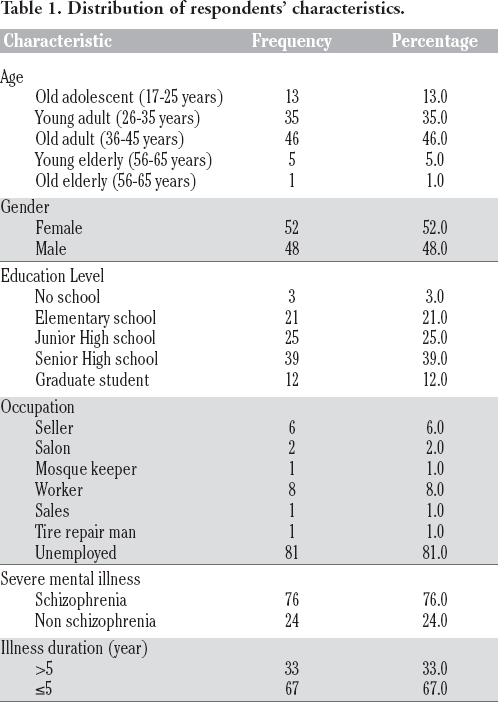
Table 2 showed the distribution of the social support among respondents. Most of respondents received support from their peers (63%), health care provider (60%), and family (51%).
Distribution of social support among respondents (n=100).

Table 3 showed the research variables. The majority of the variables were good, namely behavioral belief (79%), evaluation of behavioral belief (67%), motivation to comply (57%), control belief (80%), perceived power (89%), intention (95%), attention (58%), motivation (58%), and skills (67%).
Distribution of research variable (n=100).

Table 4 and Figure 1 showed the results of the path coefficients of the vocational social rehabilitation model related to instrumental ADL independence among people with severe mental illness. The model showed that instrumental ADL independence was directly influenced by perceived behaviour, retention, skills and intention.

Development of the vocational social rehabilitation model.
Final model for hypothesis test on the development of the vocational social rehabilitation model.

Results of the development of a vocational social rehabilitation model to increase the independence of the instrumental activity of daily living (ADL) among people with severe mental illness.

The second stage of the study was to compile a module based on the rehabilitation stages. 22 The stages were:
Determine the inclusion of patients regarding the initial screening, including their socio- economic factors and how severe their mental illness is.
Counseling and determining their attitude towards behavior, subjective norms and perceived behavior.
Implementation of the rehabilitation: attention, retention, motor reproduction and motivation.
Evaluation of the implementation of the rehabilitation: skill when conducting instrumental ADL independence.
Preparing the support system: social support variables (family support, friend support and health worker support) (Figure 2).

Results of the development of a vocational social rehabilitation model to increase instrumental ADL independence among people with mental illness.
Discussion
The model focuses on patient preparation before participating in vocational social rehabilitation in order to gain the maximum outcome. The outcome was focused on improving the patient's skills. In addition, they able to carry out instrumental ADL independently.
The results showed that there were several factors that directly affect the instrumental ADL independence among people with severe mental illness, namely the perceived behavior factor, retention, motivation, skills, and intention. Meanwhile, the other factors that indirectly influence instrumental ADL independence were the socio-demographic, mental-illness condition, social support, attitude towards behavior, subjective norms, attention phase, and motor reproduction. One of the new findings from this study was that skill directly influenced instrumental ADL independence without passing through intention. People with a mental illness in this study were different from the general population. This study was similar to the previous study which mentioned that skills can affect instrumental ADL. 23 Good physical, psychological, and psychosocial health during vocational social rehabilitation had a good effect on the social learning process, starting from the attention phase through to retention, motor reproduction, and motivation. Eventually it can improve their higher level skills as well. This study in line with the previous study which mentioned that memory will improve skill. 24 Skill will also produce instrumental ADL independence. 25 The factors that affected the independence of instrumental ADL were physiological health, cognitive function, and psychosocial function. 26
There were internal factors concerning the patient that directly influenced instrumental ADL independence. The theory planned behavior states that the internal factor that affects the independence of instrumental ADL is perceived behavior. 16 Perceived behavior is an individual's perception in terms of whether a behavior is easy or not. This variable is often assumed to refer to the use of past experiences to solve obstacles and, which has an effect on behavior. 16 The learning process during the implementation of vocational social rehabilitation is based on Bandura's social learning theory. 20 A new finding in the vocational social rehabilitation process was the relationship between the retention and motivation phases within instrumental ADL independence. The retention or memory phase is the process of transferring information to the long-term memory and recollection. Meaningful experiences will help someone in this phase. 20 The motivation phase is the process of encouragement carried out by individuals to achieve their goals. When someone pays attention to a behavior carried out by a role model, they will remember the steps of the behavior being observed.27,28
Conclusion
The vocational social rehabilitation model when used patients with mental illness must meet the patient's criteria before being used in rehabilitation. Vocational social rehabilitation can increase instrumental ADL Independence. Good family support among those with a severe mental illness can increase their productivity. The implementation of rehabilitation according to the module can help to boost the family economy and reduce the relapse rate.
Footnotes
Acknowledgments
We would like to thank to Menur Mental Hospital, Surabaya, Indonesia, as the research place. We also appreciated all nurses and staff of the hospital for facilitation during data collection. We also thank the patients as the respondents in this study.
Funding: This work was supported by Ministry of Research and Technology / National Research and Innovation Agency.
Contributions: All the authors made a substantive intellectual contribution. All the authors have read and approved the final version of the manuscript and agreed to be accountable for all aspects of the work.
Conflict of interests: The authors declare that they have no competing interests, and all authors confirm accuracy.
Ethics Approval: The procedure of this study was granted by the Ethical Review Board from Menur Mental Hospital, Indonesia (N. 070/1699/305/2020).