






Abstract
Background
Suicide is recognized as a pivotal public health issue and has become a significant cause of death worldwide. Transgender persons are at greater risk of suicide than the general population. This study aims to identify suicidal ideation in transgender women according to clusters of depressive symptoms, and levels of perceived social support using latent class analysis (LCA) and identify associations between the identified classes and suicidal ideation.
Design and methods
This cross-sectional study was conducted between March 2019 and May 2019 using the snowball sampling method in a sample of 280 transgender women in Bangkok, Thailand. Data were collected using a self-administered questionnaire, and LCA was performed according to the level of perceived social support and depression. The questionnaire included the following: demographic information, measures of social support (MSPSS), depression (CES-D), and suicidal ideation (C-SSRS). Multivariable logistic regression was used to examine the associations between the identified classes and suicidal ideation.
Results
The multivariable logistic regression analysis showed that suicidal ideation was significantly associated with perceived moderate social support with depression [class 1; odds ratio (OR) 5.57, 95% confidence interval (CI) 2.64-11.71; P<0.001] and perceived low social support with depression (class 4; OR 4.55, 95% CI 1.67-12.42; P=0.003) after adjusting for income sufficiency, chronic disease, and alcohol drinking.
Conclusions
The findings indicate that less perceived social support and depression significantly increased suicidal ideation among transgender women. To tackle this issue efficiently, it is necessary for public health service providers, parties, and individuals concerned to collaborate and prioritize key agendas that support the social and psychological aspects of transgender women.
Introduction
The term
Significance for public health
Studies have suggested that compared with cisgender and heterosexual people, those recognized as lesbian, gay, bisexual, transgender, and queer (LGBTQ) are at greater risk of poor mental health, including severe stress, social isolation, depression, and suicidality. 3 Moreover, one study reported that transgender women are at the highest risk of developing mental health issues, and suicidal ideation is perceived as a common mental health problem in transgender individuals. 4 Suicidal ideation is defined as thoughts that involve a plan of suicide, whereas suicide attempt usually refers to the action and is recognized globally as one of the most serious public health issues.
The world has witnessed an increasing number of suicides committed by people of all nationalities, genders, cultures, and religions, and corresponds to approximately 800,000 deaths per year globally; suicide is reported to be in the 20 most common causes of death. 5 A 2019 study reported that suicide occurs throughout the lifespan and is the fourth leading cause of death in the 15-29-year age group globally. Suicide occurs not only in high-income countries but also across all regions of the world. In fact, over 77% of global suicides occurred in low- and middleincome countries. 6 Literature has suggested that transgender women experience a significantly elevated risk of suicide. A study in Virginia reported that 65% of transgender women experienced suicidal ideation during their lifetime. 7 A cohort study in Sweden showed that compared with their cisgender counterparts, suicide attempts and mortalities were higher in transgender individuals. 8 Similarly, another cohort study in the United States also showed greater suicidal ideation in their transgender sample. 9
In Thailand, some evidence suggested that suicide is the second leading cause of death among people with 15-29 years of age.
Additional analyzes of Thailand's household data surveyed in 2008 indicated that 58.5% of individuals with depression was found to be at risk of committing suicide. 10 Thailand's suicidal mortality rate in 2008 was at 5.98 per 100,000 populations and 6.3 per 100,000 populations in 2012. In the year 2016, the figure had increased to 14.4 per 100,000 populations, which earned Thailand the 32nd of the world's suicidal ranking. Thus, Thailand was placed at the top three suicidal mortality rate in South-East Asia on the WHO's suicidal list. 11 One study indicated that about 40% of deaths in Thailand are registered with unknown or unspecific causes. 12 Worth pointing out is that those unknown reasons could possibly cover up a number of additional suicides that were not openly recorded due to cultural justifications.
Suicide can occur in people with or without a mental health disorder. Suicidal ideation has been shown to associate with age, distress, smoking, alcohol consumption, chronic illness, living conditions, social support, and psychological issues, including depression. 13 Furthermore, evidence has suggested that sexual partners, family problems, financial difficulties, and broken relationships are associated with suicidal ideation. 14
One study found that depression, a key cause of disability, is a significant contributor to the total burden of disease worldwide. Over 264 million people worldwide are affected by depression, 15 and approximately 4.4% of people suffer from depressive disorder globally. 5 A study by Thailand's Mental Health Department, the Ministry of Public Health, revealed that depression falls in the top five mental health disorders impacting adults. 16 The Thai National Health Examination Survey in 2014, which compared the global prevalence of depression, showed that among Thai citizens it was 3.0%, which is lower than the global prevalence. 17 In Australia, the lifetime prevalence rate of depression in transgender people is approximately five times that of the general population. 18 In the US, the prevalence rate of depression among transgender women was reported to be 62%, whereas that of depression among the general population was 16.6%. 19 A study on victimization experiences of Thai adolescents found that the prevalence of depressive symptoms among adolescents aged 13-18 years was 14.7%. 20 In the LGBTQ population, a study of depression among Thai LGBTQ adults reported rates as high as 40.3%. 16 Taken together, it is evident that the prevalence of depression among gender diversity groups is considerably higher than that of the general population.
Social support, which is acquired from interpersonal relationships, can protect people from developing physical and mental illnesses. Social support derived from family, friends, and significant others can also have a positive physical and mental impact on transgender women. Social support has been shown to significantly reduce suffering in transgender women. When facing stressful life events, those with higher perceived social support and greater psychological wellbeing are likely to have a lower risk of suicidal ideation than those with less social support and poorer mental health. Studies have indicated that social support of family and friends is also an important source of wellbeing in transgender individuals. 21 In short, social support provided by family, in particular, is a key predictor of wellbeing among transgender women and is associated with a higher quality of life and lower levels of psychological distress. 4 In contrast, transgender women with depression who have less perceived social support are at greater risk of experiencing suicidal ideation, 13 which may results in suicide attempts. 22
Social, behavioral, and health science phenomena can be illustrated by a model that encompasses distinct subgroups, types, or categories of individuals. Latent class analysis (LCA) is a statistical method used to identify unobserved subgroups based on individuals’ responses to indicators. Furthermore, in addition to such unobserved subgroups, there are often meaningful observed subgroups in the data. Therefore, LCA can be used to investigate observed variables, such as characteristics, behaviors, and symptoms, that can be organized into at least two meaningful and homogeneous subgroups. 23
During our literature search, we found that specific evidence of social support, depression, and suicidal ideation in transgender women in Thailand is limited; moreover, there have not been any studies applying latent class analysis to study transgender populations. Thus, the objectives of this study were to characterize transgender women according to clusters of depressive symptoms and levels of perceived social support derived from family, friends, and significant others using latent class analysis (LCA) and determine associations between the identified classes and suicidal ideation.
Design and Methods
Study design
The study design was a cross-sectional study. The survey was conducted between March 2019 and May 2019.
Participants
Participants were selected using the snowball sampling technique, which is appropriate for hard-to-reach populations. Initial participants were recruited for the study, who were then asked to recruit additional participants. Participants consisted of 280 transgender women aged 18 years and above who self-identified as transgender. All participants had lived in the city of selection for the past 6 months and verbally agreed to take part in our study. Participants were informed of the rationale and procedure of the study. Data were collected using a self-administered paper-based questionnaire. Only completed questionnaires were used for further analysis.
Ethics approval
Because this study dealt with potentially vulnerable participants, ethics concerns were emphasized and considered carefully. To conduct the study, in addition to protecting participants’ identity and maintaining confidentiality, we resorted to obtaining verbal, rather than written, consent, which reduced participant's feelings of intimidation. Moreover, verbal consent helped to better protect their privacy than did written consent. The research protocol was approved by The Research Ethics Review Committee for Research Involving Human Research Participants, Health Sciences Group, Chulalongkorn University (COA No.123/2019).
Measurements
Demographic variables
The demographic variables included age, religion, education level, monthly income, sufficiency of income, occupation, living arrangement, sexual partner, sex reassignment surgery (SRS), chronic disease, cross-sex hormone use, smoking, alcohol drinking, and substance use.
Multi-dimensional scale of perceived social support
To achieve our purpose, the Thai version of the Multi- Dimensional Scale of Perceived Social Support (MSPSS) was used,
24
which measures the level of perceived social support gained from family, friends, and significant others. It is a self-administered questionnaire that contains 12 items, which are scored on a seven-point Likert-type scale with scores ranging from 1 (very strongly disagree) to 7 (very strongly agree). The mean scores of each subscale were calculated by summing the items of each subscale, which included
The Center for Epidemiological Studies-Depression Scale
The Thai version of the Center for Epidemiological Studies- Depression (CES-D) was used in this study,
25
which is a 20-item self-reported measure to assess the level of depressive symptoms. Participants were asked about the frequency and degree of symptoms associated with depression over the past week. Examples of questions include:
The Columbia-Suicide Severity Rating Scale (C-SSRS)
The Thai version of the Columbia-Suicide Severity Rating Scale (C-SSRS) was used to evaluate suicidal ideation.
27
Validated CSSRS translations were carried out by Mapi, which is the worldwide leader in medical translation and linguistic validation. The methodology of Mapi ensures conceptual equivalence and cultural relevance across languages by taking the following steps: 1) two forward- translations by native speakers of the target language; 2) comparison and reconciliation of the translations; 3) back-translation by a native English speaker; 4) comparison of the original and backtranslations; and 5) review by a clinician.
28
The C-SSRS included five items (categories 1-5) with binary responses (yes/no). Examples of questions included:
Data analysis
Four indicator variables of support from family, friends, and significant others and depression were used to generate the LCA models. The log-likelihood test, Bayesian Information Criterion (BIC), and Akaike Information Criterion (AIC) were applied to compare the relative fit of the models with different numbers of latent statuses. The best-fitting model was selected based on the minimum value of AIC or BIC. Analyses were performed using the Mplus software version 7.4 for LCA and the SPSS software version 22. The demographic characteristics of the participants were analyzed using descriptive statistics. Continuous variables are presented as means and standard deviations and categorical variables are shown as frequencies. Chi-square (
Results
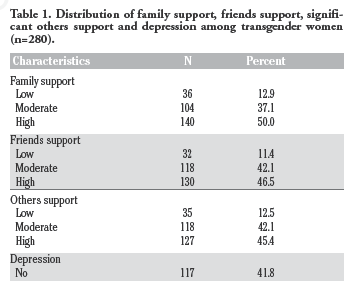
Most participants were found to have high perceived social support from family (50.0%), friends (46.5%), and significant others (45.4%). A smaller proportion of participants reported low perceived social support, which ranged from 11.4% to 12.9% depending on the source of support. Thus, most participants had moderate to high levels of social support. However, more than half (58.2%) of participants had symptoms of depression (Table 1).
Distribution of family support, friends support, significant others support and depression among transgender women (n=280).
Fit indices for the latent class models on social support and depression are shown in Table 2. Based on AIC, BIC, log-likelihood, L 2 , number of parameters, and degrees of freedom, we found that the four-class model fit the data best and had the optimal balance of the number of parameters and the information of those parameters.
Fit indices for latent class model.

BIC, Bayesian Information Criterion; AIC, Akaike Information Criterion.
The four latent classes represented a continuum of the level of perceived social support and depression. A high proportion of participants (31.5%) were assigned to class 1. This group was labeled as
Four-latent-class model.
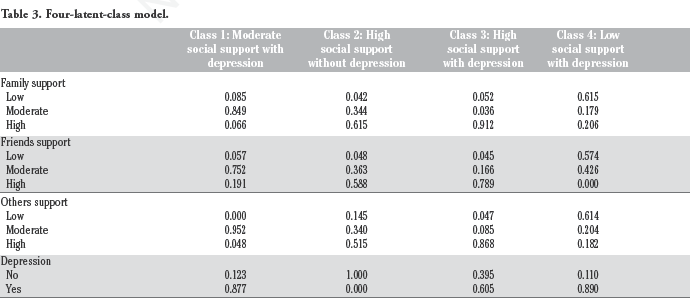
Table 4 shows comparisons of sociodemographic characteristics and other variables between the four classes. This current study included 280 transgender women residing in Bangkok. Participants’ ages ranged from 18 to 53 years, with a mean age of 29.7 years (standard deviation = 7.07 years). Nearly half of participants in class 1 were aged between 25 and 30 years and had a sexual partner, whereas most participants in class 4 were aged above 30 years and had no sexual partner. In terms of occupation, most participants in class 1 were cabaret actresses, whereas most participants in classes 2, 3, and 4 were company employees. Most participants across the four classes shared characteristics, such as being Buddhist, having a bachelor's degree or higher, having a monthly income between 10,001–30,000 Thai baht (THB), living with family, having no chronic disease, not having had sex reassignment surgery, being a non-smoker, and not using substances. Moreover, most participants in classes 1, 2, and 3 had adequate income with savings, used cross-sex hormones, and consumed alcohol. In contrast, participants in class 4 had adequate income without savings. For cross-sex hormone use and alcohol consumption, findings indicated that both had similar proportions of participants in class 4.
Distribution of demographic variables by latent class.

Chi-square test.
Pairwise comparisons of income sufficiency using the chisquare test to explore associations between classes 2 and 4 and between classes 3 and 4 showed an association between participants who have high social support with/without depression and sufficiency of income (p<0.05). Table 4 shows that the proportion of participants with high social support both with and without depression who had sufficient income with more savings was higher than that of participants with low social support with depression. For chronic disease, when exploring associations between class 4 and other classes, an association was found between participants with low social support with depression and chronic disease (p<0.05). As shown in Table 4, the proportion of participants with low social support with depression who had a chronic disease was higher than that of other groups. For alcohol drinking, we explored associations between classes 1 and 2, classes 1 and 3, classes 2 and 4, and classes 3 and 4 and found an association between participants with high social support with and without depression and alcohol drinking (p<0.05). The proportion of participants with high social support with and without depression group who drank alcohol was higher than that of participants with low and moderate social support with depression.
Multivariable logistic regression
Table 5 shows the results of the multivariable logistic regression analysis, which showed associations between suicidal ideation and the four latent classes of perceived social support and depression using the high social support without depression group (class 2) as the baseline outcome group. The moderate social support with depression group (class 1) was 5.57 times more at risk of suicidal ideation than the high social support without depression group (class 2; OR 5.57, 95% CI 2.64-11.71; p<0.001). The low social support with depression group (class 4) was 4.55 times more at risk of suicidal ideation than the high social support without depression group (class 2; OR 4.55, 95% CI 1.67-12.42; p=0.003).
Discussion
This study is the first report focusing on the characterization of transgender women in Thailand based on clusters of depressive symptoms and levels of perceived social support obtained from family, friends, and significant others. Moreover, the LCA approach was applied, which has not been employed in similar research areas to date. The study aimed to examine associations between the identified classes and suicidal ideation in transgender women in Bangkok, Thailand. Our findings revealed associations between classes and income sufficiency, chronic disease, and alcohol drinking. Notably, we confirmed an association between the identified classes and suicidal ideation.
Identified classes and income sufficiency
Because depression and depressive symptoms are strongly associated with financial adversity or strain, 29 those with lower income are at greater risk of developing mental health issues due to mechanisms, such as overcrowding, hunger, violence, social networks, and inability to acquire health care for physical health problems. 30 Our result showed a significant difference between sufficient income and classes. In support of this finding, several studies have found that unemployed people or those without savings eventually become burdened with debt. Furthermore, studies have shown that transgender women with low or insufficient income are more at risk of developing depression, 4 with some reports suggesting that individuals who experience depressive symptoms, have low socioeconomic status, and poor psychological health are often connected. Recent studies have suggested that a lower income is associated with a higher risk of incident mental health problems, whereas higher income is associated with a lower risk of incident mental health problems. 30
Identified classes and chronic disease
Individuals with chronic diseases are more likely to experience depression, and many become chronically depressed. In fact, depression is regarded as one of the most common complications of chronic illnesses, with one-third of those with a serious medical condition experiencing depressive symptoms. 31 Our data showed a significant difference in chronic disease between classes (p<0.01). Similarly, population-based studies have shown that chronic disease, such as cardiovascular disease, is associated with depression and mortality. 32
Several studies have recognized comorbidity of depression and chronic physical diseases, such as arthritis and diabetes, in various developed countries. Evidence has shown that there is a higher prevalence of depression in individuals with one or more chronic diseases. 33 One study that surveyed adults aged 18 years and over across 60 countries indicated that individuals depression accounted for 3.2% of the population, whereas those with diabetes, arthritis, and asthma accounted for 9.3%, 10.7%, and 18.1%, respectively. 34 Notably, further evidence has revealed that the prevalence of depression is higher in those with chronic respiratory and cardiovascular diseases than that of the general population. 35 Moreover, transgender women living with HIV (LWH) are more likely than transgender women without HIV to have depressive symptoms, which may be due to the negative impact of the pervasive stigma and discrimination related to HIV status on the mental health of transgender women with LWH. 36
Regardless of the direction of the association between chronic disease and depression, both factors together contribute to the ineffective handling of the diseases that lead to poor outcomes. A metaanalysis revealed that depression in diabetes patients is associated with complications, such as neuropathy, nephropathy, retinopathy, macrovascular complications, and sexual dysfunction. 37 The consequences experienced by such patients include impairment of quality of life, decrease in physical functioning, increase in social isolation, and lower utilization of healthcare. 34
Identified classes and alcohol drinking
Alcohol intake varies between countries according to the habitual type of beverage and pattern of consumption. Several studies have found that the global consumption of alcoholic beverages is continually increasing, 38 and some have suggested that excessive consumption of alcohol and heavy episodic drinking coexist with depression, which could increase the risk. 39 However, the recommended consumption of alcohol of one to two drinks per day is associated with better health quality than not drinking alcohol at all. 40 In the current study, there was a significant difference in alcohol consumption between classes. Transgender women who were assigned to class 2 (high social support without depression; 83.3%) had higher alcohol consumption compared with that of other classes. This finding was similar to a study conducted in Sweden that showed that drinkers had a lower risk of developing depression than non-drinkers. 41 Another study similarly found that moderate consumption of alcohol may reduce the incidence of depression, whereas heavy drinkers are at higher risk. 42 Drinking small amounts of alcohol has been linked to various physical and mental health benefits. However, survival bias is likely, and other confounding factors that contribute to the harmful effects of alcohol may be inaccurate based on estimations of the meta-analyses.43,44 Despite the existence of associations between low alcohol consumption and better health outcomes compared with abstaining, the nature and practical implications of such a relationship remain controversial.
The lower risk of depression among participants who were drinkers can be explained by social drinking behaviors. 41 Cross-sectional studies have shown that non-drinkers are less socially active and thus have less social support, whereas moderate drinkers have better mood better mental health, greater sociability and social integration, and enhanced long-term cognitive functioning. Although small amounts of alcohol consumption can lead to health benefits, alcohol abuse and addiction can negatively impact mental and physical health. Several studies have suggested that a drink before a meal enhances digestion and can offer a respite following a stressful day. Moreover, an occasional drink with acquaintances can improve mental and physical wellbeing. 45 However, alcohol intake has shown to be associated with an increased risk of other adverse health outcomes, which include cardiomyopathy, arrhythmias, hemorrhagic stroke, injury, and cancer. Heavy episodic intake is associated with an increased risk of death.46,47 Furthermore, for mental health outcomes, a previous study reported an association between alcohol misuse and depression. 48
Identified classes and suicidal ideation
Suicide is a problem of great concern worldwide. The objective of this study was to determine the association between clusters of transgender women and suicidal ideation based on depressive symptoms and levels of perceived social support. After controlling for participants’ income sufficiency, chronic disease, and alcohol drinking, results indicated that participants with low and moderate social support with depression were more at risk of suicidal ideation compared with those with high perceived social support without depression. Lack of perceived social support and depression was a significant predictor for suicidal ideation. Our findings are supported by a study that showed that depression in transgender women is associated with lifetime suicidal ideation. 49 Studies in LGBT individuals in the United States have suggested that youth with lower socioeconomic status are less likely to receive support from family, peers, and significant others. Traditional masculinity may discourage the development of a healthy support system. Notable, those with less family support and family rejection had a higher suicide risk. 50
Model estimates predicting suicidal ideation.

n=280, Each odds ratio is adjusted with income sufficiency, chronic disease and alcohol drinking. -2 Log likelihood = 332.525, Nagelkerke R Square=0.230.
Sources of social support that provide the most protection from suicidal ideation vary across the lifespan. Evidence is largely consistent and showed that high perceived social support is a protective factor against mental health problems. Family support is most consistently associated with protection from depression, suicidal ideation, or suicidal behavior. Previous studies have provided preliminary evidence that social support may confer resiliency to suicide ideation, and similarly, receiving family encouragement is related to a decrease in psychological distress. 4 A Canadian Trans PULSE Project study of transgender people found that social support is associated with decreased suicide risk, whereas family support and understanding of gender identity is associated with a significant decrease in suicidal ideation. 51
In line with these findings, evidence has shown that people with depression have an increased risk of suicide compared with people without depression. According to a previous study focusing on the relationship between depression and suicidal behavior, 48% of depressive participants reported lifetime suicidal ideation and 16% reported lifetime suicide attempts. 52 It is clear that depression is strongly associated with both suicidal ideation and suicide attempts.
Today's greater visibility and social support for those with diverse sexual, gender Today's greater visibility and social support for those with diverse sexual and gender identities and expression have resulted in more freedom for the LGBTQ community. Owing to global advocacy for LGBTQ rights, together with an increasing acceptance of diverse sexual orientations and gender identities and greater access to information via the internet and social media platforms, Thailand has become a more open society for the LGBTQ community. 53 Most countries worldwide, including Thailand, now hold various campaigns to promote sexual orientation and support LGBTQ individuals. In regard to concerns about mental health, LGBTQ organizations in Thailand now emphasize depathologization and offer specialized online and telephone advice. 54 Thus, social support is key to supporting transgender women to effectively adapt to their environments. If transgender women with depression are neglected by their peers and social members, they will encounter severe disadvantages and negative physical or mental health consequences. However, sufficient social support and being free of depression can help to protect them from these negative effects and prevent suicidal ideation.
Limitations
This study has several limitations. Firstly, a cross-sectional design was employed, and we have inferred causation between the predictor variables and suicidal ideation. Secondly, the snowballing sampling technique was used to recruit participants; therefore, our samples may not be representative of the general population. However, we were aware of the limitations of the snowballing sampling technique; therefore, data collection was conducted so that the recruited participants belonged to various age groups, professions, and educational levels to ensure a wideranging sample. Thirdly, the study used a CES-D cutoff point of 16 to assess depression, which has been used successfully across a wide range of ages.26,55 However, a previous study in Thailand that assessed depression using the CES-D used a cutoff point of 22. The lower cutoff used in the current study may have led to an overestimation of depression in our study population. Lastly, after grouping participants into four classes using LCA, the low social support with depression group (class 4) was relatively small (31 participants), which may have resulted in insufficient statistical power to observe the theoretically expected higher risk of suicidality in this group compared with class 1 (moderate social support with depression).
Recommendations
For future studies, we recommend that studies focus on variables that affect transgender women's mental health and wellbeing, such as exploring how to create effective interventions to reduce suicidal ideation under different socioeconomic and cultural dimensions. Likewise, a comparative study of transgender women-serving NGOs in urban and non-urban areas and the relationship with key factors that contribute to their service performance. Studies dealing with perceived social support to improve transgender women's mental health are also worth considering, especially for data acquired from different geographical areas (
For public health policy and practices, it is evident that LGBTQ people experience inequalities in health service provisions. 56 This is because the government has not yet implemented gender affirmative health services, which are a critical need. The government and concerned public health organizations should formulate public health policies that are geared toward improving mental health and healthcare services for the LGBTQ community. Recently, Thailand has seen an increasing number of LGBTQ people working with or in NGOs across the country. Faced with heavy workloads and personal and mental health problems, many have experienced the inaccessibility of healthcare services. Thus, the government, public health sectors, and NGOs must prioritize equal assistance to transgender women. Because the occurrence of depression or suicidal thoughts among transgender people varies, the government should establish training courses for healthcare providers to increase relevant knowledge, understanding, and professionalism; the more professional the healthcare providers, the better the health services. Our findings encourage healthcare providers to assist transgender women suffering from depression by focusing on helping clients to identify appropriate sources of social support to significantly reduce their risk of attempting suicide.
Conclusions
Transgender women globally are currently at high risk of experiencing suicidal ideation and behaviors. Our study identified four classes of perceived social support from three sources (family, friends, and significant others) and depression, and highlighted their associations with suicidal ideation in transgender women. Classes 1 and 4 were more at risk of suicidal ideation than class 2. The associations between social support, depression, and suicidal ideation emphasized the importance of screening atrisk transgender women for patterns of social support and depression to detect and prevent suicidal ideation more effectively. Our results demonstrate that addressing transgender women's mental health in relation to suicidal ideation and behavior needs to be a priority of health system improvements not only in Thailand but also worldwide.
Footnotes
The authors declare no potential conflict of interest.
Funding: None.
Acknowledgements
The authors would like to acknowledge the Graduate School Thesis Grant, Chulalongkorn University for supporting this thesis. My gratitude also goes to the Ms. Reberta Adele Steer Huthart for her kind support in making this research project possible.