






Abstract
The advances in eHealth have dramatically changed the face of healthcare delivery around the world, with Sub-Saharan Africa being no exception. It is essential to identify the prominent, emerging researchers, successful areas of research within the field of health informatics (HI) and telemedicine (TM) to be duplicated where there is a need. This study gives a bibliometric overview of original research articles on medical informatics and telemedicine indexed in Scopus, PubMed, and Science Direct over the last 20 years in sub-Saharan Africa. Keywords related to health informatics and telemedicine were used to retrieve relevant literature. We specifically analyzed the evolution, standard metrics, domains of medical informatics (MI) and TM in sub-Saharan Africa (SSA) and Brazil, Russia, India, China, and South Africa (BRIC) nations. Our results identified mhealth as the main field of research in telemedicine that has seen significant growth in both BRIC and SSA nations and is poised to be the focus of research activity in the near future. Research production in mhealth and telemedicine showed a considerable increase from 1999–2018. The production was dominated by articles from South Africa in Africa and China from the BRIC nations. Most prolific authors have resources and are leaders of health informatics projects. The production came from 26 sub-Saharan African countries, denoting this field's devotion in different areas around sub-Sahara. Research in mhealth needs to be encouraged, mostly in the fight against infectious and non-infectious diseases in sub-Saharan Africa, where technology can improve health services and decrease disease burden.
Significance for public health
Literature shows that medical informatics and telemedicine may expand access to services, create cost savings, and increase the ability to access health care services timely. The last decade of research in health informatics and telemedicine has been growing at a very rapid rate. Conducting a bibliometric analysis of medical informatics and telemedicine in sub-Saharan Africa will illustrate a historical perspective on the progress of scientific research on medical informatics and telemedicine. It is essential to know the total number of publications in sub-Saharan Africa and per country, whom the publishers are collaborating with internationally, and who are the most prolific and high impact researchers. This information is vital because it can be used for the evaluation of scientific developments. The information can also be used to assess journal impact factors. However, efforts to systematically map the entirety of the research field in medical informatics and telemedicine in sub-Saharan Africa are lacking.
Introduction
Health informatics is an interdisciplinary field that studies and pursues the effective uses of biomedical data, information, and knowledge for the scientific inquest, problem-solving, and decision making, motivated by efforts to improve human health. 1 Health informatics tools include computers and clinical guidelines, formal medical terminologies, information, and communication systems. eHealth is the use of information and communication technologies (ICT) for health, while telemedicine is a subset of telehealth, which falls under the broader term of eHealth: involves the provision of health care services, where distance is a critical factor or just healing at a distance. 2
Over the last decade or so, research in medical informatics and telemedicine has been growing rapidly, as evidenced by a large number of publications. 3 With the advent of social media technology, the use of social media technology has also fuelled the growth of research in telemedicine; for example, in developing countries, WhatsApp is used for administrative and clinical practice. 4 Bibliometric analysis can provide useful insights into a body of literature, and several such studies have been conducted in the domain of telemedicine.5,6 It is essential to know how the research field has evolved, the total number of publications in sub-Saharan Africa and per country, whom the publishers are collaborating with internationally, and the most prolific, high impact researchers, impact of the research or identify impactful publications within a specific research field. This information is crucial because it can be used to evaluate scientific developments and can provide useful insights into a body of literature.5,6 The information can also be used to assess journal impact factors. 7 The Journal Impact Factor assesses the quality of research being done in the ehealth field. By knowing how many times the journal has been cited one can assess the impact the journal has made through the contribution of science. Importantly, through bibliometric analysis one can determine the number of self-citations and if there are a specific group of researchers affiliated with the author citing the papers.
Medical informatics and is receiving significant research attention. For the past decade or so, medical informatics research has been increasing rapidly, partly driven by advances in information technologies and partly by an urgent need to improve quality of care and patient safety.8,9 Despite this fact, no author has ever investigated medical informatics’ bibliometric performance in sub-Saharan Africa over a long period. Scott and Mars 5 published a paper only on telehealth in the developing world: current status and prospects, and there were no comparisons with the publications from BRICS nations. BRICS is an association of major emerging economies or newly industrialized countries, which were large, fast-growing economies that exercised significant influence in their regions. 10 BRICS nations have created alliances in many respects, including research. Understanding how much they have published will allow us to understand gaps associated with each country and thus will show where possible collaborations between BRICS countries can happen. Other authors only focused on the growth of telemedicine literature from 1993 to 2012.
With this study, the main goal is to elucidate which prior publications have been the most impactful in telemedicine and medical informatics in Sub-Saharan Africa by analyzing different metrics so that other researchers can then use these results to conduct further studies. A secondary goal is to determine or establish domains or aspects of medical informatics and telemedicine research that require further attention from investigators and regulatory bodies. This would serve to encourage future research in these areas of need, which would benefit this field of research as a whole.
Methods
A desktop review was conducted using bibliometric techniques. A search strategy was created and applied to all publications indexed from 1999 to 2018, from Sub-Saharan Africa and BRICS countries. Publications were retrieved using Scopus, Science Direct, and PubMed. PubMed was chosen as the search engine because it is the largest database of peer-reviewed literature, and it includes original articles, reviews, conferences, letters, editorials, articles in press.11,12 Elsevier runs Scopus, which is one of the largest electronic databases available for literature retrieval. It is friendly to use and provides functions like “limit” and “exclude” that facilitates data refining and analysis. 13
Furthermore, Scopus can provide researchers with country profile, institution profile, citation analysis, author profile, and source journals for any specific field data. PubMed is accessed free of charge. PubMed's keyword search offers prime update frequency and includes new online articles; PubMed remains an optimal tool in biomedical electronic research. 14
The keywords searched for in publication title, abstract, and keywords were the following:
Medical informatics terms:
“Medical Informatics” or “Medical Information Systems” or “MI” or “M.I.S.” or “Biomedical Informatics” or “Health Informatics” or “Clinical Informatics” or “HIS” or “Hospital Information System” or “E.H.R.” or “Electronic Health Records” or “E.M.R.” or “Electronic Medical Records.”
Telemedicine terms:
“Telemedicine” or “Telehealth” or “telecare” or “telehomecare” or “E-health” or “ehealth” or “m-Health” or “mhealth” or “electronic health” or “mobile health” or (“cellular phone” and “medicine”).
Exclusion criteria
Papers that were not related to the field, published before 1999 and which are not from the BRIC nations and SSA. and not written in English were excluded. Since South Africa appears in both BRICS and SSA. countries, the term BRIC will be used without South Africa. South Africa will only be counted under the SSA countries.
Documents screening
Screening of articles at all stages was done by the two authors
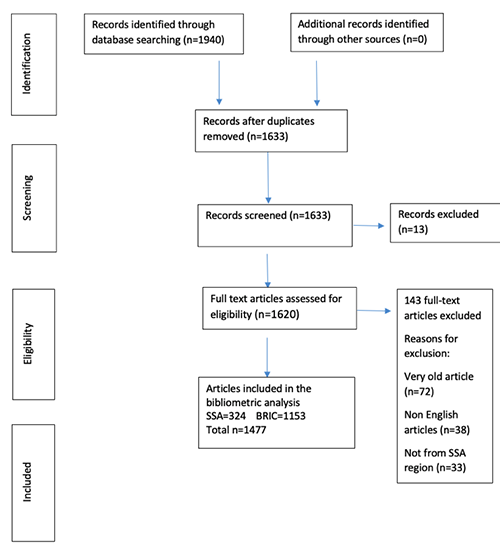
PRISMA Flow diagram used for screening and selection of medical informatics and telemedicine documents from SSA and BRIC nations (http://prisma-statement.org/PRISMA statement/ flow diagram.
Results
Evolution of ehealth research over the last 20 years between BRIC and SSA countries
A total of 324 publications for S.S.A. countries and 1153 for BRIC nations were located using the customized query in Scopus, Science Direct, and PubMed databases. The distribution of publications over time in the field is illustrated in Table 1. South Africa had the highest number of papers, 113 (34.9%), followed by Kenya, with 42 (13%) publications over 20 years. There were few publications from the 1999-2003 period. Most publications were recorded from 2004-2008 and 2009-2013 period, and a slump decline during the 2014-2018 period.
The spread of publications in sub-Saharan African and BRIC countries in the field of medical informatics and telemedicine 1999–2018.
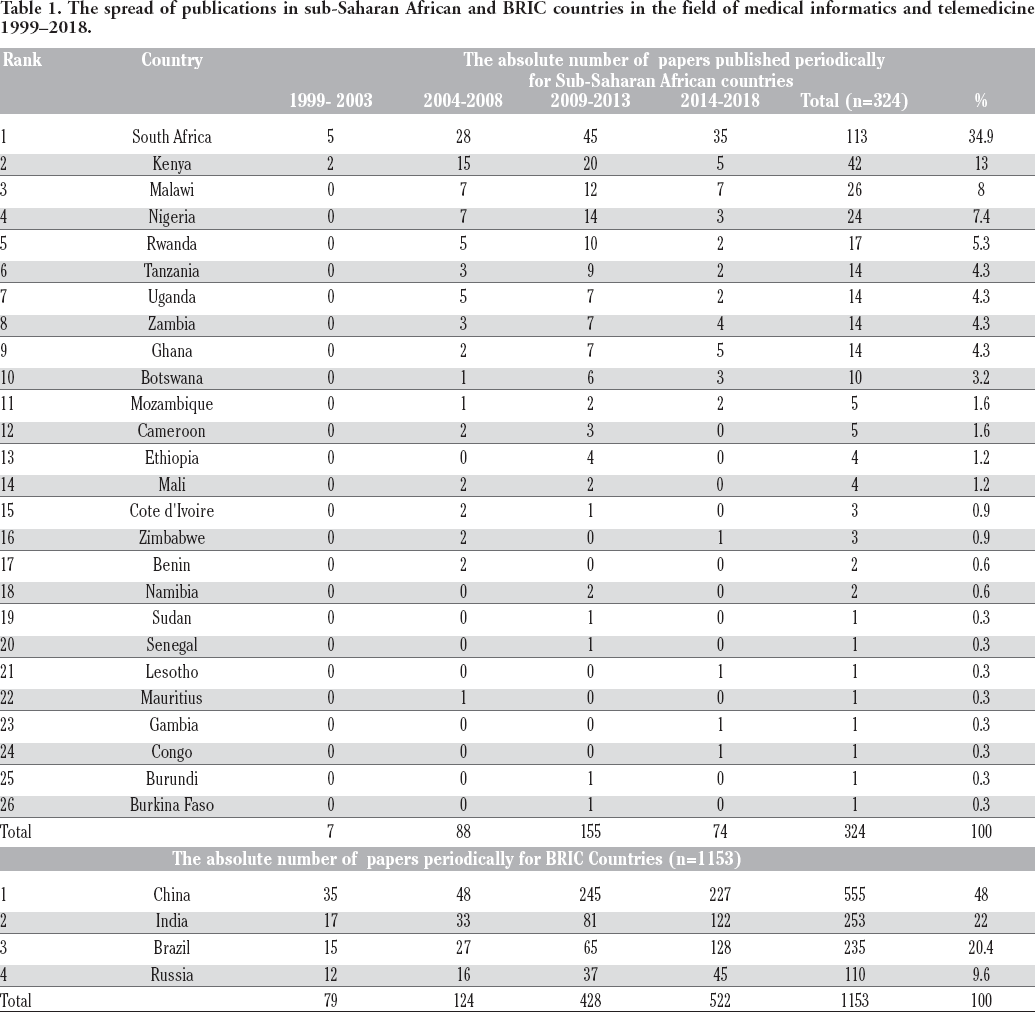
Amongst the BRIC nations, China had the highest number of publications, 555 (48 %), followed by India 253 (22 %), Brazil 235 (20.3 %), and then Russia, with 110 (9.6 %), as shown in Table 1. In Table 1, it is evident that there has been a sharp increase in publications from the 1999-2003 period to the 2014-2018 period. South Africa ranked first with an average number of citations of 26.7 per article, followed by Tanzania and Rwanda.
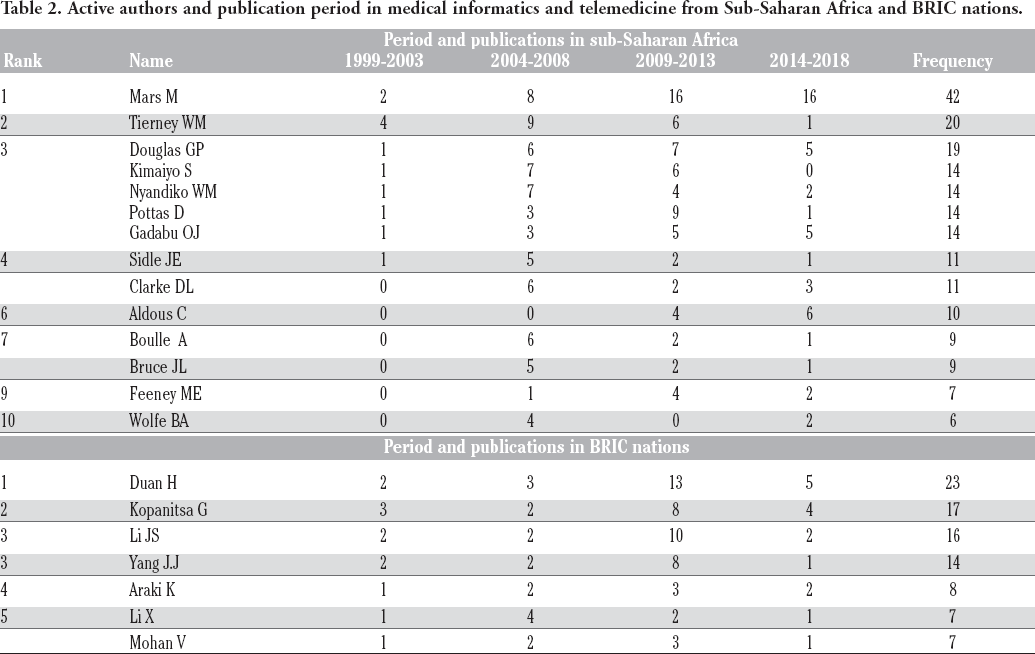
Based on the number of journal articles only the most prolific authors in telemedicine and medical informatics research in sub- Saharan Africa were M. Mars from the University of KwaZulu Natal South Africa with 42 articles, followed by W.M. Tierney from Indiana University (USA), who co-authored 20 articles, followed by G.P.W. Douglas with 19 articles. The most prolific authors in telemedicine and medical informatics research in BRIC countries were H. Duan from China with 23 articles, followed by G. Kopanitsa from Russia with 17 articles, and J.S. Li from China with 16 articles, respectively (Table 2).
Active authors and publication period in medical informatics and telemedicine from Sub-Saharan Africa and BRIC nations.
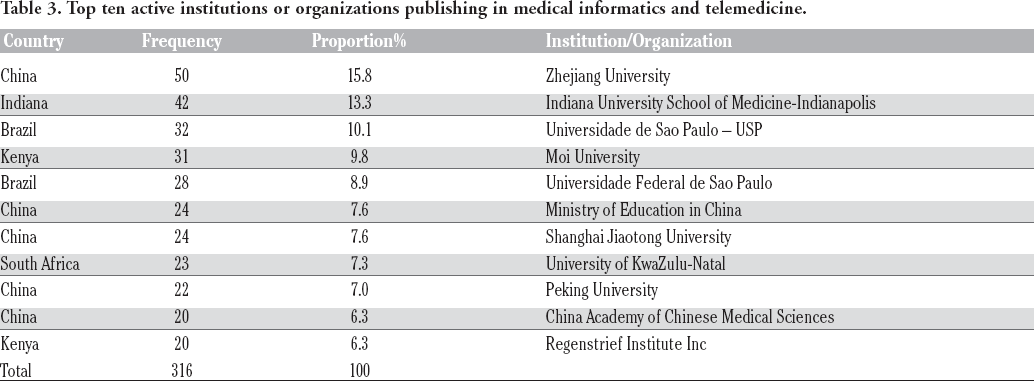
The top institutions with researchers publishing on medical informatics and telemedicine are Zhejiang University with 50 publications from China, followed by Indiana University School of Medicine with 42 publications. On the third position is Universidade de Sao Paulo from Brazil with 32 publications. Moi University is in the fourth position making it number 1 in Africa with 31 publications. The University of Kwazulu Natal is in the 8th position and the second country in Africa with 23 publications (Table 3).
Top ten active institutions or organizations publishing in medical informatics and telemedicine.
The journal mostly used by the authors in Africa and BRIC nations to publish research on telemedicine and medical informatics is the Studies in Health Technology and Informatics Journal, with 159 publications, followed by the Journal of Medical Systems with 54 and PloS One with 50 publication.
Domains that have dominated medical informatics and telemedicine in BRIC and SSA publications over the past 20 years
The primary domain that has dominated medical informatics and telemedicine in BRIC and SSA publications over the past 20 years is mhealth (Table 4). The mobile phone is facilitating telemedicine in most disciplines.

Top ten countries publishing in medical informatics and telemedicine research in Africa.
The domains of medical informatics and telemedicine between BRIC and SSA countries over the past 20 years.

Collaboration with other authors
Table 5 shows that most of the collaborations between authors writing on HI and TM in SSA are from the USA. Authors from Kenya, Moi University, collaborated among themselves and also with researchers from the USA. There were few collaborations between the BRIC nations and SSA countries. There were also a few collaborations among BRIC nations.
Collaborations between the top authors in medical informatics and telemedicine in sub-Saharan African countries and BRIC nations.

The most prolific author from KwaZulu Natal University, Mars, co-authored papers with both South African and international authors. His co-authors span from South Africa, Kenya, Uganda, Botswana, Nigeria, and the United States of America, Switzerland, and Canada. From the BRIC nations, Mars co-authored with Gogia from India and Tierney from the USA. Mars also collaborated with authors from the USA and Kenya. Douglas, from the USA, collaborated with authors from the USA, Ghana, and Malawi. Most of the authors who wrote about sub-Saharan Africa collaborated with USA authors. Out of the 14 top authors from SSA listed in Table 5, only two authors from South Africa did not collaborate or co-authored with international researchers. The other 12 authors collaborated with at least one author from the USA.
The top authors who wrote about the BRIC nations Duan, from China, collaborated with co-authors from China, USA, Canada, Japan, UK, Australia, Germany, and the Netherlands. The second prolific author from the BRIC nations, G. Kopanitsa from Russia, collaborated with researchers from Russia, European countries, and the USA; V. Mohan from India, is the only author who collaborated with researchers from other BRIC nations Brazil.
No first authors from BRIC nations collaborated with researchers from sub-Saharan. It was only Maurice Mars from South Africa who collaborated with researchers from India. The top sub-Saharan authors interacted amongst themselves compared to their BRIC nation's counterparts. All three authors from Kenya, Moi University, collaborated with each other. They also coauthored with Tierney from the USA. Feeney from the USA coauthored an article with Mars from South Africa. No interaction was observed among the BRIC nations’ authors. Collaborations among African authors themselves were few, but most sub-Saharan authors were partnering with USA authors.
Discussion
This study is a bibliometric analysis of medical informatics and telemedicine literature published from 1999 to 2018 via Scopus, PubMed, and Science Direct database. The findings indicate a significant rise in telemedicine and health informatics literature in the last 20 years.
In SSA countries, there were few publications from the 1999-2003 period. This could be because the field was still in its infancy stages. After the 1999-2003 period, there was an exponential growth in publications, which could be attributed to technological developments in the ICT industry and healthcare improvements. There was a noticeable fall in the number of publications starting in the year 2014-2018, and the reason for this decline is unclear. This suggests a common factor, such as a sudden, temporary reduction in the number of papers being published, or a sudden decrease in the number of journals being indexed by the databases.
The most prolific authors in telemedicine and medical informatics research in both SSA and BRIC nations success could be attributed to a variety of reasons; for example, Mars from the University of KwaZulu Natal is the head of a department that provides postgraduate education (Masters and PhD) in both medical informatics and telemedicine in Africa and beyond. He is more likely to have resources at his disposal to conduct a wide range of studies in the two fields. Mars is an editor of the Journal of the International Society for Telemedicine and eHealth (JISfTeH) and serves on several eHealth journals’ editorial boards. He has many publications in (JISfTeH). Tierney led the implementation and study of electronic medical records and health information technologies during his stay of more than three decades at Indiana University and the Regenstrief Institute. He was responsible for grants and contracts totalling more than $32 million USD. 33 Tierney led a team of Americans and Kenyans that implemented the first and most successful outpatient electronic medical record system in sub-Saharan Africa. His profile shows that he had resources to conduct research and publish papers. He was also an editor of the Journal of General Internal Medicine and co-editor-inchief of Medical Care in which he published several papers. Although Douglas is from the USA, he works and publishes with researchers from Malawi. He publishes in a wide variety of Journals. Duan from China holds several influential posts in China. For example, he is the Chinese Ambassador of openEHR International Standards Organization, Member of Digital Medicine Branch of the Chinese Medical Association, and Deputy Director of China Digital Medical and Medical Informatization Committee, among other posts. 34 The five Journals mostly used by the authors in Africa and BRIC nations to publish research on Telemedicine and Health Informatics are all peer-reviewed with impact factors. Three of the Journals are specialist journals in the field of medical informatics and telemedicine.
Researchers from BRIC nations dwelled much on mhealth applications for non-communicable diseases prevention and telemedicine consultation. Similarly, SSA nations also dwelled on mhealth applications for infectious diseases prevention, clinical decision support system, medication adherence and appointment scheduling. Researchers from sub-Saharan African countries focused on a variety of various domains, which included Health Informatics, telemedicine, and m-Health: is being used for education and awareness, clinical decision support, and remote monitoring. Telemedicine practices saves time, reduce travel expenses, reduce medical costs. 35
PubMed was the search engine with the highest number of papers; such a trend could be because PubMed is a recognized primary tool for scholars in the medical field. It remains the optimal tool in biomedical electronic research. 14 Most of the articles were appearing in at least two of the three search engines used.
This study's limitation is on the use of only three databases, which makes the findings not necessarily an accurate representation of all the literature on medical informatics and telemedicine. The study also looked only at the literature that was written in English. Yet, there could be more literate on medical informatics and telemedicine in some other languages other than English.
Conclusion
Both BRIC and S.S.A nations are using mhealth application for various purpose ranging from health education, disease prevention, appointments and drug adherence. However, few S.S.A are doing Telemedicine consultations as compared to BRIC nations. The most prolific authors have influential positions at their organizations and are more likely to be well resourced. This calls for further funding to be allocated to medical informatics and telemedicine research so that early carrier researchers find it easy to do research.