






Abstract
Background
Viral influenza, one of the global public health problems is specifically important in Saudi Arabia due to high susceptibility of transmission in hajj and umrah seasons (Islamic pilgrimage to the Mecca), as it has the ability to spread widely to a large proportion, in addition the disease has a higher rate of complications that might lead to death. Vaccination is an important strategy in prevention of viral influenza.
Design and methods
The study aimed to describe the association between uptake of influenza vaccine with knowledge as well as identify the barriers that prevent vaccination among Princess Nourah Bint Abdulrahman University (PNU) non-health colleges students. A descriptive cross-sectional study design was undertaken, including 385 students from non-health colleges using a convenience sampling technique. Data was collected using an Arabic self-administered online questionnaire Analysis done by JMP program. IRB approval as well as informed consent were taken.
Results
The uptake of the influenza vaccine was 15.3% in the current year and 56.8% in the previous years. No significant association was found between knowledge, and uptake of the vaccine. For the unvaccinated students, the most common encounter barriers stated by study population were concerns regarding the vaccine effectiveness, reduction of immunity the uncertainty of complete protection in a percentage of 12.0% for all.
Conclusions
Although the level of vaccine uptake is low for this year, it is not associated with knowledge. There were some barriers that need to be tackled by health education programs.
Significance for public health
The identification of the factors that prevent university students from uptake of the influenza vaccine are essential to maximize vaccine uptake as Influenza continues to cause significant morbidity and mortality in whole world, including Saudi Arabia. Studies exploring influenza vaccine coverage for students are considered important in order to find out the misconception and target it by health education program, which ultimately increase the coverage.
Introduction
Viral Influenza is one of the priorities in public health and it is considered a significant health threat that needs to be prevented. Globally, 3 to 5 million people are infected with severe influenza and 300,000 die as a result. 1 In 2019 Saudi Arabia, detected cases of influenza A reached up to 15850 cases and from these cases around 124 people died according to the World Health Organization (WHO) statistics. 2 To prevent influenza a vaccine was developed to reduce the burden, and death occurring from influenza. It is recommended to take the influenza vaccine annually because the influenza viruses mutate and the body's immune response to the vaccine decrease over time. 1
Knowledge related to influenza disease and uptake of the vaccine are an important topic in Saudi Arabia that cannot be neglected as the kingdom of Saudi Arabia has high susceptibility to influenza transmission due to hajj and umrah season (Islamic pilgrimage to the Mecca), in which there are a huge number of people coming from different countries. 3 Most of the previous studies focused on health discipline students or those who work in health sectors, such as the cross sectional study conducted by Rogers et al. in Southern California to measure the attitudes and barriers associated with seasonal influenza vaccination uptake among public health students which showed 43% reported receipt, among the barriers to vaccinations were the belief that they may get the flue as stated by 49.4% of study population, there may be dangerous side effects as mentioned by 30.4%. Another example of these studies is the one conducted by Salem et al. to assess the knowledge and limitations associated with the uptake of seasonal influenza vaccine among nursing students from King Saud bin Abdulaziz University in Saud Arabia which showed only 9.1% stated that they receive the vaccine annually while 36.9% did not receive the vaccine at all during the last 5 years.4,5 A third study by Walker et al. A distributed a 35 item self-administered online survey to medical students at large Australian university to explore influenza vaccination rates, attitudes, knowledge and intended practices found that 53.8% of study population got vaccinated, the most common barrier to vaccination was inconvenience as stated by 64% of study population, despite access to on campus clinics. 6 The Saudi Ministry of Health (MOH) provides seasonal influenza vaccine free to beneficiaries at the onset of winter at home, health facilities or where ever they are. 7
This study focused on non-health PNU Colleges students as most of the studies focused on health students4-6 Also the nonhealth colleges constitute 61% of colleges with greater number of students due to strict criteria of admission to health colleges, in addition to this the literature showed it easier for outbreaks of influenza to occur in students population because influenza has the ability to spread easily within clustered populations.8,9 This study also fits with the 2030 vision agenda with strong political commitment to public health by transformation of healthcare through conducting researches in the field of disease prevention. 10 The objective of this study is to describe the association between knowledge and uptake of influenza vaccine as well as identify the barriers toward the influenza vaccine among PNU non-health college students.
Design
A descriptive cross-sectional study was conducted at Princess Norah Bint Abdulrahman University in non-health college (Humanities and Scientific Colleges) students.
Methods
The study included 385 students. Sample size was calculated by using the equation n=Z2 pq/d2. Where Z=standard normal deviate at 1.96, p=proportion of the characteristics under study and it was considered to be 50%, q=proportion in the target population and not having the particular characteristics [1-p], d=degree of accuracy at 0.05. All the programs were included from the two colleges and the number of participant in each college was selected by probability proportion to College size. The ultimate selection of the individuals was done by using electronic questionnaire that was posted on WhatsApp groups of the students from all academic levels. A link to the questionnaire in the Google form was initially sent to each group. When the student clicked on the link, they were taken to the electronic Google form. Google saved each completely filled questionnaire in the researcher's Google drive.
Data collection
The study was carried out from September 2019 to May 2020, during the period of administration of the vaccine, as recommended by The Saudi Thoracic Society guidelines for influenza, to be given every year during the influenza season that starts September and ends in March of the following year. 11 A structured questionnaire was developed and translated to the Arabic language to collect data about knowledge, uptake and barriers toward the influenza vaccine based on a review of the literature, and some questions were inspired from a study done by Olawale et al. 12 The questionnaire contains 24 questions divided into 3 sections: the first section consists of 3 questions about sociodemographic characteristics (age, college, and academic level). The second section includes 3 questions about vaccine uptake and the reasons for not taking the vaccine, which are considered as barriers, those who are vaccinated will skip questions about barriers. The third section contains 18 questions about knowledge of influenza and the vaccine, 14 questions that answered by yes/no/I don't know, among them are 5 general knowledge questions about influenza disease (the disease is caused by viruses, types of influenza viruses that cause influenza disease, possibility of infection by more than one type of influenza viruses, influenza disease is the same as the common cold and severity of influenza complications); 4 questions for transmission of the disease (human to human, air droplet transmission, influenza occurs in winter season, the occurrence also in other seasons). The remaining 4 questions were multiple answer ones with a total of 15 responses. The knowledge about symptoms of influenza is the first multiple answer question (constant sneezing, fever, headache, sore throat, weakness and tiredness). Knowledge about people at high risk of getting influenza is the second multiple answer question (children under 5 years, pregnant women, elderly, people with weak immune system). The knowledge about influenza prevention by vaccination contains 5 questions (the disease is a preventable, possibility of infected patient with influenza to take the vaccine, possibility of current influenza patient to take the vaccine vaccinate a, vaccine could be taken frequently each year, influenza vaccine could be given to people with chronic disease). The knowledge about the vaccine content is the 3rd multiple answer question (the vaccine is mixture of attenuated virus A and B - vaccine contain only attenuated A - vaccine contain only attenuated B - I don't know). The side effect of the vaccine is the last multiple answer (can cause fever - can cause headache - it can cause minimum pain - it can cause sore throat - I don't know anything about the side effects). Among the questions there were four reversed questions. The total score for the knowledge section was 29, questions with yes/no/I don't know answers scored as 1 for correct response and 0 for wrong and I don't know response, while for multiple response questions 1 point for each correct response and 0 for I do not know. The questions are easy questions that most college students should know. The cut-off point for knowledge was determined by the data using the mean as a balancing point (above average or below average) with the standard deviations as standardizing values. The internal consistency of the questionnaire was 0.779 calculated by Kuder-Richardson Formula 20 (KR-20), which is used for a measure of internal consistency reliability for measures with dichotomous choices, and based on pilot test data that carried out on 20 students, however, their data was removed and not included in this study. The validity of the questionnaire was tested by three experts and the questionnaire translation was checked by two bilingual experts. The individual responses saved on Google drive were collected and transferred to an Excel spreadsheet, where data cleaning occurred. Any incompletely answered questionnaire was removed as a data source. Text responses were also allocated a numerical key for easier analysis. The data were then imported into analysed using JMP version 15. Descriptive statistics was used to describe the study population by frequencies and percentages. For the association t-test and Fisher exact test (for 2 by 2 table) were used. Multivariate analysis using regression analytics to analyze the data was conducted. Our analysis included testing the hypothesis of knowledge, age groups, educational level with vaccination status for the current year.
Results
Table 1 demonstrates the frequency distribution of sociodemographic characteristics among the studied sample. In terms of age, the students aged twenty years and less than twenty-two comprise about half of the total sample (45.4%), and the students who are younger than eighteen years old represent the lowest percentage which is about one percent (0.8%) from the total respondents, while students in the age group 18 years to less than 20 year and age group 22 years or more are almost the same, 27.0% and 26.7%. Slightly more than seventy percent (71.1%) of the study population were from Business and Administration College while only around thirty percent (28.3%) from Art and Design College. Regarding educational level more than two-thirds of the students were senior level (5 to 6 and level 7-8) in the percentages of 32.7% and 36.4% respectively levels whereas junior levels (1 to 2 and 3 to 4) comprises 11.4% and 19.4%. Table 2 shows the prevalence of influenza vaccine uptake in both the current and previous years. It is notable that a small percentage (15.3%) of the total students received the influenza vaccine in the current year, while in the previous years, more than half (56.8%) of the students had been vaccinated.
Sociodemographic characteristics of study population at PNU (n=385).

Prevalence of influenza vaccine uptake among nonhealth colleges students at PNU (n=385).

Table 3 represents the mean knowledge score of non-health college students calculated by summation of correct answer for the 18 questions, which is found to be 15.2±4.3 with mean SE 0.2. The percentage of students who attained knowledge above the mean were 176 students, 45.8% of the sample, whereas those attained knowledge below the mean were 208 students, equivalent to 54.2%. The detailed knowledge, the general knowledge about influenza disease is considered moderate range from 63% of the students answered correctly that the disease is caused by influenza A or B, followed by 55% knew it can be caused by other viruses to 38% of students who knew that the disease is similar to common cold. The knowledge about the transmission of the disease is generally high ranging from 95% of students knew the human to human transition to 80% of the them knew that transmission by air droplet could also occur. The knowledge about symptoms of influenza (constant sneezing, fever, headache, sore throat, weakness and tiredness) was in the following percentages (68.1%, 77.7%, 52.7%, 62.3%, 69.9%, 4.7%). Knowledge about people at high risk of getting influenza (children under 5 years, pregnant women, elderly, people with weak immune system) was in the following percentages (41.8%, 21.0%, 30.6%, 84.4, 9.6) consequently. The knowledge about influenza prevention by vaccination ranged from 87% knew that the disease is a preventable, followed by 68% knew the possibility of infected patient with influenza to take the vaccine, strikingly only 44% knew that it is possible to vaccinate a current influenza patient and 28% knew that the vaccine could be taken each year, also only 22% knew that influenza vaccine could be given to people with chronic disease. The knowledge about the vaccine contented is very low where only 4.8% knew that it is mixture of attenuated virus A and B. Regarding the side effect of the vaccine, 39.2 % knew it can cause fever, 26.2% knew it can cause headache, 37.1% knew it can cause minimum pain, 18.7% knew it can cause sore throat, whereas 39.2% don't know anything about the side effects.
Detailed and mean knowledge score among non-health colleges students at PNU (n=385).
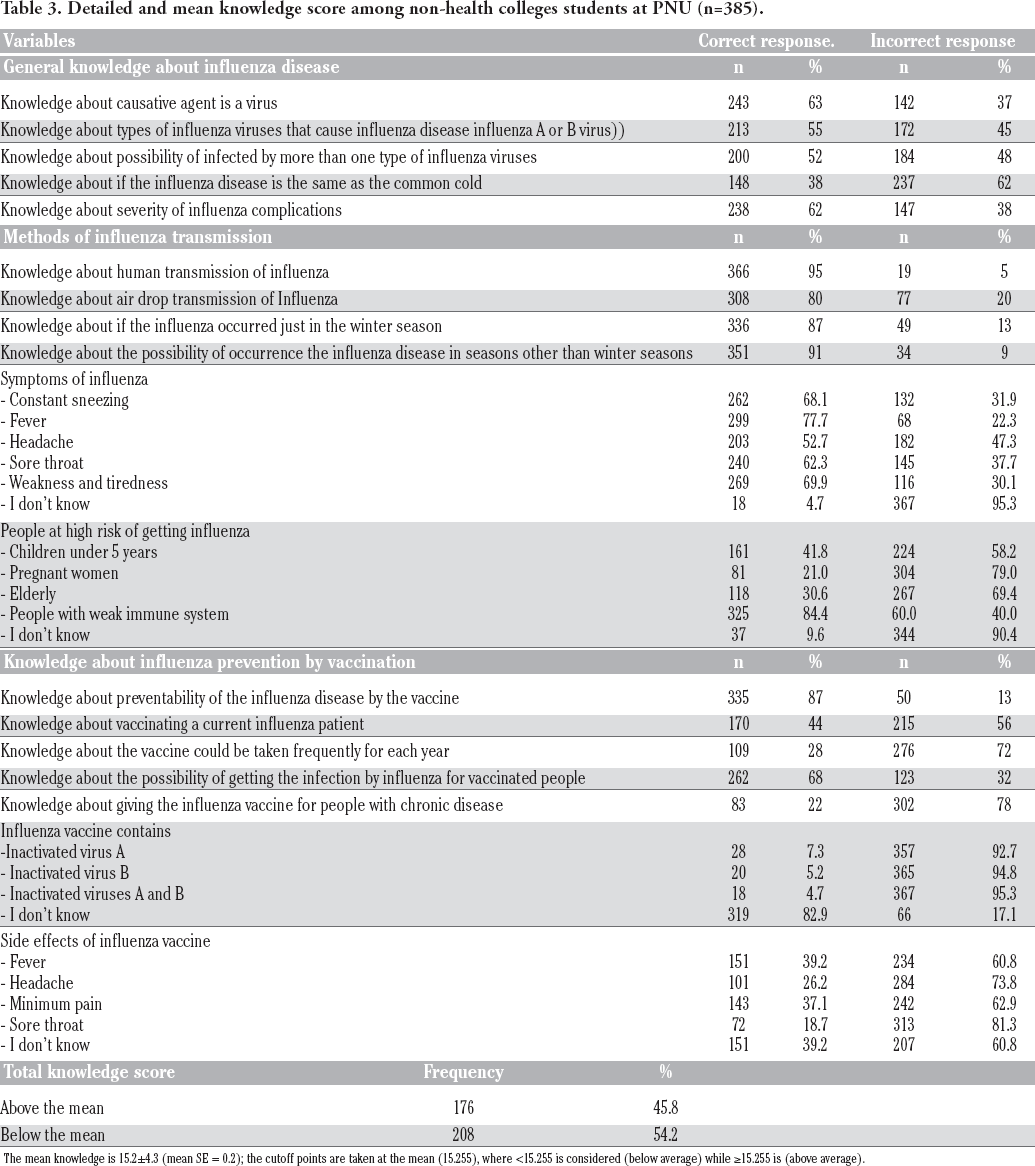
The mean knowledge is 15.2±4.3 (mean SE = 0.2); the cutoff points are taken at the mean (15.255), where <15.255 is considered (below average) while ≥15.255 is (above average).
Table 4 represents the barriers or reasons that prevented students from taking the influenza vaccine. The three uppermost reasons are doubts about vaccine effectiveness (12%), students’ beliefs that the vaccine may weaken the immune system (12%), also their belief that the vaccine may not protect them completely (12%). Followed by the reason that vaccination time is inconsistent with their lecture times (11%). The vaccine price (0.45%), the vaccine might causes autism (1%), and the vaccine is not available in health care centres (2%) are considered as the lowest selected barriers Table 5 illustrates the relationship between students’ level of knowledge, sociodemographic factors and uptake of the influenza vaccine for the current year. There is no statistically significant association between the mean level of knowledge and uptake of the vaccine (Fisher Exact=2.175, P=0.6704). Regarding relationship between different sociodemographic characteristics and uptake of the influenza vaccine for the current year. It was found that there is a significant statistical association between the college and uptake of the influenza vaccine (Fisher's exact test p=0.0005, but no significant statistical association between age or educational level with uptake of the influenza vaccine for the current year: X2=2.597, p>0.05, X2=0.708, p>0.05).
Barriers toward the uptake of influenza vaccine among none health college students at PNU.

Relationship between levels of knowledge, sociodemographic factors and uptake of influenza vaccine.
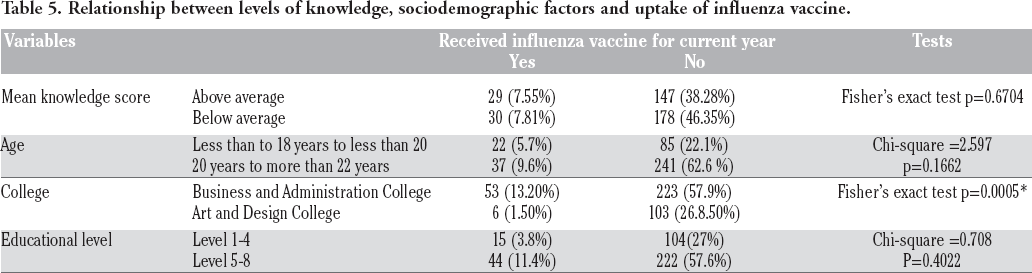
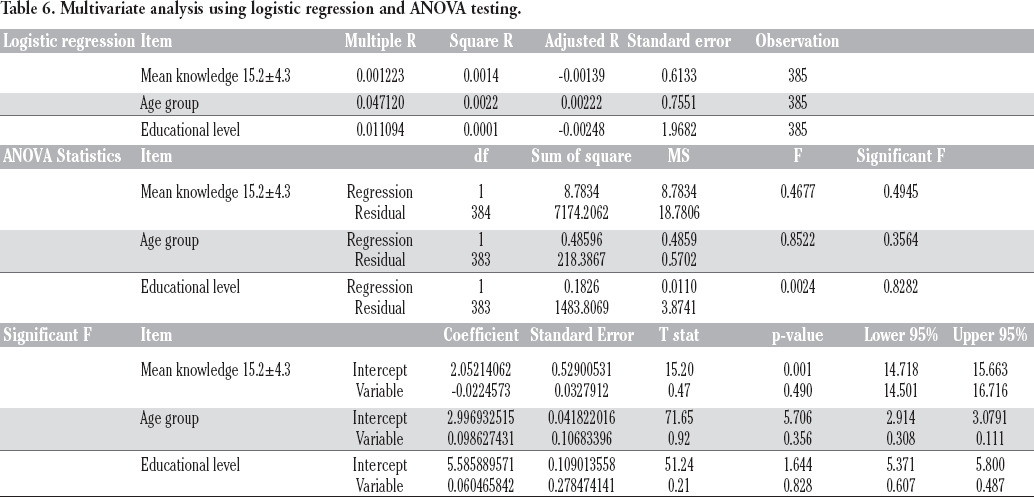
Table 6 shows the result of the multivariate analysis in term of simple logistics regression and ANOV testing 3 variables, namely knowledge level (above the mean and below the mean), age and education level with current vaccination status against influenza for this year. None of these three factors under the analysis has significant correlation or could be a predictor of the vaccination status.
Multivariate analysis using logistic regression and ANOVA testing.
Discussion
The uptake of influenza vaccine was very minimal as only 15% of students were vaccinated for this year, but 56.8% received the vaccine 2 years ago. The result is not consistent with the study conducted by Alshammari, to measure acceptance of influenza vaccine among health care professionals in Saudi Arabia, which revealed marked difference, because approximately 67.6% of HCPs were vaccinated, and also with study conducted by Aljamili to measure knowledge and practice toward seasonal influenza vaccine and its barriers at the community level in Riyadh, Saudi Arabia, which found 55% of study population was vaccinated.13,14 Also Rogers et al. studied undergraduate public health students at California State University to assess attitudes, beliefs, barriers, and factors associated with the influenza vaccine uptake, revealed that 43% of students reported receiving the vaccine. 4 The result is still far below the expected and desired level of vaccination when compared with a study conducted in Riyadh, Saudi Arabia, among nursing students by Salem et al. which reported that 53% of the participants got vaccinated several times. 5 However the study was consistent with the one by Martinez, which showed that the majority of the participants did not receive influenza vaccine annually, and also with a study conducted by Kawahara and Nishiura to explore influenza vaccine uptake and its determinants among Japanese university and college students, which stated that students belonging to medicine and healthcare related faculties were vaccinated three times more frequently than other students.15,16 The marked difference might be attributed to the difference in the field of the study as the studies from health sciences field showed more vaccination percentage than studies form other fields.
This low vaccine uptake in this study could be attributed to the barriers being stated by the students, with the most common three barriers mentioned were students’ beliefs the vaccine weakens the immune system, or doubts about its effectiveness and its ability to protect against the disease. Similar results have been reported by Rogers et al. at California State University, regarding barriers where almost half of the participants believe that they may get influenza from the influenza vaccine. 4 In another study conducted in Riyadh, Saudi Arabia, by Alshammari and his colleagues, fear of getting sick after having the vaccine was among the highest reasons for not taking the influenza vaccine. 1 Moreover, almost onethird of the participants included in a study conducted by Salem et al., in Saudi Arabia, Riyadh reported that concerns regarding vaccine safety and side effect act as a barrier toward vaccination. 5 Only two students selected price as a barrier (0.45%) although the vaccine is offered in Saudi Arabia for free. 7 In contrast, in 2014 a study conducted by Walker et al., in Australia, reported that the influenza vaccine cost considers an important barrier to vaccination. 6 Furthermore, the current study found no significant association between age and uptake of the influenza vaccine, which is similar to another study carried out in California that found that age was not significantly associated with receiving the influenza vaccine. 4 In addition, it was found that there was no significant association between the educational level and uptake of the influenza vaccine in the present study. In contrast, there was a study conducted on Australian medical students reported the year of study was significantly associated with influenza vaccination. 6 Also a study conducted in Northwest China found knowledge differed between educational levels. 17 This difference could be attributed to the different characteristic between the two populations, also it could be because the current study was conducted on non-health while the study that conducted in Australia was on medical students. A significant association was found in this study between overall knowledge and field of study, in contrast to a study conducted at Georgia Southern University where it showed no association between knowledge and field of study. 15 This difference may be due to the fact that our study was conducted among non-health female students but the Georgia Southern University study included both genders from all non-health and health majors’ students.
The analysis using regression analytics to test the hypothesis of age groups, educational level knowledge with the current year vaccination status conclude that the three has no correlation with vaccination status. While surprising that there is no correlation, this only suggests that there are other factors driving people making vaccination decision which could be anywhere from social network, media or outside influences. Also big consideration should be placed in the barriers stated by study population in term of effectiveness and safety of the vaccine.
Conclusions
The uptake of the influenza vaccine was low and it is not associated with age or knowledge regarding influenza and influenza vaccine. For unvaccinated students, the most selected barriers for receiving the vaccine are doubts about the vaccine's effectiveness, protection, and lower the immune system.
Recommendation
Universities and schools are environments where infectious diseases such as influenza are easily spread due to the presence of many students and employees. Therefore, encouraging conducting national influenza vaccination week by the students and including information about the influenza diseases and its impact on public health since the primary education years whether they are in health, scientific or humanities specialties, may help in increasing knowledge toward influenza disease and increasing the rates of reciting the vaccine to reduce its spread. It is also recommended to conduct awareness campaigns that focus more on the vaccine and its importance to reduce influenza spread because most of the campaigns conducted before were focusing on educating people about the disease and its burden, even though they mentioned the vaccine as the most effective prevention tool for influenza, they do not provide sufficient information about it, for example, the vaccine components, protection rate. Furthermore, more research about knowledge and barriers with the uptake of influenza vaccine among nonhealth students is needed because this study was applied to a university that includes only female students.
Limitations
The primary purpose of this research discussed in this article was to describe the association between knowledge and uptake of influenza vaccine as well as identify the barriers toward the vaccine among PNU non-health college students. The execution of data collection via online techniques will not allow systematically randomization which affect broader generalizations. Also with mobile messaging, while difficult, it is possible that with some effort and the use of a paid service, a mobile phone number could be traced back to a person's identity. To increase the confidentiality of the shared information, one should carefully research the most appropriate platform such as Telegram as it allows one to communicate without revealing personal phone numbers and anonymizes forwarded messages. Also, more factors that could be instituted as barriers such as peer influence, parent occupation, etc., were missed and theses could be studied in other researches. Another limitation which affect generalization is that the study was conducted in women university which will limit the generalization to male student population.
Footnotes
Acknowledgments
This research was funded by the Deanship of Scientific Research at Princess Nourah Bint Abdulrahman University through the Fast-Track Research Funding Program. We would like to thank Dr. Huny Bakry and Dr. Samira Mahboub for their guidance technical support during preparation of the proposal and data analysis. Our appreciation is extended to participants who took place in this research and enabled it to be possible.