






Abstract
Background
Sleep is associated with some behavioral factors such as maladaptive, which tend to disrupt its normal mechanism, therefore, a tool is needed to measure maladaptive sleep hygiene. This study aims to assess the psychometric properties of sleep hygiene index (SHI), translation, factor structure, validity, and reliability.
Design and methods
Data were collected from 101 Indonesia adolescents in junior high school, with SHI-Indonesia translated based on WHO guideline. The obtained data were analyzed using varimax rotation, while the convergent validity was evaluated by calculating the correlation between the item and total score. In addition, the Cronbach's alpha was computed to investigate internal consistency, and two-week interval test-retest was conducted to assess reliability.
Results
SHI is a unidimensional factor structure with an excellent test-retest reliability of P<0.001 at 0.618, and a positive convergent validity correlation between each item and the total score.
Conclusions
The SHI Bahasa translation is a reliable and valid tool to assess maladaptive sleep hygiene among Indonesia Adolescents.
Significance for public health
Poor sleep is a public health issue with broad implications for mental health, physical health, and academic performance. Generally, adolescents tend to experience poor sleep. Sleep hygiene practice is needed to maintain the quantity and quality of sleep, therefore, rapid screening tools need to be utilized, for adolescents to have an idea of their problem. This study, therefore, aims to assess the psychometric properties of sleep hygiene index (SHI), including translation, validity, and reliability among Indonesian adolescents. The data used were collected in 2014 and translated using SHI in accordance with the World Health Organization guideline. In conclusion, the SHI version is a reliable and valid tool to assess maladaptive sleep hygiene among Indonesian adolescents.
Introduction
Poor sleep hygiene is associated with maladaptive behavior and practices. 1 The strongest factor to predict sleep quality is behavioral factors, such as sleep hygiene.2,3 Sleep hygiene is needed to acquire good sleep quality, adequate duration, full daytime alertness 4 and the ability to maintain sleep-wake pattern in consecutive days. 5
Generally, sleep hygiene is associated with behavioral practices and environmental factors. 6 The key to achieving the required amount of sleep is resting regularly every day. 7 Other practices include taking late-afternoon naps, avoiding alcohol, coffee, and tobacco consumption before bedtime, sleeping in a comfortable, and quiet environment, 7 sleeping during weekends 6 and avoiding emotional, physiological, 7 or cognitively stimulating activities before bedtime. 2 Generally, adolescents tend to experience an inadequate amount of sleep.8,9 Sleep hygiene practice is needed to maintain the quantity and quality of sleep, 4 therefore, rapid screening tools need to be utilized 10 for adolescents to have an idea of their problem. Sleep Hygene Index (SHI) shows higher internal consistency compared to Sleep Hygiene Awareness and Practice Scale (SHAPS) 11 and Sleep Hygiene Self-test (SHST), 12 with moderate internal consistency and good test-retest. 13 Moreover, SHI was positively correlated (P<0.01) with all features of inadequate sleep hygiene. 13 However, SHI has not been translated into Bahasa, and there are no studies on its psychometric version. This study, therefore, aims to assess the psychometric properties of sleep hygiene index (SHI), including translation, validity, and reliability among Indonesia adolescents.
Design and Methods
This is a cross-sectional study, with data obtained from a total of 101 junior high school students living outside the school dormitory using self-reported questionnaires. The students who were not allowed by their parents to participate were excluded form the study. This sample data was part of a previous study regarding the development of a tool among Indonesian adolescent. 14
Sleep hygiene was measured using the SHI created by David F Mastin. It was used to practice the sleep hygiene behaviors of adolescents. It is a 13-item self-reported model with the higher score showing maladaptive status. It consists of a 5-point scale, namely always, frequently, sometimes, rarely, and never. The Cronbach's alpha for the original SHI was 0.66 with a good test-retest reliability r(139) = 0.71, at a significance p<0.01. Regarding validity, it was positively associated (P<0.01) with inadequate sleep in accordance with the American Sleep Disorder Association, using the Epworth Sleepiness Scale (r (599) = 0.244, P<0.01) and the Pittsburg Sleep Quality Index (r (269) = 0.481, P<0.01). 13 Research permission was obtained from the Universitas Airlangga, Indonesia, while the original authors granted the request to use the questionnaire. The data used were collected in 2014 and translated using SHI in accordance with the World Health Organization guidelines. 15 In the initial step, a nurse familiar with the terminologies was used to translate the questionnaire in the Bahasa language. This was preceded by the identification of the concepts of translation using the services of an expert panel. Finally, the questionnaire was translated back in English, with the result compared to the original SHI by recruiting 10 adolescents. The aim of the pilot study is to determine the ability of adolescents to understand the Indonesian questionnaire. All analyses used the SPSS version 20.0 for Windows, while descriptive statistics such as means and standard deviation were used as variables. Reliability analysis was used to calculate Cronbach's Alpha for each item of the SHI and was considered acceptable at >0.5.16,17 The varimax- rotated principal components analysis was used to explore the construct validity of the SHI-Indonesia (SHI-i), with Kaiser–Meyer– Olkin used to measure its adequacy (KMO) 0.60 and Bartlett's test with P<0.05,18,19 and loading variables ≥0.32. 20 Furthermore, a confirmatory factor analysis (CFA) was conducted to confirm the factors structure. The fitness of these factors was measured using the Root Mean Square Error of Approximation (RMSEA) <0.08, 21 Good model fit for the Goodness-of-Fit statistic (GFI) >0.90, 22 and the Incremental Fit Indices (IFI) ≥0.90. 23 Convergent validity was considered to determine the significant and positive correlation between global score SHI-I and 13 items of score SHI-i. A correlation of >0.2 between each domain was considered satisfactory. 24
Results
Table 1 showed the characteristic of the sample, with the respondents predominantly males (67.3%) and 14 years old (62.4%). The majority slept in their rooms (78.2%) and conducted regular exercise 2-4 times a week (95%). Mean SHI-i score was 31.84±5.861 with a range of 20-48.
Demographic Characteristics of Participants (N = 101).

Reliability estimate: Internal consistency
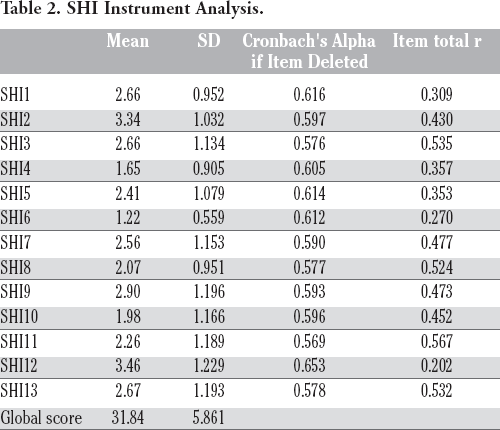
The Cronbach's alpha for SHI-i was 0.618 and ranged 0.576-0.616 when an item is deleted. Table 2 shows the item-total correlation coefficient of SHI-I, between 0.202 – 0.567. In addition, a test-retest was conducted, and the result showed that SHI-i had good reliability at P<0.001.
SHI Instrument Analysis.
Validity: Factor structure of SHI-i
An exploratory analysis was conducted to test the construct validity of the SHI-i. Kaiser-Meyer-Olkin and Bartletts chi-square showed values of 0.604 and 187.255, respectively at P<0.001, thereby, supporting the adequacy of data for the analyses. Most items had factor loading greater than 0.40. The first factor consists of 6 items, which refers to sleep-distribution, with an explained variance of 19.90% and the second factor consists of five items referred to as irregular sleep-wake schedule at 11.88%.
Construct Validity
CFA was conducted to validate the structure of SHI-i extracted through EFA. The model with second order factors was performed, using, the Goodness-Of-Fit indices (χ 2 475.826 df = 101, P=0.00, GFI = 0.95, Incremental Fit Indices (IFI) = 0.959, Root-Mean- Square Error of Approximation (RMSEA) = 0.03) as shown in Figure 1.

The Factor structure of SHI. Model fit index: χ 2 475.826 (df = 101, p=0.00); Goodness-Of-Fit index (GFI) = 0.922, Comparative Fit Index (CFI) = 0.954, Incremental Fit Indices (IFI) = 0.959, Root-Mean-Square Error of Approximation (RMSEA) = 0.03.
Convergent Validity
Convergent validity was demonstrated through a significant and positive statistical correlation between global score SHI-i and 13 items of score SHI-i. Table 3 showed the correlation range between each domain was r = 0.202 – 0.567, P< 0.05.
Factor loadings for explanatory factor analysis

φ : Unrotated item factor loadings of explanatory factor analysis.
Discussions
These findings supported the psychometric of Sleep Hygiene Index-Indonesian (SHI-i) consisting of translation, validity, and reliability among Indonesia adolescents. It is an extension of the previous study and supports the SHI-i by constructing valid and convergent methods. 13 SHI-i had good validity and reliability used to screen sleep hygiene among adolescents.
The SHI-i was supported by construct validity and convergent validity, with the exploratory factor analysis used to extract the questionnaire. The results showed some changes in the factor structure, compared with the previous psychometric of the SHI, 25 with only 11 items of SHI-i greater than 0.4. This was considered statistically significant,18,19 with the interpretation of two items and also different characteristics of the population. 26 The CFA was also conducted to assess the construct validity of SHI-i, as shown in Figure 1. Convergent validity of SHI-i version showed a positive correlation between each item and total score. 24
This study also examined the internal and test-retest reliability for SHI-i with a Cronbach's alpha value of 0.618, similar to previous research13 using a stable test-retest reliability for two-weeks for the non-clinical population. 13 However, further study is needed to test SHI-i into the clinical sample.
Adequate sleep is associated with good sleep hygiene.13,23 This study did not examine the correlation between sleep quality and sleep hygiene, therefore, further research is needed. In addition, the research is limited to the sample size for EFA, which has not been established based on the rule of thumb with a minimum value of 100. 27
Conclusions
In conclusion, this study supports the psychometric of SHIIndonesia version, including reliability, construct validity, and convergent validity. This tool can be used to assess sleep hygiene practices among healthy adolescents.
Footnotes
Acknowledgements
The authors are grateful to the lecturers of the University for their friendly support.