






Abstract
Objectives
The aim of this study was to explore drinking culture and drinking situations that employers and employees encounter in the grey zone between work and leisure, and identify what might affect employees’ risky drinking behaviour.
Methods
We used eight focus groups to interview 61 core company informants from eight Norwegian companies (private and public sector) participating in the WIRUS – Workplace-based interventions preventing risky alcohol use and sick leave – project. The informants represented employers and employees with a diversity of roles at multiple organisational levels. The transcribed interviews were analysed by applying a phenomenological hermeneutical approach.
Results
The analysis revealed six dimensions of drinking culture representing potentially risky drinking behaviour in situations that fall in the grey zone between work and leisure: (1) “Who invited me?” (Degree of obligation towards inviter), (2) “Do I have to participate?” (Degree of participation volunteerism), (3) “To drink or not to drink?” (Degree of drinking volunteerism), (4) “Work talk or small talk?” (Degree of work-related conversation), (5) “Are there any drinking rules to follow?” (Degree of regulation), and (6) “The influence of being away from home” (degree of distance to home).
Conclusions
The findings reveal that employers and employees’ experience of drinking culture can be categorised as six different “shades of grey”. The grey zone is shaded from light to dark grey, indicating how risky the informants perceive the grey zone to be. The findings may be useful when designing workplace health promotion programmes and alcohol regulations in the workplace.
Significance for public health
Identifying potentially risky drinking situations in the grey zone between work and leisure is of relevance for public health as use of alcohol is considered a threat to public health. Alcohol is causing ill health and premature death, as well as physical and social problems. Work related use of alcohol is one arena influencing the alcohol consumption, and therefore a significant arena for a public health perspective on employees’ alcohol habits. In Norwegian working life, the use of alcohol takes place in the grey zone between work and leisure time, to a small degree at work, and identifying risky drinking situations in the grey zone, is of value in order to develop efficient and effective alcohol prevention strategies. The model developed in this article for identifying potentially risky drinking situations can help improve interventions for health outcomes for working population, significant for public health.
Introduction
The use of alcohol represents significant costs for workplaces in term of absenteeism and presentism, with subsequent loss of productivity,1-3 as well as costs due to co-workers’ drinking that, in turn, lead to working additional hours. 4 When including absenteeism caused by other employees’ drinking, as proposed by Laslett et al., 4 a new aspect of the impact of drinking in the workplace is raised. These costs are estimated to be AUD 348 million, almost as much as costs relating to employees’ own drinking, which is estimated to be AUD 368 million. 1
Most previous studies of work and alcohol have focused on drinking at work,5-7 problem drinking, 8 risk factors, 9 sick leave10,11 and presentism, 12 while a very few studies have to some extent investigated the grey zone between work and leisure.2,13,14
The concept of work-related drinking relates to the consumption of alcohol among employees in contexts that may be associated with the workplace, working environment or situations in which employees find themselves because of their job. 15 Drinking in work-related contexts has a long history. Over the decades, employees in the Western world have drunk alcohol on their way to work, “re-fuelled” at lunch, and then carried on after work. 8
The metaphor “grey zone” underlines the ontological dimension of the blurred zone between the workplace actor's free will and what “determinate[s] policies, knowledge, and practices”. 16 The concept of the grey zone is understood as an irremediable area of ambiguity, which haunts even the most apparently resolute discourse. 16
Christmas parties, work celebrations, work-related travel, customer meetings and drinking with colleagues after work are typical drinking situations that fall in the grey zone.2,14 According to Gusfield, 17 these situations usually transform social dynamics and communication, where alcohol serves as a “cue” to switch from work to leisure. However, since the nature, conditions and organisation of people's working life has now changed, the boundaries between work and leisure time are diminished.18,19 Many work tasks can be done away from the workplace (e.g. at home, restaurants, airports etc.) and the threshold for using alcohol while working has become low and may even be perceived as natural or a polite gesture. Accordingly, the discourses about work-related drinking have gradually changed from strict to liberal. Moreover, drinking is often understood as a phenomenon between culture and nature that functions as a central ritual and playful interaction for middle-class adults. 20 This may explain why healthcare policies and regulations for alcohol use in the so-called grey zones tend to be absent. 7
Over the past two decades, several empirical studies have documented the rise of a more liberal drinking culture in Norway and Europe.13,21 It has been shown that alcohol can have a positive impact on the workplace atmosphere, and that constructive drinking can be seen a ritual marking the transition from worktime to playtime, 17 as well as marking personal identity and inclusion. On the other hand, risky drinking poses health challenges and can lead to exclusion,22,23 undermine employees’ productivity and safety, 6,24,25 and have a negative impact on the workplace's psychosocial climate. Since the workplace culture (e.g. attitudes, behaviour and expectations towards alcohol) and workplace factors (e.g. working conditions, interpersonal factors, extended working hours, regulations and guidelines) affect people's drinking behaviour and how they interact in drinking situations in the grey zones,7,26 an access point for reducing alcohol-related risk factors is needed.27,28
The topic “drinking culture” is therefore included in our ongoing Norwegian project Workplace-based interventions preventing risky alcohol use and sick leave (WIRUS), which evaluates the usefulness of two different secondary preventive interventions among risky drinkers recruited from 24 workplaces all over Norway, employing approximately 30,000 persons. One of the sub-studies investigates the interventions’ effectiveness on alcohol use, sick leave and presentism, followed by a process evaluation and a cost-effectiveness study. One study focuses on the companies’ drinking culture, and constitutes the material in this article. Noticeably, one of our previous Norwegian studies revealed that 50 per cent of drinking situations at work were initiated and organised by employers, 12 while more than a quarter were initiated by the companies or employees external network. In this article, we investigated possible new dimensions that might identify what could affect employees’ risky drinking behaviour. There is little indepth knowledge about grey-zone drinking culture in the research literature about alcohol and work, despite the usefulness of this knowledge for employers, occupational health service personnel and others involved in workplace health promotion programmes. The ambiguity of the grey zone is whether being allowed, prescribed or prohibited to drink represents risky drinking situations.
The aim of this study was therefore to explore the drinking situations that employers and employees encounter in the grey zone between work and leisure, by answering the following question:
How do employers and employees experience alcohol culture in the grey zone, and what might affect their risky drinking behaviour?
Materials and Methods
Design
The study employed a focus group method to explore how employers and employees experience drinking situations in the grey zone. This method can facilitate group discussions and is especially suitable for reflecting the social realities of a cultural group. 29 Therein, people are more likely to feel comfortable talking to others who share similar experiences as a means of exploring sensitive issues. This qualitative approach attempts to understand how humans experience and construct meanings in their everyday lives. 30 To reveal their views and attitudes about workrelated alcohol use, informants were encouraged to share their experiences and illuminate different opinions collaboratively. We applied a hermeneutic phenomenological framework and analysis, 31 according to Binder et al.'s perspective that meaning is constructed in the meeting between the informants and the researchers. 32
Informants
Informants were recruited through their companies and the inclusion criteria were different roles and different organisational levels. In accordance with our inclusion criteria, we invited a heterogenic sample of informants from multiple organisational levels, including top management and line management, unions, safety officers, human resources departments, health, safety and environment departments, occupational environment committees, as well as a company advisor from the public social security office. The focus groups had between five and eleven participants (5, 6, 7, 9, 6, 11, 10, and 8, respectively) with different roles, including at the management level. Not all participants were present at all the focus group interviews. Not all were present at all the focus group interviews. Occupational health service personnel were not included since they played an intervention provider role in the WIRUS project, which could interfere with taking a neutral stance in the interviews.
We invited eight companies, four private and four public sectors. The participants in each focus group stemmed from the same company, and were in that sense homogeneous. A total of 61 core stakeholders from eight companies participated; Table 1 provides an overview of the informants.
Overview of the informants.

Some informants had two roles.
Data collection
The focus groups were facilitated by the moderator who used a self-developed interview guide. This included questions concerning the informants’ experiences and views of work-related drinking situations that regularly took place in the company. The informants were firstly invited to note “work-related drinking situations” on individual post-it notes that were later placed on a whiteboard and shared with the group. They were then asked to reflect on whether any potential drinking situations were missing and, if so, to add them. At the subsequent session, the moderator invited the informants to elaborate on and discuss the situations on the notes, using questions like “How did you experience the situation?” “What did you talk about?” “How much did you and your colleagues drink?”, and other topics or issues they found relevant. The informants then shared their own experiences, described traditions at their workplace and how their own and others’ drinking behaviour had changed from liberal to stricter, recalled shocking drinking stories, and had a group reflection on their current situation. The focus group sessions took place during working hours and on the company's premises. Each session lasted approximately two hours and was audio taped and transcribed verbatim.
Data analysis
The interviews were transcribed verbatim and the first and the second author read each transcription several times from a naïve position in order to grasp the meaning of the drinking situations as a whole for each focus group. The meanings extracted guided the next level of the analysis, which was the thematic structural analysis, consisting of the following four steps: Step 1: identifying meaning units relevant to the research question and formulated as close as possible to the data, Step 2: condensation and decontextualization of the meaning units, to get the essence of the meaning units, Step 3: identifying sub-themes with some distance to the meaning units, and Step 4: classifying sub-themes within the overall main themes. The naïve reading and structural analysis processes were conducted for each focus group horizontally (Figure 1). We then vertically analysed the main themes from each focus group (Figure 1) in order to obtain a comprehensive understanding of the general recurring themes. By using an inductive approach, five dominant and significant themes emerged, and a common dimension of a pattern of continuum within each main theme became apparent. Following the first and second authors’ analysis, the preliminary results were presented to a research group of 10 people before the interpretation process commenced. Preliminary results were then given to the WIRUS reference group and to a third researcher, who read the empirical data, and one additional theme; “Who invited me?” was included, leading to a total of six main themes. However, the pattern of dimensions did not change.

Overview of steps of the analysis, inspired by Lindseth and Nordberg. 34
Ethical considerations
The study was approved by the Norwegian Regional Committees for Medical and Health Research Ethics (approval no. 2014/647). All informants gave their informed consent in writing to take part in this study, and were informed that they could withdraw at any time. To ensure the confidentiality of the companies and informants, an anonymous identification number was allocated to each company and informant.
Results
Six main themes representing dimensions of drinking culture experienced by the participants and potentially risky drinking in the grey zone, emerged from the analysis of the focus group data (Figure 2): 1) “Who invited me?” (degree of obligation towards inviter), 2) “Do I have to participate?” (degree of participation volunteerism), 3) “To drink or not to drink?” (degree of drinking volunteerism), 4) “Work talk or small talk?” (degree of work-related conversation), 5) “Are there any drinking rules to follow?” (degree of regulation) and 6) “The influence of being away from home” (degree of distance to home). Each of these six dimensions was further elaborated in order to identify a deeper and more comprehensive understanding of how the employees perceived the drinking culture and potentially risky drinking zones. This resulted in a visual model showing how the different dimensions actually divided the grey zone into six dimensions representing potential risk areas, where each show seamless variation according to the different degrees of risks. By reviewing an actual drinking situation vertical view through the dimensions in model, one can identify the he degree of risk in a situation.
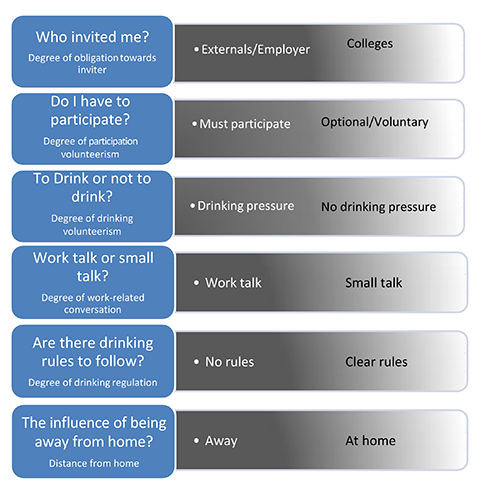
The shaded grey zone between work and leisure, illustrating gradient of potential risky drinking.
Potential risk area 1: Who invited me?
The first potential risk area is connected to the degree to which the employee felt an obligation towards the inviter. The informants reported that their experiences of work-related drinking situations varied, depending on who initiated the gatherings. For instance, if the situations were initiated by their employer, employees felt obliged to participate, and employers paid for a limited or unlimited amount of beverage. Accordingly, for employees, this resulted in a moderate level of drinking. However, if alcohol was served as a reward, the number of beverages consumed increased significantly. For example, in one of the focus groups several informants described how a health, environment and security trip, initiated as a reward for reducing sickness absence, resulted in a large amount of alcohol being consumed: “You have a group of people lying there, drinking shots and spilling drinks on their neighbour…”. Noticeably, when the employer initiated the drinking, the level of consumption was influenced by the context of the situation. Contrary, at gatherings initiated by external collaborators, the informants were often offered unlimited amounts of alcohol but were nonetheless expected to behave in a sober manner. Informants in several focus groups also discussed dilemmas related to being the host. Many employees had experienced that inviting customers and customer care had been presented as a delicate issue, due to the pushed limits of their company's alcohol policy. As one informant said: “…if they say they want gin and tonic, they'll get gin and tonic.”
When colleagues took the initiative to go out for a drink together, everyone paid for their own drinks and alcohol consumption varied depending on the occasion and who participated.
Potential risk area 2: Do I have to participate?
The second potential risk area was connected to the degree of participation volunteerism in work-related drinking situations. The informants reported that they either felt obliged to, ought to, or felt free to partake. Those who felt that they could attend voluntarily often described work-related drinking in positive terms. In contrast, those who felt pressured to participate often described the situation as challenging. However, even non-formal drinking situations (e.g. Christmas or summer parties) arranged to mark an employer's gratitude towards their employees, were considered situations where informants felt obliged to participate. As one infor mant reported: “Of course you have to come! It'll be great fun.” Many informants felt that they were deviant if they did not participate, even if the situation was taking place in their free time. Other drinking situations the informants felt obliged to participate in were situations with a professional content, such as signing contracts, customer courtesy and excursions.
Several informants reported their difficulties in identifying the differences between compulsory participation and voluntarily participation. However, some informants felt free to choose when to join in, and as one participant said “…it's completely up to you.”
Potential Risk Area 3: To Drink or not to Drink?
The third potential risk area concerned the degree of drinking volunteerism. Informants expressed an interpersonal attitudinal and affiliative conflict related to drinking expectations. Across the focus groups, the informants were aware of how workplace values and employers' expectations influenced their judgement in drinking situations. As one employee said: “You're rude if you don't drink when someone offers a toast.” Informants described their intrusive experiences in both national and international settings and drinking cultures: “When working abroad…there is a pressure to drink.” Similarly, managers reported a pressure to help along celebrations with alcohol and several informants had positive experiences with the use of alcohol. Noticeably, some informants expressed that drinking expectations have declined over the years and they found it easier nowadays to decide not to drink, due to an increased focus on work-related use of alcohol, as illustrated by the following quote: “…in most of the situations, it is completely up to you whether you want to drive or have a drink.”
Potential risk area 4: Work talk or small talk?
The fourth potential risk area was related to the degree of work relevance in the communication between those participating in the drinking situations. Stories across the focus groups revealed that the content of the conversation varied in the different drinking situations. One informant described a common experience of consuming alcohol while performing ordinary work tasks: “Alcohol is very often used at executive team strategic meetings…,” demonstrating the close link between alcohol and work. When drinking and networking with colleagues or partners after regular working hours, the drinking situations can't still retain some work relevance, as expressed by one employee: “It's more a combination of professional and social purposes.”
Potential risk area 5: Are there any drinking rules to follow?
The fifth potential risk area was related to company regulations for alcohol use. All focus groups reported episodes concerning colleagues or employees drinking too much. They mentioned dilemmas and difficulties that emerged during the various drinking situations, like careless handling of sensitive issues, rude behaviour and sexual harassment and assaults among colleagues and partners. All companies had “unwritten rules” that included acceptable behavioural norms, where employers were expected to show trustworthy and courteous conduct, but several companies had no written policy or company handbook. All focus groups described the workplace as an alcohol-free zone during normal working hours, but the definition of working hours varied. The perception of regulation in the grey zone also differed between the companies and between positions in the company, from diffuse to non-existent policies.
The grey zone was also perceived to be a delicate issue to regulate. As one informant put it: “You could say that this is defined as leisure time. This is their [the employees’] free time. Then this is like a grey zone, a borderland, where we can't impose an alcohol and drug policy [on the employees].” On the other hand, in all eight focus groups, informants expressed the need for preventive regulation in the grey zone. A quote illustrating a common opinion was: “…they [the guidelines] have probably focused a bit too much on abuse, and too little on norms and our [alcohol] culture.”
Potential risk area 6: The Influence of being Away from Home
The sixth potential risk area was the degree of distance from the primary workplace and home. Many informants underlined that working abroad and business trips resulted in leisure time spent away from home (e.g. at barracks, hotels or other facilities). Employers and employees were removed from their daily routines; they were alone and beyond their everyday regulation of drinking, as illustrated in the following quote: “We often stay at hotels alone – it's a kind of a lonely life…. So, it's convenient to go to the bar … Easy to grab a beer.” Most of the employees characterised workrelated travel as predictors of increased use of alcohol : “It ends up with everybody sitting around and drinking. Then it develops into a culture for that [drinking].”
Shading the grey zone
By identifying a common pattern vertically (Figure 2) across the six main dimensions of potentially risky areas from the individual focus groups, we interpreted the highlighted grey zone and revealed a seamless continuum within each of the six dimensions.
As all six dimensions were relevant in every grey zone situation, and in order to highlight the drinking situations experienced by the participants and identify those that entailed potentially risky drinking, our comprehensive understanding of the various drinking situations guided us to the different shades of grey according to the different dimensions. The light grey zone represented primarily driven by leisure, with little relevance to work, for example, where colleagues initiated drinking situations outside work. Both employees and employers across the focus groups expressed voluntarism as regards whether or not to participate. The topics of conversation were mostly private, and the focus groups expressed a high degree of autonomy and a limited need for regulation. They were influenced by their proximity to home.
The partly graded zone represented situations that were to some degree driven by work, for example when an employer or an external representative initiated the situation. The focus groups reported that they ought to participate and drink, and the conversations were work-related. The focus groups saw a need for alcohol regulation in these situations as they were away from the influence of their home, e.g. business travel and working abroad.
The dark grey zone portrayed a combination of dimensions where the employer invited them to drink, employees felt they had to participate, they had to drink, the conversations were strictly work topics and the situations often occurred during business travel or when working away from home. The focus groups described the drinking situations in this zone as challenging due to balancing work and personal time, and felt regulation was needed. There was common agreement in the focus groups that fall under the dark grey zone that the situation was meaningful and important for teambuilding at work.
This vertical view (Figure 2) across the different dimensions of the grey zone implies the continuum of seamless shades of the grey zone, as shown in the model, despite only three shades being highlighted here.
Discussion
The aim of this qualitative study was to explore drinking situations encountered by employers and employees that fall in the grey zone between work and leisure, and identify drinking culture and what might affect employees’ risky drinking behaviour. The results show how experiences at the micro level, i.e. the focus groups, interact with the macro level. i.e. Norwegian work-related drinking culture. Savic et al. 33 working definition of drinking culture emphasises “the multiple and multifaceted nature of drinking at both macro and micro levels”. This takes into account that the influence of drinking cultures “…on individuals is not inevitable but will depend on the configurations of factors in play in any given situation, and the nature of relationships between the culture as a whole and smaller cultural entity as they affect individual”. According tour results, the grey zone between work and leisure appears to be an even more multifaceted context than at work, and the six dimensions we identified are factors in play in all situations in the grey zone. The shading of the grey zone illustrates how cultural entities affect employees and employers, and must be taken into account in order to understand the drinking culture's influence and shade the grey zones.
The light grey zone identified in this study represents the transition from work to playtime and playtime clearly appears to dominate. 21,17
In the partly graded zone, alcohol functions as a relationship builder in working life and seems to be coloured by the purpose of the transition from working life to playtime. 17 According to Sulkunen's understanding of alcohol (and drug), 20 it is a construction of meaning, and we perceive the partly graded zone as a melting pot of constantly reconstructed meanings, and as such, it is challenging to handle.
The dark grey zone, understood in light of Hochschild's theories, 19,34 seems to be a zone in which the borders between work and leisure have been diminished, or rather, the work zone has moved into the leisure zone. The dark grey zone seems to represent a “working while drinking zone”, which was a surprising finding given that drinking is commonly regarded as disorderly behaviour in Norway.
The drinking of “expectations to drink” is in conflict with the strict of expectations to not drink at work. Drinking that falls under the dark grey zone is nonetheless considered appropriate and meaningful. 20
Increased awareness of drinking situations emphasised the need and desire for workplace regulations, in line with Moan and Halkjelsvik's findings. 22 Inspired by Sulkunen's analysis of several studies of norms, 6 functions and discourses of drinking, we understand the drinking in the shaded grey zone to not only be a result of discourses, but also as related to the individual actors’ self-control, style and individual freedom. The actual drinking, the practices and the discourses, are translations of each other, or according to Savic et al., 33 the interaction between the micro and macro level. The drinking zones are arenas in which the interplay between the individual actors and the collective of actors take place – arenas where culture and nature meet. Therefore, these arenas are significant for influencing both individual drinking practices and collective drinking discourses in the drinking situations.
One example of nature meeting culture is what is perceived as careless handling of sensitive information and rude behaviour among colleagues and partners under the influence of alcohol. These actions may have started as individual behaviour (nature) and developed into a collective acceptance of behaviour (culture) over time. This concerns both employees and employers. Collective regulation influences an individual's drinking as well as the drinking culture.
What we have chosen to call “shading the grey zone” highlights dilemmas caused by work-related drinking situations. On the one hand, it clarifies different challenges according to the identified dimensions, while on the other hand, it expands our understanding of the importance of increased awareness of the pitfalls and possibilities inherent in these zones.
Furthermore, we find support for our results by adapting Frone and Trinidad's model of the perceived physical availability of alcohol at work to our potential risk areas between work and leisure. 5 Inspired by Ames & Grube 34 and Ames & Janes, 35 Frone and Trinidad developed a structural model of perceived physical availability at work and workplaces, and find three risk factors for alcohol use and impairment during the working day. These dimensions are: (a) alcohol can be easily brought into work, b) alcohol can be easily used during the workday, and c) alcohol can be easily obtained at work. 5 In all our potential risk areas, alcohol is brought into the grey zone, alcohol can easily be used or even more easily be used than not used, and alcohol is easily obtained.
Method limitations
Eight companies in Norway have been included in the study and it is set in the context of Norwegian working life. When investigating at the micro level, we wanted the employees and employers to reflect in depth on alcohol use that falls in the grey zone and what influenced their own alcohol use. Our study does not highlight particular sectors of working life, but does cover both the private and public sector. Therefore, certain business sectors particularly exposed to alcohol or with distinctive alcohol cultures may not be covered by our findings. We nonetheless believe that our results, which draw on other studies relating to the theme or that have similar patterns, make the findings relevant to drinking that falls in the grey zone.
The management level was represented in all focus groups and this has likely influenced the discussion, since sensitive topics may have been regulated or censured. In addition, we could have benefited from collecting data about the participants’ perceptions through individual interviews in addition to collective data about norms through the focus groups.
The first and second author, who work with alcohol and work issues from the research and practical field, respectively, have participated in half of the focus group interviews, and conducted the main analysis. The closeness to the subject was challenged by the two other authors, one leading the WIRUS project, the other with a distance to the subject, and resulted in an additional finding.
Conclusions
To our knowledge, drinking culture in the grey zone has not yet been investigated from Savic et al. 33 “working definition” of drinking culture, and our study serves as an empirical contribution to their work. The findings concerning alcohol cultures and potentially risky drinking areas in the six shades of the grey zone legitimises the need for regulation and written policies due to the darker shades of the grey zone, and underlines the strong relationship between alcohol and working life. The slogan “work as an alcohol free zone” is hereby challenged.
On the one hand, we could argue for a complete alcohol-free zone due to the risks, while on the other hand, we could propose treating alcohol as a significant ingredient of modern working life, in order to develop an expedient drinking discourse, rather than the contradictions raised by current practice. This could improve workplace health by more easily identifying risky situations in the grey zone, but also by improving communication about the issue workplace actors. In addition, we argue for strong regulation in the dark grey zone, some regulation in the graded zone, and even a basis and awareness for discussing the drinking discourses in the lighter grey zones. By shading the grey zone between work and leisure via shading the various drinking situations, risky workrelated drinking situations were identified. The study culminated in a model, which is useful for identifying and defining drinking culture, policy documents, tools for practice, risk factors, the content of WHPP programmes and as a tool for further research. The model provides a benchmark to create a culture and practice within organisations in order to embrace an awareness of and healthy attitudes towards alcohol. We recommend using the model as a checklist and a starting point for dialogue between managers and employees, in order to identify potentially risky drinking situations, create a policy that represents the whole workplace and share ownership of the policy. More research is needed to evaluate our model of six shades of grey, including using the model to study the effect of new written policies and empirically challenging the model in a larger population.
Footnotes
Acknowledgements
The authors would thank Norwegian research Council for funding the project, and the participating companies and the employees/employer's contribution in the focus groups.
Contributions: HS, participating in some of the data collection, analysing, interpreting, discussion, development of the model and been in charge of the total article; SLR, participating in the data collection, analysing, interpreting, discussion, development of the model and participated through the whole research process; LGK, feedback on the manuscript, on theoretical framework, methods, structure and contents; RWA, feedback on the manuscript, participating in the interpreting, discussion and development of the model.
Conflict of interest: the authors declare no potential conflict of interest.
Funding: the paper was funded by The Norwegian Directorate of Health and The Research Council of Norway.