The present study aimed to explore using popular technology that people already have/use as a health promotion tool, in a campus wide social media health promotion initiative, entitled #LancerHealth. During a two-week period the university community was asked to share photos on Twitter and Instagram of What does being healthy on campus look like to you?, while tagging the image with #LancerHealth. All publically tagged media was collected using the Netlytic software and analysed. Text analysis (N=234 records, Twitter; N=141 records, Instagram) revealed that the majority of the conversation was positive and focused on health and the university. Social network analysis, based on five network properties, showed a small network with little interaction. Lastly, photo coding analysis (N=71 unique image) indicated that the majority of the shared images were of physical activity (52%) and on campus (80%). Further research into this area is warranted.
Significance for public health
As digital media continues to become a popular tool among both public health organizations and those in academia, it is important to understand how, why, and which platforms individuals are using in regards to their health. This campus wide, social media health promotion initiative found that people will use popular social networking sites like Twitter and Instagram to share their healthy behaviours. Online social networks, created through social networking sites, can play a role in social diffusion of public health information and health behaviours. In this study, however, social network analysis revealed that there needs to be influential and highly connected individuals sharing information to generate social diffusion. This study can help guide future public health research in the area of social media and its potential influence on health promotion.
Introduction
It is believed that popular digital media channels can play a role in leveraging health messaging and perhaps lead to behaviour change.1-4 Several aspects of the digital environment offer opportunity to support behaviour change efforts including reach, engagement, accessibility, collaboration and advocacy, and research potential.
1
Specifically, the use of social media (SM) has been shown to drive traffic and increase the interest in health promotion initiatives.5,6 The SM tools are designed to support collective knowledge sharing with interfaces that promote ease of editing and real-time changes unlike their web site predecessors.
7
There are six main types of social media platforms: blogs (including microblogs, discussion forums, and message boards), virtual game worlds, virtual social worlds, online collaborative projects, content communities, and social networking sites (SNSs).
8
Although there is no single canonical definition for a SNS, they have been defined as web-based services that allow individuals to i) construct a public/semi-public profile within a bounded system, ii) articulate a list of other users with whom they share a connection, and iii) view and traverse their list of connections and those made by others within the system.
9
This, SNSs are technologies that support a culture of community sharing (i.e., Facebook, Twitter, and Instagram). It has been suggested that sharing ideas and experience with others through online social networks may have health benefits,
10
and online communities have been described as the …single most important aspect of the web with the biggest impact on health outcomes.
11
Some research suggests that a general SNS platform (i.e., Facebook, Twitter, Instagram) works better than digital media platforms created specifically for the research study (i.e., website, app), as people feel comfortable with communication in their trusted networks, and as they are already using the sites it is easier to incorporate into their daily routine.12,13 Importantly, fewer technical barriers mean that those using these applications are potentially changing their roles from passively receiving information from a site (i.e., where content was often generated solely by the owner), to collaboratively building knowledge.
14
However, little research has examined the notion of collaborative behaviour in relation to health knowledge creation online, and more research is needed to understand the actual effect of social network technologies on health promotion. Moreover, evidence is needed regarding the actual usability of online social networking and how different platforms and interface design elements may help or hinder behaviour change and engagement.
15
The present study aimed to explore Twitter and Instagram as a health promotion tool, in a campus wide SNS health promotion initiative entitled #LancerHealth. The Lancer is the mascot at the mid-sized Canadian University where the health promotion initiative was set to occur. The concept of this health promotion initiative was developed based on studies,16,17 that have shown a positive effect size on health behaviour change, through involving network alteration.
18
In those studies16,17 it was hypothesized that people were more likely to adopt a behaviour if they knew someone similar to them, or some of their friends’ friends, had done it before (i.e., homophily and clustering; also components of offline social networks). In the present study, the goal of #LancerHealth was for the participants’ natural occurring Twitter and Instagram networks contribute to the social diffusion of what does being healthy on campus look like to you?. Specific objectives include exploring the use of Twitter and Instagram as health promotion tools, and investigating the difference between the two SNSs platforms. Furthermore objective include understanding what being healthy on campus looks like to members of a university community through an assessment of images tagged with #LancerHealth and the ability of SNS to underwrite social diffusion.
Materials and Methods
#LancerHealth was a campus wide SNS health promotion initiative. During October 19th – November 2nd, 2016 staff, students, and faculty were asked to What does being healthy on campus look like to you? by posting a photo on their Twitter or Instagram account and tagging the image with the hashtag LancerHealth. Campus members had a chance of winning a $50 gift card to on campus outlets for participating. The initiative was promoted through campus wide newsletters, email, SM, in class presentations, presentations in the student centre (where promotional information business cards were actively distributed), partnerships with school clubs, and promotional posters. Furthermore, the promotional information business cards were strategically placed throughout areas of campus that relate to health (i.e., bikes used for the bike share program, in the fitness centre, at the on campus dentist and chiropractor). Data collection for Twitter and Instagram was conducted using the Netlytic program,
19
where text and social network analysis were examined. Finally, a photo coding scheme for this group of images was implemented and further discussed below.
Netlytic analysis
Using the Netlytic program,
19
an open sourced software, all tagged media with the #LancerHealth hashtag on Twitter and Instagram were downloaded (i.e., when the post was tagged, not necessarily when it was posted). The download occurred during October 19th – November 2nd. Netlytic
19
captured all public profiles but may have returned publically shared photos from users with otherwise private profiles. Specifically, for this study, Netlytic
19
was used to identify popular topics in the #LancerHealth datasets, as measured by word frequency. Furthermore, Netlytic
19
performed a network analysis around #LancerHealth, both a name network (i.e., who mentions whom) and a chain network (i.e., who replies to whom). The records for Twitter (N=234) and Instagram (N=141) were downloaded, and all records were used in the text and network analyses, however, data was subsequently cleaned to identify unique authors of images.
Coding of images
Among the Twitter data (N=234 records), promotional, unrelated, image-less tweets, and re-Tweets (the re-posting of a Tweet) were removed, leaving 30 images for photo coding analysis. Among the Instagram data (N=141 records), unique posters of images were identified (N=50), and further deletion of promotional and unrelated posts left a remainder of 41 images for coding. Images were coded in content categories (physical activity, food, mental health, or other). Furthermore, it was of interest to indicate whether the photo was taken on or off campus and if the photo was depicting and/or was posted by a student athlete or university team and/or club.
Results
Netlytic analysis
Out of a possible ∼16,500 staff, students, and faculty on campus, only 71 unique images were posted to Twitter and Instagram, with only 41 unique authors having participated. However, it should be reiterated that the Netlytic software
19
only imports publically available data, which means more staff, students, and faculty could have participated in the health promotion initiative but they had private accounts. On average, unique Twitter users (N=19) who posted an image, had 2163±2312 total tweets, 318±335 total following, and 261±295 total followers. On average, Instagram images, had 40±34 likes, with the majority (N=26; 63%) not filtered using an Instagram filter.
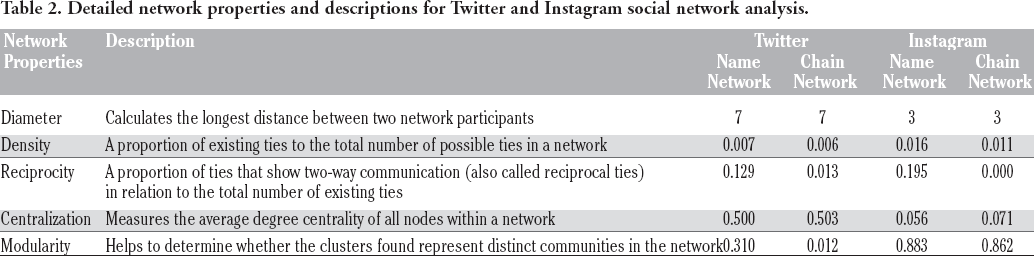
Among the 234 total records on Twitter, there were 2164 unique words associated with the posts (in the description of the picture or in the comment section). Furthermore, among the 141 records on Instagram, there were 880 unique words associated with the posts (in the description of the picture or in the comment section). The top 15 words associated with each platform, can be found in Table 1. The social network analysis for Twitter revealed that there were 207 individual names found within the dataset, with 41 nodes (i.e., users) and 310 ties (i.e., linkages between the users via mentioning someone in the post/comment). The chain network/ direct interactions analysis indicated 2 nodes (i.e., users) and 160 ties (i.e., direct replies between users). Furthermore, the social network analysis for Instagram revealed that there were 107 individual names found within the dataset, with 22 nodes (i.e., users) and 41 ties (i.e., linkages between the users via mentioning someone in the post/comment). The chain network/direct interactions analysis indicated 65 nodes (i.e., users) and 70 ties (i.e., direct replies between users).
Netlytic measured five network properties, which describe network characteristics like how individuals interact with each other, how information flows, and whether there are distinct voices and groups within the network.
19
Detailed network properties for both platforms can be found in Table 2. In regards to the social network analyses, based on the diameter property, a small network exists for both the name and chain network. As the density property is closer to zero for both networks types, it is suggested no one is connected to others in the network, there is not a close-knit community, and participants are not talking with others. The conversations appear to be one sided, with little back and forth conversation, indicated by the low reciprocity values for both networks. Specifically, there was no reciprocity score for the chain network on Instagram, as the chain network (for Instagram) is a communication network that connects each commentator to the poster of the image, this suggests that authors of images were not tagging other Instagram users on their post. The centralization values look different for Twitter and Instagram, potentially due to the way in which each SNS platform is used. As the nature of Twitter is to generate discussion, it would make sense that the centralization is closer to one (i.e., indicates few central participants who dominate the flow of information in the network), compared to Instagram where there is decentralization (i.e., closer to 0 and information flows more freely between participants). The modality, representing distinct communities in the network, is below 0.5 in the Twitter network, suggesting the network consists of a core group of nodes. In contrast, the modality is closer to 1 in the Instagram networks, suggesting that clusters do not overlap and the network does not consist of a core group of nodes.
Coding of images
Of the 71 unique images, 37 (52%) were related to physical activity, 17 (24%) were related to food, 5 (7%) were related to mental health, and 12 (17%) were categorized as other (i.e., medical services available on campus, alcohol consumption, selfies). Of the unique images (N=71), 57 (80%) were taken on campus and 13 (18%) were depicting or posted by a student athlete or university team account.
Discusssion
This study aimed to explore using Twitter and Instagram as health promotion tools, in a campus wide SNS health promotion initiative. Unfortunately, very few members of the University community participated in the SNS health promotion initiative. Although we aimed to spread this initiative all over campus, it is possible that staff, students, and/or faculty did not see (or care to engage in) the advertisements and/or may not have been comfortable using SNSs. To feel accepted, SNS users often times create an online persona based on social norms in their SNS community.20,21 Thus, individuals may have felt that participating in the #LancerHealth initiative would not fit with the persona they try to exhibit on their SNS accounts and/or be accepted in the social norms of their SNS community. It is also possible that influential campus SNS users (i.e., those with the largest reach; large following) did not participate in the study and, thus, the social diffusion of the initiative did not occur successfully as it could have. However, of those who did participate, the conversation around the images appears to be positive, focused on health, and frequently mentioning the university. An implication of this finding is that results of the online conversation could assist the University in the identification and promotion of campus based activities, which have been expressed in a positive and healthy way from the students’ perspective. Interestingly, 5 of the top 15 words within the Twitter data were specific accounts of people/places on campus, in comparison to Instagram where no people/places were in the top 15. This could suggest that specific individuals may have the potential to be influential, however, based on the network analysis, the individuals or accounts were simply more active in the campaign than others. Future directions should include investigating the motivation behind the health promotion campaign, motivation to participate, and the post-campaign level of measurable success as these aspects would help to further develop this research area.
According to Statistics Canada
22
perceived health includes overall physical, mental, and social well-being. The images appear to be dominated by physical activities (i.e., workout videos, action shots, post-work snapshots) that were available on campus (i.e., the university's fitness centre, walking paths on campus). Although many things can define health, more than twice the number of images depicted physical activity compared to the next closest category (food). This may indicate that, on this particular campus, perceptions of health may be dominated by physical activity ideals (albeit limited by the low number of images). Further, only a small number of images depicted health services on campus, something to which universities and colleges are actively trying to improve.
23
Specifically, previous recommendations to improve knowledge and access of campus health services have included extensive outreach programming and web-based education,
23
making SNSs health promotion initiatives important tools and opportunities that should be capitalized on.
One of the biggest limitations is that the findings presented here are only representative of the publically available data. However, based on the publically available data, the network properties suggest a small network where individuals were not interacting. One sided conversations, indicated by the reciprocity value, do not help in creating social diffusion. Further, interactive behaviours have distinct patterns based on the specific SNS being explored, thus it comes to no surprise that the social network analysis in the current study looks different between Twitter and Instagram. Twitter is a microblogging provider with the platform's functionality not promoting cross-sharing (i.e., sharing to another online network) and thus keep the conversation within the platform itself.
24
In contrast, Instagram is primarily focused on picture and video dissemination and with sharing as a central theme of the application (i.e., there is an embedded Share button to route the post to various social media networks) there is a drive for crosssharing and conversation elsewhere
24
. Specific to this study, the Twitter network was dominated by a few specific nodes that essentially controlled the conversation. It appears that these core nodes are not influential in their online network, as previous research would suggest that people would be more likely to adopt the behaviour, in this case posting a photo/participating in #LancerHealth, in instances of homophily and clustering.16,17 It could be that within the online networks of those that participated, their followers do not feel similar to them, they are not healthy on campus, they are not a member of the university and, therefore, did not participate, and/or their followers had private accounts and therefore the content was not retrieved. Moreover, the Instagram network revealed that people were not tagging others in their post, nor were commenters on the photo tagging other Instagram users. To improve social diffusion on Instagram future health promotion initiatives could suggest tagging a friend when posting/promoting. Overall, these network analyses suggest that this health promotion initiative did not generate social diffusion among users and that Twitter and Instagram need to be used in different ways to generate social diffusion. The lack of social diffusion among users may be explained by the two-step flow of communication theory.
25
Trends and innovations get adopted and spread by what Katz and Lazarsfeld call opinion leaders.
26
These informed, respected, and well-connected individuals
26
are a thus a critical layer for social diffusion, and the two-way communication theory has been supported in SM research.27,28 Therefore, the results of the current study suggest that there was a lack of opinion leaders that participated in #LancerHealth. As such, it is suggested that for a public health initiative to be successful on SM influential and connected individuals (i.e., opinion leaders) need to participate, thus, promoting social diffusion and the public health message to a greater audience.
Conclusions
Although participation for this study was low (relative to the size of the university), results indicated that using popular technology that people already have/use as a health promotion tool can be positive. Findings indicated that participation in a variety of healthy activities on campus can be shared through online networks. Results from both the text and social network analyses indicated there is potential for social diffusion, but there is a need to use the two-step flow of communication theory
25
as a theoretical framework in future SNS health promotion initiatives. Future research needs to explore how to engage online participants in SNS health promotion initiatives, and what interface/platform should be used to accomplish the goals of the particular promotion.