






Abstract
Background
There is currently lack of knowledge about survival trend analysis of thalassemia patients. Therefore, the aim of the present study was to assess 5-, 10-, 20-, and 30-year survival of thalassemia patients over a 20-year time period.
Results
Five and 10-year survival rates remained unchanged since 1995-2016. Overall, 20- and 30-year survival rates were lower in younger birth cohorts than older ones. A declining trend was found in 20-year survival rate from 1995 to 2000 for all and also for thalassemia major patients, but was stable from 2001 to 2016. In addition, there was a declining trend in 30-year survival rate from 1995 to 2008 for all and also for thalassemia major patients, but was an increased trend from 2009 to 2016.
Conclusion
Over the past two decades and in recent birth cohorts, the 20- and 30-year survival rates has declined. In other words, declining survival trends in the birth cohorts may be associated with some different causes of mortality such as exposure to the toxic effects of iron over time and the occurrence of diseaserelated mortality.
Significance for public health
A downward trend in the survival of thalassemia patients observed in this study suggest a potential supports of the community which is related with the quality of life and then improving the survival in the thalassemia patients. Moreover, some different social and individual factors might influence the survival which it is suggested further research to investigate these factors on the survival.
Introduction
Thalassemia is considered as a public health challenge with an annual number of 60,000 to 70,000 new cases and 18,000 deaths worldwide. 1 Thalassemia is also one of the common hemoglobinopathies disorders occurring in Iran. Despite a significant improvement in the thalassemia prevention program (TPP) 2 and treatment, 3 it is estimated that over 300 new cases are annually occurred in Iran. 4
Conducting an obvious knowledge about epidemiological status of the disease such as incidence and survival trends can help policymaker in different aspects. This information is essential for the planning of control and prevention strategies, evaluating the effectiveness of interventions, and services delivery systems.
Previous epidemiological studies conducted on survival analysis for thalassemia disease have reported a significant improvement in the survival rate based on the comparison with other similar studies.5,6 Although, a few studies have reported a significant effect of birth cohort on the survival rate.7,8 To date, there is no evaluation of the survival trend in thalassemia patients during the past two decades, and it is unknown whether this survival trend is increasing over time or not. Therefore, the aim of the present study, which is the first in its kind and also is in line with the purposes of Iran's National Institute of Health Research, 9 was to assess whether overall and 5-, 10-, 20-, and 30-year survival rates of thalassemia patients have improved over a 20-year time period.
Materials and Methods
A retrospective cohort study was conducted on enrolling 1003 beta-thalassemia (major, intermedia, and sickle cell) patients in 2016 in Shiraz, the southern Iran. The inclusion criteria were having a definitive diagnosis of beta-thalassemia major. We have excluded the sickle cell thalassemia (16 patients) and those with missing data (5 patients) from the analysis (Figure 1). This study was performed following approval by the Ethics Review Committee of Shiraz University of Medical Sciences.
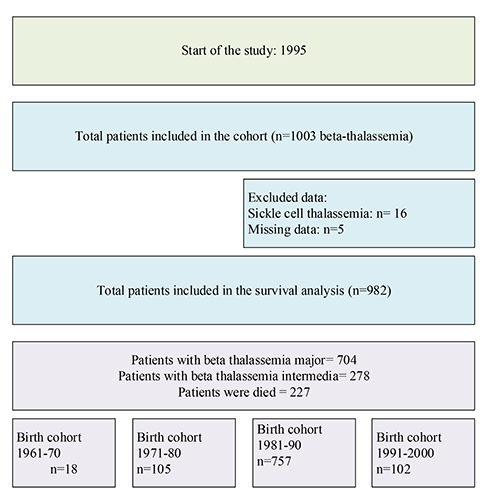
Flowchart of this retrospective study.
The Iranian TPP was established in 1997. 10 There is a referral Hospital with a document-based system in each county for treatment services of the patients. Data were extracted from patients’ medical records using a comprehensive predetermined checklist, 5 which the information including type of thalassemia, date of birth, and date of death (if applicable) were used in this analysis.
We derived 5-, 10-, 20-, and 30-year survival rates (as the endpoints of this study) in various time intervals between 1995 and 2016. The survival time for the patients was considered as the interval between the date of birth and the date of death or May 31 in each year during 1995-2016. The Cochran-Armitage test was used for survival trend analysis. The Chi-square for trend test was used to compare in survival trends by type of thalassemia. The subjects were divided into four birth cohorts (1961-70, 1971-80, 1981-90, and 1991-2000) and 20-, and 30-year survival rates were calculated in various time intervals between 1995 and 2016 for each birth cohort.
Moreover, the Kaplan-Meier estimate and log-rank tests were used to describe and compare overall survival based on different birth cohorts (1970s and earlier, 1980s, 1990s, and 2000 to the present) which birth cohort 1970s was considered to be the reference group. All statistical analyses were done with 95% confidence interval using Stata 11.2 (StataCorp. College Station, TX, USA).
Results
The data of 982 patients were identified. Of them, 704 (72%) patients were beta thalassemia major and 227 patients died.
Table 1 shows trend of 30-year survival rates of the patients by birth cohorts in the past two decades. Overall, 30-year survival rate is lower in younger birth cohorts than older ones in 2010 to 2016 for which the survival data for three birth cohorts are available. In other words, 30-year survival rate for birth cohort 1981-90 at year 2016 was 0.69 which for birth cohort 1961-70 at year 2016 was 0.882.
Trend of 30-year survival rates of thalassemia patients by birth cohorts in the past two decades, Iran.

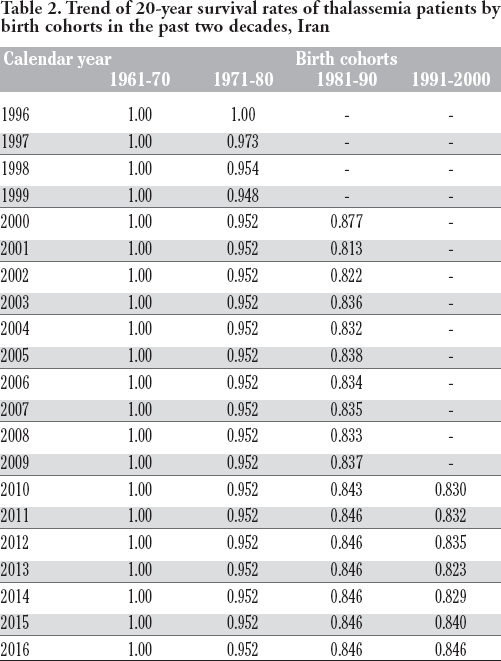
Trend of 20-year survival rates of the patients by birth cohorts in the past two decades is shown in Table 2. In all investigated year (calendar year), the 20-year survival rate slowly declined with increasing birth cohort. For example, 20-yer survival rate for birth cohort 1961-70, 1971-80, 1981-90, and 1991-2000 was 100, 95.2, 84.3, and 83.0%, respectively (Figure 2).

Kaplan-Meier survival curves for the thalassemia patients enrolled in this study stratified by birth cohorts.
Trend of 20-year survival rates of thalassemia patients by birth cohorts in the past two decades, Iran
Five-, 10-, 20-, and 30-year survival estimates for all thalassemia patients and by type of thalassemia disease obtained in various time intervals are presented in Figure 3 and 4, respectively. In the Figures, the 5-, and 10-year survival rates remained unchanged since 1995-2016. There was a declining trend in 20- year survival rate from 1995 to 2000 for thalassemia major patients, but was stable from 2001 to 2016. Also, a stable trend was observed for 20-year survival rate in thalassemia intermedia patients. In addition, there was a declining trend in 30-year survival rate from 1995 to 2008 for all and also for thalassemia major patients, but was an increased trend from 2009 to 2016 for both types of thalassemia.

Five-, 10-, 20-, and 30-year survival estimates for thalassemia patients obtained in various time intervals, Iran, 1995-2016.
Discussion
Based on data collected from a large thalassemia patients’ cohort, we found a new finding which was inconsistent with finding from the previous survival studies worldwide. We found a declining trend in the 20- and 30-year survival rates from both TM and TI patients during 1995–2016. But, the 5- and 10-year survival rates were stable during two past decades. In this study, birth cohort effect was also investigated on the 20- and 30-year survival rates. Our finding showed that older birth cohorts had a higher 20- and 30-year survival rates.
The 20- and 30-year survival rates have decreased during two past decades since 1995 for both TM and TI patients. The trend of both 20- and 30-year survival rates had a sharp reduction before 2000. There are some reasons which could explain this finding. After implementation of the thalassemia prevention program from 1997, the quality of healthcare services may be improved. On the other hand, several reforms have been implemented to Iran's health system over the last three decades. For example, the establishment of the Family Physician Programme in 2005, 11 and the Health Sector Evolution Plan in 201412 which the purposes of them were to improve the referral system and provide healthcare services in rural and urban areas. These reforms could explain the stable trend in the 20-year survival rate after 2000 and increased trend in 30- year survival rate after 2008 (Figure 3).
The 20- and 30-year survival rates declined with increasing birth cohort, which the birth cohort 1961-70 had better survival rates than birth cohort 1971 to present. We found no similar study for comparison. But the probable explanation for this is that older patients that survive from bone marrow transplantation (BMT) had very good chance of long term survival as they do not require blood transfusion. Therefore, selection bias may be affected of this finding. Another explanation is that in most previous survival studies, cohort data were cross-sectionally analysed to obtain the survival rate at the end of study period. In these studies, Kaplan-Meier plots were used to compare different birth cohorts which are inconsistent with our findings based on birth cohort. Telfer
Based on the traditional Kaplan-Meier survival analysis, our findings have also shown a significant difference among birth cohorts (Figure 4). In other words, older birth cohorts had a higher survival rate. This result is inconsistent with the results from other survival studies.7,8,15 In a study with 1044 Greek thalassemia to assess the survival rate compared to the general population, authors found that birth cohort has a negative significant trend towards past decades. 8
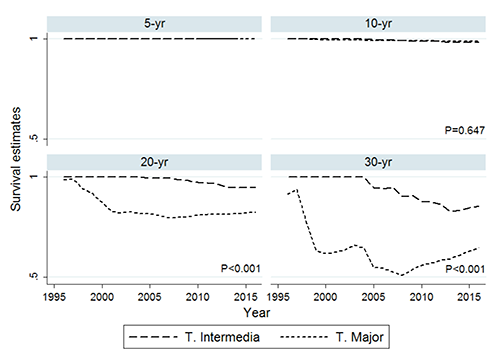
Five-, 10-, 20-, and 30-year survival estimates by type of thalassemia disease obtained in various time intervals, Iran, 1995-2016.
Despite the growing success rate of thalassemia prevention programs in the past two decades,2,17 questions remain as to why the survival rate of the patients has declined. In our opinion, establishment a multicentre study could help to identify the underlying causes of this finding.
The data used in our study have been extracted two times from document-based database. First time for another objective, 18 which was approved by Fasa University of Medical Sciences (Grant No. 93188) and the second time for our purpose. Therefore, the quality and precision of the data was a significant strength of this study. An important limitation of the study was the lack of causes of death in the studied cohort. This information could have helped in the better inference of the declining trend in the 20-and 30-year survival rates.
Conclusions
Over the past two decades and in recent birth cohorts, the 20- and 30-year survival rates has declined. In other words, declining survival trends in the birth cohorts may be associated with some different causes of mortality such as exposure to the toxic effects of iron over time and the occurrence of disease-related mortality. Moreover, some different social and individual factors might influence the declining trends which further research to investigate these factors on the survival trend is suggested.
Footnotes
Acknowledgments
This work was extracted from the PhD thesis by Shahab Rezaeian and was financially supported by Shiraz University of Medical Sciences (Grant No. 94-7610). The authors would like to thank Mr. H. R. Tabatabaee (Scopus Author ID: 6507314325) for providing us a number of valuable comments.
Conflict of interest: The authors declare no potential conflict of interest.
Contributions: Study concept and design: JH, SR. Analysis and interpretation of data: JH, SH, AM. Drafting of the manuscript: JH, SR. Critical revision of the manuscript for important intellectual content: JH, AM, MK, YV. Statistical analysis: SR, JH. Study supervision: JH.