




Abstract
Tai Chi has been shown to have many great health benefits. However, few research attempts have been made to explore the effects of practicing TCC on life span. This study provides direct evidence of Tai Chi's antiaging effects. We conducted a retrospective cross-sectional study to compare the rejuvenating and antiaging effects among Tai Chi group (TCC) and brisk walking group (BW) and no exercise habit group (NEH). Thirty-two participants were selected out of a possible 60 based on a survey, and they were separated into three groups: the TCC group (practicing for more than 1 year), the BW group (practicing for more than 1 year), and the NEH group. The CD34+ cell counts in peripheral blood of the participants was determined, and the Kruskal–Wallis test was used to evaluate and compare the antiaging effects of the three groups. Of the 32 participants in this study, the participants in the TCC group (N = 10) outperformed the NEH group (N = 12) with respect to the number of CD34+ progenitor cells. No significant difference was found between the TCC group and the BW group. TCC practice sustained for more than 1 year may be an intervention against aging as effective as BW in terms of its benefits on the improvement of CD34+ number.
Introduction
Tai Chi Chuan (TCC), also called Taijiquan, is a traditional Chinese martial art and now a worldwide healthy sport. TCC has been confirmed to benefit patients with mild to moderate Parkinson's disease (25) and fibromyalgia (39). TCC may also have advantages such as pain reduction (31,39,40), fall prevention and improvement on balance (9,12,13,19,20,23,24,29,43,44), aerobic capacity (17,35), blood pressure (5,28,37,46), quality of life (7,11,14), quality of sleep (22,45), and stress reduction (7,12,18,26,36). Owing to the above benefits, we believe that TCC may also show potential benefit in extending life span.
Cluster of differentiation 34 (CD34+) is a surface marker of hematopoietic stem cells (HSCs) providing blood cells through hematopoiesis, which is regulated by a balance between self-renewal, differentiation, and proliferation (15,27). CD34+ stem cells range from about 0.01% to 0.03% in the peripheral blood of humans (34). The life of HSCs may be limited by age-related loss of telomeric DNA (3,38), repeated exposure to irradiation (4), or diminishing proliferative capacity after serial transplantation (10). Both the clonogenic capacity and quantity of HSCs decrease with age in the bone marrow and peripheral blood (6,30,34). Therefore, HSCs are an indicator to evaluate aging (2,27).
The major aim of this study is to objectively evaluate the potential life-lengthening effect of TCC. We conducted a retrospective cross-sectional study to compare the rejuvenation and antiaging effects between TCC and brisk walking (BW) by determining CD34+ cell counts.
Materials and Methods
Study Participants
The inclusion criteria of study participants were comprised of the following: The participants should be older than 18 years of age, with no underlying disease involving long-term intake of medicine and no long-term (more than 1 year) moderate-intensity exercise habits, not pregnant or previously pregnant, with no physical deformities. All participants gave informed consent, and the study was approved by the institutional review board (IRB) at the China Medical University Hospital, Taichung, Taiwan.
Study Design
This is a retrospective cross-sectional study. We randomly collected 60 likely participants and gave them questionnaires including variables such as name, sex, age, education, occupation, marital status, height, body weight, sports habits, underlying disease such as cardiopathy, nephropathy, diabetes, or HBV infection, pregnancy status, and if there is any regular drug intake. Twenty-one participants were immediately excluded from this study (see Fig. 1 for reasons for exclusion), and the other 39 participants were separated into three groups: the Tai Chi Chuan (TCC) group (N = 11), the brisk walking (BW) group (N = 12), and the group without a regular exercise habit (NEH) (N = 16). Among the qualified participants, one participant of the TCC group (so N = 10), two participants of the BW group (N = 10), and four participants of the NEH group (N = 12) declined to participate in this study. The participants of the three groups were all evaluated by determining CD34+ cell counts in peripheral blood.
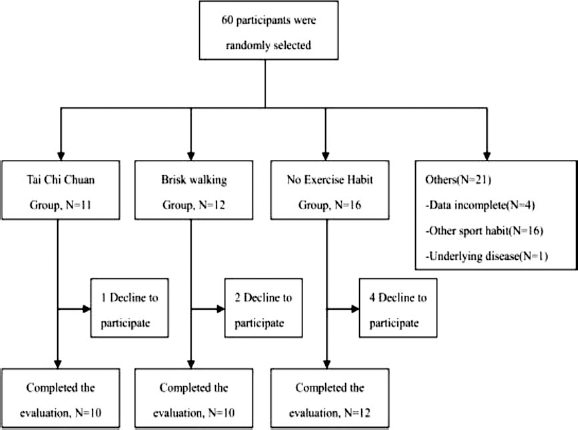
Participant screening, randomization, and completion of evaluation.
Tai Chi Intervention
The 10 participants in the TCC group all practiced “the eight essentials of Tai Chi,” which includes ward off, roll back, press, push, pluck, lay, elbow, and lean sideways (Fig. 2). The 10 participants in the TCC group practiced TCC at least twice (>2.5 h) per week and kept practicing for more than 1 year. In each practice, they started with a warming-up exercise, then practiced TCC, and ended with a static stance and diaphragmatic breathing as a palliative exercise.

The eight essentials of Tai Chi. The eight essentials of Chi contain eight actions: ward off, roll back, press, push, pluck, lay, elbow, and lean sideways.
Brisk Walking Intervention
The 10 participants in the BW group practiced BW at least twice (>2.5 h) per week and kept practicing for more than 1 year. In each practice, they started with a warming-up exercise, then practiced BW, and ended with a general palliative exercise.
No Exercise Habit Intervention
The 12 participants in the NEH group had not followed any specific exercise routine for more than 1 year. The time spent on exercise was less than 2.5 h per week.
Outcome Measures
Blood Sampling
The participants all had their blood sampled between 10 am and noon, thus avoiding circadian variations in the number of CD34+ progenitor cells concentration (38,39).
Flow Cytometry of CD34+ Hematopoietic Stem and Progenitor Cells
Flow cytometric analysis was performed directly after collecting for each donor sample. Peripheral blood was quantified using the following approach. Venous blood samples were collected into BD Vacutainer cell preparation (CPT™) tubes (BD Biosciences, San Jose, CA, USA) and then centrifuged at 1,500 × g for 15 min. The mononuclear cell fraction was washed three times in phosphate-buffered saline. The buffy coat was enumerated using a hemocytometer. One million cells were then stained with human CD45-fluorescein isothiocyanate (FITC) (BD cat. 555482), and CD34-phycoerthrin (PE) (BD cat. 555822). After vortexing, the cells were incubated for a further 30 min in the dark at room temperature. Analysis was performed on a LSR II (BD) analytical flow cytometer.
An arbitrary forward scatter (FSC) threshold to eliminate erythrocytes, platelets, subcellular particles, cell aggregates, and fragments was provided in data acquisition. A minimum of 50,000 events were acquired for each sample. In data analysis, total leukocytes were identified by sequential gating by CD45+ expression and low side scatter (SSC). The CD34+ cell population was defined as a single population of CD45+ events expressing CD34+ bright and low side scatter. The percentage of CD34+ cells was calculated as the number of CD34+ events as defined above, divided by the total number of CD45+ cells acquired, excluding debris (21).
Statistical Analysis
All statistical analysis was conducted with SPSS software. We made comparison among the performance of the TCC, BW, and NEH groups by Kruskal–Wallis test. We made further comparison between the TCC and BW groups and the TCC and NEH groups by Mann–Whitney U test with Bonferroni correction; p < 0.05 was considered statistically significant. Correlation between age and CD34+ cell counts were also performed using Pearson's and Spearman's tests.
Results
All of the 32 participants in this study are Taiwanese people that have obtained at least a high school education. There was no significant difference between the TCC group and the BW group regarding any variables including sex, age, race, education, body mass index (BMI), and duration of practicing. There was also no significant difference between the TCC and NEH groups with respect to the variables sex, race, education, and BMI, but there was a difference with respect to age (Table 1).
Baseline Characteristics of the Study Participants

All of the 32 participants were Taiwanese and were educated higher than senior high school.
We observed significant differences among the CD34+ counts of the three groups (p < 0.05) (Table 2). Though we found no significant difference in the TCC against BW comparison and BW against NEH comparison, we did find that the TCC group was significantly different from the NEH group (p < 0.05) (Tables 3–5). Tables 6 and 7 demonstrate that the significant difference between the TCC and NEH groups is unlikely to be due to age and is therefore likely to be due to TCC. A significant difference between the TCC and BW groups was also revealed with respect to age and CD34+ cell counts when the two patients older than 25 were removed from the study (Table 7).
Comparison of Longevity Parameters Between the Three Groups
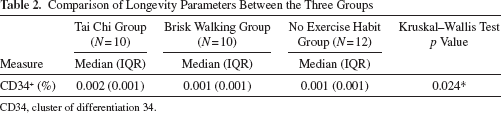
CD34, cluster of differentiation 34.
Comparison in Longevity Parameters Between Tai Chi and Brisk Walking Groups

Comparison in Longevity Parameters Between Tai Chi and No Exercise Habit Groups

Comparison in Longevity Parameters Between Brisk Walking and No Exercise Habit Groups

No Statistically Significant Correlation Between Age and CD34+ Cell Counts Was Found

The Age Composition and the Average CD34+ Cell Counts of the Three Experimental Groups Excluding the Participants Above the Age of 25

1 = TCC, 2 = brisk walking, 3 = no exercise habits.
ANOVA and Bonferroni test
Kruskal–Wallis test and Bonferroni test.
Discussion
TCC and Brisk Walking Are Both Moderate-Intensity Activity
BW is compared with TCC because they are activities at the same exercise intensity level. They are both exercises with moderate intensity ranging from 3.0 to 5.9 METs (metabolic equivalent) on absolute intensity (12,33,35,42). Therefore, under the similar metabolic equivalent, BW seems to be a proper choice of exercise to draw comparisons with TCC with an objective and quantitative scientific support (41). The similarity and differences between TCC and BW are compared in Table 8. Previous studies of aged female groups of TCC and brisk walkers have demonstrated significant improvements in fitness measures arising from the TCC (1).
The Similarity and Difference Between Tai Chi and Brisk Walking

Why a Young Population?
The participants in our study were all college students around 20 years old. Though one may argue that the effect of practicing Tai Chi should be more pronounced in a young population due to their better cell renewal ability than the old population, the choice of younger participants brings other advantages, such as the exclusion of chronic diseases and medication as interfering factors. In developing countries and in many industrialized countries, cancer, stroke, heart disease, and chronic lower respiratory diseases are now the leading cause of death (8,16,41). About 80% of adults who are aged over 65 years have at least one chronic disease, and 50% have more than two of these chronic diseases accelerating the aging process (8,16,41). Therefore, young participants exhibit a simpler condition in this study. We expect that the relatively simple condition may provide an easier way to build the mechanism about the relationship between longevity and TCC.
Tai Chi Intervention Increases Progenitor CD34+ Cells
Compared with the NEH group, the TCC group had a significantly higher number of CD34+ cells. According to Motivala et al. (32), the practice of the Westernized version of Tai Chi (Tai Chi Chih) can induce drastic decreases in the sympathetic nervous system (SNS) activity as indexed by the preejection period (PEP) in healthy older adults (p < 0.01). Therefore, it is possible that TCC may prompt vasodilation and increase blood flow, which in turn enhances the production of CD34+ cells (Fig. 3).
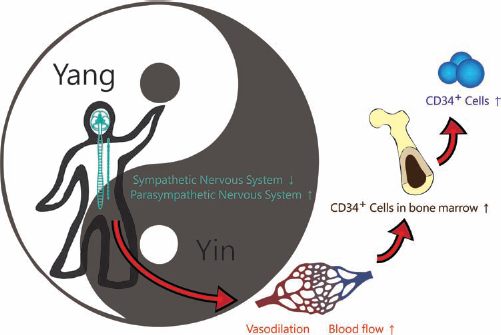
Tai Chi Chan (TCC) facilitates the production of cluster of differentiation 34-positive (CD34+) cells. Studies show TCC may prompt CD34+ cell production through the reduction of sympathetic nervous system (SNS) activity.
However, in our pilot study, we found that short-term (2 months) practice of TCC had no significant improvement in the number of CD34+ progenitor cells in young adults. This may indicate that the duration of practicing TCC could be an important factor between TCC and longevity.
Difference in Age Between the Tai Chi Group and the No Exercise Habit Group
There is a significant difference in age between the TCC group and the NEH group. Age is a factor that should be treated with caution, as both the clonogenic capacity and quantity of HSCs decrease with age in the bone marrow and peripheral blood (6,30,34). However, despite the fact that the participants of the TCC group are significantly older than that of the NEH group, the TCC's CD34+ progenitor cell counts still statistically and significantly outnumber those of the NEH group, which provides a solid proof of TCC's antiaging effect.
To further investigate the influence of age on our results, we conducted correlation analysis of age and CD34+ cell counts based on the data of [1] all of the 32 participants and [2] the participants under 25 (N = 30, excluding the two participants over 25). In either case, we saw no statistically significant correlation between age and CD34+ counts (Table 6).
Since some of the participants in the BW group are older than in the TCC (or NEH) group, and there is no significant difference between the performance of the TCC and BW groups, it is difficult to assess the relative benefit of the two treatments. Therefore, we tentatively excluded the two older participants (above the age of 25) in the BW group to minimize the age difference of the two groups and conducted analysis accordingly on the remaining participants. Interestingly, we found that the CD34+ cell count of the TCC group is then significantly higher than the BW group. Overall, our results suggest TCC is at least as effective as brisk walking as an antiaging intervention (Table 7).
Bias Control
The biomarker tests of stem cells are much more expensive, so we could only hold a small-scale study; therefore, the sample size is small. According to the above reasons, we chose a nonparametric statistical method, such as the Mann–Whitney U test, for statistical analysis. However, sampling error may still exist due to the small sample size. Therefore, we make the following efforts: prudential study design, strict screening of the participants to eliminate differences in background between the groups, and blood sampling at the same time of the day to avoid circadian variations of CD34+ progenitor cell counts (3,38).
Conclusion
Based on our results, long-term practice of TCC, sustained for more than 1 year, may be an effective intervention against aging. It is as potent as BW in terms of its effects on the improvement of CD34+ cell number. Considering that BW may generally require a larger space or equipment, Tai Chi seems to be an easier and more convenient choice of antiaging exercise.
Footnotes
Acknowledgments
This work is particularly supported by “Aim for the Top University Plan” of the National Chiao Tung University and Ministry of Education, Taiwan, R.O.C., and Lo-Sheng Sanatorium and Hospital, Ministry of Health and Welfare.