




Abstract
Persistent fetal vasculature (PFV) is a potentially serious developmental anomaly in human eyes, which results from a failure of the primary vitreous and the hyaloid vascular systems to regress during development. Recent findings from our laboratory indicate that fibrovascular membranes harvested from subjects with PFV contain neural progenitor cells (herein called NPPFV cells). Our studies on successful isolation, culture, and characterization of NPPFV cells have shown that they highly express neuronal progenitor markers (nestin, Pax6, and Ki67) as well as retinal neuronal markers (β-III-tubulin and Brn3a). In the presence of retinoic acid and neurotrophins, these cells acquire a neural morphological appearance in vitro, including a round soma and extensive neurites, and express mature neuronal markers (β-III-tubulin and NF200). Further experiments, including real-time qRT-PCR to quantify characteristic gene expression profiles of these cells and Ca2+ imaging to evaluate the response to stimulation with different neurotransmitters, indicate that NPPFV cells may resemble a more advanced stage of retinal development and show more differentiation toward inner retinal neurons rather than photoreceptors. To explore the potential of inner retinal transplantation, NPPFV cells were transplanted intravitreally into the eyes of adult C57BL/6 mice. Engrafted NPPFV cells survived well in the intraocular environment in presence of rapamycin and some cells migrated into the inner nuclear layer of the retina 1 week posttransplantation. Three weeks after transplantation, NPPFV cells were observed to migrate and integrate in the inner retina. In response to daily intraperitoneal injections of retinoic acid, a portion of transplanted NPPFV cells exhibited retinal ganglion cell-like morphology and expressed mature neuronal markers (β-III-tubulin and synaptophysin). These findings indicate that fibrovascular membranes from human PFV harbor a population of neuronal progenitors that may be potential candidates for cell-based therapy for degenerative diseases of the inner retina.
Keywords
Introduction
Inner retinal degenerative diseases, such as selective and progressive loss of retinal ganglion cells (RGCs), pose a major threat to vision (50, 51). Currently, there is no effective cure or treatment to reverse the loss of RGCs. Transplantation of stem or progenitor cells may have great therapeutic potential for treatment of neurodegenerative diseases, in general, and for the retina, in particular, by providing therapeutic benefits through both neuroprotective and cell replacement mechanisms (7, 38). In recent years, various neural stem or progenitor cells have been tested to determine their potential to integrate into the host retina after transplantation (1, 2, 8, 31). The regenerative potential of cell transplantation has already been shown for the outer retina (1, 35). Studies have shown that subretinal transplantation of postmitotic photoreceptor progenitors or embryonic stem cell-derived photoreceptors permitted integration and photoreceptor-specific differentiation of engrafted cells, and even functional recovery in rhodopsin-deficient or cone-rod homeobox (Crx)-deficient host mice (35, 43). However, it seems to be more difficult to achieve similar success for replacement of RGCs, as they adopt highly specialized properties and form numerous synaptic connections with other neurons (24). Due to the inhibitory environment present in the adult neural retina and lineage restriction of engrafted cells, limited integration and RGC-specific differentiation of engrafted cells has been found in the inner retina when cells have been intravitreally transplanted into the uninjured eye (6, 26, 47). Targeted disruption of glial cell activity and modification of the local environment with chemicals or by genetic manipulation have proven to facilitate infiltration of engrafted cells (23, 30).
However, few of these methods can be directly applied in a clinical setting, considering the obvious side effects on other retinal resident cells. If any possible therapeutic effects of replacing lost RGCs with transplanted stem cells are to be achieved for degenerative inner retinal conditions, it is essential that a suitable cell type be chosen for transplantation and a more biocompatible method be used to facilitate the integration and differentiation of engrafted cells in the host tissue. Indeed, glaucoma may not be the only inner retinal condition that could benefit from restoration of the RGCs. It is possible that RGC replacement could be applied to other diseases that result in the death or dysfunction of RGCs, such as ischemic optic neuropathy, optic neuritis, and inherited mitochondrial optic neuropathies.
In this study, we report a novel neural progenitor cell type isolated from human persistent fetal vascular tissue. In this condition, the hyaloidal vascular system that nourishes the developing lens fails to regress, leaving a whitish membrane in the anterior vitreous behind the lens. We recently discovered that this tissue contains neural progenitor cells. We first examined whether these persistent fetal vasculature-derived neural progenitor (NPPFV) cells exhibited characteristics of neuronal progenitor cells (such as antigenic and genetic profiles) and whether they were capable of differentiating into retinal neurons in vitro. To explore whether NPPFV cells have potential for cell-based inner retinal transplantation therapy, we intravitreally transplanted NPPFV cells into adult C57BL/6 mice and examined their integration and differentiation in the inner retina.
Materials and Methods
Isolation and PFV Cell Culture
Persistent fetal vasculature (PFV) membranes (Fig. 1A, insert) were obtained from young donors during corrective surgery performed by Dr. Tatsuo Hirose at the Massachusetts Eye and Ear Infirmary (MEEI). Removal of the membranes strictly adhered to the tenets of the Declaration of Helsinki approved by the Human Subjects Internal Review Board of MEEI and Schepens Eye Research Institute. Upon receipt of the PFV membrane, the tissue was placed in 1x phosphate-buffered saline (PBS) containing 3x concentration of penicillin–streptomycin, finely minced, placed in 0.1% type 1 collagenase (Invitrogen, Carlsbad, CA, USA), and agitated for 20–30 min at room temperature. Liberated cells in the collagenase solution were collected, forced through a 70-μm sieve, centrifuged, and plated in X-vivo medium (Lonza, Watersville, MD, USA) supplemented with 10% fetal bovine serum (FBS, Invitrogen), 1:50 B27 (Invitrogen), 1:100 N2 (Invitrogen), 10 ng/ml basic fibroblast growth factor (bFGF; Invitrogen), 20 ng/ml epidermal growth factor (EGF; Invitrogen), and 50 μg/ml nystatin (Sigma, St. Louis, MO, USA). Additional collagenase was added to the remaining tissue until all tissue was dissociated. Cells were seeded on 24-well tissue culture plates following each cycle and incubated at 37°C in a humidified 95% air and 5% CO2 environment. After 24–48 h, neurospheres were observed in the culture medium and transferred to fibronectin-coated tissue culture flasks in X-vivo medium with supplements described above. Cells were fed every 2 days and passaged or frozen down 75–80% confluence. At passage 5, a subset of cells was also cultured in differentiation medium consisting of all-trans-retinoic acid (100 nM, Sigma), brain-derived neurotrophic factor (BDNF; 50 ng/ml, Invitrogen), ciliary neurotrophic factor (CNTF; 20 ng/ml, Invitrogen), nerve growth factor (NGF; 20 ng/ml, Invitrogen), and 10% FBS. Cells then were examined for morphological features, antigenic profiles, gene expression, and neurotransmitter receptors.

Characterization of neural progenitors derived from persistent fetal vasculature (NPPFV) cells. Fundus view of a subject with persistent fetal vasculature (PFV) shows a whitish membrane in the anterior vitreous behind the lens (A, insert). Neurospheres of liberated NPPFV cells in subsequent passage (A). Neurospheres spread on fibronectin-coated plates (B). Coexpression of nestin (green fluorescence) and paired box protein 6 (Pax6; nuclear red fluorescence) in freshly dissected PFV membrane indicates presence of neural progenitors (C). Immunostaining of typical markers expressed by undifferentiated NPPFV cells (D–H) at passage 2. Incorporation of bromodeoxyuridine (Brdu; red nuclear fluorescence) and β-III-tubulin (green fluorescence) indicates that NPPFV cells have distinct populations. Proliferative NPPFV cells uptake Brdu have smaller morphology and fewer projections (I). Cultured NPPFV cells differentiated at passage 2 in a retinoic acid (RA) enriched conditioned medium and develop mature neuronal morphological appearance including a round soma and extensive neurites (J). Expression of β-III-tubulin (K) and neurofilament 200 (NF200) (L) in RA-differentiated NPPFV cells. Scale bar: 100 μm. Brn3a, brain-specific homeobox/POU domain protein 3A.
Immunocytochemical Examination
NPPFV cells were seeded on slide chambers (VWR, Batavia, IL, USA) and cultured in a differentiation-conditioned medium for at least 7 days or in normal growth medium for examining their antigenic profiles. Cells were fixed for 10 min in 4% buffered paraformaldehyde, washed in PBS, and blocked with 10% goat serum (Vector, Burlingame, CA, USA)/PBS solution for 30 min before immunocytochemical staining. Primary antibodies [including β-III-tubulin (Sigma), nestin (Sigma), paired box 6 (Pax6; Chemicon-Millipore, Billerica, MA, USA), Ki67 (Vector), brain-specific homeobox/POU domain protein 3A (Brn3a; Chemicon), bromodeoxyuridine (Brdu; Abcam, Cambridge, MA, USA), NF200 (neurofilament-200, Sigma), recoverin (Chemicon), retinal pigment epithelium-specific 65 kDa protein (RPE-65; Chemicon), cellular retinaldehyde-binding protein (CRALBP; Abcam), glial fibrillary acidic protein (GFAP; Sigma), α-smooth muscle actin (α-SMA; Abcam), fibroblast-specific protein 1 (FSP1; Sigma), cluster of differentiation 31 (CD31; Abcam)] were diluted in 2% goat serum/PBS solution to appropriate concentrations for incubating cells at 4°C overnight. Cells were rinsed with PBS and incubated with a secondary antibody consisting of either cyanine 3 (Cy3; Chemicon 1:500) or fluorescein isothiocyanate (FITC; Chemicon 1:300) at room temperature for 30 min on the following day. After rinsing in PBS, slides were mounted with Vectashield mounting medium containing DAPI (Vector) and visualized under an inverted fluorescence microscope (Olympus 1X51). All immunocytochemical analyses were repeated three or more times from the cells at passages 2–5. Related isotype immunoglobulins were used as negative controls (Chemicon).
Evaluation of Gene Expression by Real-Time qRT-PCR
To determine the gene profiles of NPPFV cells, real-time qRT-PCR was performed to compare designated mRNA expression of NPPFV cells with those of human retinal progenitor cells (hRPCs). hRPCs have been isolated from human fetal tissue and well characterized in vitro (1, 32, 62). The hRPCs used in this study were supplied by the laboratory of Dr. Michael J. Young at SERI, and the isolation procedures for those cells have been well addressed in a previous study (32). In brief, retinas of donors with an estimated age of 18 weeks of gestation were cut into small pieces on a dry Petri dish under a tissue culture hood and enzymatically digested in a sterile container at 37°C with periodic removal of supernatants and refilling with fresh digestion solution. Harvested cells from the supernatants after centrifugation were resuspended in cell-free retinal progenitor-conditioned medium, and then cells were transferred to fibronectin-coated tissue culture flasks containing fresh media. In the present study, both cell types (NPPFV and RPC) from passage 0 were cultured in the same medium after the original isolation from tissue samples to eliminate any possible influence from different culture conditions on their respective gene expressions. The mRNA expression of various transcription factors and retinal-specific proteins has been detected by PCR in early passages of cultured hRPCs (1). Therefore, hRPCs can serve as a well-established control for NPPFV cells in real-time qPCR experiments. Total RNA was extracted from NPPFV cells and hRPCs (both at passage 5) using an RNA isolation kit (Qiagen, RNeasy Mini Kit). To ensure samples without genomic DNA contamination, total RNA was treated with DNase (Qiagen, RNase-Free DNase Set) and cDNA was synthesized using a Synthesis Kit (Bio-rad). Total cDNA (1 μl) was loaded in each well, mixed with PCR master mix (TaqMan Universal, Applied Biosystems, Foster City, CA) and predesigned primers (IDT, San Diego, CA) for Pax6, nestin, atonal homolog 7 (ATOH7), recoverin, rhodopsin, synaptosomal-associated protein 25 (SNAP25), syntaxin-binding protein 1 (STXBP1), receptor-associated protein of the synapse (RAPSN), and THY1, respectively (listed in Table 1). The procedure for real-time qRT-PCR included 2 min at 50°C, 15 min at 95°C, followed by 40 cycles of 15 s at 95°C, 30 s at 55°C, and 30 s at 72°C (ABI PRISM 7900 HT; Applied Biosystems). Expression (evaluated as fold change for each target gene) was normalized to glyceraldehyde 3-phosphate dehydrogenase (GAPDH; a housekeeping gene) in hRPCs following the well-established Δ-Δ method (52). All assays were performed in triplicate. In addition, a nontemplate control was included in the experiment to estimate DNA contamination of isolated RNA and reagents.
Applied Primers for Real-Time qRT-PCR

PAX6, paired box 6; NES, nestin; ATOH7, atonal homolog 7; RCVRN, recoverin; RHO, rhodopsin; SNAP25, synaptosomal-associated protein (25 kDa); STXBP1, syntaxin-binding protein 1; RAPSN, receptor-associated protein of the synapse; THY1, Thy-1 cell surface antigen; GAPDH, glyceraldehyde 3-phosphate dehydrogenase.
Estimation of Intracellular Ca2+ in NPPFV Cells
To investigate the neurotransmitter receptor expression on NPPFV cells, Ca2+ imaging was performed by loading cells with the ratiometric Ca2+-sensitive Fura-2 dye. Briefly, cells were incubated at 37°C for 30 min in X-vivo medium (containing 3% FBS, 5 μM Fura-2 tetra-acetoxymethyl ester, 8 μM pluronic acid F127, and 250 μM sulfinpyrazone). Cells were washed in modified Mg2+-free Hank's balanced salt solution (HBSS, 2.6 mM CaCl2, 15 mM HEPES pH 7.4, and 250 μM sulfinpyrazone). Five types of neurotransmitters, γ-aminobutyric acid (GABA), glutamate (Glu), glycine (Gly), dopamine (Dopa), and acetylcholine (Ach) were dissolved in modified HBSS at a concentration of 0.1 mM. The largest dynamic range for Ca2+-dependent fluorescence signals is obtained by excitation at 340 and 380 nm, and their ratio of emission fluorescence intensities was detected at around 510 nm. From this ratio, the concentration of intracellular Ca2+ ([Ca2+]i) can be estimated, using dissociation constants that are derived from calibration curves. By using the ratio of fluorescence intensities produced by excitation at two wave lengths, factors such as uneven dye distribution and photo bleaching are minimized (InCyt Im2TM Ratio Imaging System, Cincinnati, OH) (16, 33). The change of [Ca2+]i was calculated from the difference between the peak Ca2+ concentration evoked by each agonist and the control value of HBSS (before the addition of agonist). At least 80 cells were selected for analyzing the change of [Ca2+]i evoked by each agonist, averaged over three repetitions.
Inner Retinal Transplantation
For studying their potential for inner retinal transplantation, NPPFV cells or hRPCs were intravitreally injected to 20 and 10 C57BL/6 mice, respectively. Animals were maintained in the animal facility of Schepens. All experimental procedures for transplantation were approved by the Institute's Animal Care and Use Committee and adhere to the statement for the Use of Animals in Ophthalmic and Vision Research. To trace the transplanted cells, NPPFV cells and hRPCs were infected with an adeno-associated virus 2 (AAV2) or retrovirus vector harboring enhanced green fluorescent protein (EGFP; HGTI, Boston, MA) following the instructions of each transfection kit, respectively. Mice (4–6 weeks of age) were deeply anesthetized with an intraperitoneal injection of ketamine (120 mg/kg) and xylazine (20 mg/kg), and pupils were dilated with 0.5% topical tropicamide. Dissociated GFP-positive cells (1 × 10⁵ cells/2 μl) were suspended in HBSS were transplanted into the vitreous cavity of the eye through a glass micropipette connected to a 10-μl Hamilton syringe via polyethylene tubing. Sham-injected mice received HBSS without cells. All experimental animals received injection in one eye, and the other eye was used as an untreated control. A small puncture in the cornea (paracenthesis) was used to reduce the intraocular pressure during the transplantation surgery (1). Rapamycin (2 mg/kg day) (LC Laboratories, Woburn, MA, USA) was administered to all surgical animals to ensure the survival of the xenograft (6, 15). To facilitate the differentiation of engrafted NPPFV cells, 10 mice were given intraperitoneal injections of retinoic acid (RA, 2 mg/kg day, Sigma) starting 1 day prior to transplantation and continuing until termination of the experiment. Of the 10 mice transplanted with hRPCs, five received rapamycin and the other five received rapamycin and RA. Animals received terminal anesthesia on week 1 or week 3 after transplantation, and the eyes were harvested after intracardial perfusion with 4% paraformaldehyde in PBS. Eyes were cryosectioned at 10 μm and examined under a Lecia TSC SP5 confocal microscope to evaluate the expression and location of different markers. Anti-GFP antibody (1:100, Abcam) was used to enhance the fluorescence of prelabeled-GFP, while anti-β-III-tubulin (1:500, Sigma, USA), anti-GFAP (1:300, Sigma, USA), and anti-synaptophysin (1:100, Dako, Carpinteria, CA) antibodies helped to assess the differentiation of transplanted cells. To estimate the survival and migration of grafted cells, we performed serial sections on four randomly selected eyes that had undergone NPPFV transplantation. We manually counted every 10th serial section, measuring 10 μM in thickness as to avoid redundancy of cell counts.
Statistical Analysis
Statistical analysis was performed using the SPSS 12.0 software package. Results are expressed as mean ± SEM (standard error of mean). Differences between groups were compared by using one-way ANOVA followed up with Tukey's test or t test, as appropriate, and two-tailed p values are reported.
Results
Immunocytochemical Characterization of NPPFV Cells
Following surgical dissection of clinical PFV membranes (funduscope of PFV subject) (Fig. 1A, inset) and subsequent isolation of cell contents, cells were collected and seeded in neural-supporting medium. As the cells were passaged, neurospheres began to emerge from the cultured NPPFV cells (Fig. 1A). Neurospheres were spread onto fibronectin-coated plates from which some cells grew long and slender projections shortly after the transfer (Fig. 1B). Immunofluorescent imaging of PFV tissue confirmed that some cellular elements in PFV coexpressed Pax6 (red nuclei) and nestin (green filaments) (Fig. 1C), indicating that PFV tissue contains some neural progenitors. Using immunochemical staining for nestin and/or Pax6, we estimate that about 0.2% (±0.16%) of resident cells in PFV membrane are neuronal progenitors (Fig. 1C). Although the population of those cells is relatively small, the cells are able to stably maintain their progenitor phenotype and normally proliferate in cultural conditions (see Materials and Methods). After being expanded up to 20 passages, characteristic markers of neuronal progenitors and retinal neurons were confirmed in the cultured NPPFV cells, including β-III-tubulin, nestin, Pax6, ki67, and Brn3a (Fig. 1D–H).
Further incorporation of Brdu and β-III-tubulin staining revealed a subpopulation of proliferating NPPFV cells that were smaller in size with fewer projections than their nondividing counterparts in the same batch (Fig. 1I). After treatment with RA-enriched medium, NPPFV cells exhibited a typical neuronal morphological appearance, including a round soma and extensive neurites (Fig. 1J). Immunolabeling confirmed that differentiated NPPFV cells only expressed β-III-tubulin (Fig. 1K) and NF200 (Fig. 1L) and not the other aforementioned markers. NPPFV cells were also investigated to exclude any possible contamination with other cell types by screening for the following markers: photoreceptors (recoverin), retinal pigment epithelia (RPE65), astroglia (CRALBP, GFAP), myofibroblasts (α-SMA), fibroblasts (FSP1), and endothelia (CD31). But none of these markers were detected in NPPFV cells (summarized in Table 2).
Antigenic Profiles of Cultured NPPFV Cells

Brn3a, brain-specific homeobox/POU domain protein 3A; Brdu, bromodeoxyuridine; NF200, neurofilament-200; RPE-65, retinal pigment epithelium-specific 65 kDa protein; CRALBP, cellular retinaldehyde-binding protein; GFAP, glial fibrillary acidic protein; α-SMA, α-smooth muscle actin; FSP1, fibroblast-specific protein 1; CD31, cluster of differentiation 31.
Gene Expression Profile of NPPFV Cells
Characteristic markers of retinal progenitors [Pax6, nestin (NES) and ATOH7], photoreceptors [recoverin (RCVRN) and rhodopsin (RHO)], synapse-related proteins (SNAP25, STXBP1, and RAPSN), and retinal ganglion cell (THY1) were selected to establish the gene expression profile of NPPFV cells. Real-time qRT-PCR revealed lower expression of retinal progenitor and photoreceptor markers in NPPFV cells than in hRPCs (t test, all p < 0.05) (Fig. 2). However, mRNA levels of the synapse-related proteins and of THY1 (a mature retinal ganglion cell marker) were significantly higher in NPPFV cells than in hRPCs (t test, all p < 0.05) (Fig. 2). These observations indicated that NPPFV cells are a type of tissue-specific progenitor in the retina with higher potential for differentiating toward inner retinal neurons (such as retinal ganglion cells) rather than photoreceptors.

Gene expression profiles of undifferentiated NPPFV and human retinal progenitor cells (hRPCs) by the real-time qRT-PCR at passage 5. NES, nestin; RCVRN, recoverin; RHO, rhodopsin; SNAP25, synaptosomal-associated protein (25 kDa); STXBP1, syntaxin-binding protein 1; RAPSN, receptor-associated protein of the synapse; THY1, Thy-1 cell surface antigen; hRPC, human retinal progenitor cell; P5, passage 5. *p < 0.05 and **p < 0.01.
Determination of Relative Levels of Intracellular Calcium
The relative number of undifferentiated and differentiated NPPFV cells was determined, and their Ca2+ concentration was tested using Fura-2 dye after stimulation with different neurotransmitters. A very small portion of undifferentiated and differentiated NPPFV cells responded to Dopa (6.41 ± 7.14% vs. 7.89 ± 9.18%), Ach (10.96 ± 8.12% vs. 8.23 ± 5.41%), GABA (14.94 ± 11.73% vs. 12.99 ± 4.86%), and Gly (16.67 ± 10.62% vs. 21.05 ± 9.72%), and no significant difference was found in each group (t test, all p > 0.05). However, Glu stimulation elicited a large response in undifferentiated and differentiated NPPFV cells (48.98 ± 11.67% vs. 87.88 ± 4.97%) compared to other transmitters (one-way ANOVA, p < 0.01). In addition, Glu evoked a response in a higher proportion of differentiated NPPFV cells than undifferentiated cells (t test, p < 0.01) (Fig. 3A).

Evaluation of responses of NPPFV cells to neurotransmitters by labeling the calcium indicator dye Fura-2. (A) The percentage of responding NPPFV cells after stimulation with different neurotransmitters at a concentration of 0.1 M. (B) Pseudocolor images of representative NPPFV cells before and shortly after the applications of different neurotransmitters. The rainbow scale from blue to violet indicates the gradual change from low to high level of [Ca2+]i. (C) The peak [Ca2+]i of responding NPPFV cells after stimulation with different neurotransmitters at a concentration of 0.1 M. **p < 0.01. HBSS, Hank's balanced salt solution (vehicle); Dopa, dopamine; Ach, acetylcholine; GABA, γ-aminobutyric acid; Gly, glycine; Glu, glutamate.
Some cells that responded to neurotransmitter stimulation were selected for measurements of relative [Ca2+]i (Fig. 3B, white arrows). A limited number of NPPFV cells responded to stimulation with Dopa, Ach, GABA, and Gly. Interestingly, the elicited [Ca2+]i of these cells was also quite low, with little or no difference between differentiated and undifferentiated NPPFV cells. Glu elicited a significant increase in the concentration of Ca2+ in undifferentiated and differentiated NPPFV cells compared to the rest of the neurotransmitters examined (one-way ANOVA, all p < 0.01) (Fig. 3C). Glu stimulation elicited a higher [Ca2+]i in differentiated than in undifferentiated cells (t test, p < 0.01) (Fig. 3C).
Survival and Migration of Transplanted NPPFV Cells and hRPCs
Transplanted NPPFV cells were tracked in vivo by their expression of EGFP, which was enhanced by anti-GFP antibody staining. DAPI was used to identify the nuclei of live cells. Generally, engrafted cells pooled together in the posterior vitreous and remained as discrete clumps adjacent to the ganglion cell layer (GCL) at week 1 posttransplantation (Fig. 4A). Some transplanted cells were observed in the inner retina, and among these cells, some exhibited migratory-like morphological features in the outer or inner plexiform layers (Fig. 4A, white arrows). A number of engrafted cells were observed at 3 weeks posttransplantation in the inner and outer retina (Fig. 4B). EGFP-labeled NPPFV cells could be observed in retinal tissues extending up to the outer nuclear layer (ONL) (Fig. 4B). Based on the observations, we estimated that approximately 3.51 ± 2.60% (range, 0.83–6.22%) grafted cells migrated in the retina, but many surviving NPPFV cells still adhered to the ganglion cell layer (Figs. 4–5). As some of the cellular segments may not have been clearly stained by immunohistochemistory and that we may have missed some intervening cells, the percentage cited above may be an underestimate.

Survival and migration of transplanted eGFP-expressing NPPFV cells (A–B) and hRPCs (C) to the retina of adult C57BL/6 mice. NPPFV cells survived well on day 7 posttransplantation and remained as discrete clumps in the host retina above the ganglion cell layer (GCL), and some cells migrated into the inner nuclear layer (INL) (A, white arrows). On day 21 posttransplantation, migrations of engrafted cells were observed in the INL and outer nuclear layer (ONL) (B). The engrafted hRPCs (enhanced green fluorescent protein [eGFP] labeled) survived well and clustered onto the GCL at week 3 posttransplantation, but few cells migrated into the host retina (C). Scale bar: 20 μm.
Some migratory NPPFV cells exhibited characteristically neural cell morphology, including long and slender projections. Although some migration of engrafted NPPFV cells was found in host retina, the anatomic structure of the retina appeared morphologically normal with distinct structural layers as revealed by DAPI labeling (Fig. 4B). In addition, EGFP-labeled hRPCs were also injected into the posterior vitreous of adult C57BL/6 using the same procedures as NPPFV cells. Engrafted hRPCs survived well and clustered above the GCL at 3 weeks posttransplantation; however, few engrafted hRPCs could be found in the inner retina (Fig. 4C). To our knowledge, this is the first observation that engrafted human progenitor cells can survive and migrate into the inner retina of adult animals through intravitreal transplantation.
Integration and Differentiation of Transplanted NPPFV Cells
Typical markers of glial cells and mature neurons were applied for checking the neuronal behaviors of NPPFV cells in the host retina. Immunolocalization of β-III-tubulin (red fluorescence) expression of engrafted cells indicated that a small number of the engrafted cells had already merged in the GCL at 3 weeks posttransplantation (Fig. 5A). Similarly, glial reactivity, indicated by GFAP (red fluorescence), was significantly increased in the host retina, but few NPPFV cells were GFAP positive (Fig. 5B). We speculate that glial activation seems to be a significant obstacle for migration of engrafts, as some NPPFV cells were observed in a gliosis.
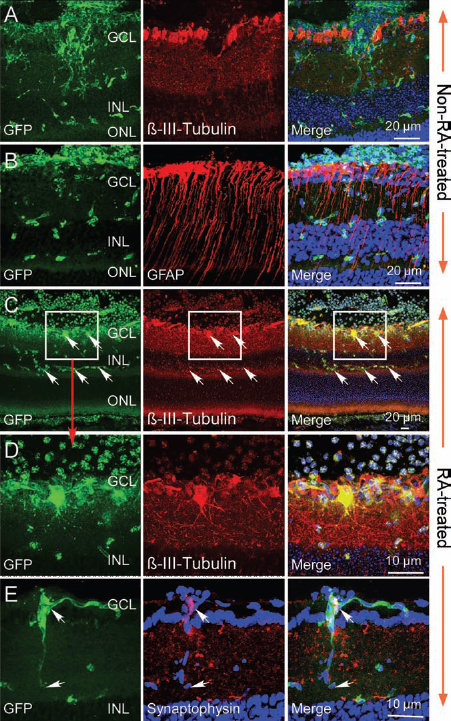
Integration and differentiation of the engrafted NPPFV cells in the host retina. Immunohistochemical examination revealed that the engrafted NPPFV cells can differentiate into retinal ganglion-like neurons and form synaptic connections within the host inner retina after modulating the host retinal microenvironment by treating with RA. We observed that some engrafted cells migrated in the retina and integration into the GCL at week 3 posttransplantation (A, Merge) by immunolabeling with GFP (green) and β-III-tubulin (red). We also saw that glial reactivity significantly increased in host retina but not in the PFV cells by immunostaining with GFAP (red) after transplantation at week 3 (B). Integration of NPPFV cells into the GCL was found after 3 weeks RA treatment; the engrafted cells displayed retinal ganglion-like phenotype with β-III-tubulin expression (C, white arrows) and a typical area covered in the white box in (C) is shown in (D) at higher magnification. Synaptophysin (red) indicated that connections had formed between the transplanted NPPFV cells and the host inner retina (E). RGC, retinal ganglion cell; GCL, ganglion cell layer; INL, inner nuclear layer; ONL, outer nuclear layer; GFAP, glial fibrillary acidic protein.
Posttransplanted differentiation into mature retinal neurons or glial cells was not clearly observed in the engrafted cells. We attempted to induce the differentiation of the transplanted cells by modulating the retinal microenvironment with intraperitoneal treatment of RA. After 3 weeks of treatment, β-III-tubulin was detected in these GFP-positive engrafts that naturally integrated into the GCL and inner nuclear layer of the host retina (Fig. 5C, white arrows). Interestingly, some integrated NPPFV cells in the GCL presented as mature retinal ganglion-like cells, such as a round soma and extensive neurites (Fig. 5D). Furthermore, immunostaining for synaptophysin (a functional marker of mature neurons) revealed that synaptic connections had formed between the NPPFVs and the inner retinal cells (Fig. 5E, white arrows). The percentage of differentiated NPPFVs may be relatively low, but they were not rare. These findings indicated that the NPPFV cells could differentiate into retinal ganglion-like neurons in the host retina in response to RA.
Discussion
Although numerous recent studies have highlighted the possibility of applying stem cell-based therapy for retinal degenerative diseases, multiple fundamental problems must be resolved before it can be used clinically (7, 36–38, 60). One of the key hurdles to the application of cell transplantation for human retinal disease is finding an acceptable source of stem cells or their derivatives. Successful experiments with animal models of stem cell-based replacement for photoreceptor degeneration have proved that an appropriate cell candidate could lead to the integration of engrafted cells into the host retina circuit and even achieve functional improvement of vision (35, 43). However, the structural and functional benefits of stem cell transplantation for the inner retina mostly come from strategies for neuroprotection of endogenous surviving neurons, including supplying neurotrophic factors, regulating the host microenviroment, and promoting endogenous self-repair, rather than targeted cell replacement (5).
Various cell types, including hippocampal stem cells (56, 63), bone marrow-derived mesenchymal stromal cells (64), oligodendrocyte precursor cells (4), and some human Müller stem cells (6), have been tested but have failed to integrate into the inner retina if transplanted intravitreally into healthy adult animals. Physical barriers for engrafted cell migration have been identified in the inner retina (23). Targeted disruption of glial activity and modification of the local microenvironment with genetic manipulation or chemicals has been proven to facilitate retinal infiltration of engrafted cells (23, 30). However, few of these methods can be directly transferred to clinical application, considering the obvious side effects on other retinal resident cells. Therefore, it would be essential to find a suitable cell type and establish some clinically feasible methods if any cell-based therapy is to be considered for inner retinal diseases in the future.
In this study, we have successfully cultured and characterized neural progenitor cells derived from human PFV membranes in vitro. Although the population of those cells in PFV membrane was relatively small, they were able to stably maintain the same characteristics as progenitor cells and normally proliferate in cultural conditions (Fig. 1A, B). Therefore, it would not be difficult to harvest enough cells for further studies. PFV results from a failure of the primary vitreous and the hyaloid vascular systems to regress during development (14) and has been described as one of the most serious developmental anomalies in the human eyes (46). The pathogenesis of PFV is still unknown. Recent studies have indicated that deficiency of transcriptional factors (19), and an imbalance of angiogenic growth factors (11) may play important roles in the pathogenesis of PFV. Considering the derivation and location of PFV membranes, we hypothesized that these membranes may contain some type of retinal progenitor cell. Repeated screening for different antigenic markers indicated that undifferentiated NPPFV cells exhibit characteristics of neural progenitors instead of other retinal cell types (Table 2). However, these NPPFV cells could be differentiated in vivo into a retinal ganglion cell-like morphology and express neuronal markers. We observe high expression of β-III-tubulin in undifferentiated NPPFV cells as well. β-III-tubulin is usually considered to be one of the earliest neuron-associated cytoskeletal markers and plays a significant role in neuritogenesis and cell motility during retinal development (28). Recent studies have revealed that expression of β-III-tubulin could be found in immature neurons of the fetal retina (27) and different neuronal progenitor cells (29, 42). Some premigratory neuroblasts in the postnatal human brain also express β-III-tubulin (59). Therefore, high expression of β-III-tubulin in undifferentiated NPPFV cells may also indicate that these progenitors exhibit a migratory phenotype, which could possibly facilitate their migration and integration after transplantation.
hRPCs have been isolated from human fetal tissue and well characterized in vitro by different groups (1, 62). The mRNA expression of various transcriptional factors and retinal-specific proteins has been detected by PCR in early passages of cultured hRPCs (1). Real-time qRT-PCR results revealed that, compared to hRPCs, NPPFV cells expressed lower mRNA levels of retinal progenitor cell markers and photoreceptor cell markers, but higher mRNA levels of synapse-related protein and THY1 (a mature RGCs marker) (Fig. 2). Aftab et al. found that hRPCs only migrated and integrated in ONL of the host retina and expressed the mature rod marker rhodopsin after subretinal space injection in mice (1). They suggested that hRPCs could be differentiated along the photoreceptor lineage. Therefore, given the different derivations of these two cell types, it is rational to consider that NPPFV cells may reside in a later developmental stage than hRPCs and that NPPFV cells could have more potential to differentiate into inner retinal neurons in preference to photoreceptors.
We also examined the neurotransmitter profile of NPPFV cells using Ca2+ imaging analysis, which is widely used to evaluate neural precursors (9, 25, 49). Unlike neurons from the central nervous system, differentiated NPPFV cells exhibited limited responses to Dopa, Ach, GABA, and Gly, but robust responses to Glu (Fig. 3). It has been shown that Glu, GABA, and Gly are major neurotransmitters for conducting visual signals in the vertebrate retina (61). Although neurotransmitter content of several lateral synapses are yet to be determined, the vast majority of synapses mediating center inputs to bipolar cells and ganglion cells are glutamatergic (61), and those mediating lateral synapses are GABAergic (horizontal cells and amacrine cells) and glycinergic (amacrine cells) (12, 13, 17, 18, 20, 53). Ca2+ imaging examinations indicated that the majority of differentiated NPPFV cells exhibited a receptor profile similar to glutamatergic neurons. Collectively, our studies indicate that NPPFV cells exhibit a neuronal progenitor phenotype and have potential to differentiate along the ganglion cell lineage.
One encouraging finding of our study is that cell migration into the uninjured inner retina was observed as early as 1 week and became more significant at 3 weeks posttransplantation. This indicated that these cells adopted an energetic migratory phenotype after transplantation. As supported by the literature, the number of cells that generally penetrate the retina is usually modest. Although some of our colleagues transplant millions of cells, our transplants have been limited to 50,000 cells, which is relatively a small number. Yet our yield of cellular penetration is similar to other published studies (1, 30). Some engrafted cells exhibited long and slender projections across the inner plexiform layer. This is the first observation of migration and integration of human cells into uninjured inner retina of adult mice. Of interest, transplanted NPPFV cells seemed to be restricted from migrating into the ONL. Few engrafted cells were found in the outer retina, although sufficient migration was observed in the inner retina. Our previous experiments on subretinal transplantation of NPPFV cells revealed that transplanted cells pooled around the injection site and were restricted from migrating through the ONL. Given that no physical barrier has been reported on the inner side of ONL, it may be possible that the microenvironment in the ONL is inhibitory for NPPFV cell migration. Studies have shown that when progenitor cells are transplanted intravitreally into the adult rodent eye, they do not generally penetrate the retinal barriers and reside on the retinal surface. In order for these cells to penetrate the retina, the retinal barriers need to be weakened or broken. This is achieved by either creating a break in the internal limiting membrane or by disturbing Müller/astroglia with glutamate agonists such as α-aminoadipate. In this study, we have shown that NPPFV cells can penetrate (albeit modestly) the intact inner retina. The purpose of the current study was not to increase the yield of NPPFV penetration, although we are currently working on strategies to increase this yield. Further experiments are necessary to investigate the detailed mechanisms that allow NPPFV cells to overcome the barriers and migrate into the inner retina, especially with respect to any involvement of matrix metalloproteinases. Although plenty of engrafted NPPFV cells were seen in the host retina, the recipient retinal tissue appeared morphologically unremarkable with clear structural layers. It is possible that the immunosuppressant effect of rapamycin may have protected the retina, at least partly, from serious xenograft rejection, as severe inflammation usually leads to damage of host tissue after transplantation. Further experiments are necessary to clarify whether the inhibitory effect of rapamycin on mammalian targets of rapamycin pathway plays a role in protecting retina from injuries.
As shown by other groups, the host retinal environment plays a vital role in neural differentiation of transplanted cells, and additional modulation of retinal environment has been proven to improve migration, integration, and differentiation of engrafted cells (6, 22, 34, 45, 55, 58). RA is an established signaling molecule that is involved in neuronal patterning, neuronal differentiation, and the maintenance of the differentiated state of adult neurons and neural stem cells (44). Embryonic stem cells, hematopoietic stem cells, and neural stem cells can be diverted down the neural differentiation pathway using combinations of RA and growth factors, or neurotrophins, which have also been implicated in vivo for their ability to enhance survival and replace lost neurons in the adult brain (21, 39, 48).
In this study, we tested the possibility of inducing differentiation of transplanted NPPFV cells using by RA in vivo. We found that some transplanted NPPFV cells integrated into the host GCL and exhibited a retinal ganglion cell-like morphology after RA treatment. Expression of synaptophysin was observed, albeit in low frequency, between the connections of differentiated NPPFV cells and host retinal neurons. Similar connections were observed between the engrafted cells and host cells in previous studies (3, 10, 34, 63). Although our estimation of the number of differentiated NPPFV cells was very low by visualization of EGFP expression, it is possible that they were underestimated, as the variation of EGFP expression is still a common unsolved problem in tracing transplanted human cells (6).
However, successful application of RA has proven that it is possible to modify the in vivo environment to enhance the integration and differentiation of transplanted cells in the inner retina. Although we have identified that NPPFV cells have the potential to differentiate into RGC-like cells, this does not mean that native (in situ) NPPFV cells nested within the retrolental membrane are able to directly migrate from the retrolental membrane into the INL toward areas of retinal pathology. The migration mechanisms that specifically drive these progenitor cells are yet unknown. There are many organic and microenvironmental factors that can affect the fate shift and migration of stem cells (40, 41, 54, 57). In addition, only a relatively small population of engrafted cells successfully integrated and differentiated in host retina even if with RA application. This remains a major limitation of the current xenotransplantation experiment. Therefore, it is necessary and important to explore the mechanisms by which RA regulates NPPFV cell differentiation in vivo, as this would help increase the yield and efficiency of inner retina migration and differentiation of NPPFV cells and raise the possibility of its clinical application in neural stem cell therapy.
Conclusion
In summary, our findings from immunohistochemical examination, real-time qRT-PCR, and Ca2+ imaging confirm that NPPFV cells exhibit characteristics of novel neuronal progenitor cells and can be induced to differentiate into mature neurons in vitro. As an appropriate source of stem cells is fundamental to transplantation therapy, NPPFV cells can be easily grown from the surgically dissected tissue from human subjects with PFV, cryopreserved, and passaged for relatively long periods of time. This suggests that these cells may have potential for clinical application. Intravitreal transplantation of NPPFV cells demonstrated that they could survive well and migrate into the inner retina. Furthermore, we have found that modulation of the retinal microenvironment by intraperitoneal injection of RA can significantly increase the differentiation of engrafts into retinal ganglion-like mature neurons, which highlights the possibility of facilitating engraft integration by modulating the in vivo microenvironment. Together, these results suggest that neural progenitor cells derived from the PFV membrane could potentially be applied to cell-based therapy for some inner retinal neurodegenerative diseases, such as glaucoma. The therapeutic effects of these cells in animal models of glaucoma and their ability to provide neuroprotection for remaining RGCs in other retinal injury models are important topics for future investigation.
Footnotes
Acknowledgments
This study was supported in part by a Seed Grant from the Harvard Stem Cell Institute, Harvard Medical School (Boston, MA), and in part by the Canary Charitable Foundation (NY, NY). We are grateful to the anonymous reviewers for their helpful comments. We are very grateful to Dr. Michael J. Young for providing the human retinal progenitor cells. We also thank Dr. Dongfeng Chen for useful discussion on this manuscript preparation and Dr. Kinsang Cho for the technical assistance in the animal surgery. The authors declare no conflicts of interest.