




Abstract
BACKGROUND:
Workers’ health and well-being are topics on the rise within occupational research. Rogers’ science of unitary human beings can potentially contribute to increased knowledge in the area. However, no previous review has investigated how the theory has been used in relation to workers in working life.
OBJECTIVE:
The aim of this scoping review was to provide an overview of studies that have used Rogers’ science of unitary human beings to study workers health and well-being in working life.
METHODS:
A literature search was conducted in CINAHL and PubMed, and other relevant sources in May-June 2022.
RESULTS:
The results showed that there seems to be a lack of use of Rogers’ science of unitary human beings regarding workers health and well-being in working life. The overarching theme was: Well-being as an essential phenomenon in working life in all dimensions of existing.
CONCLUSION:
The theory has potential to contribute more to research regarding workers’ health and well-being in working life.
Introduction
Workers’ health and well-being at work are growing topics in contemporary research, but more knowledge is needed. The contents of and interactions in working life are crucial for workers’ health and well-being [1–4]. Martha Rogers’ science of unitary human beings assumes that individuals are evolving beings, integral with their environment, which affects their health and well-being [5]. As yet, no review has investigated how Rogers’ theory has been studied among workers, and what potential the theory has to increase knowledge in working life research.
Working life is defined as the part of an individual’s life when they “do a job or are at work” [6]. This involves for example having daily routines, regular income [1], and opportunities for development [3]. A significant part of working life is the work environment, which can be defined as the settings, situations, conditions, and circumstances under which people work, according to a conceptual review by Oludeyi [7]. This encompasses three aspects: the human aspect (i.e., other people), the technical aspect (e.g., equipment and technological infrastructure), and the organizational aspect (e.g., policies, roles, and philosophies) [7]. The nature of working life, the characteristics of the worker, and the interaction between the two are important for workers’ health and well-being. For example, pain and stress-related issues such as burnout are common health problems [8–10], and aspects of working life (e.g., high workload, working long hours, or bad ergonomics) as well as aspects within the individual (e.g., lack of experience, neuroticism) are important risk factors for them [10–12]. However, workplaces have or should have the potential to promote health and well-being among their employees. The European Network for Workplace Health Promotion [13] has exemplified this with involving employees in decision-making, organizing work tasks in a health-promoting way, and have a working culture based on partnership. The Centers for Disease Control and Prevention in the United States [14] has stated that, e.g., reducing noise at work, the level of air pollution and having safe equipment are important for workers’ health. A systematic review showed that it is possible to enhance health, well-being, and work outcomes among workers with interventions that target the workplace’s physical environment and organizational structure [15].
Though the importance of the nature of working life for workers’ health and well-being is recognized, nursing theory seems to be underused in this area. A potentially relevant nursing theory for research related to working life is Martha Rogers’ science of unitary human beings. This is a grand theory or conceptual model that has been applied in a broad range of areas and methodologies [16] since its introduction in 1970 [5]. According to the theory, humans are energy fields that are more than the sum of their biological, psychological, physiological, social, cultural, and spiritual parts, and outcomes cannot be predicted from the parts. The environment is also defined as an energy field and consists of everything external to the individual, encompassing the whole universe. The integrality between the individual and the environment creates a unitary energy field that becomes manifest in behaviors, health, and well-being (the two latter are usually used synonymously) [5]. This occurs in a creative, evolving, progressive, and rhythmical life process that moves towards greater complexification through space and time (pan-dimensionality) [5]. This energy field have a wave pattern that is dynamic and changes from moment to moment, and its traits are described based on openness and the three principles of homeodynamics: resonancy, helicy, and integrality [17]. The theory is optimistic and speaks about new visions, flexibility, curiosity, imagination, courage, risk-taking, compassion, and humor [17]. Several middle-range theories have been developed from this theory, such as the Health Empowerment Theory, Power as Knowing Participation in Change, and the Theory of Healthiness [18]. The theory is highly abstract but is nevertheless considered suitable for framing both qualitative and quantitative research [17]. An overview of the use of the theory in 2008 showed that the concepts used were often different aspects of health/well-being, such as depression, pain, and quality of life [16]. The theory was also often used in studies including some kind of integrative/complementary treatment, such as healing or therapeutic touch. A few studies were found to focus on workers, but most samples included only individuals with health problems [16]. It seems that no review regarding Rogers’ science of unitary human beings has been conducted regarding workers health and well-being in working life. Therefore, the aim of this review was to provide an overview of studies that have used Rogers’ science of unitary human beings to study workers health and well-being in working life. Research questions were: How has the theory been used – assessed using Silva’s [19] classification? What was the quality of the studies? How has the theory-concept environment been used in relation to work environment? What were the major findings of the studies?
Methods
Design
This review aimed to broadly map the literature regarding workers health and well-being in relation to the science of unitary human beings. This is an appropriate method to do to prepare for a more comprehensive review [20]. Reporting of the study followed the PRISMA extension for scoping reviews (PRISMA-ScR) checklist for reporting scoping reviews [21], where applicable.
Search methods
The database searches were performed with support from a specialized librarian, to decrease the risk of bias, and were inspired by recommendations from the Cochrane handbook [22], and the PEO framework (Population – Exposure – Outcome) [23]. To identify relevant search terms, initial searches were conducted in PubMed and CINAHL. The articles found were screened for index terms and words in title and abstract. The literature search was then performed in PubMed and CINAHL in May-June 2022. The journals Holistic Nursing Practice and Nursing Science Quarterly were also screened for relevant articles, as were all available issues of Visions: The Journal of Rogerian Scholar Science. Further, PROSPERO was screened for relevant protocols. The search process began with single searches with terms relating to workers and Rogers’ theory. Both free-text and subject headings were used when possible. Then, terms relating to the same concept (e.g., Rogers’ theory) were combined using the Boolean term “OR.” Thus, there was one search block relating to workers and one search block relating to Rogers’ theory. These blocks were then combined with the Boolean term “AND” to direct the search more towards the aim of this review. The search strategy is presented in detail in Tables 1, 2.
Search strategy CINAHL 2022-06-08
Search strategy CINAHL 2022-06-08
Search strategy PubMed 2022-05-20
The inclusion criteria were original studies with qualitative, quantitative, or mixed methods approach, regardless of design. The studies had to have used Rogers’ science of unitary human beings to study workers health and/or well-being in working life. Reviews, theoretical articles (e.g., concept analyses, editorials, columns and discussion papers), case studies, pilot studies, psychometric studies, studies only focusing on patient care, studies with no relation to working life (e.g. studies among workers well-being only in private life), theses, articles in other languages than English, and articles only including other theories than Rogers’ (e.g. middle-range theories derived from Rogers’ theory) were excluded. As the initial search indicated that there was a limited number of articles in the area, no timeframe was chosen. In the first step of the selection process, duplicates were removed. The remaining articles were then screened for eligibility based on the inclusion and exclusion criteria, in a step-wise fashion (see Fig. 1, PRISMA Flow diagram) [21]. Subsequently, the reference lists of the studies that met the inclusion criteria were screened, as well as the article citations in Scopus and Web of Science. However, no additional article was identified in this way. In total, five studies met the inclusion criteria.
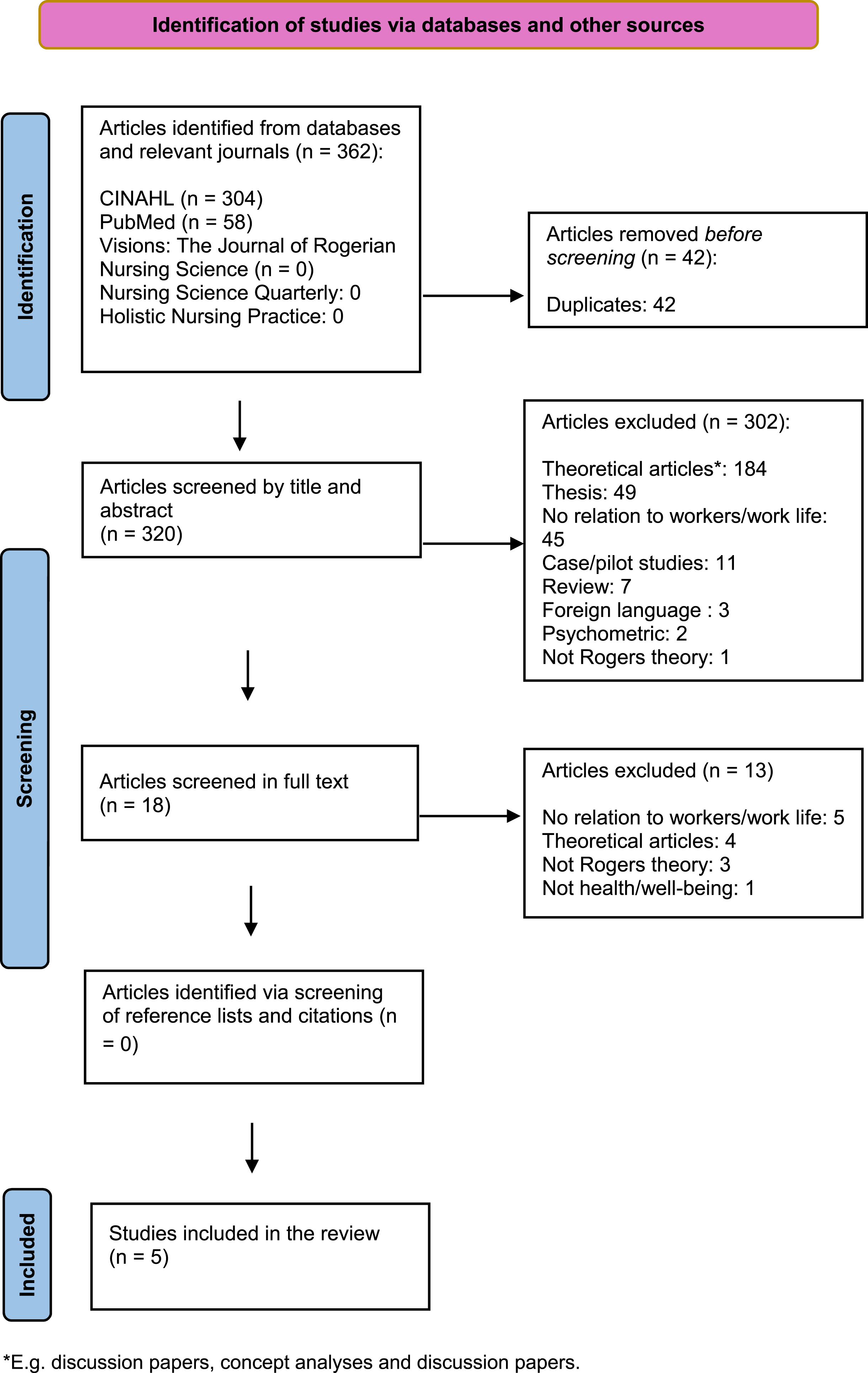
PRISMA 2020 Flow diagram illustrating the selection process.
The first research question was answered using Silva’s [19] classification of theory use, i.e., minimal use, insufficient use, or adequate use of theory. Minimal use means that a theory is briefly summarized in a study but does not really contribute to the research. Insufficient use means that a theory helped the researchers to organize their study, e.g., in choosing instruments for data collection. Adequate use is when a theory is explicitly tested, e.g., that study aims are derived from the theory. Silva described seven criteria for assessing the use of theory, which formed the basis for the assessment. The seven criteria were structured into a table, and the application of the theory in the included studies was analyzed and entered into the table. To answer research question 2, quality assessment of the included studies was performed using the Joanna Briggs Institute’s critical appraisal templates for cross-sectional and qualitative studies [24] and the Mixed Method Appraisal Tool (MMAT) for mixed-method studies [25]. No study was excluded due to quality limitations, as article quality is not the main focus in a review about use of theory [26]. Quality of study methodology and theoretical use are different research areas, meaning that high-quality empirical methods do not necessarily cooccur with adequate use of theories and vice versa [26]. However, quality assessment provides important information about the kind of studies in which a theory has been used. To answer research question 3, a manifest deductive content analysis [27] was performed, based on the aspects of work environment described in Oludeyi’s conceptual review [7]. First, a matrix including the three aspects of work environment was created, and data regarding work environment were extracted from the articles and compiled in a document. Then, the extracted data were interpreted based on if they belonged to the human aspect, the technical aspect, or the organizational aspect, and sorted into the matrix. To answer research question 4, a standardized extraction form, as described by Whittemore and Knafl [28] was used. This is a way to ensure that the same kinds of data were extracted from all studies, so they could be compared. Inspired by Whittemore and Knafl [28], the findings were extracted from the studies and entered into the form. Then, the data were compared across the studies to identify similarities, relationships and differences to create groups/categories, which then were abstracted to create an overall theme.
Results
Study characteristics
Of the five included studies, one was from 2016 [29], one from 2006 [30], one from 2005 [31], one from 1996 [32], and one from 1994 [33]. All studies originated from the United States, but had different authors. Four of the studies had a quantitative (cross-sectional) approach [30–33] and one used a mixed method approach, including a pretest-posttest design [29]. All study populations encompassed nurses. The studies related to working life in different ways, i.e. therapeutic touch at the work place with colleagues [29], nurses’ level of interaction with their nursing environment [30], job satisfaction [31], stress at work [30, 31], measures of work culture and work characteristics [33] and nurses’ social support at work and their willingness to care for AIDS-patients [32]. An overview of the study characteristics is provided in Table 3.
Characteristics of the included studies
Characteristics of the included studies
One of the studies [29] had minimal use of the theory. This meant that the theory was mentioned in the introduction as being related to the exposure in the study, without contributing more to the study. Two studies had insufficient use of the theory [30, 33], i.e. the theory guided data collection but was not tested per se. Two of the studies [31, 32] used the theory adequately, i.e., it shaped the hypotheses and was actually tested. Hence, conclusions could be drawn based on the theory. However, these studies included other theories as well, which contributed to the theoretical framework together with Rogers’ theory. Table 4 gives an overview of how the theory was used in the studies, assessed using Silva’s classification.
Classification of theory use based on Silva’s seven criteria
Classification of theory use based on Silva’s seven criteria
The studies were found to have varied quality. One study [32] had no quality flaws according to the assessment tool, while the others had varying degrees of quality. This most often concerned lack of identification of and/or dealing with confounders [31, 33] and lack of clarification whether the variables had been measured in a valid and reliable way [30, 33]. One of the studies [33] had more methodological flaws than the others. For example, participant characteristics were insufficiently described. In another study [31], it was unclear whether objective standard criteria were used for measurement of the condition (if the condition was seen as being a nurse). In the mixed-method study [29], there was no rationale for using a mixed-method design. Hence, the contribution of the design to the knowledge field was unclear. Also, the different components of the study did not adhere to the quality criteria of the tradition of each method used, with the procedure and characteristics of participants insufficiently explained. For example, the time between pre- and posttest occasions and the number of participants in the quantitative part were not described. Overviews of the quality assessments are presented in Tables 5, 6.
Quality appraisal of the quantiative studies using Joanna Briggs Institutes critical appraisal checklist for cross sectional studies [24]
Quality appraisal of the quantiative studies using Joanna Briggs Institutes critical appraisal checklist for cross sectional studies [24]
Quality appraisal of the mixed methods study, using Mixed Methods Appraisal Tool (MMAT) [25]
The deductive qualitative analysis showed that the theory-based concept environment was related to work environment in four of the five included studies [29, 33]. The study that did not include work environment [31] is therefore not represented in this part of this results. The analysis revealed that all aspects of work environment, i.e., human [29, 33], technical and organizational aspects [33] were represented in the studies, but that use of the human aspect was most common. Four of the studies [29, 33] represented the human aspect, but one study represented all three environmental aspect, albeit superficially [33]. The matrix from the deductive analysis is shown in Table 7.
Matrix over work-environmental aspects in the studies in relation to classification from Oludeyi’s conceptual review [7]
Matrix over work-environmental aspects in the studies in relation to classification from Oludeyi’s conceptual review [7]
One overarching theme emerged in the analysis: Well-being as an essential phenomenon in working life in all dimensions of existing. This theme reflects that well-being was a relevant matter for the workers (nurses) as a manifestation all the way from the physical to the existential dimension. Four dimensions were identified in the analysis: The physical, the body-mind, the psychological and the existential. The text below describes the findings in relation to these dimensions. For an overview of the major findings, see Table 4.
Well-being in relation to the physical dimension was sparsely described in the studies. However, the study by Bulette Coakley, Barron & Donahue Annese [29] found that therapeutic touch had an impact on physical aspects. Nurses that received the treatment at work had significantly lower respiratory rates after the treatment compared to before the treatment, and one nurse described how his/her back pain eased [29].
All studies addressed aspects of well-being at the body-mind dimension. Nurses providing treatments or care experienced/reported improved well-being related to this [29, 33] in terms of comfort and increased energy levels, peacefulness, relaxation and overall well-being.
The nurses also experienced/reported psychological aspects of well-being, i.e. focus, stress, anxiety, stimulation, work excitement, job satisfaction, frustration and perceived social support. Nurses experienced increased focus and decreased anxiety when providing therapeutic touch to a colleague [29]. Work excitement were positively correlated with being respected for one’s knowledge, having a stimulating work environment and the opportunity to work with other professionals [33]. A study among nurse managers revealed that they were satisfied with their jobs but anyway scored high levels of stress. Stress was however not related to their job satisfaction but with other factors, such as having direct care responsibilities alongside the manager-work [31]. In contrast, the nurses in Lucero and Sousas study [30] perceived stress only sometimes to fairly often. However, the more perceived stress among the nurses, the less engagement they had in their nursing environment. Stress was also present among nurses that provided therapeutic touch to their colleagues [29]. They could feel that it was difficult to relax during the treatment because they were working at a busy unit and couldn’t stop thinking of everything else they needed to do [29]. The feeling of frustration at work was described among nurses due to low staffing, communication problems, and insufficient time to complete work tasks [33]. Regarding perceived social support, Sherman [32] found that this was positively correlated to nurses’ willingness to care for AIDS patients [32].
Two of the studies investigated aspects of well-being at the existential dimension [29, 32], i.e. being a part of a larger context and experiencing death anxiety and spirituality. Nurses in Bulette Coakley, Barron, and Donahue Anneses study [29] felt that they were a part of, and contributed to, an overall healing environment at work when they engaged in therapeutic touch with their colleagues. In Shermans study [32], the nurses’ death anxiety and spirituality (e.g. sense of a mission in life) were associated with their willingness to care for AIDS patients. In other words, a lower level of death anxiety and higher level of spirituality among the nurses were associated with a higher willingness to care for the patients (and vice versa) [32]. For an overview of the dimensions in relation to each other and to the worker, see Fig. 2.
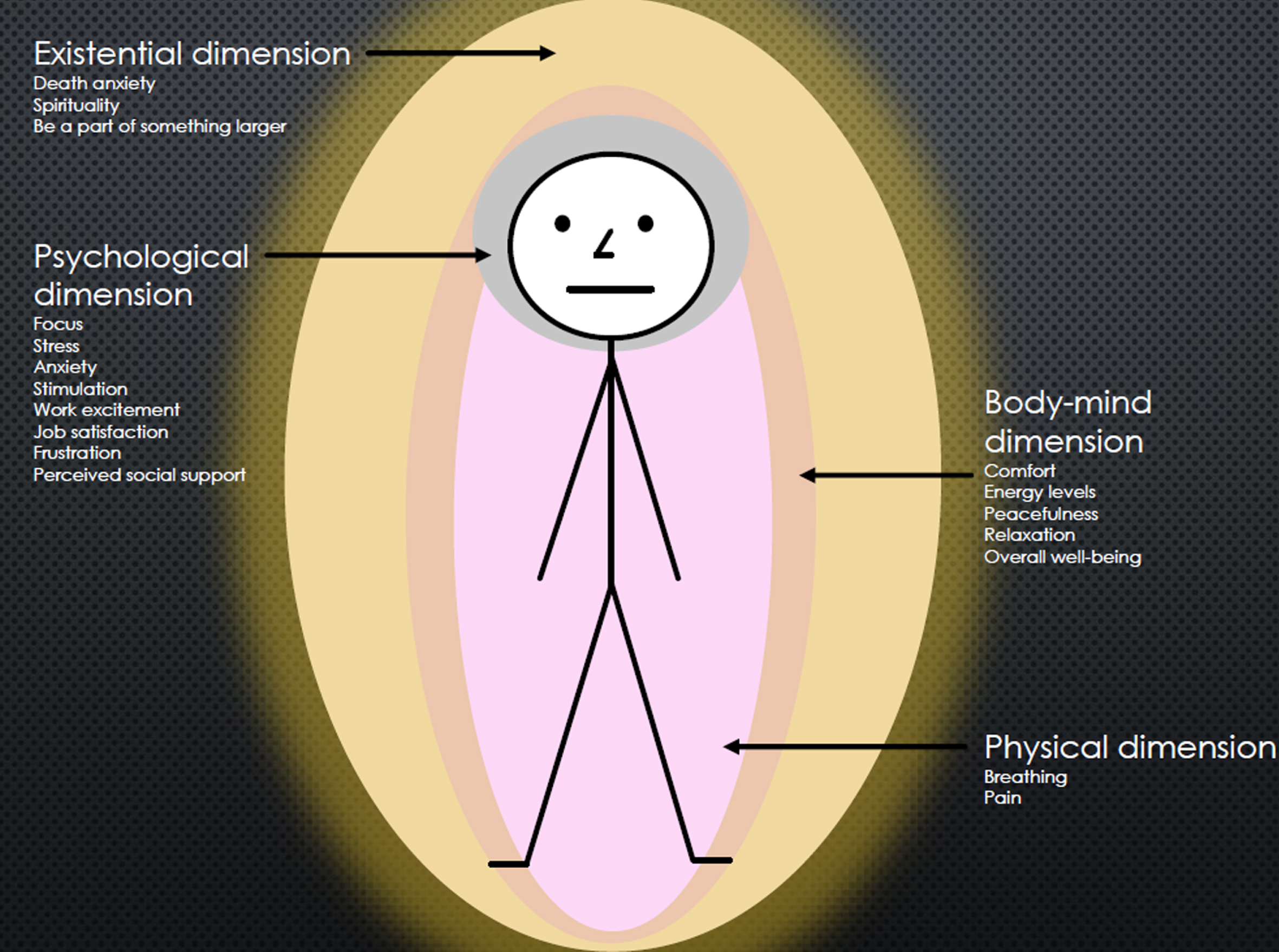
Dimensions of well-being in relation to the worker.
This literature review showed that Rogers’ science of unitary human beings seems to have been sparsely used in research among workers health and well-being in relation to working life, especially in the last decade, from which only one study was found. All included studies originated from the United States. Most studies had minimal or insufficient use of the theory and the methodological quality varied greatly between the studies. The environment was highlighted in relation to the theory in four of the five included studies, most often regarding other people at work. The major findings concerned various dimensions of well-being and the analysis resulted in one overarching theme: Well-being as an essential phenomenon in working life in all dimensions of existing.
Interestingly, there were four quantitative studies and one mixed-method study included in this review. Because of the theory’s high abstraction level, it is difficult to measure the concepts, which may mean that the theory feels more suitable for qualitative research [34]. Four of the five included studies used the theory only minimally or insufficiently, as assessed using Silva’s classification [19]. However, in the present literature review, there was a pattern that those with higher methodological quality also had a more adequate use of the theory, which cannot be assumed [26]. Those studies would be valuable to take as a starting point in future research in the area. It is worth noting that these studies combined Rogers’ theory with other theoretical frameworks to create their hypotheses. Hence, Rogers’ science of unitary human beings was not used adequately on its own. Altogether, this means that the theory has been used only marginally in research among workers health and well-being in working life.
The human aspect, i.e., interaction with other people at work, such as colleagues and patients, was the dominant work environment-related aspect. According to the theory, the environment consists of more than other people – also comprising everything around the individual [5]. Hence, it is reasonable to assume that the theory has the potential to involve more work environment aspects than the human one. According to the World Health Organization [35], all aspects of work environment are important for people’s health and well-being. Since around 2010, we live in the era of “big data,” i.e., in an era of highly developed technology which affects daily life, including work [36]. Rogers’ herself predicted this development in the early 1990s and believed that there was therefore a future need to study how individuals’ humanity can be maintained during increased technological advancement [17]. The lack of technology work environment aspects in this review may be explained by the fact that only one of the included studies in this review was published in the last decade.
Two of the theory’s most central concepts are health and well-being [5]. In the present review, this permeated all major findings more or less explicitly – with different concepts used, such as anxiety, pain and job satisfaction. Martha Rogers made no distinction between the concepts health and well-being, nor did she define them clearly. This is reflected in the research where her theory is used, e.g., this review and a previous review [16]. Both indicate confusion of concepts, or perhaps that the concepts are carelessly used. However, the openness in the relationships between concepts and their definitions can also be viewed as positive, as it means the theory can be used broadly in research related to working life, health, and well-being. The theme that emerged from analysis of the major findings was: Well-being as an essential phenomenon in working life in all dimensions of existing. This indicate that well-being among workers, i.e. nurses, is important both at the physical and non-physical dimensions. This supports the theory’s notion of the wholeness of humans [5]. When policies on working life are drawn up and formulated, this pandimensional view on workers should be taken into account in order to promote the health and well-being of workers in the best possible way.
Methodological considerations
This review is subject to some limitations. First, there is a methodological weakness in that the study selection, analyses, and quality assessments were conducted by a single author. This may increase the risk of bias in the results. According to the Cochrane handbook [23] and PRISMA checklist for reporting systematic reviews [22], it is important to minimize the risk of bias. In this current review, there might be some language bias [23], as several studies was excluded in the selection process due to not being in English. Also, two issues of Visions: The Journal of Rogerian Nursing Science were not available, which means that there might be a so-called location bias [23]. These weaknesses were difficult to prevent. However, a specialized librarian helped with the database searches, which is considered as a strength. A large number of search terms within the same concept was used, which is recommended by the Cochrane handbook [23]. However, health, well-being and working life were not searched for in the data bases but instead selected manually to minimize the risk of missing articles due to a too narrow search strategy. Nevertheless, there is always a risk that some relevant articles were not found because concepts from the theory is not visible in title, abstract and key words. This is a known problem regarding nursing theories [19]. The use of only two data bases is also a limitation, even though the two chosen data bases are highly relevant for nursing research [37]. Furthermore, the exclusion of middle-range theories might have biased the results somewhat. For example, Barrett’s theory of power [18] is closely related to Rogers’ science of unitary human beings and some might therefore argue that the present review does not give an accurate picture of the phenomenon under investigation. However, only the original theory was of interest in this review.
Recommendations for future research
The theory has the potential to be used in future research among workers. More aspects of work environment should be targeted – not least technical aspects, considering the contemporary era. I would also suggest more qualitative research as a basis for quantitative research. Research from other parts of the world than the United States would also be beneficial. Furthermore, the theory should be used in research about treatments other than integrative/complementary interventions, for example palliative care and mental healthcare. Because of the theory’s abstract level and that one of its central concepts is an “energy field,” researchers might believe that the theory belongs within “alternative medicine.” However, the essence of the theory is non-controversial and could be used in almost all kinds of nursing research. The theory was used at the individual level in the included studies. This is appropriate, as the theory described individuals and their integrality with the environment. However, there is also a potential to use it at the group level [17] or the organizational level [38]. For example, organizations are in interaction with the surrounding society, which affects their role in society and how well-functioning they are. This might be another way of using Rogers’ theory in relation to work life. The theory could also be used among other professions than nurses, as it is seen as universal and general [5], i.e., not restricted to a certain context or profession. Since we also live in an era in which research about epigenetics [39] is increasing radically, the human-environment interaction is more relevant than ever. A systematic review could be conducted as well, including more data bases and other sources.
Conclusion
There seems to be a lack of use of Martha Rogers’ science of unitary human beings regarding workers health and well-being in working life, and it has decreased in the last decade. This despite it potentially being more relevant than ever considering, for example, the rapidly evolving technological environment. However, the existing studies reveal the theory’s potential for broad use in the area. It might be time for advancing the research of working life using the science of unitary human beings.
Ethical considerations
Not applicabale.
Informed consent
Not applicable.
Reporting guidelines
The reporting of the study followed the PRISMA-ScR checklist [21].
Footnotes
Acknowledgments
None to report.
Conflicts of interest
None to report.
Funding
The study was supported by the University of Gävle, Sweden.