




Abstract
Background
Supported Employment (SE) is a widely used methodology for work inclusion, with a documented positive effect for several user groups with difficulties to enter the competitive labor market. In 2017, SE was implemented in the Norwegian Labor and Welfare Administration (NLWA), provided by employment specialists for labor market inclusion.
Objectives
To examine experiences of employment specialists adopting the SE-methodology and the coping strategies developed to handle the workload, and to identify critical issues in the implementation of SE.
Methods
Six focus groups with employment specialists at two local NLWA-offices were conducted at baseline, and three, 12 and 18 months after. Sessions were recorded and transcribed verbatim. A thematic analysis was performed.
Results
Participants showed a growing confidence in their own skill set. Coping strategies to encounter challenges included achieving a better balance between available resources and allocated workload, avoiding unnoticed dropout of employment seekers, and developing an awareness for the ‘employability’ of employment seekers. Critical issues included the increasing feeling of getting detached from teammates, a constant lack of time for satisfactory task performance, and growing discomfort with organizing the workload according to set efficiency parameters, instead of standards for good SE. Several employment specialists showed signs of professional burnout.
Conclusion
Participants became quickly familiar with the SE-methodology. They became subject to significant wear and the loss of a career perspective as an employment specialist, resulting in high turn-over. The critical issues identified must be addressed to make SE in the NLWA sustainable.
Background
In 2007 the Norwegian labor market services, the social insurance fund and the social welfare services were merged into the New Labor and Welfare Administration, later abbreviated to NAV. In this article, we refer to NAV by its English acronym NLWA. The debate preceding the reform merging a major part of Norwegian public welfare services into a single entity is reflected in several government white papers.1–3 The main goal of the reform was to provide more effective and coordinated services across the different service providers. To this purpose, local NLWA-offices were established in each Norwegian municipality. These offices were intended to function as ‘one-stop-shops’4–6; that is, as front-line services where citizens were to receive coordinated services, tailored to their social and welfare needs. These services include economic support in form of unemployment benefits, social security benefits, pensions, and work inclusion. Except for the administration of old-age and disability pension, all services provided have the overarching goal for labor market integration.
In 2017, the NLWA implemented supported employment (SE) as part of its methodological toolkit for facilitating the inclusion of unemployed people into the labor market. Until recently, SE in Norway was provided mainly by external service providers, on behalf of the NLWA. For the last two decades, several NLWA-offices included SE as pilot projects in their own methodological toolkit.7,8 Since 2017, SE has been implemented on a broader scale, as all 19 NLWA-regions in Norway were required to establish SE-units in selected local NLWA-offices.
SE is an umbrella term, encompassing different approaches to facilitate the transition of individuals with extensive support needs into the labor market.9–12 The SE-methodology is used widely across the world. In Europe, The European Union of Supported Employment (EUSE) 13 provides a platform for 22 member states for the exchange of experiences with and the further development of SE. Positive results of the SE method, among others for people with severe mental illness have been documented in several meta-studies.14,15
SE is provided by employment specialists, sometimes referred to as job coaches.11,16,17 Employment specialists in the NLWA have different professional backgrounds, but all participate in a mandatory training, offered by the Norwegian Directorate of Labor and Welfare.
18
The training is based on an acknowledged good practice model for SE, developed by the EUSE.
17
In this model, work inclusion is understood as paid work, it must take place in the competitive labor market, and it relies on ongoing support by an employment specialist for employee and employer alike. The model provides methodical guidance by a five-stage process, described as:
Engagement – Underpinned by the core values of accessibility to ensure informed choices are made. Vocational Profiling – Ensuring empowerment to the individual throughout the process. Job Finding – Self-determination and informed choice are key values in Supported Employment. Employer Engagement – Accessibility, flexibility and confidentiality are key values to be nurtured through this process. On/Off Job Support – Flexibility, confidentiality and respect are the key components to successful support measures. Support measures particularly refer to when the individual is in paid employment and are delivered through the provision of an Employment Support Worker/Job Coach.
Several studies have investigated the competencies needed for a successful employment specialist. Corbiere et.al. stressed that relationships with employers and supervisors, and a support and client-centered approach are crucial for the employment specialists’ competencies.
19
In a study with clients and IPS employment specialists in IPS-programs, Vukadin et al. identified different competencies for succeeding as an employment specialist; among these the importance of discussing the client's motivation and motives to work, unfolding facilitators and barriers to obtaining and maintaining employment, identifying facilitators to collaboration between stakeholders, and detecting organizational and financial barriers.
20
Tilson and Simonsen identified four important skills, competencies and personal qualities of successful employment specialists who are working with young people: principled optimism, cultural competence, business-oriented professionalism, and networking savvy.
21
Similarly, Teixeira et al. indicated that employment specialists need technical skills and strategies, as well as capability to increase hope for vocational recovery among those they serve.
22
Whitley et al. investigated self-reported characteristics and competencies among employment specialists and suggested the following as important factors for succeeding as an employment specialist: initiative, outreach, persistence, hardiness, empathy, passion, team orientation, and professionalism.
23
However, none of these studies has focused specifically on the employment specialists’ own experiences, and the challenges they encounter in their daily work.
Our study addresses this research gap by examining the experiences of employment specialists adopting the SE-methodology for work inclusion and the coping strategies they developed to handle the workload, and by identifying critical issues in the implementation of SE in the NLWA.
Methods
Study design
In this longitudinal qualitative study, we followed the implementation process of putting the SE- methodology into practice in the NLWA, from the upstart in November 2017 until April 2019. We designed the study as a formative dialogue based process evaluation. 24 This allowed us to reach beyond the role of evaluators as passive observers, and to continuously feedback our observations to stimulate reflection, insight and learning among the participants. As actively participating researchers, we have been part of the collective transformative learning process, 25 by initiating action and reflection, based on the employment specialist's various experiences throughout the different phases of the implementation process.
Focus group discussions
We anticipated that experiences with the SE methodology during the implementation process were both individual and collective. We also anticipated that these experiences were not necessarily shared among the teammates. It has been suggested that focus groups “provide direct evidence about similarities and differences in the participants’ opinions and experiences”. 26 :10 Therefore, we chose focus groups as a means to gather our data.
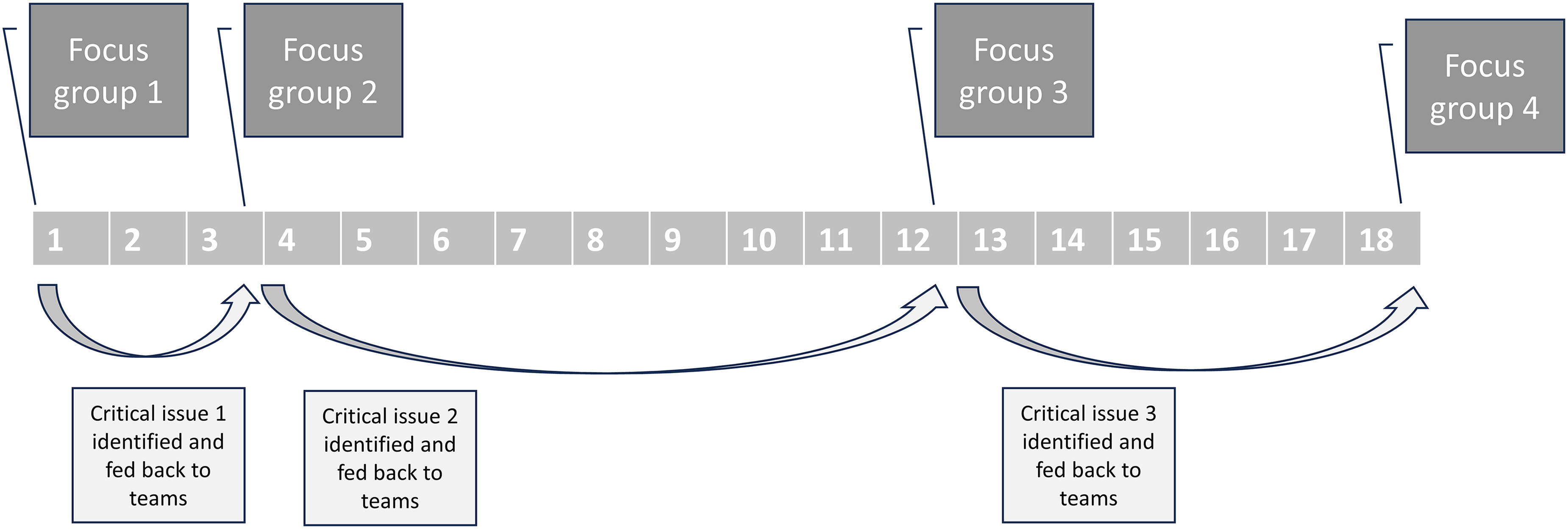
We conducted six focus groups with two teams at different NLWA-offices in northern Norway. Focus groups were organized at baseline, after 3, 12 and 18 months. In the first and second focus group interviews (at baseline and after 3 months), the two teams were interviewed separately, with four participants in each group. Following a request from both teams, the remaining focus groups after 12 and 18 months were organized together. In the focus group after 12 months, eight, and in the final focus group after 18 months, ten employment specialists participated.
Six employment specialists participated in all focus groups, one participated in three and four participated only in the last session. Focus groups lasted between two and three hours. For all sessions, the same semi-structured interview guide was used to initialize the discussion. However, participants were free to put their emphasis on what they felt important. All six focus groups were moderated by the first author, with the second author in charge of observing, taking notes and being responsible for recordings and time-management.
Recordings from the focus groups were transcribed verbatim immediately after each discussion. The first and the second author identified topics in the transcriptions which the employment specialists described as challenging or critical. One of these topics was fed back to each employment specialist team as a written task, to be discussed and worked on until the next meeting. Thus, in the focus groups after three, 12 and 18 months, the teams were encouraged to report on their ongoing work, to reflect continuously on critical issues and to develop strategies for dealing with these. Each focus group after the first one at baseline started with a round-the-table assessment of the task and a presentation of what the teams had arrived at to meet this challenge.
A visualization of the timeline for the focus groups during the longitudinal study is displayed in Figure 1.
Study design focus groups.
Sample and setting
At the time the study was conceived, two teams of employment specialists started in each of the 19 NLWA-regions. The researchers approached the head of the two local NLWA-offices in the region of Northern Norway and asked them to forward our request to follow the implementation of the SE-methodology to the designated team leaders and members. All participants from both teams responded positively to the request.
Both teams started working as employment specialists in March 2017, with a portfolio of 12 to 20 employment seekers for each employment specialist to follow up. This number was reached by the autumn of 2017. Initially, each team included three fulltime employment specialist positions. An additional position was split between a part time position as an employment specialist and the position as team leader. The professional background of the employment specialists varied between team 1, where all members had a background as professional social workers, and team 2, where employment specialists had their background in social work, political science, and sociology.
During the study, two employment specialists in team 1 left after seven and 16 months and were replaced by new team members with a professional background in social work. In both cases, there was an overlap between the leaving and the new employment specialists, allowing for a smooth transition in the follow-up of employment seekers. In team 2, the position of the team leader changed after 12 months. The new team leader had previously worked as a coordinator for the SE-program on a regional level and was therefore familiar with the team and the SE method.
In 2019, each team was reinforced with three additional employment specialists. Again, the professional background differed among the new employment specialists. Two of the new members in team 1 had a background as professional social workers and one in marketing, whereas the members in team 2 had a background in psychology, teaching, and economics.
Analysis
The final analysis was performed using NVivo, version 12. The analytical strategy followed the six-step model of thematic analysis, as described by Braun and Clarke.27–29 Step one (data familiarization and writing notes) was done by all authors by reading repeatedly through the translated transcriptions and writing annotations. Steps two (systematic data coding), three (generating initial themes from coded and collated data), four (developing and reviewing themes) and five (refining, defining and naming themes) were performed by the first and second authors. In these steps, transcriptions were coded according to the experiences of employment specialists with the SE-methodology, the coping strategies they developed to handle the workload, and the critical issues that appeared in the focus groups. Step six (writing the report) was done collectively, with all authors contributing to the writing of this article.
Quotes are translated from Norwegian into English. All authors are fluent in both languages. The first author translated all quotes. To enhance the reliability of translations, the co-authors reviewed original quotes and translations independently from each other and suggested alternatives when they felt necessary. Alternative translations were discussed collectively until consensus was reached. Contributions from different participants are marked as follows.
first employment specialist talking in the current exchange
team leader for team 1
interviewer.
Results
In the presentation of results, findings are first presented according to the experiences and coping strategies, and then according to critical issues as they appeared in the focus groups.
Experiences and coping strategies of employment specialists
Apparent need for specialist knowledge
At the time of the first focus group (baseline), both teams had been operational for five months. During this time, and in line with national guidelines for SE in the NLWA, employment specialists had a reduced caseload of a maximum of 12 employment seekers, instead of between 12–20, to consolidate their team structure and to become familiar with the local labor market.
In the first focus group, team 1 described a need for specialist knowledge related to employment seekers diagnosed with autism, Asperger syndrome and similar. The task given to the team was to discuss where and how they could mobilize external expertise necessary for following up employment seekers with a particular medical diagnosis. Team 1 was asked in the second focus group how they had dealt with the task, but the employment specialists dismissed the issue rather in passing. As one participant explained, the team communicated an eventual need for specialist knowledge to the coordinator for the SE-program at the regional level who either finds the necessary professional expertise or organizes an educational event. The participant also pointed out that the identified need for specialist knowledge had diminished significantly during the three months between the first and the second focus group. As reported, the employment specialists relied increasingly on their own interpersonal skills in the communication with the employment seekers they had in their portfolio than on external expertise.
Balancing the workload
In the first focus group discussion with team 2, the employment specialists pointed out that all their clients at that time were in stages one or two of the EUSE-model. Both stages were described as labor-intensive, since stage one (engagement) rests on building trust between employment specialist and -seeker, which requires frequent meetings. Stage two (vocational profiling) was described as equally labor-intensive since individual resources and preferences must be mapped with time consuming validated tests and tools.
We asked team 2 to discuss strategies for balancing their workload between the labor-intensive stages one and two for new employment seekers, and the follow-up for those in the following three stages. One employment specialist described the results of the discussions as follows. “We have become better in sending the ball back to the employment seeker, to gauge who does things on their own, to get people to start writing their CV from the very beginning when we start working with them. That way, we can assess who needs closer follow up, who does not manage by themselves and who we need to sit together with.”
Avoiding dropout
For both teams, the issues which were emphasized in the first focus group as critical were described three months later in the second discussion as not critical at all. It appeared that both teams had established working routines, allowing them to cope and to perform the tasks required for the new role as employment specialists.
We observed a similar development in the nine months between the second and the third focus group. Since this discussion was held with both teams together, they were given a task related to an issue which both teams pointed out as problematic. On several occasions, employment seekers had dropped out of a working contract without the employment specialists being aware. Both teams felt that this dropout probably could have been avoided if either employer or employee had contacted the employment specialist early on when problems arose. The task given was to develop strategies to ensure that clients obtaining competitive employment did not drop out unnoticed.
In the third focus group, Team 1 reported that they started marking the files of employment seekers who had obtained competitive employment and been discharged from the program with a reminder to follow up with a phone call after three months. However, it became evident that this was not practiced consequently.
Mine got in touch. Well, I told them that I would like to know how it is going: ‘Can’t you send me an update?’. So, usually I get an update, so, it's working out. And I told them to just get in touch if something happens.
Actually, one of mine called just last week. She had been working for a while now and was afraid of losing her job. So, they do call, but we do not have a plan for that. So, we thought we should have a plan for that, that we get in touch and ask how it is going, whether they called or not.
This exchange illustrates that the system which Team 1 agreed upon had not been fully implemented in the daily work routine. As practiced, an eventual follow-up depended on the initiative of employment seekers themselves. We regard this strategy hardly as an adequate safeguard against unnoticed dropout, considering that SE is tailored to persons with limited or no work experience. Most employment seekers participating in SE-programs can hardly be expected to revive the contact with an employment specialist, should difficulties arise.
The lack of systematic follow-up was pointed out by both teams. However, the reasoning presented by team 2 differed. One of the employment specialists described how this issue was handled in team 2.
We don’t follow up systematically. Not those we have discharged. But we follow up until things are stable.
We do not discharge before it is stable, in any case!
When we started, we had a list of those who have been discharged. Where we had an agreement that we should follow those up and call them by – I don’t know, three months after they had been discharged. I don’t know if this has been followed through.
As ES 2 vaguely recalls, at the time of the first focus group, team 2 had an intention to follow up their clients after discharge. Just as was the case with team 1, this intention has not been put into action. However, the justification differs since team 2 claims not to discharge employment seekers if the placement in the labor market was not assessed as stable.
Developing awareness for ‘employability’
In the third focus group, both teams reported on clients who had found a temporary workplace, but where a change to a permanent, competitive position depended on specific certifications, for instance a forklift driver's license. The task presented to the teams was to discuss strategies for developing relevant skills to make an employment seeker attractive for a permanent, competitive position.
In the final focus group discussion, the employment specialists dismissed this issue and described the cases referred to in the previous focus group as anecdotal. From the perspective of both teams, it was a basic skill inherent in the role as employment specialist to be sensitive to eventual obstacles for a transition into a permanent, competitive position, and to develop strategies to overcome these obstacles. In cases as the ones mentioned in the third focus group, a regularly suggested strategy was to suggest for the employment seeker to enter a formal educational program, while continuing as a temporary part-time employee. Both teams regarded most employers as quite open for facilitating working conditions in a way that allowed the clients to obtain the required formal education. As evident in the following excerpt, not only were employers in general perceived as open to suggestions, but as expecting employment specialists to suggest specific organizational strategies for adjusting working conditions.
It is quite ok to address this. Actually, I believe employers expect us to address this. I mean, we are there for a reason.
Yeah. In my experience they appreciate that. And they get motivated and excited when I make things manageable.
This positive assessment of employers’ willingness to accommodate specific needs of a temporarily employed candidate was confirmed by several employment specialists providing examples. Members of both teams appeared quite confident regarding their skill to facilitate the conditions for necessary personal development of their clients, and to remind employers about the goal of competitive employment.
Regardless of this confidence in their own skill set, no systematic approach to improve the chances for permanent employment became visible.
Critical issues for successful implementation of SE in the NLWA
We have pointed out that the critical issues which had been fed back to the teams appeared as not critical in the consecutive focus groups. However, several other issues were raised in the discussions, which we regard as critical for supporting or impeding the implementation of SE in Norway.
From team member to lone rider
During the study period it became evident that both teams experienced a steep learning curve regarding the SE-method and their communicative and mediating skills. Nevertheless, during the last two focus group discussions, several of the participants expressed a growing discomfort with being alone in the field and losing contact with their colleagues. An employment specialist from team 2 described this as follows.
To be an employment specialist, to be out there, can be pretty lonely. And the team-feeling, that your colleagues know who you are working with, what you are working on, that has become lost. And we must get that feeling back. We need to get that back, and that's what we are going to try.
“I think that is what makes us more and more weary. We are out and about by ourselves; it is so absolutely just you all the time. How you talk to an employer - you had a very good meeting, you did really well and then there is nobody in the office to talk to about that meeting. And at the same time, you are sitting very close to each other. I think that is what wears us down, that we are not a team, even if we are a team.”
SE as a method is based on employment specialists spending significant time in the field instead of the office. The daily contact with employers is a precondition for matching employment seeker, work environment and the specific skills needed by a local business. This is challenging at times, but also appreciated as something that makes the job interesting. As an employment specialist put it “To be out there, working with employers, that gives a refill and energy. That is a fun-part of the daily work!”. Nevertheless, what in this quote is described as a source for “refill and energy” has its downside in an emerging lack of belonging to a team of peers.
Never enough time
Employment specialists repeatedly stated that they perceived their workload as continuously reaching or exceeding their limits. In the first two focus groups, both teams presented their workload as too big to be handled in the long run. At the same time, they presented this excessive workload as temporary and attributed it to a lack of routines. This is illustrated in the following exchange where two participants in hindsight described the challenging first few months for team 1.
We came to a point when we had to ask [several employment seekers] to wait until January. I think there were three or four of them. So, when January arrived and their waiting time was over, it got pretty intense.
Yeah, we formally took on those employment seekers which we waited with until the end of December, but we didn’t start working with them until January.
As it appeared during the last two focus groups, the workload for each employment specialist had increased, rather than diminished. Nevertheless, this workload had become accepted as a feature of the job as an employment specialist, as is apparent in the following quote from a member of team 2.
It has been challenging to find a structure in the daily work. A lot happens ad hoc and suddenly. It is tough when you feel that you should be in five places at the same time. Parts of the job are put in front of you that you can’t control. Just these days I get help trying to structure my working week, trying to land some fixed points in time during the week that are sacred and that actually give me some control to handle the rest of the chaos.
In the presented example, the chosen strategy when the working situation threatens to become unbearable, rests on seeking outside assistance to structure the workload better, rather than to try to address the causes for the overwhelming workload.
Efficiency parameters as stress factors in SE
To evaluate if a particular approach to work integration can be considered as SE or not, several efficiency parameters are assessed by means of the Supported Employment Fidelity Scale, using five item scales for each parameter.30,31 Two of these parameters proved to be considerable stress factors for the employment specialists. The first relates to the caseload of 12 to 20 employment seekers that each employment specialist was expected to follow up at all times. As it was, even during peak times, the number of employment seekers per employment specialist never exceeded 17. Nevertheless, on several occasions it was evident that the participants felt they were pushing their limits, as illustrated in the following exchange in the second focus group with Team 1.
We both had 17 in our portfolio. And many of these in stage three, a very intensive stage. That was chaotic! But my portfolio is down to 15 and that is much more manageable.
How did you cope with that pressure? What specifically did you do?
[Name] quit, that caused extra pressure.
Yeah, because our portfolio became bigger since we had to take over [Name] and at the same time we had new applications. There was a brutal increase of employment seekers.
Yeah, suddenly it was “bang”!
So, how did you prioritize?
We are getting better at prioritizing, I hope. We must! Otherwise, it's not possible in the long run, because you can’t keep going on that intensely, with all at once. That is simply inhuman!
Since this focus group was conducted relatively shortly after the teams had been consolidated, the experience is described as a feeling of being overpowered in the moment and a fear of a working environment that threatens to remain unbearable in the long run. We will return to this observation in our discussion of SE in a career perspective.
The second parameter regarded the working hours each employment specialist was expected to spend in the field. The maximum achievable score of five in the Supported Employment Fidelity Scale is awarded for 65% or more of total scheduled work hours spent outside the office. For employment specialists in the NLWA this parameter is set to a considerably lower value of 40%, corresponding to a score of three in the scale. Nevertheless, this efficiency parameter proved to be problematic to achieve.
What we see as a distinct challenge with the method is the time in the field that is required. It's not that one isn’t out of the office, but you have a lot of reporting to do, and writing memos. So, that gets back to you and then you must be outside physically and write memos if it should be counted as time in the field, right? And we can’t do that. You would have to sit in your car or on the buss, to make it count as time out of the office.
But you can’t sit on the buss, either, because you must take privacy considerations into account because nobody is supposed to see your screen! You must be in a place where you know you are by yourself.
The time I took at home this morning - actually. that was my time in the field, because I was writing about the businesses. Otherwise, I wouldn’t have been able to do this.
Yeah, right? When you start monitoring yourself, then the strategies are becoming like that.
In this excerpt, it was not as much the parameter that caused stress but an emerging discontent with the coping strategies that had progressively and rather involuntarily developed. These strategies were perceived as needed to cope with a challenging work schedule, where formal efficiency requirements must be met, without falling behind schedule with other duties. As evident on several occasions in our data, these strategies were based on shared experience and an implicit understanding within the teams.
Employment specialist – a career perspective?
During the 18 months we followed the teams, we observed a development which we consider a serious threat to the success of the SE model in the NLWA. While we initially observed a rather enthusiastic embrace of this new approach to facilitate work inclusion, this enthusiasm was replaced by soberly reconsideration, not of the SE method as such, but of the individual future as an employment specialist.
In the second focus group discussion, team 2 discussed the challenging nature of the SE methodology.
But it's demanding, the intensity is demanding. Because I feel, when I have been out a lot, with all the new impressions, that I must get down to earth again [laughs]. Yeah, I must, because there has been so much happening, and then you have to write reports. So, I feel that I become a little [heavy breathing]. I must lower my shoulders a little and get to grips with the situation. And then it's back again the next day. Yeah, it's a demanding job.
Yeah. That's our struggle. To give us the space to recover. We talked about it several times. Because you are on alert, all the time, and you must give and listen to others and everything. It's as she said, it eats from you. And to give ourselves breathing space, we are still bad at that.
Already after three months, the employment specialists experienced a beginning discomfort with being constantly on alert. At that time, this feeling was not attributed to the methodology as such, but to the lack of a coping strategy that would allow the employment specialists time to be oblivious to the demands posed by their job to regain energy for being able to perform as they expected from themselves.
At the time of the third focus group, one year after start-up, two of the employment specialists had left team 1 and were replaced. In the last two focus groups, several employment specialists in both teams expressed a rather critical assessment of their further career in SE. The need for regaining energy reappeared repeatedly, while the problem had become aggravated, rather than diminished.
It's going to be interesting to see how long people remain in the job as employment specialists. How long I stay in this job. Because it's not healthy that, when it's Friday, that you just sit there and your eyes close and - yeah, you keep going for two, three years and then it's off and someone else starts the same journey again.
And the question is: Does it have to be like that? I mean, is it possible to organize and work in a way that makes it possible to stay on, to keep your head above the water, stay on the job and have it alright?
I can’t manage to be «on» all the time. Occasionally I am not so productive because I feel tired of having so much going on out there and to have to put out fires all the time and to be at meetings with someone. On those occasions I feel that I must be a little introvert.
Yeah, I can understand that! Because that's how we are. We must recover some time!
Yeah, being outside all the time and being constantly on alert, right? That makes it necessary to withdraw and to just – my brain is shutting down. I must take a step back.
The question for the reason for the high turnover remains open. A main problem – being on alert all the time - is repeated by several participants, as is the need for an opportunity to take a step back from the tight interaction with employment seekers and employers. However, strategies to meet this problem remain unclear. It is not spelled out explicitly if the employment specialists in fact feel that they can recover. Neither do the participants present potential solutions to counteract the emerging high turnover.
After 18 months, several of the first-generation employment specialists were faced with severe burnout experiences. If anything, the threat to the stability of both teams was aggravated.
I have been in a situation and a process where I have been on my way out, right? And that's where I still stand. It's an ongoing thing where I think every other day that: This is not something I want to do anymore. And that's quite arduous. But, at the same time I discover all the time things I am good at! And I crack some codes where I – damn, this is fun, too! And when we are out two at a time and work together with employment seekers, or with an employer and get some feedback on my reflections about what is positive, where one can learn - one can see all the time that, actually, it's fun, too, because I’m developing much myself! So, I’m not only out there for an employment seeker or an employer, but I am doing much for myself, too.
And where are you now? Will you still be in the job in five years’ time?
We’ll see. Time will tell.
It's a long way back to being a case worker!
It's a long way back to being a case worker! And the demands regarding what one could work with within the NAWL have increased.
This exchange illustrates that the question of staying or leaving a career as employment specialist is permanently present in the daily work of both teams and that the decision for staying, at least in part, is due to a lack of attractive alternatives within the NAWL.
Six months after the final focus group discussion we contacted the team leaders again and asked how many of the first-generation employment specialists were still part of the teams. Both teams experienced an almost complete turnover, as only one of the first-generation employment specialists in each team remained in the job.
Discussion
In our longitudinal study we monitored the experiences of employment specialists during the first 18 months after the implementation of SE in the NLWA. We identified several challenges and coping strategies developed by the employment specialists to handle these challenges. We also described various critical issues in the implementation of SE in the NLWA.
Regarding the employment specialist's experiences with the SE-method, our findings indicate a growing confidence in the own skill set. Among others, this is visible in a diminishing need for specialist knowledge during the three months between the first and the second focus group. Instead of relying on external support, the employment specialists relied increasingly on their own interpersonal skills in the communication with the employment seekers they followed up. Furthermore, members of both teams participating in our study communicated a growing confidence in their skill to facilitate the conditions for personal development of their clients to meet the requirements for working in the competitive labor market, and to remind employers about the goal of competitive employment. Regardless of this confidence in their own skill set, neither one of the teams developed a systematic approach to improve the chances for permanent employment.
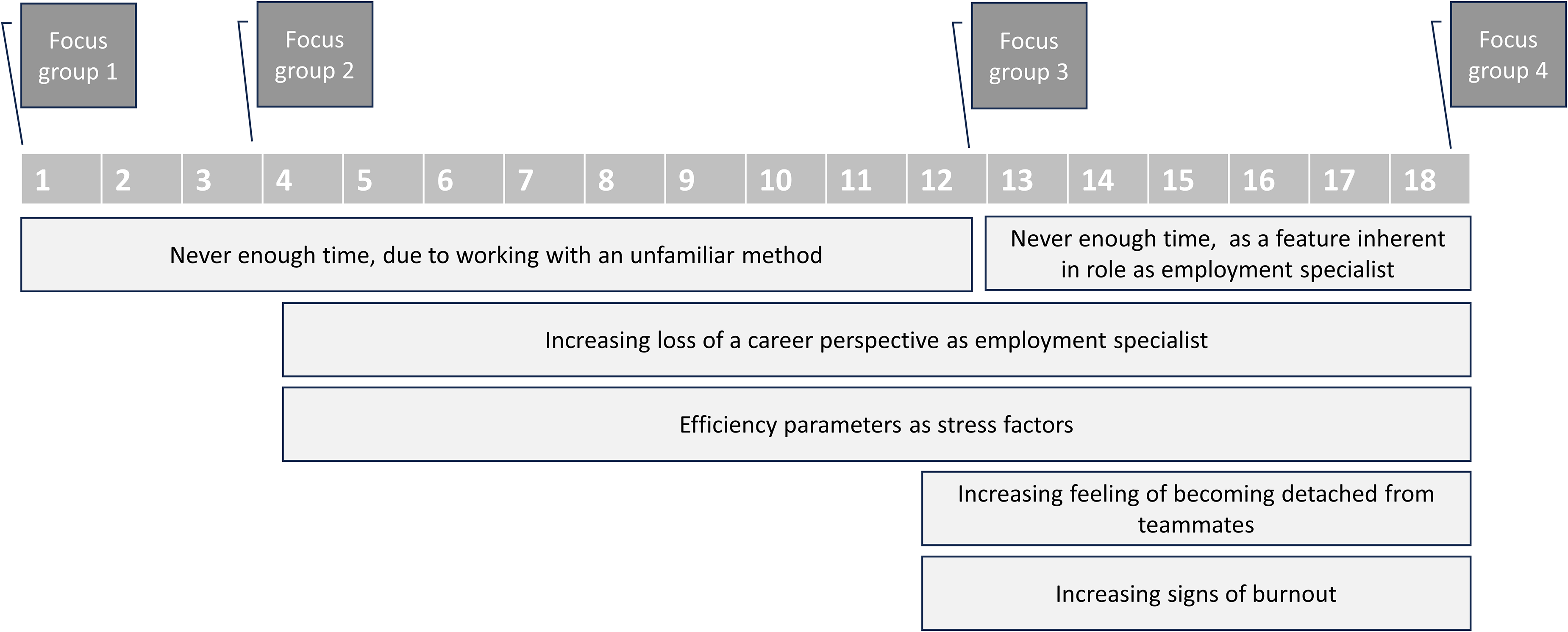
Figure 2 summarizes the critical issues we observed, according to when they appeared and how long they continued in the course of the study period.
Critical issues appearing during the study period.
During the last two decades, a considerable body of research has identified necessary competencies for successful employment specialists.10,19–23,32,33 Except for the study conducted by Tilson & Simonsen 21 who remarked on it rather in passing, and the study of Vukadin et.al., 20 the importance of stability among employment specialists as a precondition for successful SE has been largely ignored. In this regard, our findings support the results from the study of Teixeira and colleagues, 22 who noted that employment specialists acquired interpersonal skills and work alliances on the job. Skills identified in this study included the capacity to promote hope for a better vocational future, empowerment in relation to one's vocational abilities, self-acceptance of one's vocational strengths and history, and developing a sense of purpose that can be derived from work.
Regarding the challenges which the employment specialists met and the coping strategies they developed during the study period, recurrently appearing themes were a permanently high workload, a largely unpredictable daily schedule, and a permanent feeling of never having enough time for the tasks that must be performed. During the study period, the challenges appeared to have been accepted as features inherent in the role as employment specialist. Coping strategies to encounter these challenges were mainly related to achieving a better balance between available resources and their workload. The challenges appearing in our study have been emphasized by Lipsky in his seminal work on street level bureaucracies as characteristic for civil servants in public frontline services.34,35 One of the characteristics of the working conditions of street level bureaucrats, social workers included, is that their caseload always exceeds the human resources necessary to provide services to all clients, according to professional and ethical standards. The results of our study confirm this feature of street level bureaucracy for the work of employment specialists. The same does a study of employment specialists working with refugees. 36 In this study as well, employment specialists voiced concerns about an increasing workload related to documentation and writing case notes. These mandatory tasks were perceived as time-thieves, and as an obstacle for focusing on job matching. A possible solution that was suggested in this study was to have an equal number of clients in each phase in the EUSE model for SE.
Another challenge appearing in our data was related to preventing unnoted dropout of employment seekers with a workplace in the competitive labor market. Corbière & Lanctôt 37 suggest that a frequent and lasting follow-up with regard to job retainment was an essential quality of SE. Previous studies suggest that this period should be at least two years.38,39 In our study, both teams developed different strategies for preventing unnoted dropout. However, neither of the teams followed through with their strategy.
The critical issues appearing during the research period were related to an increasing discomfort with the role as an employment specialist. This discomfort was caused by a loss of a team identity, a feeling of never having enough time, stress caused by permanently being monitored according to several efficiency parameters, and the loss of a career perspective as an employment specialist. This discomfort resulted in a high turnover in both teams. Our study confirms the findings of Vukadin et al., 20 who also reported a high turnover among employment specialists, leading to severe interruptions in the workflow of the programs. It has been noted that research on loneliness at the workplace and its effects is scarce.40,41 The studies available confirm a possible association between loneliness at the workplace and decreasing job-performance. Samples for these studies have been drawn among different occupational groups, including nurses, 42 call center employees, 40 teachers 41 and hotel employees. 43 In line with the study of Vukadin et.al., 20 our study confirms this correlation to also apply to employment specialists.
Previous research has stressed the need among employment specialists to balance the amount of support given to job seekers; that is, neither more nor less than actually needed. 25 The results of our study indicate that an adequate assessment of how much support an individual employment seeker requires to find a workplace in the competitive labor market, depends on the professional experience of the individual employment specialist, and a caseload that is sensitive to variations in the amount of support needed for each client. The results of our study indicate that the latter should be decided collectively and continuously between employment specialist and team supervisor, to achieve a sustainable balance between the expected number of clients to follow up and the resources that each client requires at any given time in the process.
Strength and limitations of the study
A major strength of our study is the longitudinal design, which allowed us to follow the implementation process of SE in the NLWS over 18 months. By monitoring the development of learning experiences, emerging challenges and critical issues, the results of our study provide an unique insight in critical aspects of this approach to work inclusion for employment seekers outside the competitive labor market.
As a qualitative study, our observations cannot be generalized on a purely empirical basis. We have contrasted the results of our study with other studies focusing on different aspects of the SE-method and the working conditions of employment specialists. Nevertheless, since we have conducted our research in a Norwegian context, further research in other national settings should be conducted to test the transferability of our results, and to validate if the critical issues we have identified are features characterizing the SE-methodology to work inclusion as such, or if they must be attributed to the organization of SE in the NLWA.
Conclusion
SE has in several national contexts become a popular method for work inclusion of employment seekers with extensive support needs. In our study we monitored experiences and critical issues that appeared during the 18 months after implementing SE in the NLWA. Our analysis provides an in-depth insight into experiences and coping strategies of employment specialists, and factors supporting and impeding successful implementation of SE in the NLWA. We have documented that new employment specialists experience a steep learning curve. What is new and sometimes scary to many has in relatively brief time become a consolidated work routine. However, our study has documented that employment specialists are subject to significant wear, resulting in a high turn-over. The critical issues we identified are an increasing discomfort caused by a loss of a team identity, the feeling of never having enough time, the stress caused by being monitored permanently according to efficiency parameters and ultimately, the loss of a career perspective as an employment specialist. These issues must be addressed, to make SE an effective tool for labor market integration in the NLWA that is sustainable in the long run.
Footnotes
Acknowledgements
We would like to thank Professor Dr Mai Camilla Munkejord for her cooperation, never-ending energy and collegial support in this research project. We also want to thank the members of the research group Professions & Welfare Society at UiT The Arctic University of Norway for their feedback to an earlier draft of this article.

Ethical considerations
The project was approved by the Norwegian Centre for Research Data (project number 54689) as the relevant ethical body for research in Norway.
Informed consent
All participants were informed that participation in the research was voluntary, that they could withdraw from the study without giving reasons at any time and that their contributions were anonymized in the final research report. All participants gave their written consent to participate.
Funding
The authors disclosed receipt of the following financial support for the research, authorship, and/or publication of this article: The study was financed by The Norwegian Labour and Welfare Services, R & D department.
Declaration of conflicting interests
The authors declared no potential conflicts of interest with respect to the research, authorship, and/or publication of this article.