




Abstract
BACKGROUND:
Musculoskeletal disorders constitute one of the major health problems of workers exposed to manual work throughout the world. Nevertheless, there is no study that maps its conceptual structure based on a systematic methodology.
OBJECTIVE:
To identify the conceptual structure of ergonomics, MSDs, treatment and return to work in manual jobs in the last 12 years by applying a systematic co-word network analysis methodology which describes the replicability of the search filters and emphasizes the rigor that has to be followed in the creation of the network.
METHODS:
The search filter was customized for each bibliographic database, and followed the PRISMA 2020 flowchart for the screening process. For the creation of the network, the titles, abstracts, and keywords were used as the unit of analysis extracting the noun phrases of the first two units. In the normalization process, the terms of the search filter were deleted and their associated terms, and standardized the similar terms. Regarding the plotting of the network, Vosviewer was used applying the network settings based on content analysis.
RESULTS:
The co-word network shows three communities: Ergonomic assessment and workplace intervention tools, factors related to rehabilitation and return to work, and physical and mental overload management. For each community, there is a framework that explains the relationship within terms.
CONCLUSION:
This study is aligned with the replicability, robustness, and relevance recommendations in the implementation of rigorous scientometric studies. The occupational health community is encouraged to implement scientometric studies following a rigorous methodology and working in interdisciplinary team.
Introduction
Musculoskeletal disorders (MSDs) affect more than 1.7 billion people [1] around the world which is the main cause of disability [2], affecting the continuity of workers employment and general companies’ productivity generating a public health problem [3]. In this sense, ergonomic strategies had been implemented as a solution to Work-Related Musculoskeletal Disorders (WRMSD) [4]. Furthermore, this issue has turned into a challenge on greater importance over time, considering its relationship with workers sick leave, medical treatments and return to work [6] strategies [7]. In addition of the WRMSDs effects, its treatments need to be considered, such as rehabilitation strategies based on tailored education which yields a reduction of pain focused on shoulders, wrist and low back [8], or the study of positive effects applying exercise therapy in affected workers which improved their range of motion [9].
Regarding systemic reviews on the aforementioned topic, You, Smith and Rempel examined the association between wrist posture and carpal tunnel syndrome (CTS) [10] among workers, finding that prolonged exposure increases the risk of this disease. In another study, Alias [11] found that training programs and workstation redesign have a positive impact on the decrease of MSDs in hands and arms. In a similar theme, Williams-Whitt and others studied the intervention in workstations in the scientific and grey literature [12]. In the former, they found that the intervention was focused on individual workplace whereas, in the latter, they focused in group changes strategies based on policies and procedures. In another review, Kelly, Shorthouse, Roffi and Tack, showed that there is moderate evidence about exercise therapy reducing the symptoms of pain in Work-Related Upper Limb Disorders (WRULDs) in sedentary workers [13]. In addition, Hulshof, Pega and others; found that exposure to risks ergonomics factors at work increase the MSDs risks [14] of acquiring osteoarthritis in some body parts.
In regard to scientometric or bibliometric studies, Emmatty and Panicker [15] identified the gaps in ergonomic interventions among waste collection workers [16]. They implemented co-occurrence networks on the titles and authors’ keywords revealing that the primary concern is occupational health and safety which made them proposed a hierarchical framework for the implementation of ergonomic interventions in waste associated occupations [16]. In contrast, in body posture in relation to visual display terminals computed a co-word network on the authors’ keywords pointing out that the analysis and/or design of the workplace, and the elements that make up the computer are the most studied topics [17]. Moreover, Gómez-Galán and others; in their bibliometric analysis of the RULA method found that this could be applied in different jobs, with other analysis methods [18].
To the best of our knowledge, there is no study that implements a systematic methodology considering ergonomics, MSDs, treatment and return to work in manual jobs based on co-word network analysis. For this reason, the objective of this study is to identify the conceptual structure of ergonomics, MSDs, treatment and return to work in manual jobs in the last 12 years applying a systematic co-word network analysis methodology. The methodology describes the replicability of the search filters and emphasizes the rigor that has to be followed in the creation of the network. Therefore, it will guide the occupational health community in the implementation of science mapping studies.
Methodology
The applied methodology was based on the Joanna Briggs Institute’s approach for conducting systematic reviews and evidence syntheses [19] due to its interdisciplinarity as well as its application in evidence-based healthcare [20], and the PRISMA 2020 flowchart [21] was applied for the paper screening. Whereas, for the conceptual structure; a co-word analysis was implemented, which states that a paper’s terms are a true portray of its content. In this sense, two terms appearing within the same scholarly document belong to the same theme [22]. Therefore, as more co-occurrence terms pairs emerge their themes get strengthened [23].
Stage 1: Research questions identification
The following research question was stated: What are the trending topics in the last 12 years about ergonomics in manufacturing jobs?
Stage 2: Identifying relevant studies
The Population, Concept, Context (PPC) framework were used [24] suggested by the Joanna Briggs Institute considering:
Population:
The study was focused on blue collars manufacturing workers in manual activities. Thus, job position in office, health and other work places were excluded. All countries, ages and research methodologies were considered.
Concept:
The corpus was made with all type of open access published papers between 2010 and 2021 retrieved from Scopus, Web of Science, and PubMed [25]. Only articles written in English were considered.
Context:
The following research areas were examined: Ergonomics / Musculoskeletal Disorders / Treatment / Rehabilitation and Return to Work. Thus, any study out of these research field was excluded. It is important to point out that the treatment of musculoskeletal diseases focuses on corrective and preventive measures applied to worker and workplace.
Stage 3: Study selection
The terms selection was developed in four screening stages [26]. In the first stage, 462 terms were considered based on the thesaurus of the “International Labour Organization” (ILO) and experienced researchers on the topic of which we discarded 405 terms based on a focus group.
In the second stage, 100 terms were added to the 57 terms obtained of the previous stage. The added terms were retrieved from the MeSH terms of the Cochrane library and the National Center for Biotechnology Information [27].
In the third stage, 101 terms out the 157 were discarded because they were repeated or no-relevant. Thus, 108 terms were added retrieved from the Common MSD list of the “Instituto Nacional de Seguridad y Salud del Trabajo” (INSST), and the “International Classification of Diseases” (ICD) from the “World Health Organization” (WHO).
Finally, in the last stage, 72 terms of the 164 were selected based on the researchers’ consensus classifying them into disease natural evolution parts (exposed population –target / risk factors / effect-response and rehabilitation - reinstatement of the affected population). The classification of the terms can be seen in Table 1, and the search filter for each database is depicted in Appendix 1.
Terms used in search strategy
Terms used in search strategy
The second author, implemented an ad-hoc script based on bibliometrix [28] and Tidyverse. The former formatted the raw files obtained from the search filter, and the latter deduplicated the records from the three bibliographic databases. The output of the ad-hoc script is an Excel file which sorts the papers by year in a tab. It shows the title, abstract, keywords, journal, and the additional fields “included”, “reason”.
The three databases yield 2,129 references and after the deduplication process remained 1,749 scholarly documents. In the first run, the first author read the 1,749 abstracts of the deduplicated papers excluding the ones that do not fulfill the inclusion criteria (context). If a paper fulfills the inclusion criteria, it was assigned “Yes” to the included field and “NA” to the reason field. By contrast, was assigned “No” to the included field and the reason for no inclusion in the reason field. In case, the author was not sure about the inclusion of a paper, it was assigned “Yes” to the included field, and stated the doubt reason in the reason field. This will be analyzed in the discussion of the disagreements in the next step.
In the second step, the fourth author discussed the selection of the papers with the first author in the previous step, and if there were disagreements both explained their point of view until an agreement was reached. This step was carried out five times in sessions of three hours in which 344 papers fulfilled the inclusion criteria.
In the third step, the first author downloaded the full text of the 344 papers and read them all. He followed the same process in step 2. In the last step, the fourth and the first author followed the same process of step 3, but the working sessions were three times during two hours, selecting 185 papers (Appendix 2) as the final corpus of the topic. Figure 1 depicts the PRISMA diagrams in detail for each step.
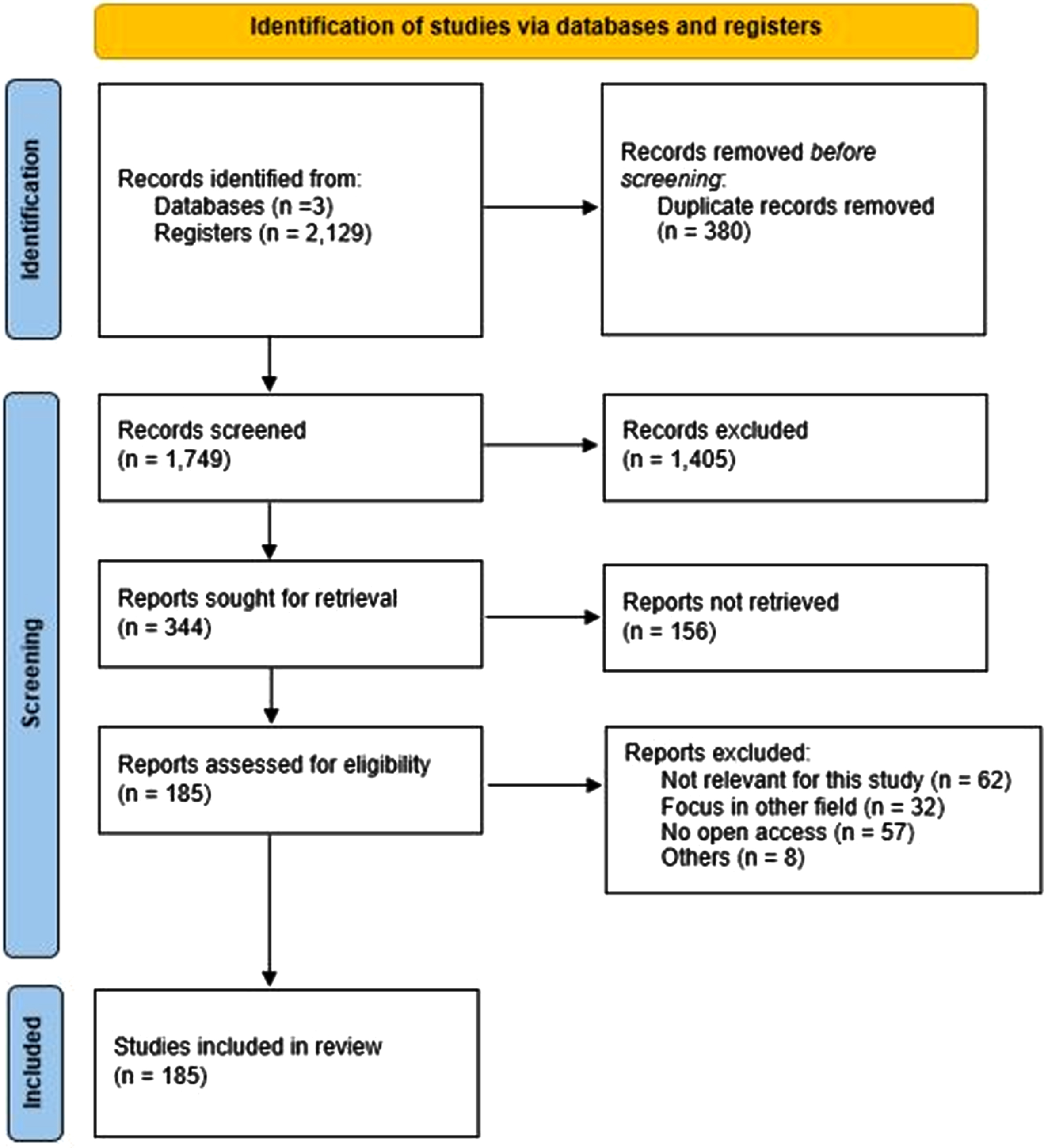
PRISMA flow diagram.
The conceptual structure was based on the 185 scholarly documents obtained from the PRISMA protocol. For data preprocessing, the unit of analysis was the titles, abstracts and keywords. For the titles and abstracts, the second author created an ad-hoc Python script based on spaCy applying noun phrases using the en_core_web_lg model.
The cleaning process was implemented on the ad-hoc script based on the Tidyverse which deleted stop words and merged the normalized terms. The normalization of the terms [29] was carried out by the first and fourth authors in four sessions of two hours. In this process, the authors deleted the terms of the search filter and their associated terms. Furthermore, they standardized similar terms, plural terms, or nomenclatures. For instance, the term work-related upper extremity disorders was changed to its nomenclature WRUED. The initial corpus was made of 634 terms, which after removing stop words decreased to 386, and after the normalization process changed to 237 noun phrases.
For the visualization of the network, the software Vosviewer [30] was used which is a well-known tool in scientometrics. The first three authors had three sessions of one hour to discuss the settings of the network and considered to establish a term frequency of one and a co-occurrence of one yielding the best results. Since the software does not allow to automatically process titles, abstracts, and keywords at the same time, the second author, implemented an ad-hoc script based on the Tidyverse in which the co-occurrence matrix was created and transformed into the Vosviewer network file format. The network was normalized with the association strength [29], which according to van Eck and Waltman [31] is the most suitable normalization measure for co-occurrence data. The network layout implemented the Visualization of Similarities with an attraction of 2 and repulsion of 1 as parameters. Regarding community detection, we used the Leiden algorithm, and after analyzing many scenarios (network outputs), we chose a parameter resolution of 0.6.
The co-word network was made with 237 nodes and 1559 edges, considering tree topics: Ergonomic assessment and workplace intervention tools (red), factors related to rehabilitation and return to work [32] (green), and physical and mental overload management (blue) (see Fig. 2). Regarding the analysis of each topic (community), the first author proposed a framework for each one. These frameworks were discussed with the third and fourth authors, and adjusted based on consensus.
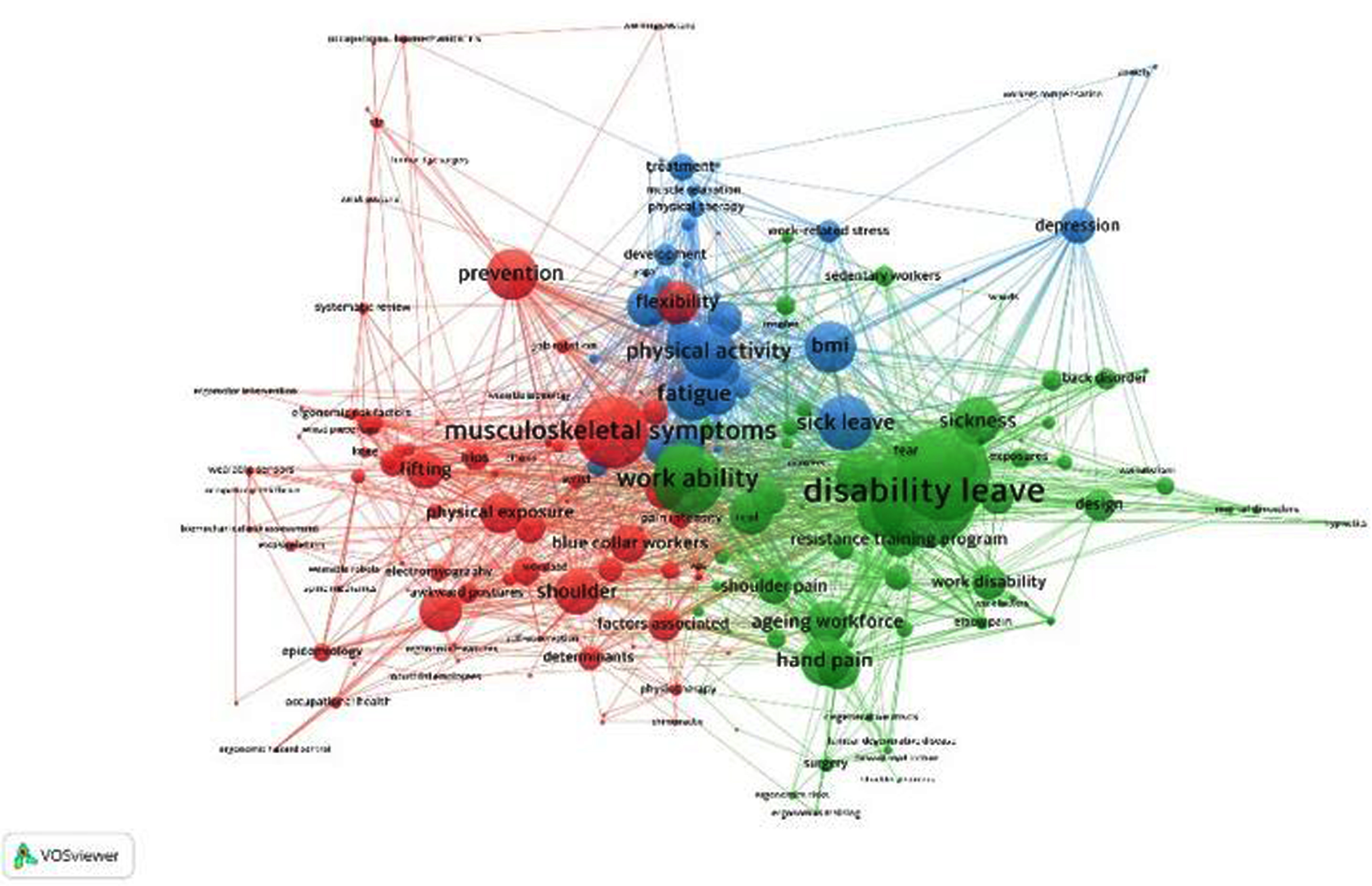
Co-word network.
In the first community, the ergonomic assessment has as inputs affected body parts and related diseases. These inputs are associated with work activities and assessment tools which are the background for ergonomic risks. The ergonomic risks are the inputs to identify the workplace intervention tools such as: participatory ergonomics, worker physical intervention, skills and training, job intervention, biomechanics, and robotics (see Fig. 3).
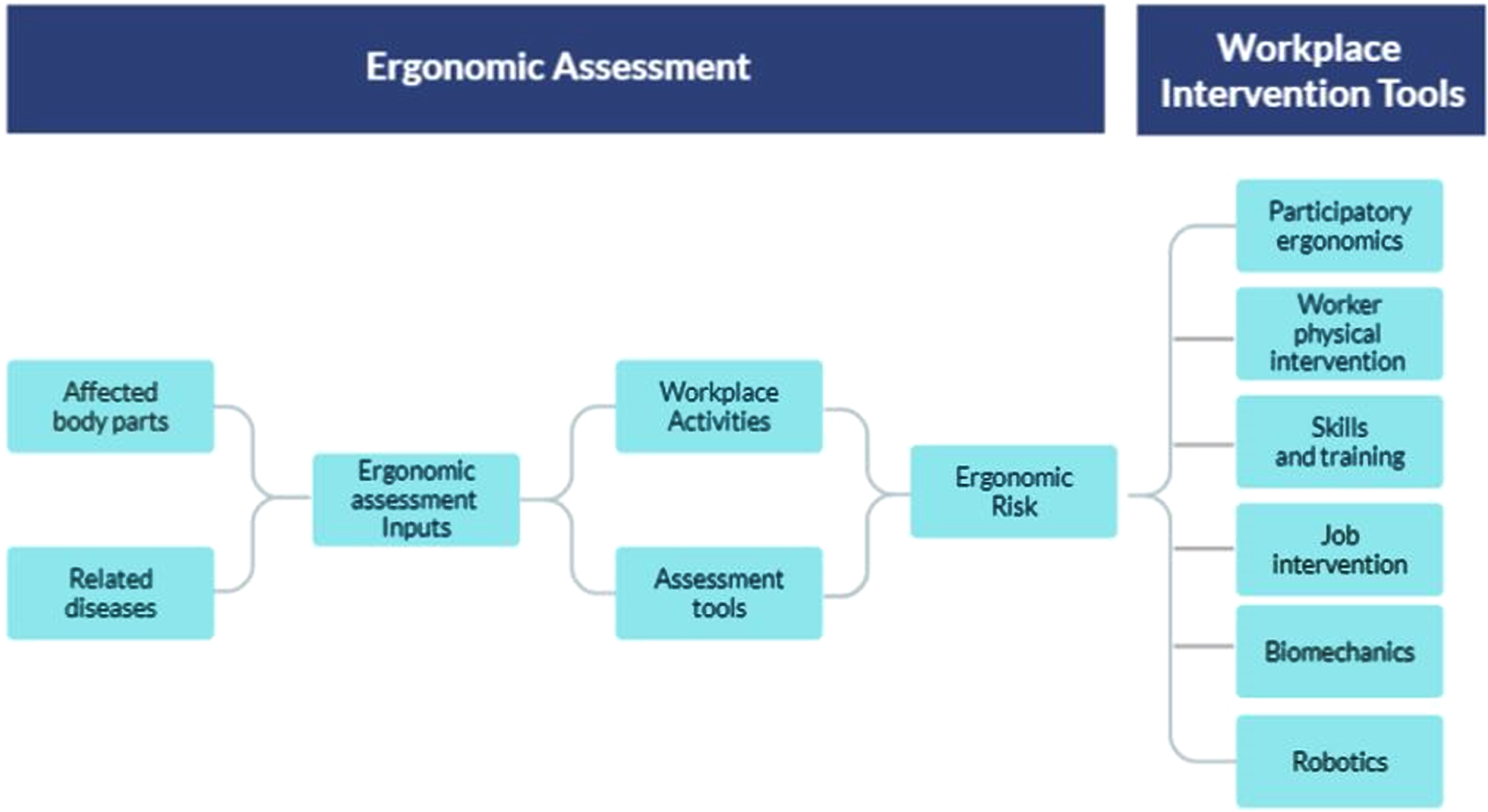
Community 1- Ergonomic asseeement and workplace intervention tools.
This community portraits musculoskeletal diseases in specific body parts which studied the relationship with work activities [33] of whom blue collar workers are the most affected [34]. In this sense, ergonomic assessments techniques were considered to define the associated risks [35] and the guidelines to manage this exposition [36]. Some of these guidelines are focused on workplace intervention tools such as: participatory ergonomics programs [38], worker physical intervention [39], skills and training effects [40], job intervention and improvement of working conditions [41], biomechanics assessments [42] and robotic application in workplace and wearable technology [43, 44]. According this analysis, the “International Labour Office” (ILO) and the International Ergonomics Association (IEA) developed some guidelines [45] against ergonomic risks integrating physical, cognitive and organizational management for effective work system design.
In the second community, the factors related to rehabilitation and return to work emerged initially with the related diseases which are inputs for sick leave. Thus, sick leave is the input for job and personal factors influencing rehabilitation which have an impact in the return to work (see Fig. 4).
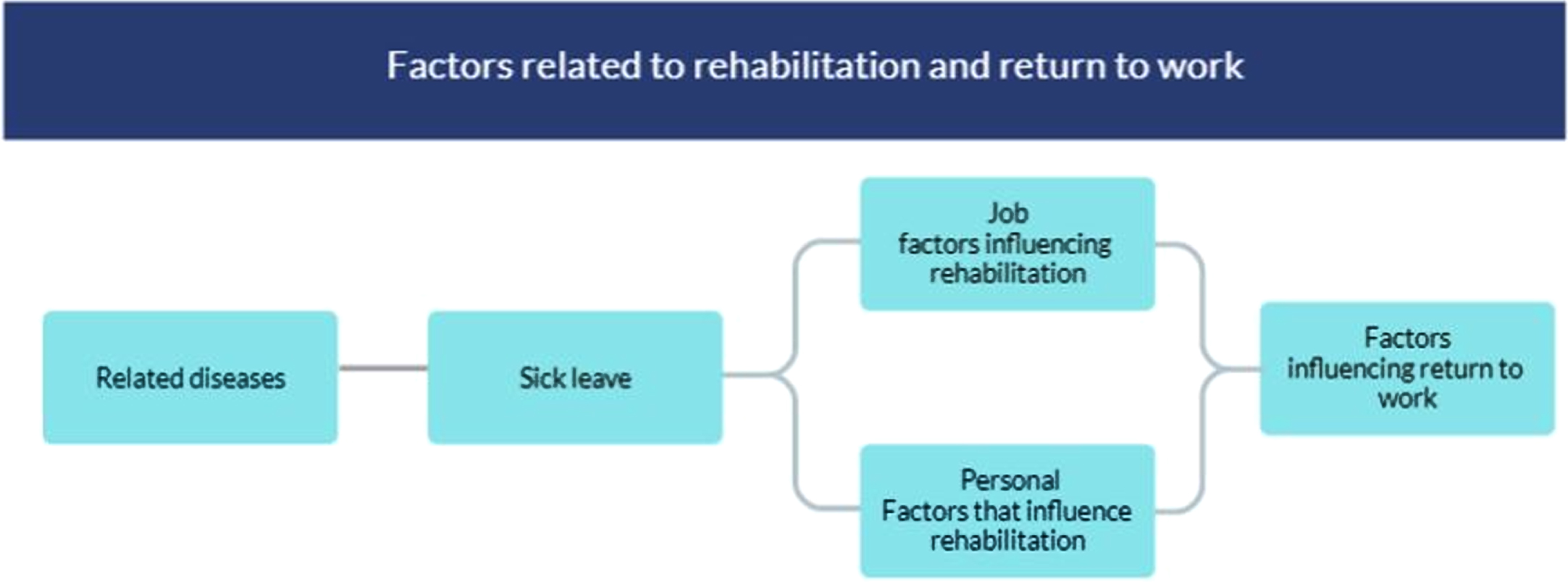
Community 2- Factors related to rehabilitation and return to work.
Regarding related diseases most of them are associated with musculoskeletal disorders as the main source of workers’ sick leave [46]. Rehabilitation techniques were developed considering job factors [47] like physical training programs [48], and personal factors like mental and physical diseases [49]. The factors that influenced the most the return to work is workers awareness level [50], medical interventions [7] and lifestyle after rehabilitations process [51]. The “World Health Organization” (WHO) considers rehabilitation as an essential health service and a strategy program and return-to-work programs including musculoskeletal disorders and mental health conditions [52, 53].
In the third community, the physical and mental overload management are based on factors of job physical overload, and worker physical overload. These are the inputs for job analysis which is the basics for physical and mental overload effects. The aforementioned effects lead to management programs that try to give a solution to this issue (see Fig. 5).
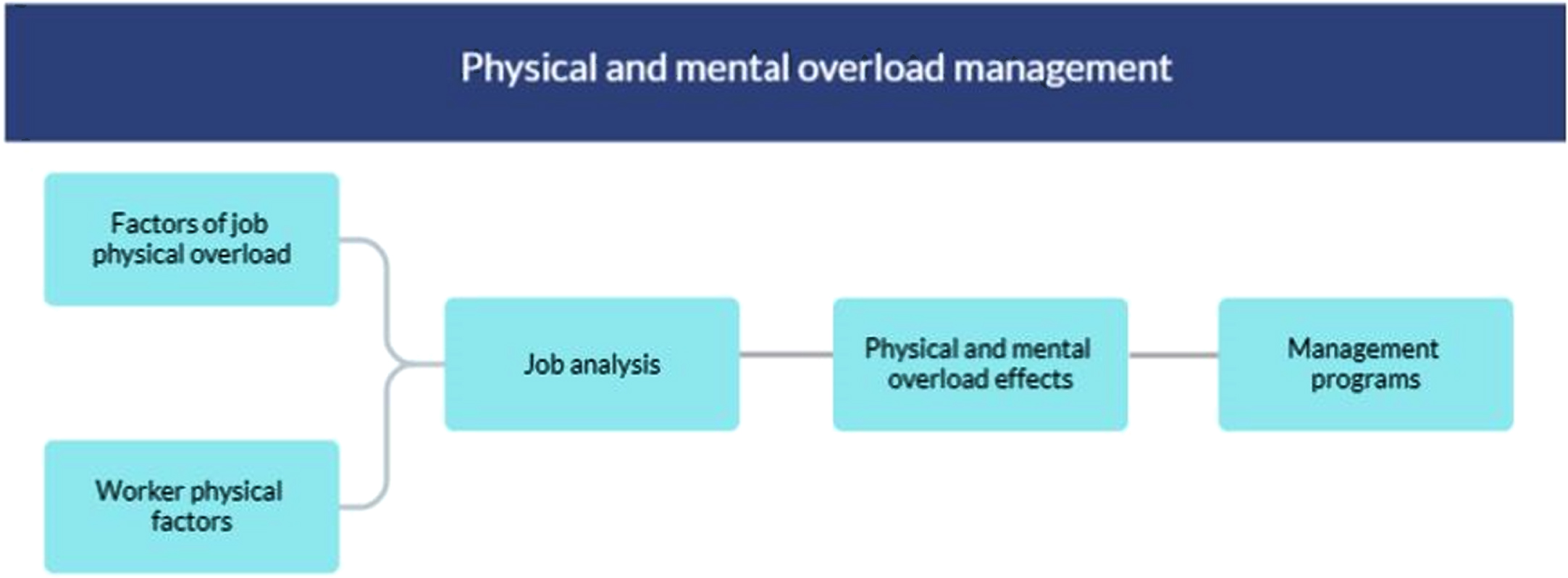
Community 3- Physical and mental overload management.
This last community focuses on the multidisciplinary features of job overload which studies worker physical capacities and strength qualification [54] with factors related to job physical activities [55] leading to job ergonomic assessment [56]. In order to prevent physical or mental effects caused by the exposure of the aforementioned factors [57] action plans such as health promotion [58], physical therapy [59] and stress management [60] had been implemented to improve workers’ health and wellness. Overload management is widely studied in specialized organizations such as the “National Institute for Occupational Safety and Health” (NIOSH) [18] in stress at work [61, 62] including workplace management programs.
This paper mapped the conceptual structure of ergonomics, MSDs, treatment and return to work in manual jobs in the last 12 years implementing a systematic co-word network analysis methodology finding three communities: Ergonomic assessment and workplace intervention tools, factors related to rehabilitation and return to work, and physical and mental overload management. For each community, there is a framework that explains the relationship within terms.
This work is aligned with the replicability, robustness, and relevance suggestions of Cabezas, Milanés and Delgado [63] and Boyack, Klavans and Smith [64] for scientometric studies because the search filters creation, their outputs, and the selected papers are shown in the Appendixes. In the former, we explained each community in depth creating its framework. In the latter, each community framework was mapped with the scientific literature as well as organizations such as ILO, IES, WHO, and NIOSH.
This study has some limitations. First, regarding to the number of papers included on the co-word network because this technique has better results if the corpus tends to be large as recommend Cabezas et al. [63] with a corpus greater than 200 scholarly documents compared to the 185 papers that were considered in this study. Second, is the type of selected papers because we examined only open-source documents. Finally, as it is a novel methodological application in an emerging field, there are few previous applied studies, which is why limitations of new applied methodologies were determined. Despite those limitations, the study yields goods results because we analyzed the title, abstracts, and keywords. In fact, we implemented noun phrases which according to Thijs [65] are more suitable features for co-word analysis due to their role in the sentences.
Future research is required regarding further analysis such as a strategic map [66] that will identify the emerging topics. Additionally, other science mapping techniques such as co-citation [67] or bibliographic coupling [68] could enrich the analysis [69]. Furthermore, a benchmarking of the content analysis based on the 185 papers could identify common and emerging topics.
Conclusion
The occupational health community is encouraged to implement scientometric studies not only as the execution of a software such as Vosviewer, but following rigorously the scientometric methodology. In fact, this study could demonstrate how to implement a rigorous and systematic co-word network analysis. Furthermore, we recommend to work in an interdisciplinary team as the authors in this paper. Interdisciplinary gives a more robust approach such as the implementation of ad-hoc scripts for data preprocessing, and the plotting of the network. For instance, the implemented ad-hoc scripts allowed us to have a more reliable network than a network based only on keywords. In fact, another recommendation is to use as the unit of analysis titles, abstracts, and keywords. Finally, teaching initiatives about scientometrics are suggested to the occupational health community as in the humanities [70].
Ethical approval
Not applicable.
Informed consent
Not applicable.
Conflict of interest
None to report.
