




Abstract
Mapping and depicting the structure, dynamics and national specialisation profiles of scientific fields at the country level affords a better understanding of national developments and changes in a given field, particularly when these changes may serve as an aid in decision-making with regard to research management. This article looks at the cognitive structure of a field over time to characterise its development across countries and to appraise the competitiveness of countries in terms of research specialisation. Based on a dataset extracted from the Scopus database, we conducted a co-word analysis and studied the degree of specialisation based on publications and on keywords, in the Nanoscience and Nanotechnology field (NST). The results reveal that NST research tends to focus on nano applications and devices. According to the keyword activity index, the countries studied centre their specialisation on electronic, biotechnology and biomedical research, certain countries showing a more competitive edge in the global realm of output. Accordingly, implications that could contribute to decision-making regarding the economy and research policies are described.
Keywords
1. Introduction
Characterising scientific knowledge by tracking patterns, dynamics and trends of scientific outcomes in a research field is useful for designing reliable and solid tools for science policy and science evaluation processes [1]. Through these patterns, the intellectual-cognitive structure and the dynamics of scientific fields over time can be explored [2] to provide an overview of emerging and/or mature research fields and to perceive how academic knowledge flows in the form of key concepts to be shared, recombined and developed over time [3].
However, depending on the level of aggregation, different approaches and units of analysis can be adopted. A combination of techniques (author co-citation analysis, document co-citation analysis, co-word analysis, etc.), units of analysis (journal, publication, keyword, etc.) and actors (countries, institutions, organisations, etc.) may lend accuracy to the identification and characterisation of scientific fields [4,5].
Co-word analysis is considered as an effective approach to investigate the knowledge structure and trends of domains. Co-word analysis can help describe, define and identify the research topics within a field. It gathers words from publications (usually extracted from titles, abstracts and keywords) to capture the changes in a field over time [6,7]. Through the study of terminology corresponding to different periods, co-word analysis draws a picture of cognitive structures and their development dynamics [8–10].
At the same time, characterising national publications profiles serve to appraise countries’ research strengths or weaknesses, which complement the analysis of the intellectual-cognitive structure. Based on the idea that research topics of a particular field signal a country’s specialisation or diversification, hence its competitive advantages [11], relative indicators can be used to compare research performance in terms of the disciplinary specialisation of countries.
The financing of research, development and innovation is based on variables, such as relevance, excellence, innovation, quality, visibility, impact research and performance. To target the financing more effectively, evaluation and support of promising areas of research, innovation and technology is crucial. The idea is that countries can exploit their potential to become competitive if they take into account their strengths in terms of key activities within technological domains. Consequently, identifying domains and priority areas while understanding the stages of transition help improve competitiveness, knowledge growth and innovation capacity.
Nowadays, Nanoscience and Nanotechnology (henceforth NST) is an area holding vast technological and social potential for the community, presenting advancements for industry, health, the environment and security. It therefore attracts great policy interest [12]. NST has been included as a promising strategic and innovative area in many research and development plans – even worldwide, for example, the EU Research and Innovation Programme known as Horizon 2020, 1 the National Science Foundation 2 and the National Nanotechnology Initiative. 3 Combining different approaches so as to grasp the global and local structure of the NST research field (here and thus far to test our proposal, a case study) should help trace its dynamics over time. This article analyses cognitive structures and specialisation profiles using the Activity Index (AI), based on the publications and on the use of keywords at global and country levels.
2. Literature review
Scientometric studies rely on the diverse methods to explore the disciplinary structure, dynamics and research patterns of NST. Network analysis of WoS publications and subject categories was applied to establish the main scientific and technological fields (i.e. materials science, chemistry or physics) comprising NST research [13–15]. Citation analysis has previously been employed to identify the subject categories of NST publications from WoS [16], confirming that biomedical sciences were highly cited. Term analysis (extracted from titles, abstracts and keywords) of WoS publications has served to determine the main research topics of NST [17], to capture cutting-edge NST research [18] or to determine to what extent countries benefit from collaboration to heighten the research performance in terms of citation, leveraging competitiveness through the design of research and development agendas [19]. Hybrid methods – such as the combination of lexical mining, citation flows and mapping techniques – have been applied to nano publications from WoS to identify the diverse topics that comprise the NST field [20] or explore the dynamics of knowledge integration in some NST-related research areas [21].
Bibliometrics aid exploration of domains, such as NST. Analyses of global NST scientific production based on WoS publications have revealed the main producers and contributors in NST output: China and South Korea underwent the most rapid growth in NST output, China being close to the overall leader – the United States – and outstanding in certain nanotechnology research topics [22–27]. Similar outcomes were reported by Grieneisen and Zhang [28] and Arora et al. [16], who found that the top producers of NST publications were China, the United States, Japan, Germany and South Korea, although a number of Asian (i.e. Taiwan, India or Iran) and European countries have become main contributors to the NST field [29]. Recent research found that Asia as a continent was the most productive in NST from 2000 to 2016, followed by Europe, whose main producers were Germany, the United Kingdom, France, Spain and Italy [30]. The most updated NST publication dataset shows China to lead in NST output, followed by the United States; although European countries, such as Germany and France, make the top-10 worldwide ranking, respectively, fourth and eighth [31].
The Specialisation Index, a variation of the AI, is an indicator of whether a country has a relatively high or low share in world publications within a particular field or domain. The AI per se has been employed to study the disciplinary evolution of some countries [32–35], while versions of the AI include the revealed comparative advance [36], the Attractivity Index [37], Document-Type variant [38] or Keyword AI [39], and similarity measures applied to scientific collaboration [40]. For a comprehensive review of this indicator, we would refer to Rousseau [41].
Based on this idea, the use of the Keyword AI would identify the most representative keywords in a more effective way because it also considers low-frequency keywords. These pertain to emergent and innovative concepts of a domain and may distinguish the most dynamic areas in sub-domains [42].
Not many bibliometric analyses of global NST scientific production have been based on Scopus publications, despite its vast coverage [43,44]. Although the main players and contributors in NST have been explored, to date the national country profile in terms of specialisation in NST has hardly been studied [45]. To support an efficient distribution of funds, however, a deeper exploration of promising areas at the national or even at the European Union level might prove essential.
3. Objectives
The aims of this article are to (1) proceed with a characterisation of NST by means of a reliable and detailed search strategy, (2) discern the evolution over time of the cognitive structure of a given scientific discipline and (3) trace its specialisation profile from a twofold perspective: publications plus keywords. Accordingly, this study updates previous outcomes [17,46,47] by extending the time period studied and refining the search strategy [12]. Our approach should help arrive at a better understanding of a field’s development and comparative advantages at the country level. To test it, we used the Scopus database to fill in the gaps of previous studies that relied on WoS research topics in addressing specific research questions:
RQ1: Worldwide, which countries are the main producers, how has their output evolved and what comparative degree of specialisation have they achieved?
RQ2: What are the main research topics in NST at the worldwide level and how do European countries – Germany, France and Spain – perform in terms of their cognitive contributions to the development of NST research topics?
RQ3: Considering the use of keywords, how specialised are countries in each research topic? How do they reflect the scientific profile of NST and its evolution over time?
4. Data and methods
Data were retrieved from Scopus database at the global and country level using an updated and refined search strategy (Supplementary Text S1) described in Muñoz-Écija et al. [12]. Following Wang et al. [31], we focus our analysis at the country level on Germany, France and Spain as the main European producers in NST, given that the United Kingdom left the European Union in 2020. We aim to see how Spain’s NST output performs in comparison with that of other European countries. This focus was adopted with the understanding that the European Union is strategically committed to the development of nanotechnology in the framework of a global knowledge-based economy. Indeed, the EU funds projects undertaken by its member states overall, while encouraging nanotechnology research endeavours.
Previous studies look into the NST cognitive structure [17] and specialisation [45] until 2013. So as to broaden the scope of these previous studies, past decade’s first year (2010), middle year (2014) and final year showing complete data for bibliometric analysis (2018) were analysed. That is, to visualise the cognitive structure of NST and its evolution, a temporal division was made into three different years, with a 4-year gap between them. Data at the global level were used to build overlay maps serving as reference for the analysis of several countries. A single representation for the full period (2010–2018) would not allow us to appraise evolution and would imply a loss of information, showing consolidated fields but not detecting emerging fields or the interactions among diverse research fronts. For this reason, we focused on those 3 years as representative of a total duration of 9 years (2010, 2014 and 2018), to perceive changes over time in the NST research field. The NST dataset comprises 396,250 publications, including all document types (Supplementary Information, Table S1).
4.1. Co-word maps
Co-word analysis [6] has been outlined and later substantiated [48] as the best method to identify the cognitive structure of a field at the level of research specialties. Furthermore, it is capable of revealing new developments within a research topic over time [47]. To perform co-word analysis, we took the keywords (author keywords and indexed keywords) contained in all the retrieved documents to build a proximity/similarity matrix. A threshold of co-occurrence ≥ 10 was set to generate the cognitive structure. To avoid synonymy and acronymy issues, the keywords were normalised after designing an ad hoc thesaurus (Supplementary Text S2), standardising plural and singular, abbreviation or acronyms, as complete keywords.
Science mapping – to intuitively analyse co-word maps – consists of developing and applying computational techniques for the visualisation, analysis and modelling of a wide range of scientific and technological activities [49]; it is intended to display structural and dynamic aspects of scientific research [10,43,50]. Local science maps are problematic when it comes to comparisons because their units or positions of representation are not stable. To overcome this, one can take the units and the positions derived from a global map of science, then superimpose on them the information to be displayed and analysed [50]. Such ‘overlay maps’ are a powerful tool for exploring an activity of interest (e.g. publications by a given organisation, the references used in an emergent field, co-words…) and appraising the increasingly fluid and complex dynamics of the sciences [47,51,52,53]. NST co-word maps at the global level in 2010, 2014 and 2018 were therefore constructed, and the corresponding overlay maps for each year were derived for Germany, France and Spain to explore and compare cognitive structures and main research topics.
Mapping was performed using VOSviewer [54]. Each node/circle represents a keyword. The circle’s size reflects the number of times it occurs in the document represented. The level of co-occurrence (how frequently keywords co-occur) is expressed by the distance between two keywords – that is, the closer the two keywords are, the stronger their relationship is. The colours represent the different clusters (research topics) detected. Then, the keywords of high frequency were extracted as the basis for our analysis since keywords of this nature usually coincide with the research hotspots.
4.2. Activity index
The AI or Specialisation Index, introduced by Frame [32], is a version of the Revealed Comparative Advantage Index (RCA) used more commonly in Economics to quantify the economic/production advantages of countries [55]. In this study, the AI denotes the relative research effort that a country devotes to a given subject field, that is, the publication profile of national research in a given country, by measuring whether ‘a country has a relatively higher or lower share in world publications in a particular field of science than its overall share in world total publications’ [56] and is defined as

When AI > 1, it means that the country’s research production in a given field is higher than the world average, just as AI ≤ 1 means lower than the world average. To assess each country’s relative disciplinary strengths in NST, we apply the Relative Specialisation Index (RSI). Thus, RSI ≥ 0 versus ≤ 0 indicates scientific specialisation or no specialisation of a country in a given field. RSI is defined as

Hence, we calculated the AI and RSI in 2010, 2014 and 2018 to estimate their NST publication profile over time and detect changes in specialisation or comparative advantages [34].
Following this framework, to estimate the comparative advantages of a country in a given research topic, the notion behind the AI for publications is applied to the keywords. Because the AI designates whether a certain country has comparative advantages in researching a certain topic, it facilitates the selection of country-specific topics [57]. The AI variant based on keywords (KAI) is defined as

KAI ≥ 1 indicates that a topic is emphasised in the country above its average level, and KAI ≤ 1 indicates that the topic is underemphasised in that particular country. To assess each country’s relative disciplinary strengths based on keywords, we apply the RSI (RSIk). Accordingly, RSIk ≥ 0 versus ≤ 0 indicates scientific specialisation or no specialisation of a country in a given field. RSIk is defined as

Sometimes high-frequency keywords from publications denote general concepts used by many researchers of a given field, without accurately representing the details of a field, especially regarding topics that may be the strength of a single country [39]. In turn, low-frequency keywords reflect innovative and emerging concepts, being more representative than their high-frequency counterparts [42]. This article puts forth a means of identifying keywords in view of the frequency of their use in the world and in certain countries. The science maps that display the entire NST keywords clearly show the most relevant keywords in one or more countries. Being lesser than the number of total keywords, these specific keywords act as spotlights that more clearly expose the research advantages of the countries under bibliometric study.
5. Results
5.1. Basic statistics
Bearing in mind the countries producing more than 50,000 documents during the period 2010–2018, Figure 1 shows the percentage of NST documents published with respect to total output in each country and worldwide for the years 2010, 2014 and 2018 (left). The United States and China are the outstanding NST producers (respectively, 22,534 and 19,883 documents), followed by Japan and Germany (7534 and 7322) (see Supplementary Information, Table S1).
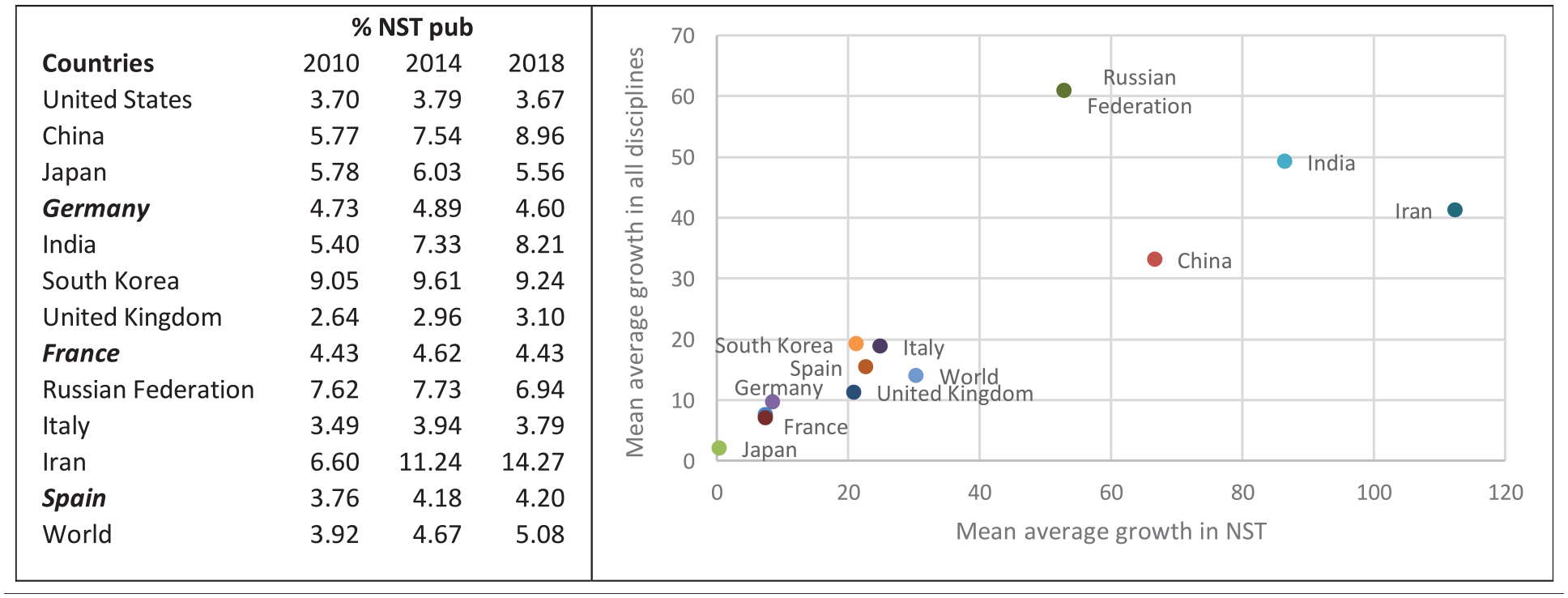
Percentage of NST publications at global and country levels in 2010, 2014 and 2018 (left) and mean average growth rate in NST and in all disciplines (right).
The graph on the left shows, for the same geographic aggregates, the average rate of growth for the entire period. At the global level, the share of world output reflects a steady increase in NST publications: a 30% annual growth rate over the 9 years analysed (Figure 1-right). At the country level, even though the raw number of publications increases year by year, growth is not homogeneous – Iran, India, China and the Russian Federation increase their output much more than the rest of the world, or the other main producers, and well above the level of output in all other disciplines (Supplementary Information, Table S2). These results largely agree with the previous reports of how countries follow different dynamics and output processes in NST [45]. Among the three countries targeted in this study, Germany shows the highest proportion of NST output, followed by France, while Spain presents the highest annual growth rate.
5.2. RSI based on publications
Figure 2 presents the RSI of the most prolific countries in NST considering their production in this field in comparison with the total production in all disciplines and taking the world as a standard (0).
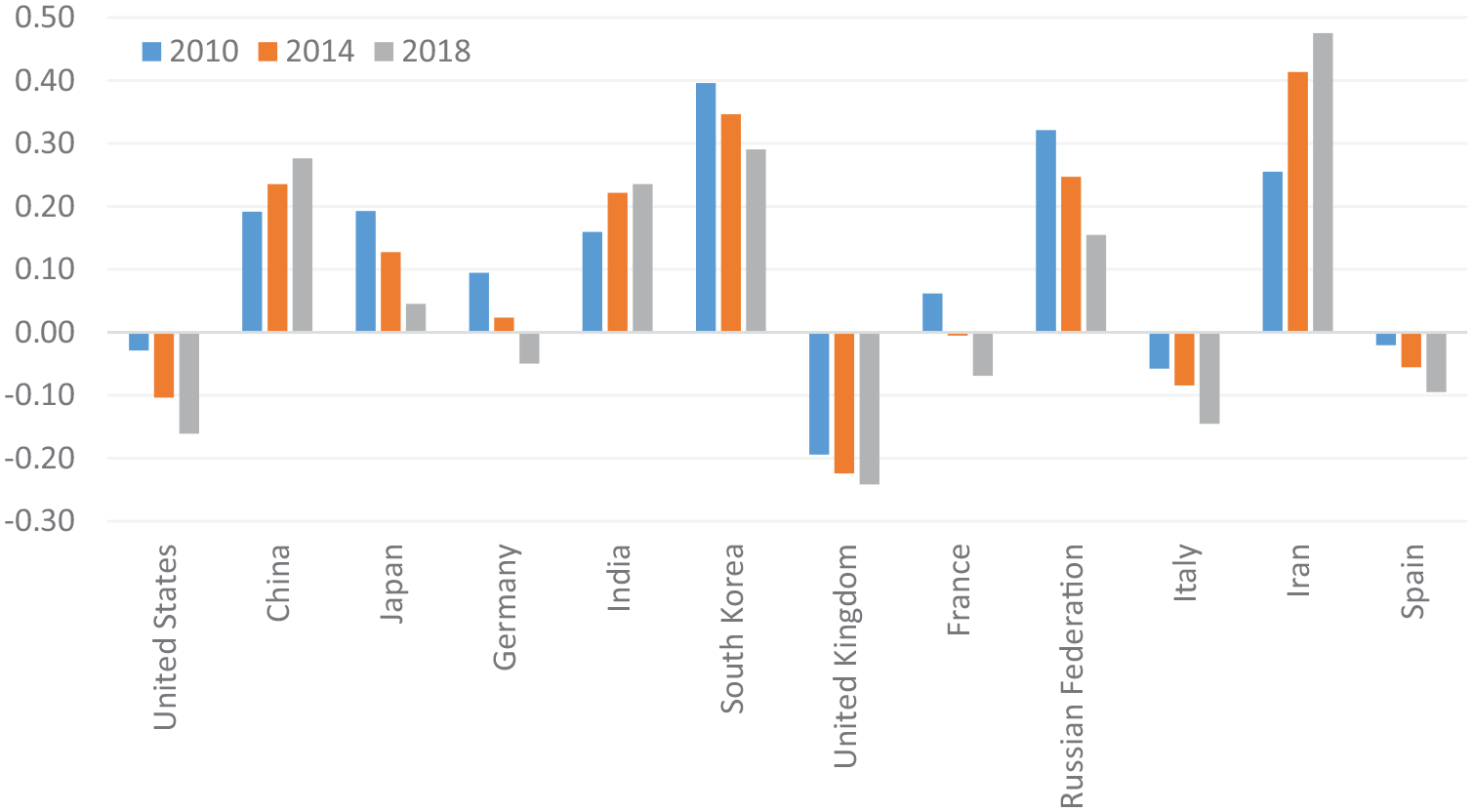
RSI in NST for the most prolific countries in the period 2010–2018.
In Germany, France and Spain, the corresponding RSI value is seen to decline after 2010. It may be that these countries are more specialised in nano applied research than in nano basic research. Similar results were divulged by Porter et al. [18], with Germany and France showing a decrease in the NST cutting-edge research activity (2006–2015), perhaps due to a growing interest in nano applications, for instance, those related to biomedical research. This also means that other countries are increasing their specialisation in the NST field. Indeed, Iran, India and South Korea show substantial specialisation growth after 2010 (Supplementary Information, Table S3).
5.3. Co-word maps
Figure 3 displays the knowledge structure of NST over time using science overlay maps. At the worldwide level, the networks represent structures having different numbers of research topics and a variety of keywords in each line. All research topics identified in the world over time are transferred and represented at the country level. The number of keywords defines the disciplinary matrix calculated by co-occurrence that determines one’s position in the hierarchy. The 50 most frequent keywords occurring for the world, for Germany, France and Spain – in descending order of prevalence by their occurrence and the total number of overlapped keywords per research topic – can be consulted in the Supplementary Information, Data S1, S2 and S3.
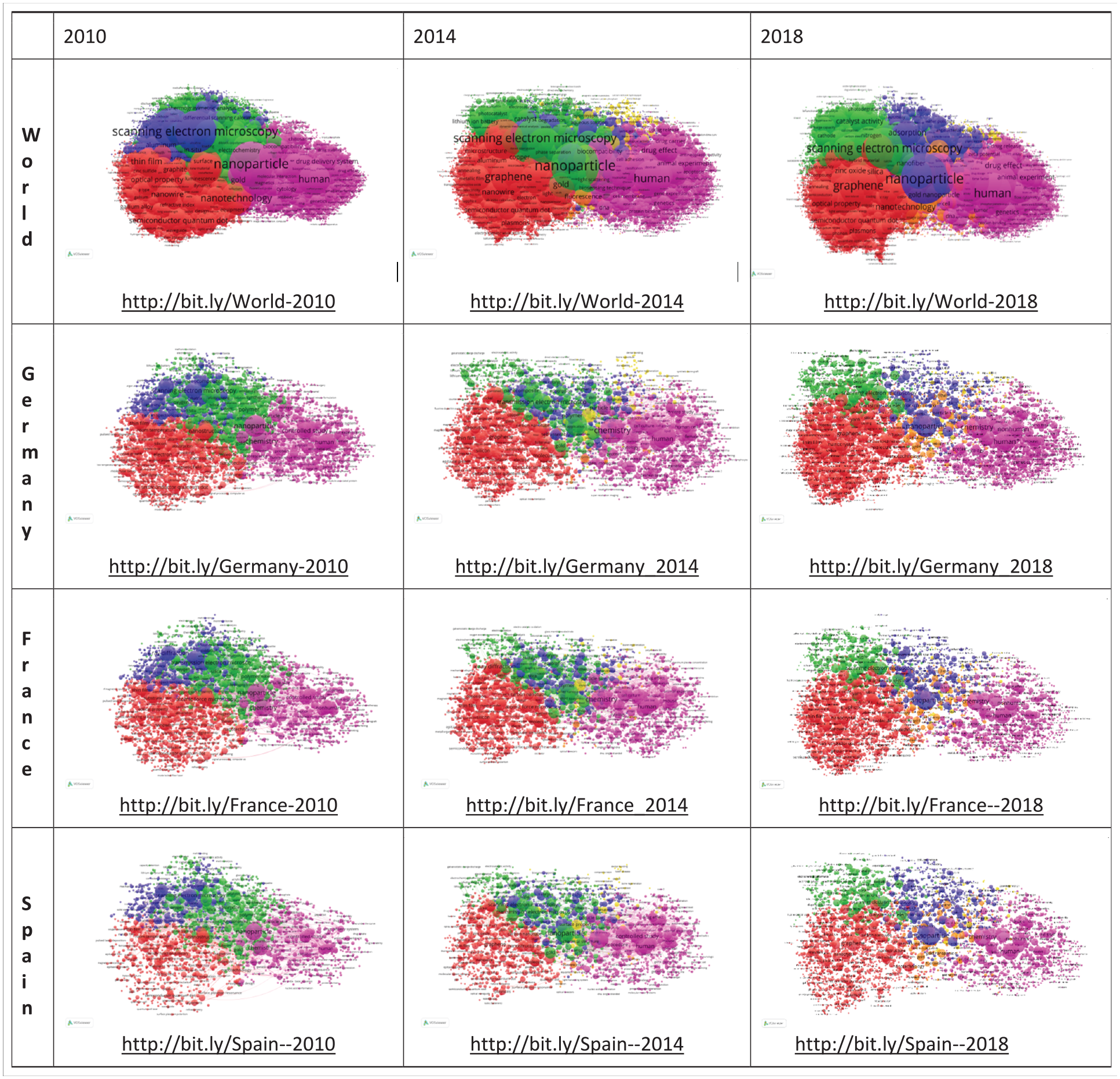
Global co-word maps for each country and the world output in NST.The links at the bottom of each map allow the reader to visualise and zoom in the maps and the networks on VOSviewer, for example, from the 2117 nodes of the Spanish domain and its 991,186 links in 2010, to the 6588 nodes of Germany in 2018, with their corresponding 3,515,751 links. Please note that for very broad domains, for example, the world map, a computer with more than 16 GB of RAM is needed to see the maps clearly.
In these global maps, the hierarchical clustering reveals a structure with four research topics in 2010: Microelectronics engineering and top-down processes (red), Synthesis of nanomaterials and bottom-up processes + Optics and electronics (green), Biotechnology and Biomedicine (purple) and Physical and mechanical characteristics of materials (blue). However, the research topic Biotechnology and Biomedicine becomes divided into three new clusters in 2014, lasting until 2018. These emergent clusters are still related with Biotechnology and Biomedicine, but they show greater specialisation in: (1) therapeutic applications through the distribution of medicines, (2) diagnostic techniques using biosensors and (3) regenerative medicine. Thus, the specialisation of the research topic Biotechnology and Biomedicine gives rise to the following clusters: Biotechnology and Biomedicine: Therapeutic biomedicine (purple); Biotechnology and Biomedicine: Regenerative medicine (light yellow) and Biotechnology and Biomedicine: Biosensing (orange).
As the global co-word maps show, the development of NST has meant the emergence of new research topics related to the application of NST for the purposes of social well-being, as in the biomedical field (clusters coloured in purple, orange and light yellow). The research topics of NST based on physics, chemistry and materials science, whether theoretical or conceptual, are represented by research topics coloured in red, green and blue. These three research topics are essential for manufacturing procedures involved in the development of new materials and technological devices.
Over the years, NST research appears to have remained stable in physics and chemistry (clusters coloured in green and in blue), key domains for its evolution. However, noteworthy interest in the biomedical applications (clusters in purple, orange and light yellow) results in a greater specialisation of researchers along new research topics. In this sense, NST research related to new materials and engineering fields (coloured in red) has increased gradually every year, but less than in the area of biomedical research.
At the country level, Germany focuses on Microelectronics engineering and top-down processes (red) and Biotechnology and Biomedicine (purple) research and undergoes minor growth in research based on Physical and mechanical characteristics of materials (blue). France shows a pattern similar to Germany’s at first; but its trend in NST research changed in 2014 and 2018, with a remarkable increase in Biotechnology and Biomedicine. This development gave rise to new research topics in the biomedical and biotechnological field or increased the existing research in the case of Therapeutic biomedicine. Spain largely follows the behaviour of Germany or France in that Microelectronics engineering and top-down processes (red) became the top research topic after 2010. Yet unlike the others, Synthesis of nanomaterials and bottom-up processes + Optics and electronics (green) decreased in terms of the number of overlapped keywords after 2014.
Worldwide, the top keywords used in each research topic show only slight differences by year. At the worldwide level, nanoparticle is the keyword that tops the ranking every year along with scanning electron microscopy and chemistry. There are some differences among the remaining top-five keywords, however. For example, x ray diffraction appears only in 2010 and 2014. Human was a top keyword in 2014 and again in 2018. Graphene appears as a top keyword only in 2018. At the country level, the keywords nanoparticle, graphene, human and chemistry showed the highest overlap with the world maps for Germany. In France, the most overlapped keywords were nanoparticle, human, controlled study and unclassified drug. For Spain, nanoparticle, chemistry and graphene were the outstanding keywords.
5.4. RSI based on keywords in each research topic
Table 1 shows the RSIk from a dual perspective. For one, the average RSIk of each cluster is calculated in terms of the total number of keywords (N terms). Second, the average RSIk is calculated in terms of the total occurrences (N occurrences). As can be seen in Figure 1, Germany, France and Spain show a specialisation below 0 with respect to world output and to that of other countries. Because this value is lower than 0, we find specialisation with values below 0 when we look at the terms of the different research topics comprising NST in the countries studied (Table 1). However, if we look at the specialisation when calculated based on total term occurrences, most values are above 0 with respect to the world. That is, after eliminating the size effect from output, we discover which countries have a research topic with a competitive edge on the global level.
RSI of each research topic based on keywords.
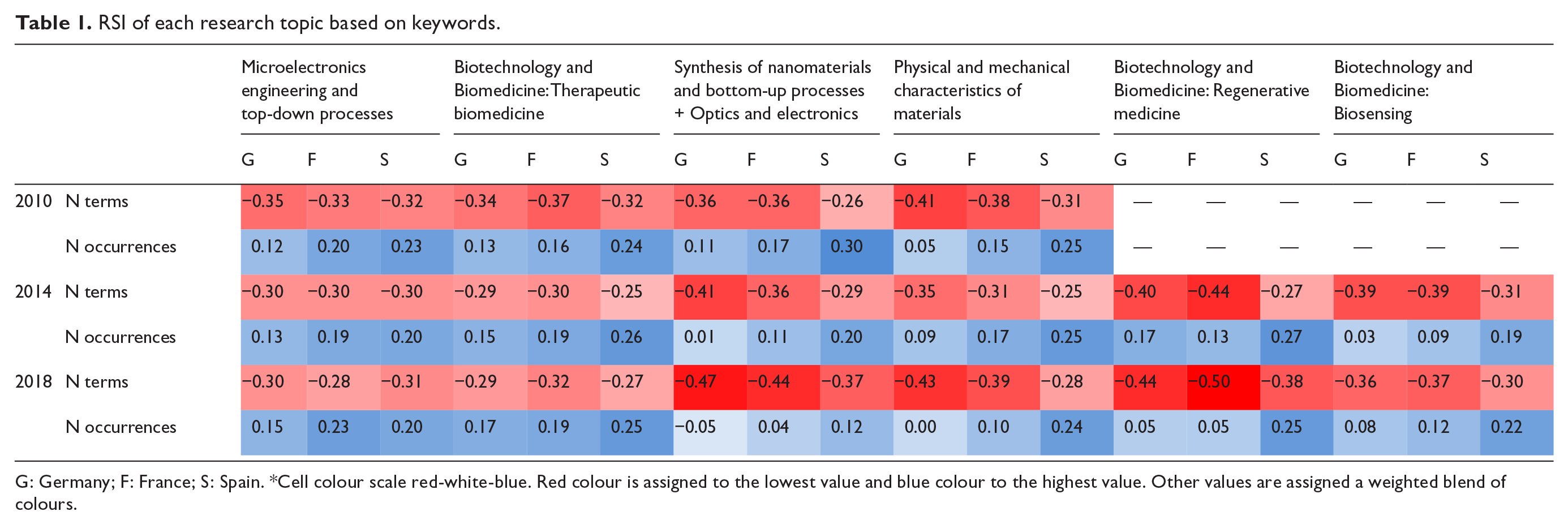
G: Germany; F: France; S: Spain. *Cell colour scale red-white-blue. Red colour is assigned to the lowest value and blue colour to the highest value. Other values are assigned a weighted blend of colours.
This cross-country comparison regarding the patterns of specialisation evidences noteworthy differences. The RSIk values (total number of terms) reveal that in Spain, all the NST research topics have relative advantages between 2010 and 2018, though Biotechnology and Biomedicine: Therapeutic biomedicine reflects the greatest advantage. France shows a relative advantage in Microelectronics engineering and top-down processes research, whereas Germany evolves towards specialisation in Biotechnology and Biomedicine: Therapeutic biomedicine, as does Spain, but to a lesser extent (Table 1).
In turn, the RSIk values (total number of occurrences) (Table 1) present greater advantages in all the research topics in Spain at the worldwide level in the period 2010–2018, especially in the areas of Biotechnology and Biomedicine and the characterisation of nanomaterials. The lowest advantages are seen for Germany, giving values of 0 in Physical and mechanical characteristics of materials or below 0 as is the case of Synthesis of nanomaterials and bottom-up processes + Optics and electronics. France shows intermediate values, between Germany and Spain, in all the research topics, although it has a greater advantage in research related with engineering.
Figure 4 indicates the top 10 RSIk of each research topic. Each cluster is described below for more detailed analysis. Further details can be found in the Supplementary Information, Data S1, S2 and S3.
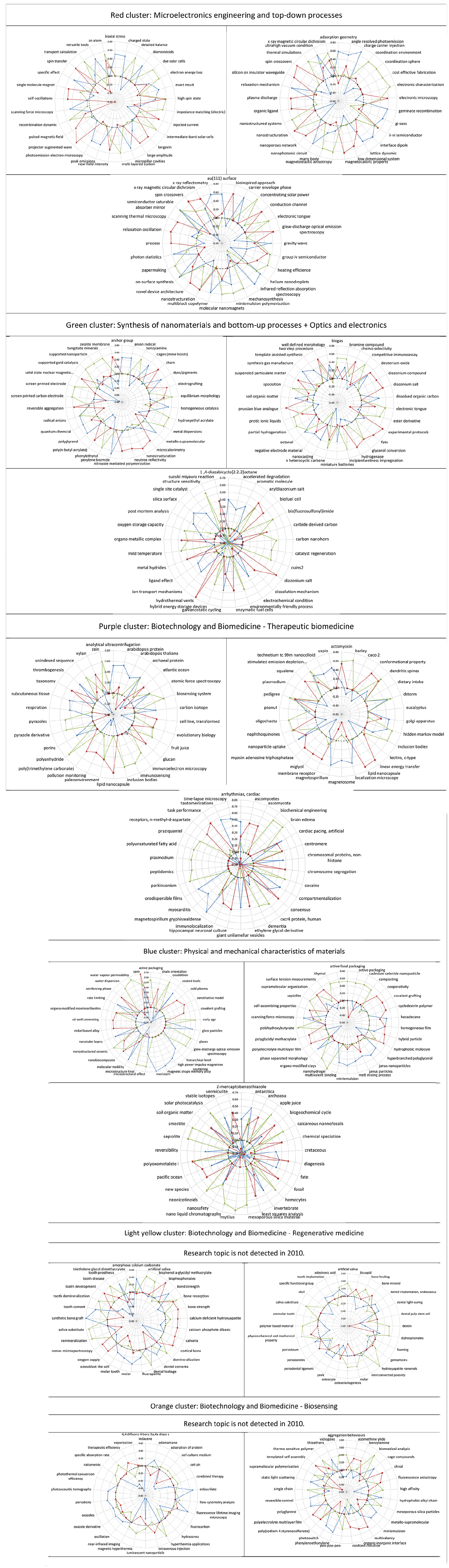
(Continued)
5.4.1. Microelectronics engineering and top-down processes – red cluster
In 2010, this research topic showed a relative advantage in micropillar cavities and biaxial stress in Germany. In France, the advantage is highest in terms that include projector augmented wave, spin transfer or high spin state. The latter term, high spin state, coincides with one of the keywords denoting higher specialisation in Spain, along with the terms, such as dye solar cells, that reflect intensive activity.
In 2014, the term carrier injection presents the highest relative advantage in Germany. The terms relative to spin, for example, spin crossovers, continue to indicate high research activity in France, although other terms arise, among them nanostructuration or x ray magnetic circular dichroism. In Spain, new terms related with major advantages include nanostructured systems, and nanostructuration or x ray magnetic circular dichroism, keywords coinciding with those of France.
In 2018, a new term signalling relative advantages is semiconductor saturable absorber mirror. In France, spin crossovers and nanostructuration continue to denote high relative advantages; and x ray magnetic circular dichroism shows remarkable growth when compared with 2014. Researchers in Spain funnelled more effort into concentrating solar power and semiconductor saturable absorber mirror; and whereas nanostructuration and x ray magnetic circular dichroism continued to mark research activity, it was less than in 2014.
5.4.2. Synthesis of nanomaterials and bottom-up processes and Optics and electronics – green cluster
In 2010, Germany reveals major research activity in perylene bisimide, homogeneous catalysis and polyglycerol, whereas France initially concentrates more research specialisation on nanostructuration or nitroxide-mediated polymerisation. In Spain, the term highlighting research advantages is screen-printed carbon electrode.
In 2014, new terms appear: for example, synthesis gas manufacture or octanol in Germany. The research activity in France is more heavily dedicated to experimental protocols or prussian blue analogue. In Spain, the terms vary, with the emergence of terms, such as electronic tongue or competitive immunoassay.
In 2018, greater research activity is focused on terms, such as galvanostatic cycling and silica surface in Germany. In France, diazonium salt rises as a relative advantage keyword, and new terms, such as hydrothermal vents or aryldiazonium salt mark the bulk of research activity. Spain witnesses the emergence of further keywords: structure sensitivity and carbon nanohorn.
5.4.3. Biotechnology and Biomedicine: Therapeutic biomedicine – purple cluster
In 2010, Germany exerted greater specialisation in the research topic arabidopsis protein, whereas lipid nanocapsule has a higher presence in France, and biomedicine prevails in Spain with polyanhydride, zein or biosensing systems.
In 2014, the keywords magnetospirillum and nanoparticle uptake cover the focus of most research activity in Germany; lipid nanocapsule still shows the highest relative advantage in France, and caco 2 and plasmodium predominate in Spain.
In 2018, magnetospirillum gryphiswaldense still evokes the highest research activity in Germany, together with terms, such as orodispersible films and tautomerisations; in France, new terms, including hippocampal neuronal culture or chromosome segregation, reflect a surge in research activity; while in Spain, plasmodium, brain edema, biochemical engineering or parkinsonism emerge to represent specialisation in NST.
5.4.4. Physical and mechanical characteristics of materials – blue cluster
The evolution of this research topic in 2010 is highly specialised in meristem and magnetic in Germany. In France, specialisation is concerned with yarn and nanobiocomposite. In Spain, the highest degree of research activity is initially represented by water vapour permeability and nanostructured ceramic.
In 2014, terms reflect lesser research efforts in Germany, when relative advantages surrounded terms, such as scanning force microscopy or miniemulsion. France’s research activity revolves around terms, such as hydrophobic molecule, polyelectrolyte multilayer film or supramolecular organisation. In Spain, terms, such as nanohydrogel and sepiolite, underline intensified research efforts.
In 2018, NST German efforts are focused on invertebrate or stable isotopes. In France, specialisation shifts to polyoxometalate or diagenesis. Sepiolite still indicates high activity in 2018, together with mytilus and smectite in Spain
5.4.5. Biotechnology and Biomedicine: Biosensing – orange cluster
In 2014, research related to Biosensing displays the highest specialisation through keywords, such as enbucrilate and fluorescence lifetime imaging microscopy in Germany; intravenous injection shows intensified research activity in France; in Spain, the keyword hyperthermia applications reflects the most NST activity.
In 2018, this research topic shows different specialised terms. For example, in Germany, phenyleneethynylene and photoswitch mark the highest research activity; in France, the keywords are terms, such as multivalency, chiral and polyelectrolyte multilayer; and in Spain, biomedical analysis or thermo-sensitive polymer are the terms designating the most intensive research activity.
5.4.6. Biotechnology and Biomedicine: Regenerative medicine – light yellow cluster
In 2014, Germany put emphasis on the term synthetic bone graft. In France, keywords bisphosphonates and cortical bone display the highest research activity. Spain’s research activity is more focused on saliva substitute and remineralisation.
In 2018, Germany’s terms reflecting the highest relative advantages are zoledronic acid and periosteum. In France, new terms emerging are bone mineral, bicuspid, physico-chemical and mechanical property. In Spain, saliva substitute and artificial saliva still show activity, but a bit less than in 2014. The emergent terms denoting new and intensive research activity would be hydroxyapatite nanorods and physico-chemical and mechanical property.
6. Discussion
This study provides an overview of the cognitive structure and the relative specialisation or comparative advantage of countries at the level of publications and research topics over time in NST research. We analysed relative strengths and weaknesses in national performance and international competitiveness. The focus is an international comparison for three European countries (Germany, France and Spain) against a world baseline. This overview proves how mapping knowledge and depicting scientific intellectual structures in NST (or any other knowledge domain) are of importance to understand how research develops and how research units relate to each other in a given domain. When provided with an intuitive ‘picture’, it is easy for informetricians, research assessors and even the public at large to discover a domain’s inner structure and extract key clusters [58].
Our results reveal changes in the cognitive structure of NST at the global level, with new research topics popping up here and there. NST research tends to explore new technologies and applications holding potential to address societal challenges, improve the quality of life and optimise industries that might benefit society, a finding in consonance with previous studies [59,60]. Porter et al. [18] argue that the development of theoretical stages in this domain helps consolidate new research topics focused on concrete applications of NST theories, which witnessed remarkable developments in engineering, medical and biological areas of NST. The novelty of this article is that we show differences in national cognitive structures. For example, we observe that Germany’s scientific research is more concentrated on Biotechnology and Biomedicine research topics and Microelectronics engineering and top-down processes than France or Spain, at the world baseline. Within France, Biotechnology and Biomedicine: Therapeutic biomedicine is well represented, although the other research topics do not suggest noteworthy strength with respect to the world. Physical and mechanical characteristics of materials (blue) output are lower in Spain than in Germany or France, but the frequency of occurrence of its terms increases more at the world baseline. Such differences may reflect diverse institutional settings and hence management cultures [61,62]. Further study is needed to explore how such factors may influence a country’s output and competitive edge. The analysis presented here, highlighting the strengths of particular countries, is helpful to orient research in certain fields to gain or maintain a firm’s research position, create alliances or collaborative ties with other countries or compensate for weaknesses detected.
Overall, NST publications have undergone vast development over the last decade, as evidenced by the cumulative number of publications at a worldwide level. Notwithstanding, the growth is unevenly distributed among countries. For example, while the number of publications in Spain is still lower than in Germany or France, its growth in the past decade is greater (see Supplementary Information, Tables S1 and S2). This growth does not correspond with the rate of specialisation, meaning that while Germany and France show some degree of specialisation with respect to the world in the early years of study, their specialisation decreases when the output in NST grows at a faster pace in other countries, for instance, Iran or South Korea. Specialisation profiles in core NST research may be high despite a relatively low world share (see Supplementary Information, Table S3). The dynamics of scientific output in every single country and interactions among countries worldwide are both determinant factors behind advances in NST or other fields of specialisation.
Some countries perform more or less evenly in terms of output and specialisation, whereas others have evident and characteristic core strengths, even in research topics where the relative investment is low [63,64]. This can be quantified in various ways. For example, the specialisation index applied by Chinchilla-Rodríguez et al. [45] showed Asian countries to have a higher concentration of NST research output than the rest of the studied countries, a possible indication that NST research has become established as a scientific priority in this geographical area. In contrast, though the United States is the greatest producer overall, it stands out only in specialisation in 2003 with an excellence rate above the world average. France is the sixth greatest producer of NST, with a specialisation index above the worldwide level, but its excellence rate is below the global average. Institutional settings and research management may play a key role in these outcomes; further analysis is needed to explore this possibility.
In short, each country (or geographical area) shows a different pattern of specialisation based on NST publications, which is a potential signal of relative advantage with respect to collaborators or competitors at the worldwide level. According to Hidalgo et al. [65], in terms of ‘product space’, these results may have important implications for economic policy because they point to topics where a country might promote efforts towards transformation and gaining an upper hand within a specific scientific field. Such efforts could be focused, for example, on the economic investment to be made for products (topics) of vast potential, bearing in mind the level of a country and its weight in the global realm. When economic resources destined to the sciences are scanty, knowing just what and how countries produce can be determinant for allotment. As stated by Adams [62], even if the frontiers of research are endless, each country has only a limited quantum of good research to offer. Investment beyond that point is nugatory; greater quantity inevitably means poorer quality.
Despite the challenges involved, the ultimate aim is to ensure greater efficacy in the development of research and sound competition in the global realm, including collaborative efforts among different countries, aspiring to ‘Smart specialisation’. This term refers to a political framework of vertical orientation that reflects the priorities established at a regional level. It combines upwards and downwards dynamics to set priorities for public investment in knowledge. This strategy helps guarantee that governmental efforts and resources are not spread out evenly; the key question is how to select the most relevant areas deserving investment [66]. Such a diagnosis foments positive transformation, by updating neglected areas, advancing along new lines of interest or fortifying areas already competitive at the international level. Smart specialisation entails identification of national strengths and weaknesses within research fields to establish priorities accordingly. It may be a useful strategy for building scientific capacity in developing and peripheral countries [67]. Alternatively, nations may develop a consensus about investment and develop programmes to concentrate talent behind core.
There are some limitations regarding this study that should be mentioned. First, the analysis and comparison of just a few European countries is an obvious geographical limitation. Still, this approach could be extended to analyse any country or institution in further efforts to study a broad set of countries across continent and/or scientific capacities [68]. Second, the results point to variations among the years under study, meaning we cannot affirm whether the results would have been different if other years had been chosen. That is, our findings apply only to the specific years under study. Therefore, the results should be considered with caution under the focus of the particular countries and two dimensions of analysis applied in this exploratory research effort. Third, criticism of the AI and its mathematical equivalents might be a limitation. AI implies some theoretical problems due to its mathematical structure [69], and its values for one field could be affected by the output activity of other countries and fields, so that an across-field comparison would be misleading [70]. Interpreting the results obtained using these indicators in the realm of science calls for some caution [41]. Finally, we use high-frequency keywords to illustrate the combination of co-word analysis and AI. Other non-high frequency keywords might be selected in further studies to unveil and compare research advantages possibly leading to innovative NST research if these keywords appear in all units of analysis (countries, institutions, etc.) [39,42].
In addition, for a more detailed analysis of NST research, approaches involving broader coverage (see for example, Hook et al. [71] and Huang et al. [72]) could be undertaken. Alternative data sources would enrich analysis – for example, considering the ration of qualified personnel with respect to the total population, or the sectors most involved in knowledge production (namely, industry, government or higher education sectors).
In sum, this approach or any other approach can always be subjected to debate. Its suitability for a broad array of fields suggests a diversity of outcomes that might serve as feedback to modify and/or improve its application, in search of a process that will lead us closer to consensus among the scientific community. The methodology suggested in this study is therefore not limited to the EU countries or domain chosen, but can be extrapolated to (1) other countries and (2) further domains. It was designed as is presented as an assay under proof. Testing this method is by no means exhaustive; here, the focus of analysis included Spain, but other countries could just as well have been chosen. Likewise, not only researchers but also policy managers and information professionals might find this method useful to explore a variety of countries and domains. Further work is needed to provide indicators and interpretations of NST that would contribute to a more profound understanding of how research is produced, shared and developed.
7. Conclusion
Despite the aforementioned limitations, this research paper and the results it projects can be seen as a platform of evidence to support decision-makers when developing new policies that favour smart specialisation and good practices in scholarly communication. The analysis of research topics is relevant because it substantiates the link between scientific yield in terms of the effort and level of activity undertaken by countries against a world baseline and brings to light relationships within the competitive structure of a domain. The combination of several techniques may be applied for technological surveillance in economic research policy and technological development. Future studies could attempt to untangle these associations at higher (regions) or lower levels (institutions) of aggregation. A global benchmarking analysis would help us gain a holistic view of knowledge production and the scientific capacities of countries, sectors or institutions.
In conjunction with the research aims stated, our contribution is twofold. First, we trace the cognitive structure of NST over time by updating the NST dataset as described by Muñoz-Écija et al. [12]. This comprehensive search strategy along with science mapping provides an opportunity for a full grasp of NST development, while also proving useful to quickly detect relevant research. Second, our modification of the AI to measure keywords helps determine the salient research topics of countries. This modification can enhance the characterisation of a national or regional profile, so as to detect efficiency in terms of specialisation/innovation, in a field within the overall context of research output. Shedding new light on the background and characteristics of a domain could aid researchers in their own development and potentially support collaborations, calls for grants or mobility programmes. Therefore, having this information essentially ‘at a glance’ may accelerate investment along strategic research topics, which is beneficial for all the parties involved.
Supplemental Material
sj-docx-1-jis-10.1177_01655515221084607 – Supplemental material for Unveiling cognitive structure and comparative advantages of countries in knowledge domains
Supplemental material, sj-docx-1-jis-10.1177_01655515221084607 for Unveiling cognitive structure and comparative advantages of countries in knowledge domains by Teresa Muñoz-Écija, Benjamín Vargas-Quesada and Zaida Chinchilla-Rodríguez in Journal of Information Science
Footnotes
Author contributions
T.M.-E. and Z.C.-R. were responsible for conceptualisation; T.M.-E., B.V.-Q. and Z.C.-R. participated in methodology; T.M.-E. performed data curation and formal analysis; T.M.-E. and Z.C.-R. contributed in writing – original draft; B.V.-Q. designed the software; T.M.-E., B.V.-Q. and Z.C.-R. contributed in writing – reviewing and editing; B.V.-Q. performed visualisation; B.V.-Q. and Z.C.-R. supervised the article.
Declaration of conflicting interests
The author(s) declared no potential conflicts of interest with respect to the research, authorship, and/or publication of this article.
Funding
The author(s) received no financial support for the research, authorship, and/or publication of this article.

Supplemental material
Supplemental material for this article is available online.
Notes
References
Supplementary Material
Please find the following supplemental material available below.
For Open Access articles published under a Creative Commons License, all supplemental material carries the same license as the article it is associated with.
For non-Open Access articles published, all supplemental material carries a non-exclusive license, and permission requests for re-use of supplemental material or any part of supplemental material shall be sent directly to the copyright owner as specified in the copyright notice associated with the article.
