




Abstract
BACKGROUND:
A huge amount of ergonomic research has been carried out in companies. However, territory is now becoming a new frontier for decision-making during design.
OBJECTIVE:
This article aims to examine how territorial scale impacts the design process of a work system.
METHODS:
Two types of methods were used. First, we analyzed and defined what constitutes a territorialized work system. On this basis we conducted a design project for the re-conception of a territorialized work system with the linden tree.
RESULTS:
It is argued that a “territorialized work system” is not limited to its productive dimensions; it engages in a “making of a milieu” which consists of matching the work system with a range of dimensions that make life possible within the territory.
CONCLUSION:
The territorial aspect of running a design project thus relates to three dimensions: the systemic dimension of the system to be designed, the organization of the design project itself, and the nature of the object to be designed: the possibility of making a milieu, i.e. of being able to live in the territory.
Introduction
Given that, according to the International Ergonomics Association (IEA), ergonomics can be defined as “the profession that applies theory, principles, data and methods to design in order to optimize human well-being and overall system performance”, the understanding and modeling of the design processes on the one hand, and the definition of well-suited methods which meet ergonomic concerns on the other hand, are widely debated topics in the discipline. In our own tradition (“activity-oriented approaches,” see [1, 2]) the aim is to design a “work system” [3] or an “interacting complex system” [4], and not only a technical system or a product. And numerous methodological proposals have been made to question key issues on future work activities, such as methods to anticipate future use [5], simulation [6–8], or participatory approaches aiming to engage users in designing artefacts at different levels of abstraction [9, 10].
However, these concepts and methods have been massively developed for designing inside company boundaries. It is of course legitimate to design at a company level: human resources, organization and technologies depend to a huge extent on the choices made within companies. But two factors are now causing the territorial scale of work analysis and design methods to be called into question [2]. The first of these stems from servitization, which questions the use-value of goods and services for the satisfaction of local needs and requirements, at the scale of a territory [11, 12]. The second factor relates to issues of sustainable development. The environmental impact of companies inevitably leads to the consideration of negative externalities which are situated beyond the boundaries of the companies themselves. And it is increasingly clear that meeting the objectives of sustainable development means acting on a territorial scale. This is why for several years France has been introducing an ambitious regulatory framework focused on “the territorial responsibility of companies” [13], and that the OECD is promoting a “New Regional Development Paradigm”, with a view to systemically considering the various aspects of sustainable development (e.g., decent work, health and well-being, climate change) [14]. Territory then becomes a new frontier for decision-making during design. And ergonomists are increasingly being invited to take part in territorialized projects that are on larger scales than corporate projects.
But such a territorial scale of work analysis and design does not easily fit within the ergonomics agenda. The concept of territory being based to a huge extent on geographical and political concerns, its primary function is that of defining a place linked to identities [15]. With what concepts can we grasp and analyze a work system on a territorial scale? And how does this change of scale impact design? Based on a “design case study” (the design of an agricultural production in the south of France) the aim of this article is to attempt to answer these two questions. After presenting our methods, we propose the notion of territorialized work system rather than that of work system. We then move on to discuss the extent to which the design of a territorialized work system affects the design process.
Case and methods
Case
The case was carried out at the request of a territorial administrative body, the Baronnies Provençales Regional Nature Park. The “Baronnies Provençales” is a rural territory of 1560 km2 located in the south of France, spread over 5 valleys and 82 communes (municipalities). The aim was to revive one of the area’s ancestral productions, that of the cultivation of linden trees. The linden tree produces a flower. The flower is picked by hand and then dried for consumption in the form of herbal teas. The harvesting and sale of linden blossom has existed in the Baronnies Provençales since the end of the 19th century, but production has collapsed despite actions to provide economic support. The Regional Nature Park therefore commissioned us to conduct a project aimed at reviving this production, the objective being to contribute to the re-conception of a work system with the linden tree.
In this investigation, we used a “design case study” approach [see also 16], where the challenge is to explore design opportunities, methods and practices following an action research paradigm. Accordingly with the design methods and processes developed within activity-oriented approaches [2], we applied a two-phase research approach which: (i) empirically analyzes the given activities within a specific field of application in order to “define the problem”, and (ii) proposes innovative methods in order to design the work system. “Defining a problem” is not just a matter of understanding the difficulties [17, 18]. The idea is to document the work system in depth, to identify the problems to solve but also to define new perspectives, for example by identifying the possibilities, opportunities or resources that exist within the situation, but which are not sufficiently brought into play. Design being a goal-oriented process, the purpose of “defining the problem” is to strengthen determination regarding the future of the design process [2, 19]. The objective of the second phase is to design the work system, to turn the determination for the future into an accomplishment, by applying methods such as simulation or participation, which are properly suited to the optimization of human well-being and overall system performance. In our case, phase one took place between February and December 2019, and phase two from June 2021 to December 2022.
Methods
The first stage (“problem definition”) made use of ethnographic approaches (one of us is a doctor in anthropology) rather than an Ergonomics Work Analysis [19]. It would go beyond the scope of this article to discuss the methodological cross-fertilization between ergonomics and anthropology (see [20] for a discussion). We will only underline that in both cases, the objective is to produce knowledge using an intrinsic approach (i.e., one that seeks to grasp reality from the same angle as the subject [21, 22]). There were two main reasons why we favored ethnographic methods: we wanted (i) to understand the territory’s inhabitants’ attachment to the linden tree, and (ii) to carry out an analysis based on long-term archives (production having begun in the 19th century). Four methods were used during this first phase: Semi-directive interviews [23], the objective of which was to collect a range of points of view on the history and current status of linden tree cultivation. These interviews covered harvesting, marketing and work on territorial valorization (tree maintenance, the link with tourist activities, etc.). We conducted eighty 2-hour interviews. The following people were interviewed: pickers active and retired, farmers and employees, (current and former), traders (current and former), beekeepers, nurserymen/women, pharmacists, technicians from the Tourist Offices and the Municipal Technical Departments. Participatory observations [24]. With this method, the analyst takes part in the work - in our case the task of picking - by working with and in the same conditions as the pickers. This method makes it possible to experience the work, so as to grasp its rhythms, the workload, the skills required, etc., and, through kinesthetic empathy [25], to feel that which cannot necessarily be described orally. This method was put into practice by picking linden trees over a period of 6 full days (7am-8pm) during the picking period (from the end of May to the beginning of July) and in 5 different work situations (new and old pickers, with help from the family or with employees). An ethnobotanical study [26]. From a botanical standpoint, we wished to identify the varieties of linden tree that were grafted by the pickers, and to link them to the growing techniques used in the territory (flowering date, drying techniques, etc.). The gathering and analysis of municipal archives [27] allowed us to document the evolution of work systems, crises, and the valorization actions of the territorial actors.
We will come back in more detail to the approaches and methods of the second phase of design (see Section 4). We can nevertheless give an indication here of the process that was implemented.
Design began after three public meetings, each of which lasted approximately three hours and was held at the end of the day. The main idea was to shift from the definition of the problem to a vision shared by the territorial actors. These meetings involved approximately 45 people, all of whom were concerned by the issues that had been identified: pickers, distributors and processors, various territorial actors (chambers of agriculture, road maintenance services, botanists, etc.) and local elected officials.
Following these public meetings, three “working groups” were created: “tree resources and their maintenance”, “product innovation” and “territorial valorization”. Their aim was to promote share scenarios for the design of the territorialized work system. A total of six shared scenarios were tested: restorative linden tree pruning, resource inventory mapping, new production of leaf powder, promotional events, knowledge of the varieties grown and harvesting of wild seeds with which to plant new orchards.
A territorialized work system as the “making of a milieu”
The aim of this section is to explain what we mean by the terms “making a milieu,” and “a territorialized work system”.
In the Baronnies Provençales, the linden flower is referred to as “Baronnies gold” 1 . Yet its value cannot be reduced to the economic aspect alone. It is linked to the making of a milieu, to the fact that through their activity, the territory’s inhabitants had created a coherence between a range of dimensions which contributed to life in the Baronnies Provençales.
Making a milieu through the emergence of a work system
The linden flower trade began in the Baronnies in the late 19th century when aromatic plant sellers began to organize the picking of the linden flower, and this picking became an integral part of small-scale farming based on the complementary nature of the diverse productions.
Baronnies linden flowers were distributed throughout France, respecting visual quality criteria that were all the stricter for it being sold in bulk (in 5 kg or 10 kg boxes). This standard required the flowers to have been picked when fully mature, with long, unbroken, blemish-free, yellow bracts. It is not easy to achieve this standard: the period of full bloom is short (no more than three days for a mature tree) and once harvested the flowers are fragile and vulnerable to rain, wind, excessive cold or heat, and insects. Pickers therefore had to develop specific picking and drying techniques.
The period of bloom being short, the pickers would use two techniques for extending the picking period. Firstly, they organized “harvesting itineraries,” with plantations being created at different altitudes to delay the flowering of trees higher up. Secondly, varietal selection made it possible to create varieties that bloomed early or late. Grafting led to dozens of local varieties which increased productivity by making harvesting easier (due to the way the flowers and leaves were positioned on the branch) and by improving the drying process (through more or less rapid water loss). Productivity was also facilitated by the development of tree-pruning techniques that helped the sun to reach the bracts, and by keeping the trees at a lower height, thus making it easier to set up ladders. To such an extent that in the 1950s the Baronnies was the only region in France producing linden flowers. And there were as many as 7 fairs in the Baronnies known as “linden flower fairs”.
Pickers refer to the money earned from the sale of linden flowers as a “manna” in as much as “picking requires no work” in the agricultural sense of the term: no inputs, no soil preparation, no crop rotation. When this money is not used “simply to live” it is associated with “memorable purchases”: buying one’s first moped or plans for children’s education.
However, the value of the linden tree is not simply financial. Harvesting was done not only by the pickers themselves, but also by grandparents, sons and daughters. Picking brought “everyone” together, entire families. Inhabitants of the region remember entire villages buzzing with the joy of family gatherings. Moreover, while “linden flower fairs” were places where pickers and distributors met, local inhabitants remember them as times when the inhabitants of the various valleys could get together, and as festive and cultural moments.
The value of the linden tree is not only financial. It is also emotional, social and even esthetic. The work connects the pickers to the trees, just as it brings together pickers and sellers, generations and villages beyond the hidden valleys of the semi-mountainous land of the Baronnies. The making of a milieu brings consistency to a set of heterogeneous phenomena: climatic variations, periods of unemployment, the beauty of the landscape, everyday life and projects, and the festivity of the fairs. Above and beyond the picking and sale of the flowers, the work carried out with linden trees weaves the fabric of life within the territory.
Crises and the unraveling of the milieu
Yet as from the 1970s, this milieu gradually unraveled, to the point that the “death of the linden tree” was announced at the end of the 1990s.
The first, and highly deconstructing phenomenon, was a change in cooperations between pickers and distributors. As from the 1960s, linden flowers were packed in small sachets known as “infusettes” (small infusers). In sachet form, the flowers were ground, often mixed with flowers of a lower quality. This was to lead to a decrease in the volumes of linden flowers purchased and to a fall in price. But it was also the visual quality criteria of the flowers, so important to the picking and drying techniques, that were to lose their meaning.
The second phenomenon was a reduced labor force, which occurred for two reasons. Firstly, rural desertification meant taking on employees. But French law does not allow a ladder to be an employee’s permanent work station (which would be the case here). Thirdly, the development within the territory of fruit tree monocultures was to create a significant workload at the same time as the linden trees were flowering.
These misalignments caused regular crises that impacted flower purchasing prices. But it was also the fairs that disappeared, preventing any cooperation between pickers and distributors, or any family gatherings under the linden trees. Furthermore, the landscape deteriorated due to inadequate maintenance of the trees, which sometimes had to be cut down to prevent accidents. Actions to relaunch linden tree cultivation by increasing prices were unable to prevent the milieu from unraveling. One after another the fairs shut down, picking was no longer a family celebration, and the trees deteriorated at the expense of the landscape. Filled with bitterness, the pickers abandoned linden tree flowers: the linden tree, “is worthless now.” This “worthlessness” referred to the devaluation of linden tree work, which no longer allowed people to hold together the many aspects of their existence. What died, was not just a work system, but also the benefits that linden tree cultivation provided to the inhabitants of the Baronnies Provençales.
A territorialized work system
Through the making of a milieu, a territorialized work system was woven, and it was this territorialized work system which unraveled as from the 1970s. The notion of a territorialized work system that we propose is based on the work of three authors: Georges Canguilhem, John Dewey and Tim Ingold. Each in his own field focused on the idea that humans must make do with and deal with an environment in order to create a milieu in which they can live.
Georges Canguilhem [28] particularly emphasized a distinction between an “environment” and a “milieu”. He showed that living things do not have a relationship of submission to an environment. The environment is chaotic, disorganized, marked by variations, differences and violent fluctuations that are not particularly conducive to life. Faced with the environment, living things must therefore create a milieu. The wild varieties of the linden tree were thus modified using grafting techniques, and the geographical environment was reconfigured as a result of the tree being planted throughout the territory. “To live” writes Canguilhem, “is to transform an environment in order to turn it into a milieu and mobilize norms of life” [18, p 147].
A territorialized work system is first and foremost just such a milieu. The development of the harvesting and trade of linden flowers, along with the creation of related techniques, as the expression of this normativity which consists in creating a milieu that is necessary for existence and life in the Baronnies.
However –and this is our second point –this normativity does not involve dominating a space or fighting the environment. Turning an environment into a milieu is a creative act that above all relies on a relationship of arrangement and flexibility between the living thing and its surroundings. Constitution of the milieu engages an activity similar to what Tim Ingold calls “making” [29], and that he describes as a work of weaving together the things of the world. He defines “making” as a process where the maker joins forces with the active and vibrant matter being worked and matches phenomena and dimensions that are a priori heterogeneous. So, for example, by planting linden trees at different altitudes we can match the very brief period of flower maturity with the workload of the pickers; the trees planted at higher altitudes flower later, which allows us to spread out the harvest period. This work of matching thus concerns not only the relationship with things but also cooperation between humans. The tree-grafting and flower-pruning and drying techniques used by the pickers were matched with the quality criteria defined by the retailers. Making a milieu thus implies an activity of matching heterogeneous human and non-human elements.
A milieu does not mean a place. It means a web, a system of human and non-human elements that are woven together and made coherent. And this woven milieu is “territorialized”: its extension and its elements can be indexed, located within a geographical space.
Third idea: like Ingold, Dewey also underlines the need to bring together and adjust elements that are a priori scattered. But Dewey adds a further idea: the connections established between humans and their environments must be understood within a means/ends schema [30]. Dewey’s central idea is that human acts are performed with ends in mind –not the stones with which we build, but the houses they will become. Dewey refers to these as “ends-in-view. ”
The articulation of ends and means to constitute a whole is the third dimension of what we call making a milieu. In the case of linden tree cultivation, some of the elements that are woven and connected relate to means. This is particularly the case for everything that is related to the work done with the linden flower: the growing, pruning, drying and distribution techniques organized into a system. In this respect, we can speak of a “work system with the linden tree”. But this work system must be understood as a means to achieve ends-in-view. Linden tree picking guarantees the monetary revenues that come from sales, which pay, for example, for children’s schooling. But it also makes possible family reunions during the picking period, and the sociability of the fairs, which are one of the infrequent cultural activities that take place in rural areas such as the Baronnies Provençales. It also allows for tree maintenance, thus contributing to the aesthetic dimensions of the landscape. These end-in-views are inseparable from the work system woven with the linden tree. In this sense, a territorialized work system is based on a relationship of combination and correspondence between the work system and the utilities that contribute toward life within a territory.
We can now define what we mean by a territorialized work system: it is an environment made up of a work system that focuses on what is necessary to life within the territory. To create a milieu with the linden tree is to create a work system: that of picking and drying the linden tree flowers, transforming them and selling them. But it also involves weaving links between this work system and the territory’s needs: economic needs, of course, but also family life, cultural life, and even aesthetic dimensions. From our point of view, the territorial dimension lies in this articulation between the work system and the non-work system, in weaving a production activity with its contribution to the needs of those who live in the territory. The linden tree’s territorialized work system was a milieu of work and life: it made it possible to both work and live within the Baronnies Provençales.
Designing a territorialized work system
Designing a “territorialized work system,” understood as the making of a milieu, profoundly impacts the methods and tools usually employed in design. When designing work systems for industries or services, it is above all a question of specifying the objects (a product or a tool), with the main objective of anticipating the future activity in order to reduce uncertainty during the design process [5, 8]. However, the design of a territorialized work system must be seen as a process of adjusting, throughout the territory as a whole, ways of collectively thinking and doing. In as much as the making of a milieu is an emergent process of self-organization and cooperation between makers, the main challenge for design is then to initiate and support this individual and collective emergent distributed process of making, of facilitating cooperation between a variety of stakeholders-pickers, design experts, acting together in share scenarios. The challenge is then to provide resources to make the territorialized work system happen. Based on our case, we will now discuss what we consider to be the four most important points for supporting such a process.
Setting up a facilitating organization
As some works emphasized [31–33], ergonomists must act on the organization of the design project, design constraints not necessarily being conducive to taking the work activities of future operators or users into account. But in companies, design processes are highly organized, as promoted by the American National Standard’s PMBOK for example [34]. There is an organization whose boundaries have already been established, where there are actors whose roles are well defined (users, designers, ...) and where existing rhythms and places facilitate meetings and discussions. Such an organization was totally lacking in our case. So, we needed to set up a facilitating organization and to frame the design process for the making of a new milieu. In our case, there were at least four dimensions to consider: Sharing the definition of the problem in order to orientate the design. When designing in companies, ergonomists dialogue with the decision makers (the company directors) and the designers who make the design choices. But when designing a territorialized work system, there are no such institutional decision makers. The definition of the problem needs to be shared between a variety of stakeholders and the future objective for framing the design process has to be defined. It is for this reason that we decided to hold public meetings. The participants agreed on the idea that the cultivation of linden trees was central to a revival, due to the benefits it can bring back to life within the territory. As previously argued, design is a goal-oriented process, and there was the need to build a shared determination regarding the future. Collectively, the stakeholders came to an agreement on the ultimate objective: “to continue to live in the heart of the Baronnies Provençales, rather than going to live in the city”. Defining “triggers,” which orient and initiate the design process around share scenarios. The design of a territorialized work system might be viewed as a complex and often intractable social, environmental, and even political problem. This complexity needs to be tackled through the identification of a multiplicity of less complex, smaller scale sub-issues. One must focus on properly identified dimensions to trigger the design process. It is for this reason that we suggested creating three working groups: tree resources and maintenance, product innovation and event creation within the territory. The ultimate objective was to initiate encounters between the stakeholders (pickers, distributors and consumers) on the subject of share scenarios. The definition of the working groups have no scientific basis. They are instead based on the identification of limited but clearly defined problems that one believes they can be resolved given the resources available to the territorial actors, with the idea that this will make it possible to initiate a dynamic of transformation. Identifying and creating places where the stakeholders can meet, cooperate and weave links at a scale of “doing together”. A territory is inhabited by human actors. But one very basic idea of a territorialized work system is that these actors will be able to develop different types of cooperation based on a common purpose. Yet our analyses show, for example, that distributors no longer have any opportunity to meet the pickers, and that the latter do not know the owners of the trees to be pruned, and need to be put in contact with them. In the case of a territory as vast and hilly as the Baronnies Provençales, it was necessary to identify places so as to facilitate encounters between actors who were geographically very distant from one another. For example, the decision was made to redefine a “linden tree festival,” with the objective of facilitating encounters between producers, distributors and consumers who no longer had opportunities to meet. Setting up a temporality specific to the project. The challenge here is to get away from rhythms, and even logics exterior to the design, so as to provide the time needed for experimenting shared scenarios. To this end, the rhythms of meetings and experiments must consider a wide range of parameters of a highly diverse nature: annual flowering cycle, the intensity of agricultural work, the roads and mountain passes that are closed during the winter, etc. It was necessary to anticipate well in advance and adapt the meetings in order to carry out collective work during the few months most conducive to collective participation.
Supporting the systemic dimension of making a milieu
The second dimension relates to the systemic dimension of making a milieu, where the whole (the milieu) is more than the sum of its parts due to the need for coherence. Mendes and colleagues [35] have discussed this systemic dimension of a work system during its design by highlighting a process they describe as a “systemic appropriation”: a modification that is a priori very local spreads throughout the whole work system due to the interdependency between actors. As a result, the entire system is reconstructed from one person to the next, due to the cooperation between actors.
The process of making a milieu does not escape this dimension. Let us take an example from the “product innovation” group. Linden blossom is traditionally used for herbal teas. But our analyses had identified an opportunity to create new products for food purposes, in this case “linden blossom flour”. The idea was to add value to the linden tree leaves that result from the picking (given that only the flowers are currently marketed). An initial test was carried out in 3 farms: the branches were pruned and dried, and the leaves were then sorted and ground. This “flour” was then tested in the kitchen by students from a school of culinary arts. The experiment revealed that the “flour” should be considered as a condiment. But the tests raised questions concerning the fineness of the grind, the use of whole leaves and the optimal season for harvesting the leaves. A new experiment was therefore conducted the following season, involving former pickers. The idea was to use their knowledge of the different drying and sorting techniques. This second experiment made it possible to optimize the techniques and to improve quality. The powder obtained was passed on to pastry and cookie makers who experimented with new recipes. This second experiment validated certain taste combinations, highlighted the olfactory utility of the powder, and brought to light a possible use in cosmetics. This possibility was then tested in a third phase. It involved performers and soap makers. This experiment led to changes in the distillation techniques, and in return asked questions of the picking techniques.
Such a process has two characteristics, which were also present in the systemic appropriation process described by Mendes and colleagues [35]. The first is that it is an emergent process for the construction of the experience and the development of new ways of working. As highlighted by Bittencourt et al. [36], discussing different perspectives of design options also means bringing possible work changes into the discussion. But one needs “to experiment” in the sense of experiencing these work changes. The second characteristic is that the making of a milieu is an expanding and open-ended process, where the cooperation which is to take place is revealed gradually, as the milieu is woven. Such a process is “expanding” in the sense it is inclusive: an increasing number of stakeholders are enrolled, contributing toward the making, aligning people with a share direction, and reciprocally adjusting their ways of thinking and doing, both individually and collectively.
We hypothesize that such a developmental and expanding emergent process requires appropriate methods. In our case, we used a method that we call “step-by-step design” [37, 38]. Step-by-step design is a method where the design is based on “concrete situations” (“steps”) which are specifically defined so that the actors can develop experience by doing shared scenarios and looking for possible solutions. These concrete situations experienced by the stakeholders must lead to reflexive assessment dynamics in order to define and to perform the following step. The experience acquired during a step constitutes a substrate that makes it possible to assess and adjust the experimented scenario, but also to bring out new scenario and to associate new actors with whom to cooperate during a next step.
Designing for the community
Supporting the making of a milieu and facilitating cooperation between different stakeholders in terms of share scenarios and potential solutions does not mean that innovative solutions designed by institutional designers are not necessary. On the contrary, design for the community is needed.
Let us take tree resources as an example. The resumption of picking means having access to a sufficient quantity of trees to ensure a significant harvest. But those who wish to resume their picking activity do not always have enough trees on their land. Consequently, those who are not tree-owners are looking for non-financial solutions of reciprocity with tree-owners: the pruning that is required for picking constitutes a service provided to the tree-owner in exchange for the right to keep the flowers. Such a non-financial solution is also of interest to tree-owners. Additionally, the pickers try to create a “dispersed linden-tree orchard,” so as to perform tree rotations that allow them to manage their workload. But they must then cooperate with tree-owners all over the territory. The problem is that there is no inventory of trees in the territory, and that pickers and tree-owners (who are often tourists who own second homes in the region) do not know one another. To resolve this problem, we decided to conduct a census of trees available within the territory, and develop a computer application (see Fig. 1). This application offers an interactive map which identify potential owners and pickers, shows the trees available for harvesting, and provides contextual elements that meet the pickers’ requirements and constraints (state of the trees, distance from roads thus meeting linden flower trade criteria, presence of nearby drying locations, ...). This interactive map makes it possible to support meeting and cooperation between tree owners and potential pickers.
In designing such a tool, we design for the community. We support the making of a milieu by tooling cooperation between the stakeholders. Designing for the community is a process where the design (choice of tools, conceptual design) is based on, and proceeds from the problems and needs experienced by the stakeholders.
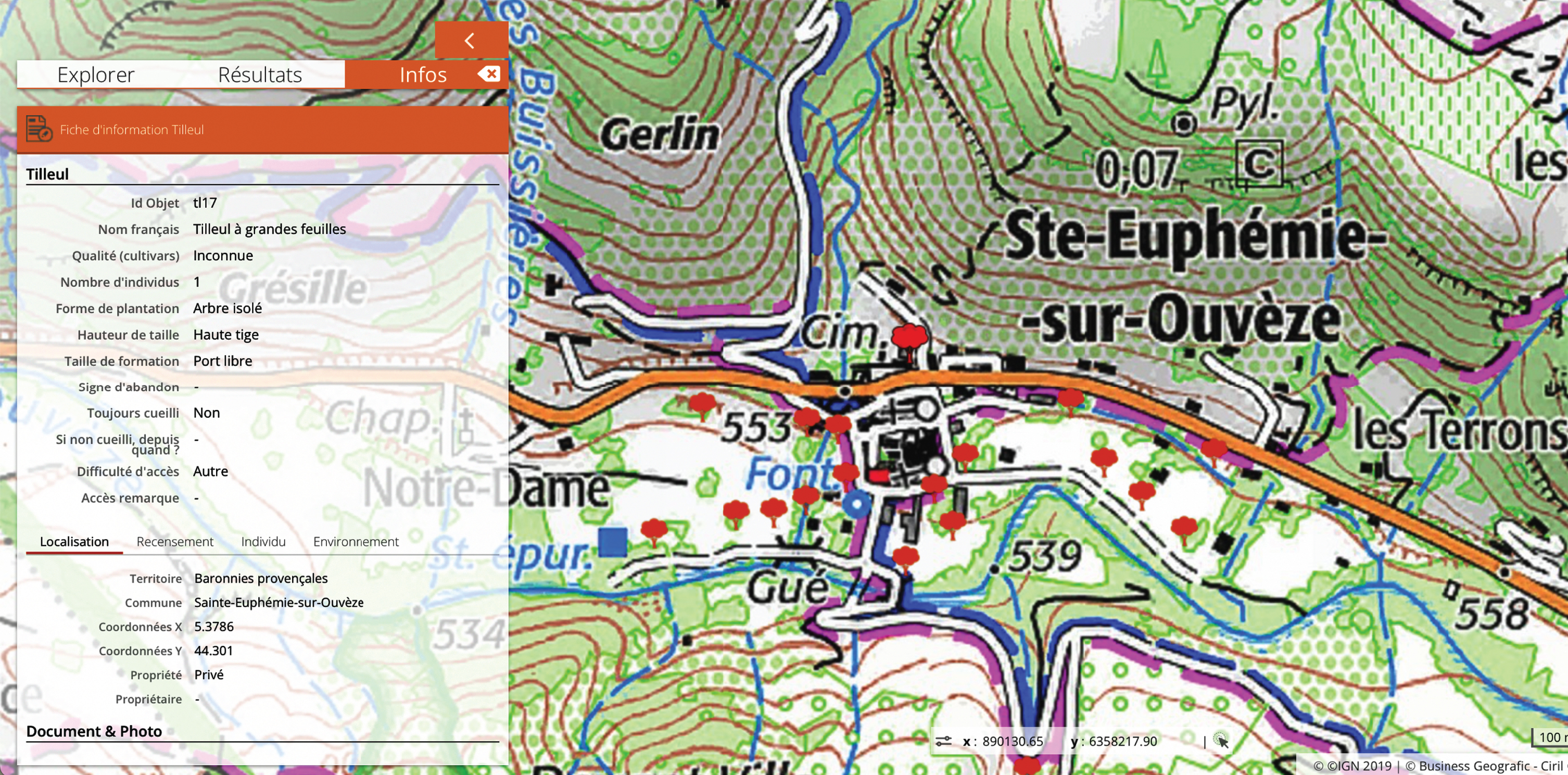
Screenshot of the interactive map. It shows the description of a selected lime tree. Two entries can be selected: a portion of the area and the cultivars. The map then provides the number of trees available in the selected area, items that document their status, the date of their last pruning and the conditions of access, a photo when possible and finally the precise location of each of the trees concerned. Available from: http://sit.pnrpaca.org/baronnies-provencales-inventaire-tilleul/index.html.
As previously discussed, a territorialized work system questions the relationship between a work system on the one hand, and dimensions located outside work and which concern life within a territory on the other. In such a context, designing a territorialized work system leads one to examine questions relating both to work activity, and to issues outside work.
Two types of population have become involved in picking: former inhabitants of the region and “neo-pickers”. “Neo-pickers”’ are newcomers to the territory, often former city-dwellers. These people are clearly looking for alternative “lifestyles” to those available in towns. For former inhabitants of the region, the revival of linden tree picking is first and foremost a reconsideration of a certain model of agricultural production (the “industrial” model, essentially focused on single-crop farming), which has its origins not only in the fragilities that this production model presents in the face of increasingly frequent climatic variation, but also in the desire to develop a different relationship with living things (plants or animals) and in an aspiration for “other rhythms of life”. Both pickers therefore postponed certain changes to the work system due to the impacts they might have outside work, making a balance between work and outside work.
Hence the group that dealt with “tree resource and maintenance” included an aromatic plant specialist. He suggested developing new linden tree cultivars of a low height (approximately 1.5 meters instead of the current height of approximately 7 meters). There were many advantages to this solution. It became possible to plant orchards, which in turn optimized cultivation. And it avoided pickers having to spend long hours working at the tops of the trees, thus improving working conditions given the risk of falling. The notion of low height linden tree cultivation was however rejected. First of all, it was deemed to not respect the esthetic aspects of the landscape. Secondly, this solution required significant investment in agricultural equipment (both for the plantations and for orchard maintenance). But the amortizations would impose rhythms that impact outside work that the pickers (new and old) have considered as being unacceptable.
In this example, it is clear that the workers themselves balance working conditions with living conditions within the territory. But the living conditions within the territory must not be taken to mean “contextual constraints” or “resistances to change”. On the contrary, the needs of the inhabitants of the territory and their quality of life are ends-in-view in the sense of John Dewey. They are fully part of a project understood as a desire for the future, and they contribute to the stakeholders’ involvement within the design process. For these reasons, well-being and life concerns outside work and within the territory must be considered as something to bring about through design.
Discussion and conclusion
The design case study discussed in this article was an exploratory analysis. Clear limitations come from the fact that the conclusions are derived from a single case, and future investigations are required. It is nevertheless a rich and complex case that offers insights into both theoretical and methodological implications. From a theoretical standpoint, it improves our understanding of territorialized work systems. From a methodological standpoint, it documents the extent to which the design of a territorialized work system impacts the design process.
The notion of a territorialized work system begins a debate on the unit of analysis and design used in ergonomics. A work system can be defined as an “interacting system” which includes both human (individual and collective), artifactual and organizational dimensions [3, 4]. However, a work system is located at the scale of a process of production or of the transformation of matter or information. The notion of territorialized work system leads one to question the links between this work system and the benefits provided (or on the contrary, the impacts caused) to the inhabitants of a given territory. The most obvious benefit is of course access to monetary resources. Employees who work within a work system have access to a monetary resource that allows them to meet a whole range of needs. However, the analysis of linden tree cultivation shows that the financial resource that comes from production does not exhaust the different types of utility provided by a work system on a territorial scale. The cultivation of linden trees has totally transformed the landscape of the Baronnies Provençales, and the beauty of the landscape is more than just a resource for tourism; it also has an aesthetic dimension that contributes toward the quality of life within the territory. While ancestral techniques punctuated family life and made it possible for the whole family to meet at harvest time, which was then experienced as a festival. And the fairs were not only trade concerns, but also opportunity for cultural and social life within the territory. We propose the notion of territorialized work system as a unit of analysis and design with which to grasp the links of co-determination (working conditions included) that operate between a work system and the benefits of the work system within a territory. But such a unit of analysis raises serious questions which call to deeper the links between work and outside work and between workers and non-workers (particularly the consumers, but also the other inhabitants of the territory such as the family).
The second point addresses the design process. Basing ourselves on the idea that a territorialized work system is an emergent process of making a milieu, we have argued that the design process must facilitate and support cooperation between a variety of stakeholders - pickers, inhabitants, design experts - enrolled in share scenarios, and must provide resources to make the territorialized work system materialize. Such an orientation overlaps with a considerable amount of research carried out within different schools of thought such as “Collaborative Value Creation” [39], “Social Innovation” [40] or “Transition Design” [41], among others. All of these works focus on “creative communities” [42], where people cooperate to design new ways of living. Surprisingly, however, these schools of thought takes very little account of issues relating to human work, its conditions, its role and its impact on the making of an environment. Our notion of territorialized work systems aims to define human work as a central dimension of the changes to which these research communities aspire. Accordingly with the pragmatic approach of a means-end scheme (previously argued based on Dewey’s work), activity is an irreplaceable resource for the making of a milieu and an essential dimension of maintaining a territorialized work system. However, designing at the scale of a territorialized work system, with a large variety of stakeholders, has a considerable impact on the design process and on the role that ergonomics can play in this respect. As we have argued, the design process then resembles an emerging process of experience construction and of the development of new ways of working together; it becomes and expanding process that enrolls an increasing number of stakeholders, workers and even non-workers (as in the case of the tree owners).
But for engaging others research based on design case studies, we need to define the issues that cut across the different cases. Design case studies and their further analysis being our main vehicles for the transferability of our findings, multiple studies offering common themes and clear categories for comparative analysis are required. It is with this in mind that we have argued that, when designing a territorialized work system, the role of the ergonomist is: (i) to empirically analyzes the given activities within a specific field of application in order to collectively defining the problem, (ii) to set up a facilitating organization which frames the design process, (iii) to propose an appropriate method for developing work experience in an inclusive manner, (iv) to design for the community, and (v) to take into account needs and well-being outside of work.
Footnotes
Acknowledgments
The research presented in this paper has benefitted from resources provided by European Regional Development Fund (ERDF). It has been supported by the Baronnies Provençales Regional Nature Park.
Conflict of interest
The authors declare that they have no conflict of interest.
Ethical approval
Not applicable.
Informed consent
All participants provided informed consent for contributing to the research presented in this article.
Words in italics are quotes taken from the interviews we conducted.