




Abstract
BACKGROUND:
The working population is exposed daily to unavoidable climatic conditions due to their occupational settings. Effects of the weather such as rain, heat, and air pollution may increase the risk of diseases, injuries, accidents, and even death during labor.
OBJECTIVE:
This paper aims to summarize the impacts of climate change on workers’ health, safety and performance, identifying the risks, affected workplaces and the range of methodological approaches used to assess this problem.
METHODS:
A thorough systematic mapping was conducted in seven scientific international databases: Emerald, IEEE Xplore, Science Direct, Scielo, Scopus, SpringerLink, and Web of Science. Three research questions guided the extraction process resulting in 170 articles regarding the impacts of climate change on occupational health and safety.
RESULTS:
We found an accentuated trend in observational studies applying primary and secondary data collection. Many studies focused on the association between rising temperatures and occupational hazards, mainly in outdoor work settings such as agriculture. The variation of temperature was the most investigated impact of climate change.
CONCLUSIONS:
We established a knowledge base on how to explore the impacts of climate change on workers’ well-being and health. Researchers and policymakers benefit from this review, which explores the suitable methods found in the literature and highlights the most recurring risks and their consequences to occupational health and safety.
Introduction
The research approach on climate change is broad. It can focus on analyzing the origin of this phenomenon, assessing the evolution of the emission of greenhouse gases [1, 2], or the influence of deforestation on rising temperatures [3]. Other authors focus on the consequences, such as the loss of biodiversity [4–6], or the economic losses on activities impaired by climate change, such as agriculture [7], tourism [8], or supply chains [9]. One of the main study categories is climate change’s impacts on the population’s health and safety. There are studies on the increase in the proliferation of diseases transmitted by vectors, insects, or through water [10, 11], respiratory diseases caused by air pollution [12, 13], heat-related illnesses [14, 15], and even the risks of climatic disasters [16].
Studies that aim to discuss the impacts of climate change on the population’s health often end up highlighting demographic groups considered more vulnerable, such as the elderly [17, 18] and children [19–21]. A population group also very susceptible to these risks is the labor force. Workers are the first exposed to climate change’s damaging effects, often for a longer time and greater intensity than the general population. This exposure happens because work activities end up “forcing” workers to endanger themselves to conditions that other individuals could avoid, especially for outdoor activities such as agriculture and construction [22, 23].
Climate change has been previously linked with effects that contribute to occupational impairment, such as the heat-related illnesses of heat cramps, heat exhaustion and heat stroke [24], the physical strain caused by heat stress that affects the worker’s body strength and cognitive reactions, leading to injuries, accidents, and loss of productivity [25], but also non-heat related impacts such as vector-borne diseases and the consequences of extreme weather events [26].
Research about this topic may vary regarding the methods applied and the data used to analyze the issue. Some papers gather information linking the climate change and occupational safety and health to develop a conceptual framework that summarizes the effects on occupational hazards [27], others search the literature systematically regarding a specific characteristic of this phenomenon, such as the association between climate change and vector-borne diseases on the working population [28] or the effects of heat stress among construction workers [29]. Some researchers investigate the problem through primary data collection, such as workplace temperature measurements [30], or physiological data from workers such as core body temperature and sweat rate to estimate their level of heat stress [31], while others use secondary data from occupational and meteorological databases to conduct their analyzes [32].
The effects of climate change can vastly interfere with the health and safety of the workers, and a constant assessment of these risks can enhance the survivability and workability of this population. Representing diverse scientific literature, the research on this topic may range from evaluating specific occupational risks to extensive hazards analyses. This study provides a comprehensive overview of the literature’s state regarding the impacts of climate change on occupational health and safety. We systematically explore the last decade of literature to identify the most successfully applied methodological approaches while gathering data on the recurring examined impacts caused by climate change, its consequences to the workers, and the most affected workplaces. By compiling the recurrent and best-suited theoretical and practical methods used to discuss these effects, we built a knowledge base that can guide future researchers while also shining light upon the range of occupational risks associated with the climate change phenomenon.
Methods
We developed a systematic mapping (SM) following the Collaboration for Environmental Evidence guidelines [33] and the steps presented by James et al. [34] to identify studies that relate the impacts of climate change to the health and safety of workers and explore their methodological approach to this issue. An SM gathers, catalogs, and describes scientific information related to a certain topic; it has the same principles as a systematic review in regards to being able to highlight trends and gaps in the literature while having sequential, well-structured, and clear steps [34]. This approach does not restrict itself by defining specific elements, making it a valuable method for studies guided by broad and varied research questions.
The methodological process started with the identification of a problem that needed evidence and the definition of the scope and the research questions to guide the development of the study [33, 34]. The evidence that the working population is exposed daily to adverse climatic conditions - most of the time for a longer period and with more intensity than the rest of the population - and the fact that these risks tend to increase under the projected scenarios of climate change [22], motivated the development of a study focused on occupational health and climate change, with three research questions guiding it: RQ1 - “How do studies relate the impacts of climate change to workers?” RQ2 - “What research methodologies are used to assess the effects of climate change on the health and safety of workers?” RQ3 - “What are the main negative effects of climate change on workers?”
Once we defined the focus and scope of our study, we conducted a preliminary search of articles using different keywords related to occupational health and climate change topics, which allowed us to understand some characteristics regarding this type of publication, such as the objective and subject area of the articles. With the preliminary screening of these publications, we expanded and refined our keywords to guarantee that the selected articles were the closest to our research questions. We used the final selected keywords to develop our search string:
(“climate change” OR “global warming” OR “temperature rising”) AND (“occupational health and safety” OR “occupational health” OR “occupational safety” OR “workers’ safety” OR “workers’ health” OR “labor safety”)
We defined seven online databases to conduct the searches: Emerald, IEEE Xplore, Science Direct, Scielo, Scopus, SpringerLink, and Web of Science, each of them limited to a 10-year time cut (2010–2020). In addition to these databases, we included more articles through the snowballing process. And, for the eligibility of the articles, we defined exclusion and inclusion criteria [34]. The exclusion criteria (EC) were as follows: EC1: Publications that are not articles published by journals, such as conference papers, books, among others; EC2: Articles that are not in English or Portuguese; EC3: When duplicated, only the most complete one was kept; EC4: Articles published before 2010; EC5: Articles that do not discuss the impacts specifically on workers; EC6: Articles that do not associate the issue with climate change; EC7: Articles that are not available online for reading.
We applied the EC1, EC2, and EC4 criteria using the filters available in the database search tool itself, where we filtered the results by type, language, and year of publication, respectively. The rest of the criteria were applied during the screening process.
Inclusion criteria (IC) were as follows: IC1: Articles that explore the adverse effects on workers’ health caused directly by some effect of climate change; IC2: Articles that address a loss of productivity or economic impact due to impacts on workers’ health caused by some effect of climate change; IC3: Articles that discuss scenarios or projections of the effects of climate change on workers’ health.
This information regarding the search strategy and selection process was included in the study protocol that was validated by other researchers [33]. Once the protocol is validated, the search process begins and the articles go through a process of titles and abstracts screening, followed by reading the introductions and conclusions to ensure consistency with the research questions. The selected papers were then thoroughly read, and the information regarding their methods and results were collected in an Excel spreadsheet for analysis.
The information extraction process was conducted by the record of generic data such as the article’s title, name of the authors, year of publication, and journal. However, our focus was mainly on specific data regarding the results of the papers, such as the impacts of climate change on occupational health and safety and the consequences to the workers, the most affected workplaces, and the different methods used to conduct the research. These aspects will be deliberated in the next topic of this paper.
To better discuss the different methodological approaches found in the mapping, we classified the studies into four categories based on [35]: experimental, observational, discussion, or synthesis. The Experimental studies employ some intervention and primary data collection. An Observational study analyzes an event or phenomenon without intervention and uses secondary data. The Discussion studies are mainly theoretical without data collection. Finally, the Synthesis studies use structured methodologies, such as systematic reviews. Some of the categories were further divided into subcategories. The experimental one, for example, was divided according to the type of data collection performed, such as qualitative or quantitative. The observational category subdivided the articles according to the type of data considered in the analysis, such as records of occupational injuries or even compensation claims registered by workers. The Observational category and Synthesis category were not subdivided.
Results
The search process in all databases resulted in 4002 publications. After excluding the duplicated and applying a partial read of the articles, it was possible to reduce to 143 papers selected. We consulted the references from these 143 for the backward snowballing process [36], where 27 more articles were included in the mapping. The resulting 170 articles went through the complete reading and extraction process, generating the data to be discussed in this topic. This process is summarized in Fig. 1.
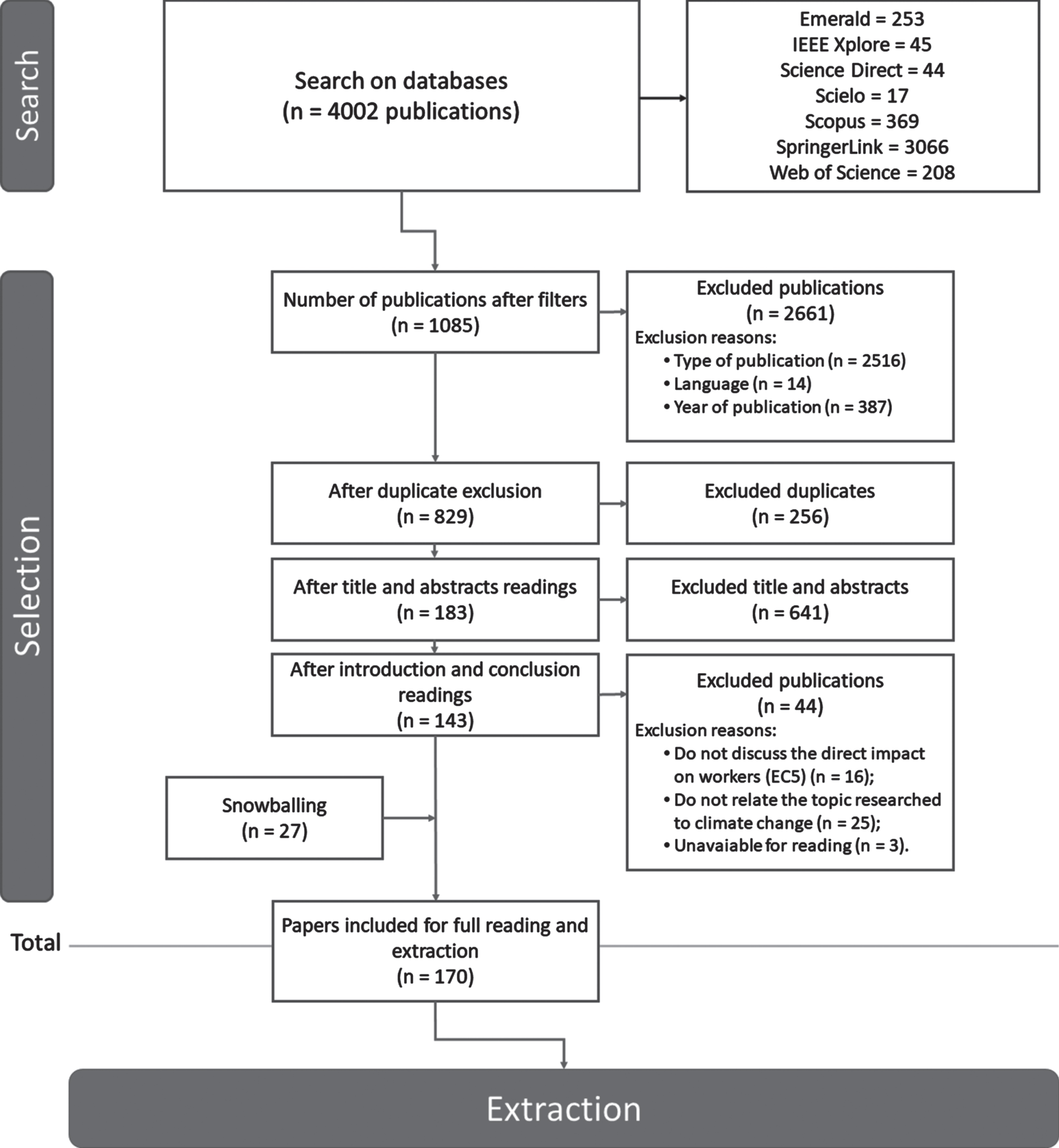
Flowchart of the selection process of the articles.
First, we will discuss the different types of methodologies used by the articles, specifically the distribution among the four categories [35]. There was a greater emphasis on the Observational and Experimental, with 65 and 61 articles, respectively, while the categories of Discussion and Synthesis presented 23 and 21 publications, respectively. The articles and their respective methodological categories are displayed in Supplementary Table 1.
Observational category
The main difference of this category, when compared to the Experimental one, is that there is no primary data collection, such as questionnaire application or measurement of the working environment conditions. Instead, the information used to discuss the issues comes from occupational health and safety databases, such as records of occupational injuries or fatal accidents, and meteorological data used to calculate indexes like the Wet Bulb Globe Temperature (WBGT) to develop climatic projections of different scenarios.
Out of these 65 Observational papers, it is possible to group them according to the type of data used and purpose. The most adopted method, present in 15 papers, used compensation claims data for occupational injuries, accidents and diseases combined with meteorological data where, through statistical analysis, the authors were capable of identifying a kind of association between the rise in temperatures with the rise of these occupational adverse events [37–51]. One article used the same kind of data, but instead of combining it with meteorological data, the authors compared the behaviour of the compensation claims data before and after implementing an awareness program for outdoor workers [52].
Seven articles used occupational data available from governmental agencies, where 2 articles focused explicitly on mortality data [53, 54], and the other 5 gathered information regarding occupational injuries [32, 55–58]. In addition, 2 articles combined the meteorological data with information regarding occupational injuries from insurance payout databases [59, 60].
On the one hand, 5 articles, instead of using meteorological data, used occupational heat-related data, such as the occupational heat-related deaths [61–63], fatal and non-fatal heat-related injuries [64], and the difference of wage between heat-exposure risks workers and non-heat-exposure risks workers [65]. On the other hand, some articles did not use any data on the occupational settings; instead, they used only meteorological information. Some gathered weather data to calculate different kinds of indexes to estimate the risks and exposure to heat, like the Wet Bulb Globe Temperature (WGBT), the Universal Thermal Climate Index (UTCI) or the Heat Index (HI). 5 articles used the WBGT to measure the health risks [66–70], 1 used it to measure the work adaptations towards heat-related risks [71] and 1 used the WBGT to project the future perspectives of heat exposure [72]. Combined with the WBGT, some papers used the HI in future projections on work performance under heat stress [73], and the UCTI was used to estimate the occupational risks of heat stress [74].
The collection of meteorological data and the calculation of WBGT was also used in 5 articles to estimate the economic losses [75, 76] and reduction in productivity [77–79] due to high temperature exposure. Meteorological data was also used for future projections, 5 articles focused on assessing different possible futures regarding the scenarios of climate change mitigation [25, 80–82], 7 approached the productivity loss and reduction on work capacity [83–89], while 2 discussed the heat-related work reduction and its economic impacts [90, 91].
Three articles used data from a national and ongoing questionnaire, the Thai Cohort Study, with over 80 thousand respondents. 2 of them focused on gathering information regarding occupational heat stress and kidney diseases [92, 93], while the other focused on the association between heat stress and occupational injuries [94]. The last 4 papers in this category were not grouped because each had its particularity. One article gathered data from the National Ambulatory Care Reporting System in Canada regarding heat-related visits to the emergency department and data from workplace compensation lost-time claims. It assessed the rising occupational illnesses due to heat exposure [95]. One paper discussed the workplace risks of heat stress by rating the level of exposure of each workplace [96]. One used heat stress records measured on different workplaces to discuss the current and future projections of the risk [97]. The last paper focused on a non-heat climate change impact, the risk of dengue among supply chain workers, using methods to estimate the population at risk of dengue infection in 2030 [98].
Experimental category
The articles in this category have methodologies that involve primary data collection or application of field study methodologies. It was possible to classify three types of data collection carried out by the studies: a qualitative one through the application of questionnaires, focus groups, or interviews to collect the perception and opinion of employees regarding health, safety, and climate change issues; and two quantitative approaches, one method using devices and tools to measure the climatic conditions of the workplace, and the other performing measurements of workers’ physiological characteristics, such as body temperature, sweat rate, and heart rate. Out of the 61 articles, the most used methodology was the qualitative data collection, applied in 52 papers, followed by the quantitative data collection in the workplace, present in 34 publications. Finally, 21 articles used the quantitative collection of the workers’ physiological characteristics.
Some studies combined these types of data collection, while others applied only one of them. A total of 13 articles used the three methodologies together, where the qualitative data was collected usually through the application of questionnaires regarding the work activity, like workload and clothing, or the worker’s risk perceptions, while the quantitative data gathered information on the workplace such as air temperature and WBGT, and information on the workers such as core body temperature, sweat rate, urine specific gravity, and heart rate [31, 99–110].
19 papers used two types of data collection combined. 17 applied some kind of qualitative data collection from questionnaires, surveys and interviews; 12 of these combined this qualitative data with quantitative data collected from the workplace, such as temperature measures [111–122], while 5 combined it with quantitative data regarding physiological characteristics from the workers [123–127]. The other 2 papers with two types of collection combined data from the workplace’s condition with measurements of the workers’ physical attributes [128, 129].
The last 29 papers in this category used only one type of data collection. 22 used qualitative data collection and focused on workers’ perceptions of the risks, their understanding of the issues related to climate change, and self-assessment of the impacts to their health and safety [130–151]. 6 papers used only quantitative data collected from workplace measurements, usually calculated the WBGT and compared with exposure threshold values defined by international standards such as OHSAS and ISO [152–157] and one single article focused on gathering data regarding the physiological response of the workers’ body to hot work environments [158].
Discussion category
The main difference between articles in this category and articles in the Synthesis category is that the Discussion ones have an approach based on an unstructured theoretical review, while Synthesis studies bring a specific and detailed systematic methodology for collecting and analyzing information on the topic.
Among the 23 Discussion studies, some articles presented themselves as literature reviews but were classified as Discussion because they did not clarify the methodological approach for collecting the papers’ data and conducting the review [159–165]. One article developed an unsystematic review to construct a framework regarding the economic impacts of heatwaves [166]. The other articles in this category lacked information regarding the methodological techniques used to collect the data discussed. They did not even have the “methods” section along the text body, making it impossible to categorize them. All they had in common was the theoretical discussion about the impacts of climate change on occupational health and safety [22, 167–179].
Synthesis category
In the latter category, all 21 studies were literature reviews, with well-defined objectives, a methodology with clear information regarding the search engines used and the selection criteria applied, as well as the information extraction process for the selected papers [23, 180–186]. This category could encompass other structured methodologies that aim to synthesize a topic, such as systematic mapping. However, in this case, the only methodology present in the studies was a systematic review.
Among the four categories, it is possible to note a significant emphasis on approaches that investigate the link between data from the work environment or the workers with meteorological information. Both the Experimental and Observational categories had a more significant predominance in this mapping than the articles of Discussion or Synthesis. Additionally, this lower portion of more theoretical studies may represent an opportunity for future research on this topic.
Climate change impacts
The second topic of discussion regards the climate change’s impacts investigated by the articles and their main consequences for workers’ health and safety. The most noticeable effect was the temperature variation, addressed in about 86% of the articles. Indeed, to approach this issue, some studies focused on periods of extreme heat (n = 4) and heatwaves (n = 6), others discussed the effects of the cold (n = 4), while some studies examined the harmful effects of heat, both of this phenomenon on its own (n = 130) and combined with other implications caused by climate change, such as ultraviolet radiation (n = 1) and air pollution (n = 1). Figure 2 demonstrates the diversity of impacts explored by the studies on this review, as well as the different consequences caused by these impacts and their effects on workers.
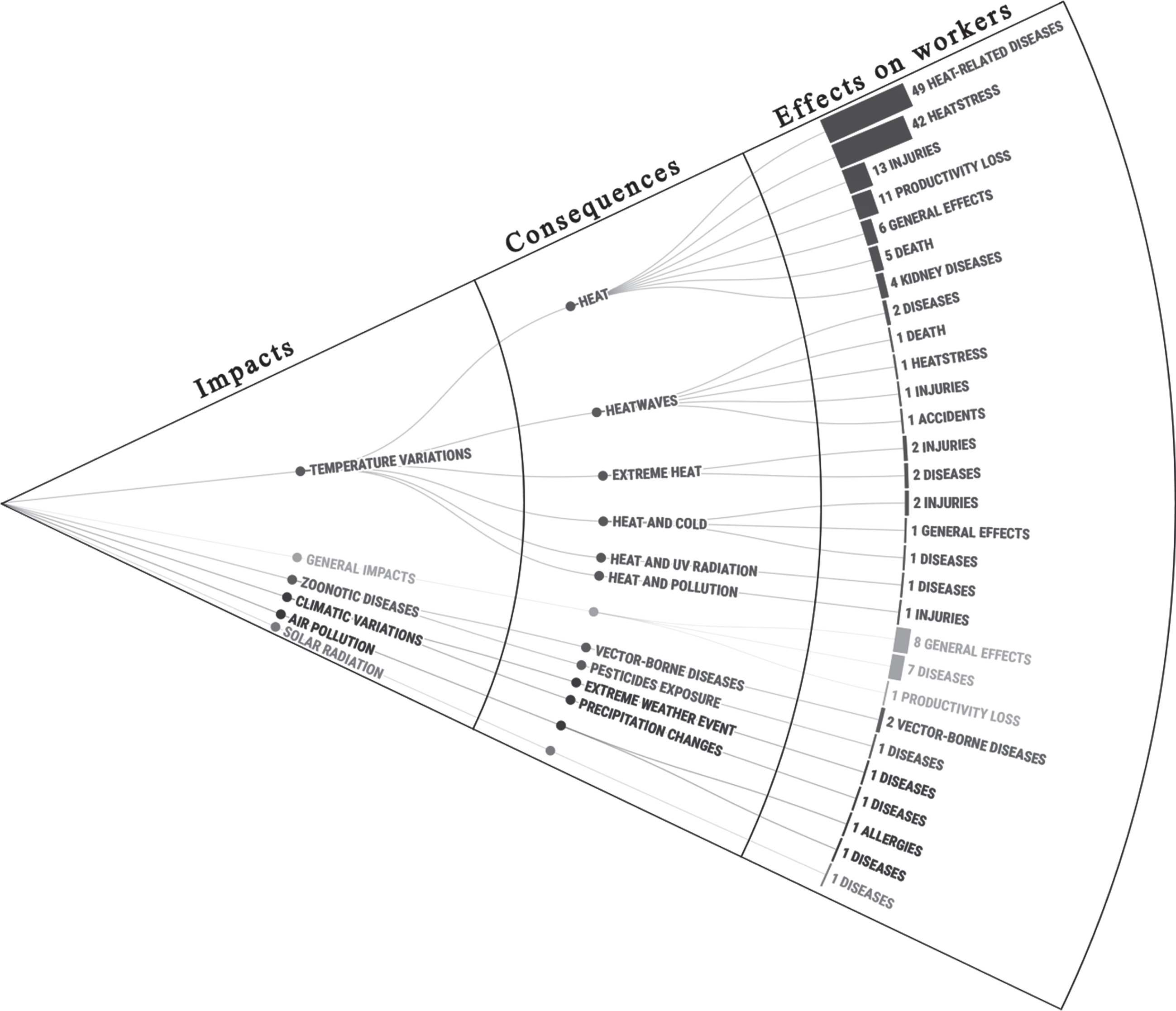
Climate change’s impacts, consequences and effects on workers.
The most addressed effects approached by the 130 articles on heat were the development of heat-related diseases (n = 49), heat stress (n = 42), increased incidence of occupational injuries (n = 13), productivity loss (n = 11), workers’ mortality (n = 5), and even kidney diseases (n = 4). The other articles (n = 6) took a more general approach, discussing all the harmful effects of heat on workers’ lives.
The articles also discussed other impacts of climate change besides temperature variation. Such as solar radiation and its effect on workers’ health [177]; the development of allergies and other diseases related to air pollution [174, 182]; the increase in vector-borne diseases, such as dengue [28, 98]; climatic variations such as changes in humidity characteristics that worsen workers’ exposure and absorption to dangerous substances such as pesticides [176]; changes in rain patterns and a consequent increase in insect-borne diseases [136]; extreme weather events such as floods and their consequences for the health and safety of workers [173].
Our systematic mapping showed research on the effects of climate change on workers’ health and safety in several occupational sectors. 87 studies did not specify the work environment examined. Some addressed all jobs considered outdoor work while others explored all occupations in a single region. A total of 178 work environments studied were counted, distributed among the rest of the articles. Of these, the most addressed ones were Agriculture (n = 42 articles), Construction (n = 34 articles) and the Services sector (n = 17 articles), the latter adding an extensive range of different occupations. The two most investigated work sectors have similarities: agricultural workers and construction workers tend to perform activities with greater physical demand and exposure to climatic conditions since their work is primarily outdoors.
There is also a trend to investigate occupational settings whose work environment is already characterized by some risk that may be enhanced by climate change, especially those with heat-generating processes, such as the metallurgy sector [31, 128], the pottery industry and brick kilns [31, 161], manufacturing [67, 143], the production of cement/concrete [67, 148], coal mining [90], and even some services such as welders [148, 157], and cooks [114].
Discussion
The choice to apply the methodology of systematic mapping collaborated to understand how, and for what purposes, the international literature about the impacts of climate change on occupational health and safety have been approached and developed in the last decade. It made it possible to distinguish possible future paths for the scientific knowledge on this matter, establishing the successfully used techniques to approach this issue and gaps still little explored.
The use of methodological categories to group similar studies helped us understand not only the range of methodological approaches available to discuss this topic, showing a variant number of possibilities for investigating the occupational risks associated with climate change, but also it demonstrated the type of data needed to perform each of these methods. In the case of Observational studies, the most recurrent category, the most commonly used type of information came from secondary data collected from occupational and meteorological databases, where a statistical analysis allowed the authors to investigate a possible influence of heat in the increase of occupational events. We consider this relevant not only for researchers that intend to develop similar research, showing the type of data and approach they could use in order to achieve a successful outcome, but also it is relevant for policy-makers and government agencies responsible for the collection of this kind of data, showing the importance of consistent and available databases to scientific literature.
In addition, the Experimental category shows us that the collection and use of primary data to investigate this topic is also relevant and possible. Different from the Observational studies, where the researcher is able to investigate a whole country, considering all types of workplaces and through a large time frame, all depending on the type of database available for use, the Experimental studies are more limited, usually narrowed to a single workplace, in a single location and along a smaller period. This limitation is similar to the case study or field study approaches, where it is defined, for example, an industry, the population of workers from this industry to be analyzed and, throughout a defined amount of time, some kind of calculation and measurement is carried out. In our case, most of the papers used sensors and tools to measure the environment temperature of the workplace or physiological measurements of the workers’ bodies such as body temperature, heart rate, and sweat rate, and, through this primary data, the authors assessed the burden and health risks associated with that labor activity. Although it is not as broad as an Observational study, this more workplace-specific approach is still very relevant and can be applied to any kind of work activity, allowing an exclusive investigation of the occupational settings those workers are being subjected to, which can be applied to industry sectors that are more exposed to climatic conditions, such as outdoor workers and heavy-loaded activities.
While these two categories make use of primary and secondary data, the other two categories collected their information through other publications. The Discussion category gathers information through non-structured methods, while the Synthesis category applies well-structured and linear methodologies to collect their references. These types of studies show us that the discussion around this topic and issue is not necessarily dependent on meteorological or occupational data collection, one can raise awareness through the creation of a framework summarizing information, collection and discussion of the evidence regarding risks and mitigation strategies, or systematic reviews of literature about the problem.
These four methodological categories represent possible paths for future research. They all share the same trends regarding the type of climate change effects and the affected workplaces analyzed. There is an accentuated trend to investigate the relation between heat and occupational issues, which could be explained considering the increase of temperature that has been projected for the near future. It’s also possible to argue that it is easier to access relevant information regarding these changes, such as meteorological data collected throughout the whole world.
In addition, the trend to investigate occupational settings that take place outdoors could also be explained by the lack of influence of other factors, for example, when we consider an office scenario, the acclimatization and other methods of controlling the climatic conditions need to be considered, while on outdoor workplaces, a sugarcane harvest, for example, most of the work time is spent exposed to these conditions, making it easier and more accurate to point the influence of climate to the workers’ well-being.
Conclusion
Climate change represents an unprecedented global challenge that can be reflected on an environmental, social, economic and political scale, with direct consequences on the health and safety of the population [180]. Workers represent a demographic group quite vulnerable to these changes, both concerning the jobs’ availability or the adverse impacts on the population’s health.
Our systematic mapping collaborated to establish a knowledge base on how the subject has been discussed in the global academic sphere. It helps understand some aspects that characterize this topic of research and accomplish two main academic contributions: the first concerns the structure of the articles, discussing the most practiced methodological ways to research the issue of climate change’s effects on workers, highlighting the most used practical or theoretical methods; the second contribution is associated with the most significant impacts of climate change discussed in the literature, identifying which ones represent the primary research concern and what are their consequences for workers. By highlighting the main research methods used, this study can guide future research by pointing to scientifically well-founded methodologies that have been successfully applied before. Similarly, by highlighting the significant impacts of climate change on workers, this study contributes to guiding how the literature has been investigating these risks and how to analyze this type of impact. It also collaborates in identifying potential risks that are still little explored and with room for research development.
In more detail, the methodological approach most present was the use of secondary data collected from workers’ or meteorological databases to base the research. The most usual method explores the association between heat and accidents or occupational diseases. There is considerable potential for quantitative and qualitative approaches, combining large-scale secondary databases on occupational settings with meteorological data to analyze. At the same time, it is possible to make a primary data collection to improve this analysis closer to reality. In the opposite direction, studies with a more broad and general approach - such as reviews - appeared less frequently in this mapping, which can be seen as a potential for expanding the literature.
Regarding the impacts of climate change on occupational health and safety, about 86% of the articles focused on increasing temperatures. There was a lack of research focused on the other effects of climate change, such as air pollution, increased vector-borne diseases, higher incidences of extreme weather events, and others. It is also possible to argue that there is a greater frequency of studies on the impacts of climate change for workers in outdoor sectors, emphasizing agriculture and construction.
Future research opportunities include more theoretical studies capable of drawing a comprehensive profile on the issue and guiding other researches. Systematic studies, such as reviews and mappings, also have a space of opportunity, particularly research focusing on a particular problem, such as those that address a particular impact or a different industrial sector. Research aimed at other impacts are necessary to make the literature and the debate on this health problem even more vast and complete.
Ethical approval
There is no work conducted directly with patients or human subjects in this paper. The methodological procedures were approved through the validation of the research protocol done by researchers and professors from the State University of Maringá (UEM) and the Federal University of Paraná (UFPR).
Informed consent
Not applicable.
Conflict of interest
The authors declare that they have no conflict of interest.
