




Abstract
BACKGROUND:
In an increasingly competitive marketplace, workers struggle to find a good balance between work and personal life. Difficulties in fulfilling the demands arising from these different domains may undermine employees’ well-being and job-related outcomes, thereby, impairing organizational productivity.
OBJECTIVE:
Does resilience play a relevant role in relation to work-life interface? And, if so, how is resilience related to its three facets (i.e., work-life conflict, enrichment, and balance)? To answer these questions, the current paper systematically reviews studies analysing the role of resilience in the work-life interface.
METHODS:
A key terms literature search was performed using multiple electronic databases (i.e., Scopus, PsycINFO, Web of Science, PubMed) without setting any publication date limitation. The review process followed the international PRISMA statement guidelines. A quality assessment was conducted using the Mixed Methods Appraisal Tool.
RESULTS:
A total of 26 eligible papers published between 2009 and 2020 were included. Among these, 6 employed a qualitative design, while 20 studies adopted a quantitative design mostly examining resilience as antecedent. Data were predominantly collected in the healthcare sector. Resilience was mainly analysed in relation to work-life conflict. The most commonly used theoretical framework was Conservation of Resources theory.
CONCLUSIONS:
Overall, resilience was negatively associated with work-life conflict and positively related to both work-life balance and enrichment. A positive work-life balance can promote resilience, but resilience can also help workers to balance work and life. Additionally, resilience can protect from the negative effects of both work-life imbalance and work-life conflict on workers’ health and job-related outcomes.
Introduction
Nowadays, striking a healthy work-life balance has become even more difficult [1] because of several factors, such as the presence of dual-earner couples and the growing number of working women [2]. Thus, an ever-growing number of people experience difficulties in fulfilling family needs [3, 4].
Throughout this review, the term “work-life interface” will be used to refer to the relationship between work and non-work domains. This umbrella term includes three different facets [5]: a) negative facet (i.e., conflict), b) positive facet (i.e., enrichment), c) and integrative facet (i.e., balance).
The first facet is work-life conflict that occurs when employees perceive incompatibility between work and other domains of life [6]. For example, work demands may interfere with family needs and vice versa [7]. Both situations may negatively affect employees’ well-being [8, 9] and family functioning [10], in addition to impairing employees’ job satisfaction [11] and performance [12, 13]. Thus, the boundaries between work and family life are often blurred such that individuals’ behaviours, and emotions from one domain may spill over into another [14]. Then, spillover can be bidirectional. Most studies on the work-family interface concentrate on the negative spillover between the two domains [6, 15]. These studies adopt a conflict perspective which assumes that people in multiple roles often do not have enough time (i.e., time-based conflict) to satisfy the demands in all of the roles [14, 16]. Alternatively, they cannot meet the requirements of one role because of certain behaviours required by (i.e., behaviour-based conflict) or strain resulting from their involvement in another role (i.e., strain-based conflict) [14, 16]. However, more recently researchers have begun to concentrate on the positive work-family spillover by assuming that the benefits of multiple roles may prevail over the disadvantages [17]. As such, resources produced in one role may improve the quality of experiences and outcomes in another role, thereby leading to work-family enrichment [17]. Enrichment can be conceptualized as a bidirectional construct [18]. It may lead workers to experience greater well-being [19], lower turnover [20], greater work engagement [21], and a better family functioning [22].
Besides work-life conflict and enrichment, researchers considered work-life balance which reflects an overall perception of role balance based on general work-life situations [5]. It refers to the ability to combine family commitment, leisure, and work [23], although researchers have paid more attention to family issues than to other non-working life aspects [24]. In this respect, work-family balance regards the ability to fulfil expectations related to both work and family roles [25]. It is related to high psycho-physical health [26], lower psychological distress [27] and burnout [28], high family satisfaction and functioning, in addition to being positively associated with commitment [29].
Among the numerous personal features influencing work-life interface (e.g., neuroticism [30], positive affectivity [31], emotional intelligence [32]), resilience is an interesting variable as it embraces the core qualities of personal resources [33] that are salient for handling stressors. Resilience refers to a dynamic process that enables people to handle stressful events and recover from adversities [34]. Resilient individuals are likely to experience greater well-being [35], lower burnout [36], decreased psychological distress [37], and lower depression [38]. As a result, they are also likely to report positive work-related outcomes, such as greater job performance [39] and lower turnover [40]. Indeed, resilience may facilitate workers in overcoming professional challenges and striving to achieve their job goals. Thus, highly career resilient employees can more easily persist in their own careers, even in the face of negative work situations [41]. Resilience can also be viewed as a state-like component of the Psychological Capital (PsyCap) construct (i.e., an individual’s favourable psychological state composed by resilience, optimism, hope and efficacy) [33]. Therefore, resilience is a state-like ability and a dynamic resource that may be learnable through proper training [42–44]. This systematic review aims to understand whether resilience might protect from work-life conflict, promote work-life enrichment, and facilitate work-life balance.
Methods
This systematic review was conducted between May and June 2020 following the Preferred Reporting Items for Systematic Reviews and Meta-Analysis statement guidelines (PRISMA) [45]. First, we established the following research questions: Does resilience play a relevant role in relation to work-life interface? And, if so, how is resilience related to its three facets (i.e., work-life conflict, enrichment, and balance)? Then, a search for registered and work in progress studies on this topic was conducted in the International Prospective Register of Systematic Reviews (PROSPERO) database. Given that no similar work was found, this systematic review protocol was registered (ref. CRD42020188575).
Eligibility criteria
Inclusion criteria
We included peer-reviewed papers written in English analysing the relationship between resilience and at least one of the three work-life facets (i.e., conflict, enrichment, balance), which were identified as the key aspects of work-life interface [5]. In doing this, we considered the interface between the work domain and not only non-work general life domains, but also the specific domain of family in both directions (i.e., work to life and vice versa; work to family and vice versa). In addition, we included quantitative, qualitative, mixed-method and research-intervention studies which explicitly assessed resilience and work-life constructs on samples of workers or working students who were at least 18 years of age. Additionally, we included papers which considered resilience not only as a unidimensional construct but also as a component of Psycap. In the latter case, included studies were those reporting findings that either considered resilience with other dimensions of Psycap or separately, which allowed us to detect the specific effects (at least in terms of correlations) of resilience on work-life constructs. We included papers containing specific forms (e.g., time-based conflict, strain-based conflict) and synonymises (e.g., work-life interference) of work-life conflict [5].
Exclusion criteria
We excluded articles focusing on subjects which were similar but not fully ascribable to the three considered constructs of work-life interface (e.g., work-related pressure to be available in the private domain). We excluded grey literature, editorials, commentaries, books, chapters of books, dissertations and papers which were written in languages other than English and/or published in non-peer-reviewed journals. Also, studies that focused on children, non-working students and family issues were not included. Moreover, we excluded qualitative studies from which these topics were not research questions or did not emerge as recurrent themes and quantitative studies which did not utilise instruments to measure resilience and work-life interface constructs.
Identification
The databases of PubMed, Scopus, Web of Science and PsycINFO were searched for peer-reviewed papers written in English on the role of resilience in work-life interface. To this end, we searched for articles whose titles or abstracts contained the following keywords: “resilience” OR “resiliency” OR “resilient” AND “work life conflict” OR “work life interference” OR “work family conflict” OR “work family interference” OR “work family negative spillover” OR “work life balance” OR “work family balance” “work family enrichment” OR “work family facilitation” OR “work family positive spillover” OR “work family enhancement”. Hyphenated alternative spelling variants were considered as well (i.e., work-life, work-family). In order to provide an up-to-date and comprehensive review, no publication date limitations were set.
Screening
Following each search in the above-mentioned databases, 459 references were exported in EndNote software. After removing 198 duplicates, all titles, and abstracts of the remaining 261 papers were screened to select the relevant papers based on the inclusion and exclusion criteria. The selection of the papers was performed independently by the first two co-authors. Two reviewers then performed a convergence assessment and evaluated any discrepancies before agreeing on which papers should be included in the next stage. After removing 205 articles which met the exclusion criteria during the initial screening, the full text of the 56 remaining papers was actively searched using different methods (e.g., database searches, enquiries on collaborative research platforms, contacting the authors) and evaluated against the inclusion criteria. Figure 1 depicts a flowchart outlining the number of papers identified and rejected at each phase. Any doubts or disagreements about keeping or removing papers were discussed between the two review authors. Where no consensus was reached, a third reviewer made the final decision. According to the eligibility criteria, we also excluded a paper in which resilience was considered as a type of personality cluster stemmed from the combination of the Big Five factors [46]. In addition, we excluded a mixed-method study in which work-family conflict was analysed in the quantitative part and resilience emerged as a topic in the qualitative part, but the authors did not analyse the relationship between the two constructs [47]. Two studies [48, 49] were conducted on the same sample and, therefore, we decided to include the most recent article only. In all, 26 papers were finally selected for the review, with 30 papers removed during this phase.
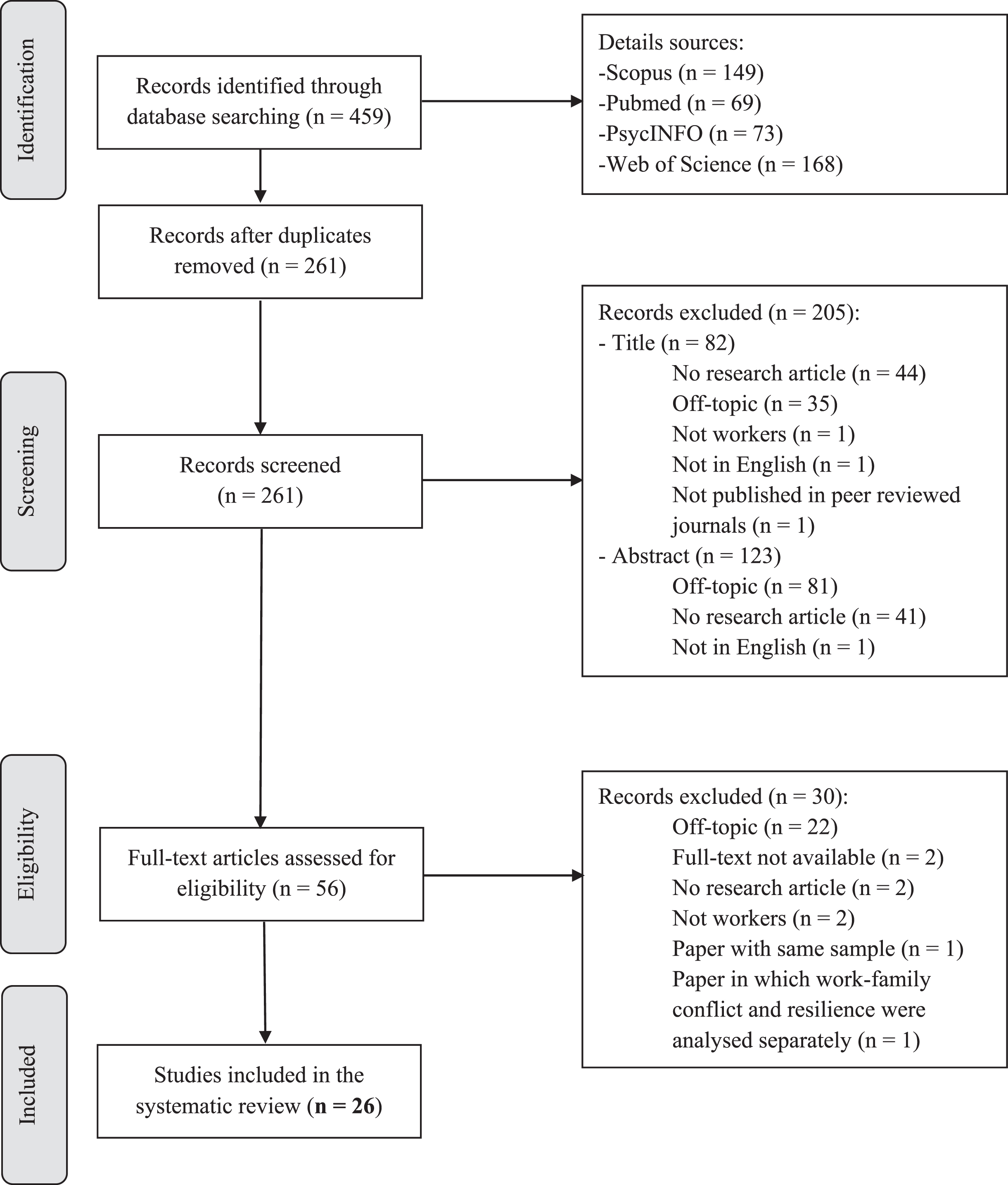
Flow diagram of records identified, screened and included in the systematic review, according to PRISMA guidelines.
Next, a characteristics table was designed, describing each selected paper to detect and cluster the relevant information. This table included: (a) study, (b) country, (c) study design, (d) sample, (e) observed variables, (f) resilience and work-life interface measurement tools, (g) theoretical frameworks and (h) main findings concerning the relationships between resilience and work-life interface constructs (see Table 1). The review authors distributed the included papers in order to re-read them and extract any relevant information. Subsequently, each reviewer checked the information gained by the other one to reach a consensus on the final content of the characteristics table.
Summary of findings on the relationships between resilience and work-life interface constructs
Summary of findings on the relationships between resilience and work-life interface constructs
Note: WFC = Work-Family Conflict; FWC = Family-Work Conflict; WLB = Work-Life Balance; WIF = Work-interferes-family; WFE = Work-Family Enrichment; FWE = Family-Work Enrichment; WIFT = time-based work interference with family; WIFS = strain-based work interference with family; WIFB = behaviour-based work interference with family, n1= sample number at pre-test, n2= sample number at post-test, n3= sample number at follow-up; WNWC= work and non-work conflict.
The methodological quality of the included studies was assessed by adopting the Mixed Methods Appraisal Tool (MMAT) [50] which has been used by previous systematic reviews in the work psychology literature [34, 51] to critically appraise included quantitative and qualitative studies. Following the MMAT guidelines [50], no studies were excluded because of the quality assessment. The MMAT tool includes two initial screening questions that need to be met in order to continue with the quality assessment. These questions regard the clearness of the study’s research question(s) and the appropriateness of the data collected with respect to the study’s purposes. Subsequently, the researcher has to choose the appropriate category for each study appraised depending on the research design. Each category of studies includes five core quality criteria on the basis of which studies are evaluated. In the current review, the selected studies fall within three categories: qualitative, quantitative non-randomized, and quantitative descriptive. The criteria for qualitative studies regard: a) the appropriateness of the qualitative approach with respect to the research question(s); b) the adequacy of the qualitative data collection methods; c) whether the findings are properly derived from the data; d) whether the interpretation of results is adequately substantiated by the data; e) the coherence between qualitative data sources, collection, analysis, and interpretation.
The criteria for quantitative non-randomized studies include: a) whether the research participants are representative of the target population; b) the appropriateness of measurements concerning both the outcome and intervention (or exposure); c) the presence of complete outcome data; d) whether the confounders are adequately considered in the design and analysis; e) whether, during the research period, the intervention (or exposure occurred) is administrated as intended. The criteria for quantitative descriptive studies comprise: a) the appropriateness of the sampling strategy with reference to the study’s research question(s); b) whether the sample is representative of the target population; c) the appropriateness of the measurements; d) whether the risk of nonresponse bias is acceptably low; e) the appropriateness of the statistical analyses with reference to the study’s research question(s). To perform the assessment, the last version of the MMAT recommends selecting one out of three response alternatives (yes, no, can’t tell) for each of the quality criteria that have been identified for the specific design category [50]. According to the suggestions provided by Hong et al. [50], the first two authors performed the assessment independently and any discrepancy was solved through discussion with the third author. As shown in Table 2, all the selected papers met at least three out of five quality criteria.
Mixed methods appraisal tool (MMAT), version 2018
Mixed methods appraisal tool (MMAT), version 2018
Note: (Y) yes, (N) no, (–) can’t tell.
A total of 26 papers, which were published between 2009 and 2020, were included. Among these, 20 adopted a quantitative design and 6 utilised a qualitative design. Regarding the sample characteristics, 11 studies included healthcare professionals (e.g., nurses, physicians, general practitioners), 6 studies did not provide a detailed sample description, 4 studies were conducted on employees working within the education sector (e.g., teachers, school leaders, academics), and the remaining 5 studies comprised workers employed in different occupations (i.e., industrial salespeople, frontline hotel employees, police officers, soldiers and athletic trainers).
With regard to the observed variables, 16 articles analysed the relationship between resilience and work-life conflict. Among these, 3 papers also investigated how resilience was linked to work-life enrichment, while 10 articles also examined the association between resilience and work-life balance. More specifically, most of the included quantitative studies tested resilience as an antecedent (8 studies), followed by investigations analysing its mediating (3 studies) or moderating (4 studies) role, while it was studied as an outcome only once.
The remaining studies did not hypothesize any specific role of resilience. More specifically, regarding the resilience-work-life conflict association, 4 studies treated resilience as an antecedent, 3 investigations studied it as a moderator, 3 studies analysed it as a mediator, 1 research article considered it as an outcome, whereas 5 studies did not include any statistical model, making it difficult to detect a specific role of resilience. Concerning the resilience-work-life enrichment relationship, 2 research papers analysed resilience as antecedent while 1 research paper included only correlations. Regarding the resilience-work-life balance link, 5 research articles studied resilience as an antecedent, 1 research paper analysed its moderating role, while 1 research paper did not hypothesize any specific function of resilience.
The most commonly used theories were Conservation of Resources (COR) theory [52], which was adopted by 7 research articles, Job Demands-Resources (JD-R) model [53], which was used in 2 research articles and the Role theory [54] which was mentioned in 2 research articles. Other theoretical frameworks cited once comprised: Broaden-and-build theory of positive emotions [55], Cognitive appraisal theory [56], Congruence theory [57], Differential exposure reactivity framework [58], Job Demand-Control-Support [59], Resource Allocation theory [60] and Work-family enrichment theory [17]. Notably, 14 research articles did not adopt any theoretical framework.
Resilience and work-life conflict relationship
Resilience was negatively related to work-family conflict [61–70] and family-work conflict [61, 70]. For instance, athletic trainers with high resilience developed lower levels of both work-family conflict and family-work conflict than their colleagues with low resilience [70]. Additionally, resilience was negatively related to both strain-based and time-based work-to-private-life interference [71], in addition to being negatively associated with strain-based work-life conflict [72]. Furthermore, in a work by Nicklin et al. [68], resilience decreased working students’ stress levels, both directly and indirectly, by reducing the conflict that they experienced among school, work, and personal life. In a similar vein, frontline hotel employees’ PsyCap, which included resilience as its component, was negatively associated with turnover and absence intentions, both directly and indirectly, by decreasing family-work conflict [61]. Conversely, the study by Krisor et al. [73] revealed a non-significant relationship between resilience and work-family conflict, whereas the first study conducted by Wayne et al. [69] found a non-significant relationship between resilience and family-work conflict.
Moreover, employees who were targets of workplace victimization (e.g., bullying) [74] were likely to experience psychological malaise [75, 76], even though these effects were conditional on their resilience levels. For instance, workplace victimization increased the risk for soldiers with low resilience of engaging in suicidal behaviours and experiencing work-family conflict [77]. Such risk was not present among soldiers with high resilience, supporting the protective role of resilience against workplace victimization. Similarly, work-related bullying predicted strain-based and time-based work-to-private life interference among nurses [71]. This relationship was partially mediated by resilience, such that work-related bullying undermined nurses’ resilience, but resilience reduced strain-based and time-based work-to-private life interference anyway. Two research articles examined the mediating role of resilience [65, 78]. The first study found that employees’ core self-evaluation (i.e., a latent personality construct composed by self-esteem, locus of control, generalized self-efficacy, and emotional stability) led to greater career resilience. This, in turn, resulted in higher levels of both behaviour-based and strain-based work interference with family [78]. This finding suggested that career resilience might exert a detrimental impact on employees’ family life [78]. The second study indicated that resilience had a partial mediation effect in the relationship between family-work conflict and depressive symptoms: greater family-work conflict reduced resilience, this, in turn, led to higher depressive symptoms [65]. The same study revealed that resilience did not moderate the association between work-family conflict and depressive symptoms, even though it was directly and negatively related to these symptoms [65].
Two studies analysed the moderating role of resilience [66, 72]. The first showed that on days when employees felt themselves more resilient, they experienced lower strain-based work-life conflict in response to daily work-related interpersonal conflicts [72]. By confirming that resilience may fluctuate on a daily basis, this research article provided further evidence for the changeable nature of this personal characteristic. The second investigation revealed that more resilient physicians were less likely to experience work-family conflict in the face of high job demands than their lower resilient colleagues [66].
Finally, only one research article investigated resilience as an outcome. By investigating observed work-to-family conflict in 139 couples, the study explained how employees’ feelings about their own work were influenced by the interactions with their partners [63]. More specifically, the study found that the focal employee’s work-interfering-with-family behaviours were positively related to the partner’s reports of observed work-to-family conflict, resulting in more partner negative emotional displays when discussing work. This, in turn, was associated with lower career resilience by the focal employee [63].
Resilience and work-family enrichment relationship
Resilience was positively correlated with both work-family and family-work enrichment [68–70]. More specifically, resilience was found to decrease working students’ distress levels directly but not indirectly as mediated by enrichment, even though resilience had a statistically significant and positive effect on enrichment [68]. In addition, although resilience positively impacted balance satisfaction, its effect was not mediated by enrichment due to a lack of statistical significance in the resilience-enrichment association [69].
Resilience and work-life balance relationship
Resilience was positively correlated with work-life balance and, more specifically, with work-family balance [49, 80]. For instance, among family medicine program directors, resilience was positively associated with having a moderate to great amount of personal time, healthy work-life balance, and capability to stop thinking about work [79].
A number of studies determined that resilience enabled employees to reach a good work-life balance. For example, a qualitative study, which was conducted on a sample of first-line nurse managers, revealed that resilience promoted the individual’s ability to balance the work and life areas [81]. Accordingly, two quantitative studies demonstrated that after taking part in resiliency development programs, participants reported greater satisfaction with their work-life balance [82, 83].
However, qualitative studies supported that work-life balance facilitated the development of resilience against workplace adversities among healthcare professionals [84–86]. The role of a positive work-life balance in increasing resilience was also confirmed by research on school staff [87, 88]. For instance, teachers identified work-life balance as an important strategy to improve resilience [87]. Nevertheless, school staff perceived that the achievement of a good work-life balance was, simultaneously, both a challenge and a potential stressor [88]. Thus, the difficulties that they were facing in reaching a good work-life balance might hinder the development of their resilience [88]. Then, work-life imbalance can be considered as a job-related stressor whose negative effects on workers’ health may be buffered by resilience [80]. Resilience may also reduce employees’ psychological and physical ill-health both directly and indirectly, by improving their work-life balance [80]. Similarly, Krisor et al. [73] recognized resilience as a statistically significant and positive antecedent of work-life balance, even though this latter was not, in turn, significantly related to distress (which was measured using cortisol levels). Similarly, a cross-lagged study revealed that PsyCap, which included resilience as its component, enhanced healthcare professionals’ work-life balance that was assessed five months later [49].
The good news is that the individual’s ability to reach a positive work-life balance may be strengthened by improving employees’ resilience through specific resilience-based training as confirmed by two studies [82, 83]. The first research article showed that participants in a multi-faceted seven-week resilience promotion program for adults reported greater satisfaction with their work-life balance in comparison with those in the control group at the completion of the program and five months later [82]. The second study, in which researchers implemented a one-year multifaceted program called Energy Leadership Well-Being and Resiliency Program found that participants reported greater work-life balance scores at the end of the intervention in comparison with their own pre-intervention scores [83].
Discussion
This systematic review aimed to provide a state-of-the-art overview of the role of resilience in the work-life interface. This is to ensure a better understanding of how resilience may protect workers from work-life conflict, foster work-life enrichment, and facilitate a good work-life balance.
Taking together, the results from the 26 eligible papers [49, 77–88] supported the relationships between resilience and work-life interface constructs. Resilience was analysed as antecedent [49, 83], moderator [65, 80], mediator [65, 78] and outcome [63].
First, most studies adopted quantitative methods and focused on the relationship between resilience and work-family conflict, predominantly analysing resilience as an antecedent. To this regard, overall, resilience was negatively associated with work-life conflict [61–72], confirming its role of antecedent in relation to this type of conflict [61, 69]. Conversely, the only quantitative study analysing resilience as an outcome showed that work-family conflict reduced career resilience [63]. Regarding its mediating/moderating role, the results are varied probably because resilience was differently conceptualized (e.g., Psycap, career resilience) and work-family conflict was diversely treated in the mediation models (i.e., antecedent, outcome). Considering its moderating role, resilience protected workers from work-life conflict even in presence of job demands [66, 72]. However, resilience did not buffer the relationships between work-family conflict and health outcomes [65]. Concerning its mediating role, on one side, family-work conflict reduced resilience which, in turn, resulted in negative health outcomes [65]. On the other side, resilience mediated the links between job demands and work-life conflict, reducing this kind of conflict [71].
Second, we obtained mixed results regarding the role of resilience as an antecedent of work-family enrichment, although the positive correlation between these two was constantly confirmed [68–70].
Third, overall resilience positively correlated with work-life balance [49, 80]. A positive work-life balance promoted resilience [84–88] and vice versa [49, 80–83]. Moreover, resilience buffered the impact of a poor work-life balance on employees’ health outcomes [80].
To interpret these findings, we decided to discuss them in light of the COR theory [52, 90] because most selected studies employed it as a theoretical basis. The COR theory is considered the most commonly used theory in the work-family domains interaction literature [91]. It assumes that people strive to acquire, retain, and protect resources they centrally value and experience stress when these resources are threatened with loss or actually lost [92]. Then, work-life conflict is a stressful event as it leads workers to lose resources when juggling both work and other personal life roles. This may result in a negative “state of being” [93], as confirmed by included studies [62, 68]. For instance, when an employee has to stay late at work at the expense of one’s own family life, he/she may lose resources in the form of time with loved ones, and family stability. This may also lead his/her partner to develop negative emotional displays which, in turn, may reduce the employee’s career resilience [63].
This loss of resources engenders a sense of conflict which, then, leads to distress [64, 68]. When facing the consequences of work-life conflict, workers need to invest further resources to recover from resource losses. If workers are unsuccessful in their coping efforts, they may further exacerbate their losses, entering an escalating spiral of losses [94]. In such a situation, employees may lack the energy to maintain their normal functioning at work. Thus, they may act to preserve their remaining resources by developing withdrawal intentions [61]. Additionally, negative health outcomes, such as burnout [62, 64] and depression [65, 77], may occur. This is more likely to happen when employees possess lower resilience as they are less equipped against resource loss [94]. Thus, differences in resilience might explain individual differences in the risk of experiencing work-life conflict [70]. Indeed, employees with low resilience may more quickly pass from work-life conflict to distress [70]. Conversely, employees with high resilience are less likely to experience work-life conflict and less vulnerable to its detrimental effects as they are better-equipped to manage work and family demands [61, 67–69]. As such, resilience represents a personal coping resource as it helps employees successfully fulfil multiple roles by flexibly adapting themselves to changing circumstances [34]. This might explain why resilience may protect employees against work-life conflict [72], including work-family conflict [66]. This might also explain why resilience may buffer the negative effects of work-life imbalance on employees’ health [80]. Additionally, although job-related stressors may impair employees’ resilience, this resource may maintain its protective role [71]. However, in contrast with all the other studies, Yu [78] found that career resilience increased work-family interference. A possible explanation might be that highly career resilient employees might devote extra time and efforts to their own job, which might be unlikely compatible with family role expectations. Moreover, resilient employees possess rich reservoirs of resources from which they can draw upon in case of need. Thus, they are better positioned for resource gains, given their tendency towards the accumulation of resources over time and then towards resource caravans [94]. Thus, resources are linked to each other, such that they are co-travellers [94]. Given that resilience travels in packs, its protective role may be fostered by the presence of other personal resources, so that the greater the available resources, the greater the worker’s capability of facing stressors. Indeed, PsyCap may be negatively related to withdrawal behaviours directly and via family-work conflict [61]. Additionally, drawing on the COR theory [52], multiple role memberships may provide resilient workers with the opportunity to acquire further resources. Thus, resource gains in one role may improve the quality of life in another role, leading to work-life enrichment. Indeed, resilient workers may have a resource pool to draw upon stemmed from the work role that can benefit their family life (or vice versa). Accordingly, resilience was positively related to both work-family enrichment [68–70] and work-life balance [49, 81–83]. Additionally, achieving a good work-life balance allow workers to acquire further resources, including resilience [84–88].
Overall, this systematic review provides support for the role of resilience as a personal coping resource which is particularly salient in relation to work-life interface.
Strengths and limitations
The present review has a number of strengths. To the best of our knowledge, this is the first systematic review focusing on the relationships between resilience and work-life interface constructs among employees from different sectors. Moreover, given that no date publication limits were set, the current review provides an up-to-date and comprehensive overview of all relevant peer-reviewed (both quantitative and qualitative) studies on this subject. These studies were conducted in several countries and available through most commonly used databases within the psychological field.
Despite the contributions made, the current systematic review is not without limitations. Most included studies adopted a cross-sectional design, and this makes it difficult to draw conclusions based on causal inferences. Thus, there is a need to enrich these findings with longitudinal and experimental studies (e.g., examining the impact of resilience on work-life interference over time). The majority of the included studies merely relied on one source of information for data gathering (i.e., self-reported measures), which might have contributed to common methods bias. Then, future studies should use multisource ratings for data collection. In addition, as the literature on the relationship between resilience and work-life enrichment is still very poor, further research is needed to shed more light on this association. Given the contrasting results regarding the effects of career resilience on work-life interface constructs [63, 78], future studies should analyse conditions under which high career resilience levels might undermine or otherwise facilitate employees’ work-life interface. Furthermore, we included peer-reviewed empirical papers written in English only. This choice might have excluded valuable findings from other sources (e.g., books, conference abstracts or dissertations). However, we are confident that we have identified the key empirical works through our screening process. Moreover, since resilience has been studied in different roles (i.e., antecedent, mediator, moderator and outcome) with regards to work-life interface constructs, the authors of this review could not provide a single theoretical model based on the findings from the selected studies. Therefore, further research is needed to better clarify which preferential role might be played by resilience in relation to the three work-life interface facets (i.e., conflict, enrichment, balance), possibly examining them together as they can co-exist [6]. Additionally, besides the differential role in which resilience has been tested, the studies included in this systematic review were also different in terms of aims and research designs. This heterogeneity did not allow the authors to provide a quantitative integration of the results. We hope that this systematic review will provide a starting point for performing a meta-analysis in the future. Additionally, most of the included studies were not theoretically grounded. Thereby, future studies could adopt COR theory [52] as a theoretical framework because, as shown by the current review, it may be particularly useful for explaining how resilience may promote work-life interface constructs.
Practical implications
Since the present systematic review shows that resilience can help employees reconcile work and life and protect them from the detrimental effects of work-life imbalance, organizations should adopt interventions focused on the enhancement of this resource, such as resilience-based programs [82, 83]. Included resilience-based research-intervention studies [82, 83] provide lessons on how to design useful interventions. The success of such programs might be due to the fact that they employ a combination of actions that operate at different levels, last at least several weeks and foster the creation of a sense of community among participants.
To prevent the loss of resilience, companies could create a family-friendly work environment to make their employees more resilient. For instance, organizations could allow flexible start/finish working time and part-time contracts, offer an on-site childcare facility, and allow employees to take time off to meet family emergencies (e.g., to pick up children from school when they are unwell).
Conclusion
Through this systematic review, we unveiled what is currently known about the role of resilience in relation to the three main work-life interface constructs (i.e., conflict, enrichment, balance). Most of the included studies were quantitative in nature and analysed the association between resilience and work-family conflict showing that this personal characteristic was negatively associated to this type of conflict. Moreover, research constantly found that resilience facilitated the achievement of a good work-life balance, while only a few studies concentrated on the relationship between resilience and work-life enrichment, revealing a positive correlation between these two constructs. Thus, more research is needed to reach a better understanding of this latter association. In sum, we identified resilience as an important personal coping resource which can protect employees from work-life conflict, foster work-life enrichment and facilitate balance between work and other life domains. To conclude, we believe that the current systematic review provides an important basis from which researchers can design further studies that can expand our knowledge of the mechanisms and conditions under which resilience may affect the ability to successfully balance work and personal life.
Funding
This study received no specific funding from public, commercial, or not-for-profit funding agencies.
Conflict of interest
None to report.
Footnotes
Acknowledgments
The authors gratefully acknowledge Dr. Marina Maffoni (Psychology Unit of Montescano Institute) for her valuable support and suggestions.