




Abstract
Ride-sharing contributes significantly to lowering trip expenses, easing traffic congestion and decreasing air pollution. However, current order pairing approaches in ride-sharing usually focus on minimizing total trip distances or maximizing platform profits, overlooking the drivers’ desire for increased earnings. As a result, drivers might provide dishonest information to gain higher profits, leading to inefficient order pairing for the ride-sharing platform and potential losses for both the platform and drivers. In this paper, we address this challenging issue by developing efficient order pairing mechanisms that maximize the social welfare of the platform and drivers. Specifically, we introduce two truthful auction-based order pairing mechanisms, SWMOM-VCG and SWMOM-GM, where drivers bid on platform-published orders to complete them and earn profits. We provide theoretical proof that both mechanisms fulfill the criteria of individual rationality, profitability, truthfulness and so on. Using real taxi order data from New York City, we assess the performance of both mechanisms and show that they achieve greater social welfare compared to existing methods. Additionally, we find that SWMOM-GM requires less computation time than SWMOM-VCG for order pairing, with only a minor reduction in social welfare.
Introduction
Presently, the development of an effective road transportation system poses a critical challenge in modern society. This is due to the substantial negative environmental impact of vehicular emissions and the exacerbation of traffic congestion resulting from the increasing number of vehicles on the road. Remarkably, each automobile typically transports an average of 1.6 passengers, signifying that a mere 25% of emissions can be attributed to actual human transportation, while the remaining emissions stem from the movement of unoccupied seats [16]. To mitigate the associated social expenses, such as trip expenses, traffic congestion, and environmental degradation, researchers from various fields have put forth the concept of ride-sharing as a viable resolution [5,22,24].
In fact, to capitalize on vacant seats and minimize passengers’ financial burden, ride-hailing enterprises such as Uber1
In this paper, we assume that the platform charges prepaid fares4
In the ride-sharing industry, the prepaid fare for passengers is calculated based on multiple factors, including the departure and destination, current supply and demand conditions, and dynamic discounts. Once the passenger has paid the prepaid fare, no additional fees are incurred for the ride-sharing service.
A typical ride-sharing system involves three key entities: passengers, vehicle drivers and the ride-sharing platform. However, since we assume that the ride-sharing platform employs an upfront charing policy to passengers, it is not necessary to consider the revenues of passengers when pairing the orders with vehicles. Therefore the social welfare in this paper just consists of revenues of the ride-sharing platform and vehicle drivers.
In this paper, we adopt a round-based order pairing approach to address the need for real-time service, consistent with the methods used in [33,34]. Specifically, we implement a one-sided reverse auction, wherein the vehicle drivers bid on orders posted by the platform with upfront charged fares. Subsequently, the ride-sharing platform determines the optimal order pairing and driver payments for each round, with the intent to maximize the social welfare while preserving individual rationality, profitability, truthfulness and computational efficiency. This paper contributes to the existing body of knowledge in the following ways:
Firstly, we introduce a VCG based mechanism, termed SWMOM-VCG, designed to optimally pair ride orders with vehicle drivers in the ride-sharing, thereby maximizing the social welfare. We demonstrate that this mechanism successfully adheres to the above properties of individual rationality, profitability, truthfulness and computational efficiency.
Moreover, while SWMOM-VCG is capable of performing order pairing within polynomial time, the actual computational burden remains significant in scenarios involving a vast number of incoming orders and potential vehicles. To expedite the order pairing process with only a minor compromise in social welfare, we propose an alternative mechanism, termed SWMOM-GM, which incorporates a greedy method for order pairing. We calculate the lower bound of social welfare for SWMOM-GM compared to the optimal pairing and demonstrate experimentally that its social welfare is only marginally lower than that of SWMOM-VCG. Importantly, SWMOM-GM also satisfies the above four properties.
Finally, we conduct comprehensive experiments to assess the performance of our proposed mechanisms in comparison to the state-of-the-art approaches with respect to social welfare, social expenses, rate of served orders, and other relevant metrics. The experimental results demonstrate that our proposed mechanisms yield superior social welfare compared to the state-of-the-art approaches.
The paper is organized as follows: Section 2 provides an overview of the related work, Section 3 describes the problem in detail, and Sections 4 and 5 present the proposed mechanisms. Section 6 presents the experimental evaluation of these mechanisms, and the paper concludes with Section 7.
Numerous studies have been conducted to analyze various aspects of ride-sharing, including topics such as system implementation, route planning and so on [7,14,20,26]. For instance, [1] presents a flexible ride-sharing scheme incorporating spatio-temporal constraints, aimed at minimizing total trip distance and maximizing the number of served orders. When examining route planning, researchers typically focus on devising trip plans for each vehicle to pick up passengers while minimizing the overall trip distance [19] – a problem that has been proven to be NP-hard [27]. Several studies, such as [7,20,21], have attempted to address the route planning challenge in ride-sharing. Additionally, to expedite the generation of route planning in ride-sharing, a Kinetic Tree-based method has been proposed to decrease time complexity [15], while a branch-and-bound-based algorithm has been introduced to iteratively adjust the original route plan, resulting in the creation of a new plan [2].
Furthermore, as previously discussed, order pairing constitutes a critical component of ride-sharing systems. Existing research on order pairing in ride-sharing typically aims to minimize total trip distance, maximize the order served rate, or optimize profits. For instance, a spatio-temporal grid index has been proposed to facilitate passengers in quickly identifying vehicles with the shortest detour distances [20,21]. Additionally, a range of space-time pruning techniques have been employed to accelerate the pairing process [10]. In [3], a forecasting method is integrated with dynamic pricing techniques in the order pairing process to increase the number of served orders. Another approach involves an auction-based parallel order pairing mechanism, where drivers bid on orders published by the platform, which subsequently determines the pairing of drivers and orders [2]. This approach is further refined through the introduction of a greedy-based order packing algorithm [33]. In [6], a queuing theory-based order pairing framework is proposed with the objective of maximizing the platform’s profit.
Mechanism design has found extensive applications in various domains, such as auction [23], meeting scheduling [9] and public safety [25]. Given that the entities involved in ride-sharing (i.e., the platform, drivers, and passengers) are typically self-interested and may act strategically to maximize their profits, mechanism design is applied in ride-sharing to mitigate such strategic behavior [11]. In [17], a system named ABC is introduced to determine passengers’ ride-sharing plans based on their valuations, employing a VCG price to calculate passengers’ payments and ensure truthful valuation disclosure. A second-price-based auction mechanism is proposed to address the order pairing challenge in ride-sharing, with the objectives of maximizing the served order rate and minimizing the overall trip distance [18].
Moreover, several studies have employed auction-based mechanisms to pair orders with drivers, with the aim of maximizing social welfare, as demonstrated in [31,34]. Such works typically require passengers to report their valuations for the trips. However, accurately assessing trip expenses may prove challenging for passengers [4]. To tackle this issue, a pricing algorithm based on trip demand (incorporating departure and destination information) is proposed, along with an online mechanism designed to motivate passengers to truthfully report their trip information [28]. Furthermore, to maintain the platform’s budget balance, a pricing algorithm is developed to prevent budget deficits in a mixed bilateral ride-sharing market, where the distinction between drivers and passengers is not strictly defined [32]. Some studies have analyzed approaches to maximize the ride-sharing platform’s profit. For instance, in [2], the platform functions as an auctioneer, receiving bids from drivers and selecting the highest bidder to optimize profits. In [3], a second pricing-based reserve auction is employed to ensure truthful bidding from drivers and to maximize the platform’s profit.
However, to the best of our knowledge, existing works usually ignores the profits of both the platform and vehicle drivers. Consequently, in this paper, we propose auction-based truthful mechanisms wherein drivers bid on orders to maximize the social welfare of both the platform and drivers, ultimately ensuring that both sides remain motivated to participate in the business.
Problem formulation
In this section, we first present the fundamental concepts and describe the general framework of the ride-sharing system, and then we provide a detailed, formal definition of our problem in detail. Table 1 enumerates the key notations used in this paper.
Notations
Notations
We model the order pairing process as an one-side reverse auction operating within a series of discrete time slices
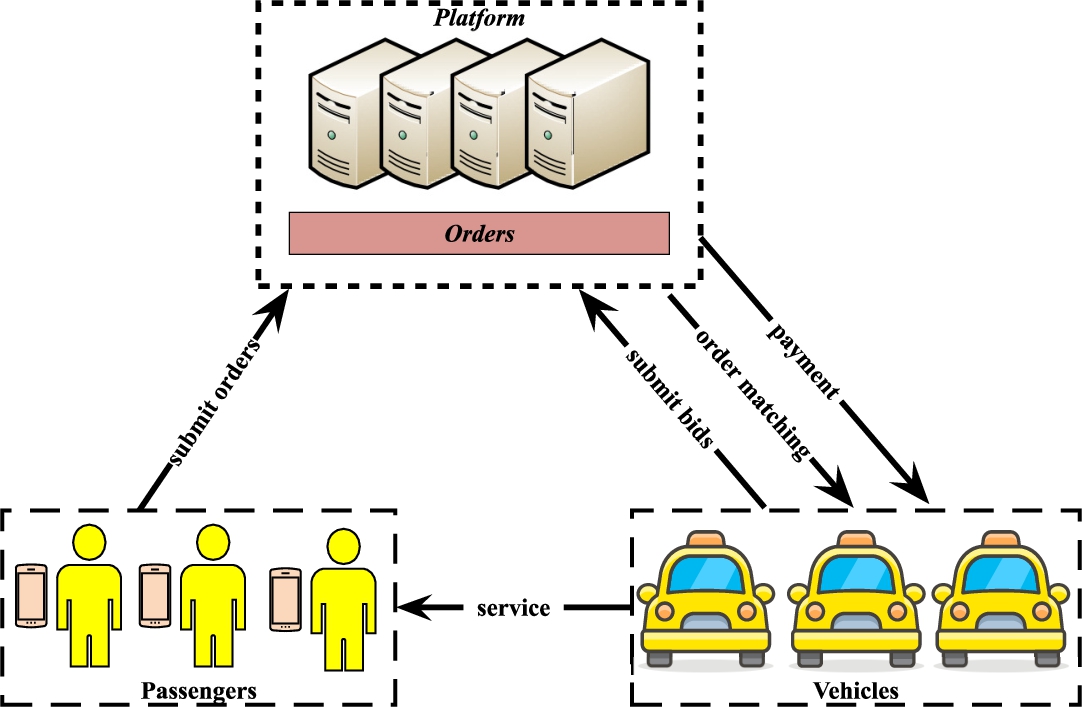
An auction-based real-time ride-sharing system. In this system, passengers first submit riding orders, and then vehicle drivers bid for the orders. The platform then pair orders with vehicles and provide payments to drives upon completion of the ride.
Order
Upon receiving riding orders, the platform is required to compute prepaid fares to be charged to passengers. Subsequently, passengers are given the option to accept or reject the offered fares.6
How passengers making decision is also a tricky problem. In [18], passengers bid strategically for riding services. In [31], a truthful mechanism was designed where passengers bid truthfully. However, as demonstrated in [28], requiring passengers to bid for vehicles can present challenges, and such mechanisms may not be practical for real-world applications. Therefore, in this paper we consider the prepaid fares to passengers and ignore the strategic bidding behavior of passengers.
Vehicle
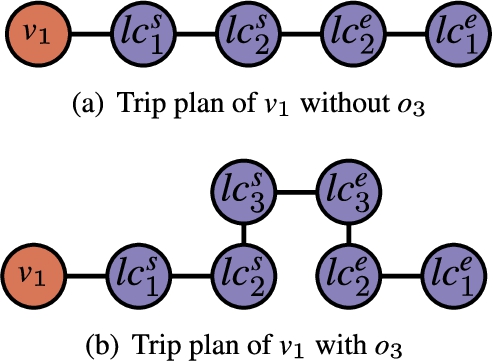
An example of trip plan.
Note that
Having average speed
The first criterion implies that the number of passengers in the vehicle cannot surpass its seat capacity at any time. The second and third criteria mean that the trip plan must adhere to order
(Viable Pair).
A viable pair is defined as a tuple
Upon receiving passenger orders, the platform computes all viable pairs at time slice t which constitutes the set of viable pairs
Finally, the platform performs order pairing based on the bids submitted by the drivers. The resulting pair is represented as
Problem definition
Following the presentation of relevant symbols and definitions, we provide the definition of the problem that this paper addresses.
(SWMOM).
Given the set of vehicles
As discussed previously, our mechanisms need to satisfy these economic properties including individual rationality, profitability, truthfulness and computational efficiency. In more detail, we provide the formal definitions of these properties below. A mechanism is individual rational if the profit of each driver is non-negative, i.e., A mechanism is profitable if the profit of the platform is non-negative, i.e., A mechanism is truthful if the best strategy of any driver is to bid its expense truthfully, i.e., A mechanism is computational efficient if the process of order pairing and pricing can be accomplished in a polynomial time. (Individual rationality).
(Profitability).
(Truthfulness).
(Computational efficiency).
SWMOM-VCG mechanism
In this section, we introduce a Vickrey–Clarke–Groves (VCG) inspired reverse auction mechanism for the SWMOM framework, named SWMOM-VCG. This mechanism consists of two distinct components:
Vickrey–Clarke–Groves (VCG) [8,13,29] is widely recognized as a highly efficient auction mechanism where the participants reveal their information truthfully.
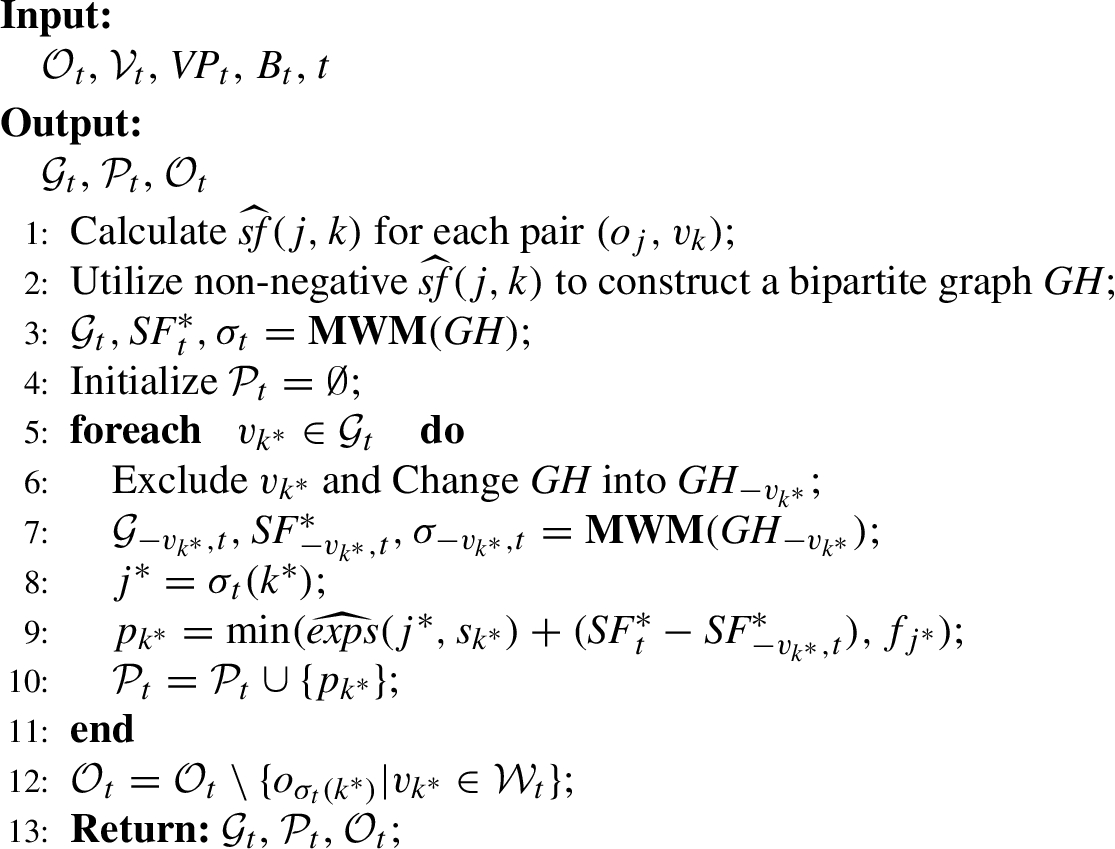
SWMOM-VCG mechanism
Finally, the platform takes the unpaired orders that have not surpassed their maximum waiting time threshold (line 12) to the next time slice, and try to establish new pairs for these orders.
In the following, we provide a formal proof that SWMOM-VCG satisfies the key properties of individual rationality, profitability, truthfulness and computational efficiency.
SWMOM-VCG guarantees individual rationality.
When
SWMOM-VCG guarantees profitability.
As defined in Equation (7), we can get that
SWMOM-VCG guarantees truthfulness.
In this analysis, we establish that no driver can enhance their profit through the submission of an untruthful bid. When
SWMOM-VCG guarantees computational efficiency.
Here we analyze the time complexity of our mechanism as presented in Algorithm 1. In the beginning of the algorithm, it consumes
While SWMOM-VCG can accomplish order pairing within polynomial time, the substantial time consumption associated with processing thousands of vehicles and incoming orders renders it unsuitable for ensuring real-time performance. Therefore we propose an enhanced mechanism, named SWMOM-GM, which incorporates a greedy method for order pairing and employs a critical value for driver payments. This mechanism, though more computationally efficient, may result in a minor reduction in the social welfare. Detailed in Algorithm 2, SWMOM-GM is composed of
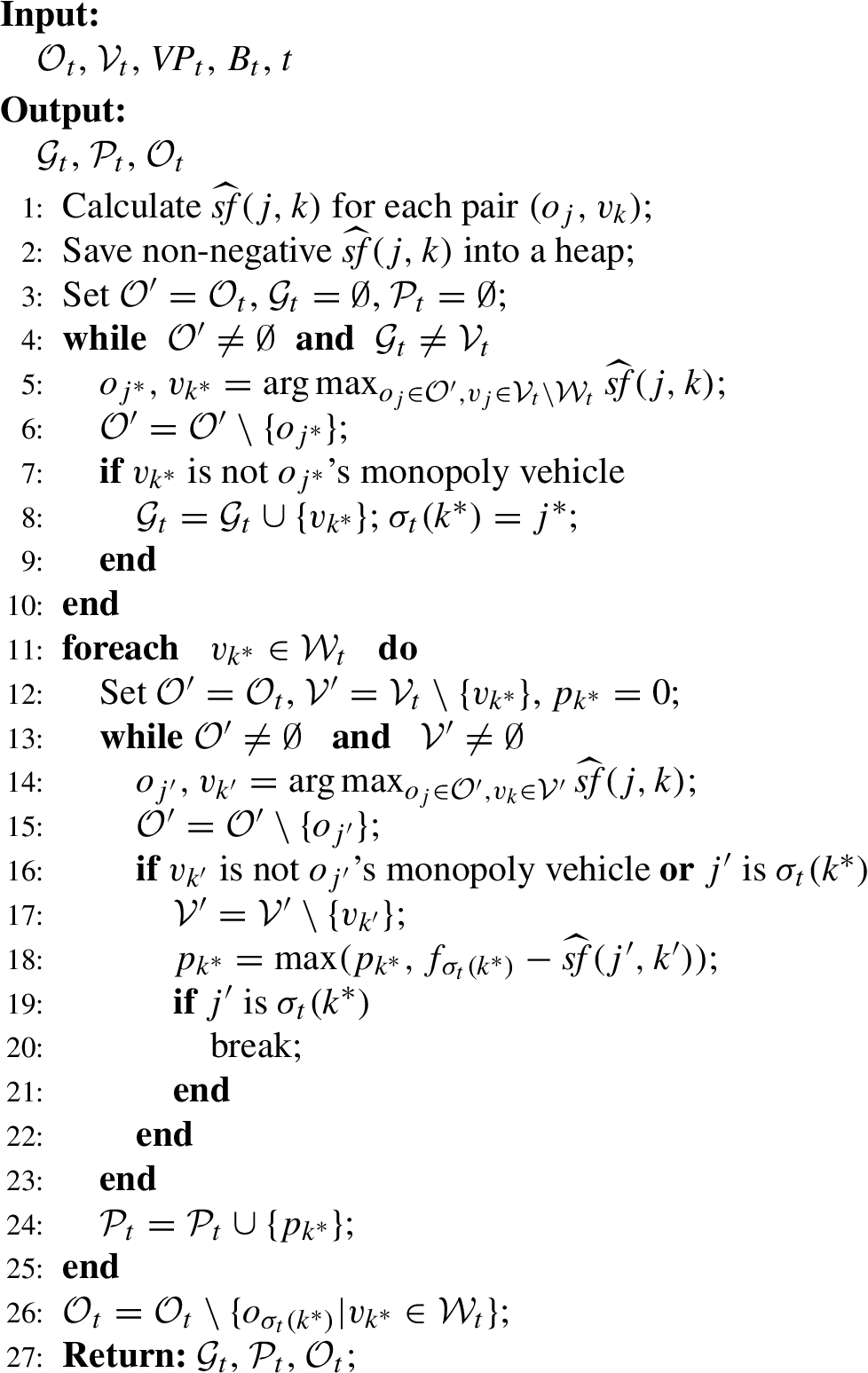
SWMOM-GM mechanism
A vehicle is a monopoly vehicle for an order if this order is only bid by this vehicle.
In the following, we provide a proof that SWMOM-GM satisfies the properties of individual rationality, profitability, truthfulness and computational efficiency. Furthermore, we calculate the lower bound of the social welfare when utilizing SWMOM-GM in comparison to the optimal one.
SWMOM-GM guarantees individual rationality.
In SWMOM-GM, we assume
SWMOM-GM guarantees profitability.
Since the platform only saves non-negative
SWMOM-GM guarantees truthfulness.
We establish that no driver Based on the above analysis, it can be concluded that SWMOM-GM can guarantee truthfulness.
SWMOM-GM guarantees computational efficiency.
Here we analyze the time complexity of our mechanism as presented in Algorithm 2. In the beginning of Algorithm 2, it consumes
The social welfare made in SWMOM-GM
We use
In this section, we conduct experiments to evaluate the performance of our mechanisms using the real taxi order data from New York city.9
The data set used for evaluating our mechanisms is the Manhattan taxi order data set. The data set contains data of all days in June 2016. In order to avoid random disruption, instead of randomly running the experiments on the data of one day, we extract the fundamental characteristics of these data and then generate the data for running the experiments.10
In this paper, we try to evaluate our mechanisms in the realistic situations. Therefore, we will preprocess the data set and then obtain the characteristics of some necessary properties. We then generate the order data for experiments and consider different settings of order demands, under which we demonstrate the effectiveness of our mechanisms.
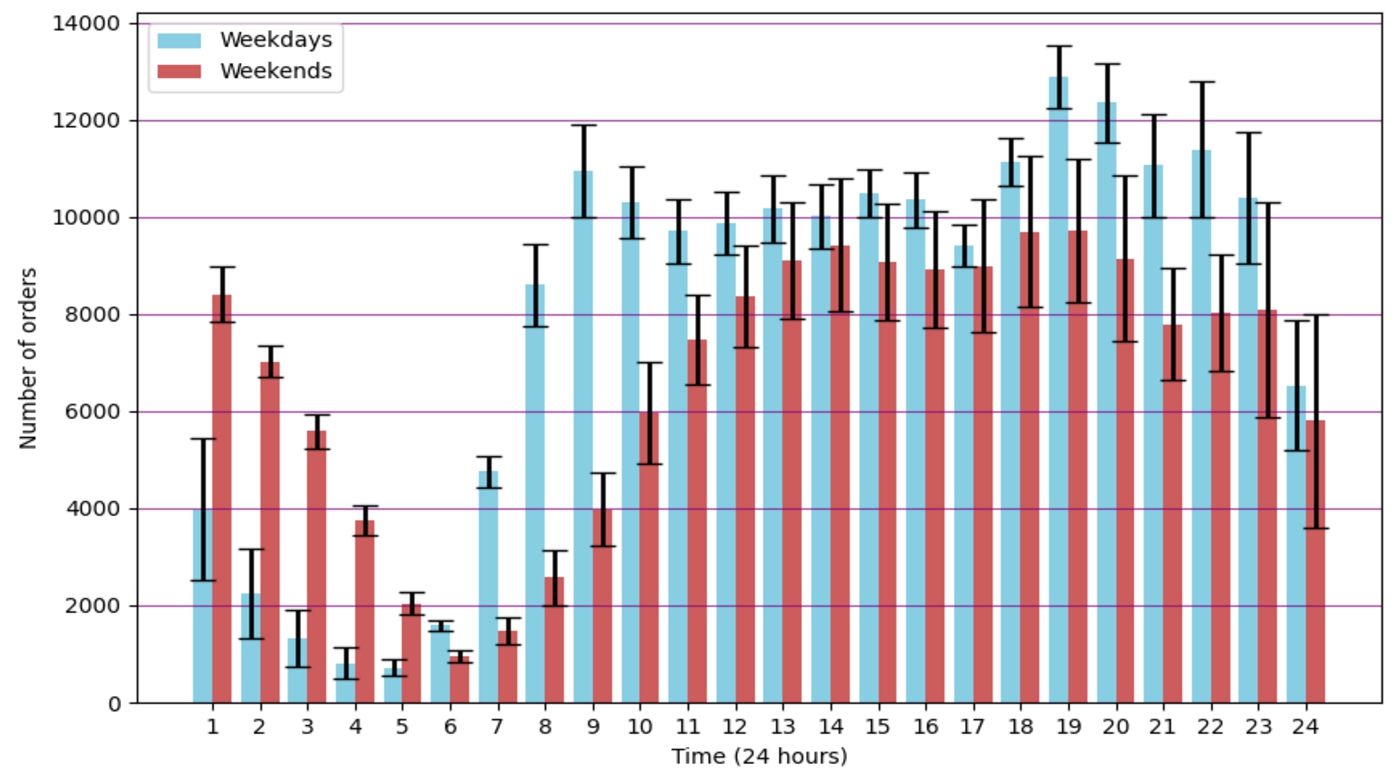
The number of orders on weekdays and weekends.
In Fig. 3, a huge difference is observed between the number of taxi orders on weekdays and weekends. Consequently, we exclude weekend order data, leaving 22 days for analysis. Subsequently, we obtain Manhattan’s road network data from Open Street Map, which is represented as a directed graph consisting of 4,490 vertices and 9,762 edges. Utilizing the k-means algorithm, we cluster departures and destinations from the order data and then divide Manhattan into distinct blocks, as illustrated in Fig. 4. This enables the generation of order data for conducting experimental evaluations. Moreover, to ascertain vehicle expenses, we gather fuel consumption data from the Ministry of Public Information and Communications of China.11
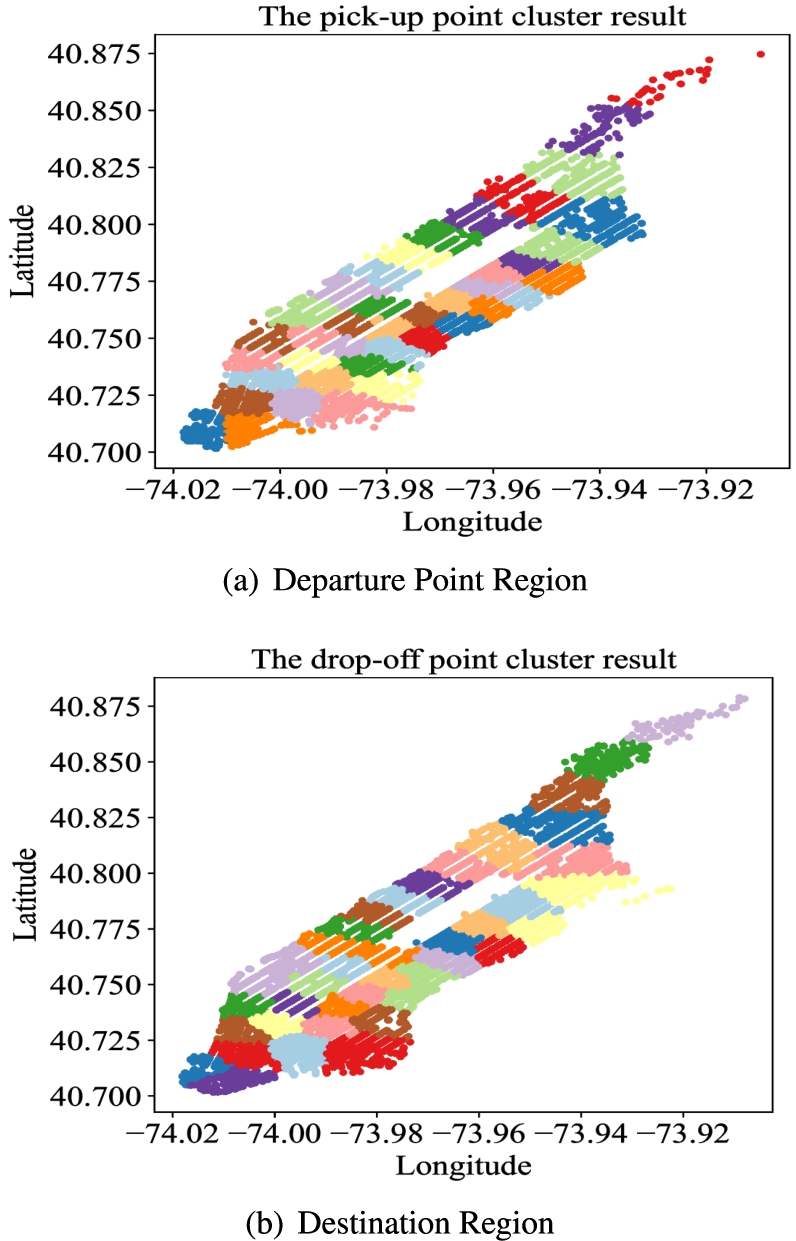
Dividing Manhattan into several blocks by clustering departure and destination regions from the order data.
Parameter values
In order to show the effectiveness of our mechanisms, we intend to evaluate them by considering different demanding situations. Specifically, we consider three different time windows, i.e. 4:00 am–5:00 am, 4:00 pm–5:00 pm and 9:00 pm–10:00 pm, corresponding to low, medium and high riding demands. The amount of orders in 9:00 pm–10:00 pm is the largest in the day, and the amount of orders in 4:00 am–5:00 am is the smallest and the amount of orders in 4:00 pm–5:00 pm is at a medium level. In each time window, we assign one minute to each time slice. If an order remains unserved in the current time slice, it is postponed to the next time slice. An order is removed from consideration if it has surpassed its maximum waiting time. Vehicles with unaccomplished orders trip according to their trip plans, while idle vehicles randomly navigate to explore potential passenger opportunities.
Our experimental evaluation compares the performance of our proposed mechanisms, namely SWMOM-VCG and SWMOM-GM, with that of
We conduct experimental evaluations of our mechanisms, considering varying numbers of vehicles in different time windows. Our evaluation criteria include six metrics, namely: social welfare, which represents the sum of driver and platform profits; rate of served orders, which denotes the proportion of successfully paired orders to the total number of orders; social cost, referring to the total cost of driver services; profit of the platform; total profits of drivers; and total payments to drivers.
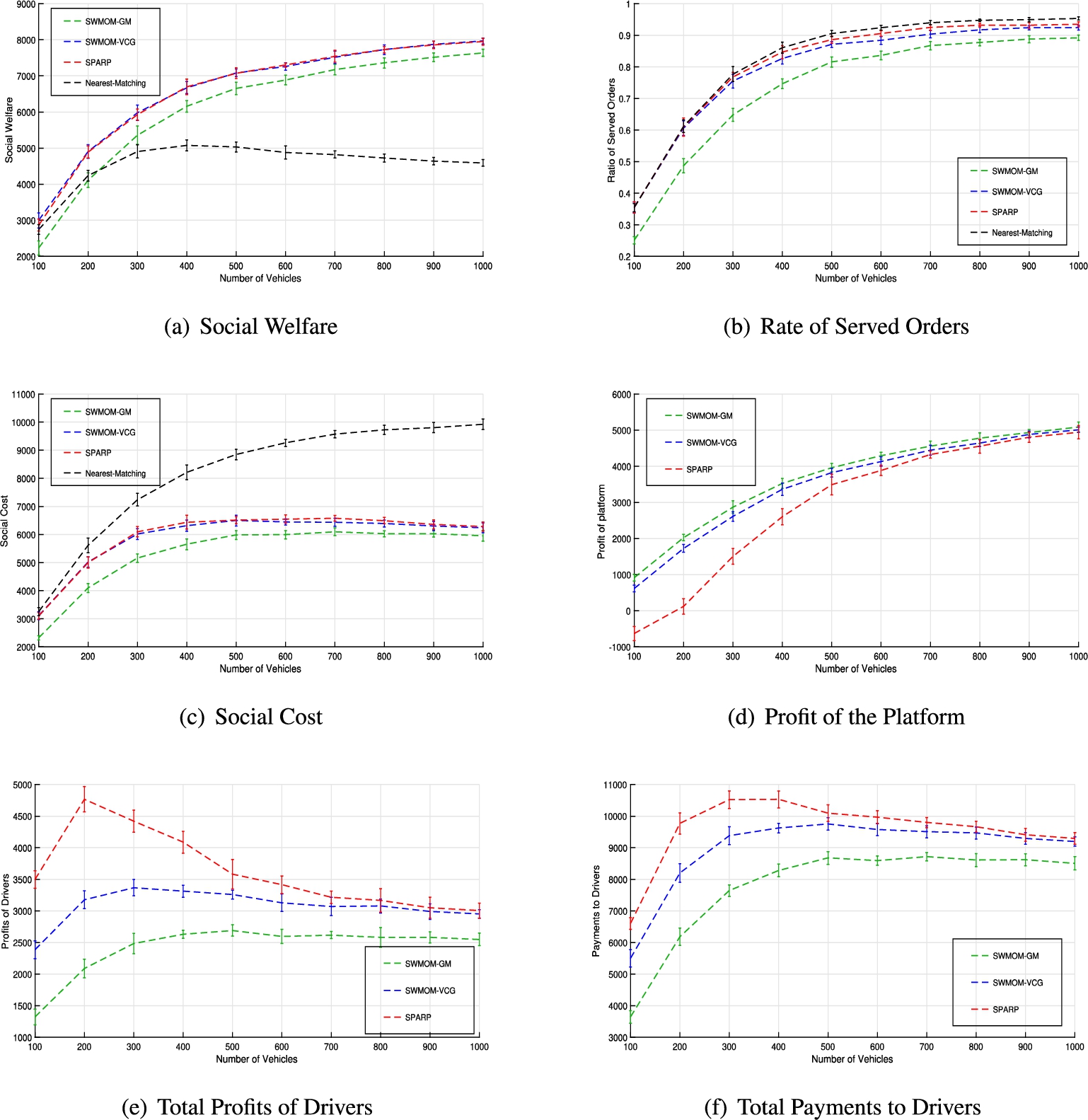
Results of low demands (4:00 am–5:00 am), where we can find that the social welfare of all approaches, except
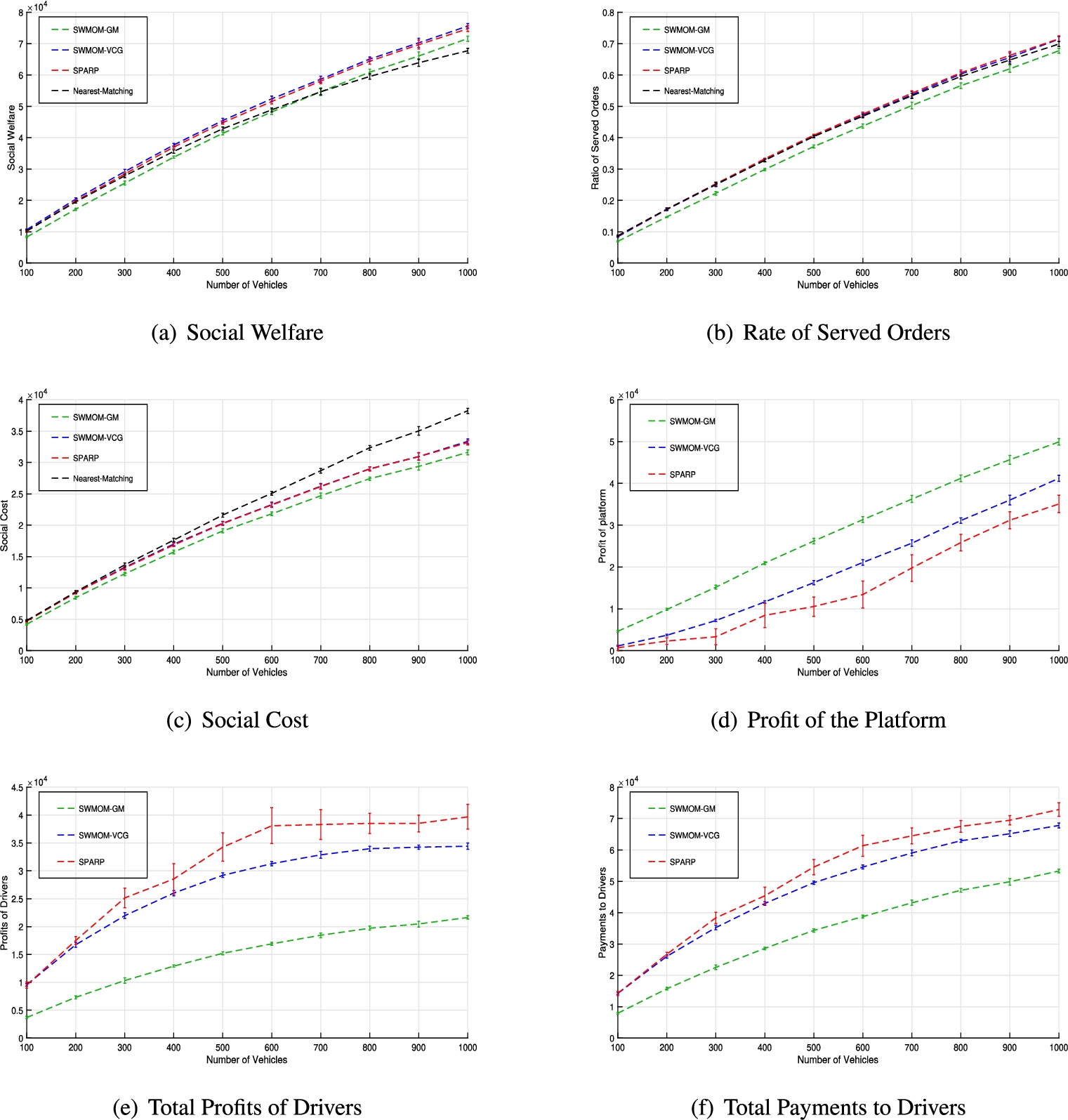
Results of medium demands (4:00 pm–5:00 pm), where we can find that all metrics increases since the amount of orders increases and
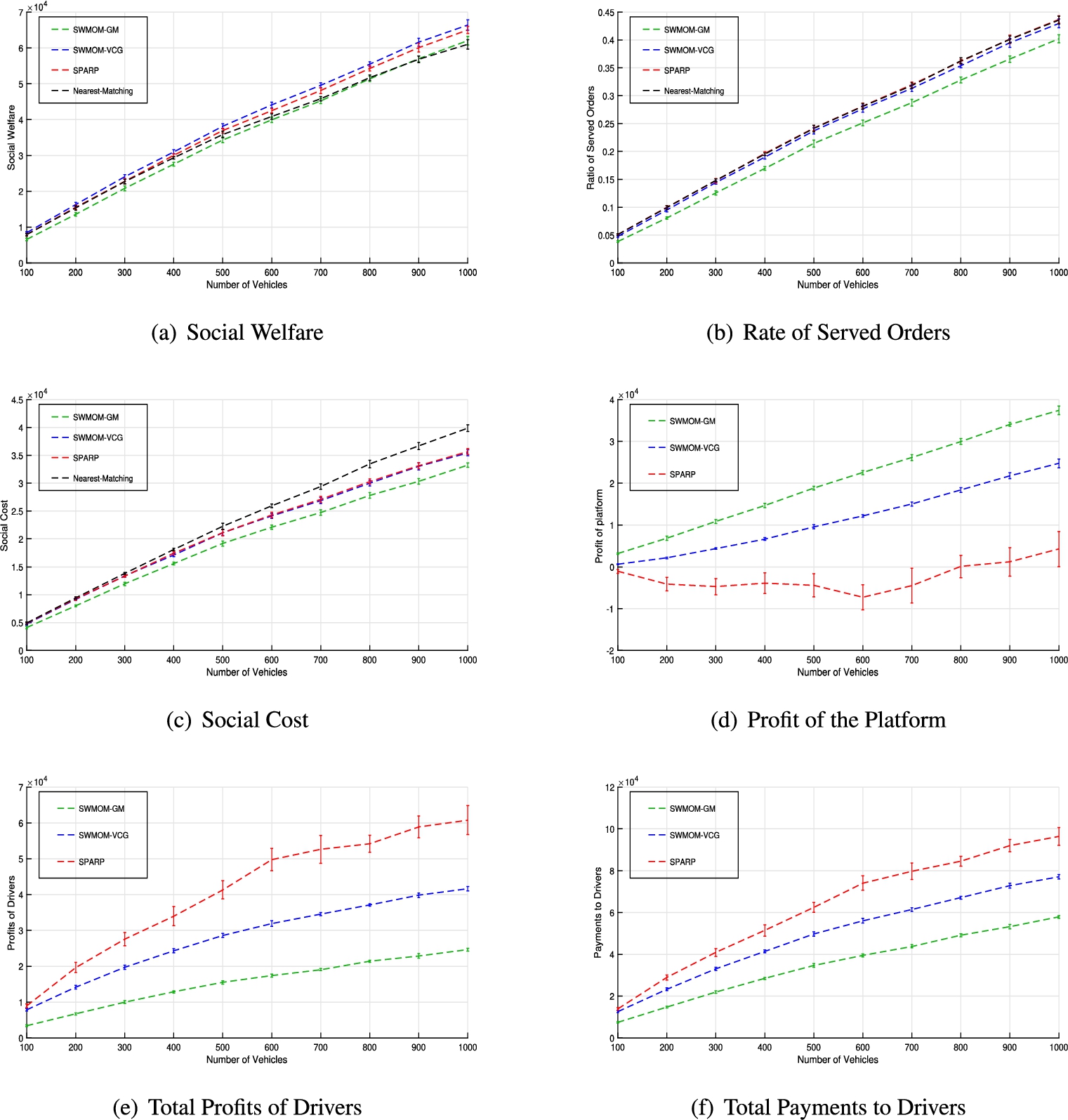
Results of peak demands (9:00 pm–10:00 pm), which is similar to Fig. 6.
We conduct experiments with varying numbers of vehicles, repeating each experiment 100 times with randomly sampled parameters. The average value of each metric is then computed. The results of these experiments for different time windows, namely 4:00 am–5:00 am, 4:00 pm–5:00 pm and 9:00 pm–10:00 pm, are shown in Figs 5, 6 and 7, with the x-axis representing the changing number of vehicles and the y-axis representing the relevant metric. Additionally, we conduct an extra experiment during the high-demand period of 9:00 pm–10:00 pm to evaluate actual runtime. This experiment is carried out using a configuration of macOS Mojave 10.14.5, Intel Core i5 2.3 GHz, and 8G RAM.
Figure 5 presents the experimental results of serving orders with low demands, spanning the time window of 4:00 am–5:00 am. As shown in Fig. 5(a), the social welfare of all approaches, except
Our analysis will now turn to the examination of the profit made by the platform and the vehicle drivers. Note that there is no pricing method in the
We now run experiments by considering medium riding demands (time window 4:00 pm–5:00 pm) and peak riding demands (time window 9:00 pm–10:00 pm). The experiments results are shown in Figs 6 and 7. We can find that compared to Fig. 5, all metrics increase since the amount of orders increases. Because there exist enough riding orders, the social welfare of
Finally, we analyze the running time in the peak time windows, which is shown in Fig. 8. The running time of
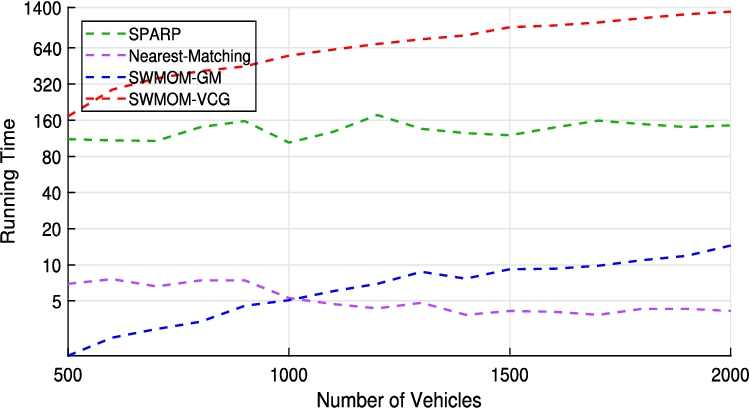
Running time of peak demand period, where we can see that
In general, from the above experimental results, we can see that
This paper proposes two auction-based mechanisms, SWMOM-VCG and SWMOM-GM, designed to pair riding orders with vehicles in order to maximize the social welfare of both the ride-sharing platform and vehicle drivers. We provide theoretical proofs demonstrating that these mechanisms hold desirable properties, including individual rationality, profitability, truthfulness and computational efficiency. Additionally, we conducted extensive experiments using real taxi order data from New York City and compared the performance of our mechanisms against several benchmark approaches in various demand scenarios. The experimental results illustrate that our mechanisms achieved good performance in terms of social welfare. Furthermore, we found that SWMOM-GM outperforms SWMOM-VCG in terms of computational efficiency with only a slight decrease in social welfare. It is important to note that we do not consider long-term social welfare in this paper. The order pairing results in the current time slice may impact future pairing results, demand and supply. In the future, we plan to incorporate this factor into our models. Additionally, free vehicles currently randomly travel, but in future work, we aim to consider the dispatching of idle vehicles to reduce social costs.
Footnotes
Acknowledgements
This paper was funded by the Humanity and Social Science Youth Research Foundation of Ministry of Education (Grant No. 19YJC790111), the Philosophy and Social Science Post-Foundation of Ministry of Education (Grant No.18JHQ060) and Shenzhen Fundamental Research Program (Grant No.JCYJ20190809175613332).