






Abstract
Procurement auctions are widely used by governments and corporations to solicit bids for services and projects. Such auctions involve significant risk for the buyer, because the delivered quality is highly uncertain. We examine a multi‐attribute procurement auction combined with a performance‐based contract. In this setting, suppliers submit bids which include both price and promised quality. After the buyer awards the contract to the winning bidder with the highest score, the supplier exerts efforts to accomplish the project, and buyer satisfaction is randomly affected by both promised quality and effort. A performance‐contingent reward or penalty occurs upon project delivery. We show that bidders jointly optimize promised quality and effort before submitting a bid price. Depending upon the relative impacts from promised quality and effort on buyer’s satisfaction, the promised quality and execution effort can be complements or substitutes. Our analysis reveals that the information rent that the supplier gains depends on the relationship between promised quality and buyer satisfaction. Further, the optimal scoring rule distorts promised quality downwardly. We find that either reserve quality or price alone is insufficient to exclude undesirable bidders. Compared with efficient mechanism, the effort under optimal mechanism is distorted upwardly (downwardly) when it substitutes (complements) promised quality. We also find that the risk uncertainty can benefit both buyer and supplier, under certain conditions of an additive relationship between supplier’s behaviors and randomness, resulting in a Pareto improvement.
Introduction
Procurement auctions are widely adopted to solicit suppliers (i.e., bidders) of unique products, such as services, construction projects, and public infrastructure. This type of auction is also known as a “reverse auction,” since the roles of buyers and suppliers are reversed. Many corporations and governments have used procurement auctions to induce competition in order to reduce procurement costs and cycle time. It has been estimated that the use of procurement auctions is increasing at a rate of 10–15% per year (Beall et al. 2003). With the development of information technology, firms and governments are increasingly embracing multi‐attribute procurement auctions to obtain services in areas such as marketing, insurance, legal services, human resources, maintenance, and consulting (Elmaghraby 2007). It is estimated that procurement auctions account for 7% of total U.S. government contracts worth roughly $31.2 billion per year (Ladick 2015). Honeywell has been reported to use procurement auctions to procure legal services, even for litigation (Edwards 2015). Recently, Indian Railways announced plans to implement procurement auctions with the aim of saving $1.4 billion in spending per year (Ians 2018).
Unlike sales auctions in which bids usually only involve price, bids in procurement auctions also include bidders’ promise to deliver certain quality levels as well. This unique aspect creates multidimensional bids in this class of procurement auctions. Further, the uncertainty in buyer (dis)satisfaction also plays a significant role in procurement auctions. The
In this study, we investigate the role of the satisfaction risk in the context of performance‐based contracts (PBCs). PBCs have been widely adopted in operations management practice (Tan et al. 2017). For example, the construction industry has long suffered from low productivity, and PBCs are one of the most common mechanisms to mitigate satisfaction risk (Groves 2017). According to
The analysis of bidder behaviors and mechanism design in the procurement auctions described above has significant practical implications. However, the presence of a buyer's uncertain satisfaction in multi‐attribute auction is not extensively studied in the existing literature (e.g., Asker and Cantillon 2008, Branco 1997, Che 1993, Parkes and Kalagnanam 2005). To the best of our knowledge, the model discussed in this study is the first attempt to embed endogenous satisfaction risk into multi‐attribute scoring auctions. The crucial feature that distinguishes our work from previous studies is that we examine both effort and promised quality can simultaneously affect the degree of uncertain satisfaction, and the buyer and suppliers have
Our analysis provides several important managerial implications. First, we find that the supplier in the auction with satisfaction risk must optimize promised quality and effort together, while price can be determined separately. This is an extension of the previous literature on multi‐attribute auctions without buyer satisfaction rewards and penalties, which shows that supplier quality and price can be determined separately (Che 1993). Also, we note that satisfaction risk can drive bidders to bid less (or more) aggressively on the quality dimension depending on the effect of promised quality on satisfaction, thus reducing or increasing the supplier's information rent. Second, our analysis highlights the importance of classifying the relationship between promised quality and effort (in particular, whether they are complements or substitutes) and how they influence the supplier's behavior. We find that less effort will be exerted in an optimal auction (i.e., buyer utility maximization) than in an efficient auction (i.e., social surplus maximization) when effort complements promised quality, while the opposite is true when effort substitutes for promised quality. Third, with respect to mechanism design, we find that an optimal reserve score is required to avoid a situation where undesirable bidders leave the buyer with a loss. A crucial implication here is that neither reserve quality nor reserve price alone is sufficient to exclude undesirable bidders that can create negative buyer surplus. Finally, to further explore the impact of uncertainty on our results, we analyze two classes of satisfaction functions (linear and nonlinear) under an additive relationship between bidders’ behaviors and randomness. Interestingly, we find that uncertainty can actually benefit both supplier and buyer under certain conditions, resulting in a Pareto improvement.
The rest of the study is organized as follows. We first review the relevant literature and position of our study with respect to it in section 2. The model and analysis of bidder behavior are presented in section 3. In section 4, we explore the mechanism designs for efficient and optimal auctions of the buyer. Section 5 investigates the impacts of uncertainty. In section 6, we consider two extensions of our base model. Finally, in section 7, we conclude our study with key takeaways and directions for future research.
Literature Review
The current work is closely related to three streams of literature: scoring auctions, keyword auctions, and procurement auctions or procurement risks in supply chain management. We review the existing studies in each stream and point out the differences between the current work and previous works to highlight our contributions.
Scoring Auctions
Che (1993) proposed the quasi‐linear scoring rule used to design efficient and optimal procurement auctions (multidimensional or multi‐attribute auctions) and compared buyer utilities under different auction mechanisms. Bushnell and Oren (1994) and Branco (1997) also used scoring rules to handle bidding in multidimensional auctions with non‐price dimensions. Beil and Wein (2002) as well as Parkes and Kalagnanam (2005) applied scoring rules in iterative auctions. Asker and Cantillon (2008) studied scoring auctions in which suppliers have multidimensional private information and found that, like one‐dimensional cases, quality bidding in optimal auctions is distorted downward compared with efficient auctions. Our study considers the
Chen et al. (2010b) used scoring auctions to regulate project bidding with failure risk, assuming that suppliers bid based on both project cost and the penalties in the event of failure, and that the binary probability of success is exogenous. In the current study, both promised quality in bid and effort affect satisfaction risk, and supplier effort is incentivized by a contingent transfer. Gupta et al. (2015a) studied the bidder's behavior and agency decisions in A+B auction of construction projects, which do not focus on optimal auction design due to the assumption of a linear scoring rule. Our study is different in that it explores scoring auctions with moral hazard and analyzes the impact from different types of uncertainty on supplier bidding behavior, hidden effort, and scoring rule. In essence, the contingent transfers in the previous two papers referenced above and our model resemble the payment in a PBC, which concerns the quality or outcome of service provision and ties contractor payment to achieved performance. In the literature, PBCs are used to solve the moral hazard problem described in agency theory (e.g., Baker 1992, Holmstrom 1979, Kim et al. 2007). In particular, Laffont and Tirole (1987) and McAfee and McMillan (1987) studied the linear PBC with a direct auction mechanism, where suppliers simply decide their levels of effort and report their types accordingly. In the model presented here, which is an indirect multidimensional auction, the suppliers decide promised quality, price, and effort, and thus a contingent payment scheme is incorporated into the scoring auction under an environment of multidimensional bid competition.
Keyword Auctions
From the perspective of payment forms, the literature on keyword auctions includes pay‐per‐exposure (pay‐per‐impression) auctions and performance‐based (pay‐per‐action) auctions (Zhu and Wilbur 2011). In pay‐per‐exposure, advertisers bid for impressions and pay each time their ad is displayed on a Web page (e.g., Chen et al. 2009, Edelman et al. 2007, Fukuda et al. 2013, Shin 2015). In a performance‐based auction, advertisers bid and pay for measurable actions (click, call, sale, etc.) from customers (e.g., Agarwal and Mukhopadhyay 2016, Chen et al. 2010a, Liu and Chen 2006). Chen et al. (2010a) explored the design of performance‐based unit‐price contract auctions, in which bidders bid their unit prices and the winner is chosen based on both their bids and performance levels by a linear scoring rule. In addition, bidders with a low performance level can improve their performance at a certain cost. They found that the possible upgrade in bidders’ performance level provides the auctioneer an incentive to modify the auction rules over time. Liu et al. (2010) proposed a keyword auction model in which advertisers bid their willingness‐to‐pay per click on their advertisements, and the advertising provider can require different minimum bids based on advertisers’ click‐generating potential. They showed that the revenue‐maximizing minimum‐bid policy with a linear scoring rule can generate higher revenue than standard pay‐per‐exposure auctions. Unlike the above works on performance‐based keyword auctions, our model considers the multiple attributes of bids (quality and price) along with bidders’ efforts under ex post satisfaction concern, and optimal scoring rule, including the reserve score, is derived.
Procurement Auctions and Procurement Risks in Supply Chain
The supply chain literature includes many papers on procurement auctions. Tunca and Zenios (2006) compared the use of auctions and long‐term relational contracts given non‐verifiable quality. Chen (2007) studied procurement contract auctions with a buyer‐announced quantity‐payment schedule. Wan and Beil (2009) explored the trade‐offs between different levels of pre‐ and post‐qualification when the manufacturer uses a request‐for‐quotes (RFQ) reverse auction to select the qualified supplier. Chaturvedi and Martinez‐de‐Albeniz (2011) considered a multi‐sourcing problem with two‐dimensional private information on exogenous production cost and supply reliability. Li and Scheller‐wolf (2011) determined whether a buyer should specify order quantity before or after demand realization in procurement auctions. Li et al. (2015) investigated the design of procurement mechanism when the manufacturer has two‐dimensional private information and the retailer makes the assortment planning. Gupta et al. (2015b) analyzed the descending mechanism design under the constraints of individual/group capacities and business rules separately. The uniqueness of our study is that the ex post performance, which is endogenously affected by promised quality and unobservable effort of supplier, is embedded into the ex‐ante multi‐attribute scoring auction.
This study focuses on the interaction of promised quality and effort, and on how bidder behaviors and auction design are influenced by the dynamics of uncertainty in different scenarios. Supply/procurement risks have been widely studied, including (1) quantity risk, such as random yield (e.g., Federgruen and Yang 2009, Gerchak and Parlar 1990) or random capacity (e.g., Ciarallo et al. 1994), and (2) quality risk, such as quality defects (e.g., Baiman et al. 2000 and Lim 2001) and non‐verifiable quality risk/failure risk (e.g., Tunca and Zenios 2006). In our model, the procurement satisfaction risk differs, as it is endogenous and relates to bidder behaviors, that is, both promised quality and effort. Thus, we further scrutinize the impact of this risk on behaviors, utilities and mechanism designs, given the additive relationship between randomness and behaviors, which is commonly examined in the supply chain literature (e.g., Agrawal and Sechadri 2000, Chen 2005, Chu and Lai 2013).
In summary, we combine a multidimensional auction with a PBC to study procurement with
Base Model
Model Description
The basic setting of our model can be described as follows. The procurement auction consists of one buyer (i.e., government agency or corporation) and
Specifically, the utility for the buyer comes from two sources: utility from promised quality 


Bidders compete for the contract by bidding (





The contract is awarded according to a scoring rule known to all parties at the start of bidding. Following Asker and Cantillon (2008), we use a quasi‐linear function
The bidder's cost function
The properties in Assumption 1 are commonly adopted in multi‐attribute procurement auctions (e.g., Che 1993). For the supplier, the marginal quality cost increases in both 
The effort cost increases in
The convex property of effort cost function in Assumption 2 is also widely adopted in the literature (e.g., Rees 1985), which reflects that the marginal disutility of the supplier from exerting more effort increases. A common example of the effort cost is 
The realized quality 


Assumption 3 indicates that both higher promised quality in bid and higher effort during the project can lead to higher realized quality performance stochastically, while at the same time, higher promised quality decreases the probability of achieving an exceeding 








This assumption is a regularity condition and is commonly adopted in the moral‐hazard literature, which ensures that the supplier's problem is unimodal and thus enables the first‐order approach (see Grossman and Hart 1983, Holmstrom 1979, Jewitt et al. 2008). Many common distributions of random shock can lead to this condition, for instance, the uniform distribution and the gaussian distribution.
Promised Quality and Unobservable Effort
Hereafter, the supplier's subscript 
Promised quality 

Lemma 1 shows that bidders must jointly optimize promised quality and effort before submitting a bid price. This essential characteristic of bidder behavior differentiates our study from the existing literature. That is, the bidder's strategy not only considers the winning probability, the deterministic cost in terms of promised quality (e.g., Asker and Cantillon 2008 and Che 1993), and the expected cost in terms of penalty bid and risk type (exogenous failure probability) (e.g., Chaturvedi and Martinez‐de‐Albeniz 2011 and Chen et al. 2010b), but also the expected utility from uncertain satisfaction, which is affected by both promised quality and endogenous effort. Thus, the pseudo‐type in our model has two distinct features: (1)
Note that the sign of Λ


We summarize the impact of second‐order condition Λ
When Λ
When Λ
All proofs are provided in Appendix S1. Let us consider the case where supplier production cost decreases, that is, a smaller
The promised quality under the scenario of dominant reference role (i.e.,
The intuition of this result is as follows. Under the satisfaction concern, the supplier needs to balance the utility of the initial promised quality and performance contingency payment. As a result, we find that it is optimal for the supplier to bid less aggressively on the initial promised quality when the promised quality decreases the expected satisfaction than when the promised quality increases it. Such actions also positively influence buyers’ belief of a higher probability of
Bid Price and Information Rent
Next, we analyze the bidding strategy of price.
The unique optimal bid price of the bidder with 
There are several immediate observations from Lemma 2. To begin with, if effort does not affect satisfaction, the total expected cost can be simplified to 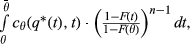
Bidders obtain less information rent when the reference role is dominant (i.e.,
Corollary 1 shows that compared with the case where promised quality can increase the expected satisfaction (i.e., Λ
Mechanism Design
In this section, we focus on the mechanism design facing the buyer. We consider two mechanisms: (1) “Efficient Mechanism” and (2) “Optimal Mechanism.” “Efficient Mechanism” is the efficient allocation design of the scoring rule and contingent transfer that maximizes expected social surplus, while “Optimal Mechanism” represents the construction of a scoring rule and contingent transfer that maximizes expected buyer utility.
Efficient and Optimal Mechanism
Efficient mechanism requires
Proposition 3 shows that if the buyer wishes to maximize expected social surplus, she should apply her true preference to evaluate the promised quality, and require the supplier to fully shoulder the risk of satisfaction uncertainty. The intuition of this result is that promised quality and effort must both be efficient in an efficient mechanism. The winner assumes all moral hazard with no effort distortion, and therefore she must carry the risk by sharing the uncertainty fully with
Expected buyer utility prior to bidding is 

Note that the expected buyer utility can be characterized by two equivalent expressions: the direct form, and taking the difference between social surplus and information rent. Here we adopt the latter because of expositional convenience. In mechanism design theory, buyer utility is similar to the notion of “
Under the optimal mechanism, 



The managerial implication of Proposition 4 is that the buyer should not expect to gain further from contingent transfers.
3
Note that the information rent is directly related to the promised quality in bid. Under the optimal mechanism, the distorted scoring function
Hitherto, we have adopted the common assumption (e.g. Che 1993) that 


Based on the common requirement of regularity in mechanism design, we further assume that
An optimal reserve score 







Regulated by 





The most important managerial implication from Proposition 5 is that neither reserve quality nor reserve price alone is sufficient to achieve the optimal mechanism. Specifically, if the buyer only sets a reserve quality 


Recent developments in information technology have facilitated the implementation of multi‐attribution auction. Buyers submit their needs through an electronic platform and solicit bids from the pre‐qualified suppliers. When the buyer submits the specifications of the procurement, she also reports her valuation and/or scoring rules on the request items, which includes both price and non‐price dimensions. To respond, the suppliers submit their bids, which include their promised quality and price. Further, we observe that many buyers in practice also set the minimum acceptable quality level and ceiling price together, which can be translated to a reserve score in our setting. Our results here provide practical guidance regarding how to design and implement procurement auctions when satisfaction concern is significant.
The quality distortion
Corollary 2 provides an immediate insight for procurement managers. When promised quality involves an uncertain performance with a dominant reference role, bidders will submit lower bids because a high‐promised quality decreases the possibility of fulfilling or exceeding the buyer's expectations upon completion of the project. Accordingly, the buyer deploys an optimal scoring rule with mild distortion. For the reverse case with a dominant enhancement role, the buyer should distort the promised quality more aggressively.
Bidder Behaviors under Efficient and Optimal Mechanism
We denote 

When the buyer is quality sensitive (i.e., Λ


Proposition 6 illustrates that promised quality is distorted downwardly as expected. However, whether the effort is distorted downwardly or upwardly depends upon the relationship between promised quality and effort. The optimal mechanism adversely affects the interest (utility) of suppliers compared with the efficient mechanism. Effort thus acts as a loss hedging tool in the scenarios of both quality sensitivity (Λ


Impact of the Uncertainty
The above discussion illustrates that uncertainty regarding satisfaction will affect promised quality, effort and optimal mechanism design. A more thorough assessment of the impact of
Assume 
Impact of Uncertainty on Promised Quality and Effort
We first analyze the impacts of
Under linear
The additive uncertainty and linearity of
For nonlinear 

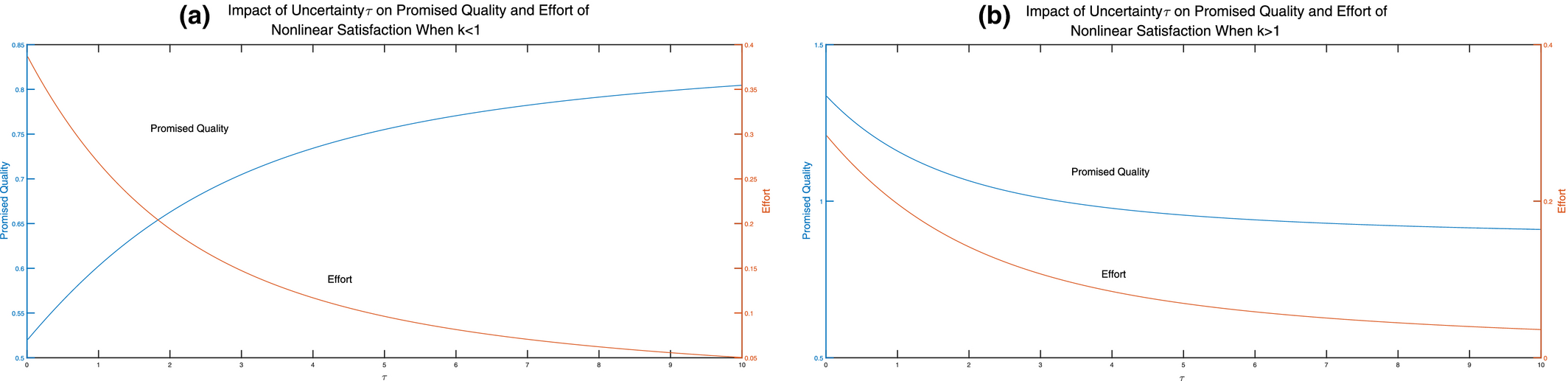
Impact of
Unlike 








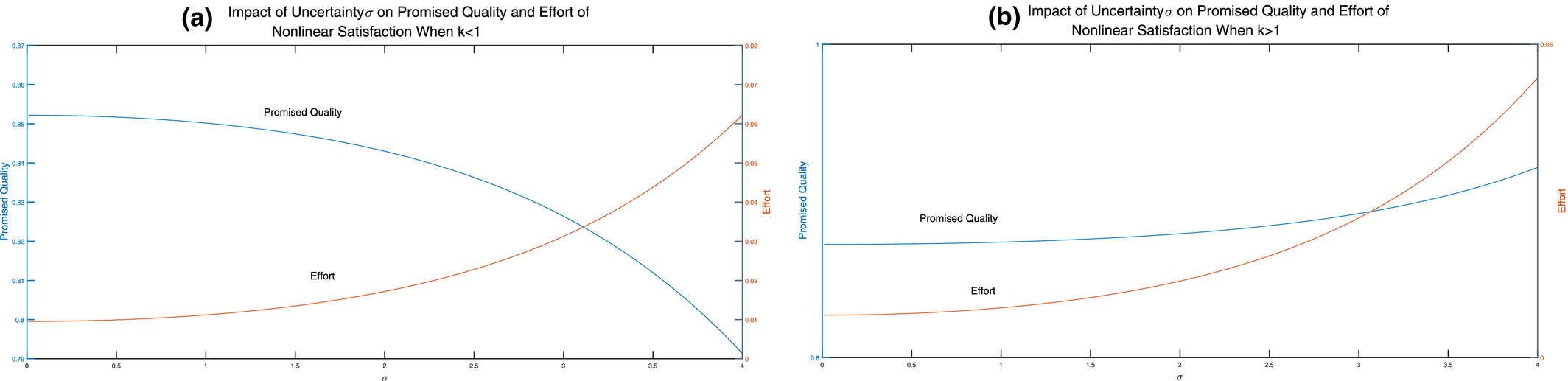
Impact of
Further, we also investigate the impact of effort cost on the promised quality and effort under nonlinear satisfaction, which is illustrated in Figure 3.

Impact of Effort Cost on Supplier's Behaviors [Color figure can be viewed at
It is intuitive to see that when the marginal disutility of effort increases, the supplier will decrease the effort. However, the impact of effort cost on promised quality is not monotonic but depends on the whether the satisfaction function is quality sensitive or effort sensitive. When promised quality and effort complement with each other (
Impact of Uncertainty on Buyer Utility and Optimal Mechanism Design
In this subsection, we focus on analyzing the impacts of
Buyer's expected utility increases in 
Proposition 8 shows that the buyer's 
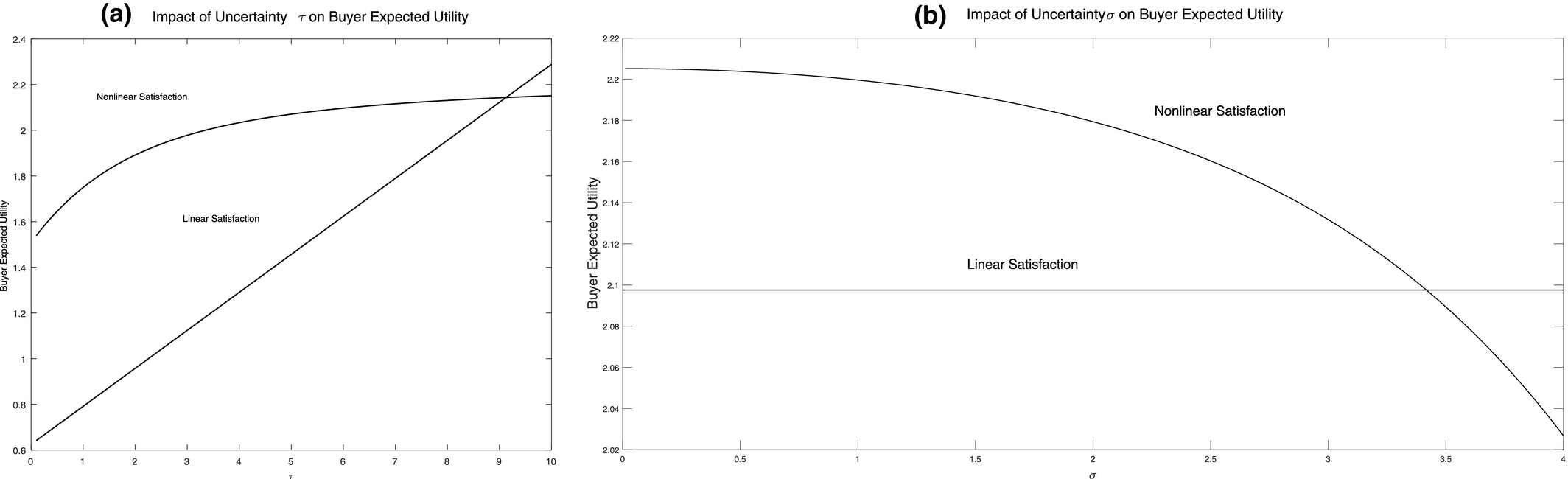
Impact of Uncertainty on Buyer's Expected Utility
In contrast to 


In summary, we analyze the impacts of two uncertainty types on the bidder's and buyer's behaviors. Under linear satisfaction, promised quality and effort remain unchanged with uncertainty, while the buyer's expected utility increases in uncertainty when both mean and variance of the uncertainty increase, but remains unchanged when only the variance of uncertainty increases. Under nonlinear satisfaction, the uncertainty impact depends on the types of uncertainty, two roles of promised quality, and the marginal contributions of promised quality and effort on satisfaction. Conventional wisdom suggests that bidders and buyers will both be hurt by high uncertainty. However, our results reveal that a win‐win situation (i.e., Pareto improvement) can be achieved along with two types of uncertainty increment. Further, to maximize the buyer's revenue, the bidder's behaviors are regulated by the adjusted mechanism where the core is the quality scoring rule. Larger (smaller) distortion always accompanies the increasing (decreasing) promised quality; such adjustments accommodate different bidder types due to the nature of the optimal scoring rule.
Extensions
In this section, we extend our base model in two directions. To begin with, we consider the scenario where the promised quality is deterministic and can be achieved with certainty. In the second extension, we relax the assumption that all bidders share the same cost of exerting the efforts by considering a scenario where the effort costs from different suppliers are different.
Deterministic Performance of Promised Quality
In the base model, we assume that the realized performance of the promised quality is stochastic. This is true in many practical scenarios. However, in some circumstances, the realization of promised quality can be achieved with certainty as well. To incorporate this realistic perspective into consideration, we consider an alternative model in which the promised quality in bid is deterministic while the
For exposition, we only introduce the differences between the extended model and base model here. The degree of uncertain satisfaction 


Note that the bidder decisions on 
Then we can immediately show the following result.
When the outcome of promised quality in bid is certain, the promised quality and information rent are both greater than those in the scenario of uncertain performance when the reference role is dominant.
In the base model, when the performance of promised quality is uncertain and the reference role dominates, the expected satisfaction decreases in the promised quality. Thus, compared with the case when the enhancement role is dominant, the optimal mechanism under dominant reference role decreases both the promised quality and information rent. Proposition 9 suggests that when the performance of promised quality is certain, bidders offer higher promised quality compared with those in an auction of uncertain performance of promised quality under dominant reference role. This phenomenon occurs because promised quality without uncertainty generates an incentive on uncertain satisfaction (Φ


Asymmetric Effort Cost
In many practical scenarios, suppliers share similar production costs but may differ from each other in after‐sales services and their unobservable efforts. Thus, we consider the scenario where suppliers have different costs of exerting their efforts to achieve the promised quality. Specifically, we introduce a parameter 


The expected social welfare is 
When the performance of promised quality is uncertain and the type is effort efficiency 



Unlike the result in base model, we find that the buyer can maximize her expected profit with any
Conclusion
In service procurement, promised quality and the supplier's unobservable effort are crucial drivers, usually together, of the buyer's
We find that bidders jointly optimize the promised quality and effort before submitting the bid price. This finding is a generalization of the separation property in multidimensional auctions without satisfaction concern. Further, when the reference role of promised quality is dominant, the suppliers will submit lower promised quality in bid than when the enhancement role is dominant. The incorporation of satisfaction risk leads to several intriguing findings and insights. We find that it is crucial to classify the type of a buyer's satisfaction function, in terms of marginal contribution of promised quality and effort, as either quality sensitive or effort sensitive. When the scoring rule in the efficient mechanism (social surplus maximization) is compared to the one in the optimal mechanism (buyer utility maximization), the promised quality is always distorted downwardly. However, the effort level is distorted upward when the buyer is effort sensitive but downward when the buyer is quality sensitive. In the optimal mechanism, the buyer should use less distortion with a dominant reference role of promised quality compared with a dominant enhancement role, in response to anticipated lower promised quality. Further, we prove that the optimal mechanism requires a unique reserve score to exclude undesirable bidders who would cause negative utility for the buyer if they won the bid. An immediate implication is that neither reserve quality nor reserve price alone is sufficient to screen the undesired suppliers.
To further explore the impacts of uncertainty on our results, we studied two types of uncertainty with additive relationships between bidder behaviors and uncertainty. We consider both linear and nonlinear satisfaction functions and find that under certain conditions, both buyer and supplier can benefit from increasing uncertainty, which achieves a Pareto improvement. In particular, under linear satisfaction, promised quality and effort remain unchanged with uncertainty, while the buyer's expected utility increases in uncertainty when both mean and variance of the uncertainty increase but remains unchanged when only variance of uncertainty increases. Under nonlinear satisfaction, the impact of uncertainty depends on the types of uncertainty, two roles of promised quality, and the marginal contributions of promised quality and effort on satisfaction.
The multi‐attribute auction combined with the PBC contract opens several promising avenues for potential future research. To begin with, our study poses some testable empirical questions which call for formal empirical investigation. Quantifying the cost saving and quality improvement from implementation of the PBC contract would allow us to better understand the economic value of this purchasing policy. Further, extending our two attributes auction framework to a more general setting would also be a potentially fruitful research direction for future scholars.
Footnotes
Acknowledgments
The authors are listed alphabetically and contribute equally to this work. Hongyan Xu is the corresponding author of this study. We thank the department editor, Eric Johnson, the senior editor, and two anonymous reviewers for their valuable and constructive suggestions. He Huang was supported by the National Program for Support of Top‐notch Young Professionals and the National Natural Science Foundation of China (Grant No. 71471021, 71871032). Hongyan Xu was supported by the National Natural Science Foundation of China (Grant No. 71472017) and the Fundamental Research Funds for the Central Universities (Grant No. 2018 CDJSK02XK16).
1
For exposition, we use bidders and suppliers interchangeably in the remainder of the manuscript.
2
This is because that the promised quality is of concrete input cost, a higher investment is more likely to achieve a higher performance.
3
To illustrate the result of Proposition  , consider
4
We thank the anonymous reviewer who encouraged us to investigate along this direction.