




Abstract
BACKGROUND:
The existing patient clothing is not suitable for patients that have to maintain a prone position for a long time after vitrectomy.
OBJECTIVE:
To investigate the effect of a new design of patient gowns for prone position patients after vitrectomy.
METHOD:
This study designed a kind of patient’s gown for prone position patients. A non-randomized, concurrent, controlled study was conducted on 212 patients who met the inclusion criteria for the prone position after vitrectomy in Grade III at a Class A hospital department of ophthalmology in Zhejiang Province from April to August 2020. The experimental group (106 patients in prone position) and the control group (106 patients in common position) were managed by the same group of nurses. The study recorded and compared the comfort degree of patients’ clothing used in the course of operation rehabilitation between the two groups and the satisfaction degree of doctors with nurses to patients’ clothing used in the prone position.
RESULTS:
The satisfaction degree and comfort degree of patients and the health care providers in the experiment group were significantly higher than those in the control group (
CONCLUSION:
The process of making patient gowns for prone position patients is simple, which can improve the safety and comfort of patients when they were in the prone position. The new design also facilitated the treatment and nursing procedures of the medical staff and improved satisfaction among patients and medical staff.
Introduction
At present, vitrectomy combined with silicone oil and gas tamponade is the most classical surgical method for complex retinal detachment. The aim is to use the principle of silicone oil/gas lighter than water through its buoyancy and surface tension to reset the detached retina, thereby restoring vision [1, 2]. After the operation, patients adopt a prone position, because the forced posture needs to be maintained for a long time, which causes various aspects of discomfort and complications, affecting the quality of life of patients and treatment safety [3]. The existing patient clothing usually adopts the counter-flap structure design of normal clothing, that is, a row of buttons is designed in the front of the clothes. This kind of button design will press the patient’s front chest for a long time when the patient is in a prone position and can cause a pressure sore in severe cases [4].
According to Zhang et al., patients with chronic diseases such as diabetes and stroke have a higher risk of developing pressure sores [5]. Once diabetic patients form skin wounds, they are faced with the problem of decreased healing ability and prolonged healing time [6]. People with diabetes have a higher risk of Retinal detachment disease [7, 8], and a higher risk of pressure sores during prolonged prone rest after vitrectomy. According to statistics, there are more than 30 million patients with diabetic retinopathy in our country at present [9]. Ordinary patient clothes bring many troubles to patients who adopt the prone position for a long time after the operation.
In this study, we designed and made a suit for prone position patients, the comfort of the patient’s suit in a prone position after vitrectomy and the satisfaction of medical staff with the suit were evaluated. This design has obtained the National Utility Model Patent (Chinese National Patent # Zl 20192039021.5), which can not only improve the comfort and safety of patients when wearing, but also facilitate the treatment and nursing of medical staff, and has high clinical promotion value.
Patients and methods
The structure and characteristics of patient gown for prone position
The patient gowns for the prone position were made of soft and breathable cotton cloth, and the neckline was in a “V” shape, including the jacket body surrounded by the front piece and the back piece for covering the patient’s torso. The left and right sides were respectively provided with one sleeve, which was a tubular structure, and the shoulder is provided with a strip opening for the patient through the collar. The detachable connection structure comprises a button and a button hole, wherein the button is connected on one of the front sheets and the back sheet, and the button hole is arranged on the other of the front sheet and the back sheet (Fig. 1). The utility model has the advantages that the patient uniform is designed as a tubular structure, the front button does not oppress the patient’s chest, and the comfort of the user is improved. The process of taking off the patient’s clothes is as follows: unbuttoning and pulling down the utility model, thereby taking off the patient’s obedience to the patient’s body, so that the arm of the patient need not be raised too high when taking off the sleeve at this time.
The left and right sides of the jacket body are respectively provided with two hollow interlayer parts which are composed of the inner layer and the outer layer, the outer layer is provided with an outer layer incision, the inner layer is provided with an inner layer incision, and the inner layer incision is staggered with the outer layer incision. During use, the lead wire is inserted into the mezzanine through an incision in the outer layer and then into the clothing through an incision in the inner layer and is connected to the patient, this not only improves the convenience of ECG monitoring but also not produce patients with body exposure problems. The cuff of the sleeve is provided with a gap of 4 cm to 8 cm in length. The use of venipuncture and infusion through a gap improves the convenience of treatment. The outer side of the upper arm of the sleeve is marked with “Gas” or “Silicone oil” to indicate the mode of operation. When using, the patient’s uniform with the corresponding words was selected according to the operation mode, so that the medical staff can immediately notice the operation mode of the patient (Figs 1 and 2).
Design of the patient’s gown for the prone position. Front Panel 1, Back Panel 2, Coat Body 3, interlayer 4, left rear panel 5, Right Rear Panel 6, Collar 7, Opening 8, Button 9, Button Hole 10, lapping panel 11, Sleeve 12, Notch 13, end 14, Sleeve Suture 15, back panel suture 16, typeface 17, Inner Panel 18, Outer Panel 19, Outer Panel Incision 20, Inner Panel Incision 21, interlayer interior space 22.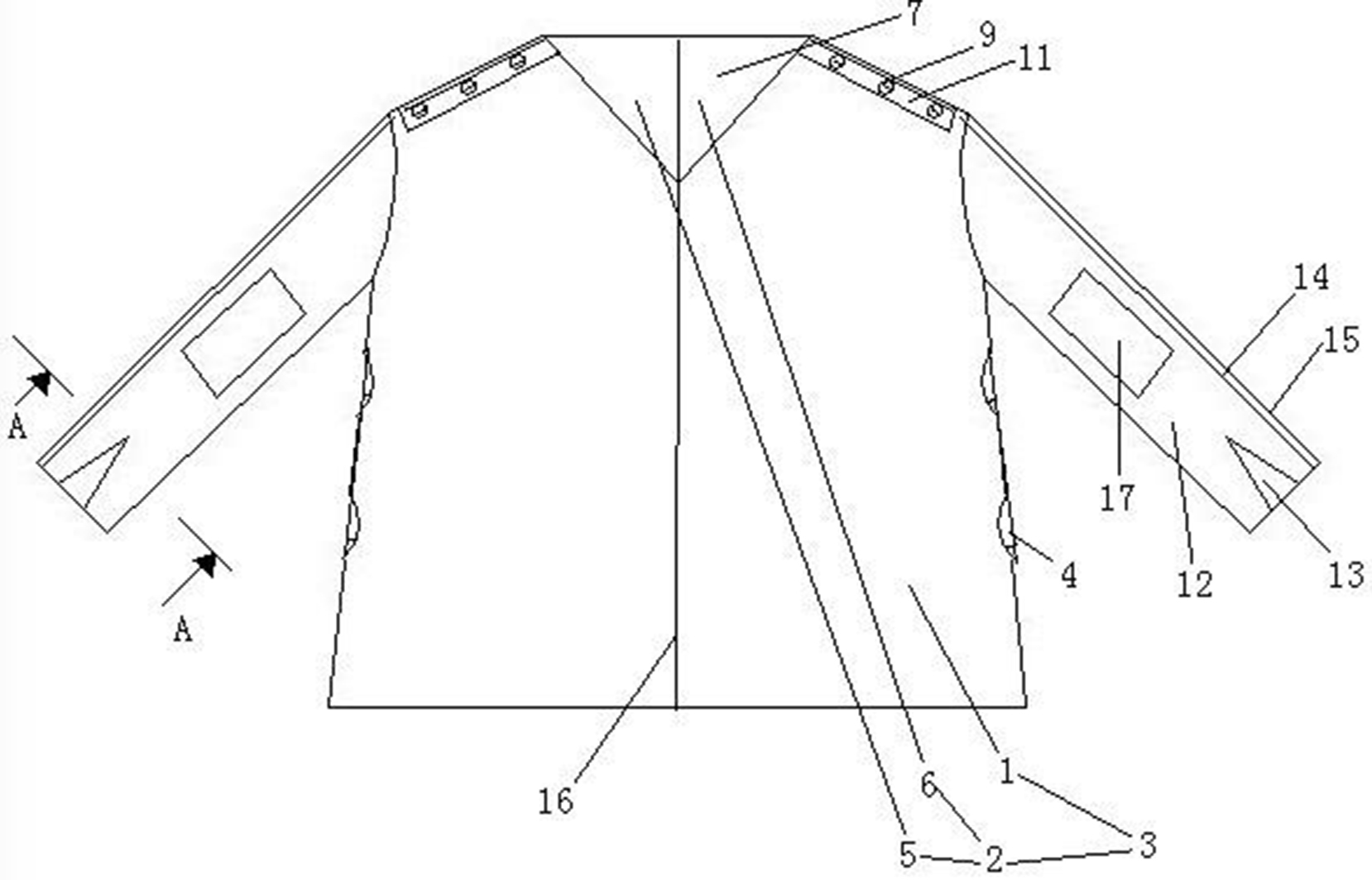
Patients in a prone position wearing the designed gown.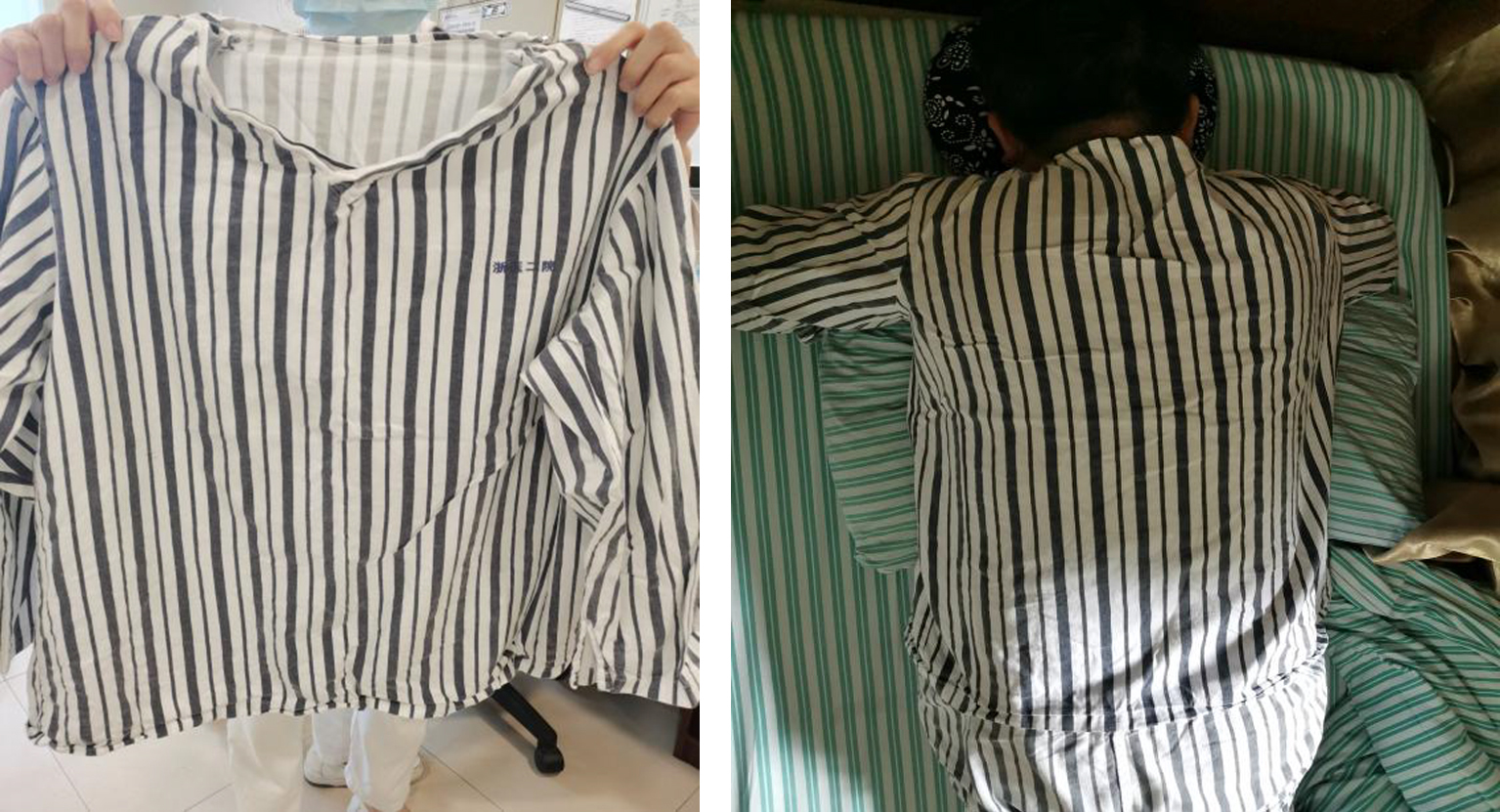
Participants
A non-randomized, concurrent, controlled study was conducted on 106 patients in the prone position after vitrectomy from April to August 2020, one hundred and six patients in the prone position after vitrectomy were selected as the control group, and the patients in prone position were taken as the experimental group, while the patients in the control group were taken as the ordinary patients. There was no significant difference in age, sex, education level and duration of prone position between the two groups.
Evaluation methods
The patients in the experimental group were changed to the patient’s clothes in the prone position when they returned to the ward after ophthalmic vitrectomy according to the surgical method, and the patients in the control group were changed into the ordinary patient clothes until they were discharged from the hospital. The two groups of patients were compared on the day after surgery (or the day of discharge) about their wearing of the patient’s uniform or the normal patient’s uniform in the prone position using a questionnaire.
Patient comfort survey
According to the patient’s chief complaint and chest and abdomen compression, a comfort score was designed to evaluate the patient’s comfort. The contents of the questionnaire included the comfort of the patient’s clothes, suffocation and breathing, the pain of button pressing on the skin, and the redness and swelling of the skin. The evaluation was divided into three levels: agree, slightly agree, and disagree.
Nursing staff satisfaction survey
A self-made questionnaire was used to evaluate the nursing staff’s satisfaction with the patient’s clothing in the nursing process. It is convenient to know the surgical method of the patient, and whether it is convenient for postoperative treatment and nursing. The assessment is divided into three levels: agree, slightly agree, and disagree.
Statistical methods
In this study, SPSS 23.0 statistical software was used for data analysis. Enumeration data were expressed by case, and statistical analysis was performed using the
Results
Demographic data of patients in control and experimental groups
The patients in the experimental group with a newly designed gown for the prone position after the operation; the patients in the control group used the ordinary patient’s suit. There were no significant differences in age, gender, educational level, and duration of prone position between the two groups (Table 1).
Comparison of age, gender and educational level between the experimental group and the control group
Comparison of age, gender and educational level between the experimental group and the control group
Note: 1)
The patients in the experimental group were significantly more comfortable with the patient’s suit in the prone position than the normal patient’s suit in the control group (
The comfort evaluation of the patient clothes by the patients in the experimental group and the control group
The comfort evaluation of the patient clothes by the patients in the experimental group and the control group
There was a significantly higher level of satisfaction for the nursing staff in the experimental group (
Comparison of nursing staff satisfaction between the experimental group and the control group
Comparison of nursing staff satisfaction between the experimental group and the control group
With the increasing aging of the population, the incidence of diabetes is gradually increasing. Diabetic retinopathy is a common complication of diabetes [10]. If left untreated, rhegmatogenous retinal detachment is a blinding disease. Surgical treatments include scleral buckling, barofixation, and vitrectomy [11]. All treatments use intraocular gas tamponade to prevent fluid flow into the subretinal space and promote retinal adhesions [12, 13]. During the first postoperative week, patients may be instructed to maintain a specific head position to displace subretinal fluid or maximize exposure to gas and retinal fissures. The nursing of special ophthalmic positions after surgery is very important, which directly affects the prognosis of patients [14]. Due to the special requirements of eye care after surgery, the patient needs to take a long-term supine position during the rehabilitation process [15], which brings inconvenience to the comfort of the patient and the nursing work of the medical staff. In particular, the button position and the design position of the opening and closing part of the patient’s clothes directly affect the comfort of the patient lying on his back for a long time and the convenience of nursing work.
Based on the above problems, this study designed a patient suit for prone position patients, including a top body surrounded by a front piece and a back piece and used to cover the patient’s torso. The detachable connection structure includes buttons and button holes, and the buttons are connected to the front. On one of the front and back panels, button holes are provided on the other of the front and back panels, and the shoulders are provided with an undressing opening for the patient through to the neckline. This new design not only solves the problem that the button presses the patient’s chest and abdomen when the patient is lying down but also provides convenience for the patient to put on and take off the patient clothes in cooperation with the medical staff and nurses. In our survey results, the comfort of the patient suit in the prone position was significantly higher than that of the normal patient suit in the control group, and the patients in the experimental group felt suffocation and affected breathing, and the pain and redness of the skin were significantly reduced. During the treatment process, the patient’s emotional response to the hospital’s comfortable environment can affect the treatment effect and recovery [16]. Previous studies have shown that factors such as the design, arrangement, and spacing of the patient’s gown can affect the patient’s positive emotions and contribute to the healing effect [17]. Therefore, the new design for patients in a prone position improves the comfort of a long-term supine position after ophthalmic vitrectomy, which is expected to help improve the positive emotions of patients. At the same time, the use of the newly designed gown for the prone position reduces the concerns of the medical staff about the compression of the buttons on the front of the patient’s chest, pain, and even pressure ulcers on the skin of the chest and abdomen, and it is convenient for the medical staff to know the operation method of the patient, and it is also more convenient for postoperative treatment and care. The satisfaction and positive attitude of medical staff can directly affect the quality of nursing services they provide [18, 19], so the use of the gown designed for the prone position can improve the work convenience and work quality of nursing staff.
Conclusion
The newly designed gown for the prone position in this study can improve the comfort of patients in the prone position after an ophthalmic vitrectomy. The invention solves the problem of poor comfort of the existing patient gown and alleviates the pain caused by chest buttons pressing against the skin of the open-buttoned design, which is expected to reduce the likelihood of pressure ulcers in thin-skinned, diabetic, or elderly patients. At the same time, it also reduces the concern of medical staff about the skin condition of the patient and has little interference with the administration of treatment. The newly designed gown for the prone position patients not only guarantees the comfort of patients during rehabilitation after ophthalmic vitrectomy but also improves the work quality of medical staff. In future research, we will explore whether this design can be applied to patients with different diseases to improve their postoperative quality of life.
Funding
The authors did not receive any financial support.
Ethics statement
This study was approved by the ethics committee of the Second Affiliated Hospital Zhejiang University School of Medicine (2020[637]). Patients whose data or images are included in the publication have consented for all images and (clinical) data included in the manuscript to be published.
Availability of data and materials
All data included in this study are available from the corresponding author upon reasonable request.
Footnotes
Acknowledgments
The authors are most grateful to the remote management team for their enthusiastic participation and all participants.
Conflict of interest
The authors declare that there are no conflicts of interest associated with this manuscript.