Abstract
In recent years, drug-abuse problem is growing by leaps and bounds all over the world. The master minds spearheading its proliferation among the youth are difficult to identify, so drug-abuse case has become a hard nut to crack even with the help of best international experts in forensic science and criminology. Because most nations have tightened their controls on traditional drugs, the younger generation is now hooked onto new-type drugs: 1-(3- trifluoromethylphenyl) piperazine (TFMPP), 1-(3-chlorophenyl) piperazine (mCPP) and other new piperazine-drugs, acting as hallucinogens like ‘ecstasy’, are being consumed by vulnerable masses all over the world. However, only few research studies have focused on developing highly effective detection methods for TFMPP and mCPP in biological fluids; the number of detection methods for these new-type drugs is almost nil in China. Therefore, it is difficult to detect and prevent drug abuse cases related to piperazine drugs in China. There is an urgent need to develop some simple, fast, and reliable methods for detecting piperazine-drugs in vulnerable masses. Thus, the development of novel detection methods with high sensitivity and selectivity is a difficult task for the officials working in the department of forensic science in China. In this work, a new method was developed for the detection of piperazine derivatives: it was performed under the various specific conditions required for conducting chromatography and mass spectrometry analysis. With this novel method, TFMPP and mCPP was successfully detected with high accuracy in various biological samples. By comparing the purification effect of different solid-phase extraction columns for TFMPP and mCPP in biological fluids (urine and blood), we confirmed the validity of the novel method. In addition, this method has good linear relationship and a low detection line when GC/MS was performed for detecting TFMPP, mCPP in the biological fluids (urine and blood). It is a simple, reproducible method that is highly specific in the detection of piperazine-drugs. Thus, it is indeed a reliable method in forensic science.
Keywords
Introduction
Although the global economy has grown by leaps and bounds in the past few decades, it has also led to some serious malaise among vulnerable masses, such as youth and children. Drug abuse issues have also increased tremendously all over the world in recent times, and these menacing issues can seriously diminish the social security of any country within a very short period. People who are addicted to drugs are not just unproductive but they are also usually involved in public-order crimes. In recent years, youngsters have got hooked onto new-type drugs, such as ‘party pill’, ‘Club drugs’, etc. [1]. In new-type drugs, the most common psychoactive drug substances are as follows: synthetic cannabinoid, phenylethylamine, synthetic kathy ketone, tryptamine, and piperazine. Our aforementioned pharmacological analysis is based on the official statistics in 2012 (Fig. 1). In particular, piperazine derivatives are representative substitutes of ‘ecstasy’ [2]. In recent years, the incidence of piperazine drug abuse has been reported in many countries such as New Zealand, America, and Japan; however, a new uniform framework of law has not been introduced till date to prevent the rampant use of new-type drugs, so youngsters get easily hooked onto these drugs and the menace seems to be uncontrollable these days [3]. Meanwhile, many research studies today are focusing their investigation on N phenyl piperazine in order to understand the pharmacological activity of this compound [4, 5, 6, 7, 8, 9, 10, 11]. Both TFMPP and mCPP are N-phenyl-piperazine derivatives; these compounds are drugs with mind-altering nature. Therefore, they are included in the class of illegal drugs.
The new psychoactive drug is confirmed in 2012 [24].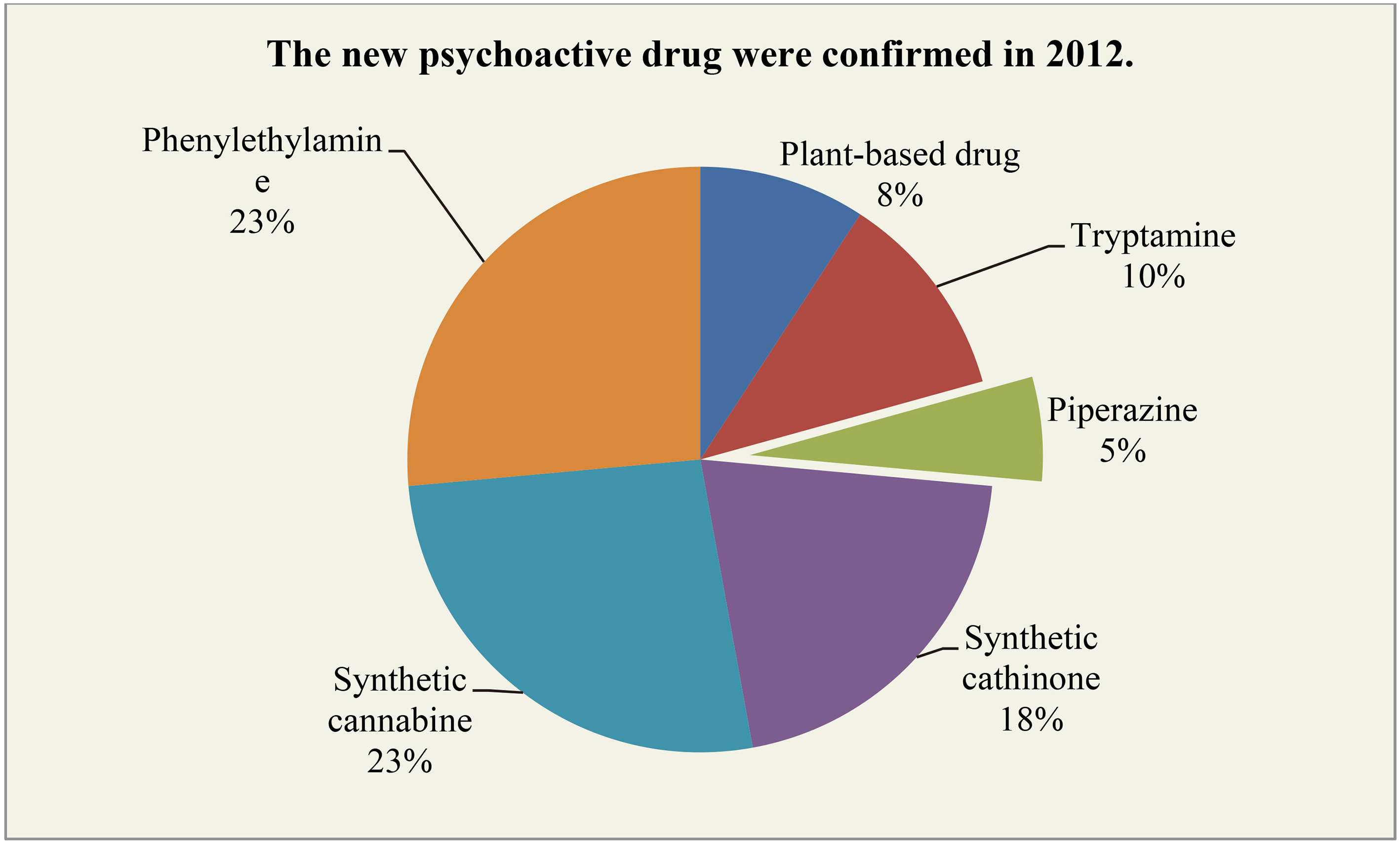
To investigate and verify cases related to incessant consumption of new-type drugs and to detect addicts of new-type drugs, GC/MS is one of the most useful means of detection and so it is used extensively in the latest techniques of drug analysis. In forensic diagnosis, the blood and urine of drug addicts can be used to analyze and diagnose cases of new-type drug consumption [12]. The drug lasts for several hours in the human body; however, the half-lives of different drug abuse are also different [13, 14, 15, 16], so it is very difficult to detect them. During biological fluid testing, the following two steps are used to determine the content of drugs: i) purification of extractand ii) analysis of testing. Presently, one of the most difficult problems in forensic science is the inability to complete the detection of drug substance rapidly, because the drug substance has a complex composition and biological fluids are the most common interfering species during detection. The most common methods of pretreatment are protein precipitation, liquid-liquid extraction (LLE), and solid-phase extraction (SPE). On the other hand, the methods used in the detection of TFMPP and mCPP are as follows: HPLC/V, HPLC/FD, LC/MS, CZE/UV, etc. [17, 18, 19, 20, 21, 22, 23]. However, capillary zone electrophoresis has complex operations, and the related results do not have an appreciable accuracy. In this case, the results are not accurate enough to meet the standards of forensic science. This is because the sensitivity and reproducibility of UV detector is not good enough to detect TFMPP and mCPP in biological fluids. Therefore, our objective was to determine whether GC/MS was suitable for the detection of drugs in this study.
Gas chromatography-mass spectrometry (GC/MS) is the most commonly used technique in China. Moreover, GC/MS is an industry standard method used for detecting toxic substances in many biological fluids. The principle of gas chromatography is based on the distribution order of characteristic peaks of each component of a given solution; these components get separated according to their distinct adsorption capacity in the column. Thus, the analyte is successfully isolated from the sample and subjected to further investigation. Subsequently, the analyte is separated by protonation, and mass spectrometry provides information about the mass-charge ratio of the ions obtained by protonation. Thus, GC/MS exhibits high separation efficiency by effectively separating all the components of any given sample. Furthermore, owing to the large database of mass spectrometry, the integrated technique of GC/MS also ensures that the identification results are exceedingly high in most cases. All the aforementioned observations establish that GC/MS is a suitable technique for conducting qualitative and quantitative analysis of most drug poisons. With this integrated method, piperazine derivatives, such as trifluoromethylphenylpiperazine (TFMPP) and meta-chlorophenylpiperazine (mCPP), can be detected without derivatization [25]; the method’s results have precision that is usually greater than 20% provided the limit of detection is 5
In this paper, previous jobs were further confirmed and depended [27, 28]. Gas chromatography mass spectrometry (GC/MS), a popular method of every analytical chemistry laboratory, is investigated to determine whether it can be used as an instrument analysis method for the detection of TFMPP and mCPP. Moreover, researchers have also comprehensively studied all the possible methodologies of this method, and they have suggested instrumental improvements subsequently.
Validation of the method
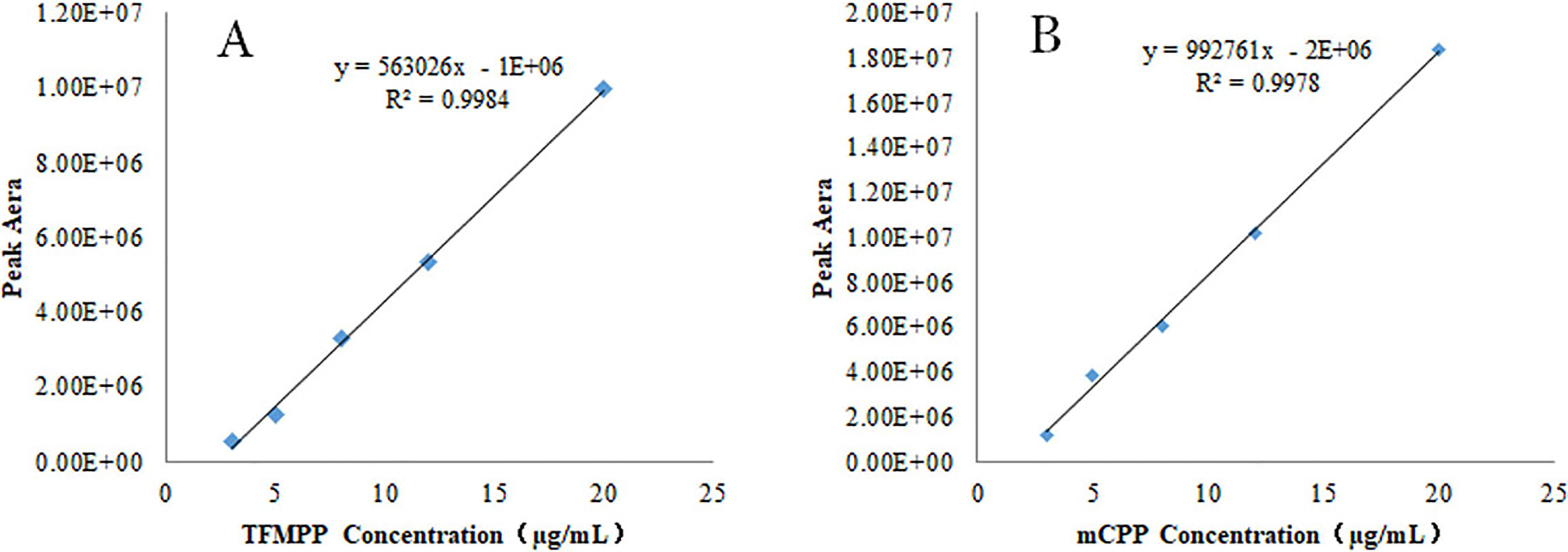
Calibration curves
The standard working solution TFMPP-mCPP mixed solution (from “4.4.2 Sample pretreatment”) was prepared and diluted with methanol to form solutions of the following concentrations: 100
Standard Curve Equations of TFMPP and mCPP standard derived by GC/MS analysis
Standard Curve Equations of TFMPP and mCPP standard derived by GC/MS analysis
Table 2 presents the limits of detections (LODs) and limits of quantifications (LOQs) for the TFMPP and mCPP standard solutions. Interestingly, same values were observed for both the substances.
LOQs and LODs of TFMPP and mCPP by GC/MC
LOQs and LODs of TFMPP and mCPP by GC/MC
In this experiment, the quality control samples (QC) included only TFMPP and mCPP standard solutions with an intermediate concentration (10
Precision study on 5 replicates
Precision study on 5 replicates
Calibration curve for TFMPP (A) and mCPP (B) standard working solution.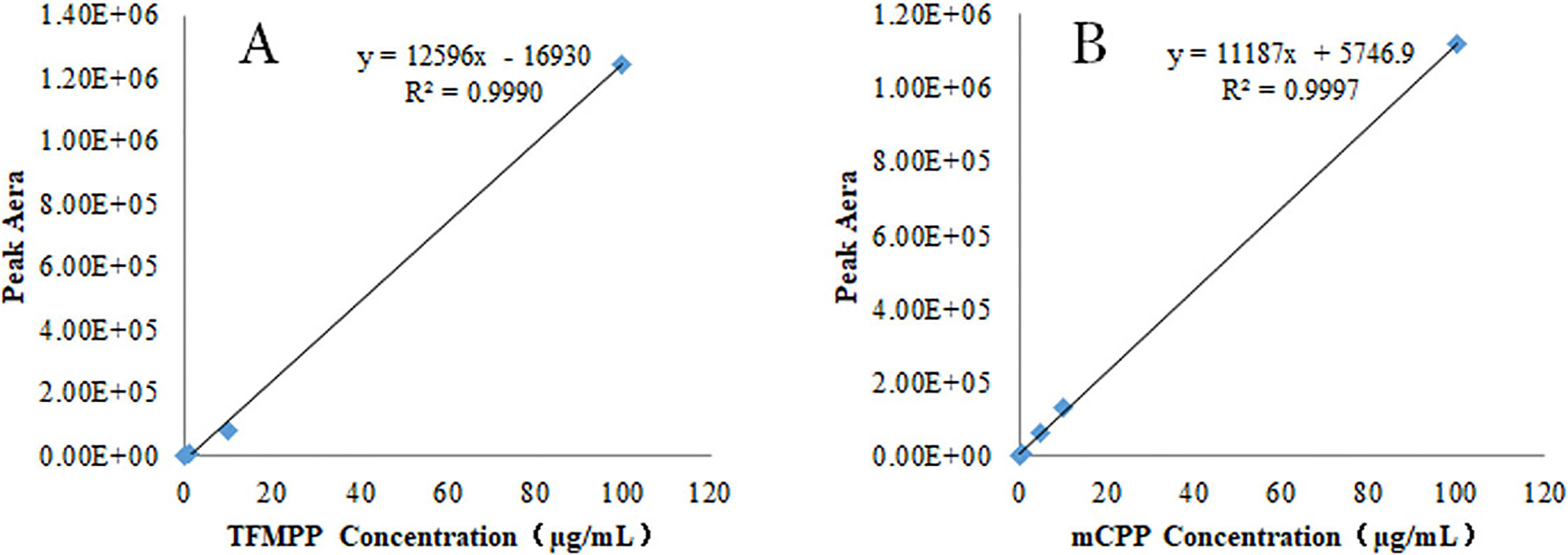
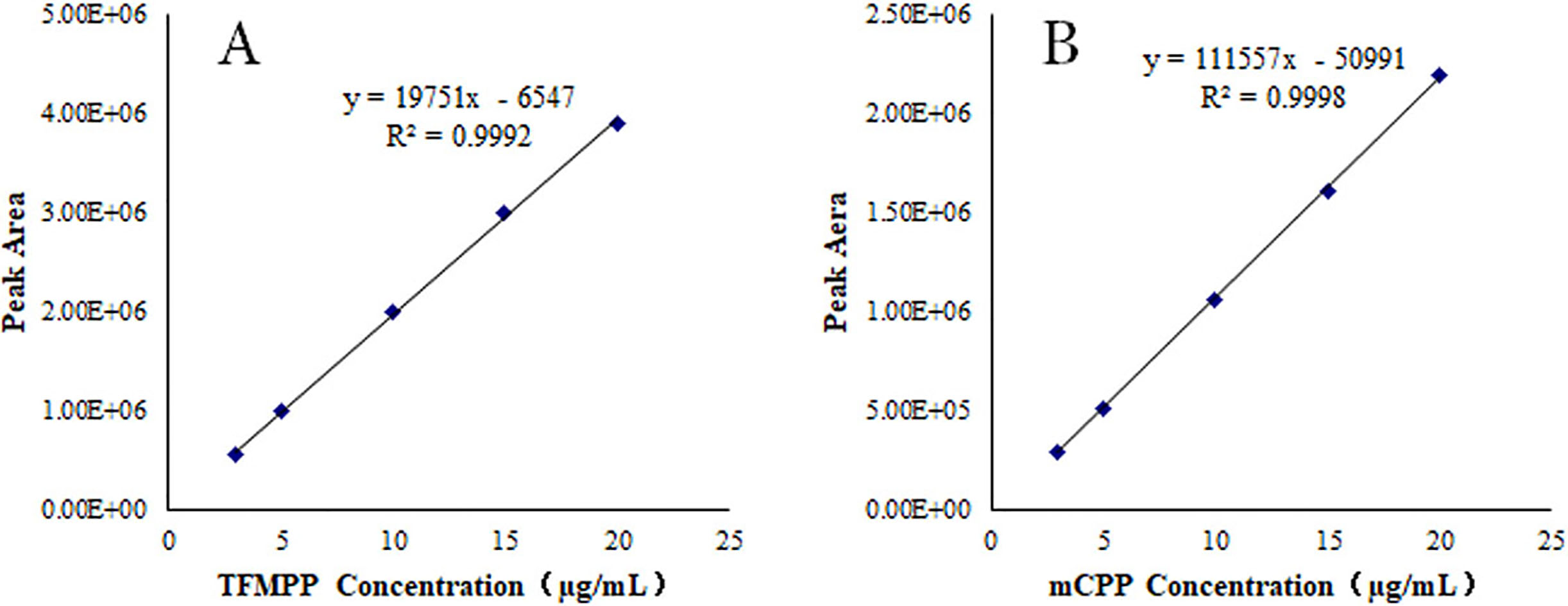
Standard curve, limits of quantification, and detection
The standard curve was plotted after analyzing urine samples in parallel; these urine samples contained different concentrations of TFMPP and mCPP. Three replicate analyses of each urine sample were performed to determine the reproducibility of results. In this experimental analysis, 0.9 ml aliquot of five samples was taken from the blank urine. Then, mixed standard solutions of 0.1 mL were prepared using different concentrations of TFMPP-mCPP mixed solution (from “4.4.2 Sample pretreatment”); the various concentrations of TFMPP and mCPP were as follows: 1
Standard Curve Equations and LOQs-LODs of TFMPP and mCPP in urine matrix derived by GC/MS analysis
Standard Curve Equations and LOQs-LODs of TFMPP and mCPP in urine matrix derived by GC/MS analysis