




Abstract
The environmental pressure, CO2 emissions (including embodied energy) and delivery risks of our digital infrastructures are increasing. The exponentially growing digitisation of services that drive the transition from industry 4.0 to industry 5.0 has resulted in a rising materials demand for ICT hardware manufacturing. ICT devices such as laptops and data servers are being used on average for 3 and 4–5 years respectively (van Driel (2020)), while research shows that they should last 7 years before replacement (Journal of Cleaner Production
Introduction
Facing global issues surrounding resource scarcity, energy consumption and carbon emissions, and ever growing waste streams, there is an increase in societal and governmental focus on solutions that rethink the current linear economic structure. One such solution that has seen legislative progress over the last decade in particular is the idea of a circular economy (CE) [68], commonly understood to be a model through which materials that were previously disposed of as waste are re-entered back into product life-cycles through operations (or strategies) such as reuse [116], recycling [2], remanufacturing [121], and repurposing [79]. Figure 1, which is an adaptation of the CE Butterfly1

Circular strategies for products and materials [12].
Information and communications technology (ICT) such as laptops, is a major stream of focus in the CE due to its increasing impact on the environment, society, and the economy [7,34]. The increasing digitisation and unprecedented amount of data that is generated on a daily basis has resulted in ICT hardware such as laptops being used on average for 3-4 years [113], while research shows that they should last 7 years before they are replaced [13]. Based on this, at its current state, the ICT sector is not sustainable as there is a discrepancy between the economic lifetime and technical lifetime of ICT hardware. The result is short lifetime replacement cycles that increase the carbon footprint. Further, it is responsible for 2.1%–3.9% of the global greenhouse gas emissions [42]. The composition of ICT hardware alone, made up of varying combinations of critical raw materials, makes an interesting and important case for the growing CE [115]. Access to these materials is often fraught with complications relating to limited natural supplies, difficult geographic deposit locations, and precarious political agreements. The issues surrounding ICT hardware continues to follow the product through its life-cycle impacting the health and safety of mining communities and their surrounding environments, intense energy consumption (see [55]) and CO2 emissions during manufacturing, further impacting environmental and human health at end of life as a hazardous waste, and resulting in the loss of financially and otherwise valuable materials through disposal and inefficient recycling technologies. The CE seeks to address these issues through both product lifetime extension, i.e., keeping the materials in their original product longer, closing resource loops, and through the reuse or re-purposing of products, product components, and materials.
Based on a report4
In organisations many departments (e.g. sales, IT, finance, delivery) are involved in the decision making-process for the implementation of information technology (IT) infrastructures. ICT experts provide technical assistance, while CE experts develop sustainability strategies that procurers can follow. However, the explanations for each decision (and the data for it) often remain within specific expert groups. This contributes to forming knowledge silos, which also leads to lack of decision making transparency and data traceability. Knowledge exchange should be better facilitated in an understandable for all expert groups manner so that both technical requirements and sustainability factors are considered during ICT procurement and maintenance.
Data’s findability, acessibility and interpretation are also common barriers when data sharing needs to be facilitated between companies, suppliers and manufacturers. For example, the production of an iPhone involves more than 200 component suppliers, spread over 43 countries and 6 continents [4]. Each supplier has specialised knowledge about their products such as their material composition, design and hardware-software dependencies. Such information is rarely available to end users and decision makers (procurers). Inaccurate, incomplete and unavailable data about an ICT device can lead to misleading and incorrect sustainability recommendations during processes such as life cycle assessment (LCA) [111]. Several studies, namely [70,95,104] confirm that data’s availability, format standardisation and quality are some of the key challenges for LCAs. Motivated by the lack of data availability, studies such as [7,66] have made progress in publishing online ICT (e.g. laptops, tablets) material datasets in the form of a bill of materials (BoMs). The datasets present material data for a specific component or for a device as a whole and do not follow a standard format that can easily facilitate their federation and interpretation. Furthermore, there is data available for only several laptop brands (e.g. Dell, Apple and HP) with models manufactured between 1999–2011, which can be considered as already outdated.
Last but not least, establishing CE standard(s) could also help to derive clear requirements for what specific ICT data should be made available, to whom under what circumstances. ICT devices such as a laptops comprise of multiple components (e.g. display screen, keyboard, base panel, top panel, cooling fan, random-access memory (RAM), hard disk, palm rest assembly, battery, hinges, speaker, optical drive, antenna). Each component has sub-components such as sensors and specific material composition. When a product needs to be refurbished, repaired, remanufactured it has to go through multiple processes (e.g. hardware and software testing). Testing can be standardised via tools such as Aiken6
These are also factors that need to be considered when developing software that aims to support ICT decision making in cases such as predictive maintenance and sustainable procurement recommendations. Further, with the transition from industry 4.0 to 5.0, having meaningful data is essential as it can not only drive the automation but also the optimisation of services (in terms of computational costs and even energy consumption [112]). As discussed in [63], to gather and process such data, collaboration between different domain experts from the ICT, materials and sustainability domains is needed.
FAIR principles, ICT challenges and the Semantic Web
The Semantic Web can provide a findable, accessible, interoperable, reusable (FAIR) solution to these challenges in the form of ontologies that can technologically drive the data FAIRification [61] process (see Table 1). Through the years, research such as [14,40] has shown ontologies’ ability to not only organise and interconnect knowledge within organisations but to also make it accessible and interoperable across machines. Due to their ability to represent dynamic contexts in a machine-readable format ([15,58]), ontologies have been widely utilised as knowledge organisation schemas in diverse domains such as cultural heritage as discussed in [36,41]. Further, reseach has shown that ontologies can successfully assist and even improve machines’ decision making in scenarios such as recommendations [18,25,120], legal compliance [23,39,69,108], predictive maintenance [21,22,80,81], tourism [65], chemical safety and drug design [91] and intelligent surveillance [33]. This is due to ontologies’ ability to enrich data with context and provide information in a machine-readable format. Further, both organisations and individuals can benefit significantly from the utilisation of ontologies, which help establish common understanding (i.e. unified vocabulary of real world concepts and their meaning) of a domain. Technology-wise, when it comes to facilitating ICT data sharing for the CE, more and more experts have been utilising Semantic Web technologies such as ontologies. As a start, the focus has been on building simpler knowledge organisational systems such as taxonomies. However, there has been a rise in building and utilising more complex linked data models such as ontologies and knowledge graphs (see [5,78,98]). “Linked Data can function as an exchange medium for the CE driving the “push and pull” between diverse industry resources.” [99]. However, there is a lack of systematic semantic analysis (i.e. discussion on the mechanisms used for building the model, the followed linked data principles, the scope and guidelines towards their reuse) of the existing ontologies for ICT data and materials and their relation to the CE domain.
This paper presents a systematic survey and analysis of existing semantic models (e.g. ontologies, taxonomies) for ICT devices such as laptops, materials and the CE. The main use case that motivated our work is the increasing use and manufacturing of laptops, which are often disposed of (e.g. replaced) earlier than needed (e.g. due to planned obsolescence [1,52]) and the associated ecological footprint in terms of CO2 and e-waste. The paper is aimed at motivating and assisting ontology engineers in selecting ontologies (e.g. classes, sub-classes, object and data properties) for reuse or extension, when building semantic technology-based tools for the CE. Further, we present an overview of tools in the domain that utilise semantic technologies. By analysing the state-of-the-art, we provide guidelines for building and utilising ontologies for advancing the implementation of the CE. We believe that our work can help both CE experts and ontology engineers as it provides an overview of existing domain ontologies, information on how they were built, their limitations (Section 4), and how they can be reused (Section 5). Further, we provide examples of research work (Section 4.4) that showcases the successful utilisation of ontologies within CE software tools.
The rest of the paper is structured as follows. Section 2 outlines the followed methodology, while Section 3 presents a set of requirements used for the selection and analysis of relevant existing semantic models. Section 4 presents an overview of existing semantic models in the ICT, materials and CE domains. The section also presents examples of CE tools that utilise ontologies. The analysis of the related work is presented in Section 5 followed by a discussion in Section 6 and the conclusions in Section 7.
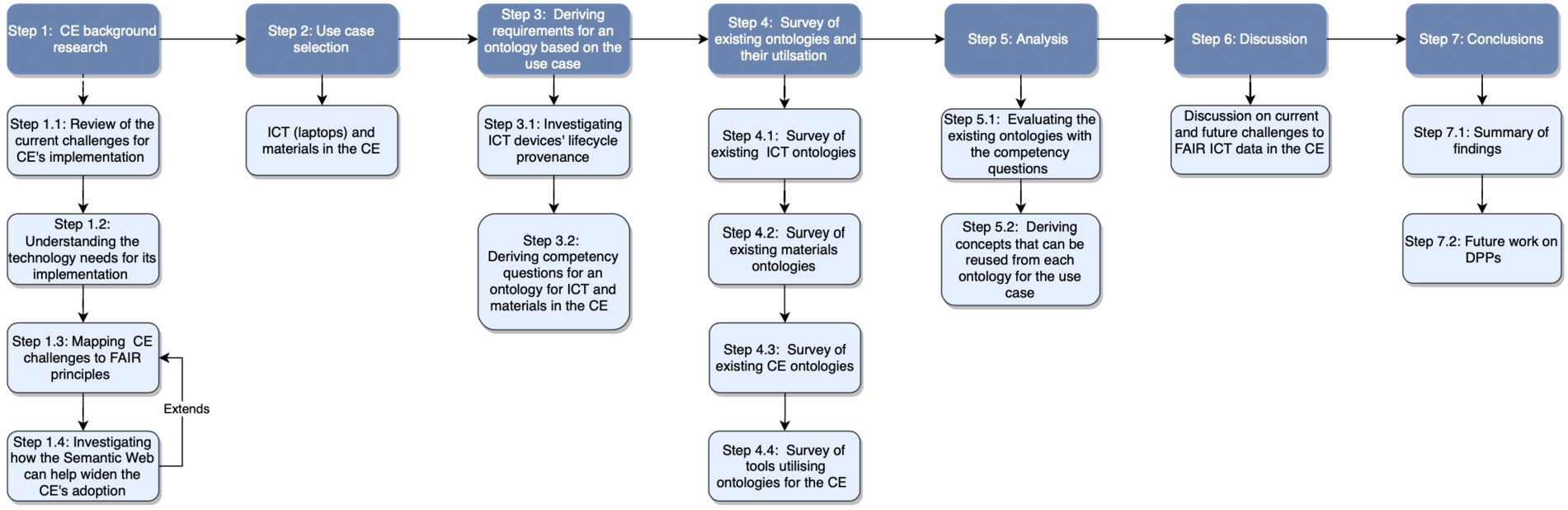
Survey methodology.
To compile this paper, guided by our previous survey in the Semantic Web domain (see [72]), we undertook several steps which are presented on Fig. 2. We began with background research into the CE to better understand its scope, goals and current level of implementation (Step 1). Next, based on the authors’ diverse expertise (computer science, CE, industrial design and sustainability), collaboration with refurbishment, ICT and CE domain experts and interviews with industry and government representatives (details in [84,85]), we reviewed some of the current challenges/barriers that limit the further adoption of the CE (Step 1.1). The collaboration has been done in the scope of the Circular Resource Planning for IT (RePlanIT)7
The main sources for this survey were peer-reviewed scientific publications in the CE, ICT and Semantic Web domains, which we identified via Google Scholar,8
To illustrate the complexity of interlinking the ICT, materials and CE domains we present a graphical representation on Fig. 3 of and ICT device’s life-cycle in terms its life-cycle provenance. An ICT device (e.g. a laptop) can be represented in terms of the components that it is comprised of. Each component has provenance information, which is a record of its material, sustainability and physical properties and changes in them that have occurred as a result of an implemented CE strategy. ICT and materials provenance and lineage is vital for supporting product life-cycle assessment [8,62], establishing responsibility along the supply chain and for implementing CE strategies such as predictive maintenance.

Conceptual model for an ICT device’s life-cycle history (see Table 8 for details).
Based on this and on our collaboration with the refurbishment, sustainability and CE experts during the RePlanIT7project, we present a set of competency questions (see Table 8 in the Appendix) that can be used as a starting point (or a guideline) when building an ontology for ICT’s and its materials’ lifecycle management in the CE. We have also used the competency questions to evaluate the relevance of each existing ontology (Section 5) with regards to our use case. The evaluation results can help to better understand which semantic model and which specific concepts from it can be reused to build a common shared vocabulary for ICT in the CE. Table 8 presents the competency questions (with focus on laptops) organised in six categories: (i) ICT devices, (ii) ICT device’s components, (iii) physical properties of ICT devices and their components such as weight, age, warranty duration, usually (specified by a manufacturer but can be updated after a CE strategy such as refurbishment is used) (iv) ICT sustainability properties related to the environmental impact of the device, (v) material properties of ICT devices and (vi) CE strategies that can be adopted. For example, the first category (ICT devices) comprises of questions such as “What is the type of the ICT device?, What is the brand of the device?, When was the device assembled?, What are the components of a device? etc.”, which assist in building a general semantic representation of a device. The next categories (e.g. ICT device component) focus on lower-level questions (e.g. “What is the serial number of the component?, What is the status of the device’s component? Has it been reused, remanufactured, or refurbished before?, What is the brand of the component?”) and help define a more granular laptop representation (one can answer the questions for each component of a laptop). To further support the ontology engineering process, we have derived the key concepts that an ontology should represent to answer each question (see Table 8 in the Appendix).
This section presents an overview of existing semantic models in the ICT, materials and CE domains. Specific focus is put on ICT devices such as laptops and their hardware components. An overview of the existing CE tools that utilise semantics is presented as well. For each ontology, we presents its (i) purpose and scope, (ii) modelling language, (iii) conformace to best practices for ontology engineering, (iv) level of reuse of existing ontologies, (v) availability (open-access or private), (vi) limitations and (vii) possible applications.
Semantic models for ICT
This section presents an analysis of the existing semantic models in the ICT domain ranging from single device-focused ontologies to more generic semantic models such as top level-ontologies.
ICT energy resource management ontology by Daouadji et al. [31]
Daouadji et al. [31] present an ICT resource management ontology for the energy efficiency domain. The ontology, which was built with the Resource Description Framework (RDF),20
Motivated by the technological advancements of government-supporting tools and the increasing need for data governance, Lampathaki et al. [75] propose a taxonomy that helps categorise ICT research. Being developed in the context of the CROSSROAD21
The lack of standardisation in terminology in the ICT domain has also inspired Gower and Andrich [50], who propose a taxonomy for ICT devices’ features in the assistive technology (AT) domain. The taxonomy comprises of two main categories - features and clusters. Features represent different measures (e.g. weight, length) and attributes (boolean values) of ICT devices, while clusters are a combination of several features. Some of the modelled clusters, which help represent knowledge about an ICT device in detail, include browsers, licenses, price, visualisation and energy type. The taxonomy has been successfully adopted by the European Thematic Network on Assistive Information and Communication Technologies (ETNA)22
Dhingra and Bhatia [35] discuss the different requirements and tools that are available for building ontologies and propose three ontologies in the laptop domain, which represent laptop reviews, specifications and sellers. In the laptop review ontology, a laptop can be associated with specific advisors in the form of customer feedback, rating and reviews, which were collected from different media sources (i.e. newspapers and magazines). The laptop specification ontology models laptop specifications such as audio devices (microphone, stereo speakers), brand, camera, dimensions, display size. The laptop seller ontology, on the other hand, focuses on the selling process itself (from purchase to delivery). Different payment methods are modelled as well. Although the work in [35] follows the ontology engineering methodology from [88] it is not openly available, there is no mention of the specific object properties between the classes, how all three ontologies connect and if any existing ontologies were reused. Namespaces are not presented as well, which limits the reuse of the work. The evaluation of the ontology with a set of competency questions, which were translated into Description Logic (DL) queries, showed that it is expressive enough to be used in use cases such as buying of laptops.
ICT taxonomy by Inaba and Squicciarini [60]
By following the International Patent Classification (IPC)23
The ontology is the main semantic model used by the oneM2M25
One of the earliest and most expressive OWL ontologies that represents smart devices is DogOnt [17]. The ontology, which was built for the domotic domain, represents smart devices, their location, capabilities and technology-specific features and states. With this level of detail, DogOnt can assist ontology engineers in modelling complex Intelligent Enviroments (IEs) and devices such as home and office appliances that comprise them. However, ICT is not the main focus of the work, specific switches (e.g. on off, rocket and level control) and sensors (e.g. temperature, CO2, humidity and light detection) are modelled as well. Several ontologies such as the Semantic Sensor Network (SSN) [26], Dublin Core,27
Similarly to [35], Ayundhita et al. propose an ontology for the laptop domain aimed at assisting a conversational recommender system (CRS) in making better product recommendations. The developed ontology, which builds upon the work in [11], models three main laptop-related concepts - functional requirements, the product itself and the products’ specification (gathered from its manufacturer). Several types of products such as notebooks and ultrabooks have been modelled. The instances of these classes can be categorised as high, mid and low-end products based on product specifications such as RAM memory. The ontology is not open access and it is not clear if the authors followed Semantic Web standards such as OWL and RDF when building it. However, the authors have shown its successful utilisation and improvement of the accuracy of CRS’s recommendations.
High-level ontology network for ICT infrastructures by Corcho et al. [29]
To solve some of the challenges within ICT services such as lack of common understanding, heterogeneous data and the presence of knowledge silos, Corcho et al. [29] propose a network of 9 interconnected ontologies that model different entities (organisations, data centers), hardware and software components and network security. These ontologies fall under a top-level ontology which has the specific goal to present a high-level model of ICT component configurations, resources and the relationships that hold between in a machine readable format that supports ICT service management. The ontology was built by following the Linked Open Terms (LOT) methodology with OWL. Dublin Core and the Simple Knowledge Organisation System (SKOS) [86] have been reused. The ontology is openly available online32
In addition to the work in [29], Corcho et al. have built an ontology [28] that focuses on representing hardware items related to software development and IT operations (DevOps) infrastructures. The ontology, built with OWL, represents several types of hardware items (e.g. disk, frame, network card, server hardware), server hardware types such as firewalls and switches and characteristics such as bandwith, port, power, disk size that can be used to describe the items in detail. Similarly to [29], concepts from Dublin Core, SKOS, DevOps [29] have been reused. Both the ontology and its documentation are available online,34
Yowe and Astawa [118] recognise the need for information organisation and its machine-readable representation in the ICT domain and prose a laptop hardware-focused ontology. This is one of the few ontologies that represents laptop’s specific hardware components (e.g. processor, screen, types of storage, GPU) and their functional characteristics (e.g. storage size, screen size.) The concepts of brand and price, which can significantly influence one’s decision making when selecting a laptop for procurement or personal use have been represented as well. By far this ontology is one of the few that fit our use case. However, it is not publicly available and has not been documented. According to [118], the ontology has been evaluated in terms of its ability to be used for data annotation and querying. Details on the ontology’s evaluation in terms of its engineering, however, have not been provided.
Summary
Table 2 presents a summary of the overviewed ICT semantic models based on the criteria that was specified in the beginning of Section 4. For each model, the table provides information on its type (taxonomy, schema, ontology), scope and year of last update. We have also reviewed each model’s conformace to best practices for ontology engineering in terms of the followed Semantic Web standard, the model’s availability and the level of reuse of existing ontologies (also noted in the table). Known limitations, current and possible applications for each model are presented as well. The information has been derived from each models’ online documentation and scientific publication and by using the OOPS! [94] pitfall scanner (for the public ontologies). A “–” symbol is used when no information has been found in the resources.
Overview of ICT semantic models
Overview of ICT semantic models
(Continued)
11 semantic models (3 taxonomies, 1 RDF schema and 7 ontologies) have been identified as revelant to the ICT domain. The literature review has shown that the available semantic models vary in terms of the granularity level of the represented knowledge. Some taxonomies such as [50] and [60] are highly expressive (represent numerous ICT-related concepts) and even follow specific ICT standards. However, they have not been implemented into ontologies yet thus their true benefit for machines (e.g. utilisation for decision making) is unexplored. Other models such as the hardware and DevOps ontology [28], DogOnt [17] represent less concepts but are already encoded as ontologies, are openly availabe and ready for reuse. Ontologies such as [29,31,75] focus on representing ICT infrastructures and their management as a whole, while others (see [17,28]) represent specific ICT hardware components and their capabilities. Only 4 of the ontologies [17,28,29,110] are openly available, which allows one to reuse specific namespaces and URIs. Although the rest of the semantic models (taxonomies and ontologies) have been documented in the form of public reports or scientific publications, namespaces and URIs, to support their reuse, are rarely available online. OWL was the most used Semantic Web standard. In conclusion, the analysis has shown that modelling the ICT domain is a complex use case dependent task. The reuse of the existing ontologies, which is currently at a low level, should be encouraged (e.g. making ontologies and taxonomies public).
This subsection presents an overview of semantic models for materials motivated by the existing work that was reviewed in [102]. The importance of ICT and materials in the CE is discussed in Section 1.
MaTOnto by Cheung et al. [20]
Motivated by the increased availability of material data and the lack of its standartisation, Cheung et al. [20] present the MatOnto ontology, which aims to ease data-driven material discovery. The ontology follows the OWL Semantic Web standard and is based on the DOLCE [44] upper level ontology. MatOnto models several categories (ceramic, glass, polymer, metal) of materials, their properies (magnetic, chemical, mechanical, biological) and data measured during the materials’ modelling and evaluation. To model specific scientific activities and experiments related to material discovery several other ontologies have been reused as well. These include the Ontolingua’s Standard Units and Dimensions [51], W3C’s Time,35
Data heterogeneity is also a challenge in the materials domain. In [5], Ashino sees this as an opportunity to create an infrastructure that supports material knowledge exchange. The author presents a materials ontology, built with OWL, that comprises of 7 sub-ontologies related to materials and their properties. The ontologies are organised in three groups - core ontologies, material information and peripheral ontologies. The core ontologies model various materials, processes, properties and the environment. The substances ontology, for example, can represent different substances as either pure or mixture. Each material can be associated with its relevant chemical, thermal and mechanical properties, which are modelled by the property ontology. From an ontology engineering perspective, the naming (or labels) of some sub-ontologies (e.g. core ontologies and peripehrial ontologies) lack consistency. Although several existing ontologies have been discussed, it is not clear if they have been reused and the level of their reuse. The modularity of the ontologies in [5] supports their reuse and extension. However, the ontologies are private and no specific namespaces are presented in [5]. The ontology has been successfully utilised as a way to synchronise material data exchange amongst three different databases and can be informative with regards to the types of properties that can be modelled.
eNanoMapper by Hastings et al. [53]
As part of the eNanoMapper36
project, Hasting et al. focus on the semantic representation of nanomaterials and propose the eNanoMapper37
at
To built the MMOY ontology, Zhang et al. [119] undertake a slightly different approach for ontology engeneering to the existing traditional (manual) ones. The authors utilise the String Matching on Ordered Alphabets (SMOA) [105] algorithm, which extracts existing metallic material related concepts from the Yago40
Developed as part of several European projects (e.g. SimDOME ,42
The BIMMER ontology, built with OWL, is a modular ontology that focuses on representing several domains such as the building, material, energy consumption and weather in order to assist the integration of multiple external data sources for building model generations. Sensor data (e.g. occupancy measurements) has been modelled as well, which is an extension of existing such ontologies. Several ontologies have been reused (e.g. GEO,47
The work of Voigt and Kalidindi [114] presents a materials graph and an ontology based on it that aim to support the fomalisation and merge of knowledge in the domain. The authors follow the suggested material definition in [19] based on which four components (i.e. processing, structure, properties, performance) define a material. Provenance of the material’s process history and process hierarchies can be modelled as well. This is helpful when determining the sequence of process execution (e.g. heat treat, soak, ramp) for each material. The ontology presents the minimum set of concepts needed to model existing and new materials and their dependencies (i.e. relationships that hold between the materials). The ontology has been sucessfully used to generate a materials graph by utilising the dataset from [67]. Although several standards and ontologies have been discussed, it is not clear if the authors have reused any of them. Supplementary materials, including the ontology itself are also available online .49
One of the latest ontologies in the domain is the MDO50
Ihsan et al. [59] narrow the focus of their work down to specific class of materials called crystalline and the commonly encountered disclocations (i.e. “a line-like defect” [59]) in their structure. The main goal of the ontology is to formalise the existing knowledge on crystallines based on their crystallography and to encourage future research in the domain. The proposed ontology has been published online .52
Piane et al. present the MAMBO ontology that semantically represents materials at molecular level to support community’s material development efforts at nanoscale level. In MAMBO, a material has a structure, which can comprise of different molecular units. Each such unit can be modelled down to particle and atomic level. Materials can also be related to measurements and calculations. Existing ontologies have not been reused. Due to its modularity, MAMBO can be easily extended and reused for other domains such as molecular materials, nanomaterials, supramolecular and bio-organic systems as suggested by the authors. More specifically, MAMBO can be integrated with already existing ontologies such as EMMO and MDO. Although the ontology is still in its initial development stages, it is openly available54
By following the same criteria as presented in Section 4.1.12, in this section we present a summary of all findings regarding the state of the art of materials’ semantic models. In the past few years, several material ontologies have been built as shown in Table 3. Apart from, the MMOY [119] ontology, which was built automatically, all other ontologies were built manually by domain experts. This relates to the need for human involvement in the ontology engineering process. Although with automatic methods ontologies can be built faster, they usually lack the human knowledge of the domain, the iterative collaboration between several domain experts and URIs. Regarding the scope of the ontologies, some such as [53] and [93] model materials at nanoscale, while [20] focuses on modelling materials in a generic way. The EMMO [27] ontology, on the other hand, look at materials from a philosophical perspective, while [119] and [59] focus on specific materials and their properties (metals and crystalline materials). As shown in Table 3, most of the ontologies are openly available, which is a good Semantic Web practice for knowledge exchange. Finally, the reuse of these ontologies is also supported by their modular design.
Overview of materials semantic models
Overview of materials semantic models
(Continued)
This section presents an overview of the existing semantic models that represent the CE domain.
CE business models (CEBMs) by Chiaroni et al. [24]
As a result of an in depth analysis of the CE, Chiaroni et al. [24] present a taxonomony for it. The main goal of the taxonomy is to help determine the degree of adoption of the CE based on two factors - customer value proposition and the value network. Product or service price and promotion, features related to them and the degree of circularity have been defined as the most important criteria for business categorisation based on customer value proposition. For the value network, the following variable types have been defined - design for recycling (DfR), design for remanufacturing and reuse (DfRe), design for disassembly (DfD) and design for environment (DfE). Further, three levels of CE adoption have been distinguished, namely linear, upstream, downstream and full circular. Although the proposed taxonomy is used as a framework for the evaluation of the CE’s adoption, it presents CE terminology and processes that can be modelled with an ontology to support machines. The proposed taxonomy is documented in detail but from a business and CE domain expert perspective. Technology utilisation has not been discussed.
CE conceptual model by Sauter and Witjes [99]
Motivated by the potential benefits of utilising Linked Data for data sharing in the CE, Sauter and Witjes present a taxonomy and ontology in [99] for the CE to help standardise product passport data exchange. The developed taxonomy focuses on a retail use case in the CE and on the combination of Linked Data and QR codes. It models resources and actors. Resources can be bio-based or technological, while actors can be organisations and individuals (e.g. designers, farmers, consumers). Each resource has product parts and material composition. Provenance information such as the products’ creation company, certifications (e.g. Fair Trade) and use activities are modelled too. Specific CE stages such as repair, recycling and reuse are modelled as post-use activities related to reverse logistics services. Based on this taxonomy and with a set of competency questions, the authors have proposed an ontology. Discussion about the possible reuse and extension of the Good Relations [54] ontology is present as well. Although, the ontology’s implementation is set as future work, the current taxonomy presents the minimum information that is needed for modelling generic product passports. It can be used as a base ontology that can be extended for more complex use cases.
Circular exchange ontology (CEO) and the circular materials and activities ontology (CAMO)[98]
Following their previous work in [99], Sauter et al. [98] extend the existing CEO ontology and propose the CAMO ontology. Similarly to [74], the NeOn methodology is followed. The CEO ontology, which models agents, activities and referents involved in CE processes has been extended with new concepts (e.g. post-use, reverse logistics, product, resource) that help specify the processes in detail. The updated ontology has been later used for building specific product passports. The CAMO ontology, on the other hand, is modular and focuses on classifying different materials, products and activities [98]. The Place Reference Theory (PRT) has been reused and extended by CEO to model in detail agent and their CE actions. After RDF serialisation, both CEO and CAMO have been used to annotate a small dataset from the Madaster55
Led by the lack of standardisation for the adoption of the CE, Saidani et al. present a set of indicators (in the form of a taxonomy) for the evaluation of its performance. The concept categories that the authors focus on are CE loops, CE implementation, performance and perspective of circularity. For example, the CE loop represents the life-cycle (i.e. maintain, reuse, remanufacture, recycle stages) of a product within the CE, while the CE implementation focuses on the CE level (micro, meso, macro) of its implementation. Several groups of indicators have been defined as well-descriptive, performance, efficiency, policy effectiveness and total well-fare. The proposed indicators have been selected by following specific, measurable, achievable, relevant and time-Bound (SMART) [82] and clear, relevant, economic, adequate, monitorable (CREAM) mnemonics and have been utilised in the macro-based open-access Microsoft Excel56
Following a modular approach Blomqvist et al. [16] present the CEON58
Another recent work is the CE ontology presented in [37], which is aimed at assisting organisations and their staff (e.g. managers) in selecting most optimal suppliers in terms of several factors such as sustainability. To help realise this, the authors have focused on semantically representing five categories of criteria, namely economic, environmental, social, resilience and circular, that can be used to evaluate potential suppliers. Examples of criteria have been defined for each category as well. For instance, circularity criteria include CE awareness and training, CE practices such as repair, refurbishment, recycling, reuse, reduce, while the economic criteria include the cost of a service, type of payments, reputation, warranty, transit time etc. Minimal evaluation of the ontology has been performed with the HermiT reasoner and OOPS!. However, the ontology is not openly available and has not been yet utilised in a real-world setting to truly evaluate its usefulness for decision making.
Summary
Similarly to the analysis in Section 4.1.12, in this section we summarise the findings from the literature review of existing CE semantic models (see Table 4). Our survey has shown that there is a limited number of studies available. Most of them present taxonomies based on specific use case analysis and standards. The provided CE terminology and process information from [24] and [97] can be used to define an initial set of competency questions for ontology engineers. We were able to identify 3 ontologies for the CE (see [16,37,98]). The work in [98], specifically the extended CEO and proposed CAMO ontologies, provide a generic data model down to material level. However, specific types of products and materials, which can be critical have not been modelled. The CEO and CAMO ontologies are no longer accessible, which is a barrier to their current reuse and possible extension with ICT ontologies such as [17,28,29] and material ontologies such as [5,114,119]. The CEON ontology network, on the other hand, is publicly available and provides a high-level coverage of a product’s lifetime in the CE. CEON can be extended with more domain-specific ontologies as well for capturing the lifetime of specific ICT devices such as laptops and their materials in the CE.
Overview of CE semantic models
Overview of CE semantic models
Online resources (
This section presents an overview of software tools that utilise ontologies to aid the further adoption of the CE. Common applications include building DPPs, supporting CE decision making in the IoT domain and recommender systems.
Laptop recommender system by Ayundhita [6]
Motivated by the lack of knowledge about the technical specifications (e.g. hard drive capacity, processor types) of hardware such as laptops and based on their previous research in the field (see [9–11]), Ayundhita [6] propose an ontology-based conversational recomender system (CRS) that aims to support end users in buying laptops. The CRS promts users with questions about the desired random access memory (RAM), processor, camera and makes recomendations to the user. Users can also give ratings for each recommendation, which helps optimise and improve the system with regards to the quality of the recommendations. To generate the questions, the system utilises an ontology that models laptops’ functional requirements and product specifications such as RAM. The system was evaluated with regards to its performance and user satisfaction. The analysis showed that the ontology-based CRSM achieved both better recomendation accuracy (84.6%) and higher user satisfaction in comparison to general e-commerce systems. Although an ontology was sucessfully utilised, it is not openly available and implementation details about it’s specific use are not provided in [6].
SmartTags IoT product passport for the CE by Gligoric et al. [47]
To support the transition from linear to CE, Glicoric et al. propose a method for building DPPs based on the combination of physical components (i.e. barcodes printed with functional ink) and software. On the software side, the authors propose a modular ontology for the CE. The ontology comprises of several sub-ontologies that model virtual entities, smart tags, users, services and sensor observations made by each tag. The work in [47] focus primarily on the development of the tags with thermochromic and photochromic ink and on the description of the ontologies. From a technology perspective, it is unclear how exactly the ontologies were utilised and how the product passport was built. However, the proposed work is one of the few on the topic and justifies the advantages of using ontologies in the CE.
IoT-enabled decision support system (DSS) for the CE by Mboli et al. [83]
A recent work, which has set as one of its main goals to raise awareness about the CE and assist its implementation within industry, is the ontology-driven IoT decision support system (DSS) by Mboli et al. [83]. The authors present a novel approach for supporting circularity decision making by combining the semantic representation of all CE-related processes, forward and backward logistics and rule-based reasoning. With the help of the ontology, each IoT component (also referred to as product) can be associated with different stages of the CE based on its usecycle and life-cycle. For example, the DSS uses rules such as “if the usecycle is low and life-cycle is very high, recommendation will be direct reuse” [83] have been defined with the ROWL [43] rule language in OWL. Implementation details regarding the DSS system and the utilisation of semantics have not been presented. However, the proposed approach has been evaluated with three scenarios focused on the status quo in linear economies, the reuse and the remanufacture CE stages. The results have justified the soundness of the proposed approach for a DSS and the use of an ontology to support data interoperability within it.
Summary
Although several ontologies for the CE have been built, there is limited work on their utilisation. The existing work briefly discusses their development and use but does not provide specific implementation details on exactly how the ontologies were utilised. It’s unclear if they were used just as a schema and guidelines or actually integrated (and how) within the systems. Most of the work presents approaches and their prototype implementation. To conclude, our survey into the field has confirmed that “the work on ontology for the CE is under-researched and there are only a few studies on this topic” [47].
Analysis
Ontology reuse is one of the recommended practices in ontology engineering that many follow. Our overview of the related work has shown that currently there is no unified consistent model that can represent the life-cycle of ICT and its materials in the CE. In order to build such (interdisciplinary) ontology, reuse can be a key strategy. To support this, we have evaluated each one of the open-access ontologies from Section 4 against the competency questions from Table 8.
The analysis was carried out manually by an experienced ontology engineer. The results were validated by all authors. Each publicly available ontology was downloaded and explored in Protégé. We also investigated the OWL encoding of the ontology itself with OOPS!. Online documentations often generated with WIDOCO and the scientific publications accompanying the ontology were also considered. Each ontology was investigated in terms of its ability to represent information (i.e. the key concepts) needed to answer each competency question. When a key concept was found it was listed as defined by the ontology to ease its future reuse. However, some concepts can be used interchangeably or as synonyms (depending on the domain). For example, in the CE experts think of product’s lifetime and view many things such as ICT devices as products. In such cases (e.g. with CEON [16]), we have noted down the namespace of the higher level or synonym concepts.
As expected, the ICT ontologies can answer most of the questions focused on ICT devices and their components, while the materials ontologies can answer the questions about materials. There is a clear domain knowledge separation. This might not be an issue for domain-specific research, but is a barrier for cross-domain collaboration (e.g. circular ICT). Table 5, 6 and 7 present each ontology from its corresponding domain, the competency questions that it can answer and the relevant concepts and object properties that can be reused.
ICT ontology evaluation with the competency questions
ICT ontology evaluation with the competency questions
Materials ontology evaluation with the competency questions
The ontology does not have a namespace. For readability purposes, we have assigned the namespace “ex”.
CE ontology evaluation with the competency questions
Unknown namespace thus we have assigned “ss” (short for supplier selection).
When evaluating the existing ontologies with the competency questions, the main challenges we encountered were the lack of public access and standard documentation to them. The evaluation was performed by examining either the ontology’s online documentation or its source file when a documentation was not available. Most of the ontologies were built to support specific software functionalities and no ontological evaluation in terms of quality (with HermiT [48], OOPS! [94]) was performed within the associated scientific publications. Discussion and guidelines for reuse for other use cases are, usually, not provided. The ontologies were evaluated through their successful software utilisation and use case-specific expressivity (the granularity of the represented knowledge). The common pitfalls that we encountered when analysing them with OOPS! include: missing annotations of classes and properties, missing inverse properties, inconsistent naming conventions, no specification of object property’s characteristics (e.g. if the property is functional, symmetric, asymmetric, transitive), missing domain and range of object and data properties between and of classes. In addition, most of the publicly available ontologies have not been documented using standard tools such as WIDOCO61
The ICT ontologies in Table 5 can answer several of the competency questions regarding a device’s hardware components (e.g. sensors) and processing. For example, DogOnt [17] represents the concept of a computer, which is relevant for our use case (i.e. laptops). Several types of sensors such as CO2, have been represented as well. Both [28] and [29] represent ICT hardware components such as a hard disk and server, which can be reused to extend our use case. The laptop ontology by Yowe and Astawa [118] can answer significantly more questions focused on the device itself and its components. However, it is not publicly available and has only been briefly described in its accompanying publication, which can be seen a disadvantage and main barrier to its wider reuse by the community.
The materials ontologies (see Table 6), although varying in expressivity, are generic enough to be reused or extended for our use case. The ontologies in [20,93,109,114] represent the concept of a material, while [27,53] and [74] can be reused to extend them with specific types of materials (e.g. natural, engineered, organic, plastic, resin, metallic) and their composition. However, none of the ontologies provides information about the criticality of the materials, which is an economic indicator in our case.
In the CE domain, the ontologies in [16,98] and [37] can be noted. The work of Sauter et al. [98] has a limited expressivity in terms of the modelled ontological concepts (see Table 7). However, by representing several generic types of materials and CE activities, it successfully connects the materials and CE domains. The ontology can be seen as a starting point for an ICT and materials ontology for the CE and can be extended to represent different hardware by reusing concepts from the existing ICT ontologies from Table 5. The CEON [16] ontology network is by far the most advanced ontology that allows one to interlink concepts from several domains needed to capture a product’s lifetime in the CE. However, CEON captures this knowledge at a high-level. It can be used as a top-level ontology, which can be extended with more specific product categories (e.g. brown, white goods from DogOnt [17]), types of materials from MatOnt [87] and CAMO [98]. Last but not least, the ontology by Echefaj et al. [37] provides an extensive list of indicators/criteria for selecting suppliers. However, the restricted access to it limits its reuse as an independent tool for decision making or as an extension for the above-mentioned mentioned ontologies.
Following the ontology analysis, this section presents several discussion points on ontology engineering, availability and on data accessibility, privacy and security. During our survey, these were highlighted as important factors for the successful implementation of the CE with semantics.
Ontology reuse and alignment
To interlink the ICT, materials and CE domains, the existing ontologies can be aligned (e.g with an upper-level ontology) or can be reused separately (e.g. reuse of specific classes, object and data properties or extension with missing concepts). Aligning the ontologies requires an expert to monitor the quality of the alignment as duplicate concepts, inconsistencies in labelling and lack of background knowledge can occur [57,101]. The reuse of a specific ontology also requires an ontology engineer working closely with domain experts to derive use case requirements and select the most suitable ontology for reuse (from each domain) as each varies in its level of granularity and scope. Although this survey focused on laptops (as an example of ICT), their materials and life-cycle in the CE, we believe that the use case can be a good starting point in bridging the gap between the domains. Many ICT devices such as laptops and data servers have multiple hardware components and materials in common (e.g. hard drives, central processing units (CPUs), and power supply). Following a modular ontology engineering approach such [100], using the competency questions (Table 8) and analysis (Table 5, 6, 7) as guidelines, paves the way towards an ontology that can harmonise the domains.
Ontology availability
Current challenge to the reuse of the existing ontologies is the lack of online documentation and public availability. Many of the publications that present ontologies outline their structure in a generic way that does not support reuse. Including specific namespaces and URIs of classes, their object and data properties in the publications that outline the ontologies can be a minimum viable solution. If an ontology cannot be made public due to institutional ownership rights or legal concerns, it should be clearly stated in its scientific publication. Specific creative commons (CC)62
Despite the benefits of having FAIR data in the CE, data accessibility for external to an organisation entities (e.g. researchers, third-party party service providers) remains an obstacle. Many companies are reluctant to freely share their data due to various reasons such as market competition and security. The accessibility to data is also affected by the organisation’s internal digital IT infrastructure and the types of database used (e.g relational or graph). Data is spread between different departments and databases. The access to it requires specific access rights even within organisation. Even when such access is granted, federating data from different relational databases can be a cumbersome time-consuming task. Linked data and semantics can help in this regard as discussed in the introduction (Section 1). Data licensing and contract-based subscriptions to it can be a solution that facilitates external access to it. An example of a technology solution that supports this is the Data Licenses Clearance Center (DALICC)63
ICT data sharing for the CE also raises privacy concerns as any data that can be related back to an individual (e.g laptop’s usage behaviour and performance over time) is considered personal under the General Data Protection Regulation (GDPR) [96] (Art. 4(1)). Such data should be protected and processed in a GDPR-compliant manner. Establishing privacy preserving mechanisms through the implementation of specific privacy enhancing technologies (PETs) [49] can be a solution that enables (sensitive) data to be shared when building DPPs in both business to business (B2B) and business to consumer (B2C) use cases. In the case that ICT DPPs have been implemented and are actively used, ontologies can be used to defining specific agreed upon data access and usage rights (e.g. policies) as discussed in [38,69]. This will enable different levels of DPP data transparency and accessibility to support the growth of the CE.
Conclusions
This paper presented a survey of existing semantic models in the ICT, materials and CE domains. While there is a variety of such models, they have been built for use cases within their domain and rarely connect to knowledge from other domains. Many of the existing models remain taxonomies thus their full potential, from a semantic and technological perspective, has not been realised yet. The surveyed ICT ontologies model specific hardware and rarely reach hardware’s material composition level, while the materials ontologies focus on the materials themselves (their discoverability, chemical properties, compatibility, reactions). There is a clear partition of the domains, which are, however, significantly interrelated within the CE domain. The recent survey by Li et al. [77] further looks into the topic of general cross-domain ontologies for the CE. The authors’ work confirms our findings that the lack of data interoperability and unified agreed upon vocabulary for products (in our case ICT devices) in the CE are some of the key challenges limiting the further adoption of the CE and that ontologies can aid this.
A current limitation of our work is that it analyses mainly ontologies that have been published as scientific publications and reports and/or have been publicly documented. We acknowledge that ontology engineering is a dynamic iterative process and we envision that more work will be done in the field as CE standardisation and legislation become more prominent. In spite of this, we believe that this survey can be useful to both sustainability domain experts (e.g. industrial ecologists) and ontology engineers. For sustainability experts, our work is a source of information on how the field of the Semantic Web can provide technology such as ontologies that can be used to advance the implementation of the CE. For instance, Ghose et al. [46] present an upper level ontology that models data needed for LCAs. Insights form our survey can be used in the future to extended the work in [46] with specific ICT, materials and CE concepts. Doing so will allow one to semantically representing detailed ICT data for LCAs, which can potentially result in more precise and insightful results. Ontology engineers, on the other hand, can benefit from the systematic analysis of existing work in the domain, which aims to support and ease ontology reuse and the implementation of FAIR ICT data sharing for the CE. The digitization of CE processes such as maintenance (or predictive maintenance) that support service optimisation at scale is highly dependent on data’s availability and interoperability. Reusing and further sharing insights from such processes in a consistent machine-readable format can help optimise production and manufacturing supply chains.
Current standardisation efforts are leading to the development of DPPs, which aim to bring more transparency of products’ lifetime provenance in terms of its manufacturing, materials and their sources, use etc. DPPs, which as we discuss in [71] can be represented with Semantic Web technology (e.g. ontologies and knowledge graphs) to store diverse data about ICT such as functional specifications, manufacturing and materials details and more dynamic data such as performance (e.g. energy consumption) over time. Knowledge graph-based DPPs as a technology solution can help establish better transparency and traceability into ICT supply chains by making data about material mining, ICT device manufacturing and its use accessible, reusable and interoperable. Building such digital infrastructures that support FAIR principles can boost the transition to a CE and can help cultivate a more sustainable digital economy driven by data reuse.
Footnotes
Acknowledgements
This work is supported by the Circular Resource Planning for IT (RePlanIT) project, which is funded by a Topsector Energy subsidy from the Ministry of Economic Affairs and Climate Policy in the Netherlands. We would like to express our gratitude to the whole project consortium (Aliter Networks, Ideal&Co, WCooliT, Amsterdam Institute for Advanced Metropolitan Solutions (AMS), KPN, GreenIT Amsterdam Foundation, Amsterdam Economic Board Foundation, Municipality of Amsterdam and Rijkswaterstaat) that helped shape and motivate our work. Further, we thank Ingrid de Pauw and Joppe van Driel for the constructive feedback.
Appendix
A set of competency questions for building an ontology that represents ICT devices such as laptops and their materials in the CE. The questions have been organised in six categories: ICT device, its components, physical, sustainability, material properties and CE strategy. For each question, examples of key concepts that an ontology should represent, have been provided. The first category questions help to represent an ICT device and its components in generalised way. The second category presents component specific questions. The physical properties of ICT such as overall weight, component weight, warranty etc. are usually assigned by the device’s manufacturer or refurbisher. The sustainability properties relate to the environmental impact of the ICT device and its components. The material properties questions are aimed at an ICT device’s material composition. We present material questions at a device component level. However, when such information for an ICT device is available for all of its components, the overall material composition of the device can be derived as well. The final category questions help represent CE processes for a specific device and/or its component(s) and the monetary value of a device (or component) before or after a CE strategy has been carried out.