




Abstract
The increasing digitisation that we have witnessed in the past few years has resulted in increased information and communications technology (ICT) hardware manufacturing, which is not sustainable due to the growing demand for critical materials and the greenhouse emissions associated with it. A solution is transitioning to a circular economy (CE). To facilitate this, boost the data economy and digital innovation, the European Union has introduced digital product passports (DPPs), which should provide information about a product’s lifetime to bring more transparency into supply chains. However, several challenges, namely the lack of findable, accessible, interoperable, reusable ICT and materials data and tools to support its interpretation for decision-making, are present. Utilising ontologies and knowledge graphs is a possible solution. Although the ontology work in the ICT and materials domains has been on the rise, there is a lack of a unified semantic model that can capture the complex, heterogeneous cross-domain data needed for building DPPs of ICT devices such as laptops and data servers. Motivated by this, we present the RePlanIT ontology for ICT DPPs, which captures knowledge on several levels – ICT device, hardware components, materials and the CE itself. RePlanIT’s specification is based on a literature survey, interviews and inputs from domain experts from both industry and academia. The ontology, its utilisation for building a knowledge graph of DPPs of laptops and data servers and its application have been successfully validated in a real-world case focusing on supporting more sustainable ICT procurement in government.
Introduction
Information and communications technology (ICT) devices such as laptops and data servers are being used on average for 3–5 years (van Driel, 2020), whereas research shows that they can be used up to 7 years before being replaced (Bakker et al., 2014). This has accelerated the demand for ICT manufacturing, which has caused significant environmental pressure with greenhouse gas emissions and increased use of critical materials. Transitioning from a linear to a circular economy (CE) (Kirchherr et al., 2017), which encourages the repair, reuse, recycling, re-manufacturing, and re-purposing of materials and products, is a possible solution. To facilitate this paradigm shift, and boost the data economy and digital innovation in the field, the European Union has introduced the concept of digital product passports (DPPs), which should provide information about a product’s lifetime to bring more transparency into supply chains (European Commission, 2022). Although the research on DPPs is on the rise, the adoption is limited and there is a lack of guidelines for its easier facilitation. Motivated by this, we conducted interviews (McMahon et al., 2023) with ICT procurers, managers and sustainability experts from the telecommunications industry, the Dutch government and academia to further investigate the current barriers to CE’s adoption in the ICT domain. Data’s availability, accessibility and interoperability have been highlighted as underlying barriers to diverse decision making scenarios for ICT procurement. The lack of findable, accessible, interoperable and reusable (FAIR) (Wilkinson et al., 2016) data is also a technical challenge when building DPPs of ICT, which aim to support sustainable decision making by providing details about a product (e.g. an ICT device, its hardware components, materials and their lifetime) (Walden et al., 2021).
Ontologies have emerged as a possible solution due to their ability to interlink knowledge from different domains, represent it in a machine-understandable format and be used as unifying vocabularies and knowledge management infrastructures across organisations (Fensel, 2002; Maedche et al., 2003). Motivated by the need for FAIR ICT data sharing for the CE, we carried out an extensive survey (Kurteva et al., 2024) of ontologies for ICT, materials and the CE and investigated the role and value of semantic interoperability across these domains. Our analysis showed that currently, there is a lack of connectivity between these three domains, which are closely connected when looking through a CE lens. While ICT devices (e.g. laptops) and their hardware components have been represented by some ontologies, the materials they are made of and possible CE processes that can be applied are rarely present. The ontologies for materials also do not provide direct links to hardware components thus most ontologies remain domain-specific. In addition, most of the existing ontologies in these domains are not openly available and have not been documented according to best practices to aid future work on their reuse, extension and alignment with other ontologies.
This article is based on a real-world ICT DPP use case supported by the Circular Resource Planning for IT (RePlanIT)
1
project: ‘The municipality of Amsterdam needs to procure laptops for their staff. The goal of the municipality is to become more sustainable in every area of its operations including laptop procurement. The experts, responsible for the decision-making, come from different backgrounds (technology, sustainability, management) and thus have different knowledge of the product’s (or device’s) sustainability and the factors affecting it. Currently, the knowledge on this is not easily accessible and interoperable by machines and humans. It is siloed between different people, departments, organisations and even the device’s manufacturers. Further challenge is the lack of tools that can support the experts’ decision-making process’. The main goals are to establish a unified vocabulary between all different expert groups of what ICT DPPs are, what data they should store and how they can be used to support CE’s implementation in the ICT domain. This can be realised by utilising the DPPs for ICT procurement and machine-based decision making such as predictive maintenance. Based on this use case and findings by McMahon et al. (2023) and Kurteva et al. (2024) regarding the current challenges to cultivating a more circular ICT ecosystem, the role of semantic interoperability and importance of FAIR data sharing, we present the RePlanIT
2
,
3
ontology for machine-readable DPPs of laptops and data servers. Our work goes beyond state-of-the-art by representing laptops and data servers at both hardware component and material levels to aid their CE lifetime monitoring. In addition, the ontology represents several categories of indicators that can be used to measure the sustainability of a device. As presented later on in Section 4, the RePlanIT ontology is currently utilised for building knowledge graph-based DPPs of laptops and data servers, which are the core data source for the RePlanIT tool (see Figure 1) aimed at motivating sustainable ICT procurement. To summarise, with this article, we make the following contributions:
A novel, open access, publicly documented and validated with a real-world use case ontology for ICT (laptop and data servers) DPPs, which interconnects the ICT, materials and CE domains. A set of (semantically represented) functional, economic and sustainability indicators, derived from interviews with expert end-users and literature survey part of the ontology, which assist the sustainability evaluation of ICT devices during procurement. A knowledge graph of ICT DPPs of over 120 diverse laptops and data servers that is openly accessible through APIs.

RePlanIT UI: DPP-based laptop sustainability report (Noordhoek et al., 2023). UI: user interface; DPP: digital product passport.
The rest of the article is structured as follows. Section 2 presents an overview of related work on ontologies for DPPs and a summary of the findings. Section 3 presents the methodology for building the RePlanIT ontology, while Section 4 outlines the main ontology concepts and their relations. The evaluation and validation of the ontology, its utilisation as a schema for a knowledge graph of DPPs and its application to support human decision-making during ICT procurement are presented in Section 5. Conclusions are presented in Section 6.
According to Kurteva et al. (2024), we conducted an extensive literature survey of existing semantic models in the ICT (focus on laptops), materials, and CE domains. Overall, as shown by Kurteva et al. (2024), 27 semantic models (taxonomies and ontologies) have been identified. However, the majority of them lack public documentation and are not openly available, which limits their reuse. This section presents a brief overview of the openly available ontologies in the above-mentioned domains.
In the ICT domain, the oneM2M Base Ontology (The oneM2M Consortium, 2019), DogOnt (Bonino & Corno, 2008), and the ontology by Corcho et al. (2021a, 2021b) represent a variety of ICT and its hardware at different levels of granularity and through different lenses. The oneM2M ontology, built in collaboration with several Internet of Things (IoT) standardisation organisations, is a general representation of operations, services and input/output data in the scope of the oneM2M device ecosystem. A device has been defined as a thing that can communicate electronically via a network. Specific types of devices have not been represented thus the definition remains abstract. Metadata has been defined as a class itself, however, there is no specification of the metadata types themselves. Due to its abstract nature, oneM2M can be utilised as an upper-level ontology to align more detailed ontologies or can itself be extended with more concrete examples of ICT hardware. The DogOnt ontology, on the other hand, represents more concrete and diverse types of devices (referred to as appliances) in the scope of smart domotic environments. Appliances have been categorised as white (washing machine and boiler) or brown goods (e.g. printer and computer) based on their size and functionality. The ontology is one of the few that not only represents specific devices but also represents different sensors (humidity, flood, light etc.) that can be embedded in them and measurements such as their active, reactive and energy usage. However, the high granularity of it can also be seen as excessive and when modelling cases focused on specific types of ICT devices such as ours. To mitigate this, while utilising the relevance of DogOnt, as shown later on in this article, RePlanIT reuses the concept dogont:Computer as a type of ICT device. In contrast, Corcho et al. (2021a) present a high-level ontology network for ICT infrastructures, which comprises nine interconnected ontologies that model different entities (organisations and data centres), hardware and software components and network security. Despite the modular nature of the work by Corcho et al. (2021a), which allows for the ontologies to be reused in a standalone manner, many interdependencies between them are still present. Reusing even one of the ontologies without following these dependencies can rupture the represented domain knowledge. As an extension of Corcho et al. (2021a), the authors present by Corcho et al. (2021b) an ontology for hardware items related to software development (dev) and operations (ops) (DevOps) infrastructures. The ontology represents specific hardware such as disks, and types of servers. To utilise the work by Corcho et al. (2021a, 2021b), RePlanIT currently reuses the concepts (devops-infra:VirtualServer, devops-infra:PhysicalServer) to represent types of servers.
An important aspect for successfully monitoring an ICT device’s lifetime in the CE are the materials used for its manufacturing and their CE lifetime. The materials domain has seen significant contributions in terms of ontologies as showcased by Kurteva et al. (2024). Cheung et al. (2008) present the MatOnto ontology, which aims to assist with data-driven material discovery. Through a chemistry perspective, the ontology represents types of materials (polymers, metals and glass) their chemical, biological and magnetic properties and the results of processes such as chemical material modelling and evaluation. Although MatOnto was built for a particular material-related activity, which limits its application, it still provides a generalisable categorisation of materials’ types. In our work, the class matonto:Material and its subclasses have been reused and extended with concrete examples of each material category. Hastings et al. (2015), on the other hand, focus on semantically representing a specific type of material – nanomaterials and their characteristics on a particle level. The presented by Hastings et al. (2015), eNanoMapper ontology, further represents different physicochemical and biological characteristics of engineered nanomaterials to support processes such as drug discovery, delivery and safety. eNanoMapper’s particular nature and scope restricts its reuse in more abstract use cases such as our, where materials have a pivotal role as well. In contrast to eNanoMapper, the EMMO (The EMMO consortium, 2021) ontology network represents 4D objects at different levels of detail. The top-level ontology represents types of quantum, physical and void items and collections of items, while the middle layer ontologies – specific domains that EMMO can be utilised for. While EMMO is not suitable for our use case due to the domain it models, it can be utilised as an upper-level ontology. The work by The EMMO consortium (2021) has shown promising results with regards to EMMO’s successful utilisation and alignment with the battery value chain (BVC) 4 and mappings 5 ontologies.
The semantics of materials are also quite divergent across domains. For example, the Building Information Modelling-based holistic tools for Energy-driven existing Residences (BIMMER) (The BIMERR Project, 2021) ontology represents materials in the building domain. The ontology focuses on property building and renovation processes and represents a building board as a type of material. However, it does not capture information on the type of material the board is made of. In contrast, Voigt and Kalidindi (2021) present an ontology that focuses on materials themselves, their chemical structure, properties and performance. In addition, the developed ontology is able to capture provenance information on a material level, which is useful for deriving process steps such as heat treatments and soaking and their sequence of execution. The information can provide valuable insights into the current lifetime (e.g. highlight errors, and incompatibilities on chemical level) of a material and support future material engineering. Lambrix et al. (nd) further look into the materials domain and present the Materials Design Ontology (MDO). The ontology captures knowledge about materials from the lens of solid-state physics and condensed matter theory and can support various computational methods for material design. Representing provenance information about each material’s history is achieved by reusing the PROV (Lebo et al., 2013) ontology. Although MDO is still under development, it has proven to successfully facilitate the harmonisation and federation of several materials databases (Lambrix et al., nd). A more recent work, which is currently under development, is Materials and Molecules Basic Ontology (MAMBO) by Piane et al. (2021). One of the main goals of MAMBO is to support processes related to material engineering at the nanoscale. To achieve this, the authors propose capturing knowledge of materials at a molecular level. Each material is represented in terms of the material units (e.g. particles and atoms) in its structure and is associated with various measurements and calculations as part of the material’s engineering process.
Last but not least, there has been a rise in the ontology work in the CE domain. According to Kurteva et al. (2024), we identified six semantic models, amongst which three ontologies (i.e. Blomqvist et al., 2023; Echefaj et al., 2023; Sauter et al., 2019). Sauter et al. (2019) present the circular exchange ontology (CEO) and the circular materials and activities ontology (CAMO), which focus on the circularity of textiles in the retail sector. In comparison to the previously overviewed ontologies for ICT and materials, CEO and CAMO represent cross-domain knowledge. The authors have recognised the numerous factors affecting a product’s lifetime in the CE and have represented concepts of different types of materials and CE processes and activities. Despite its limited scope, the work by Sauter et al. (2019) can be seen as a baseline and guideline for future CE ontologies. The importance of cross-domain data interoperability to drive the implementation of the CE has been also recently acknowledged by Blomqvist et al. (2023). By following a modular ontology engineering approach to aid reuse, the CEON (Blomqvist et al., 2023) ontology network has been proposed. Although it is more of a high-level representation of products, materials and CE strategies for lifetime extension (e.g. repair, reuse and refurbishment), this is one of the most up-to-date ontologies that covers a wide range of cross-domain concepts. Last, but not least, Echefaj et al. (2023) investigate the CE domain from a resource supply chain perspective. To assist organisations in selecting the most optimal suppliers in terms of, for example, sustainability, cost, and CE awareness, the authors have semantically represented a set of criteria (e.g. sustainability and economic) to aid the process. While a valuable resource and contribution to the CE domain, the developed ontology is not openly available and its limitations need further investigation.
To summarise, most of the existing ontologies are domain-specific, have limited scope and interpret the ICT, materials and CE domain through different lenses. Cross-domain relationships are rarely represented and when defined they are often quite abstract. The limited availability of the ontologies further restricts their reusability. Representing DPPs of ICT devices for the CE in a machine-interoperable format necessitates overcoming these challenges to facilitate cross-domain knowledge exchange. Motivated by the need for better data interoperability in the CE and decision support (for both humans and machines) and the lack of an ontology that can be used as a guideline (or baseline) for representing DPPs of ICT devices in detail when it comes to their functional characteristics, hardware components, material composition and CE lifetime, we propose the RePlanIT ontology. To showcase the novelty with regards to the cross-domain knowledge that RePlanIT captures for building ICT DPPs, we compared it to existing ontologies as shown in Table 1. The data types in Table 1 were derived from collaboration with industry on the RePlanIT project, interviews with ICT managers (McMahon et al., 2023) and literature review (Kurteva et al., 2024) in the scope of our use case. Definitions and examples for each term from Table 1 are presented in Table A1 in the Appendix. A ‘✓’ signifies that an ontology represents or can represent the information via inference of classes and their subclasses. Table 1 shows that apart from RePlanIT, the CEON (Blomqvist et al., 2023) ontology is the only existing ontology that represents diverse concepts across domains relevant to a product’s lifetime in the CE. However, CEON represents these concepts at an abstract level. It represents only high-level concepts such as a product, component and material and not specific types for each (e.g. laptop as a type of a product, specific hardware components such as central processing unit, hard disk, materials such as plastics, metals and ceramics), which makes it suited to be used as an upper-level ontology to align domain-specific ones. In comparison, RePlanIT can represent knowledge (i.e. DPPs) about an ICT device at different granularity levels to support its sustainability and circularity evaluation – two complex processes that require the interpretation of various heterogeneous data about the device’s hardware components, materials used for their manufacturing, and both of their lifetimes in the CE.
Comparison of Openly Available Ontologies for Building ICT DPPs.
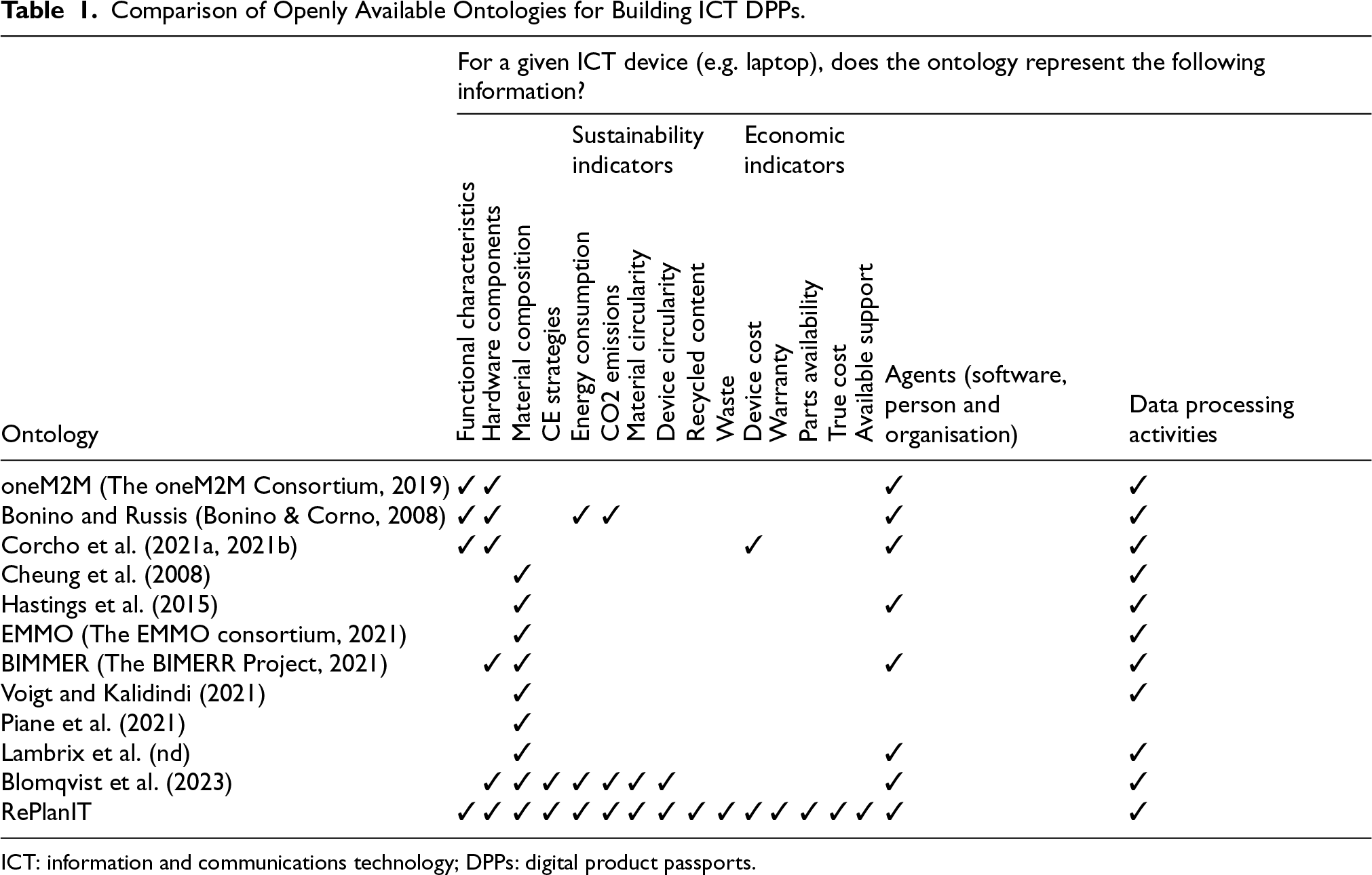
Comparison of Openly Available Ontologies for Building ICT DPPs.
ICT: information and communications technology; DPPs: digital product passports.
The overall methodology for building the RePlanIT ontology comprises eight steps as presented in Figure 2. The work began with an exploration of the main use case’s scope, namely building DPPs for laptops and their hardware components, and setting a hypothesis for the types of data that need to be modelled by the ontology. In the next step, we conducted interviews (McMahon et al., 2023) with 11 experts (over five public and private organisations) from the domains of organisational decision making for the procurement, maintenance, repair and disposal of ICT equipment. The domain experts were asked about the existing procedures for each of these activities, the success or failure of new initiatives to introduce circularity into these activities, and the experienced or anticipated barriers to that introduction of circularity for each ICT-related activity. Further details and insights are presented by McMahon et al. (2023). Next, we conducted an extensive literature survey (Kurteva et al., 2024) of semantic models for ICT devices, their hardware components, materials and CE processes. The gathered information on the topic (from the interviews and the literature survey) led to deriving a set of competency questions (Table A2 by Kurteva et al., 2024). The set of questions was refined (see Table A2) and used as guidelines for the data that our ontology needs to represent semantically. The survey further helped identify existing ontology concepts (classes, data and object properties) that can already be reused within RePlanIT to answer the competency questions. In summary, some of the ontologies that we have reused are MatOnto (Miller, 2021) for representing materials due to its clear and easy to comprehend specification of the different types of materials (see Figure 3 by Miller, 2021), the well known and widely used PROV-O (Lebo et al., 2013) for defining types of agents involved in the lifecycle of an ICT device in the CE, the Data Catalog Vocabulary (DCAT) 6 (Consortium et al., 2014) for defining the agents’ roles and SOSA (Janowicz et al., 2019) for sensors, their observations and results.

Overall methodology.
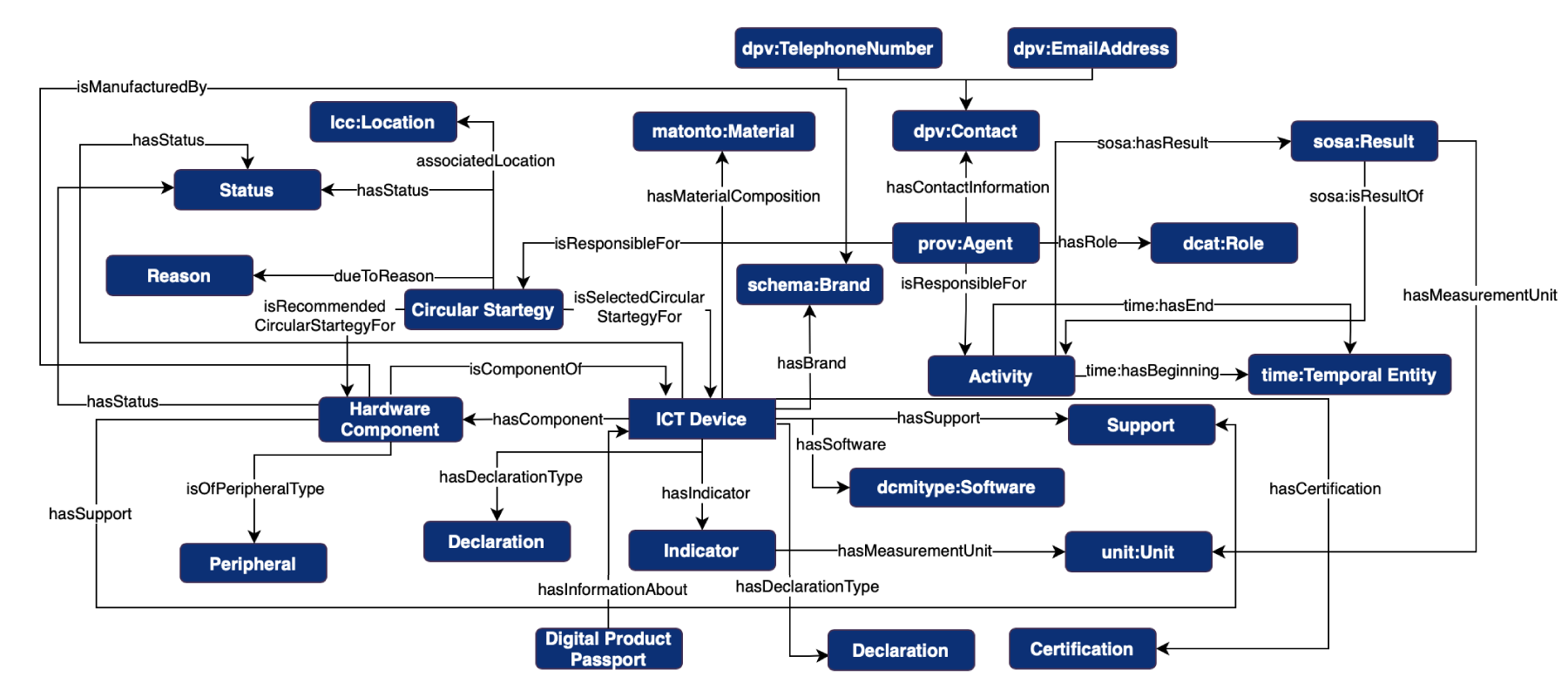
RePlanIT ontology class overview (reused concepts, object and data properties are presented together with their existing namespaces, while newly defined ones have the name space ‘replanit’ (omitted for readibility purposes)).
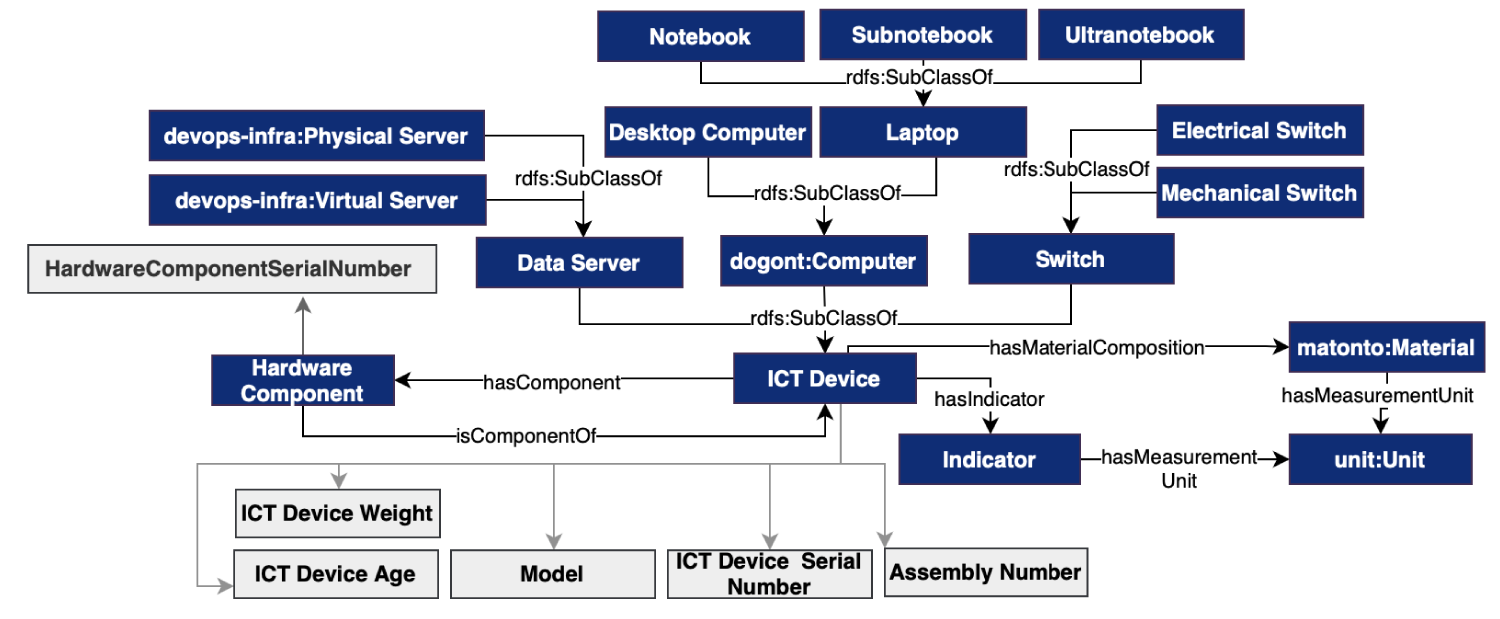
RePlanIT ontology overview: class ICTDevice (classes in blue and data properties in grey). ICT: information and communications technology.

RePlanIT ontology overview: class indicator (classes in blue and data properties in grey).

RePlanIT ontology overview: class HardwareComponent (classes in blue and data properties in grey).
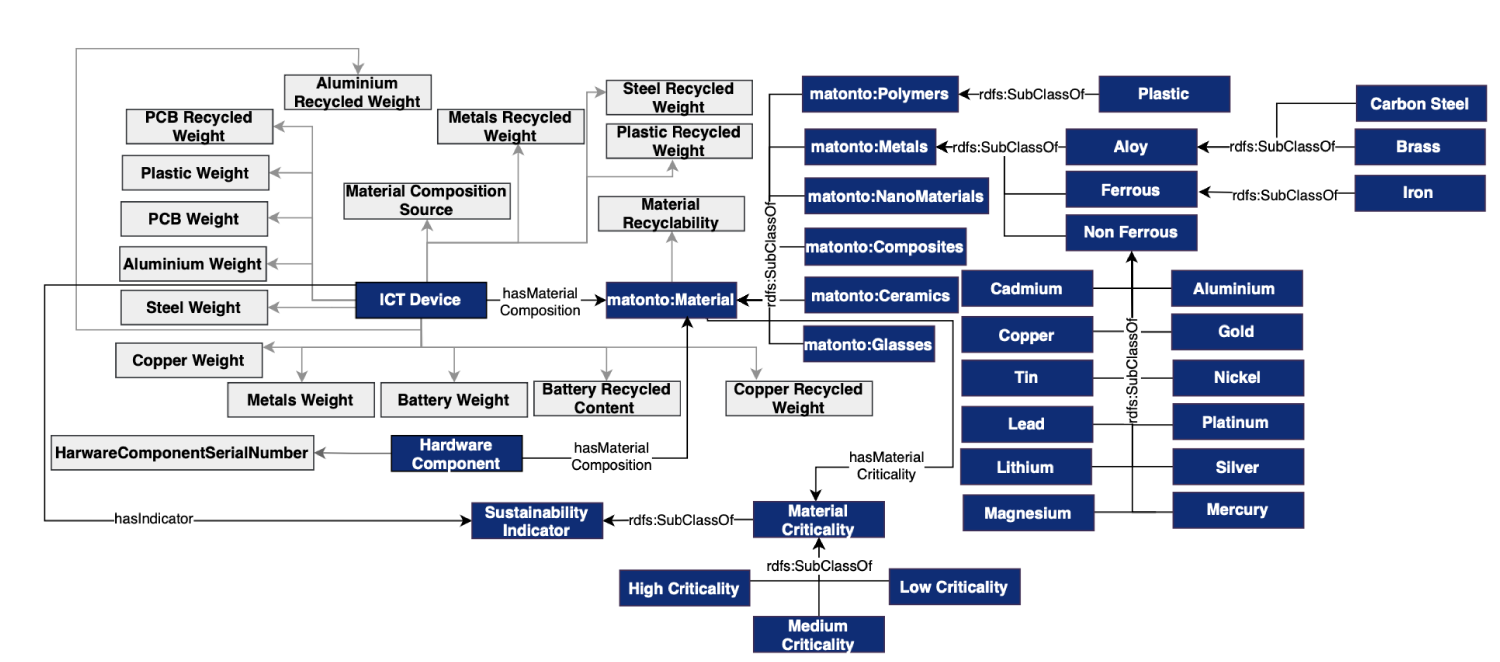
RePlanIT ontology overview: class Material (classes in blue and data properties in grey).

RePlanIT ontology overview: class CEStrategy (classes in blue and data properties in grey). CE: circular economy.

RePlanIT ontology overview: class unit (classes in blue and data properties in grey).

RePlanIT ontology overview: class activity (classes in blue and data properties in grey).

RePlanIT APIs: Swagger documentation.10

RePlanIT UI: DPP-based laptop comparison (Noordhoek et al., 2023). UI: user interface; DPP: digital product passport.
The ontology development itself carried out with Protégé 7 , followed a top-down modular approach similar to the one by Shimizu et al. (2021). We begun by defining high-level concepts (e.g. ICT Device, Hardware Component, Materials, CE Strategy and Indicators) that form modules of knowledge that are interconnected in RePlanIT (details in Section 4). For consistency, we have used ‘isA’ relationship as a guideline when defining classes and subclasses before the actual ontology implementation. This helped as we collaborated with domain experts who did not have experience in ontology engineering. We then translated the ‘isA’ relationship to the more formal ‘rdfs:subclassOf’ in the ontology. Once all concepts for each module were defined, the relationships interconnecting the modules were specified. The ontology was then evaluated with standard ontology evaluation tools such as the OntOlogy Pitfall Scanner! (OOPS!) (Poveda-Villalón et al., 2014), the Pellet (Sirin et al., 2007), and HetmiT (Glimm et al., 2014) reasoners in Protégé. The evaluation was also performed with the set of predefined competency questions (presented in Table A2). An iteration of the ontology to fix inconsistencies was performed, followed by ontology documentation with WIDOCO (Garijo, 2017) and its public release. These steps comprise the ontology development process. To further validate the ontology, its utilisation as a schema for a knowledge graph that represents DPPs of laptops and data servers was investigated. Through the use of APIs, the built knowledge graph was further used as the main data source for the sustainability calculations provided by the RePlanIT user interface (UI) (Figure 1). Details on the RePlanIT ontology’s evaluation and validation based on its application(s) are presented in Section 5.
The RePlanIT2,3 OWL ontology interlinks the ICT, materials and CE domains to represent machine-readable DPPs of ICT devices, namely laptops and data servers. Currently, the ontology (Figure 3) comprises of 295 classes, 72 object properties and 143 data properties, reuses concepts from 15 existing ontologies and defines new ones to represent highly granular DPPs at both device and device component levels. Figure 3 presents an overview 8 of the main ontology concepts represented as classes and the relationships between them. A detailed ontology documentation is available online.2
ICT Device
The concept of an ICT device is at the core of the ontology. As shown in Figure 4, three main types of highly utilised and increasingly manufactured ICT devices, namely replanit:DataServer, dogont:Computer and replanit:Switch have been represented. To distinguish between laptops and desktop computers, each has been defined as a subclass of dogont:Computer. Types of data servers and switches, which can have different hardware thus different material composition, have been represented as well. Specific ICT device characteristics such as model, device weight, age, assembly number and serial number, which are subject to change through the device’s lifetime have been represented as data properties. Each device is comprised of a number of hardware components, each with its own specification (e.g. functional, sustainability and material characteristics). To build DPPs that capture knowledge at different ICT levels (e.g. hardware component and material), while supporting ontology’s modularity, we have defined the concepts replanit:HardwareComponent and replanit:Material as a standalone classes. The connection to these classes is made via the object properties replanit:hasHardwareComponent, its inverse replanit:isComponentOf and replanit:hasMaterialComposition, respectively. The impact of an ICT device and/or its hardware components can be measured through several indicators, as shown later in Figure 5.
Hardware Components
The class replanit:HardwareComponent (Figure 6) represents different types of hardware components that ICT devices such as laptops and data servers comprise of. This knowledge can be represented via the object property replanit:hasComponent (with domain replanit:ICTDevice, and range – replanit:HardwareComponent) and its inverse replanit:isComponentOf. A hardware component has a data property replanit:HardwareComponentSerialNumber that is used to store its unique serial number (see Figures 4 and 7). The manufacturer (represented by the class replanit:Brand), can be represented via the object property replanit:isManufacturedBy, as shown in Figure 3.
To represent various hardware components and adhere to best practices for ontology engineering, several concepts (classes) from existing ontologies, such as sosa:Sensor (e.g. sensor:Temperature, sensor:Pressure, sensor:Humidity and smashHitCoreCore:PhotoElectricSensor), obo:Camera (known as obo:NCIT_C49858), obo:Battery (known as obo:NCIT_49839) have been reused. As many new models of laptops include new ways of authentication, we have defined replanit:FingerPrintSensor as another type of sensor that can be monitored for errors and failure that affect the device through its lifetime. Manufacturers and retailers often provide different types of support for their products, which can help mitigate and handle different failures. Based on this, we have defined three types of support (replaint:TechnicalSupport, replaint:SoftwareSupport, replaint:HardwareSupport), which can be available on both ICT device and hardware component levels. The data property replanit:SupportCostValue has been defined to record information about each device’s and component’s support costs. Dynamic data such as the RAM and ROM size of device, battery weight, camera pixels, CPU load and speed, energy consumption, temperature and more have been represented as data properties (see Figure 6) of both a device and a hardware component. Such data and its provenance can be utilised later on to support predictive maintenance processes per device. The full specification of the hardware components represented in the ontology is available online.2
Materials
To represent a classification of the different types of materials that can and are often used for the manufacturing of ICT devices, the class matonto:Material and its subclasses (e.g. matonto:Polymers, matonto:Metals and matonto:Glasses) have been reused (see Figure 7). RePlanIT expands the class matonto:Metals by defining specific types of metals (alloys such as brass, ferrous such as iron and non-ferous such as aluminium, copper etc.). An ICT device’s material composition and material weight can be represented at both device and hardware component levels through the relationship replanit:hasMaterialComposition and specific data properties such as replanit:AluminiumWeight, replanit:CopperWeight, replanit:SteelWeight. An important property of a material is its recyclability (i.e. if a material is recyclable or not). This information can be recorded via the data property replanit:MaterialRecyclability of type xsd:boolean. To represent the content of each recycled material in a device specific data properties such as replanit:AluminiumRecycledContent, replanit:CopperRecycledContent can be used. For traceability and transparency purposes, we have defined the data property replanit:MaterialCompositionSource of type xsd:anyURI to record the online source of material’s information for an ICT device. Each material has also associated replanit:MaterialCriticality level, which is a type of replanit:SustainabilityIndicator used to assess how sustainable and ICT device is. Details on RePlanIt’s indicators are presented in Section 4.5.
To support sustainability-relevant calculations (e.g. circularity score and e-waste) related to the end of life (EoL) of an ICT device and its materials (examples in 5.3), we have represented concepts related to both open-loop (OL) and closed-loop (CL) value chains for each material. In an OL ‘used products are recovered by other firms and reused instead of being returned to the original producers’, 9 while in CL the returned products are reused for the manufacturing of new ones. To capture such knowledge, we have represented OL and CL for each material at its EoL (e.g. replanit:EoLRecycledOLSteel, replanit:EoLRecycledCLSteel, replanit:EoLRemanufacturingSteel), as an ICT device’s data properties of type xsd:double. Measurement units for mass (e.g. grams and kilograms) and ratios (e.g. percent) are discussed in Section 4.7.
CE Strategy
The concept of a CE is represented through the processes (or strategies) (see Figure 8) of replanit:Maintenance, replanit:Recycling, replanit:Remanufacturing, replanit:Refurbishment, replanit:Recovery, replanit:Repair and replanit:Reuse that can be adopted for an ICT device to prolong its lifetime. Definitions for each process are presented in Table A1. Differentiating between a recommended (e.g. by AI or a CE expert) and actually used CE strategies, can be done by utilising the object properties replanit:isRecommendedCircularStartegy and replanit:usedCircularStartegy.
To support the explainability and transparency of decision making (e.g. using a specific CE) the class replanit:Reason has been defined. With this class we aim to represent different events (e.g. damage, failure and contract’s end) that lead to specific circular strategies such as repair, reuse and other activities such as data processing, audit, testing that support their execution. A CE strategy can be linked to a specific reason such as contract end, damage, support end and failure, by utilising the object property replanit:dueToReason. The ontology represents several types of reasons such as contract end, damage, support end and failure, which were highlighted in our interviews with domain experts and ICT procurers as most common reasons (McMahon et al., 2023). The duration of performing each CE strategy is represented by the class time:Interval and the object properties time:hasBeginning and time:hasEnd. A CE strategy can have different replanit:Status such as replanit:Complete, replanit:Delayed, replanit:InProgress. Here the class replanit:Status also represents the status of an ICT device in the context of the CE (repaired, reused and refurbished). The location (city and country) where a selected CE strategy is performed is represented via relationship replanit:associatedLocation with range the class lcc:Location (e.g. specific replanit:City and replanit:Country). Both the location and the duration of performing a CE strategy affect its cost thus we have defined the data properly replanit:CircularActivityCost. Recording such information can later on assist activities such as auditing and predictive maintenance that can help discover the most optimal and efficient (in terms of time and cost) CE for a device.
Indicators
To support users (e.g. sustainability experts, ICT procurers, ICT end users and ICT experts) in evaluating the sustainability, functionality and economic effects of an ICT device and its components, we have represented several types of indicators (Figure 5), namely replanit:FunctionalIndicator, replanit:EconomicalIndicator and replanit:SustainabilityIndicator, which were derived based on interviews with end users (McMahon et al., 2023) and a literature survey (Kurteva et al., 2024). Functional indicators refer to functional characteristics of ICT devices that are of importance during procurement processes. Examples of these include the memory (in terms of replanit:RAMSize and replanit:ROMSize), the capacity, weight and lifetime of a battery, camera pixels, CPU load and speed. The monetary cost of a CE strategy, ICT device’s purchase cost (brand new device) and current cost (device cost after CE strategy has been applied) are categorised as economical indicators. The true cost, defined as the sum of the purchase cost, green house gas production and green house gas use and the warranty duration also fall into this category. Last but not least, 27 (counting classes and subclasses) sustainability indicators have been identified and represented. Among these indicators are replanit:EnergyConsumption, replanit:MaterialCircularity, replanit:MaterialCriticality, replanit:GreenHouseGasEmissions produced during the manufacturing, use, distribution of a device and the produced replanit:Waste. Each indicator is measured with a specific unit. This is captured via the indicator’s object property replanit:hasMeasurementUnit that links to the unit:Unit class (see Figure 9).
Activity and Agent
The class replanit:Activity (see Figure 10) represents processes running on or supported by a software. The class helps differentiate specific CE strategies used to prolong the lifetime of a device from other supply chain and software- and hardware-focused activities such as replanit:ICTProcurement, replanit:Auditing and replanit:Distribution, replanit:Recommendation and replanit:Testing (of both hardware and software). To bring end-to-end process transparency and traceability, the ontology allows one to model each activity’s start and end time, location (city and country) where it is carried out, the input and output data for it, its result and the agent responsible for it. The class dpv:Agent has been reused to represent different types of agents (software, organisation or a person) responsible for an activity, CE strategy and ICT device. Agents can have multiple roles (e.g. replanit:Procurer, replanit:Manufacturer and replanit:Client) depending on the context. This information can be captured via agent’s object property replanit:hasRole and the association with a specific ICT device. Each agent is associated with and agent ID (defined by the data property replanit:AgentID and its contact information, namely replanit:Email and replanit:TelephoneNumber can be recorded as well.
Unit
The concept of a measurement unit has been represented by reusing the class unit:Unit (Figure 9). Thirty one types of measurement units, organised into the following eight categories: replanit:Temperature, obo:EnergyUnits, obo:FrequencyUnit, obo:InformationUnit, replanit:MassUnit, replanit:CurrencyUnit, obo:Ratio and replanit:TemporalUnit have been represented within the RePlanIT ontology. Connecting an indicator to its measurement unit is done via the indicator’s object property replanit:hasMeasurementUnit.
Evaluation
The RePlanIT ontology was evaluated following best practices for ontology evaluation – against a set of competency questions based on an extensive literature survey and interviews with experts from the sustainability and ICT domains in the context of the use case, with the OOPS! (Poveda-Villalón et al., 2014) ontology pitfall scanner throughout its development and with the HermiT (Glimm et al., 2014) and Pellet (Sirin et al., 2007) reasoners in Protégé. The ontology was validated through its successful utilisation for (i) building a knowledge graph of ICT DPPs and (ii) by designing and implementing a UI, which utilises the knowledge graph-based DPPs to support more sustainable ICT procurement in companies. The usability of the UI and the usefulness of the DPP data visualised on it, have been evaluated with end-users from the Municipality of Amsterdam in the scope of the RePlanIT project. Last but not least, RePlanIT not only reuses but also has already been reused for alignment with other existing ontologies (Section 5.4) to enable semantic interoperability between data spaces for CE’s monitoring. The following sections present more detail on the ontology evaluation in terms of use case modelling, ontology engineering, usability and reuse.
Use Case Modelling
The RePlanIT ontology is used as a schema for a knowledge graph, which comprises a total of 129 DPPs of (new, refurbished and repaired) laptops from different brands (commonly used by companies in the Netherlands). The DPPs modelled as knowledge graphs store information about the laptop’s hardware components and their functional characteristics, material composition, circular strategy history, and functional, economic and sustainability indicators that support decision-making. The DPPs were manually annotated with predefined SPARQL queries. The main data sources for the DPPs were laptop manufacturer’s websites, open source scientific publications stating material declarations of laptops and environmental product declarations (EPDs) (Schmincke & Grahl, 2006). The DPPs are currently available through several APIs
10
,
11
(see Figure 11), which have been documented according to standard with Swagger.
12
DPPs of refurbished ICT devices have information on the utilised circular strategy (e.g. refurbishment), which is not present in DPPs of new ones. Based on this, separate API endpoints have been defined (e.g. NewLaptopDPP and RepairedLaptopDPP) as shown in Figure 11. Querying DPPs is unrestricted, however, inserting new laptop DPPs can be performed by only authorised agents (based on the bearer
13
authentication mechanism). Implementation details on the APIs and the knowledge graph itself (e.g. SPARQL queries, ICT device IDs for testing and DPP visualisation examples) are available in GitHub.11 Currently, the knowledge graph consists of 31,776 total statements and utilises 0.40 GB of memory. For reference, on average (based on 10 runs with GraphDB’s SPARQL EndPoint), inserting a laptop’s DPP takes
Based on the use case of building laptop’s DPPs that can capture information on its materials and the CE strategies that can be applied to extend its life on both device and hardware component levels and on the interviews with end users (McMahon et al., 2023) and our extensive survey by Kurteva et al. (2024), we have derived a set of competency questions that helped guide and evaluate our work. Table A2 in the Appendix presents six categories of competency questions and the classes, object and data properties from the RePlanIT ontology that can be used to answer them. The results of the analysis show that our ontology can not only represent the information needed to answer the specific competency questions, but it also supports representing the information at different levels of granularity (on both ICT device and device component levels). Further, as discussed in Section 2 and showcased in Table 1, the RePlanIT ontology is currently the only one that represents highly granular data about ICT devices, their materials and lifecycle in the CE used to build DPPs in one place.
Ontology Engineering
In terms of ontology engineering, the ontology was evaluated following best practices with the OOPS! 14 (Poveda-Villalón et al., 2014) ontology pitfall scanner and with both the HermiT (Glimm et al., 2014) and Pellet (Sirin et al., 2007) reasoners in Protégé 15 v 5.5.0 for inconsistencies. The validation with OOPS! was carried out iteratively throughout the ontology engineering process. The detected pitfalls (e.g. missing annotations and data property domain and range), early on in our engineering process, were used as feedback for improvement. The ontology was also validated with the OntoMetrics 16 (Lantow, 2016) tool, which provided insights on RePlanIT’s base, schema, knowledge base, class and graph metrics. Overall, the results 17 show that RePlanIT is able to represent a wide range of concepts from various domains and captures rich relationships between those concepts while maintaining its consistency and concept readability. Last but not least, both the HermiT and Pellet reasoners, which processed the ontology for 93 and 80 ms, respectively, did not highlight any inconsistencies and errors.
Ontology Usability
One of the main goals of the ontology is to represent the data needed to support decision-makers in cases such as sustainable ICT device (e.g. laptop) procurement. Learning from our previous research on human-centred ontology utilisation and visualisations that support one’s comprehension (e.g. Bless et al., 2021; Kurteva & De Ribaupierre, 2021), the RePlanIT UI (Figures 1, 12) that is aligned with the RePlanIT ontology, was prototyped by designers from IDEAL&CO 18 and implemented by front-end developers from Maxicom 19 (formerly Aliter Networks 20 ). The UI presents in a visual format various types of data per laptop, which is retrieved from the DPPs stored in our knowledge graph (based on the RePlanIT ontology) via APIs (see Figure 11). For example, the UI utilises DPP data about the laptop’s functional characteristics (e.g. model, brand, screen size and resolution, memory (RAM and ROM), camera pixels, purchase cost, CPU speed and battery life), material composition in terms of critical materials present in its hardware and sustainability data such as its energy consumption, primary material use and greenhouse gas emissions during its manufacturing and use phases to calculate its circularity score. The circularity calculations have been derived by design and sustainability experts from IDEAL&CO based on their research on the Circularity Calculator. 21 The calculator was developed in the context of the Resource Conservative Manufacturing (ResCoM) 22 European project and is part of the ResCoM 23 platform that aims to support more sustainable decision making and transitioning to a CE. With the help of visualisations of product design workflows, designers and sustainability experts can make strategic decisions about a product’s design and its effect on sustainability.
The research team conducted evaluations of the RePlanIT UI with two industry experts holding positions in the management of ICT procurement, maintenance and disposal at a large organisation in the Netherlands. The evaluations were conducted separately, during which each industry expert was given the same scenario (tasked with making a decision about four currently identified as end-of-use laptops of a specific brand and model) and
The evaluations were observed by members of the research team consisting of a software developer involved in the ontology engineering process, a designer, and an interviewing researcher, focused on their respective aspects of the interface and its contents. After the industry expert’s trial session with the interface, the interviewing researcher asked questions to confirm if and how the interface helped to overcome barriers in the categories of (i) access to suitable and timely circular ICT equipment, (ii) lack awareness and knowledge about circular ICT, (iii) issues relating to accountability and the ability to make effective decisions, (iv) limited prioritisation of circularity in ICT and (v) financial and other costs of circular practices (McMahon et al., 2023). The industry experts indicated that the tool performed most favourably in terms of providing accurate and accessible information about the laptops, including financial information, in order to enable a real-time increase in awareness of the circularity benefits and consequences of the decisions made as well as an increased ability to compare the true impacts of a decision, therefore increasing confidence in the decision’s effectiveness on improving meaningful circularity. We take this as an indication that the RePlanIT ontology and the knowledge graph of DPPs built with it achieve their goal(s) of being useful with regards to interconnecting the ICT, materials and CE domains and representing the right amount of details of ICT DPPs for our use case.
Ontology Reuse
Reuse itself is a common good practice for ontology engineering. Our work not only reuses existing ontologies such as MatOnto (Cheung et al., 2008), DogOnt (Bonino & Corno, 2008) but is also already reused by the DATAPIPE 25 project for aligning the batteries and electronics domains via the FEDeRATED 26 upper-level ontology (see Chirvasuta et al., 2025). The motivation for this reuse stems from the need for greater flexibility, extensibility and compatibility between data spaces that the CE affects and existing and upcoming legislation. To be specific, the class replanit:ICTDevice and its subclasses have been reused for manual alignment with the BattInfo (Clark et al., 2022) and Catena-X 27 ontologies with the help of FEDeRATED. The main goal of the alignment was to utilise RePlanIT to expand FEDeRATED’s semantic representation of products with specific types of ICT devices and their hardware components (which RePlanIT represents). Specification of this will be provided in DATAPIPE’s deliverable D2.1 (DATAPIPE Consortium, 2023).
Conclusions
In this article, we presented the RePlanIT2,3 ontology which by interlinking the ICT, materials and CE domains supports the representation of machine-interoperable DPPs of ICT devices such as laptops and data servers. RePlanIT’s evaluation and validation with a real-world scenario have shown that it represents useful data about devices, their components, material composition and possible circular strategies that can be used to extend lifetime and that it can be utilised successfully for various sustainability calculations that support decision makers in ICT procurement.
While we acknowledge that our work is limited with regards to the use case it covers (i.e. laptops and their sustainable procurement), it can already be reused for representing DPPs of ICT hardware components depending on the level of granularity of one’s use case. The hardware components that RePlanIT represents are often part of other ICT devices such as data servers thus we see a wide range of applications for our work. The reuse of RePlanIT for supporting cross-data space data interoperability for CE’s implementation in the batteries domain has already been investigated as well (see Section 5.4 and Chirvasuta et al., 2025). An improvement that we plan is the temporal aspect of our ontology. More specifically, validating that temporal changes for each data type are successfully captured and managed for processes such as predictive maintenance. Due to the intricate nature of laptops and the various factors affecting their recyclability, including material composition, device condition and economic considerations, we recognise the need for a more detailed representation of the recyclability characteristics of devices and materials in our ontology. While this was not in the scope of our work initially, it becomes an important aspect to consider for the future iterations of the ontology.
Following the RePlanIT ontology, we have also already built prototypes of data server DPPs and provided APIs for their querying with SPARQL. We are also actively monitoring the developments 28 on DPP standardisation and believe that Open Access work such as ours can support their wider adoption and technical implementation. As for future work, a research direction that we are currently investigating is RePlanIT’s enrichment or alignment with existing lifecycle assessment ontologies to fully capture the sustainability and circularity of all ICT components and their materials through their lifetime from mining, through manufacturing, distribution, to use and specific CE strategy use. Last but not least, we are currently investigating the utilisation of knowledge graph-based DPPs for more explainable predictive maintenance and automated sustainability recommendations throughout a device’s lifetime.
Footnotes
Acknowledgements
We thank Ingrid de Pauw, Bram Grinten and Eliza Noordhoek (IDEAL&CO) for their collaboration on design, for sharing their expertise on product sustainability and deriving sustainability calculations for the RePlanIT project and Ali Ogurol (Aliter Networks) for collaborating on the interface’s implementation. Last but not least, we thank Boriana Rukanova, Yao-hua Tan (TPM, TU Delft), Theodor Chirvasuta (TNO) and Wout Hofman (TNO) for collaborating on bridging knowledge silos together.
Funding
The author(s) disclosed receipt of the following financial support for the research, authorship, and/or publication of this article: This work is part of the RePlanIT project, which is funded by a Topsector Energy subsidy from the Ministry of Economic Affairs and Climate Policy in the Netherlands.
Declaration of Conflicting Interests
The author(s) declared no potential conflicts of interest with respect to the research, authorship and/or publication of this article.

Notes
Evaluation of RePlanIT With Competency Questions.

| No. | Competencyquestion | RePlanIT class | RePlanIT object property | RePlanIT data property |
|---|---|---|---|---|
| 1. ICT device | ||||
| 1 | What is the type of the device? | replanit:ICTDevice; replanit:Switch, replanit:MechanicalSwitch, replanit:TechnicalSwitch, dogont:Computer, replanit:DesktopComputer, replanit:Laptop, replanit:Notebook, replanit:Subnotebook, replanit:Ultranotebook, replanit:DataServer, devops-infra:PhysicalServer, devops-infra:VirtualServer | – | – |
| 2 | What is the brand of the device? | schema:Brand, replanit:Apple, replanit:Dell, replanit:HP, replanit:Intel,replanit:Lenovo, replanit:Toschiba | replanit:hasBrand | – |
| 3 | What is the brand model of the device? | – | replanit:Model, replanit:ModelYear | |
| 4 | Where was the device assembled? | lcc:Location, lcc:CCountry, schema:City | replanit:associatedLocation, replanit:associatedCity, replanit:associatedCountry | |
| 5 | What is the assembly number of a device? | – | – | replanit:AssemblyNumber |
| 6 | What is the age of the device? | replanit:DeviceAge, replanit:TemporalUnit, obo:UO_0000036 (Year) | replanit:hasIndicator, replanit:hasMeasurementUnit | replanit:ICTDeviceAge |
| 7 | When was the device assembled? | time:TemporalEntity, time:Instant, time:Interval | owl-time:hasBeginning, owl-time: hasEnd | replanit:DateTime, replanit:startDate, replanit:endDate |
| 8 | When was the device purchased? | replanit:ICTDevice | replanit:PurchaseDateTime | |
| 9 | Who manufactured the device? | prov:Agent, dcat:Role, replanit:Manufacturer, schema:Brand | Replanit:isManufacturedBy | – |
| 10 | What is the current status of the device? (Has it been reused, remanufactured, refurbished, recycled or is it new?) | replanit:Status, replanit:New, replanit:Refurbished, replanit:Repaired, replanit:Reused | replanit:hasStatus, replanit:isStatusFor | – |
| 11 | Has the device been certified? What is the device’s certification? | replanit:Certification, replanit:ChinaCECP, replanit:EnergyStar, replanit:EPEAT, replanit:TCO | replanit:hasCertification | – |
| 12 | What are the components of the device? | replanit:HardwareComponent, replanit: Cables, replanit:Capacitor, replanit:CPU, replanit:NVDIMM, replanit:CoolingSystem, replanit:Chassis, replanit:Display, replanit:GraphicsCard, replanit:GraphicsCardProcessor, replanit:Inductor, replanit:Keyboard,replanit:Microphone, replanit:Networkcard, replanit:PCB, replanit:Port, replanit:Slot, replanit:PintingDevice, replanit:ComputerMouse, replanit:Trackpad, replanit:Speakers, replanit:StorageDevice,replanit:HardDrive, replanit:SolidStateDrive, replanit:Videocard,replanit:WirelessCard, sosa:Sensor, obo:NCIT_C49839 (battery), obo:NCIT_C49858 (camera), replanit:External, replanit:Internal | replanit:hasHardwareComponent, Replanit:isComponentOf, replanit:isOfPeripheralType | |
| 13 | What is the device’s software system? | dcmitype:Software, replanit:OperatingSystem, replanit:Linux,replanit:MacOS, replanit:MicrosoftWindows, replanit:SecuritySoftware, replanit:AntivirusSoftware, replanit:AuthenticationSoftware, replanit:VMHost | replanit:hasSoftware, replanit:hasOperatingSystem, replanit:hasSecuritySoftware, replanit:hasAuthenticationSoftware | |
| 14 | What is the memory capacity of the device? | replanit:Memory, obo:UO_0000231 (information unit), unit:unit/TeraBYTE, unit:unit/GigaBYTE, unit:unit/MegaBYTE | replanit:hasIndicator, | replanit:RAMSize, replanit:ROMSize |
| 15 | What support is provided for the device? What is the duration of the support? How much does the support cost? | replanit:Support, replanit:HardwareSupport, replanit:SoftwareSupport, replanit:TechnicalSupport, replanit:SupportCost | replanit:hasSupport, replanit:isSupportFor, replanit:hasSupportDuration | replanit:SupportCostValue |
| 16 | What is the purchase cost of the device? | replanit:EconomicalIndicator, replanit:PurchaseCost, unit:Currency, replanit:Euros, replanit:PoundSterling, replanit:UnitedStatesDollar | replanit:hasIndicator, replanit:hasEconomicalIndicator, replanit:hasMeasurementUnit, replanit:inCurrency | replanit:PurchaseCostValue |
| 17 | What is the energy usage of the device? | Replanit: SustaianbilityIndicator, replanit:EnergyUsage, obo:UO_0000111 (energy units), replanit:KilloWattHourPerYear, Unit:unit/KilloW-HR | replanit:hasSustainabilityIndicator, replanit:hasMeasurementUnit | replanit:EnergyConsumption, replanit:EPDUseEnergyDemand, |
| 18 | What is the device’s energy efficiency certification? | replanit:Certification, replanit:EnergyStar | replanit:hasCertification | |
| 19 | What is the device’s carbon dioxide (CO2) footprint? (during the production/distribution use phase) | obo:UO_0000187 (percent), unit:kilogramOfCarbonDioxideEquivalent, unit:unit/KilloGM | replanit:hasMeasurementUnit | replanit:CarbonFootprintUse, replanit:CarbonFootprintManufacturing, replanit:CarbonFootprintDistribution, replanit:CarbonFootprint_kg_Use, replanit:CarbonFootprint_kg_Manufacturing, replanit:CarbonFootprint_kg_Distribution |
| 20 | What is the device’s product specification source? | – | – | replanit:ProductSpecificationSource |
| 2. Hardware component | ||||
| 21 | What is the serial number of the component? | – | – | replanit:HardwareComponentSerialNumber |
| 22 | What is the brand of the component? | schema:Brand, replanit:Apple, replanit:Dell, replanit:HP, replanit:Intel, replanit:Lenovo, replanit:Toschiba replanit:hasBrand | – | |
| 23 | What is the brand model of the component? | – | – | replanit:Model, replanit:ModelYear |
| 24 | What is the type of the component in terms of its location within a device? | replanit:Peripeheral, replanit:Expernal, replanit:Internal | Replanit:isOfPeripheralType | – |
| 25 | What is the status of the component? Has it been reused, remanufactured, or refurbished before? | replanit:Status, replanit:New, replanit:Refurbished, replanit:Repaired, replanit:Reused | replanit:hasStatus, replanit:isStatusFor | |
| 26 | Why was the component reused, remanufactured, repaired or refurbished before? | replanit:Reason, replanit:ContractEnd, replanit:Damage, replanit:Failure, replanit:SupportEnd | replanit:isReasonFor, replanit:dueToReason | – |
| 27 | What is the current age of the component? | – | – | replanit:Hardware_Component_Age |
| 28 | What are the functional characteristics of the component? | replanit:FunctionalIndicator, replanit:Battery_Capacity, replanit:Battery_Lifetime, replanit:Battery_Weight, replanit:Camera_Pixels, replanit:Clock_Rate, replanit:Cooling_Rate, replanit:CPU_Load, replanit:CPU_Speed, replanit:DataTransportRate, replanit:DeviceAge, replanit:HardwareComponentAge, replanit:HardwareComponentWeight, replanit:ICT_Device_Temperature, replanit:ICT_Device_Weight, replanit:ICTDeviceLifetime, replanit:Memory, replanit:Performance, replanit:Screen_Size. | replanit:hasIndicator | replanit:BatteryCapacity, replanit:BatteryLifetime, replanit:BatteryWeight, replanit:CameraPixels, replanit:ClockRate, replanit:CoolingRate, replanit:CPULoad, replanit:CPUSpeed, replanit:CPUCache,replanit:MinCPUCache, replanit:Hardware_Component_Age, replanit:Hardware_Component_Weight, replanit:Temperature, replanit:DeviceWeight, replanit:ICTDeviceLifetime, replanit:MemorySlots, replanit:RAMSize, replanit:ROMSize, replanit:Screen_Size. |
| 29 | When was the component purchased? | replanit:HardwareComponent | – | Replanit:PurchaseDateTime |
| 30 | What is the weight of a device’s component? | – | – | replanit:Hardware_Component_Weight |
| 31 | What is the duration of the device component’s warranty? | Replanit:HardwareComponent, replanit:Warranty | replanit:hasWarranty | replanit:WarrantyDuration |
| 32 | What is the cost of the component before and after a CE strategy is used? | replanit:EconomicalIndicator, replanit:PurchaseCost, replanit:CurrentCost, replanit:Circular_Activity_Cost, replanit:Currency | replanit:hasMeasurementUnit, replanit:inCurrency | replanit:PurchaseCostValue, replanit:CurrentCostValue, replanit:CircularActivityCost |
| 33 | What is the stock availability of the hardware component? | – | – | replanit:PartsInStock |
| 34 | Are spare parts available? | replanit:PartsAvailability | – | replanit:PartsInStock |
| 3. Material composition (at ICT device and component levels) | ||||
| 35 | What is the material composition of a hardware component? | matonto:Material, matonto:Ceramics, matonto:Composites, matonto:Glasses, matonto:Metals, replanit:Alloy, replanit:Brass, replanit:CarbonSteel, replanit:Ferrous, replanit:Iron, replanit:NonFerrous, replanit:Aluminium, replanit:Cadmium, replanit:Cobalt, replanit:Copper, replanit:Gold, replanit:Lead, replanit:Lithium, replanit:Magnesium, replanit:Mercury, replanit:Nickel, replanit:Platinum, replanit:Silver, replanit:Tin, matonto:Nanomaterials, matonto:Polymers, replanit:Plastic | replanit:hasMaterialComposition | replanit:AluminiumWeight replanit:CopperWeight, replanit:GlassesWeight, replanit:MetalsWeight, replanit:OtherMaterialsWeight, replanit:OtherMetalsWeight, replanit:PlasticWeight, replanit:PCBWeight, replanit:SteelWeight |
| 36 | What is the material composition of the ICT device as a whole? | matonto:Material, matonto:Ceramics, matonto:Composites, matonto:Glasses, matonto:Metals, replanit:Alloy, replanit:Brass, replanit:CarbonSteel, replanit:Ferrous, replanit:Iron,replanit:NonFerrous, replanit:Aluminium, replanit:Cadmium, replanit:Cobalt, replanit:Copper, replanit:Gold, replanit:Lead, replanit:Lithium, replanit:Magnesium, replanit:Mercury, replanit:Nickel, replanit:Platinum, replanit:Silver, replanit:Tin, matonto:Nanomaterials, matonto:Polymers, replanit:Plastic | replanit:hasMaterialComposition | replanit:AluminiumWeight, replanit:CopperWeight, replanit:GlassesWeight, replanit:MetalsWeight, replanit:OtherMaterialsWeight, replanit:OtherMetalsWeight, replanit:PlasticWeight, replanit:PCBWeight, replanit:SteelWeight |
| 37 | How much material is used during recycling at the end of life in a closed loop lifecycle? | – | – | replanit:EoLRecycledCLAluminium, replanit:EoLRecycledCLBattery, replanit:EoLRecycledCLCopper, replanit:EoLRecycledCLGlasses, replanit:EoLRecycledCLOtherMaterials, replanit:EoLRecycledCLOtherMetals, replanit:EoLRecycledCLPCB, replanit:EoLRecycledCLPlastic, replanit:EoLRecycledCLSteel, |
| 38 | How much material is used during recycling at the end of life in a open loop lifecycle? | – | – | replanit:EoLRecycledOLAluminium, replanit:EoLRecycledOLBattery, replanit:EoLRecycledOLCopper, replanit:EoLRecycledOLGlasses, replanit:EoLRecycledOLOtherMaterials, replanit:EoLRecycledOLOtherMetals, replanit:EoLRecycledOLPCB, replanit:EoLRecycledOLPlastic, replanit:EoLRecycledOLSteel |
| 39 | How much material is used during remanufacturing at the end of life of a device? | – | – | replanit:EoLRemanufacturingAluminium, replanit:EoLRemanufacturingBattery, replanit:EoLRemanufacturingCopper, replanit:EoLRemanufacturingGlasses, replanit:EoLRemanufacturingOtherMaterials, replanit:EoLRemanufacturingOtherMetals, replanit:EoLRemanufacturingPCB, replanit:EoLRemanufacturingPlastic, replanit:EoLRemanufacturingSteel |
| 40 | What is the source of the material information for the device? | – | – | replanit:MaterialCompositionSource |
| 41 | What is the source of the CO2 information for the device? | – | – | replanit:CarbonFootprintSource |
| 42 | What is the source of the environmental product declaration (EPD) of the device? | – | – | replanit:EPDSource |
| 43 | What is the criticality level of the material? | replanit:MaterialCriticality, replanit:HighCriticality, replanit:LowCriticality, replanit:Medium_Criticality | replanit:hasCriticalityLevel | – |
| 4. CE strategy | ||||
| 44 | What CE strategy is recommended for the specific device or component? | replanit:CircularStrategy, replanit:Maintenance, replanit:Recovery, replanit:Recycling, replanit:Refurbishment, replanit:Remanufacturing, replanit:Repair, replanit:Reuse | replanit:isRecommendedCircularStartegyFor, replanit:dueToReason | |
| 45 | What CE strategy is selected for the specific device or component? | replanit:CircularStrategy, replanit:Maintenance, replanit:Recovery, replanit:Recycling replanit:Refurbishment, replanit:Remanufacturing, replanit:Repair, replanit:Reuse | replanit:isSelectedCircularStartegyFor, replanit:dueToReason | |
| 46 | What is the monetary cost of performing the CE strategy? | replanit:CircularStrategy, replanit:Maintenance, replanit:Recovery, replanit:Recycling replanit:Refurbishment, replanit:Remanufacturing, replanit:Repair, replanit:Reuse, replanit:Currency | replanit:hasMeasurementUnit, replanit:inCurrency | replanit:CircularActivityCost |
| 47 | What is the status of the current CE strategy used for the device or component? | replanit:CircularStrategy replanit:Maintenance, replanit:Recovery, replanit:Recycling replanit:Refurbishment, replanit:Remanufacturing, replanit:Repair, replanit:Reuse, replanit:Status, replanit:Complete, replanit:Delayed, replanit:InProgress, replanit:Terminated | replanit:isStatusFor, replanit:hasStatus | – |
| 48 | Who is responsible for executing the CE strategy? | prov:Agent, prov:Organisation prov:SoftwareAgent, prov:Person | replanit:isResponsibleFor | replanit:AgentID |
| 5. Agent | ||||
| 49 | What are the contact details of the agent? | prov:Agent, prov:Organisation, prov:SoftwareAgent, prov:Person, dpv:Contact, dpv:EmailAddress, dpv:TelephoneNumber | replanit:hasContactInformation, smashHitCore:hasEmail, smashHitCore:hasTelephoneNumber | replanit:AgentID, replanit:TelephoneNumber, replanit:Email |
| 50 | For whom does the agent work for? | prov:Agent, prov:Organisation prov:SoftwareAgent, prov:Person | replanit:worksFor | replanit:OrganizationWebsite |
| 51 | What is the role of the agent associated with the specific device or component? | prov:Agent, prov:Organisation prov:SoftwareAgent, prov:Person, dcat:Role, replanit:DataProvider, replanit:Client, replanit:DeviceOwner, replanit:Manufacturer, replanit:Procurer, replanit:Recycler, replanit:Refurbisher replanit:Remanufacturer, replanit:Repairer | replanit:hasRole | replanit:AgentID |
| 6. Indicators | ||||
| 52 | What are the indicators used to measure the sustainability of the ICT device? | replanit:ICTDevice, replanit:SustainabilityIndicator, replanit:EnergyConsumption, replanit:EnvironmentalImpact, replanit:EoLRecycledCL, replanit:EoLRecycledOL replanit:EoLRemanufacturing, replanit:GreenHouseGasEmissions, replanit:GreenHouseGasDistribution, replanit:GreenHouseGasEndOfLife, replanit:GreenHouseGasErrorRatio, replanit:GreenHouseGasFootprint, replanit:GreenHouseGasFootprintRatio, replanit:GreenHouseGasUse, replanit:GreenHouseGasesManufacturing, replanit:MaterialCircularity, replanit:MaterialCriticality, replanit:HighCriticality, replanit:LowCriticality, replanit:Medium_Criticality, replanit:MaterialWeight, replanit:PrimaryResource, replanit:NonRenewableResources, replanit:RenewableResources, replanit:ProductCircularity, replanit:RecycledContent, replanit:UseEnergyDemand, replanit:Waste | replanit:hasSustainabilityIndicator | – |
| 53 | What are the indicators used to measure the economic impact of the ICT device? | replanit:ICTDevice, replanit:EconomicalIndicator, replanit:Warranty, replanit:Warranty_Duration, replanit:Circular_Activity_Cost, replanit:CollectionRate, replanit:CurrentCost, replanit:Delivery_Time, replanit:GreenHouseGasCostProduction, replanit:GreenHouseGasCostUse, replanit:PartsAvailability, replanit:PurchaseCost, replanit:SupportCost, replanit:TrueCost | replanit:hasEconomicalIndicator | – |
| 54 | What are the indicators used to measure the functionality of the ICT device? | replanit:ICTDevice, replanit:FunctionalIndicator, replanit:DeviceAge, replanit:Battery_Capacity, replanit:Battery_Lifetime, replanit:Camera_Pixels, replanit:Battery_Weight, replanit:Clock_Rate, replanit:CoolingRate replanit:CPU_Load,replanit:CPU_Speed replanit:DataTransportRate, replanit:DeviceSpeed, replanit:HardwareComponentAge, replanit:HardwareComponentWeight, replanit:ICTDeviceLifetime, replanit:ICT_Device_Weight, replanit:Memory, replanit:Performance, replanit:ScreenSize, replanit:ICT_Device_Temperature | replanit:hasFunctionalIndicator | – |
| 55 | What is the measurement unit for a specific indicator? | replanit:Indicator, replanit:EconomicalIndicator, replanit:FunctionalIndicator, replanit:SustainabilityIndicator,Unit:Unit, replanit:Currency, replanit:MassUnit replanit:TemperatureUnit, replanit:TemporalUnit obo:UO_0000105 (frequency unit), obo:UO_0000111(energy unit), obo:UO_0000190 (ratio), obo:UO_0000231 (information unit) | replanit:hasIndicator, replanit:hasMeasurementUnit, replanit:InCurrency | – |