




Abstract
Ninai/Udiron, a living function-based natural language generation system, uses knowledge in Wikidata lexemes and items to transform abstract representations of factual statements into human-readable text. The combined system first produces syntax trees based on those abstract representations (Ninai) and then yields sentences from those syntax trees (Udiron). The system relies on information about individual lexical units and links to the concepts those units represent, as well as rules encoded in various types of functions to which users may contribute, to make decisions about words, phrases, and other morphemes to use and how to arrange them. Various system design choices work toward using the information in Wikidata lexemes and items efficiently and effectively, making different components individually contributable and extensible, and making the overall resultant outputs from the system expectable and analyzable. These targets accompany the intentions for Ninai/Udiron to ultimately power the Abstract Wikipedia project as well as be hosted on the Wikifunctions project.
Introduction
The Abstract Wikipedia project [7] has the intended goal of creating a body of structured, language-independent encyclopedic information (“abstract content”) that can be written by anyone. This abstract content, whose authors specify the concepts the content relies on and how those concepts are organized within that content, would then be transformed into natural written text in arbitrary languages when provided functionality to do so. The Wikifunctions project, a general repository of functions to which volunteers would contribute, is intended to also host the necessary code for the aforementioned transformations into natural text. Both named projects were approved for creation in July 2020 [3], and development of both continue as of the time of writing [13,14]. There have nevertheless been invitations from their development team to the community to provide both possible ideas for functions and ideas for possible output texts, including one to submit code to a beta version of Wikifunctions [11].
Ninai1
The rest of this paper proceeds as follows. Section 2 details several decisions made in the course of Ninai/Udiron’s development that help explain certain idiosyncratic features of the system. Section 3 discusses information added to lexemes, forms, and senses on Wikidata, including various Wikidata properties on those entities used (and potentially usable) by Ninai/Udiron as well as how the resultant relationships convey certain types of information. After Section 4 discusses both the core and the wider umbrella of Ninai and Udiron components, Section 5 outlines the different steps of the overall abstract content rendering process. Section 6 gives concluding remarks.
Several aspects in the development of Ninai/Udiron, whether data-driven, linguistic, or technical, do not have trivial origins, may appear to contravene existing methodology around rule-based text generation, and yet continue to serve as guiding principles for the system’s future development.
Data-driven design choices
The outputs from Ninai/Udiron are intended to be composed to the maximum extent possible through combining different lexical forms, whether enumerated explicitly in Wikidata lexemes or deducible from other information present on those lexemes or connected items. This is particularly enforced through requiring that abstract content first be transformed into a syntactic representation before a flat textual representation may be formed, which does not leave room for components to inject entirely arbitrary free text into the output. This intends to drive the development of Wikidata’s lexicographical data, as well as the knowledge graph of items to which the senses on Wikidata’s lexemes link, so that improvements to the textual output of the system may primarily originate from improvements to the underlying lexical and conceptual elements.
The decisions that Ninai/Udiron makes with lexical elements, however, need not always be encoded inside Wikidata’s data explicitly. The system should generally be tolerant enough in the absence of certain information to make potentially reasonable estimates about what processing needs to be done with a certain lexeme or lexical form or sense in a particular language, this by virtue of having certain implemented functionality to that effect. Though the degree to which such estimation needs to be done may vary per language or per lexical element, the addition of data to a certain lexical or conceptual element for completeness should in principle reduce the amount of necessary estimation.
Linguistic design choices
Syntactic trees are represented through tree nodes named Catenae (singular Catena) – so named as a reference to a type of flexible unit used in dependency grammars. These nodes and the grammars in which they are used are adopted mainly due to the presence of Universal Dependencies [1] trees for more than 100 languages, whose syntactic role sets could be mapped to Wikidata items and against which the structures of output texts from Ninai/Udiron could be easily compared. (For languages and constructs not adequately handled by Universal Dependencies, new roles and structural linkage strategies may be readily devised and used.) They have also been adopted, in part, due to their ability to be expressed more readily in Wikidata lexemes for lexical entities with multiple components: each link between two components can be annotated with a single syntactic dependency.
Abstract content is represented through nested objects named Constructors – so named as a reference to the content units described in prior writings about Abstract Wikipedia, but consistently capitalized here due to a number of structural differences, also described in Section 4, from those previously described units. Constructors can represent any number of semantically meaningful entities, such as concepts, phrases, clauses, sentences, containers for all four of those, or simply signals for any of these.
Content design choices
The specific choice to represent all Constructors as similarly structured nested function-like objects is largely inspired by the parenthesized syntax of Lisp-like programming languages, and to a lesser extent by Wikifunctions’ ‘composition’ syntax for defining functions entirely in terms of other functions. This is intended to make abstract content highly declarative, since the intended meaning of nested Constructors is frequently sufficiently clear on a surface reading. This choice also allows Ninai abstract content to be effectively homoiconic, since modifications to that content within the content itself become a possibility (as performable by Constructor pre-hooks, described in Section 5.1). It also ensures, from an implementation standpoint, that differences in how Constructors are handled are dealt with purely by functions at different stages in the overall rendering process. A potential drawback of this choice at this time is that any rendering steps requiring iteration over a sequence of Constructors (such as may be handled by a state machine) become much more difficult to implement, but at the time of writing there is ongoing work to address this difficulty.
Because much of the information used by Ninai/Udiron is retrieved from Wikidata, one might suggest that the abstract content itself should instead be represented similarly to Wikidata items, with the same vocabulary of items and properties and hosted in the same database. This would be limiting and problematic for several reasons. First, not all relationships between a predicate, its participants, and other additional information can be expressed cleanly using existing Wikidata properties; proposals for new properties to represent novel relationships – and often for a revision of how an existing property is used – additionally introduce a lot of contention and can take a long time to properly conclude. Second, not every detail easily handled with a signal to other Constructors (such as the “FutureTense” example in Section 4.1.1) may be notable enough under Wikidata’s policies to warrant having an item: an item representing the behavior of a particular inflection for a particular class of verbs in a particular language sub-variety may be considered too specific and quite under-applicable in other parts of Wikidata. Finally, not all granularities of events expressible with individual units representing sentences are likely to be Wikidata-notable for similar reasons; a more significant event such as the assassination of a political figure may warrant having an abstract content item on Wikidata, but the arrival of the culprit at a particular doctor’s house to treat a leg injury may not be thus warranted.
Technical design choices
Although Ninai/Udiron is envisioned for deployment on Wikifunctions and use on Abstract Wikipedia, and although the development of Ninai/Udiron is currently taking place without the Abstract Wikipedia project having been launched, specific considerations are being taken into account in the system’s code.
Many of these considerations are intended to make the current implementation consistent with how code must ultimately run on Wikifunctions [12]. To this end the following are ensured throughout the codebase:
All of the code is written in Python (one of the two programming languages available at Wikifunctions’ launch). All code relies only on each other and the Python Standard Library. All newly defined types are immutable container types (achieved by only directly subclassing All objects provided to functions are assumed to be immutable. All code is statically typed (achieved by annotating for compliance with the most recent version of
Note that functionality to retrieve/use/manipulate Wikidata lexemes and items3
A few other changes are meant to align with the language-neutral nature of both Wikidata’s data and Wikifunctions’s code implementations:
Wikidata item IDs are used as much as possible – whether as keys or values for mappings or as names only ever propagated as strings within the code. Functions’ parameters and roles are separately and thoroughly documented.
For convenience when writing this implementation, identifiers for actual Python objects are exempt from the first point above. The second point above has been adopted since the names of functions must be converted to ZIDs (e.g.
Ninai and Udiron also aim to satisfy a number of desiderata for Abstract Wikipedia that were elaborated on soon after its development began [8]. How much the current Python implementation satisfies these is outlined below:
The set of constructors has to be extensible by the community: any Constructor may be newly defined through invoking a single function (see Section 4.1.1). Renderers have to be written by the community: various function types (including renderers and their components) may be written and then registered through a single decorator (see Section 4.3). Lexical knowledge must be easy to contribute: achieved through contributing to Wikidata lexemes.4
Graceful degradation: the current system is a living system; different languages currently handle different phenomena better than others, and it is possible to specify that, in the absence of a particular function for a particular language, a function for another language may be used.
Before Wikidata may be used as a source for the retrieval of words in text generation, the entities within it, particularly senses on lexemes, should have certain pieces of information in the form of statements, not just to orient them in relation to other lexeme senses and to Wikidata items representing entities, but also to control the behavior of Ninai/Udiron functions that can take advantage of such information. The suite of Wikidata properties that make such information possible to add continues to grow as more types of linguistic data become conceivable to import or necessary for the completeness of a particular set of items or lexemes; this section goes through only some of those that exist at the time of writing, including those which are actually used somewhere in the implementation at the time of writing (introduced here with italicized names).
(Throughout this section, entities are generally referred to with their identifiers as exported for Wikidata’s Query Service, be these items (e.g.

Predicates and objects for two lexeme senses. All objects presented are actual Wikidata entities.
A number of properties used by Ninai/Udiron were actually introduced soon after lexicographical data support was added to Wikidata, including some of the most frequently used properties across all types of lexemes, forms, and senses. Their specific potential use in text generation applications has been previously described more generally [4], but the principles behind how they are used have since evolved and been clarified in different areas.
Correspondences between different lexeme senses may be marked directly with the “translation” (
Senses that encompass other senses may be linked using “hyperonym” (
The contexts in which a sense is used can be specified by one of “language style” (
As listed in Fig. 1, the sense “book” on the Bengali “pustak” is linked via “translation” to the sense “book” on the Hindustani “pustak” (
Syntactic properties

RDF predicates and objects qualifying two statements. All objects presented (save for the two string values of
Some properties end up being particularly useful to model syntactic phenomena. They are specifically used to qualify the “combines lexemes” ( The position of a component relative to other components may be specified using the “series ordinal” ( The specific form and sense a component takes on in the parent lexeme may be specified using “object form” ( Due to the lack of a string-item tuple data type in Wikidata for properties, the link between a dependent and a head in a syntactic relationship is expressed with two qualifying properties: “syntactic dependency head position” ( “syntactic dependency head relationship” (
An example of the qualifiers to such a “combines” statement is shown in Fig. 2a, for the German idiomatic verb phrase “den Teufel mit Beelzebub austreiben” (
Certain properties are particularly relevant to noun-like lexemes (be these pronouns, nouns, or noun phrases):
As an indirect counterpart to the “translation” and “synonym” properties, and appearing far more frequently than those, the “item for this sense” ( A noun (or, sometimes, a pronoun) with an inherent grammatical gender, number, or person indication may have these specified with “grammatical gender” ( Languages using classifiers may specify them on lexemes or senses with “classifier” ( Where the gender of a entity to which a sense refers differs from the lexeme’s grammatical gender, the referred entity’s gender may be specified with “semantic gender” ( Specific places whose inhabitants are referred to by a sense may be specified with “demonym of” (
Preparing predicates
Just as certain properties are relevant to noun-like lexemes, certain properties are particularly relevant to verb-like lexemes (be these verbs, verb phrases, or other predicates):
Just as “item for this sense” serves as an indirect counterpart to “translation” and “synonym” for nominals, “predicate for” (
Although there are properties such as “transitivity” (
Verbs inherently expressing particular aspects may specify these with “grammatical aspect” (
Verbs using particular auxiliary verbs in periphrastic constructions may specify these with “auxiliary verb” (
Some examples of statements relevant to verb-like lexemes are shown in Fig. 1b, for the sense “to read” on the Swedish “läsa”. It is linked via “predicate for” to “reading” and via “has thematic relation” to the item for “agent” (
An example of the qualifiers to a
Architecture

Overall diagram of the components of Ninai/Udiron. The thickest lines separate components of Ninai from components of Udiron and components not part of either. The sequence of boxes between “ideas” and “strings” represent the types of the various intermediate representations in the transformation from abstract content to natural language text, with the arrows representing the order in which they are transformed into one another. The pentagonal arrows indicate components, used in particular transformations between representations, where community input is expected (for example, converting from Catenae to OutputEntries requires stringifiers that the community must supply). The ovals represent accessory types used in the handling of the representations they sit above or under (for example, CatenaTrackings are accessories to OutputEntries).
Ninai/Udiron’s actual software components consist of a number of core elements (the ‘base system’) and several areas which are intended to be developed by the community. A diagram of the components pertaining to Ninai/Udiron is given in Fig. 3.
The current implementation of the base system is generally stable, insofar as the functionality needed to perform the steps in Section 5 is in place and is highly unlikely to change except through refactoring for code quality and efficiency. The current implementations of the components discussed in Section 4.3, however, vary wildly in completeness; some are quite thorough for a particular Constructor-language combination, while others are merely very preliminary efforts. (In principle these components would be improved on by volunteers in a collaborative multilingual function editing interface such as Wikifunctions, but absent such an interface – the implementation is currently developed solely by the author in a Python source code repository – they are subject to different levels of application of the author’s limited knowledge, especially for languages the author has not studied.) They are subject to abrupt changes as specific language and Constructor machinery is rethought (with respect to the author, often in the face of new linguistic information that is brought to the author’s attention). Additionally, as code from other languages and Constructors is adapted for new ones, ways in which functionality can be shared rather than duplicated are frequently considered and adopted, such as through introducing generic methods for certain common inflections or introducing a new language-based function dispatch mechanism for a class of rendering procedures. A number of demonstrations of how the current set of Constructors is used, each demonstration introduced over time with the expansion of Ninai with new Constructors and rendering languages, is provided along with the implementation, however; it is generally intended to keep those demonstrations functional with any changes to the base system or community-developed components.
Ninai, broadly speaking, handles semantic representations as well as pragmatic and contextual decisions arising therefrom. The primary conceptual abstraction that Ninai introduces is the Constructor, described in the first subsubsection, although multiple other data constructs are defined in the current implementation to ease the processing of Constructors, described in the second subsubsection. Ninai only deals with syntax in a surface-level fashion, mainly because of Ninai renderers’ use of Udiron’s syntax tree editors.
Constructors
The Constructor is the primary unit of abstract content definable in Ninai. It consists of an indication of the type of abstract content it represents (whether concept, phrase, clause, sentence, container, signal, or something else), a unique identifier for that Constructor usable by other Constructors, and three different sets of arguments: 1) core arguments, all of which are Constructors themselves, which the Constructor’s abstract content type requires be present (by assigning names to them), 2) scope, or non-core, arguments, also all Constructors themselves, which are not specifically required by the abstract content type in question, and 3) all arguments that are not Constructors themselves.
A Constructor type is defined when an argument filter is provided for it; see Section 4.3 for more on argument filters. It is important to note that types of Constructors, and especially the English names currently given to them, are
Some examples of Constructor types defined by the author and provided by the current implementation include the following:
“Speaker”, yielding a nominal representing the abstract content’s author, typically a first-person singular pronoun;
“FutureTense”, a signal to another Constructor that a statement said other Constructor represents occurs after the present;
“Cause”, manipulating another Constructor to indicate that it is the cause of another Constructor; and
“Existence”, manipulating another Constructor to yield a clause or sentence stating that said other Constructor exists.
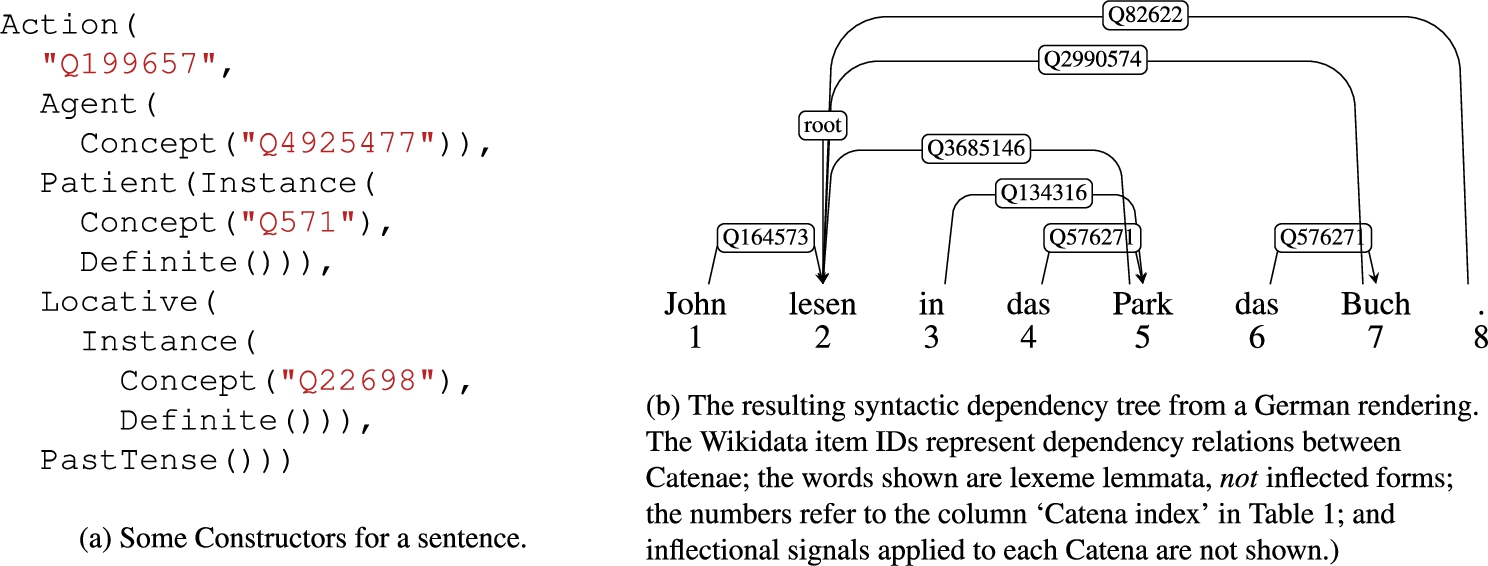
The input and output from rendering a sentence about someone named John reading a particular book in a particular park in the past.
Abstract content in Ninai is ultimately assembled through the nested composition of different types of Constructors in a particular arrangement; an example of such an arrangement of Constructors is shown in Fig. 4a. How exactly a Constructor is created, and how it and its arguments are processed when rendering a Constructor, are discussed in Section 5.1.
A number of other data structures are provided by the current implementation of Ninai for ease of information management throughout the Constructor rendering process (for which see Section 5). They are defined mainly for technical reasons, subject to the restrictions noted in Section 2.4, and the purposes they serve could be realized wholly differently should Ninai/Udiron be implemented in another software environment.
“Contexts” are lists representing where and how deep into a tree of Constructors a particular rendering step is occurring (effectively functioning like a stack trace). When rendering the Constructor “Framings” hold information provided at the start of the Constructor rendering process to control the behavior of named individual Constructor types, named individual Constructors, individual languages, or some combination of all three. If, when rendering Fig. 4a, the lexeme senses used should be those preferred in a particular location (see Section 3.1 for discussion of “location of sense usage”), this information would need to be supplied within a Framing to the Constructor at render time. “RendererArguments” objects collect and separate outputs from the different argument types mentioned in the previous subsubsection so that they may be properly referred to in the main step of the Constructor rendering process. “Processors” are multiple function object types that perform different steps of the Constructor rendering process, described in Section 5.1, that can be paused if certain required information is absent, and that can be resumed when said information is ultimately provided.
Udiron
Udiron, broadly speaking, handles syntactic manipulations as well as phonological and morphological transformations that may be needed throughout the abstract content rendering process. The primary conceptual abstraction that Udiron introduces is the Catena, described in the first subsubsection. As with Ninai, however, multiple other data constructs are defined in the current implementation to ease the processing of Catenae, including the OutputEntry and those described in the second subsubsection.
Catenae and OutputEntries
The Catena is the primary unit of syntactic trees that may be generated by Udiron. It consists of a lexeme, the language to be used when stringifying the Catena (typically the same as the lexeme’s language), the sense being expressed by the lexeme, a set of inflections – that is, Wikidata item IDs representing grammatical feature items – to be applied when stringifying, a configuration container, and links to both logical left- and right-hand syntactic dependents (which are pairs of Catenae and Wikidata item IDs, where the item IDs representing syntactic relationships).
Distinct from but related to Catenae are “OutputEntries”, which are the main outputs from rendering Catenae. (They are a more recent development, relative to the time of writing, prompted by an interest in maintaining some ability to examine the origins of parts of the output.) In languages that use word separators such as spaces or other characters, they represent distinct words, which may in fact represent multiple underlying lexical components (an OutputEntry for German ‘im’ would have two components representing ‘in’ and ‘dem’). The components of these OutputEntries have much of the same information as Catenae, save for the links to dependencies and configuration, while the OutputEntries themselves provide, in addition to the components, the surface representation yielded by the combination of the components and a configuration container similar to that used by Catenae. An overall output string from Catena rendering is generally formed by concatenating the OutputEntries’ surface representations in order.
Textual content in Udiron is ultimately assembled through the arrangement of Catenae by generating them at different stages of the Constructor rendering process and attaching them together at other stages into a syntactic tree; an example of such an arrangement of Catenae is shown in Fig. 4b. How exactly a Catena tree is transformed into OutputEntries, or “stringified”,8
A more ideal term might be “linearized”, but this already has different meanings in other text generation contexts.
A couple of other data structures are provided by Udiron for ease of information management throughout the Catena rendering process (for which see Section 5):
“FunctionConfigs” hold information used to configure the behavior of syntax tree editors. They are simply stores of key-value pairs, where the key is represented by a Wikidata item ID and the value is either a string (most frequently) or some other unique object type (such as a Wikibase lexeme object or a Wikibase statement value). They may be derived from a Framing but are typically populated by other rendering steps as those steps proceed and pass them around. “CatenaTrackings” indicate the origins of individual Catenae (that is, the Constructors and their place in the abstract content tree that directly led to their generation).
Community-contributed functions
The previous two subsections discussed the base Ninai/Udiron system, but this system simply cannot operate without community contributions. (As of the time of writing, the ‘community’ consists solely of the author – see the start of this section – although the author has consulted with numerous individuals as these contributions progressed regarding their correctness.) The first of two major parts into which these contributions may be divided consists of writing various types of functions to be invoked by the system. Both Ninai and Udiron specify these types and their ability to be chosen and run based on different parameters, usually the language and the Constructor type being dealt with. The first two function types below may be defined for Ninai, and the second two for Udiron:
When Constructors are created (e.g. by executing When a Constructor is rendered into Catenae, several types of functions are run at different stages of the process, for which see Section 5.1. Individual Constructor types (typically more generic or container-like Constructors) may define renderers that call out to sub-renderers, which are themselves chosen and run based on the same or different parameters as those involved in selecting the original renderers. Syntax tree editors spawn and edit Catenae in various ways, potentially taking various types of parameters but still returning changed syntax trees in the process. Most of these typically either attach Catenae to other Catenae as dependents in particular positions (leftmost, to the right of the root, and after particular other dependents are among the many possibilites) or modify the fields of Catenae while leaving the syntactic structure intact. Various sub-functions and helper functions, sometimes shared across languages, are often defined alongside these. Different types of stringifiers control the selection of forms for a particular type of lexeme and inflection set in a given language, as well as handle any outward changes that must be applied after all forms have initially been selected.
For any abstract content to be fully renderable in a given language, each of these types of functions must exist for all such Constructors in that abstract content for that language. Language fallbacks for most of these function types may also be defined (except for the argument filters, which are not executed with respect to a particular output language). If, for example, a renderer for a Constructor in a particular dialect of a language doesn’t exist, then the renderer for the language in general may be specified to be used; if that doesn’t exist, then the one defined for ‘multiple languages’ (‘mul’,
Sense graph
The second of two major parts into which community contributions may be divided consists of improvements to Wikidata’s lexicographical data, specifically with regard to the construction of a dedicated sense graph used by Ninai to retrieve specific lexemes given a particular concept. (This is treated separately here, rather than considered a part of the base Ninai/Udiron system, because appropriate graph database software that can perform the necessary searches is not currently powering the Wikidata Query Service, and it is desired that such software be used and be accessible for all possible natural language generation systems that could be hosted on Wikifunctions, not just this system.)
The current implementation of Ninai/Udiron assembles using NetworkX [2] a graph of relationships involving certain properties (currently “translation”, “synonym”, “antonym”, “hyperonym”, “pertainym”, “item for this sense”, “predicate for”, and “demonym of”, for which see Section 3), retrieving these relationships using simple Wikidata queries. It then produces views of these graphs containing some of these relationships (e.g. with only predicates, or with only substantives) that may be breadth-first searched from a given origin sense or item to yield all other senses connected to that origin, no matter how far they may be.
As an example, using
Rendering
Rendering in Ninai/Udiron consists of the entire set of transformations from a Constructor into a string. When “rendering” is spoken of unqualified (or qualified with “overall”), all parts of this process are meant. This process, however, is ultimately divided into two main parts which are important to distinguish by the types of objects involved: 1) the transformation from Ninai Constructors as an input to Udiron Catenae as an output, and 2) the transformation from Udiron Catenae as an input to Udiron OutputEntries.
Abstract content rendering
The rendering process for a Constructor typically yields a single Catena for a syntax tree (as well as configuration information to be passed on elsewhere, if the associated Context is not empty). It can be split into five main steps, some of which may be skipped if they are not applicable to a particular Constructor, whether due to a lack of appropriate function definition or due to a lack of arguments in question:
The pre-hook function (if it is defined) performs some initial modifications to the Constructor itself, returning as output a Constructor. If no modifications end up being performed (that is, if the output is the same as the input), then the step is over; otherwise, the pre-hook associated with that Constructor’s type is run, and a similar check is performed on the result of that pre-hook, and so on. (“Meta-Constructors” could be set up in this way by defining appropriate pre-hooks that yield Constructors of entirely different types than those of the Constructors initially provided.)
For each scope argument in the result from the pre-hook, this entire Constructor rendering process is run, and the output Catena and configuration from that Constructor rendering process is stored.
For each core argument in the result from the pre-hook, the following is run and the output Catena and configuration therefrom are stored:
The argument pre-hook (if it is defined for that argument) makes adjustments to, or extracts information from, an argument Constructor before it is rendered;
This entire Constructor rendering process is run for that argument; and
The argument post-hook (if it is defined for that argument) typically performs some clean-up related to the actions of the argument pre-hook.
The main renderer must be defined for a particular Constructor type in a particular language before a Constructor of that type can be rendered in that language. It takes in the set of Catenae and the combination of configurations output from rendering core and scope arguments, and it produces a single Catena and potentially modified configuration. It is here that most calls to Udiron syntax tree editors originate, and thus where most Catenae are generated, combined, and modified in the Constructor rendering process.
The post-hook (if it is defined) performs some post-processing steps to the Catena returned by the main renderer.
The Constructor in Fig. 4a contains two
Syntax tree rendering
After obtaining a Catena from rendering a Constructor, that Catena’s rendering process yields a list of OutputEntries whose surface representations, when concatenated, yield a readable output string in a natural language. The process can be split into four main steps, functions for which must be defined for each language:
The first step, “selecting forms”, consists of performing a generalized in-order traversal of the syntax tree and, for each Catena, typically checking whether the Catena’s inflection set is empty and there is exactly one form in the Catena’s lexeme that has the inflections in the inflection set. If both are the case, then nothing else is done; otherwise, it tries to develop a form based on the information in the Catena and registers it in the Catena’s configuration and inflection set. (This development typically involves multiple sub-functions for a particular language tailored to particular parts of speech, and may involve exploring the rest of the syntax tree if necessary.)
The second step, “collecting forms”, performs the same traversal of the syntax tree, but instead for each Catena produces an OutputEntry (or OutputEntries) using just the information in that Catena: no arbitrary syntax tree exploration is permissible at this stage. The decisions to be made in this step are thus likely to be less complex than those in the previous step, and if there is any information about the Catena that is not reflected in the form representation chosen and absolutely must be carried over to later steps, then it must be supplied in the OutputEntry (or OutputEntries) being produced. This includes information about surface transformations needed in the fourth step of the Catena rendering process.
The name of the third step, “surface joining”, might suggest that it “joins” the list of surface forms obtained from the previous step. Prior to the introduction of OutputEntries, this was in fact the case, as the output from this step was a single string. Since the entries now must remain distinguishable at the end of the Catena rendering process, however, the effect is now limited (for those languages with explicit word separators) to introducing word separators to the surface forms of the OutputEntries.
The fourth step, “surface transformation”, performs transformations on the list of OutputEntries output by the previous step. These transformations can originate from morphological, phonological, or simply orthographic considerations, but typically in each case lead to the merging of adjacent OutputEntries into one with multiple components. The information about transformations from the “collecting forms” step is applied here.
The result from the first two steps applied to the Catena in Fig. 4b is visible as the OutputEntry components in Table 1. The sentence after the third step is initially “John las in dem Park das Buch .” (note the space between ‘in’ and ‘dem’, as well as the space between ‘Buch’ and ‘.’), but information provided alongside the Catenae for “in” and “.” trigger transformations in the fourth step that contract “in” with “dem” to form “im” (whence the component with surface index “2”) and remove the space between “Buch” and “.” to yield “Buch.” (whence the component with surface index “5”), yielding at the end “John las im Park das Buch.”
Ninai and Udiron form the two main parts of a natural language generation system, highly function-based in the spirit of Wikifunctions, and highly operant with lexicographical data in the spirit of Wikidata. The system is continually being designed and revised to be general enough so that any handling of linguistic phenomena has a place in which it may reside, whether in community-edited Wikidata entities or in community-contributed functions, and to be accessible enough to end users that operations common to multiple groups of functions need to be recreated as little as possible. The system’s inputs are intended to be clear enough, and its outputs similarly transparent enough, that any problems or sources of improvement within the overall rendering pipeline can be identified and addressed as clearly as possible.
In addition to general code improvements and optimizations, the future development of Ninai/Udiron could be separated into two equally productive avenues, each requiring input from different types of communities. One such avenue could consist of adding and expanding support for rendering Constructors in more typologically diverse languages, especially as their lexicographical data becomes sufficiently enriched that sentences may be reliably produced using lexemes in those languages. Another such avenue could consist of introducing and expanding more general facilities within and after the overall rendering process, in order to provide more practical and powerful capabilities for users with interests in specific facets of abstract content inputs (e.g. the pausing/resuming facilities of Ninai Processors) and of textual outputs (e.g. the use of OutputEntries). Both are likely to require flexible and performant visual (and possibly aural) user interfaces for community members to suggest, edit, and add code and data once Abstract Wikipedia and Wikifunctions eventually launch.
Footnotes
Acknowledgements
Special thanks to Cory Massaro, Kutz Arrieta, and Maria Keet for their feedback regarding Ninai’s and Udiron’s code, and to (among other active contributors to Wikidata’s lexicographical data) Jan Ainali, User:Nikki, and Nicolas Vigneron for their feedback regarding some of the texts output by Ninai and Udiron.