




Abstract
Modern life is increasingly made more comfortable, efficient, and sustainable by the smart systems that surround us: smart buildings monitor and adjust temperature levels to achieve occupant comfort while optimizing energy consumption; smart energy grids reconfigure dynamically to make the best use of ad-hoc energy produced by a host of distributed energy producers; smart factories can be reconfigured on the shop-floor to efficiently produce a diverse range of products. These complex systems can only be realized by tightly integrating components in the physical space (sensors, actuators) with advanced software algorithms in the cyber-space, thus creating so-called Cyber-Physical Systems (CPS). Semantic Web technologies (SWT) have seen a natural uptake in several areas based on CPS, given that CPS are data and knowledge intensive while providing advanced functionalities typical of semantics-based intelligent systems. Yet, so far, this uptake has primarily happened within the boundaries of application domains resulting in somewhat disconnected research communities. In this paper, we take a cross-domain perspective by synthesizing our experiences of using SWTs during the engineering and operation of CPSs in smart manufacturing, smart buildings, and smart grids. We discuss use cases that are amenable to the use of SWTs, benefits and challenges of using these technologies in the CPS lifecycle as well as emerging future trends. While non-exhaustive, our paper aims at opening up a dialog between these fields and at putting the foundation for a research area on semantics in CPS.
Keywords
Introduction
Recent years have brought about accelerated developments in embedded networked systems such as the Internet of Things, communication technologies and information processing, as well as, as a side effect of these advances, their convergence to novel, complex systems generically referred to as Cyber-Physical Systems (CPS) [46]. CPS span the physical and cyber-world by linking objects and processes from these spaces. In a typical CPS, data are collected from the physical world via sensors while computation resources from the cyber-space are used to integrate and analyze the information in order to decide on optimal feedback processes which can be put in place by physical actuators. CPS go beyond traditional engineering systems in terms of size, complexity and dynamism. CPS have diffused and play an increasingly important role in a variety of (mission critical) domains and their infrastructures, including public transportation, energy services, and industrial production. Therefore, CPS are at the forefront of several national and regional research agendas [18,21] and funding bodies.1
EUs Digital Single Market Policy on CPS,
NSF Division on CPS, https://www.nsf.gov/funding/pgm_summ.jsp?pims_id=503286&org=NSF&sel_org=NSF&from=fund.
In terms of the information processing aspect, an emerging concept in CPS research, and beyond, is that of a Digital Twin (DT): the digital representation of a physical system, which reflects the system status thanks to data collected in real-time through sensors across the entire life-cycle of the system. As such, the Digital Twin consists both in a model of the system itself (e.g., its components and their characteristics) as well as real-time data. Therefore, the Digital Twin relies on the combination of several, heterogeneous, often dynamic data sources and should pave the way to analytics that support advanced functionalities – thus providing an excellent context for the use of SWTs.
Not surprisingly, the use of SWTs in settings that bridge into the physical space, have already been investigated in the last decade, for combining sensor networks with the Web [9], augmenting products with semantic descriptions [39], or enabling smart city infrastructures [8]. Since then, the application of SWTs has been steadily increasing, focusing on entire systems (e.g., CPS), even in mission-critical domains. However, research mainly focused within the boundaries of concrete domains and research communities, such as manufacturing [5,31], electric grids [23], or buildings [6]. As a result, there is a lack of understanding of the commonalities and differences between applying SWTs in the CSP life-cycles of these domains, thus hampering exchange of ideas between communities, comparison of solutions and exchange of data.
With the amplified interest in CPS, this is therefore a good time to go beyond the boundaries of domain-focused research communities, and to reflect on commonalities across them, such as:
What are domain-overarching CPS use cases amenable for the use of SWTs?
Which SWT capabilities can support CPS use cases best?
What challenges were observed when applying SWTs in CPS life-cycle so far?
What are future trends that will influence semantic research in CPS in the next decade(s)?
In this paper, we aim to answer these questions by taking a cross-domain view on the applications of Semantic Web research for CPS. To do so, we build on an extensive study of the use of SWTs in smart manufacturing [5] and extend it with experiences in the areas of smart grids and buildings gathered in Austria’s largest Smart City Living Lab, the Aspern Smart City Initiative.3
Aspern Smart City Research:
We start with a brief introduction of the three CPS-based application domains that informed this paper in Section 2, then discuss topics regarding semantics-amenable use cases, benefits and challenges of SWTs as well as emerging future trends in Sections 3 to 5.
For each mission-critical domain, we discuss the notion of CPS and why SWTs are promising.
Production systems (Industry4.0)
The manufacturing sector is facing challenges such as shorter time to market, increased product diversification and customization, highly flexible (mass-)production while ensuring high product quality and improved production efficiency. Several initiatives aim to address these challenges by modernizing industrial production: Industrie 4.0 [3] in Germany, the Factory of the Future initiative in France, and the UK [38] or the Industrial Internet Consortium in the US.
Core to these initiatives is the focus on increased digitization of production systems in factories and of production processes. These digitization efforts lead to the upgrade of traditional factories to
Industrial production has several characteristics that make it an attractive application area of Semantic Web research. First, it is a knowledge and data intensive domain: the engineering of products and of the factories that produce them rely on complex engineering knowledge; large data sets are handled both during the engineering (e.g, a factory may be described by tens of thousands of signals and components) and operation of CPPS (e.g., logs of the production process). Second, the engineering of complex mechatronic objects, especially production systems, is increasingly driven by information models that enable representing different aspects of the produced system [27]. To that end, a range of IEC/ISA standard information models are adopted during the engineering of factories. However, these standard information models lack a formal semantics that would make them amenable to automated processing. Third, data exchange standards, such as SysML and AutomationML [24], provide standardized schemas to represent engineering information and as such address syntactic heterogeneity across engineering disciplines, but again they do not address semantic heterogeneity of the data encoded with them. Therefore, challenging tasks according to [27] include: model representation, model transformation, model integration, model consistency management, and flexible comparison of components, as detailed in Section 3.
Energy systems (smart grids)
Smart Grids, also referred to as
This increased complexity, heterogeneity and automation of the grid requires adequate digitization, i.e., through digital twins. Electric digital twins could enable planning, operation, and maintenance of grids based on a set of information models. For instance, it will be possible to plan how to integrate new components and controls in the daily network operation business considering different steps of operation, e.g., the planning process or the daily field work. Digital twins could also offer a solution to dealing with sensor data – created as a side effect of decentralization and renewables – which is complex to manage and exchange.
Electric digital twins enabled by SWTs are already available for high-voltage grids because they contain a relatively small and static number of devices. It is therefore feasible to semantically describe these devices and manage the resulting static digital twin.4
There is also an abundance of domain vocabularies for modeling power grid information. For example, the Common Information Model (CIM) allows describing power system resources such as energy management systems, SCADA systems and power system topology. It can therefore act as a domain ontology for digital twins in the energy sector.In low-voltage grids, however, both the number and diversity of devices is much higher than in high-voltage grids thus making the application of SWTs more desirable, but at the same time also more challenging. Therefore, medium-sized Distribution System Operators, in charge of low-voltage grids, are still at the beginning of mapping their infrastructure to a coherent electrical digital twin, and provide a promising application area for SWTs.
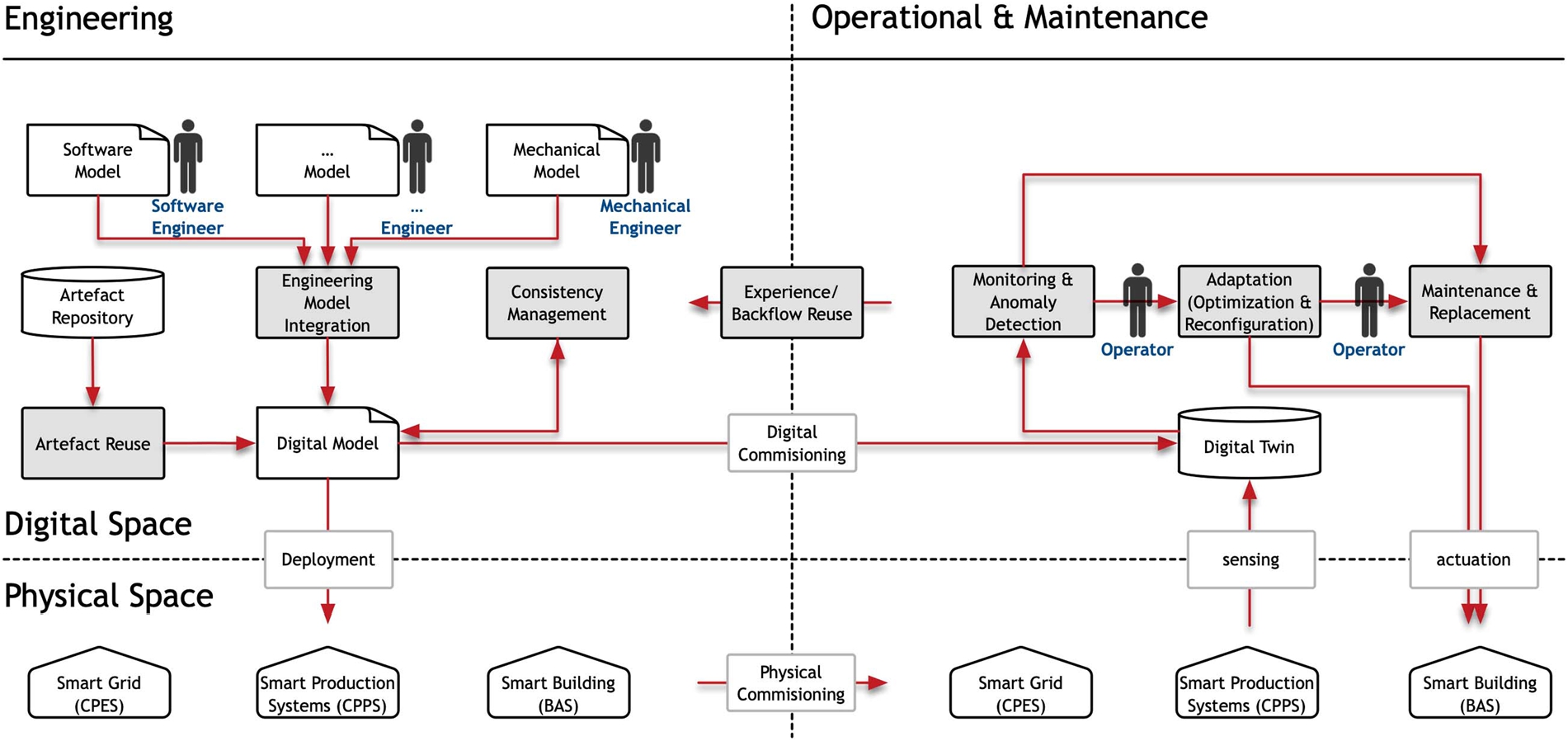
Use cases amenable to the use of Semantic Web technologies in the lifecycle of a Cyber-Physical System.
Residential and commercial buildings are the third main sector of final energy consumption besides industry and transportation. Key to sustainability in this area are cyber-physical systems in the form of networked automation systems, also known as
The need for information modelling and integration of heterogeneous data is present in several aspects of smart buildings.The development of BAS over the years led to a heterogeneous landscape of networking standards, technologies and proprietary BAS solutions. Deployed BAS solutions are often specialized for a distinct field of application (i.e., trade) in a building. Therefore, it is necessary to deploy more than one technology within an installation of a single building. These subsystems must be able to exchange information by relying on shared data models and interfaces (i.e., digital twins). To that end, SWTs, in particular ontologies, are extensively used for information modeling for building automation [6].
Another active area of research is the interoperability of different BAS standards. For example, OPC Unified Architecture (OPC UA, IEC 62541) supports the modelling of engineering and runtime data through an object-oriented approach. For technical equipment in buildings, also more specific models and taxonomies are used, for example brick schema [2] or the project haystack [37], some of which already use RDF to facilitate basic integration across standards.
The advent of the digital building and Building Information Modeling (BIM) further increased the importance of modelling engineering and runtime data as well as the relation between them in a digital twin. To that end, several industry standard data models were developed, such as Industry Foundation Class (IFC) or BIM. SWTs can facilitate this integrated use of the models through techniques such as ontology-based data integration or ontology matching.
Where can Semantic Web technologies help?
Based on the experiences of the authors in the three domains, we present a (non-exhaustive) list of use cases valid across the three domains, where the application of SWTs is promising. Figure 1 captures a simplified view of the CPS life-cycle across two stages, namely (1) engineering and (2) operation and maintenance. In each stage, we distinguish between the physical and the digital space. The physical space covers the concrete, material system both during CPS construction (engineering) and, after commissioning, CPS operation and maintenance. The digital space depicts the main information models at each stage and the use cases related to these data models.
Engineering
The engineering of a complex CPS (a smart factory, smart building, or smart grid), is typically performed in multi-disciplinary settings, where (engineering) experts with different expertise collaborate towards creating a Digital Model of the CPS according to which the real-world CPS is built as part of the deployment process. Such multi-disciplinary settings are characterized by the need to support this collaborative effort towards (1) integrating heterogeneous engineering data models into a single, complete and consistent digital model; (2) ensuring the consistency of this model; and (3) supporting modifications of this model through artefact reuse. Accordingly, there is an opportunity to use SWTs to support these tasks, as follows:
In the area of production systems, ontology-based data integration methods are widely used to integrate engineering models [14] and, more recently, Knowledge Graphs were proposed for addressing this task [20]. Although there are several ontologies available for different engineering domains relevant to smart buildings, there is a need for ensuring interoperability and improved interaction processes among these different domains [35], for example by ontology alignment [44]. To support the engineering of smart grids, an ontology matching process is proposed to align the Common Information Model and IEC 61850 standards [41].
Operation and maintenance
The transition from engineering to operation is marked by the commissioning of the CPS: at the physical level this includes putting the system in operation (e.g., transporting and installing a previously engineered production system); at the digital level, the digital model is, ideally, also passed on to the operation phase (note: in reality, the digital model is often not shared with the stakeholders in the operation phase).
During operation (runtime), information is collected through sensing about the functioning of the CPS through various sensor streams. For example, in a production system, information about the materials used, the current process, and the positions of the industrial robots can be recorded. In smart grids, active and reactive power in the distribution grid is recorded. This runtime information complements the “static” digital model created during engineering and results in the Digital Twin of the CPS, which enables a variety of use cases that could be supported by semantics.
A use case that spans both the operation and engineering phases of CPS, concerns enabling
Lessons learned from the application of SWTs
Benefits of Semantic Web technologies
The following SWT capabilities were perceived as beneficial in the CPS life-cycle:
Challenges in using Semantic Web technologies
Some requirements and assumptions of CPS are fundamentally different from typical Semantic Web application areas, which focus on the integration of Web-scale data. This leads to a number of challenges when using SWTs in CPS engineering and operation.
Looking forward: Future research trends
To conclude, we discuss selected emerging trends in CPS that will require substantial, long-term research.
FIWARE:
Web of Things:
Footnotes
Acknowledgements
We acknowledge the financial support of FFG PoSyCo (867276), FFG CitySPIN (861213), Aspern Smart City Research, the Christian Doppler Association, the Austrian Federal Ministry for Digital & Economic Affairs and the National Foundation for Research, Technology and Development.