




Abstract
Energy consumption and performance assessment of Smart Cities must consider different levels and various sub-domains. A comprehensive energy profile of a city, in fact, should work at the city, district, and building levels. At the same time and for each level, it should take into account both electrical and thermal consumptions, and gather these information from a plethora of different sensors and from various stakeholders (i.e., citizens, utilities, policy makers, and energy providers). Current modeling approaches for this context address each level and domain separately, thus preventing a structured and comprehensive approach to a unified energy representation. Moreover, current approaches make it difficult to keep the consistency between the energetic data through levels, sub-domains, and across stakeholders. Starting from an analysis of ontologies at the state-of-the-art, this paper shows how DogOnt can be used as a foundation towards a shared and unified model for such a context. DogOnt was firstly developed in 2008 and withstands over 8 years of usage without major failures and shortcomings. We discuss successful design choices and adaptations, which kept the model up-to-date and increasingly adopted in such a mid-term time frame for energy representation in Smart Cities.
Introduction
Energy consumption and performance assessment of Smart Cities must consider different levels and various sub-domains. A comprehensive energy profile of a city, in fact, should work at the city, district, and building levels. At the same time and for each level, it should take into account both electrical and thermal consumptions, and gather these information from a plethora of different heterogeneous sensors and from various stakeholders (i.e., citizens, utilities, policy makers, and energy providers).
In such a context, intelligent, and in particular, semantic-based approaches can be seen as viable solutions to extract sense from the vast sea of information made available by the large number of sensors spread all over the city, at different levels, and involving the various stakeholders. Several research groups and companies are working on techniques deriving from the Semantic Web and Artificial Intelligence to address the modeling of so many different aspects, be it at the application, sensing, or device level. Three initiatives, in particular, tackle this issue from different perspectives: the Linked Open Data (LOD) initiative, the Semantic Sensor Web (SSW) initiative, and the Semantic Big Data research activities.
Linked Open Data (LOD) [3] acts at the application level and it provides machine understandable, shared and open semantics for representing a wide set of knowledge domains in the world. While monolithic approaches aim at modeling entire domains in a comprehensive manner, thus leading to single, rigid and practically not-scalable representation models, the LOD approach exploits the linking and mapping primitives defined in OWL and integrates more than 295 datasets1
Such a figure refers to 2011, with the number of datasets steadily increasing in the last years.
The Semantic Sensor Web (SSW) [27], instead, specifically focuses on sensing networks, thus aims to address the diversity of sensors and sensory data. To do so, it provides means for modeling sensor devices (and their capabilities), systems, and processes. The most important results of the SSW initiative are the Semantic Sensor Network (SSN) ontology, defined by the W3C SSN XG group that was active from 2009 to 2011, and the related Sensor, Observation, Sample, and Actuator (SOSA) ontology [20].
Finally, the Semantic Big Data research field2
A definition and some papers are available at
Current modeling approaches and initiatives, however, are too general for the energy context (e.g., SSW [27]) or too domain-specific(e.g., [30]), since they aim at modeling each level and domain separately. In this way, a structured and comprehensive approach to a unified energy representation is not possible and, similarly, it is difficult to maintain the data consistency between the energetic information through levels and across sub-domains.
This paper builds upon the motivations sustaining semantics as a viable solution to effectively tackling the energy domain in Smart Cities with a unified model. Starting from an analysis of ontologies at the state-of-the-art, the paper discusses an ontology representation, DogOnt,3
The DogOnt ontology is available at
In the past eight years, DogOnt evolved to tackle representation issues emerging from residential, building, and factory automation solutions. Lately, it included primitives for dealing with distributed networks of sensors deployed as part of smart buildings. Nowadays, DogOnt empowers several research projects needing uniform, semantic access to environment sensors and actuators. Those projects encompass several domains and field of interest. To exemplify, in the smart grid domain DogOnt has been used in the Leaf Island project (i.e., imported in the Leaf Ontology) [7], while in the JEERP project [6] it was used for building an Energy-Aware Enterprise Resource Planning. Furthermore, it has been incorporated in the EEOnt ontology [13] for providing an unified representation of energy efficiency in buildings, it has been used as “as a starting point for the specification of [some] concepts in ThinkHome” [25], adopted by the UniDA framework [29] for the integration and interoperation of devices in Human Interaction Environments, and it was among the most important sources used in the creation of the SAREF ETSI standard [11,15].
Eventually, it successfully supports abstraction of several standards including both Internet of Things (e.g., ZigBee4
E.g., the ZigBee Home Automation (HA) extension is available at
The remainder of this paper is organized as follows: Section 2 provides an up-to-date overview of the current modeling panorama for energy consumptions and assessment in Smart City settings. Section 3 introduces the DogOnt model in its current form, by discussing the foundations and showing practical modeling examples, while Section 4 motivates and illustrates why DogOnt can be used as a unified model for this context, thus serving as an evaluation of the proposed approach. Finally, Section 5 provides final remarks and discusses the foreseen evolutions in the next 5 years.
Energy performance assessment and representation demands for models able to deal with an increasing variety of ground truth data, generated through heterogeneous monitoring networks and devices. The emergence of IoT approaches to Smart Cities is stressing the importance of a uniform and machine understandable representation of the energy qualities of devices, rooms, buildings and, by extension, of districts and entire cities. This need is currently acknowledged by several research efforts, both industrial and academic, which aim at building domain ontologies to model energy consumption and performance. In the energy domain, ontologies are employed to define shared and common inter-language for performance evaluation, energy rating, device consumption profiling, etc. Approaches present in the literature, typically, address the energy domain by splitting the analysis along different forms of energy, i.e., electrical and thermal. On the one hand, this division permits to tackle the specificity of the single energy form and the related engineering domains. On the other hand, it prevents a structured and comprehensive approach to energy representation, at higher levels of detail, like at the district level.
Electrical sub-domain
Electric energy consumption is one of the most important aspects modeled in the smart environments (e.g., home and building) domain. Such an importance is related to the amount of “saving” that can be achieved by considering energy management as fundamental part of home and building automation. Approaches for modeling energy consumption in smart environments mainly address the problem under two complimentary point of views. The first aims at modeling instantaneous consumption, i.e., consumption levels associated to specific, observable states of devices and appliances. The last, instead, considers the overall consumption “profile” of a given electric device, i.e., the sequence of consumption levels associated to a complete “working” cycle.
As an example, consider a washing machine. The first approach finely models the machine consumption when spinning, heating water, drying clothes, etc. while inferring the current consumption according to the machine state. The second, instead, considers complete washing cycles (e.g., delicate washing) and models the energy consumption trend with respect to time, often in discrete steps.
An extension of DogOnt designed and developed by the authors and available at
The challenge of representing electric device consumption has been tackled in several initiatives driven by home automation standardization bodies. Among these, the Energy@Home consortium,6
In the last years, the increasing need for standardization of energy consumption modeling and representation promoted the European initiative on Energy Using and Producing Products [12], which lead to the creation of the Smart Appliances Reference ontology (SAREF [11]), now an ETSI standard [15]. SAREF formalizes in OWL the “energy profile” concept developed in the ZigBee Alliance, thus providing a standard, machine understandable representation of energy consumption of devices, over time. Moreover, it models explicitly the observable states of devices7
As DogOnt was among the most important input sources used in the creation of SAREF.
With respect to DogOnt, whose first edition is antecedent the release of SAREF, the latter has considered more than 23 base ontologies in its design, while DogOnt was designed and built on the basis of the former standard models for the home automation and appliances domains, e.g., the EHS taxonomy and the DomoML ontologies [18]. Nevertheless, in its evolutions, DogOnt incorporated many modeling primitives and representation choices deriving from other related models, and its success in such a task is proven by its extensive adoption in SAREF. It is important to notice that here the authors are not claiming that the modeling approach and solutions provided by DogOnt are better than those supported by SAREF. Instead, they strongly sustain the adoption of SAREF as reference model, in particular considering the latest extensions for energy [17] and building [16]. The main rationale of presenting DogOnt as a possible seed for AEC/FM modeling is providing a first “unified modeling” core, SAREF-compatible and able to easily include/map existing energy-related models relying on DogOnt, e.g., [25] and [13] . In perspective, the authors aim at bootstrapping mappings between such models and the ETSI standards, exploiting the common model described in this paper.
While SAREF tackles energy consumption modeling at the device level, ThinkHome [25] (that also exploits many of the DogOnt concepts for modeling devices) addresses energy representation with a more structured approach. In fact, it considers building information for supporting optimized control strategies striving for energy-efficient operation of smart environments. It achieved this goal by explicitly integrating data stored in Building Information Models (BIM). Both Industry Foundation Classes (IFC) concepts and Green Building XML specifications [14] are supported.
The common modeling base shared by SAREF, PowerOnt and ThinkHome, i.e., DogOnt, provides a strong hint on the viability of a unified energy modeling framework, based on ontologies, able to deal with different levels of detail from single devices to full homes and buildings, regardless of the energy form.
The latter aspect, which is worth citing in the electrical domain, regards consumption flexibility, i.e., the ability to perform temporal load switches depending on both internal (self-production) or external (active demand-response) constraints. In such a context, some attempts can be cited which tackle the flexibility challenge by exploiting a formal, ontology-based modeling. Among them, the MIRABEL project defines the FlexOffer ontology [30] and represents objects involved in energy flexibility systems and their relationships. It provides a conceptual framework where the flexibility concept is defined and set in relation with building information and smart grid data. FlexOffer is mainly intended as a tool for supporting IT and Energy stakeholders to handle supply and demand of energy, using a common inter-operation language. In addition, FlexOffer is partly integrated in SAREF, thus being easily reconducted to the SAREF modeling base ontology.
Ontologies addressing energy profiling under the thermal standpoint typically represent the temporal evolution of consumption, since instantaneous data is less relevant in environments where time constants are of the order of minutes or hours. In the thermal domain, most of the ontology-based models address energy performance evaluation in terms of multiple energy efficiency indexes, as prescribed by the European Energy Performance of Buildings Directive (EPBD), which imposes the adoption of measures for improving energy efficiency in buildings.
The Energy Efficiency Ontology (EEOnt) [13], for example, provides a semantics-rich, representation of energy data in terms of EPBD objectives, thus offering means to model buildings and energy efficiency in a unified way. Moreover, it provides tools for building energy assessment inventories, enabling the creation of formal, machine understandable and easily assessable certification schemes.
Similarly to most of the ontologies described for the electrical sub-domain, EEOnt builds upon the work done in DogOnt [4] and its extensions. Through DogOnt, appliance properties are exposed according to existing semantic models, while power consumption is modeled by introducing a specific Energy Profile ontology (i.e., PowerOnt [5]). EEOnt explicitly represents links between building components and corresponding energy efficiency indexes, which is clearly complimentary to the ThinkHome approach.
The SmartCoDE ontology model [1], instead, represents the thermal homologous of profile-based modeling of electric consumption. It provides a classification of Energy using Products (EuPs) into seven categories based on their compound temporal and energy behavior. Included categories are: (a) variable services; (b) thermal services, (c) schedulable services, (d) event-timeout services, (e) charge control, (f) complete control, and (g) custom control. Moreover, an energy management and a cost profile characterize each product. SmartCoDe mappings with SAREF exists and can be easily obtained [19].
City and district-level modeling
Systemic views of energy consumption are gaining momentum, thanks to an increasing demand for representing building energy profiles in the context of a wider district- or city-level vision. The Urban Energy Ontology (UEO),8
The CERISE CIM Profile for Smart Grids, i.e., the Common Information Model developed by the Cerise-SG project,10
an RDF/XML model for the smart grid domain:
Other relevant standards, at the city and district level, such as the LandXML13
Overview
The DogOnt ontology aims at offering a uniform, extensible model for all devices being part of a smart environment, no matter if at the home, building or district level. Its major focus is on device modeling, for all the aspects needed to abstract device “capabilities” from low-level idiosyncrasies and communication issues. This enables both abstract reasoning on devices, e.g., to find similar devices or to identify the most suitable output to which forward urgent notifications, and actual integration of different technologies, and paradigms. DogOnt was firstly introduced in 2008 [4] and was originally meant to represent home automation devices for interoperability support. Currently at version 4.0, DogOnt underwent several reviews and amendments in the past years, and its scope was widened to include devices and technologies typically part of an indoor IoT network (e.g., through the cluster-based ZigBee HA extension16
e.g., available at

DogOnt relations with well-known ontologies.
If in the first release of DogOnt the main target stakeholders were system integrators and developers dealing with issues related to interoperability of different home and building automation systems, the last version of DogOnt, here summarized, targets a much wider user base including: system integrators, developers, IoT companies, IoT developers, data analysts and in general any stakeholder having the need to access and represent IoT data according to a uniform, standard and machine understandable model.
From a very high-level perspective, the ontology is deployed along three main hierarchies of concepts, supported by four additional trees that better specify the knowledge encoded in the main topics. The three hierarchies are respectively rooted at BuildingThing, Functionality and State (Fig. 2).
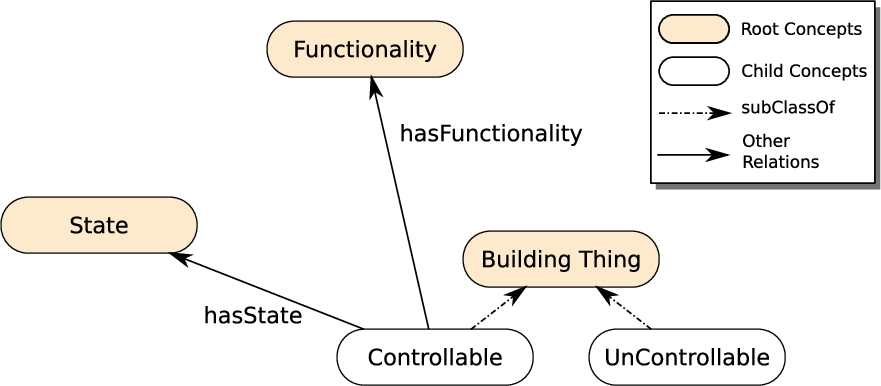
The main representation pillars.
The BuildingThing hierarchy is one of the pillars of the DogOnt ontology and is completely devoted to the description of objects contained inside architectural spaces. These object are divided in Controllable and UnControllable entities. The former represent any device that can be somewhat controlled into a closed environment, i.e., it represents the nodes of any smart environment network. The latter, instead, represents all physical, inanimate objects contained in an indoor environment, including furniture, inner walls and partitions, etc. This hierarchy is strictly interconnected with the other two main pillars of the representation: the Functionality and the State trees of classes.
Functionality is the top concept of a class hierarchy that was originally designed to represent devices under an operational perspective. Each device was given a set of functionality which completely specified the device type, allowing - for example - classification reasoning. In the latest ontology evolution, the functionality representation has moved to a more service oriented approach,18
In such a sense also the “Functionality” name is undergoing a serious review process to better reflect the new nature of modeled concepts.
Finally, concepts inheriting from the State class model the current condition of a device (Controllable, in DogOnt), using the Harel’s state chart semantics [21] as reference model and allowing devices to assume multiple states at the same time, with different state values. For example, a smart microwave oven which is heating a frozen meal can be modeled as being in the “on”, “defrosting”, and “emitting microwaves” states at the same time. This enables higher flexibility in modeling, and permits to tackle different abstraction levels and different granularity depending on specific application cases.
On the formal standpoint, DogOnt is an OWL2 DL compliant ontology with
DogOnt metrics
As can easily be noticed, DogOnt adopts a modeling paradigm that maintains a clear separation between ontology schema and instances (0 instances in the main ontology). In such a way, environment descriptions are independent and slowly evolving knowledge (the schema) is well separated from quickly changing models (environment representations).
Subsequent paragraphs better detail the DogOnt model with respect to devices and surrounding environments.
Devices and sensors corresponding to physical objects, or behaving as (virtual) physical devices, are represented as subclasses of the main Controllable concept (equivalent to the Device class defined in the SSN ontology). Controllables are further specialized into Appliances, HousePlants and NetworkComponent (Fig. 3), which respectively identify smart objects (e.g., fridges, washing machines, etc.), sensors and actuators,21
The common ancestor concept name (HousePlants) is under revision as it is no more intended to represent devices belonging to house plants, only.
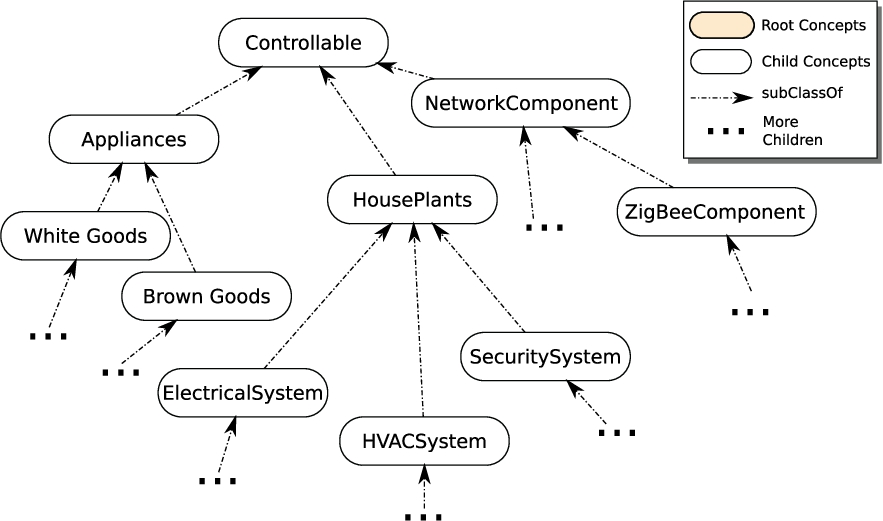
Controllable subclasses.
While the initial modeling approach was mainly descriptive and modeled device operations through single, shared instances of subclasses of the Functionality concept, the current ontology adopts a strong service-oriented approach where devices and operations (functionality classes) are associated by means of object properties (
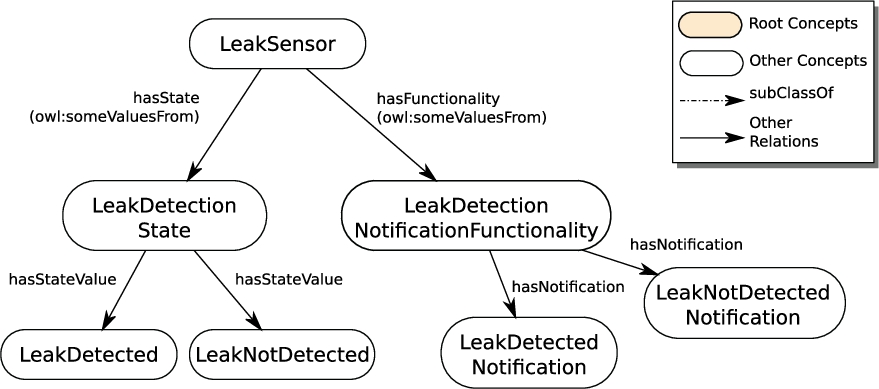
An example of device class predefined in the ontology.
The set of named devices defined in DogOnt encompasses devices included in the early European Home System (EHS) taxonomy, in the ZigBee device specification for Smart Metering and Home Automation, plus several other entities typically occurring in actuation and metering infrastructures (e.g., in indoor IoT networks). Nevertheless, this structure can easily be extended to support generic device definition, by removing the indoor constraint, and by adopting a more general naming schema less bounded to typical indoor systems, e.g., by renaming the Controllable class to ConnectedDevice, and so on.
Predefined device classes, in DogOnt, are organized in the main three hierarchies reported in Fig. 3, which are further subdivided in commonly used categories. Appliances are split along the main white and brown goods categories, respectively referring to big appliances such as fridges, ovens, stoves and to small devices such as TVs, Hi-Fi systems, etc. HousePlants are divided into sub-systems each pertaining a single, homogeneous field of application and include the electric, the Heating, Ventilating and Air Conditioning (HVAC), and the security (e.g., smoke or movement sensors) sub-systems. NetworkComponents are eventually organized according to the physical network they represent, e.g., ZigBeeComponent for ZigBee networks, ModbusComponent for Modbus networks, HueComponent for the Philips Hue connected lighting system, and so on. While Appliances and HousePlants are completely independent from network specific information and can be freely adopted to abstract any physical device in terms of supported functionality and possible states, the concepts belonging to the NetworkComponent tree are designed to “attach” network-specific data to abstract devices (through multiple typing), thus enabling low level access to the underlying physical sensor (e.g., through a gateway software). Section 3.4 reports a complete, yet simple, modeling walkthrough to better clarify the notions introduced here.
The concepts hierarchy stemming from the Functionality root defines the possible services (or operations) that devices can provide. Such services are categorized on the kind of interaction they support/imply. In particular, 3 different types of interactions are considered: query, notification and control. They are modeled by the sub-trees of classes rooted at QueryFunctionality, NotificationFunctionality and ControlFunctionality, respectively.
Query functionality model all possible interrogations that a device could answer to. They represent the typical request-based (or polling-based) interaction between devices and applications aimed at gathering data at application-driven instants. They represent, in other words, those device services that provide data upon explicit request, e.g., to get the current power consumption from an electricity meter or to obtain the amount of cars counted by a vehicles counter sensor. Notification functionality, on the converse, represent event-driven interactions between devices and applications, i.e., they represent the ability of a device to autonomously notify new data, e.g., measures, current state, etc. Eventually, control functionality represent the actuation (and configuration) capabilities of a device. They permit to associate pre-defined set of commands (modeled by Command instances) to devices, thus allowing to completely model the device capabilities at an abstract, technology-independent level. For the sake of clarity, control functionality can be seen as abstract, shared interfaces that define how a device can be controlled by applications (or end-users).
Control and notification functionality are complemented by two auxiliary set of classes respectively rooted at Command and Notification, which are exploited to attach predefined set of commands (notifications) to functionality modeled in DogOnt. For instance, an OnOffControlFunctionality is defined as having at least one OnCommand and one OffCommand by means of suitable OWL restrictions (

Example of functionality modeling.
While concepts inheriting from the Functionality class model services offered by a given device, the current device state is represented by means of the hierarchy of concepts stemming from the root State class, and can assume several StateValues depending on its definition. State modeling, in DogOnt, follows the Harel’s statechart semantics (Hierarchical FSMs) which provides support for complex state descriptions including parallel states, history states, clustering, and refinement. Such a semantics well adapts to complex behavior of real-world sensors and permits to represent complex devices as having multiple state values at the same time. For instance, a smart plug might be at the same time on, and measuring electric power, and so on. It should be noted, however, that statecharts semantics does not imply exact modeling of any real device state, as this is often unfeasible. Real devices might, in fact, evolve through several, unknown, internal states which are of little interest for actual interaction in EAC/FM scenarios. Therefore, modeled states are typically a subset of actual device states, and mostly refer to observable conditions in which the device might be. Figure 6 reports an example of state modeling for color dimmable lamps.

State modeling for color dimmable lamps.
Both functionality and states are partitioned in descriptions of properties assuming real and discrete values, as defined in the former ontology versions. However, in the presented ontology, the formal representation of functionality and states assuming real values has been improved by accounting explicitly the associated unit of measures, thanks to a tighter integration with the well established UCUM/MUO ontologies.22
Concepts stemming from BuildingEnvironment and from the UnControllable branch of the BuildingThing hierarchy provide means to describe the environment hosting the modeled devices, and in particular to roughly represent the architectural spaces (i.e., rooms, etc.) containing the modeled network. Such a hierarchy has remained almost unchanged since 2008, therefore we provide a general overview of the adopted modeling paradigm, only, while interested readers may look at the original publication [4].
Environment modeling in DogOnt is rather abstract and mainly aimed at locating indoor devices at room granularity. Reflecting this general design goal the available concepts permit to represent: (a) Buildings as instances of the Building concepts. (b) Storeys, as part of multi-storey buildings. (c) Flats, either located on single or multiple storeys. (d) Rooms inside flats and other indoor locations (e.g. Garages) located outside flats; (e) Walls, ceilings, floors, partitions, doors and windows composing both rooms and building boundaries.
Positioning is addressed by simple containment relations, i.e.,

Example room modeling, in RDF/XML syntax.
Extensions are currently under development to link DogOnt concepts to positioning ontologies capable of handling indoor positioning systems. In particular, while exploiting the W3C WGS84 for localizing the “origin point” of a building, storey or room, we are planning to integrate relative
To better clarify how DogOnt can be exploited to model devices and networks, and the services they offer, a sample modeling walk-through is reported in this section. Lets assume a Smart Energy context in which a given indoor environment is hosting a sensing network to monitor energy consumption of appliances, smart home devices, sensors and actuators, e.g., for implementing Smart Grid or Demand-side Management Policies (e.g., as in the GreenCom EU project23
For the sake of simplicity, let us shrink down the problem to the representation of a single metering plug measuring the consumption of a traditional oven located in the kitchen of a given house participating in the project. As the smart-plug object is already modeled in DogOnt by means of the MeteringPowerOutlet concept definition, the modeling process simply consists in creating the individuals needed to represent the given plug, the oven, the room, and the house in which the plug is placed.
The aforementioned modeling approach follows a simple, yet general, set of representation steps:
identify the object to represent and the corresponding DogOnt concept (if exists); model the object according to the DogOnt class definition including functionality and states, as imposed by DogOnt-defined constraints; define individuals for additional functionality and states (not available in the pre-defined class specification); model any object that is functional to the correct representation of the initial object (e.g., connected devices for the smart plug scenario); model the environment(s) in which the objects are placed; model any explicit relation between objects, e.g., the control relation between a switch and its corresponding actuator; model the network-specific information allowing to interface real-devices, e.g., by adopting a gateway software.
The final result of these steps applied to the sample metering plug is reported in Fig. 11, while the process applied in steps 1-3, 4 and 5 is better detailed in Fig. 8.
The first three steps of the modeling methodology tackle the representation of the device in focus, i.e., of the sample smart plug, Fig. 8 shows the corresponding activity diagram.

Activity diagram describing steps from 1 to 3. Step 4 and 5 follow a similar process.
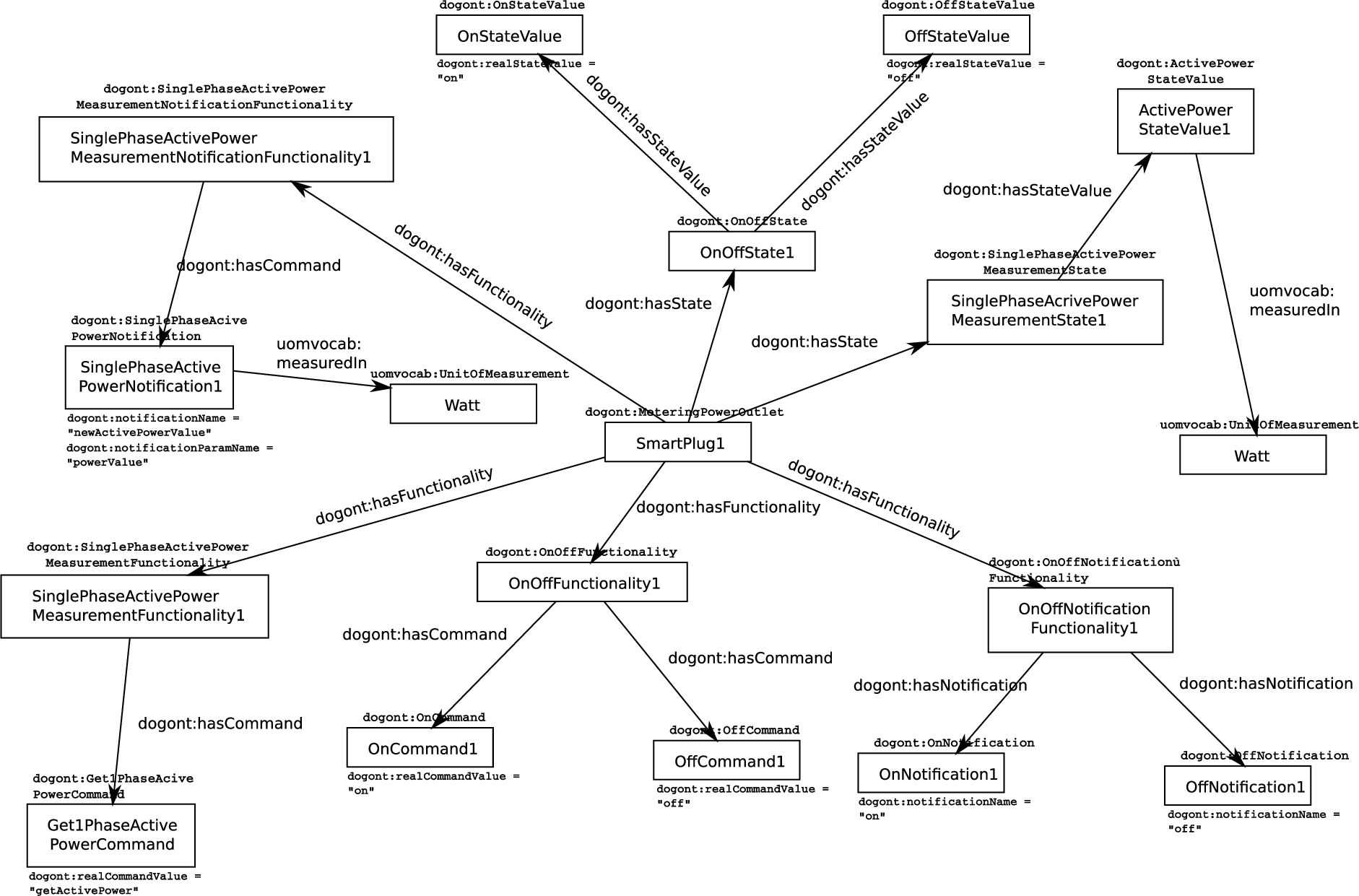
Modeling approach applied to a smart plug, steps from 1–3.
The earliest step in this phase involves a quick browsing of devices currently supported in DogOnt. As a general hint, in this phase, the more quick approach to browsing is “thinking” at system-level: the plug is part of a general electric system/plant, and it is something that can be controlled. The corresponding DogOnt concept, if available, should therefore be under the Controllable concept, possibly located in the ElectricSystem subtree, which in turn stems from the HousePlants class. By browsing the concepts immediately inheriting from the ElectricSystem, it is easy to notice 2 candidate subtrees, respectively rooted at PowerDelivery and Meter. Few hierarchy levels below, the two subtrees converge on the PowerMeteringPowerOutlet class, which perfectly matches the sample smart plug; for the sake of simplicity we assume here that the plug is only able to measure the instantaneous power absorbed by connected electrical loads.
At this point, the modeler shall concentrate on the class definition, where mandatory relations and properties are defined through suitable OWL2 restrictions (constraints). In the PowerMeteringPowerOutlet case, these restrictions (either locally defined or inherited through all the concept ancestors) define the plug (see Fig. 9) as having:
an OnOffFunctionality, i.e., the ability to be turned on and off;
an OnOffNotificationFunctionality, i.e., the ability to autonomously generate events about the current activation state of the plug, e.g., to detect external control events;
a SinglePhaseActivePowerMeteringFunctionality, i.e, the ability to measure currently consumed power and to be queried about current consumption;
a SinglePhaseActivePowerMeteringNotificationFunctionality i.e., the ability to autonomously generate events about the current consumption of connected electrical loads;
an OnOffState, modeling the state assumed by the plug, reflecting its ability to be providing power to connected devices, or not;
a SinglePhaseActivePowerMeasurementState, representing the current state in terms of the currently measured consumption value, and the relative unit of measure.
A suitable instance shall be created for each concept involved into such existential constraints, and the process must be recursively repeated on each of the newly created models. It must be noticed the complete absence of any technology-specific detail in the representation generated so far.

Modeling approach applied to a smart plug, step 4.
The fourth modeling step involves the analysis of the existing relations between the device in focus (the smart plug) and the other devices present in the same smart environment context. Relations modeling in DogOnt is quite lightweight, and mainly 3 relation families are represented: control,connection and metering. The former represents the fact that a device can control/be controlled by another device, e.g., a switch that controls a lamp. The second is specifically related to instances of classes stemming from the PowerDelivery concept and represents the fact that a device is connected to a power delivery object to draw the electric energy needed to provide its own functions. The latter, allows modeling the process of measuring physical quantities of interest, over a set of devices: for example, it permits to specify which set of electrical loads are monitored by a given power meter.
In this modeling step (4th) these relations are analyzed to find devices and, more in general, objects forming the context surrounding a given object, focus of the modeling process. In the sample smart plug case, a single electric load is connected to the plug: a “standing” lamp, with no intelligence on board. As the plug only powers one device, also the metering relation will involve only one instance, i.e., the same lamp. If we assume that our plug is controlled by a remote switch, e.g., located inside the same room of the plug, we finally obtain the result in Fig. 10 where the plug model has been omitted to concentrate on objects modeled in this step.
Step 5
In this step the “built” environment in which objects are placed is represented, including all architectural features as well as all “relevant” UnControllable elements. In the considered example, the main involved entity is the room containing the plug, the switch and the standing lamp. The instantiation process is almost equal to the one followed in steps 1 to 3 for controllable objects and is omitted here for the sake of clarity.
Step 6
The sixth step is the last technology-independent modeling step and provides the complete representation of concepts involved in the described modeling exercise. In such a step, previously isolated models are connected through object properties and corresponding instances are related, thus allowing to perform inferences on the represented information; e.g., to derive that since the lamp is connected to the plug, turning the plug also causes the lamp to be switched off. Figure 11 reports the full model.

Modeling approach applied to a smart plug, step 6.
Given the survey of current energy modeling efforts reported in Section 2, it clearly emerges that energy consumption modeling at district and city level is feasible, and can be achieved on the basis of a solid, standard and shared modeling framework based on ontologies. Among the analyzed efforts, DogOnt proved to be a solid baseline model for high granularity information on device states, which can be easily related to both instantaneous (PowerOnt) and temporal (e.g., as in SAREF) behaviors in terms of energy. Due to existing connections between DogOnt and the SAREF ETSI standard [15], any effort for exploiting DogOnt as a seed for end-to-end modeling of the AEC/FM domain can also be seen as a concrete possibility of defining a “unified modeling framework” for the AEC/FM domain based on standard representations (ETSI) and Linked Open Data approaches.
Clearly, some needed glue layers are still missing. In particular when crossing the modeling domains, from bottom layers (devices) to higher layers (district) modeling gaps and inconsistencies emerge and need to be addressed. In the following subsections, initial mappings between layers are, therefore, discussed and their relations with the DogOnt ontology are highlighted. Clearly no fully applicable, generally viable solution can be identified. Nevertheless, end-to-end modeling of the AEC/FM domain seems feasible and most of the gaps appear to be bridgeable through suitable ontology-mappings, many of those basing on DogOnt. This confirms the potential validity of the authors’ initial claim.

Oversimplified mappings between DogOnt and ThinkHome.
Bridging the device-level representation addressed by DogOnt and the relative energy indicators abstracted at the building level is feasible and could be based on, for example, ThinkHome and EEOnt. Unfortunately, direct mappings between DogOnt and these building level ontologies, in the AEC/FM domain, are not always available. While for EEOnt links already exist, which for example relate the
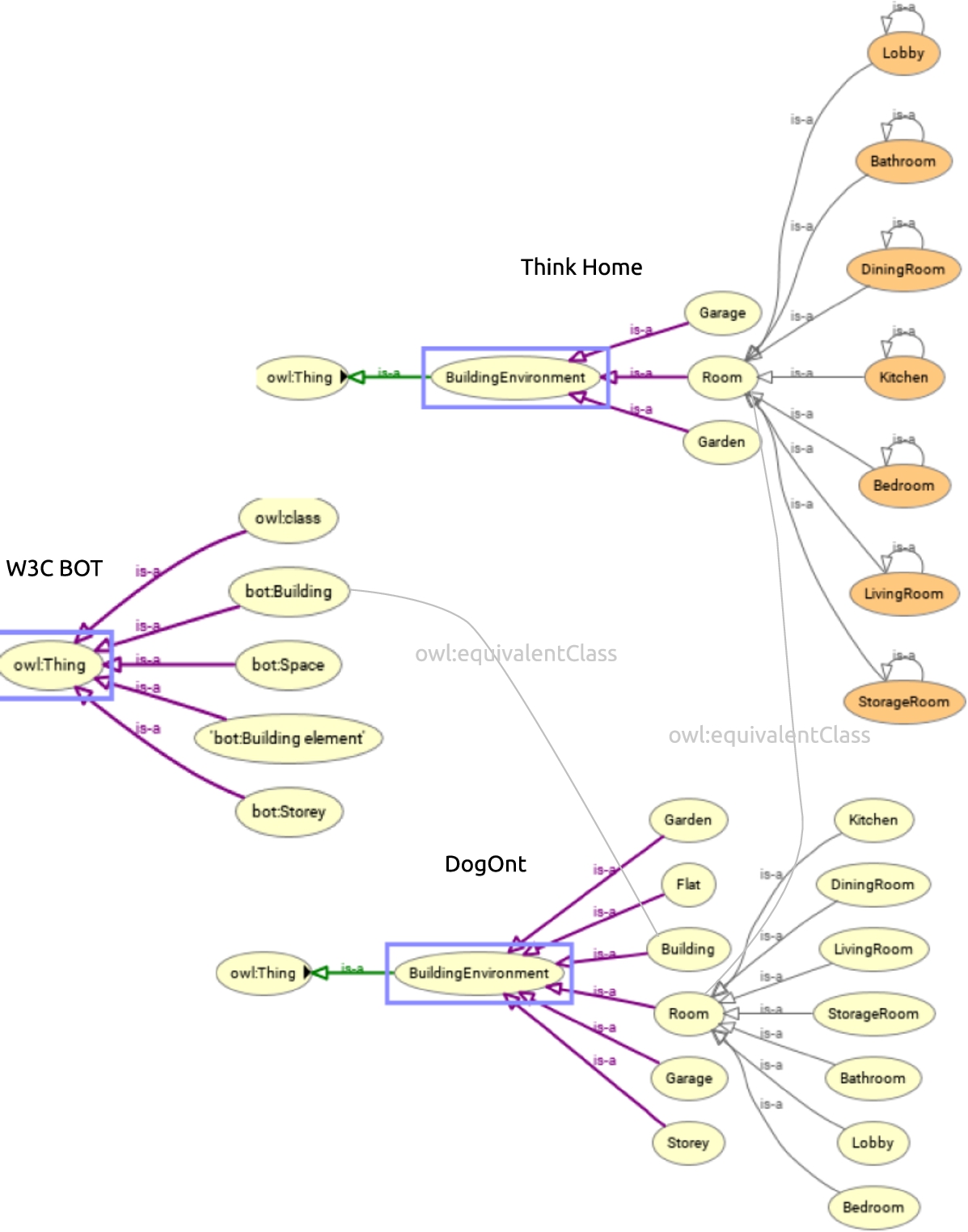
Relations between DogOnt, W3C BOT, and ThinkHome, oversimplified for the sake of clarity.
Still in this case some mappings can be defined which allow exploiting DogOnt as seed model. For example, single sensor and actuator classes in DogOnt can be directly mapped (through
Far more challenging would be setting up suitable mappings between same-level ontologies, e.g., between ThinkHome and EEOnt as they potentially follow completely different approaches to model the building-level information. Nevertheless, being both linkable to DogOnt, bridging over a common subset of “shared” classes is certainly feasible.
One of the initially unforeseen commonalities between DogOnt-based modeling and building-level ontologies, emerging from shared adoption of the former, is the rather abstract approach to representation of the built environment, in terms of rooms, walls, etc. While existing efforts in BIM modeling have extensively addressed the building modeling issues, in many applications of the energy domain BIM models are too detailed and include details which are often superfluous. As an example, modeling walls and openings is important for defining the energy indicators of a certain building, however, fine grained details on building materials may often be replaced by much lighter coefficients, thus reducing the computational footprint of the resulting model (e.g., as done in EEOnt). To acknowledge these common needs a dedicated W3C working group24
At the district-level, ontologies providing district and city-level views of energy performance indicators and models for energy flows are available. However, a general lack of mappings between systematic representations at district-level and existing building-level characterizations, can be observed. Similarly to the device-to-building case, a possible modeling framework to bridge such a gap can exploit DogOnt as seed, optionally building atop of mappings defined at the building level. Considering the SEMANCO-HEAD ontology [10] as a viable example of district-level model developed in the context of the SEMANCO EU project25

A very preliminary mapping between SEMANCO-HEAD and DogOnt.
These mappings are not yet published, nor completely checked: for example a possible inconsistency might arise from disjoint axioms in DogOnt that are potentially in conflict with the hierarchy relationship between
In this paper we presented the latest edition of DogOnt (version 4.0) and we discussed its possible role as “emerging” seed for linked, shared modeling of the AEM/FC domain. While monolithic approaches to modeling are clearly not feasible, a linked-open data approach emerging bottom-up from currently adopted models can provide a suitable, shared modeling basis for this challenging domain. According to literature, the DogOnt ontology is starting to emerge as a possible seed to such a bottom-up process and many of the currently available ontologies in the AEC/FM domain can somewhat be referred to such an ontology. While introducing the latest modification to the DogOnt model, the authors highlighted how the emerging role of DogOnt can be sustained by the availability of official mappings between ontologies at the device, building and district levels.
The proposed mappings have various degrees of maturity and are neither exhaustive nor complete. The work presented in the paper, in fact, is more focused on fostering the definition of links between different modeling efforts in the AEC/FM domain rather than in completely specifying ontology mappings and alignments. Several open challenges remain to reach a sufficiently linked set of ontologies for Architecture/Engineering/Construction (AEC) and Facilities Management (FM), thus calling for further research from both the semantic modeling and the AEC/FM research communities.