




Abstract
We have extended OWL-Time to support the encoding of temporal position in a range of reference systems, in addition to the Gregorian calendar and conventional clock. Two alternative implementations are provided: as a pure extension or OWL-Time, or as a replacement, both of which preserve the same representation for the cases originally supported by OWL-Time. The combination of the generalized temporal position encoding and the temporal interval topology from OWL-Time support a range of applications in a variety of cultural and technical settings. These are illustrated with examples involving non-Gregorian calendars, Unix-time, and geologic time using both chronometric and stratigraphic timescales.
Introduction
OWL-Time [7] provides a lightweight model for the formalization of temporal objects, based on Allen’s temporal interval calculus [1]. Developed primarily to support web applications, date-time positions are expressed using the familiar Gregorian calendar and conventional clock.
Many other calendars and temporal reference systems are used in particular cultural and scholarly contexts. For example, the Julian calendar was used throughout Europe until the 16th century, and is still used for computing key dates in some orthodox Christian communities. Lunisolar (e.g. Hebrew) and lunar (e.g. Islamic) calendars are still used, and many similar have been used historically. Dynastic calendars (counting years within eras defined by the reign of a monarch or dynasty) were used earlier in many cultures. In more contemporary applications, Loran-C, Unix and GPS time are based on seconds counted from a specified origin (in 1958, 1970 and 1980, respectively). Archaeological and geological applications use chronometric scales based on years counted backwards from ‘the present’ (defined as 1950 for radiocarbon dating [6]), or named periods associated with specified correlation markers [4,5,10].
Since OWL-Time only allows for Gregorian dates and times, applications that require other reference systems must look elsewhere. However, the basic structures provided by OWL-Time are not specific to a particular reference system, so it would be preferable to use them in the context of a more generic solution. Some previous extensions to OWL-Time have been proposed, in particular to deal with aggregates and recurrent intervals [13]. Perrin et al. [14] use the OWL-Time temporal relations in their geologic timescale ontology, but introduce a new class and property for geochronologic instants.
In this paper we describe extensions to OWL-Time, which support
the use of an explicit temporal reference system when specifying temporal position,
general encodings for dates and times not based on the Gregorian calendar and clocks.
We provide two implementations: “Time-plus” is a pure extension to OWL-Time, and “Time-new” is a generalized replacement,1
The Time-plus ontology is published at
We illustrate the application of the ontology with a number of examples. While we do not provide a model for describing temporal reference systems, we show how the extended ontology supports the description of ordinal temporal reference systems also extending into deep time.
Temporal reference system
A useful classification of temporal reference systems is provided in ISO 19108 [9]. Four kinds of system are distinguished:
Coordinate systems, in which a (temporal) position is expressed as a signed quantity, offset from a specified origin
Ordinal reference systems, based on ordered named intervals
Calendars, in which position is expressed using a year-month-day structure
Clocks, in which position within a day is expressed in hours-minutes-seconds.
The temporal reference system used in OWL-Time is not explicitly specified [7], but can be inferred to be the Gregorian calendar and conventional clock as this is specified for the
In Time-plus we introduce an additional property, denoted
Temporal position
Two encodings for temporal position are provided in OWL-Time. Using the datatype
Resources from OWL-Time are denoted in this paper with the prefix “time”.
Elements of the ontology

Extended time ontology for supporting additional temporal position encodings. Resources from OWL-Time use the namespace prefix “time:”. (UML-style representation of classes and properties from TopBraid.)
In order to support a wider range of temporal position descriptions, in Time-plus we introduce two classes –
These extensions allow temporal position to be specified using all the temporal reference system types mentioned in Section 2.1:
A temporal coordinate using a
An ordinal position using a
A position in the Gregorian calendar using
A position in an arbitrary calendar using
A position in a calendar/clock system using either
The range of
The range of each generalized date property is defined using the datatype restriction capability of OWL2 [12] so that it has the same lexical form as the original property used in OWL-Time, extended as necessary. For example, the definition of
Note, however, that a generic OWL processor will not support value-based reasoning over purely lexical representations.
The Time-plus ontology described above extends OWL-Time non-intrusively. However, while the class
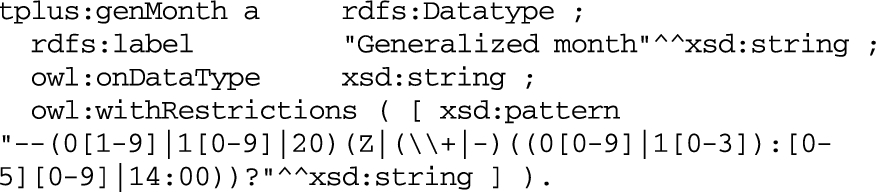
definition of tplus:genMonth as a string pattern (Turtle syntax [2].

Generalized time ontology for supporting additional temporal position encodings. In the context of
We have used the latter approach in Time-new, which is summarized in Fig. 2. The class
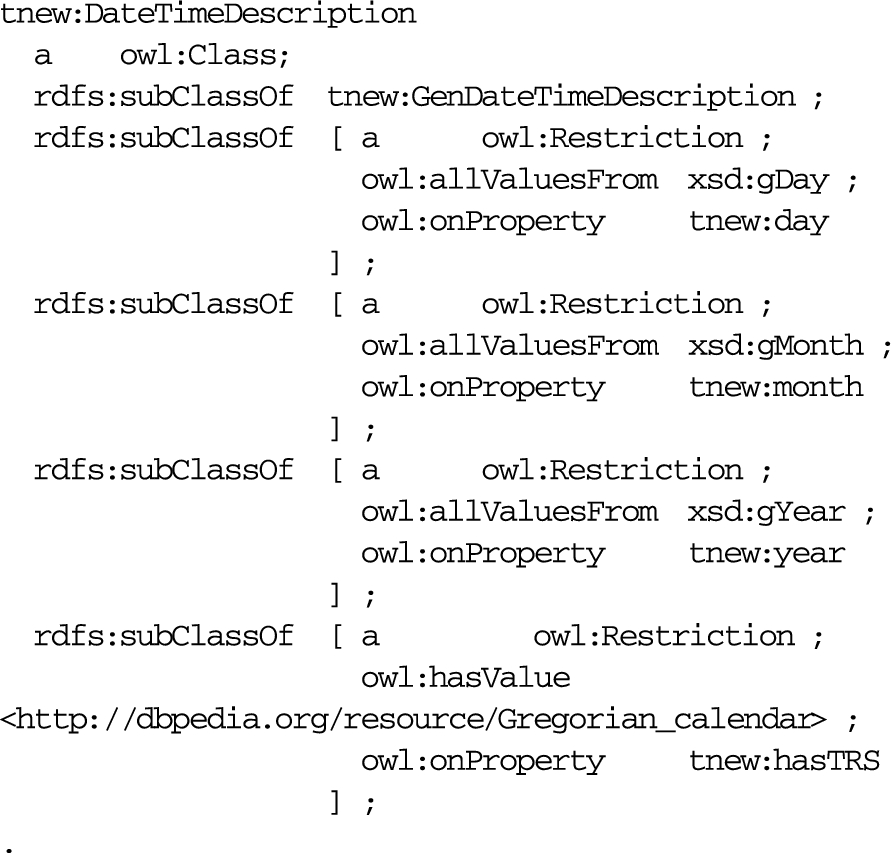
Local constraints on values of day, month and year properties in the context of a Gregorian date-time description.
While this appears to reflect the class semantics better, the mechanics of OWL datatype definition and derivation introduce complications.
The datatypes
Overshadowing all this, however, is the fact that even the XML Schema date-fragment datatypes are not built in to OWL [12], so are not supported by generic OWL reasoning applications. The “temporal reasoner” referred to in the OWL-Time specification [7] might be expected to deal with this, and “Time-new reasoners” could in turn map each additional lexical form to a rigorous value-space in order to support value-based processing. Note that the definition of the date-fragment datatypes is a particularly complex area in XML Schema, with them strictly being understood as elements in the “seven-property model” of a calendar/clock system. It is notable that the values are not integers: the lexical representation of
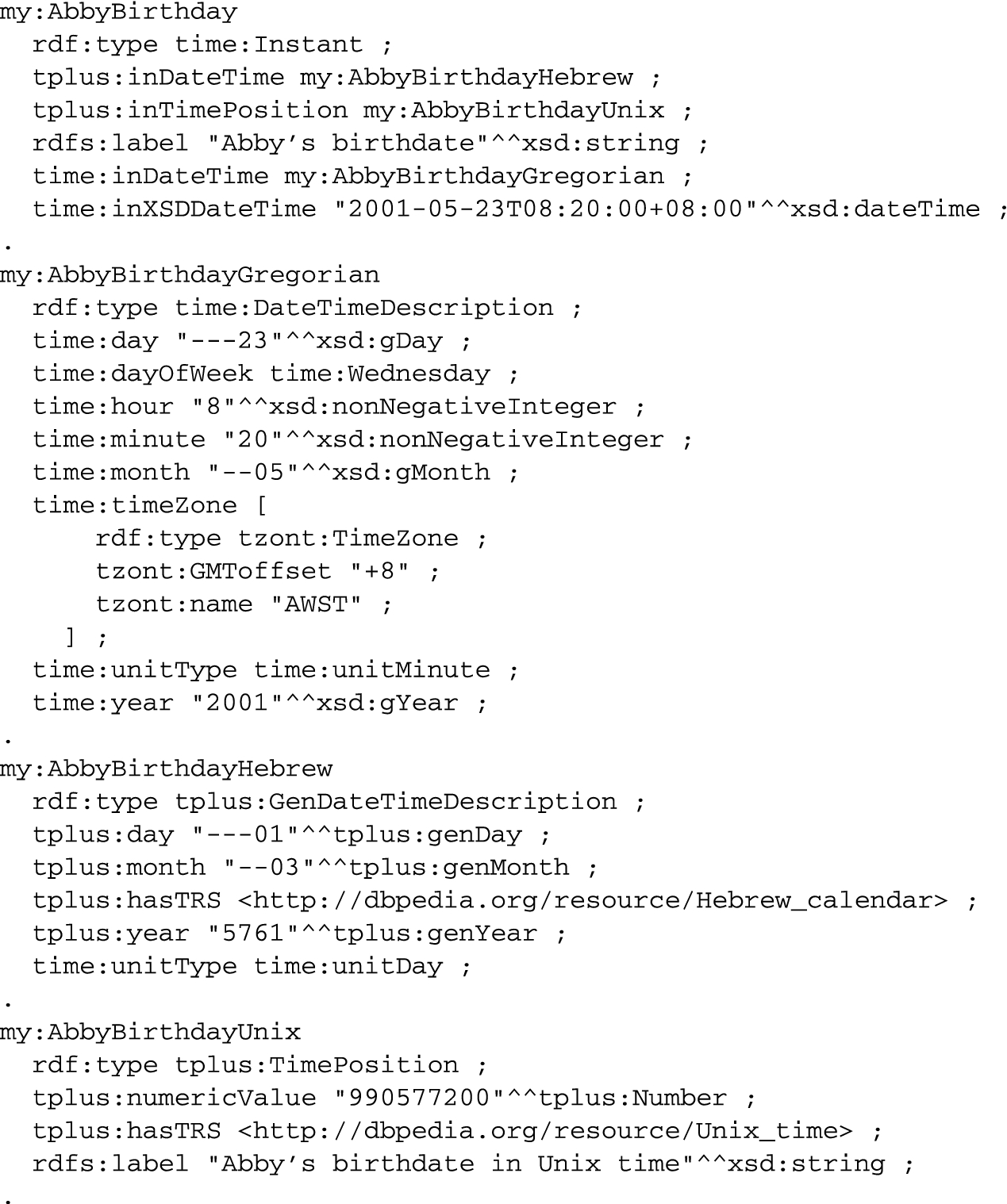
A single event with temporal position encoded in multiple temporal reference systems.
Time-plus and Time-new inherit the limitations of OWL-Time [7] concerning OWL 2 conformance:
restrictions on cardinalities of properties in the
the date-fragment datatypes used in
Time-plus and Time-new meet the requirements for the OWL 2 DL profile, except that some vocabularies used only for metadata annotations on the ontology are not formal OWL ontologies (e.g. Dublin Core and its imports).

Events in geologic time encoded using a deep-time coordinate (in “years before present”), and using a named element from the geologic timescale.

Elements from the geologic timescale, showing some topological relations.
Listing 3 provides an example of a time instant with position formalized in four different ways, using Time-plus:
Listing 4 provides two examples of events in geologic time. The time of formation of the earth is given as a coordinate in the reference system that counts years backwards from the present. The time of the end of the dinosaurs is given as a named position within the international chronostratigraphic chart [5].
Listing 5 shows how the extended ontology supports the description of elements in an ordinal temporal reference system. The Cambrian Period is modeled as a
Using the Time-new ontology, these examples will be structurally identical, but with the prefixes
Note that in both Time-plus and Time-new, the cases supported by OWL-Time are represented identically to the original. This was a key design goal of the new ontologies.
Summary
We have introduced an extension to OWL-Time to support description of temporal position with an explicit temporal reference system, allowing use of temporal coordinate systems, ordinal temporal reference systems, and generalized calendars. The ontology uses the interval topology from OWL-Time. The new ontology is implemented as a non-intrusive extension with three new classes, eight new properties, and four datatypes, or alternatively as a replacement for OWL-Time with a smaller total element count.
The primary complications arise from the involvement of datatypes from XML Schema that are tied to the Gregorian calendar, which must be generalized for use in a wider range of applications. We define generalized types for date-fragments to match the familiar lexical productions from XSD. However, the value space for both the XSD types used in OWL-Time and the new types defined here are not supported in OWL2, so no standard reasoning support should be expected or relied upon when used in class descriptions.
Aside from the datatypes concern, the new ontologies are capable of OWL2-conformant encoding of temporal concepts used in a variety of cultural and technical settings, covering all of the temporal reference system types described in ISO 19108, but retaining exactly the same form as OWL-Time for the cases handled by the original ontology.
Footnotes
Acknowledgements
This work is a contribution towards the harmonization of W3C and Open Geospatial Consortium standards for geospatial data, and was supported by the CSIRO Land and Water Flagship. Michael Compton encouraged me to add the Time-new ontology to the paper, and David Ratcliffe provided advice on some of the hairy datatyping issues.