




Abstract
The aim of the work is to assess the environmental impacts of Ultra High Frequency RFID tags. Through a Life Cycle Assessment approach, two case studies have been investigated, namely a standard plastic and a paper-based tags. Primary data on tags’ components, manufacturing and transportation were collected, while secondary data for the raw materials processing and tags’ end of life were retrieved. The Recipe Midpoint method was used to evaluate the impacts. Results show that, for both tags, the greatest contributions to global warming, terrestrial acidification, mineral and fossil resource scarcity are due to raw material extraction (more than 50%) and manufacturing phase (30–50%), which resulted impactful also on the ionizing radiation (70%). Interestingly, the paper tag allows to save up to 23% of the greenhouse gas emissions and decreases the impact on the above-mentioned categories, resulting the eco-friendly option. The conclusion of the work contributes to update the scientific literature, still poor in RFID environmental evaluations, and are useful for researchers interested in comparing the traditional handling systems’ impacts to the RFID scenario. Furthermore, the outcomes will be used as input for subsequent research, aimed at developing a tool to measure the return on the environment of RFID deployments.
Introduction
The Internet of Things (IoT) is one of the pillars of the fourth Industrial Revolution, also called Industry 4.0, and it is expected to bring additional global benefits (Oberheitmann 2020). Its applications are countless spanning from manufacturing (Ahmetoglu, Che Cob & Ali 2023) to the energy sector (Pandey, et al., 2023), from mobility (Galego & Pascoal 2022) to healthcare (Aliakbarian e Franz 2020) (Caredda, et al. 2016) and fashion (Cilloni, et al. 2019). One of the enabling technologies for this revolution is undisputedly Radio Frequency Identification (RFID) (Maharana & Lathabhavan 2023). Coupled with cloud computing and machine to machine (M2M) communication it is set to improve efficiency and time management in all aforementioned sectors (Sharma & Kumar 2020) Alongside this technological revolution, a major societal change is also taking place: citizens, businesses and institutions are now approaching production and consumption of goods with a more holistic approach. In this sense, the 17 Sustainable Development Goals (SDGs) represent a clean break from the past vision of progress, trying to bend it from a linear to a circular conceptualization (UN 2023). Responsible consumption and production, which is goal 12, states that by 2030 countries should “achieve the sustainable management and efficient use of natural resources” and researchers proved that RFID could make a direct contribution to its fulfilment (Maraveas 2023). Some authors argue that radio frequency identification enables continuous and real-time measurement of farming ground, mainly in greenhouses, that consequently leads to a reduction in wastage by introducing the exact input of nutrients, humidity and temperature needed (Krystallidou, et al. 2022). Others focused on the fashion supply chain, claiming for instance that tags could cut greenhouses gas (GHG) emissions during farming and manufacturing of the fibres (Konina 2023) or stating that the technology could reduce wastage, improve recyclability of the garments and forecast demand more effectively thus avoiding overproduction (Nayak, et al. 2022). Researchers also explored the RFID benefits to reduce medical waste and improve recycling management (Liu & Yao 2017). They discussed how RFID could monitor the information of medical waste in hospitals in real-time which could ensure that wastes are processed according to the relevant standards, thus could reduce the environmental pollution and the spread of diseases caused by the wrong process. Finally, inquiries in the field of food retail reported similar findings to those in farming and fashion and showed how industry 4.0 enabling technologies can affect the sustainability (Stefanini & Vignali 2023). However, some focused on perishable fresh products (Nikolicic, et al. 2021) reporting that it enables a rigorous first-in-first-out policy, preventing shrinkage caused by inventory expiry (Bertolini, et al. 2013).
However, concerning the environmental footprint of the RFID tag life cycle, the literature is gaunt, with no relevant Life Cycle Assessment (LCA) in the past nine years. Authors have mainly focused their attention on disposal scenarios (Bukova, Tengler e Brumercikova 2021) and reported impact assessments based on methods that do not conform with international standards, such as ISO 14044 (Voipio, Korpela & Elfvengren 2021). Interestingly, researchers carried out a cradle to grave analysis focusing on an anticounterfeit label (ACL) and a shock-detection tag (SDT) which are two complex tags whose application is limited to specific situations (Glogic, et al. 2021). Finally, an LCA of RFID tags considered its application on fresh milk and then compared the impact of the tag rollout against the wastages avoided. Results showed that food waste reduction outweighed tag impact (Bottani, et al. 2014). However, nine years have passed since this first LCA and the technologies production are improved, as well as the materials used. In particular, today more attention is paid to the reduction of the plastic use and its substitution with paper, and the replacement of antenna metals with conductive inks. Which are today the environmental impacts associated to the life cycle of an RFID Tag? Can a paper tag be more eco-friendly than a plastic one? This work aims to answer those questions, contributing to the scientific literature that is yet poor on environmental evaluation of this technology. The authors focused on two case studies, carrying out a Life Cycle Assessment of a traditional RFID tag with plastic base, and comparing it with a paper based one. Inventory data have been newly collected from an international manufacturer and a global method, named ReCiPe, has been used to evaluate the RFID contribution to global warming, ionizing radiation, terrestrial acidification, mineral resource scarcity and fossil resource scarcity potentials. Providing up-to-date inventory data and reliable results, the article can be useful for other researchers that could be interested in using RFID impacts in comparison to traditional handling systems (Alsharif, et al. 2023).
Impact assessment methodology
The LCA is recognized by the European Commission as the best methodology able to assess the environmental impacts of a product, process or activity, through the identification and quantification of consumption of raw materials, energy and emissions as well as the evaluation of possible actions for tackle these impacts (European Commission 2023). According to the two reference standards, namely ISO 14040 and 14044, the term Life Cycle Assessment refers to the collection and assessment of the inputs, outputs, and potential environmental effects of a product system during the course of its existence, starting with the purchase of raw materials and continuing through manufacture, distribution, consumption, end-of-life care and final disposal. According to regulation (ISO 14040 2006), an LCA study is divided into four phases, which have been followed to carry out this work and are presented in the following sections:
Goal and scope
The goal of the Life Cycle analysis is the impacts evaluation of an Ultra High Frequency (UHF) RFID tag in both its standard plastic-based version and its innovative paper-based one. The results’ comparison will be useful for retrieving the best RFID tag solution from an environmental point of view. The functional unit of this research is one UHF tag. The LCA is “from cradle to grave”: it analyses the entire life cycle of the RFID tags. Therefore, the system boundaries include the upstream, core and downstream processes, as illustrated in Fig. 1. The first ones comprise the extraction and production of raw materials that make up traditional and paper-based RFID, the transports of the raw material, the impacts due to upstream power generation, and the production of primary, secondary and tertiary packaging used for the transportation of RFID tags. The core processes include the assembly/fabrication of RFID tags, the impacts due to electricity production. On the other hand, they do not include, as they are outside the scope of the research, the production of manufacturing equipment, buildings and other capital goods, the staff business trips, the personnel travel to work and the research and development activities. Finally, as downstream processes, the end-of-life transport, as well as the end-of-life processes of RFID tags and packaging waste have been considered. The impact of the use phase has not been assessed, given its dependency on the kind of technology deployed and geographical location.
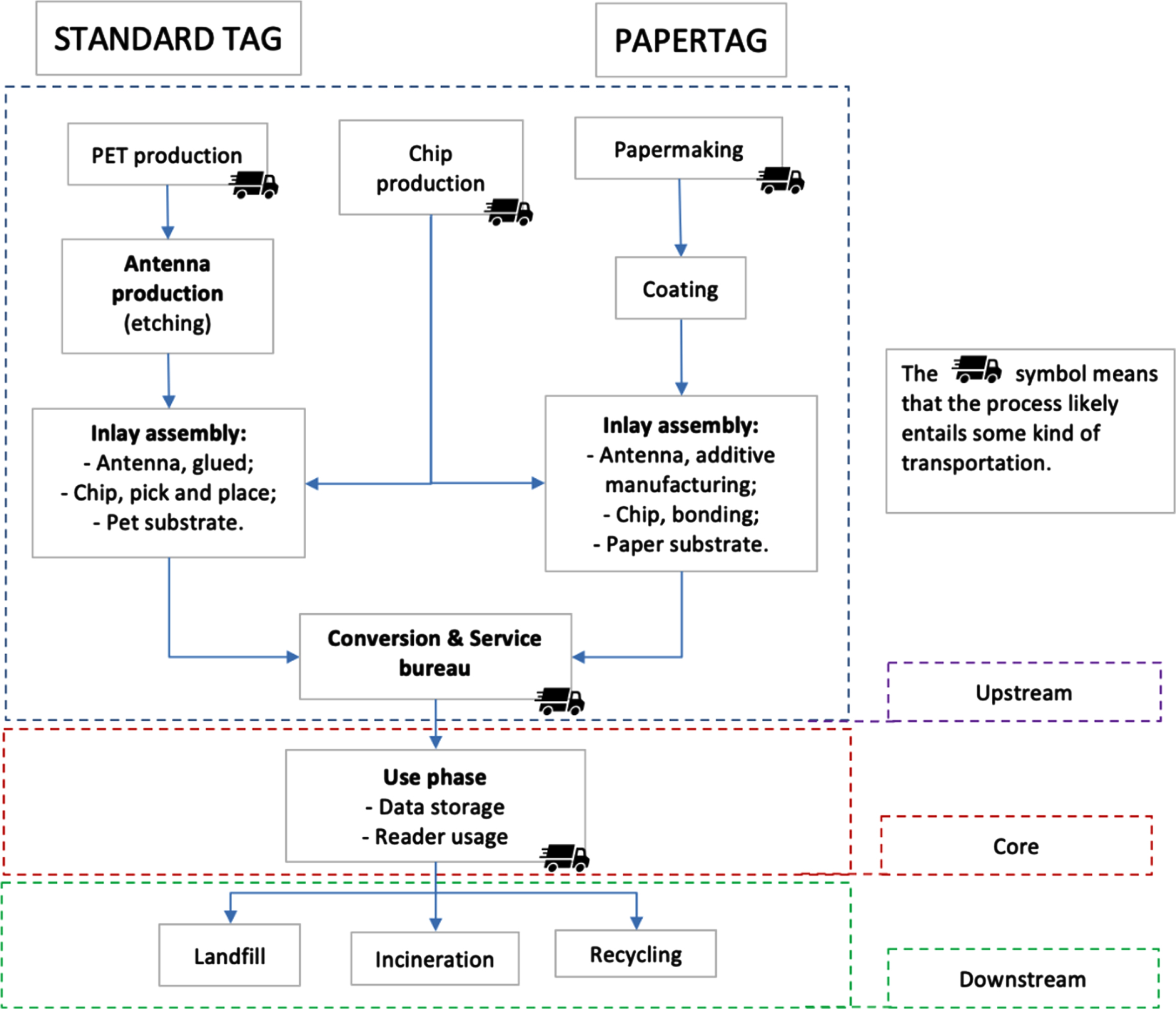
System boundaries of standard tag and paper RFID tags.
The study follows the attributional LCA approach, i.e., according to the conventional definition, it models the system to ensure that all inputs and outputs are attributed to the functional unit of a product system by linking and/or partitioning unitary processes (Sonnemann & Vigon 2011); the result of this approach provides a static picture of the impacts associated with all processes included in the system boundaries, without looking into the future or taking into account the market and economic implications of a decision, which are the typical features of the so-called consequential approach.
The inventory was provided in cooperation with eAgile Inc. located in Grand Rapids, MI, USA. All the data about the process have been collected from the field while, and Ecoinvent 3.9 was used as the source of secondary data. The company filled out an Excel document stating the raw materials, with related weights and transport figures, manufacturing processes, and packaging. Table 1 illustrates the basic dimensional values related to the two tags.
Dimensions of the standard and paper tag
Dimensions of the standard and paper tag
The standard UHF tag is composed of: Face label –a thin plastic film that protects the chip; UHF chip –it receives and answer to the signal of the reader; Inter layer –a thin plastic film that divides the chip and the inlay; Inlay –the actual antenna that allows the chip to receive the signal; Adhesive layer –it enables to glue the tag to a surface.
The data supplied by eAgile were modelled following the broad composition of the tag, therefore all raw materials, manufacturing processes and transportations have been accounted as these five separate elements. The life cycle of a standard plastic-based tag follows a straight line of intertwined processes. Firstly, all the raw materials are extracted, collected and then undergo a first chain of processes that makes suitable for manufacturing purposes. Table 2 shows the weight of the components, their core materials and the corresponding items chosen in Ecoinvent database. Secondly, Table 3 shows the mode of transportation and the distance from the sourcing point to the manufacturing hub. Thirdly, raw materials are subjected to specific manufacturing processes. For instance, the antenna is obtained by etching or chemical milling, which is a kind of additive manufacturing technique that employs chemical etching agents to craft intricate and exceptionally precise parts from virtually any type of metal. Table 4 reports the overall electricity needed for assembly, also covering the pick and place procedure where a mechanical arm picks a chip and places on a tiny drop of glue on the inter layer. Since Ecoinvent still does not have items related neither to etching nor to additive manufacturing and the company was not able to supply primary data, metal and plastic workings were modelled using items whose core processes were as close as possible to the original. Table 5 shows the packaging involved in the shipping of the end product. The packaging data were provided as cm3 or cm2 meaning that, in order to get a weight, some calculations were carried out. A corrugated board box has an average density of 0,0001 kg/m3 (UNI10351 1994) and an average thickness of 0,00295 m (Tecnocart 2020), therefore it is applied the following formula:
Raw materials used for the production of the standard tag
Raw materials used for the production of the standard tag
Transportation of raw materials used for production of the standard tag
Manufacturing processes used for the standard tag
Packaging items used for handling of standard tag
Please, note that commas are used in the work as decimal separators. The corrugated core has the same density as above and the volume is provided by the company so the formula is just W [kg] = V [m3] * D [kg/m3]. Besides, the first formula is applied to the antistatic bag whose average density of 950 kg/m3 (LLC 2023) and an average thickness of 7,62E-5 m (PlastMagazine 2022).
Finally, Table 6 shows the end-of-life of the components, modelled as a market waste process. About the chip, since only the area was available, a simplification was made by calculating the ratio between the area and weight of the whole RFID and the area of the chip. The result, namely the weight of the chip, was then used to determine its disposal procedure.
End-of-life of a standard tag
A paper tag is composed of: Face label –the paper substrate on which it is assembled the tag; UHF chip –it receives and answer to the signal of the reader; Inter layer –a thin plastic film that divides the chip and the inlay; Inlay –the actual antenna that allows the chip to receive the signal; Adhesive layer –it enables to glue the tag to a surface.
The life cycle follows the same steps as the standard tag. The components, their weight and their modelling on the Ecoinvent database are shown in Table 7, while Table 8 illustrated the transportation and the distance from the sourcing point to the manufacturing hub. Table 9 reports the overall electricity needed for assembly. The packaging involved in the shipping of the end product are shown in Table 10 and, finally, the end-of-life of the components, again modelled as market waste, excepting the paper substrate that is recycled, are presented in Table 11.
Raw materials used for the production of the paper tag
Raw materials used for the production of the paper tag
Transportation of raw materials used for production of the paper tag
Manufacturing processes used for the paper tag
Packaging items used for handling of paper-tag
End-of-life of a paper tag
To comply with the established objective and scope representative data of the analysed processes were collected accurately and comprehensively, with a focus on: Time coverage: primary data of the procurement of raw materials and RFID tags and auxiliary materials are from 2022. Secondary data come from the Ecoinvent 3.9 database, updated in 2023. Geographical coverage: the production of primary materials, their assembly and distribution refer to the United States, where the company that provided the primary data is based, or to a global dimension, where they are marketed. Secondary data and final disposal data also refer to the global landscape or include the world except Europe. For electricity consumption of the upstream and core phases, reference was made to the US energy mix. Technology coverage: the data collected cover the specific technologies, or their combination, for the production of traditional and paper RFID components, and their auxiliary materials.
Life Cycle Impact Assessment
The ReCiPe 2016 Midpoint (H) was chosen as impact assessment method. The Recipe method was first developed in 2008 through cooperation between RIVM, Radboud University Nijmegen, Leiden University and Pré Consultants (Huijbregts, et al. 2017). From its update in 2016, it has really taken the lead among other impact methods and, according to a brief search carried out on Scopus database, in 2022 it was used in 50 articles, while in the same period EPD is found in 27 and ILCD in 11 papers. The Recipe method has been also tested in comparison with other methods, showing its effectiveness to report reliable data (Borghesi, Stefanini & Vignali 2022) For the sake of this study, five impact categories were chosen based on their reliability and relevance: Global Warming Potential (GWP) [kg CO2 eq]: it refers to the increase in the earth’s average temperature due to human activities releasing greenhouse gases (GHGs), such as carbon dioxide (CO2). These gases, being trapped in the lower layer of the atmosphere, act as a barrier to solar radiation reflected from the earth’s surface, whose energy is converted into heat. This causes the global average temperature to rise. This impact category is broadly based on the Intergovernmental Panel on Climate Change (IPCC) and it includes a total of 207 GHGs that converge in the single value of kg CO2 equivalent (IPCC 2013). Ionizing Radiation (IR) [kBq Co-60 eq]: based on two main searches (Frischknecht, et al. 2000) (De Schrijver, et al. 2011), it studies the radionuclide emission and its final effects on human health. Terrestrial Acidification (TA) [kg SO2 eq]: it assesses the emission and deposition of NOx, NH3 and SO2 with subsequent damage to ecosystems (Roy, et al. 2014). Mineral Resource Scarcity (MRS) [kg Cu eq]: it predicts the amount of material that has to be mined in order to obtain a certain grade of ore (Vieira, et al. 2016). Fossil Resource Scarcity (FRS) [kg Oil eq]: it is similar to MRS but in this case the grade of the ore is replaced by the complexity of fossil resource extraction (Ponsioen, Vieira e Goedkoop 2014).
Results and discussion
Starting from the comparison between the environmental performances of standard and paper RFID tags, it can be noted that the standard tag is responsible for the highest impacts in all the considered impact categories. The paper tag allows to save up to 23% of the greenhouse gas emissions and decrease up to 39% the mineral resource scarcity potentials, 29% the fossil resource scarcity and 24% the terrestrial acidification. Table 12 shows the numerical results and Fig. 2 illustrates their elaboration in percentage impacts. In general, the two main life cycle stages where this divergence takes place are manufacturing and transport. However, transportation is important only when considered in relative percentage terms through a direct comparison, otherwise it is dwarfed by raw materials and manufacturing stages across all impact categories. In this context, Table 13 and Table 14 are particularly interesting as they show the sheer impact of each life cycle stage for the standard and the paper tag respectively. Re-elaborating these results in histograms, some additional considerations can be made. Figure 3 illustrates that, for the standard RFID tag, the raw material extraction is responsible for more than 50% of the impact on all categories, except for the ionizing radiation (24%), in which the manufacturing phase resulted very impactful (73%). The same phase is responsible for 30–40% of the impacts on all the other categories. The transports, on the other hand, contribute only from 1 to 10%, while the end of life and auxiliary packaging gave few contributions (0–2%). Figure 4 demonstrates that, apart from few variations, the trend is confirmed also for the paper tag.
Environmental impact results of standard and paper RFID tags
Environmental impact results of standard and paper RFID tags
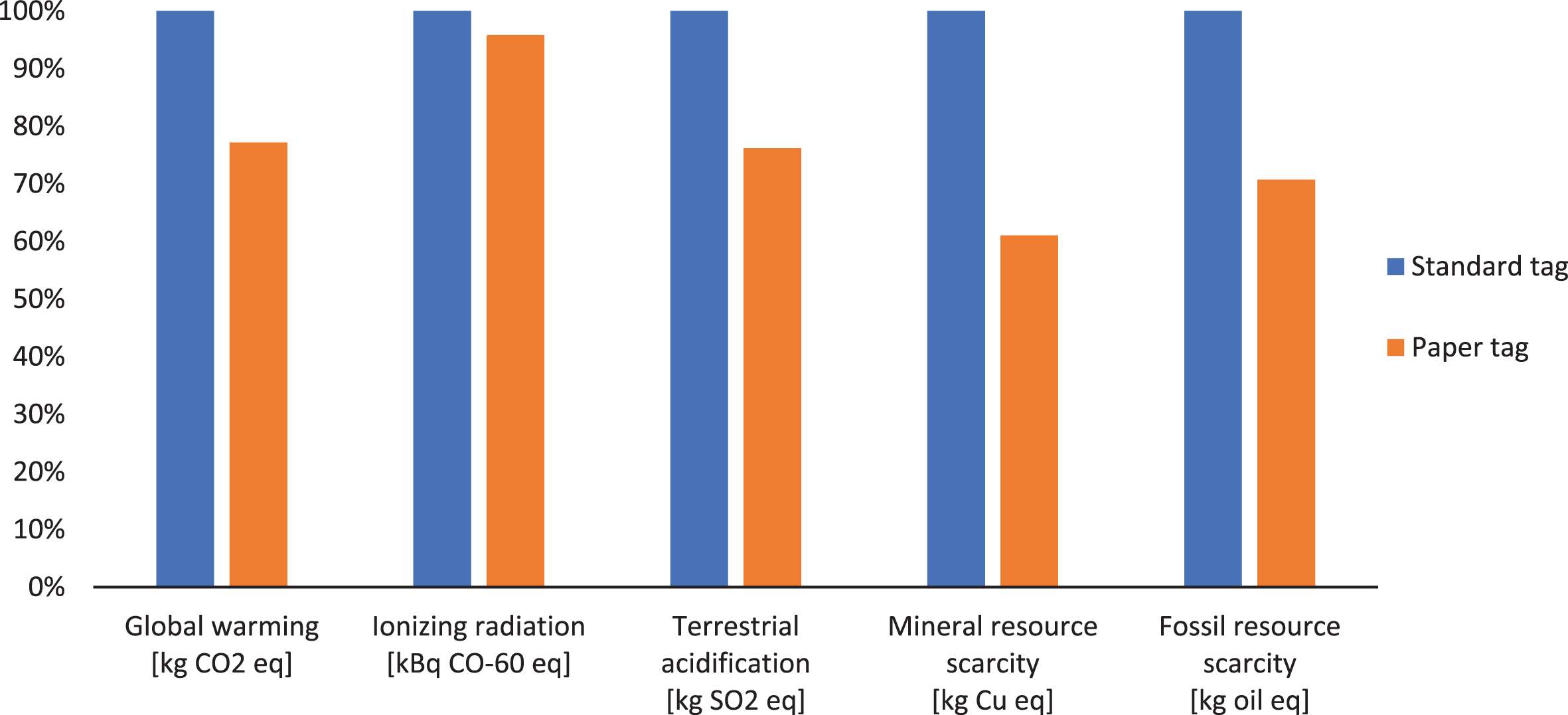
Environmental comparison [% ] between the standard and paper RFID tags.
Standard tag - Impact category per life cycle stage
Paper tag - Impact category per life cycle stage
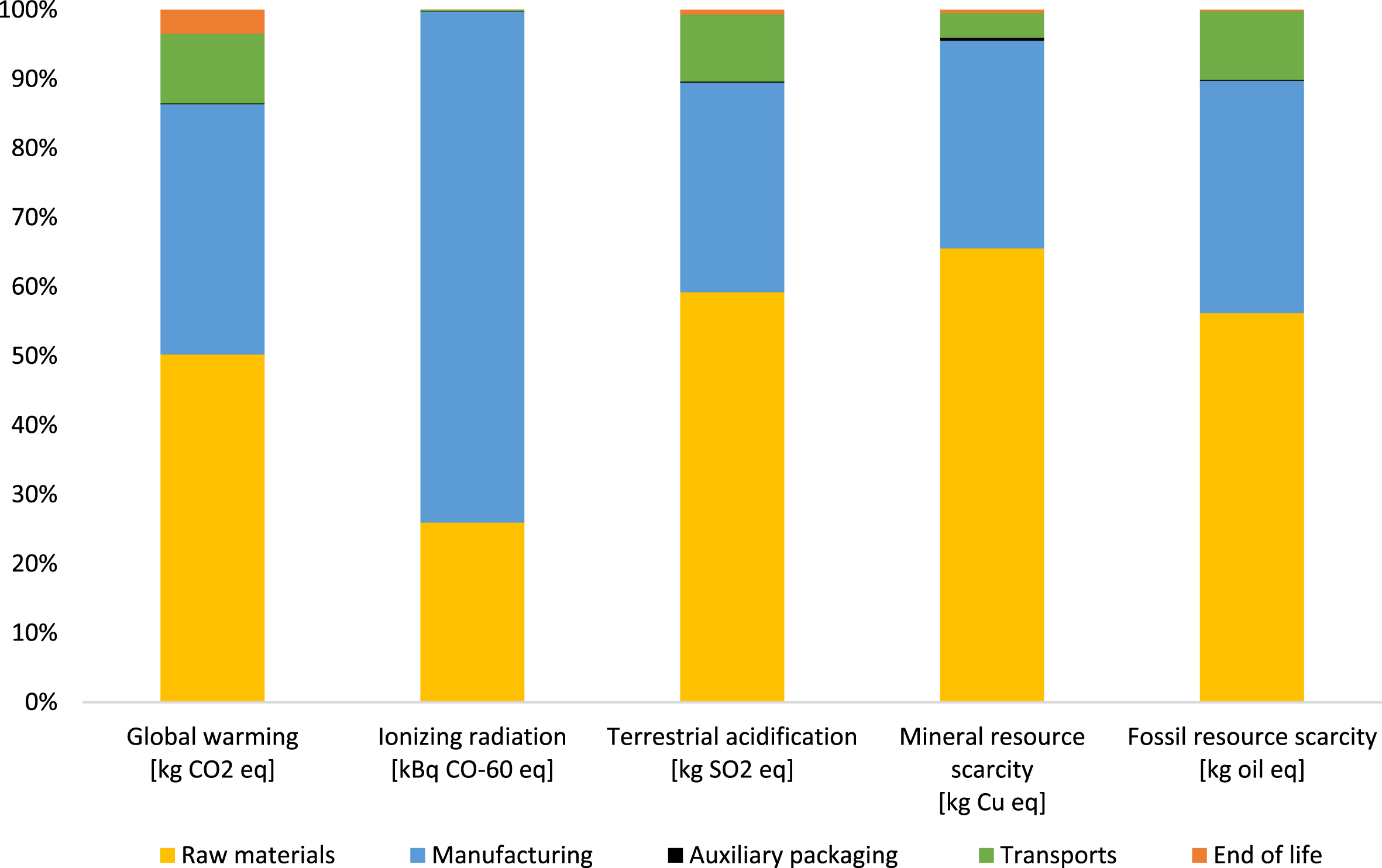
Environmental impacts [% ] of the standard RFID tag during the cycle stages.
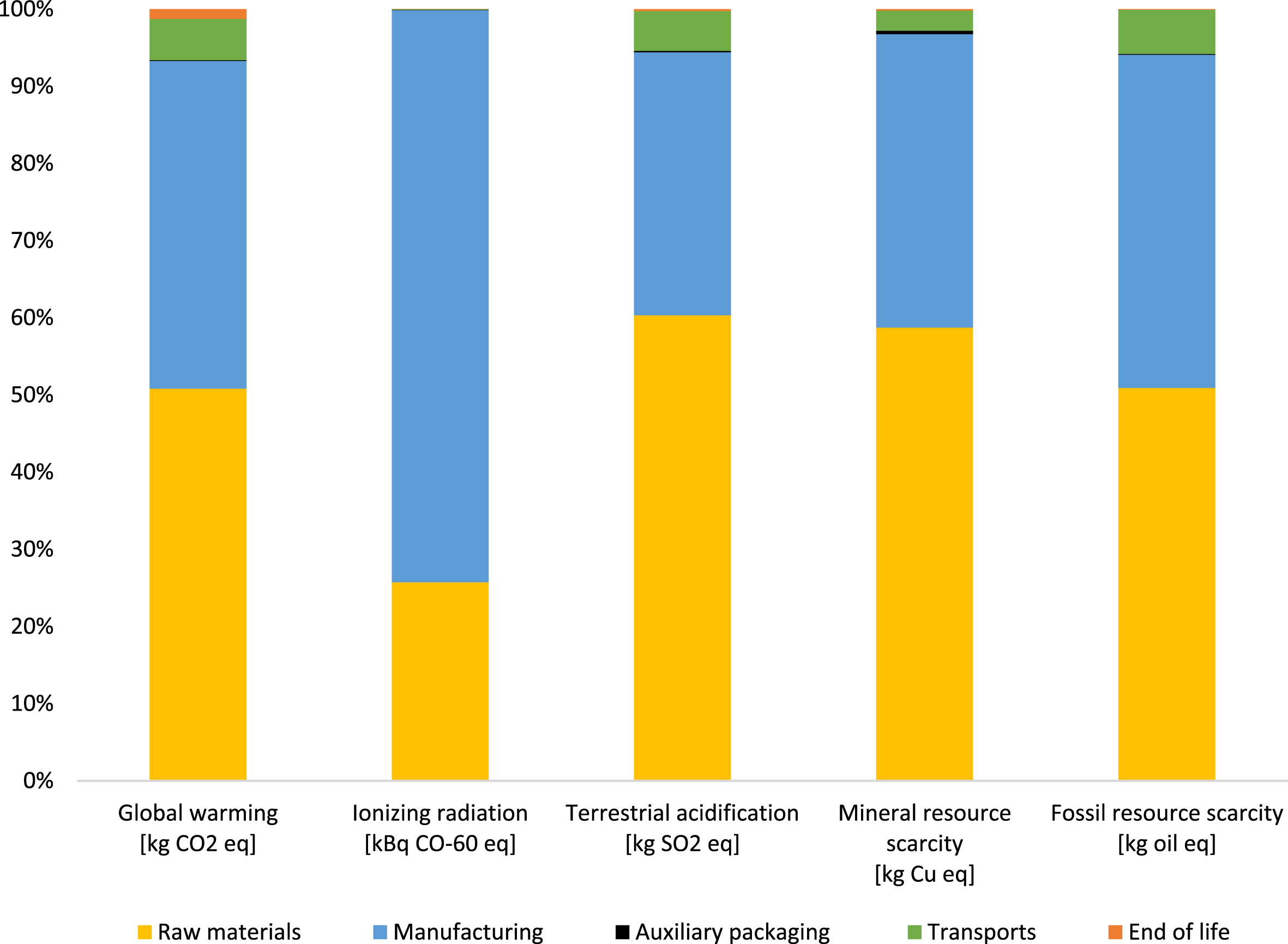
Environmental impacts [% ] of the paper RFID tag during the cycle stages.
In comparison with the findings of the first LCA of an RFID tag found in literature and already mentioned in the introduction (Bottani, et al. 2014), it results that the GWP of a standard tag shrinked by 54% in almost 10 years thanks to less materials required, especially electronics. The three main contributors to global warming in the 2014 paper were: printed wiring board (59,8%), wafer chip (22,4%) and electricity production (12%). Whereas in this study are the wafer chip (33,4%), electricity production (31,5%) and aircraft transport (9,3%). Therefore, the two over three items are consistent in their impact and still represent a critical point for all electronics production, while the printed wiring board, which represented the old type of production of the antenna, has been replaced by additive manufacturing techniques.
The article aimed to provide a reliable evaluation of the environmental impacts associated with a standard plastic RFID tag and an innovative paper-based one. The Life Cycle Assessment has been chosen, being the methodology suggested by the European Commission for these purposes. The functional unit of the study was one RFID tag, covering its whole life cycle, from the raw materials extraction up to end of life, excluding the use phase. Primary data were collected thanks to an RFID producer, while the downstream was modelled through secondary data provided by the Ecoinvent library. The evaluation of the impacts was carried out through the Simapro software and the Recipe 2016 methods, in which five impact categories, considered by the authors the most important, were chosen.
Resuming the main results, the study has proved the claims of the paper-based tag to be more eco-friendly, quantifying the emission gap in comparison with the standard tag. Looking at the global warming potential, which can be considered as the main indicator, it is quantified as 1,18E-02 kg CO2 eq for the paper tag, while 1,52E-02 kg CO2 eq are associated with the life cycle of the standard tag. These results can be useful for RFID users in order to choose the best option for the environment, but also to eventually compare the impacts associated with a RFID scenario to a traditional identification scenario. In future developments of this work, the results will be implemented in EROI, a quantitative tool to measure the return on the environment of RFID deployments. The economical impact of RFID deployments has long been studied and the ROI (Return on Investment) has been widely used as the one and only metric and driver for RFID adoption. Nowadays however companies are becoming more and more sensitive about their role and concerned about the environmental impacts of their moves. Therefore metrics to measure the return on the environment, that is how much tons of CO2 could be saved annually thanks to the adoption of RFID technology, are growing importance, and should join traditional economic ones to decide whether or not to deploy. EROI strives for measuring the environmental impact of an RFID project, and is based on RFID tags LCAs presented in this work.
Footnotes
Acknowledgments
The authors would like to thank MURATA ID Solution S.r.l. which fund the research project., and eAgile Inc. for providing all the relevant data for the inventory.