




Abstract
PURPOSE:
Bowel dysfunction, such as constipation and fecal incontinence, has a significant impact on health, activities of daily living, and quality of life among people with spina bifida. Secondary complications may result from bowel dysfunction and include urologic dysfunction, loss of skin integrity, shunt (hydrocephalus) function, as well as loss of social opportunities and employability.
METHODS:
Using a consensus building methodology, the guidelines for management of bowel dysfunction in spina bifida were written by experts in the field of spina bifida and bowel function and care.
RESULTS:
The evidence-based guidelines are presented in table format and provide age-specific recommendations to achieve fecal continence without constipation. Recommended treatments are presented from least to most invasive options. Literature supporting the recommendations and the interval research published to date is also presented.
CONCLUSION:
These guidelines present a standardized approach to management of bowel dysfunction in spina bifida. Bowel management in children and young adults with spina bifida is limited by variability in clinical practice and paucity of robust research in neurogenic bowel. Collaborative multi-institutional efforts are needed to overcome research barriers and provide innovative solutions.
Keywords
Introduction
Bowel dysfunction, such as constipation and fecal incontinence, have a significant impact on quality of life and well-being of individuals with spina bifida as well as their parents [1, 2, 3, 4, 5]. This was highlighted in 2019 when the Spina Bifida Association conducted a survey of adults with and parents of both children and adults with spina bifida. When asked about the impact of bowel incontinence, 50% of parents of children rated it as their biggest issue. Parents of adults with spina bifida rated it as their 3
Managing bowel function can be one of the biggest challenges accompanying the diagnosis of spina bifida and is also one of the most important. In spina bifida, the secondary complications from neurogenic bowel dysfunction extend beyond constipation and fecal incontinence to include urinary incontinence, urinary tract infections, shunt (hydrocephalus) malfunction, potential for skin breakdown, hemorrhoids, anal fissures, loss of social and work opportunities, and decreased quality of life [3, 5, 7, 8, 9, 10]. Proactive, systematic and rational approaches to these problems can lead to continence and a more functional lifestyle [7, 11, 12, 13, 14, 15, 16, 17]. Thus, the guidelines were written to emphasize bowel management in spina bifida to address a specific goal: bowel continence without constipation.
In spina bifida, the lack of normal nerve function and subsequent loss of sensory and motor control significantly impact the lower gastrointestinal tract and colorectal function. Slow colonic transit, probable alterations in colorectal motility, abnormal anal sphincter function, and decreased sensation lead to constipation and fecal incontinence [15, 16]. Attention to these pathophysiologic mechanisms of neurogenic bowel will lead to a better understanding, increased adherence to treatment, and increased probability of attaining the goal of continence without constipation. Treatment should be considered from least to most invasive and the guidelines are intended as a step by step guide to achieve continence without constipation.
The guidelines are designed to be adaptable to each individual. Tailoring the treatment to the individual’s mobility, cognitive development, and underlying medical and social comorbidities is important in the success of the bowel program [7, 11, 12, 13, 16, 17, 18, 19]. These guidelines should be followed with the guidance of a healthcare professional who has expertise in bowel management in spina bifida.
Guidelines goals and outcomes
The goals and outcomes are based on what is healthy from a medical standpoint and also on what is desirable from a personal-social standpoint. As can be seen from the outcomes listed here, the bowel guidelines are both practical and aspirational in that the authors believe continence without constipation is possible for the majority of patients.
For the bowel care guidelines, the following outcomes were identified:
Primary Outcomes (intervene before health effect occurs)
Maintenance of social continence as appropriate for age level Secondary Outcomes (screen and identify problems in the earliest stages)
Maximization of independence with managing bowel program Maximized knowledge and compliance with diet and bowel program Tertiary Outcomes (try to improve quality of life and reduce the symptoms)
Minimization of constipation
Methods
The methodology for writing the guidelines have been published by Dicianno et al. [20]. The process included one hundred Spina Bifida experts from around the world. The work includes 24 topics, including bowel function and care for people with spina bifida from birth through adulthood [21].
Clinical questions that informed the bowel function and care guidelines
A set of clinical questions was the foundation of the Bowel Management Guidelines. These clinical questions were used to focus attention on the outcomes or goals of the guidelines and inform the quidelines. Table 1 shows clinical questions specific to five sequential age groups. These questions informed the research and writing of the guidelines. There were five clinical questions that were pertinent to all of the age groups, which are listed here:
Clinical questions that informed the bowel function and care guidelines
Clinical questions that informed the bowel function and care guidelines
What is expected for bowel management at each stage of life (infancy, toddler, preschool, school age, teenage & adult)? What are the options for bowel management at each stage of life? What bowel symptoms should be evaluated by age? Why is patient satisfaction important in regard to bowel management? What education relating to bowel management is necessary for life long positive outcomes?
The guidelines for bowel care and function for people with spina bifida and the citations of supporting evidence
Bowel management steps from conservative to higher levels of intervention are pictured here [19].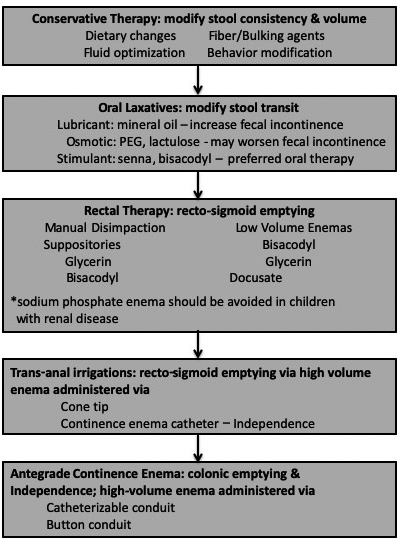
The guidelines for management of bowel dysfunction in spina bifida are presented in Table 2. Each age group is represented with consideration given to the potential variations in their functional abilities. Literature supporting the guidelines of care and the interval research published to date is also presented accordingly. Treatment is presented in a stepwise manner from the least to most invasive options to achieve fecal continence without constipation as shown in Fig. 1 [19]. The guidelines should be individualized to meet the medical, developmental, and social needs of the child and young adult with spina bifida [11, 19, 22].
Discussion
Bowel dysfunction in children and young adults with spina bifida has a significant impact on their quality of life and social, emotional, and physical well-being [1]. Guidelines for bowel function and care of neurogenic bowel in spina bifida were developed to provide age-specific recommendations in order to achieve fecal continence without constipation [20]. The bowel program should be individualized to accommodate for the physical, developmental, medical, and social barriers. Ultimately, the desired outcomes are social continence in conjunction with education and compliance to foster independence [21].
The evaluation and management of bowel dysfunction in children and young adults with spina bifida is hampered by variability of practice within and between centers. This variability stems from limited robust clinical, translational, and basic science research in neurogenic bowel in children with spina bifida. Specifically, there is lack of normative physiologic data of colorectal function in neurogenic bowel. We must foster collaborations between the disciplines of clinical, basic, and translational research to better understand the pathophysiological mechanisms that underlie the aberrations in colorectal transit, motility, and sensation that result in fecal incontinence.
To accurately assess symptoms of neurogenic bowel and the impact of treatment interventions, we need reliable and validated questionnaires for children and caretakers. Two such promising questionnaires include the pediatric Neurogenic Bowel Dysfunction Score [29] and Adolescent Fecal Incontinence Constipation Symptom Index [30]. However, multi-institutional collaborative efforts are needed to design and execute larger validation studies. Additionally, initiative should be taken to standardize the use of validated questionnaires across institutions in future clinical trials.
In conjunction to these guidelines, social and community support as well as resources are recommended in order to provide all-inclusive care for children with spina bifida who suffer from bowel dysfunction. Resources, such as at-home bowel tracking, have been shown to be effective in revealing specific triggers that hamper the bowel program [11]. Standardized bowel tracking systems via paper and more importantly via smart phone application programs may be helpful to closely monitor and to implement in-time changes to bowel management. For school aged children, tracking of bowel movements and continence could be facilitated by school aids and teachers. The school nurse plays a vital role in assisting the child to reach educational goals and manage health concerns [12]. Development of educational resources for caretakers and teachers would be a great asset to the current and future guidelines of care.
Limitations
Clinical trials evaluating the efficacy of bowel regimens in children with spina bifida are hindered by variability in clinical practice and specifically non-standardized definitions of bowel success. Protocols utilizing algorithmic approaches to bowel management in children with spina bifida have been shown to be effective in ensuring fecal continence; however larger validation studies are needed [11]. Collaboration is needed between institutions to design large scale randomized controlled intervention studies with robust methodology to overcome these barriers. This would then allow us to evaluate the efficacy of different bowel regimens and design standardized treatment protocols based on clinical and diagnostic predictors of bowel success. Ultimately, we need to bridge the knowledge gap between clinical practice, research, and technology in order to develop innovative predictive modeling of bowel success in the neurogenic bowel of children with spina bifida.
In summary, bowel management in children and young adults with spina bifida is challenging and has significant psychosocial implications for the patient and caretakers alike. These guidelines provide a proactive, systematic, and rational approach to management of bowel dysfunction including fecal incontinence and constipation. Collaborative multi-institutional efforts are needed to overcome the research barriers and provide innovative solutions.
Footnotes
Acknowledgments
This edition of the Journal of Pediatric Rehabilitation Medicine includes manuscripts based on the most recent “Guidelines For the Care of People with Spina Bifida,” developed by the Spina Bifida Association. Thank you to the Spina Bifida Association for allowing the guidelines to be published in this forum and making them Open Access.
The Spina Bifida Association has already embarked on a systematic process for reviewing and updating the guidelines. Future guidelines updates will be made available as they are completed.
Executive Committee
Timothy J. Brei, MD, Spina Bifida Association Medical Director; Developmental Pediatrician, Professor, Seattle Children’s Hospital Sara Struwe, MPA, Spina Bifida Association President & Chief Executive Officer Patricia Beierwaltes, DNP, CPNP, Guideline Steering Committee Co-Chair; Associate Professor, Nursing, Minnesota State University, Mankato Brad E. Dicianno, MD, Guideline Steering Committee Co-Chair; Associate Medical Director and Chair of Spina Bifida Association’s Professional Advisory Council; Associate Professor, Department of Physical Medicine and Rehabilitation, University of Pittsburgh School of Medicine Nienke Dosa MD, MPH, Guideline Steering Committee Co-Chair; Upstate Foundation Professor of Child Health Policy; SUNY Upstate Medical University Lisa Raman, RN, MScANP, MEd, former Spina Bifida Association Director, Patient and Clinical Services Jerome B. Chelliah, MD, MPH, Johns Hopkins Bloomberg School of Public Health Julie Bolen, PhD, MPH, Lead Health Scientist, Rare Disorders Health Outcomes Team, National Center on Birth Defects and Developmental Disabilities, Centers for Disease Control and Prevention Adrienne Herron, PhD Behavioral Scientist, Intervention Research Team, National Center for HIV/AIDS, Viral Hepatitis, STD, and TB Prevention, Centers for Disease Control and Prevention Judy Thibadeau, RN, MN, Spina Bifida Association Director, Research and Services; former Health Scientist, National Spina Bifida Program, National Center on Birth Defects and Developmental Disabilities, Centers for Disease Control and Prevention
Funding
The development of these Guidelines was supported in part by Cooperative Agreement UO1DD001077, funded by the Centers for Disease Control and Prevention. Its contents are solely the responsibility of the authors and do not necessarily represent the official view of the Centers for Disease Control and Prevention or the Department of Health and Human Services.
Conflict of interest
Dr. Beierwaltes has been on the Coloplast Advisory Board for bowel management. The other authors have no conflicts of interest to report.
Advertisement