




Abstract

Aging is a physiological process characterized by a progressive deterioration of all the biological functions and a marked reduction in stress resistance, thus resulting in an increased susceptibility to several pathologies [1, 2]. Although aging presents a well-described definition and a familiar set of phenotypic, genotypic and biological characteristics, i.e. genomic instability, telomere shortening, mitochondrial dysfunction, epigenetic modifications, dysregulated nutrient sensing, altered cellular communication, etc., it remains one of the most poorly understood of all biological phenomena [1]. This inadequate knowledge is due not only to the multifaceted nature of aging but also to the complexity in separating the effects of “normal aging” from those derived as a consequence of age-associated disease conditions. Indeed, it should be noted that aging is closely related to the onset of so-called age-related diseases, such as neurodegenerative diseases, cardiovascular ailments and cancer, that in many cases can overlap with aging features and represent the main reasons of infirmity and death in aged individuals [3–5].
In the last decades, some theories have been proposed to explain the complex phenomenon of aging: the most known is the “free radical theory” suggested by Harman, according to which “the damage to cellular macromolecules via free radical production in aerobic organisms is a major determinant of life span” [6]. Reactive oxygen species (ROS) are the main contributors to oxidative damage to cellular macromolecules, and, if they are not adequately counteracted by cellular antioxidant system, they can promote a state of redox imbalance and oxidative stress, that may lead ultimately to cellular apoptosis and death. However, since not all ROS are free radicals with an unpaired electron in their outer shells, the “free radical theory” has been substituted with a more general and modern “oxidative stress theory” of aging.
As shown in Fig. 1, during the last 50 years the number of studies on aging published each year on the database PubMed has exponentially increased, highlighting the interest of the scientific community towards this research field worldwide.
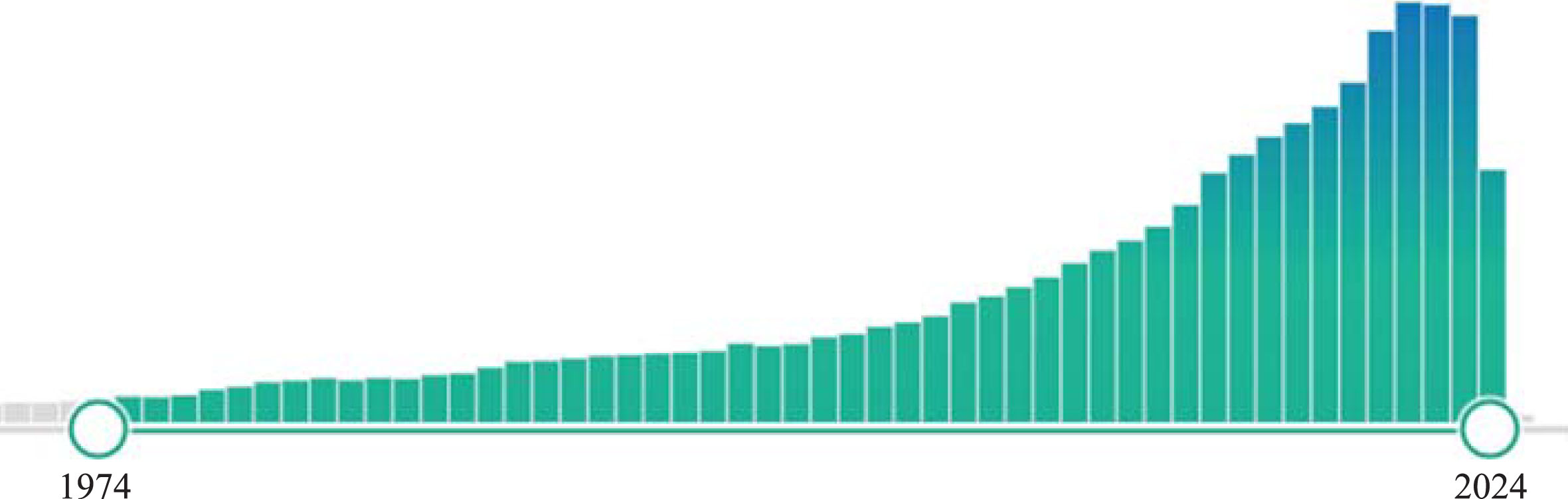
Number of papers published on PubMed, from 1974 to 2024 on aging.
All these studies have highlighted a strong correlation between aging or age-related diseases and an increase in oxidative damage in different tissue body, in a wide range of different species, ranging from in vitro studies, to Caenorhabditis elegans and humans [7–14], confirming, to some extents, the oxidative stress theory. In particular, structural damages to lipids, proteins, nuclear and mitochondrial DNA caused by redox imbalance have been identified, with the consequences of gene expression and intracellular signaling pathways modification as well as many functional alterations up to cellular senescence [1]. Not surprisingly, senescent cells accumulate in aged tissues and contribute to the onset of many age-related diseases, including neurodegenerative pathologies [1, 5]. However, it is important to note that the extent of these structural and functional oxidative changes significantly differs according to the species, the tissues and the methods used for detection.
On the basis of the “oxidative stress theory”, in the last years researchers started to focus their attention on natural antioxidants as a means to slow down the aging process and prevent the main age-related diseases. Natural antioxidants, such as vitamins and polyphenols, are indeed natural substances present in plant-based foods that exert several beneficial effects on human health, contributing to maintain a good well-being and preventing many human chronic diseases, thanks to their ability in scavenging free radicals and decreasing oxidative stress [15–25].
In order to assess the correlation between antioxidants and aging, the most common approach used by researchers is to determine directly if experimental interventions could improve oxidative damage and thus slowing down the rate of aging or reducing the risk to develop aging-related diseases. However, the results obtained by these studies are contradictory, so that it is still difficult to dawn a general conclusion about the effects of antioxidants on aging slowdown and related diseases. On one side, many in vivo studies, on animals and humans, have found a positive correlation between the intake of single antioxidant or the intake of antioxidant-enriched food and the improvement of aging status. Some examples are: (i) pecan [26], selenium and CoenzymeQ10 [27], Camelina oil-enriched crackers [28], red orange [29], turmeric root extract [30], extra virgin olive oil [31] in healthy aging adults, (ii) broccoli byproducts [32], fenugreek seeds [33], omega-3, carotenoid and vitamin E [34], selenium with probiotics [35], carotenoids [36] in different models of Alzheimer’s disease, (iii) cranberry [37], blueberry [38], omega-3, carotenoid and vitamin E [39, 40], folic acid and thiamine [41], pomegranate seed oil [42] in cognitive decline and dementia conditions.
On the other side, several studies did not find any association between the consumption of antioxidants or antioxidant-enriched foods and aging or age-related disease improvement. This is the case, for example, of CoQ10 [43], beetroot juice [44], resveratrol [45] in healthy old individuals, cocoa oil supplementation in Alzheimer’s patients [46], vitamin D and E [41], as well as Mediterranean diet, a very well-known dietary patter enriched with antioxidants, [47] in dementia condition.
These contradictory results could be due to different factors [48]. First of all, the “oxidative stress theory” of aging doesn’t consider the phenomenon of “hormesis”, according to which a moderate level of ROS (or stressor in general) are beneficial for cellular functions; nowadays the concept is gaining ground that mill exposure to free radicals or heat stress, for example, may exert hormetic effects on longevity extension. Therefore, are we sure that decreasing ROS levels is the most effective strategy to improve aging condition? Many studies on C. elegans seem to highlight the contrary [49].
Other factors to take into account when evaluating the potential effects of antioxidants on aging regard the type of antioxidants (natural or industrial supplement), the matrix used (single compound or whole food), as well as the methods applied to prepare the extracts (temperature, time and solvents), since all these factors can affect the amount and the bioavailability of the antioxidant molecules. Finally, also patient selection is a crucial point, since sex, age, genetic inheritance and gut microbiota, the so-called gut-brain axis, play a fundamental role on the individual responses to any type of treatment.
Therefore, considering that the number of subjects over 80 years or older is expected to triple between 2020 and 2050, the concept of “healthy aging” should be promoted: indeed, an aged individual in good health can have an acceptable level of independence, with an active role in the community and a lower weight on the national health system [50, 51]. The interactions between nutrition and health play a central role also in aging, so that, besides antioxidant supplementation, researchers should start to investigate the potentiality of other strategies, such as hormesis, or combinations of different approaches, to develop new antiaging stratagem.
Conflict of interest
Quiles, Battino and Giampieri are members of the Editorial Board of this journal, but were not involved in the peer-review process nor had access to any information regarding its peer-review.
Funding
Authors have not received any financial support for this work.