




Abstract
BACKGROUND:
Ramadan fasting has been associated with a significant body weight, fat mass and waist-hip circumference reduction. However, this is mostly followed by weight regain in 2 weeks after the fasting is stopped. Currently there is no explanation on how this rebound phenomena occurred.
OBJECTIVE:
The aim of this study was to examine the role of lifestyle and hormonal background on weight regain after Ramadan fasting in overweight individuals.
METHODS:
This was an observational study with prospective cohort design. Subjects were overweight/obese men and women adults with age between 21 and 56 years old. Body weight, percent fat, fat free mass and hip-waist circumference were measured before (week 0), 28 days after Ramadan fasting (week 4) and 2 weeks after the end of Ramadan (week 6). In addition, data on lifestyle factors such as dietary intake and physical activity were collected in those time points. Leptin was measured before and at the end of Ramadan fasting period.
RESULTS:
Body weight was significantly reduced at the end of Ramadan (week 4, p < 0,0001) and increased after Ramadan (week 6, p < 0,0001). Leptin was significantly reduced after Ramadan (p = 0,018) and we found that leptin level at the end of Ramadan was associated with percent body weight reduction (p = 0,011).
CONCLUSION:
We conducted a study to understand Ramadan fasting yo-yo effect in overweight and obese individuals and this study showed that dietary factor prior to the fasting has a significant impact on overweight/obese individual.
Introduction
Fasting during Ramadan is one of the obligation of every Moslem during one (month of Ramadan) of the 12 months of Moslem lunar calendar. During the fasting period, Moslem were not allowed to eat and drink during the day. Because eating before dawn is also highly suggested, these changes in dietary habit is usually followed by changes in sleeping pattern. In four season countries, the length of fasting during summer time could be around 18–20 hours. For countries that located close to the equator such as Indonesia, the length of fasting period was relatively constant in the range of 13–14 hours throughout the years.
Although Ramadan fasting is not a major research field, it has a potential to be used as an alternative for a weight loss intervention. A meta-analysis study showed that there is a significant reduction on body weight approximately one kilogram for those who did Ramadan fasting [1]. Unfortunately, weight loss that occurred at the end of Ramadan is usually followed by weight regain after the dietary habit changed into normal. Moreover, there is a danger of overeating during the Eid holiday in the end of Ramadan because of the food abundance during family and friends gathering. This phenomena is called yo-yo effect or as we proposed in this study with the term “Ramadan fasting yo-yo effect”.
There were several theories that explain how the phenomena occurred. It previously been assumed that body weight loss during Ramadan fasting was due to reduction in in dietary intake [2]. However, a meta-analysis showed that the effect of dietary intake during Ramadan on weight loss and rebound after Ramadan is somewhat controversial [1]. Investigations on appetite, energy expenditure and several hormones also could not explain the weight rebound phenomena of Ramadan Fasting [3–9]. Therefore, it was assumed that other factors might be responsible for this effect.
This study was aimed to investigate several factors that might be associated with weight loss and rebound during and after Ramadan fasting. Those factors include dietary intake, physical activity and sleeping duration. We therefore focused on the report of dietary habit before, during and after Ramadan. In this study we also connected the complexity of lifestyle factors on leptin dynamics during Ramadan.
Methods
This was a prospective cohort study on overweight/obese individuals during Ramadan fasting period and 2 weeks after Ramadan. Subjects were adults living in Yogyakarta, Indonesia selected using a purposive sampling. In order to recruits the subjects, an obesity screening was done in Faculty of Medicine, Universitas Gadjah Mada. Subjects with BMI more than 25 kg/m2 were included in the study. Because Ramadan fasting is a religion-based activity, all subjects were Moslem. Subjects who were pregnant, diagnosed with degenerative diseases (e.g. diabetes mellitus, heart diseases, stroke), routinely taking prescription drugs, smoking, using any means of weight loss program (e.g pills or liposuction) were excluded in this study. The study was approved by the Medical and Health Research Ethics Committee (MHREC) of the Faculty of Medicine, Universitas Gadjah Mada, Indonesia. The subjects were given the informed consent regarding the study design, what is the purpose of the study and what will be measured.
In this study, fasting period was approximately 13–14 hours a day. This fasting period was done in 30 days. In this study, the measurements were taken in 3 time points i.e. before Ramadan (week 0); the end of Ramadan (week 4); 2 weeks after Ramadan (week 6). After the subjects signed the informed consent, an interview was done to collect the characteristic data and their lifestyle during and after Ramadan. Dietary pattern and nutritional intake was measured using a semi-quantitative food frequency questionnaire. This questionnaire was measured in three time points. In addition, a dietary recall was used to measure timing and types of dietary intake including: 1) Whether they ate at night before fasting; 2) Meal frequency; 3) Whether they have a sweet appetizer for breakfast. Physical activity was measured using an international physical activity questionnaire in three time points. Additionally, 24 hours physical activity recall was used to measure sleeping pattern.
Following the interview, anthropometric measurements were taken; these includes height, weight, waist circumference, hip circumference, and % body fat. Overweight and obesity status were determined based on body mass index/BMI (overweight > 25 kg/m2 and obese > 30 kg/m2). Height was measured using a stadiometer while body weight was measured using digital scale. Waist and hip circumference were measured using non elastic tape. Body fat was measured using bio- impedance analyser.
Fasting blood sample was collected before and at the end of Ramadan fasting. Subjects were asked to fast 8 hours prior to blood collection. Before Ramadan, blood collection was done in the morning. At the end of Ramadan, blood collection was done in the afternoon. This was because subjects should fast for at least 8 hours prior blood collection (the fasting started at 5 am) and based on previous studies which showed that leptin concentration was varied throughout 24 hours period [10]. Leptin was measured from plasma blood using enzyme linked immunosorbent assay (DRG 2935, DRG International, NJ, USA). The comparison was done in two time points at week 4 and week 6. The changes in body weight and other measures were analyzed using paired t-test. Pearson correlation test was used to examine the correlation between body weight changes, dietary intake, sleeping duration and physical activity. All analysis were done using GraphPad Prism version 5.00 for Windows, GraphPad Software (San Diego California, USA). The repeated-measures ANOVA analysis of data in 3 time points were measured using JASP (The University of Amsterdam, The Netherlands).
Results
This cohort prospective study was conducted within 7 weeks of time frame started in week 0 (before Ramadan), week 4 (end of Ramadan) and week 6 (after Ramadan). We recruited 78 overweight/obese individuals for this study based on obesity screening. From those who participated in this study, 45 subjects (13 male and 32 female) were successfully followed until week 6 of this study with completed data.
Characteristics of participants are shown in Table 1. Anthropometric and dietary data were compared before (week 0), end of Ramadan (week 4) and after Ramadan (week 6). The result showed that there was a significant reduction in body weight at the end of Ramadan (71.3±10.5 vs. 69.9±10.4, p < 0.001) and there was a significant increment in body weight after Ramadan (69.9±10.4 vs. 70.9±10.8, p < 0.001). The result also showed that there were a significant reduction in percent fat mass and no changes in fat free mass indicated that weight reduction at the end of fasting period was most likely due to reduction in fat loss. Interestingly, we showed the dietary intake changes within Ramadan. In this study, we showed that there is a significant reduction in total energy intake, protein and carbohydrate (all p < 0.05) but not total fat intake (p = 0.830).
Characteristics of subject and changes in anthropometric and dietary during Ramadan (n = 45, 28.9% male)
Characteristics of subject and changes in anthropometric and dietary during Ramadan (n = 45, 28.9% male)
1paired t-test with data from before – end of Ramadan; 2paired t-test with data from end – after Ramadan; 3Repeated measure ANOVA for data on before, during and after Ramadan; BMI: body mass index; PUFA: polyunsaturated fatty acid; Data are presented as mean±standard deviation.
Lifestyle factors were measured before, during and after Ramadan. In this study meal frequency was reduced from approximately 3 times a day into 2 times a day (Fig. 1). There were no changes in physical activity during Ramadan. Interestingly, there was a slight reduction in sleeping duration during Ramadan (p = 0.087) and sleeping duration was significantly increased after Ramadan (p = 0.037). We reported that there was no correlation between meal frequency, sleep duration, physical activity and weight changes during and after Ramadan fasting (all p > 0.05, data not shown).
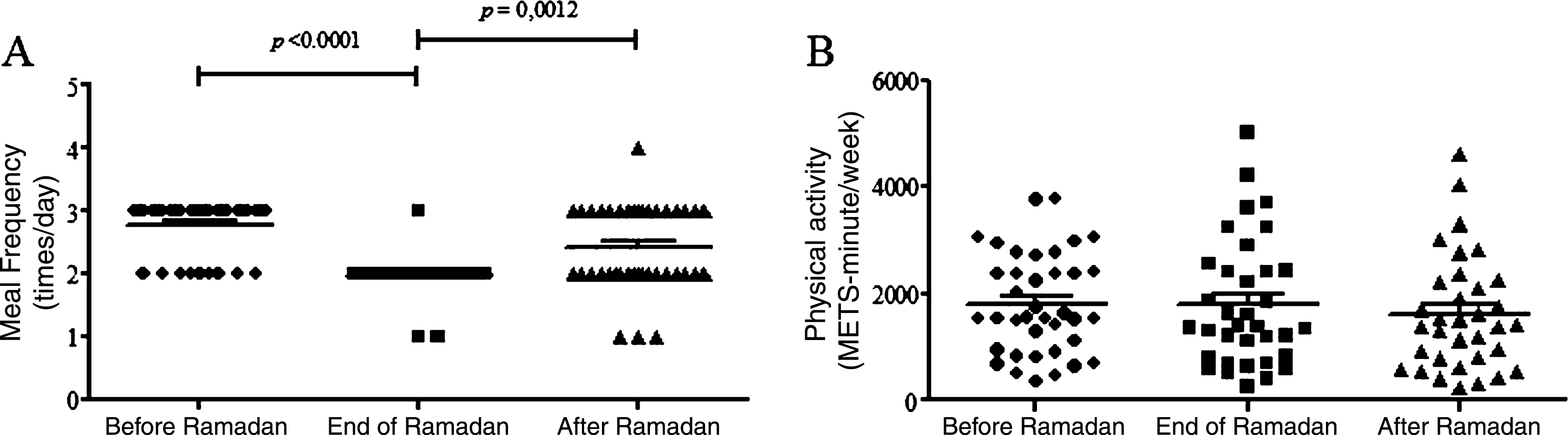
Lifestyle changes including meal frequency (A) and physical activity (B), before, at the end and after Ramadan.
Fasting leptin level was measured before and at the end of Ramadan (Fig. 2). In this study, we showed that there was a significant reduction in fasting plasma leptin at the end of Ramadan (12.9±9.7 vs. 10.3±5.8, p = 0.019). We investigate the correlation between plasma leptin and percent body weight changes at the end of Ramadan. In this study, we showed that plasma leptin at the end of Ramadan was associated with percentage weight reduction (r = 0.395, p = 0.011). Individuals with overweight/obesity underwent Ramadan Fasting had a significant increment in body weight after the fasting month is over (p < 0.0001)(Fig. 3).
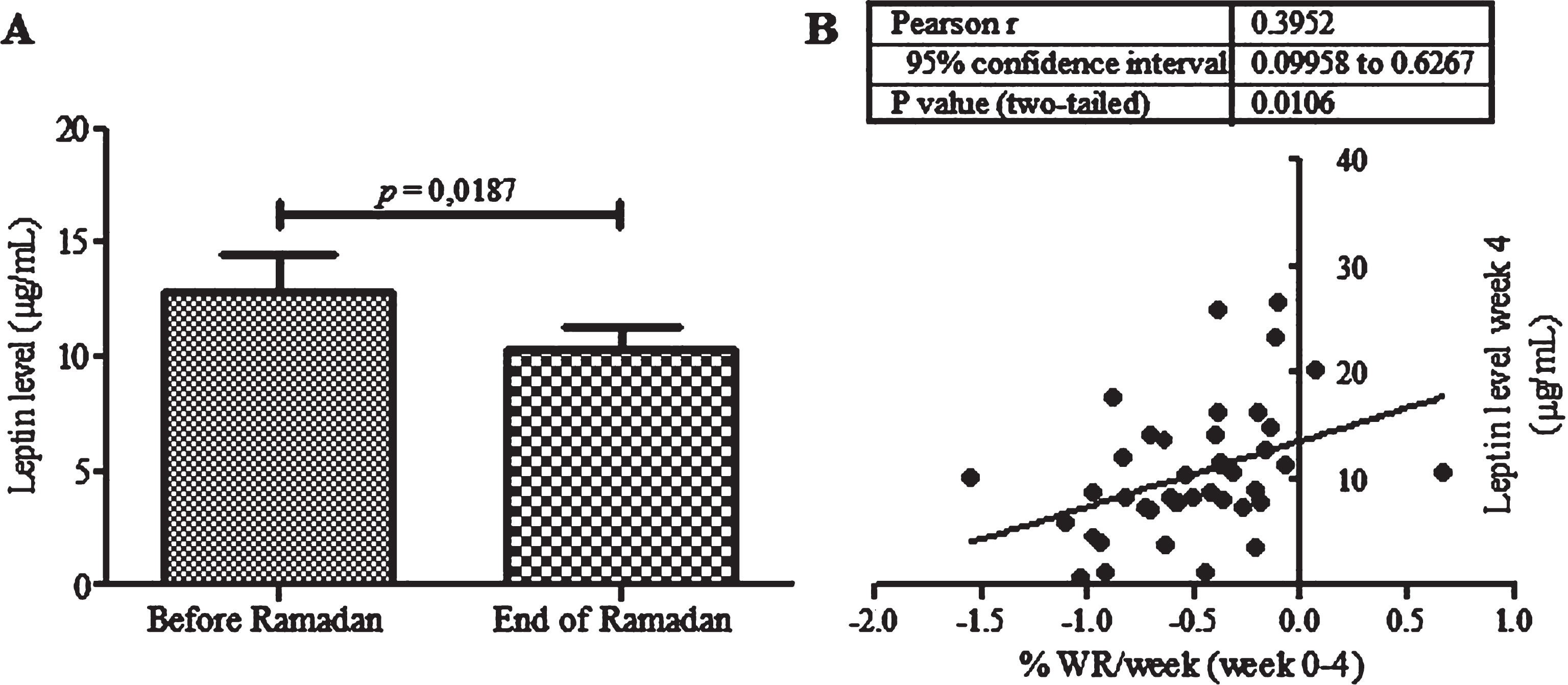
Changes in fasting plasma leptin level before and at the end of Ramadan (A). Correlation between leptin level before (B) and after (C) Ramadan and body weight changes.
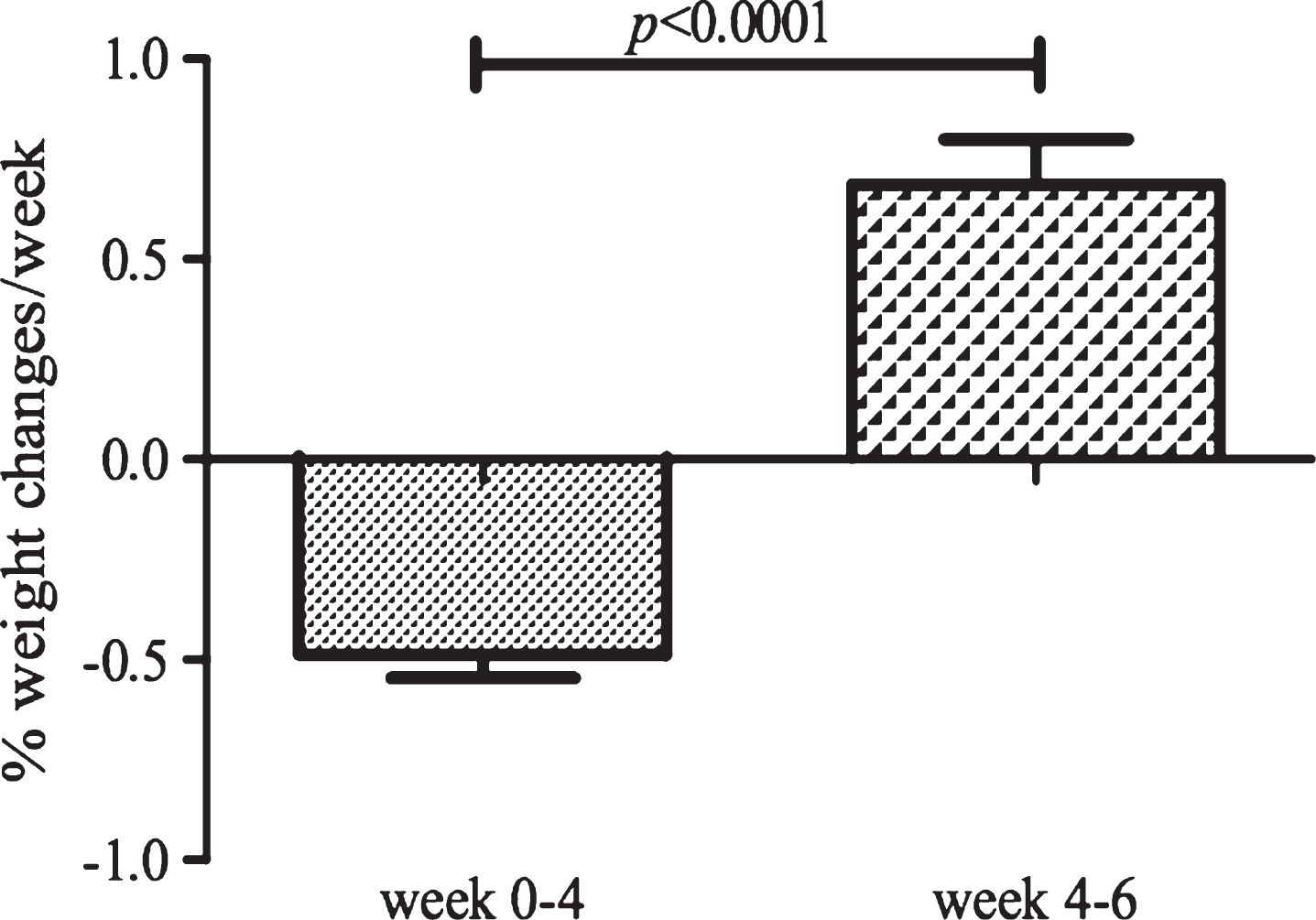
Weight rebound 2 weeks after Ramadan fasting. The percent weight changes per-week during Ramadan fasting and 2 weeks after Ramadan fasting were evaluated.
Ramadan fasting can be a good example of a common practice of an intermittent diet. This religious activity has a significant impact of body weight reduction but also provide a challenge of weight gain risk after the fasting is stopped. In this study we revealed that the Ramadan Fasting Yo-yo Effect was occurred in overweight/obese individuals. The body weight was significantly reduced at the end of Ramadan and there was a significant increment in body weight after Ramadan fasting was finished.
In order to justify the anthropometric changes during Ramadan, several parameters of body composition has been compared. Body weight, body mass index and percent body fat was significantly reduced during Ramadan and regained after Ramadan. These changes were not seen in waist circumference and fat free mass. This result suggested that the changes of body weight during Ramadan was because of changes in subcutaneous fat rather than visceral fat or muscle mass.
We speculated that there was a role of location and ethnicity on how this weight rebound phenomena happen. Indonesia is one of Asian ethnic groups with a majority of Moslem population. A study done by Sadeghirad et al. [1] showed that Asian were more prone to weight rebound after Ramadan compared to other ethnic groups (African and European). As shown by a meta-analysis of Ramadan fasting in all over the world [1], people from East Asian (including Indonesia) tend to reduce their total energy intake during Ramadan and they found that return their energy intake after Ramadan. In order to clarify the mechanism, we evaluated several factors that might explain this phenomena which includes lifestyle, dietary and hormonal changes during Ramadan.
The duration of fasting varies between countries. In Indonesia, Ramadan usually takes around 12 hours while in Europe such as France can last until 18 hours [11]. And because this is a significant amount of time, Moslem did several adjustments and changes in relation to their lifestyle. We evaluated whether lifestyle changes affect individual response towards Ramadan fasting. During and after Ramadan, there were significant changes on meal frequency. Our subjects tended to spend 2 meals a day during fasting and the frequency was bounced back into 3 times a meal after the fasting period was reduced. There were no significant changes in physical activity during Ramadan which means that people tend to keep their physical activity although they were not eating and drinking during the day. Additionally, we also found that there was a slightly reduction on sleeping duration during Ramadan. Meal frequency, sleeping time and physical activity were evaluated in this study but those variables were not correlated with weight changes during and after Ramadan fasting. This was in contrary with other studies which showed that those factors were associated with weight loss at the end of Ramadan [12–15].
There were several changes in dietary intake and dietary composition during Ramadan fasting. Total energy intake was significantly reduced by the end of Ramadan and increased after Ramadan. This similar trend was seen in protein and carbohydrate intake but not in total fat intake. Therefore, we suggested that there was an increment in composition on total fat intake relatively towards total energy intake. The trend of dietary reduction at Ramadan and increment after Ramadan was seen in mostly Asian population. Interestingly African populations were tend to increase their total dietary intake during Ramadan fasting period [1].
It was previously showed that Ramadan was associated with changes of sleeping duration and sleeping duration affect leptin production [8]. However, there were several controversies regarding the effect of Ramadan fasting on plasma leptin production [7, 16]. In this study, we showed leptin production was reduced at the end of Ramadan. Interestingly we also revealed that leptin level was correlated with weekly weight reduction during Ramadan.
Ramadan fasting is an example of intermittent diet because of the dietary intake is restricted into several hours during the day [17]. The health benefit of intermittent diet has been long known in animal trial [18]. To date, there were several studies that showed intermittent fasting could be beneficial effect on obesity [19–22]. Investigation of the potential treatment for individuals with obesity is important because obesity affects millions of adults and this state of over-nutrition is responsible for an increasing economic and health burden worldwide [23, 24]. And because Ramadan fasting is only conducted in a short period of time, perhaps the impact of weight loss was not pronounced. In fact, we proposed data that overweight individuals who undertake this regime were prone to weight regain.
Aside from the role of leptin in the regulation of weight regain, there is also another new mechanism that can explain individual tendency towards weight regain. It might that the microbiome profile of subjects who undertook Ramadan fasting did not change due to the short period of time. It was previously shown that gut microbiome plays an important role in energy metabolism and individual susceptibility to obesity [25]. It suggested that the persistent post-dieting microbiota with obesity properties play an important role in causing obesity relapse post weight loss [25] and this might explain the yo-yo effect of Ramadan fasting.
We conducted a study to understand the Ramadan fasting yo-yo effect in overweight and obese individuals. We also showed that after 4 weeks of Ramadan fasting, leptin concentration was significantly reduced while leptin concentration at the end of Ramadan were positively correlated of weight changes. In this study we also showed that lifestyle related factors such as sleep duration, physical activity and meal frequency were not correlated with weight regain after weight loss. Further study is needed to confirm this findings in larger population.
Discloser
The authors have disclosed that they have no significant relationship with, or financial interest in, any commercial companies pertaining to this article.
Conflict of interest
We stated that there is no conflict of interest conducting this study.
Footnotes
Acknowledgment
This study was funded by Nutrition Grant, Faculty of Medicine, Universitas Gadjah Mada.