




Abstract
The problem of buildings and structures durability during their long-term operation in aggressive environments is discussed. It is closely connected with the problem of destruction of composite materials as a random process of birth, development, and death of defects at chemical corrosion. The content of the study is to analyze the influence of non-stationary chemical reactions occurring in real conditions on these processes. The analysis is carried out taking into account the incidental physical phenomena affecting corrosion, the most important of which is the diffusion of initial substances and reaction products occurring under different hydrodynamic conditions, i.e., the nature of fluid motion and its pressure which stimulates corrosion. The synthesis of three processes – chemical kinetics, diffusion, and hydrodynamics – allows us to study one of the possible scenarios of corrosion process development as a Markov process based on the statistical theory of the “weakest” link and the joint distribution of the random material and geometric parameters. Numerical analysis of changes in elastic and electrical properties of composite materials under these conditions allows us to substantiate the technology of non-destructive control of changes in the state of the structure. The research results are based on mathematical and statistical modeling.
Keywords
Introduction
The importance of the durability problem of structures using composite materials, in particular, concrete, is beyond doubt. Durability is defined as the ability of material to retain the specified physical and mechanical properties for a long period of time in unfavorable conditions of external influences. This ability decreases abruptly in the form of a random response of the system to a smooth change in external conditions. The modern approach to solving the problem of durability assumes that by creating an ideal composition at the initial stage of the project it is possible to ensure the prolonged existence of the structure before its destruction. However, the conditions in which the structure is living can differ from those in which the design composition is tested. Moreover, after a period of time, the material properties change to such an extent that they have little or nothing common with those originally designed. The obvious difference is that a specimen subjected to strength testing at the design stage under conditions of constant temperature and unilateral compression is virtually free of macroscopic defects and is not exposed to corrosive fluids. All these effects occur quite slowly and simultaneously, and their role is difficult to assess through physical experiments. On the other hand, under conditions of long-term operation of a structure, its elements are subjected to all-round compression by stresses, including those applied at infinitely remote boundaries. Estimation of elastic energy loss on specimens is performed under unilateral loading and on specimens of finite dimensions in the absence of sharp temperature fluctuations, frequent moistening and drying, the impact of chemically active air and water environments, leading to dissolution and leaching of individual components under the action of running water, sulfate, chlorine, or alkaline corrosion. At each stage of chemical corrosion there is a simultaneous occurrence of mass transfer processes – diffusion of solvent molecules and chemical reactions, leading, in the end, to changes in the physical properties of the used composite material, including loss of its strength and destruction of the whole structure, thus, to a catastrophe, often resulting in human casualties and economic losses.
The objective of the current research is to prevent disasters by continuously monitoring and predicting the state of the object. This goal can be achieved by solving the following problems, partially discussed in (Vilge, 2016):
solving the problem of composite material durability in order to optimize their designed properties under conditions of physical and chemical corrosion requires a set of experimental studies to determine for each type of material the following parameters: the diffusion coefficient of the liquid “giving birth” to a defect in the material, the rate constant of dissolution of a particular composite material, the rate of chemical reactions in it, and the rate and chemical composition of groundwater; development of the technology of continuous control (monitoring) of the composite material state and determination of the measured parameters. development of special methods of processing and interpretation of measurement results related to the random nature of the measured parameters since it is practically impossible to carry out direct assessments of the state of materials.
The study of the effect of chemical corrosion on the durability of composite materials requires the development of mathematical and statistical models which take into account the complex physical and chemical processes occurring in the material and the environment. Our research is based on the statistical theory of the “weakest element” (Freudenthal, 1969) and the assumption that the corrosion is a Markov process which describes a sequence of random changes in the state of the system, independent of the previous ones, over time. Each next state of the system depends only on the state at the current point in time and is independent of how the system arrived at the last state. This approach was justified and used in (Landau & Lifshitz, 1987; Liebowitz, 1969). It is important to note that not only corrosion processes are nonstationary, since chemical reactions and hydrodynamics vary in time, but also physical parameters, such as diffusion coefficients and rate constants of chemical reactions, are functions of time and randomly distributed in space. The latter circumstance requires clarification of the concept of the “weakest” link. This is important because in the process of monitoring the system state in real conditions all measured parameters are indirect, and the very definition of critical strength of an element as the “weakest” (Freudenthal, 1969) link needs to be clarified. The analysis of the listed processes is carried out by methods of mathematical and statistical modeling. They have no alternative in the study of long-term processes and are realized on a simplified but relevant model of a random macroscopic element of the medium containing an elementary, macroscopic defect. The adopted model (Freudenthal, 1969) transforms a homogeneous medium with unknown homogeneous properties (strength) into a medium with known inhomogeneous properties by means of assumptions formulated in (Landau & Lipshitz, 1987; Liebowitz, 1969; Polyanin & Zielinski, 2016). This goal is achieved by analytical and numerical analysis of boundary value problems for the model of the medium describing the nature of the mutual influence of diffusion rates and homogeneous chemical reaction under conditions of mass transfer across the interface. The transport of matter in a moving fluid is caused by two quite different mechanisms. Firstly, in the presence of concentration difference in the liquid there is molecular diffusion, and secondly, particles of dissolved substance in the liquid are captured by the latter during its motion and are transported together with it. The combination of both processes is convective diffusion of matter in a liquid.
The paper is organized as follows. After Introduction, Section 2 describes the medium model and the formulation of the physical and chemical kinetics problem for a single cylindrical defect of a finite radius and a finite extent “born” and “developing” in the medium element. Section 3 describes internal and external problems: Subsection 3.1 presents the results of solving the internal problem of the process of “birth” of the defect, development of chemical corrosion by analytical method and analyzes the process of destruction of the solid “film”; Subsection 3.2 considers the results of numerical solution of the external problem in the absence of flow of the solution of aggressive liquid filling the defect; Subsection 3.3 is devoted to the analysis of the influence of hydrodynamic conditions on the process of physical and chemical kinetics; Subsections 3.4–3.6 present the results of the analysis of the numerical solution of the external problem, from which follows the formula of the dimensionless similarity criterion, linking chemical, physical and hydrodynamic parameters of the process of formation and destruction of the solid “film”. Section 4 shows the relationship between the elastic energy and radius of cylindrical defects in a closed macroscopic element under bilateral compression and its critical strength. Section 5 is devoted to the analysis of the problem of random distribution of three types of the set of physical and geometrical parameters of the joint distribution for the generalized characteristic of the model: critical strength, thickness of the solid “film” and chemical reaction rate. Section 6 presents result of numerical experiments related to the substantiation of methods for monitoring changes in the electrical and elastic properties of the medium element, supplementing the results in (Vilge, 2011). Section 7 concludes that continues analysis of changes in the elastic and electrical properties of composite materials under conditions of chemical corrosion would make possible to control changes that lead to a decrease in the strength and reliability of the structure.
The environment model should provide a solution to the problem of statistical processing of the results of indirect measurements of physical and geometric parameters using non-destructive testing methods. The model of the medium considers an elastic body in the form of a parallelepiped of limited dimensions, the outer surface of which is surrounded by an aggressive liquid of infinite volume with a given concentration of active solvent. We describe the entire volume of the body under study as divided into macroscopic elements (Freudenthal, 1969; Landau & Lifshitz, 1987; Liebowitz, 1969; Vilge, 2016), large enough for any of them to contain a significant number of defects of various sizes. These defects are small in comparison with the smallest size of the volume element to ensure mutual independence of stress fields and concentrations of dissolution products around each of the defects. Then the elastic energy and its change for any volume element will be predominantly determined by the most dangerous, “weak” defect, i.e., the one at which the joint distribution of physical and geometrical parameters is most likely to lead to the element failure. We assume that inside the element there is a defect in the form of a circular cylinder of finite length and radius, small at the initial stage of dissolution. Suppose the defect axis is perpendicular to the outer surface of the element, and the defect itself has direct contact with the surrounding liquid through the cylinder section on one of the outer surfaces of the element. The defect is subjected to the continuous influence of three unsteady processes: diffusion, macroscopic chemical kinetics, and hydrodynamics. The process of interaction between the aggressive fluid and the environment leads to the separation of the material into the internal region of the defect and the region external to it. The necessity to consider two classes of problems – internal and external – is due to the important circumstance that at the first stage the processes are practically independent of hydrodynamic conditions inside the defect, except for external pressure and temperature. The solution of the internal problem of diffusion kinetics is analytical, and the solution of the external problem of physicochemical kinetics is numerical. A specific feature of diffusion and chemical dissolution is that they occur at the boundary between the inner and outer regions. At the initial stage, a solid “film” a thin surface layer of reaction products is formed (Frank-Kamenetzky, 2015; Sherwood et al., 1975). The emerging new structure of a macroscopic element of the medium leads to the loss of elastic energy and strength of the entire element. A unified model was investigated in the study of changes in the elastic and electromagnetic properties of the medium when the defect geometry changes in the process of chemical corrosion. The obtained results are part of the basics of the technology of nondestructive control of the object’s condition.
Internal and external problems
Internal problem: The first stage of the defect’s origin
Correlation connections of measured parameters with physical and geometric properties of the environment are the main content of the analysis of internal and external problems for subsequent statistical processing of monitoring results.
Suppose in some arbitrary element of the body there is a defect in the form of a circular cylinder of finite length
The process of destruction of SF in a medium element is described by the following diffusion equation (Vilge, 2010) in cylindrical coordinates:
The initial condition is
Suppose that the concentration of dissolution products at the outer boundaries of the defect is:
where:
The following remark is important. To simplify the estimates, we assume that at the boundary
Green’s function of this problem is:
where:
Bulk transformations lead to the following final expressions for the solids’ concentration inside the confined defect volume:
The analysis of the obtained Eqs (3.1) and (3.1) allowed us to make the conclusion: the development of a defect having the form of a circular cylinder of small length L, and radius R, occurs under the action of diffusion, dissolution, and external pressure. Indeed, it follows from the obtained relations that the time of the SF destruction is the same at
This condition is satisfied in two cases. In the first case, there is no flow from the inner volume of the defect to the outer volume
Suppose that the macroscopic element of the medium is a rectangular parallelepiped, and in its center, there is a defect in the form of a cylinder, the axis of which
where
with the notations:
The function
In Eq. (12) the exponential multiplier describes the change in the solute concentration in the external medium, (
Let us supplement the Eq. (12) with the initial and boundary conditions in the domain of
An important feature of the processes related to the influence of liquid flows inside the defect region on the concentration of dissolution products in a solid body is that the processes of formation of SF (as shown below) occur in a very short period. Their destruction by liquid flows in the boundary layer (in real conditions of low velocities) is a significantly longer process. Therefore, there are two processes going on: the birth of the SF, and its destruction. They can be considered separately, as the case A)
Let us consider the case A)
which is macroscopic rate of chemical reaction. These formulas allow us to determine numerically and by measurements the concentration of matter between two surfaces in the process of mass transfer during the “development” of defects. L us introduce some definitions for SF: TB – time of birth; TS – time of stabilization; TD – time of death; FT – thickness of SF;
Table 1 presents some results of calculations of PD values for different (R/L).
Dependence of the penetration depth of the chemical reaction (PD) and stabilization time (ST) on the thickness of the solid “film” (TP) with varying (R/L)
The coresponding graphs in Fig. 1 illustrate e process of dissolution and penetration of the chemical reaction.
Variation of solvent flow rate in time and space. D 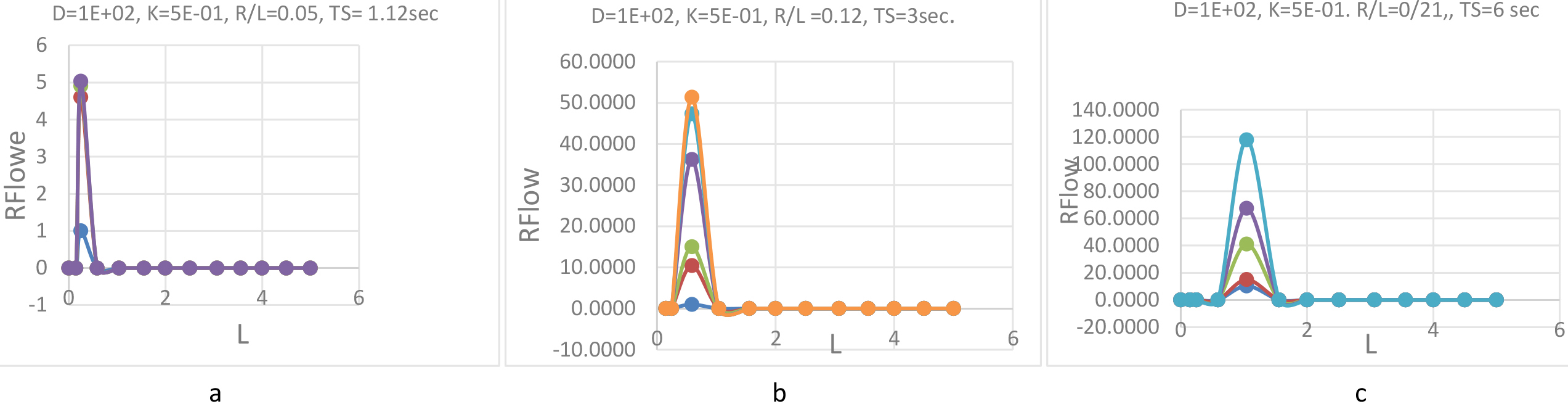
The analysis of the presented materials allows us to study the changes in the above characteristics for the specified range of changes in the physical properties of the material. Here TS – stabilization time of SF at K
The technology of continuous monitoring of the state of the material corroded as a result of chemical reaction allows to estimate the rate of birth and development of SF, as a result of chemical reaction.
The rate of a chemical reaction. D 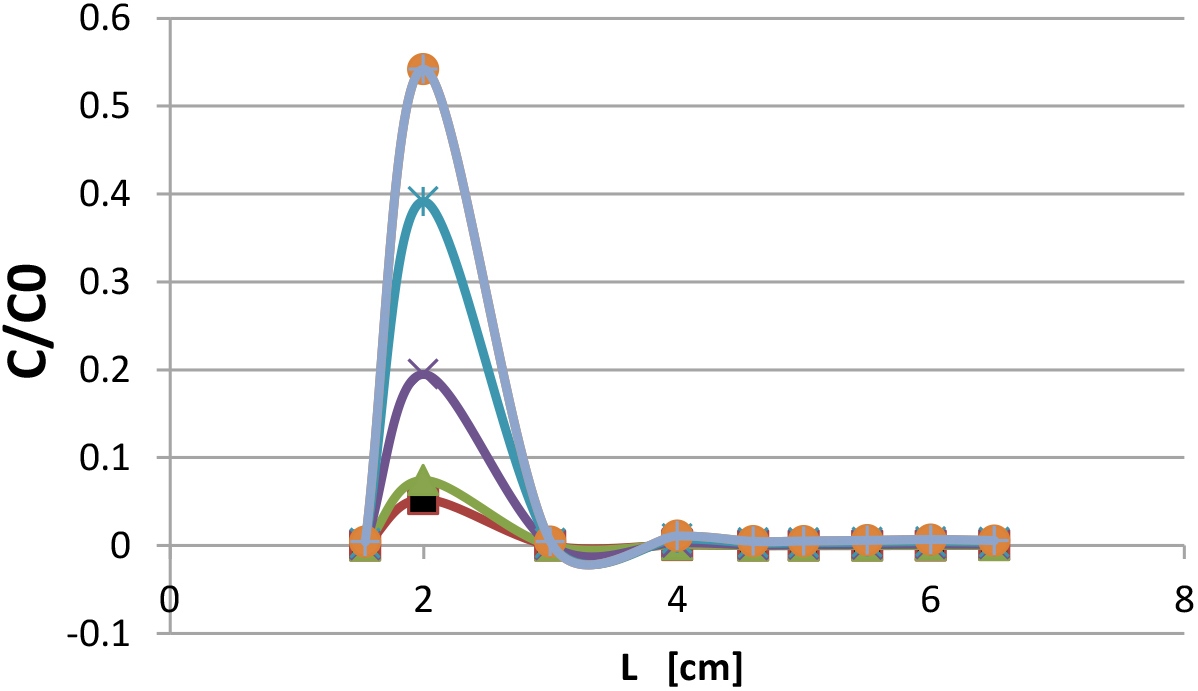
Figure 3 illustrates the results of numerical experiments to estimate the rate of film nucleation for two relative defect radii: on the upper curve (R/L)
Relative concentration as a function of time.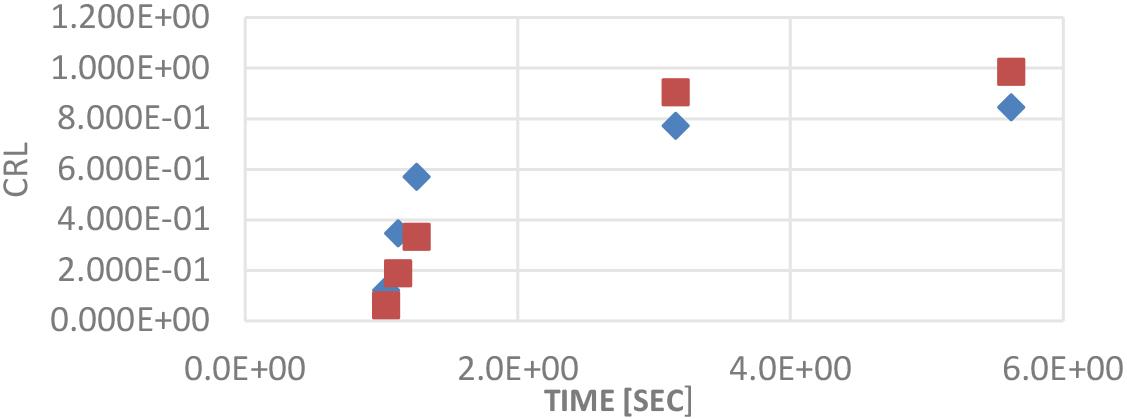
This illustrates the possibility of implementing reaction rate estimation. Here CRL
Relative concentration as a function of time in the initial part.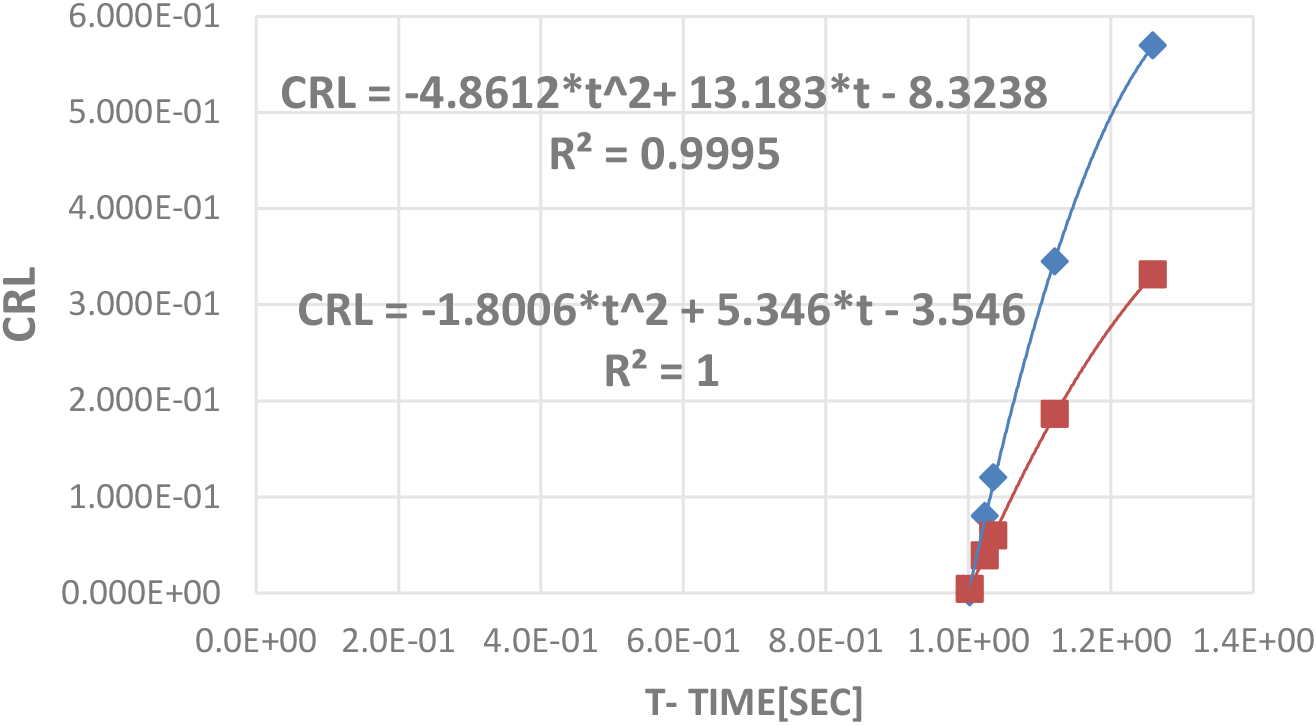
It should be noted that at the initial stage of diffusion kinetics with dissolution, the reaction rate is approximately constant, the concentration of reaction products increases linearly. It is the greater for the greater (R/L).
If D
If D
Indeed, the rate of change in the concentration of dissolution products, i.e., the rate of a chemical reaction satisfies the regression equation:
The resulting relationship characterizes the high level of linear correlation between the rate of change in the concentration of dissolution products and the process time. However, with the onset of the second stage of dissolution (Fig. 4), its rate sharply decreases, dissolution acquires a stationary character with the reaction rate tending to zero.
Frank-Kamenetzky (Frank-Kamenetzky, 2015) proposed for the first-order dissolution reaction a formula for determining the thickness of SF. It is valid only for the model of the medium in which a flat boundary between the aggressive medium and the solid body:
Another formula (ibid.) obtained theoretically is
where
Numerical analysis of Eq. (19) made it pble to obtain the explicit dependence. For each diffusion coefficient FT, it has the form of a linear function of (R/L) 103 with a correlation coficient equals 1.
Dependence of the film thickness on the relative defect radius.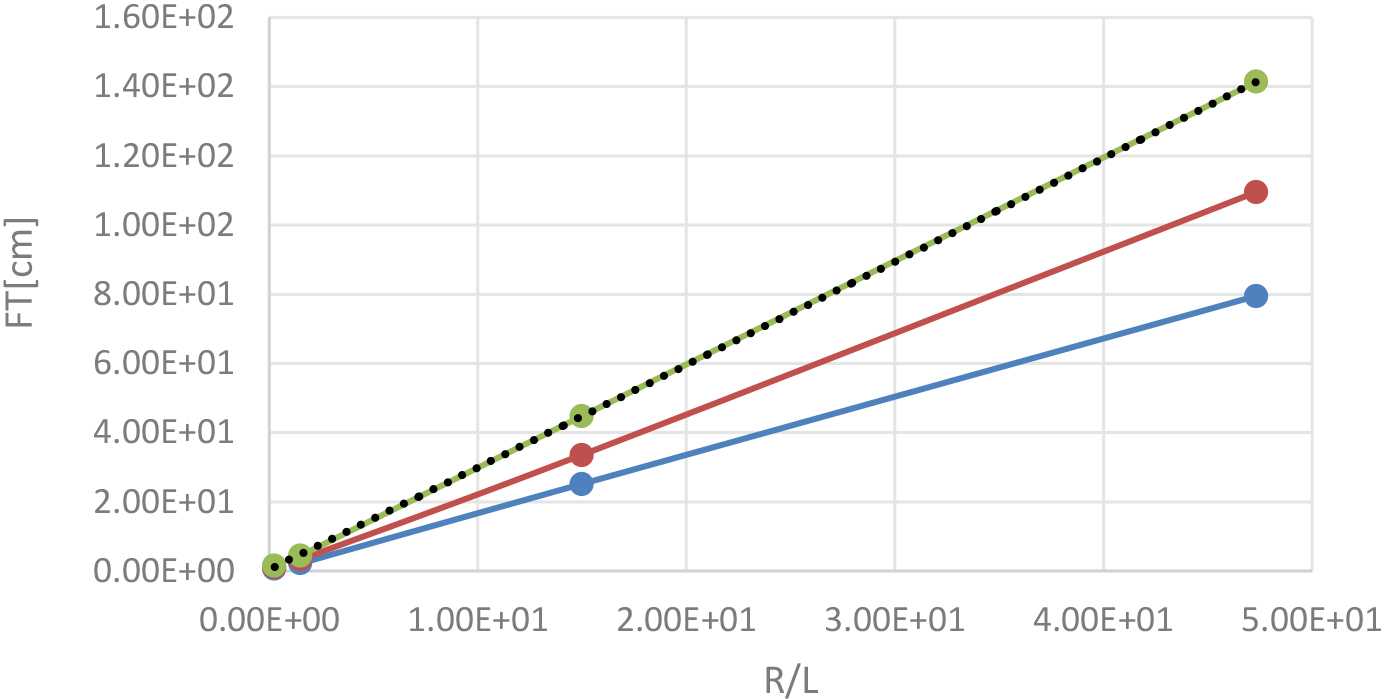
For those examples, from the top to the bottom for
Equation (20) determines the correlation between the measured parameter – FT (film thickness) and the geometric – (R/L), defect radius. The correlation coefficient
The general solution to the problem of distribution of dissolution products in the region of SF, is based on a characteristic feature of the problem under consideration: it is that at the initial moment
Let us consider the case B)
Dependence of solid “film” formation time (t0 [sec]) and destruction time (T0 [sec]) of solid “film” as a function of flow rate and diffusion
Dependence of solid “film” formation time (t0 [sec]) and destruction time (T0 [sec]) of solid “film” as a function of flow rate and diffusion
Table 2 shows examples of the influence of the laminar flow velocity of the liquid inside the defect on the time T0 – destruction of SF in comparison with the time
The main conclusion from the realized analysis is that the rate of destruction of a solid containing a defect with an aggressive liquid is determined by the rate of birth and death of SF in Eqs (12) and (13). Let us represent this regularity in the form of equation:
or
in which the rate constant of the birth of SF is
and the rate constant of the destruction of SF is, in [1/sec]:
Thus, each stage of corrosion is a sequence of two opposite processes – birth and death of SF with a common dimensionless term “BV”. As noted above,
From the formulas
and from Eq. (20) we get:
The similarity criterion should be determined for monitoring the corrosion process. Having established by means of experimental data processing, the form of the obtained dependences for certain physical and geometrical conditions can be used further the found dependence to calculate any processes occurring in similar geometrical and physical conditions, but at other velocities and physical properties of the substance. For this purpose, the monitoring technology should provide measurements of groundwater flow velocity
Consider the time
Elastic energy of an arbitrary element of a solid containing a cylindrical defect of variable radius
It should be noted that there is a difference in the magnitude of stress on the surface of a defect which depends on its R/L, in the case when the external compressive stress is set at a limited distance from the defect, from the case when it is applied at an infinitely large distance from it. Let us consider the elastic energy of a random element of a solid body containing a defect of variable radius
Elastic energy of a random element of a solid body, containing a defect of varying radius (R/L); the model of the regression eqation: 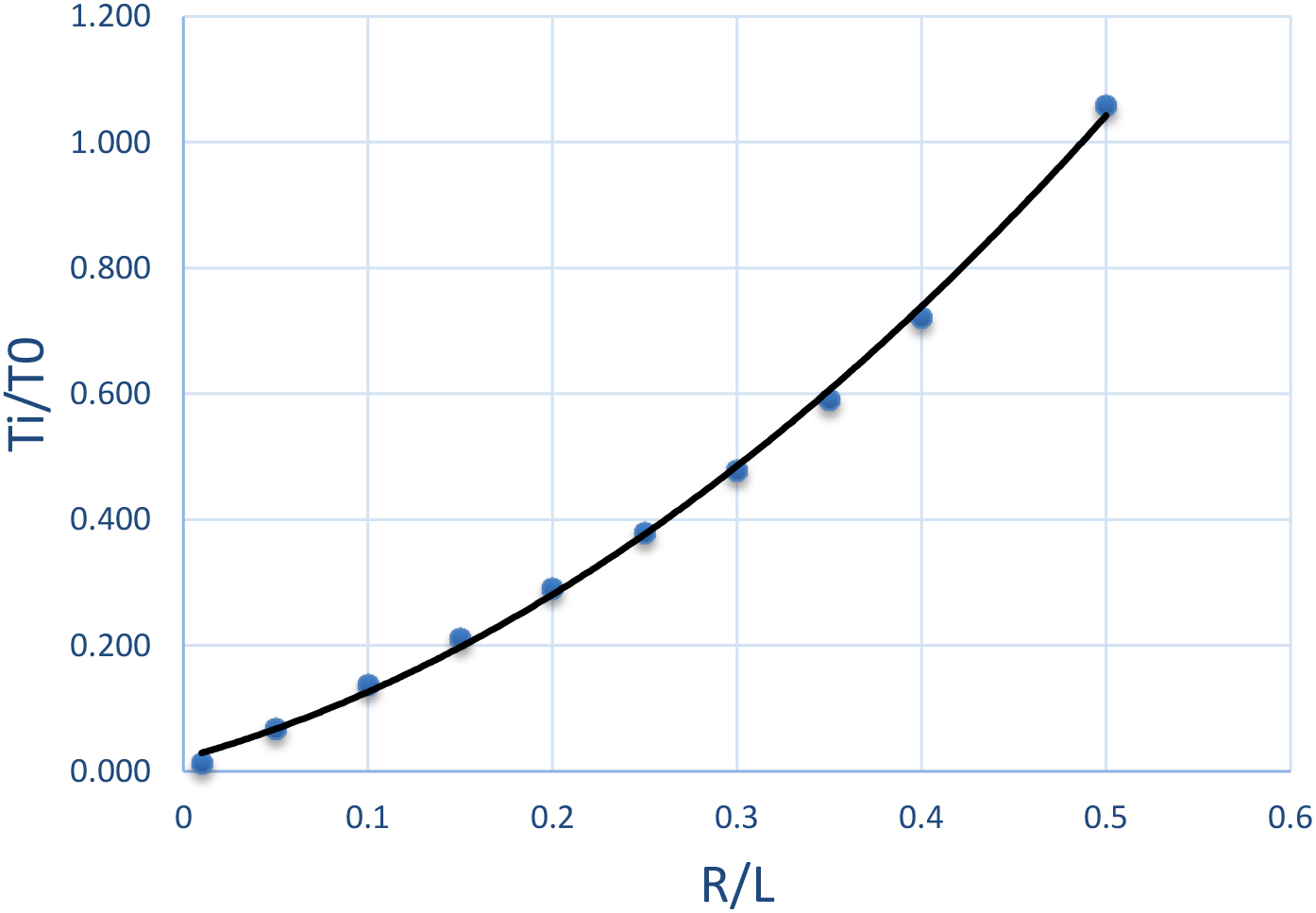
Let us discuss dependence of the relative change of surface tension energy on
Let us consider the general case when t elements contain a defect located at infinity from the boundary of the applied compressive stress.
Before the hole was cut, the volume element had the strain energy of the system under plane stress state and bilateral compression (Liebowitz, 1969):
where R – the radius of the defect,
The introduction of a cylindrical cavity increases the free energy by the amount
in which
Let
Denoting
The random nature of the state of the structure is associated with the random distribution of physical properties of the composite material in its volume. One of the possible scenarios for statistical analysis of such a case is considered in (Vilge, 2016). Below we discuss the random joint distribution of physical and geometric parameters of the medium in a random element of the structure. A comprehensive interpretation of local and spatial distributions allows us to develop the fundamentals of statistical methods for analyzing the results of non-destructive testing methods.
The random nature of a state of the object exposed to chemical corrosion is a consequence of random processes of birth, development, and death of defects (Vilge, 2016). Repeatedly emphasized characteristic feature of monitoring the state of the object is impossibility of the direct measurements of each of the physical and geometric parameters. Their determination by monitoring can only be obtained from the results of continuous or discrete indirect measurements. In this case, the required parameters, such as film thickness, time of its birth, rate of development and death of the defect, depth of penetration of the reaction, critical strength, etc., depend simultaneously on a set of independent random variables and the distribution of each physical and geometric parameter in space. In other words, only the analysis of their joint distribution allows us to assess the state of the entire structure. Consequently, there is a need to develop new methods of processing and interpretation of measurement results in order, to predict the state of the object and its durability. To solve the task at the first stage, it is natural to assume that physical and geometric parameters, being random variables, are distributed in space according to the normal law. In this case, the results of theoretical analysis allow us to formulate the requirements for the technology of monitoring the state of the object, in particular, the requirements for the distribution in space of the corresponding sensors – training sample of parameters characterizing the whole process of birth, development, and death of defects.
The relations between the main physical and geometrical parameters obtained in the results of studies of corrosion processes in our model of the medium, in the simplest cases, can be presented by generalized functions
a)
The “weakest link” is the element of the medium for which the probability of joint distribution of material and geometric parameters is the highest, i.e. the highest probability of critical strength.
b)
c)
Equations (33)–(35) of the joint distribution density of the listed random variables give an idea of possible methods of processing and interpreting the results of indirect measurements to obtain the distribution of material and geometric parameters of the controlled objects.
The works (Vilge, 2010; Vilge, 2011; Vilge & Vilge, 2016; Vilge, 2019) considered the physical basis for monitoring the state of a composite material using non-destructive methods in which sensitive sensors inserted in the structure throughout the entire period of its existence, with measured electromagnetic and acoustic parameters. In case of electromagnetic method, it can be the ratio of the electric field strength components
Single – Sided Amplitude Spectrum, Series 1 (top): R/L 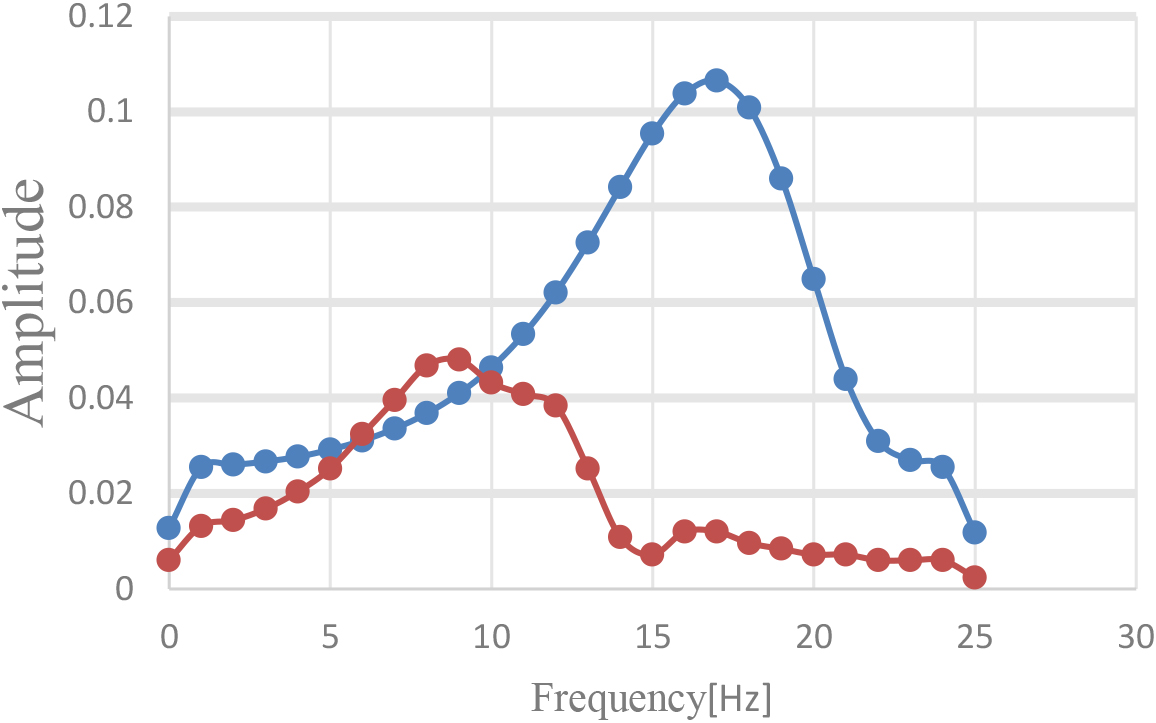
Physical parameters of the element: Young’s Modulus E
The obtained results can be summarized as follows.
Statistical modeling and regression equations are the basis for creating technology for non-destructive methods for monitoring the condition of Buildings and Structures. The durability of an object’s existence is the time during which its structure undergoes sequential transformations before destruction. In other words, the longevity of the structure is the time of stable equilibrium of the evolutionary system. The process of transition of a structure under conditions of chemical corrosion from a stable state to an unstable one is a sequence of smooth, continuous changes in the structure and its abrupt transformation as a result of changes in some physical and/or geometric parameters. Each element of such a sequence represents a set of processes of dissolution of the composite material with the formation of a solid film and its destruction. The random process of “birth”, development, and “death” of defects arising in chemically active composite materials because of chemical corrosion is one of the fundamental reasons determining their durability. Prevention of catastrophic destruction of buildings and structures lies on the foundations of the technology of continuous monitoring of the material state. It is based, to a large extent, on mathematical analysis and the synthesis of three processes: physical and chemical kinetics, diffusion, and hydrodynamics. Various possible scenarios of “birth”, development, and “death” of defects should be considered. The choice of an idealized model of the medium can be based on the statistical concept of a “weak link”. The difference between the technology of nondestructive control of the object state to prevent catastrophe lies in the indirect nature of measurement results. They represent information about the joint distribution in space of physical (material) and geometric properties of the medium. However, their independent estimations can be of main interest. The random character of physical and geometrical parameters, chemical reaction rates, thickness, time of formation and destruction of solid films determines the necessity of theoretical study of a specific possible scenario of corrosion process development. This task is solved by analytical and numerical analysis of internal and external boundary problems of physical - chemical kinetics for the selected model of the medium. The appearance of the above-mentioned solid “film” is the result of physical and chemical processes at the boundary between the solid and the aggressive liquid. The solid film is a key factor in the process of birth and development of the defect. This process is a sequence of “birth” and formation of a solid film, its destruction because of diffusion of dissolution products inside the defect filled with aggressive liquid and their further diffusion into the external space, formation of a new defect of greater radius and extent, birth of a film at a new interface. This sequence is a step function with increasing time step, and the time of “film birth” is significantly less than the time of its destruction. The first period of the defect birth ends with the formation of the second external interface between the defect and the environment. The second stage of the defect development process is characterized by reduction of the film destruction time due to groundwater movement along the defect, both because of particle transport and vortex flow at the interface between the body and the fluid. The evaluation of such important parameters of the chemical corrosion process as the depth of reaction penetration, its speed, thickness of the solid film, etc., as well as the determination of relations between them is a necessary basis for the technology of continuous monitoring of the state of the structure and durability, i.e., the forecast of its existence time. Dimensionless similarity criterion of birth and development of a defect in the process of chemical corrosion is a fundamental link between physical and geometrical parameters:
New methods of processing and interpretation of the results of monitoring of the object state to assess its durability should provide information about physical and geometric properties of the medium from the results of their random joint distribution. Relationships between the main physical and geometric parameters should be based on the results of studies of physicochemical kinetics phenomena for specific models of the medium. These relations in the simplest cases can be represented by generalized functions
Footnotes
Acknowledgments
I thank Dr. Michael Dokhnovsky for useful discussion helped to improve the paper.