




Abstract
Evaluating players’ performance for decision-makers in the sports industry is crucial in order to make the right decisions to form and invest in a successful team. One way of assessing players’ performance is to group players into specific “types”, where each type represents a level of performance of its players within. In this paper, we develop a novel clustering approach in order to cluster types of players in the NBA. The proposed methodology is initialized by a k-Means clustering, then the prescribed clusters inform weights of a weighted network, in which players are the nodes and the arcs between them carry those weights that represent a numerical similarity between them. We then call upon a weighted network clustering approach, namely, the Louvain method for community detection. We demonstrate our methodology on six years of historical data, from seasons ranging from 2014–2015 to 2019–2020. Considering these seasons allows us to use a new type of data, called Tracking Data, instated into the league in 2014 which further differentiates our research from other player clustering approaches. We show that our approach can detect outliers and consistently clusters players into groups with identifying features, which give insights into league trends. We conclude that players can be categorized into eight general archetypes and show that these archetypes improve upon the traditional five positions and previous research in terms of explaining variation in Win Shares.
Keywords
Introduction
Since the highest-level executives (i.e., decision-makers) in the sports industry have started utilizing modern analytics in helping inform their decisions, sports analytics has gained an increasing popularity for the applications of data science and statistical analysis. The National Basketball Association (NBA) is one of the leagues that is highly utilizing it for making better decisions. While there are many different avenues in which analytics can be applied, one of the crucial concerns of the sports industry is how to evaluate players’ performance. More specifically, in team sports, it is also important to analyze how players’ performances work together, since it is vital to building a successful team. One approach that acts as a starting point for player valuation is determining which “types” of players exist within the league. Generalizing player types can help executives evaluate their value within the context of a team setting.
Basketball traditionally labels players into five positions; Point Guard, Shooting Guard, Small Forward, Power Forward, and Center. This classification, however, is an oversimplified version of the types of players that have emerged over the evolution and growth of the game. It is widely accepted that players of the same position may not necessarily be of the same type. For example, LeBron James and Stephen Curry, are both listed as point guards for the 2019–2021 seasons (basketball reference.com/ 2021). James, at 6’9” and 250 pounds, and Curry, at 6’3” and 185 pounds, have just about as much in common in their style of play as they do in their physiques. James uses his size to post up smaller guards and drive to the basket, while Curry makes 30’ shots from behind the arc (3-PT line) look as though they are as easy as free throws.
Although oversimplication of positions is certainly one motivation to perform cluster analysis of players, the driving force that motivates a better classification of players goes beyond the cluster itself. Decision-makers are often interested in building a team consisting of different types of players that would perform the best on the court. A more granular characterization of players can set the stage for lineup optimization, and therefore can be of very high value to decision-makers. For example, similar to this idea, Chan et al. (2012) perform k-Means clustering for professional hockey and determine the relationship between team performance and player types by using a regression model. Muniz & Flamand quantify the interaction between player clusters by developing a new metric that encompasses the synergy potential between “groups” that each player belongs to. Note that these “groups” are provided by the analysis of this paper. The authors incorporate these findings into an optimization model that prescribes the optimal team building decisions, including which new players to draft, which current players to trade with those of other teams, and/or which free agents to acquire in a way that maximizes team’s total value, including players’ individual values as well as the synergy potential among players on the team.
A more holistic evaluation can also better inform decision-makers’ draft, trade, and free agent acquisition decisions. When faced with comparing and contrasting players such as James and Curry, executives need to know more than their position. Specifically, an efficient cluster analysis would help them in learning about how a player performs, what makes him effective, what his strengths and weaknesses are.
The remainder of this paper is organized as follows. In the next section, we present a literature review to summarize previous research. In Section 3, we describe the data used in our approach. In Section 4, we propose and discuss our methodology in detail. Section 5 presents a case study for a single season (2018–2019) to fully demonstrate the utility of our approach, including a detailed analysis of the resulting clusters, while in Section 6 we explore the previous six seasons to validate our approach and develop insights in trends among the years. Section 7 presents our sensitivity analysis. Finally, we conclude and provide suggestions into future work, specifically in the context of the NBA, in Section 8.
Literature review
To address the large discrepancy between the traditional positions and the types of players that are labeled by them, one approach that has been explored in the literature is clustering players according to their statistics. In a seminal study that won top prize in the “Evolution of Sports” category at the 2012 MIT Sloan Sports Analytics Conference, the author clusters players using a technique known as topological data analysis and identifies thirteen “new positions”, which he eventually whittles down to ten (Alagappan 2012). Since then, many different clustering approaches have been explored. Zhang et al. (2016) also use the traditional k-Means clustering approach to classify guards (point guards and shooting guards) in the NBA, and identify six different types of guards. Patel (2019) also uses k-Means to cluster players, but first employs dimensionality reductions techniques to the data and identifies four groups of players. Bianchi et al. (2017) use self-organizing maps and fuzzy clustering procedures to develop a new set of five clusters that are different than the traditional five. Dehesa et al. (2019) use player and team statistics and a two-step clustering with log-likelihood distance and Schwartz’s Bayesian criteria to classify players in both the regular season and playoffs; they identify five player types for the regular season and four in the playoffs.
In the literature, there are also studies that focus on clustering players that would help in building successful teams and lineups. Lutz (2012) presents the first work that incorporates this idea and uses multivariate cluster analysis to identify ten clusters of players; the author then analyzes 2- and 3-way interactions of clusters to determine which combinations of players affect winning. Kalman & Bosch (2020) first use model-based clustering to give soft-assignments to players and clusters by assigning a probability that each player belongs in a cluster. The authors develop nine positions, similar to that of Alagappan’s size of ten. Then, they investigate different combinations of these cluster-lineups to determine the most successful ones using random forest models.
Thus far, all existing clustering approaches use a single data set, and primarily, a small set with limited amount of traditional or advanced statistics (e.g., Alagappan (2012) uses only seven statistics to inform his analysis). Alagappan (2012) builds a semblance of a network structure to form player clusters, though topological data analysis is more precisely a geometric approach (Carlsson 2009). Other network clustering approaches in basketball, such as Fewell et al. (2012) and Xin et al. (2017), take an approach such that the nodes consist of players and play-type outcomes and ball movement as arcs. Skinner & Guy (2015) present one of the first network-style approaches to incorporate Tracking data, with the aim of learning players’ skills and predicting the performance of untested 5-man lineups in a way that accounts for the interaction between players’ respective skill sets. Our work differs from theirs in terms of the network structure of the model and the way in which tracking data is incorporated. Specifically, the network in their research models offensive structures and they use tracking data to describe the flow of possessions through the network. This paper takes a different approach, as summarized below.
The contribution of this paper is as follows: to the best of our knowledge, this is the first study that incorporates multiple data sets separately, which allows for more information to inform our clusters and develops a network-based methodology for clustering player types. While the introduction of tracking data allows for more information to be included in the analysis of players, it is also difficult to preserve all of the information encoded within it due to the vast amount of new statistics. Bruce (2016) suggests that the “high dimensionality” of this new tracking data source can be troublesome, as it demands more computational resources and reduces the ability to easily interpret findings. He develops a new metric using Principal Component Analysis (PCA) to summarize the information, although the interpretation of this metric is still not immediately apparent. In this study, we employ PCA on our multiple data sets for reducing the dimensionality, while the results are still interpretable, since information from each data set from which we obtain clusters is encoded into a weighted network. Once PCA is performed on each data set, the proposed methodology is then initialized by several k-Means clustering models that are independently applied to each data set. Then, a weighted network is built, where each node represents a player and each arc represents the similarity between two players (i.e., nodes). Prescribed clusters that are initially obtained from k-Means clustering models inform the weights of these arcs in the network. Using our weighted network, we then perform the Louvain method for community detection, which is a weighted network clustering approach popular in the fields of biology and social network analysis. The network structure allows for a more thorough posterior investigation of the relationships in the clusters. One can call upon network metrics as well as examine the network itself to develop insights that are not previously provided in other clustering approaches. Newman & Girvan (2004) show community detection examples on networks of scientific authors with links between co-authors, on networks of actors in films with links between actors appearing in scenes together, and on networks of interactions between karate club members at an American university. We apply this idea to sports by using k-Means clustering to build ‘similarity’ among players. Our algorithm proposes a new way to think about similarity among players and results in the formation of new archetypes of players in the NBA.
Data
In this study, we utilize several data sets from NBA.com/stats (2020) for seasons ranging from 2014–2015 through 2019–2020 that span a variety of categories. We extract the data using Python’s
Prior to the 2014 season, Player Tracking data that is considered in this paper was not available throughout the league. For this reason, most of the existing clustering approaches use simple statistics, typically coming from either the Traditional or occasionally, the Advanced, data sets described in Table 12 under the General category. In 2014, a real-time tracking technology, SportVU, was introduced into every NBA arena and the data offered by such technology has been made available on NBA.com. Its inclusion in our analysis allows for a more thorough investigation of player tendencies, since it covers statistics not previously seen before such as speed and information on different types of shots (i.e., catch-and-shoot and pull-up) and touches (i.e., elbow, post, paint) and their efficiencies. While these statistics are organized as in Table 12 according to NBA.com, we reorganize the data sets and categorize statistics into six general areas, namely, Scoring, Passing/Playmaking, Rebounding, Defense, Hustle/Miscellaneous, and Clutch, such that each area forms a “Master data set” that includes statistics related to each category, as shown in Table 1.
Master data set description
Master data set description
The decision to reorganize the data into these six categories is deliberate. Basketball is a multi-faceted sport consisting of both offensive and defensive aspects. For example, we break offense into Scoring and Passing/Playmaking to allow for distinction between types of offensive players. Typically, rebounding is lumped in with defense, but there are offensive components to it as well. Thus, Rebounding becomes its own category. In addition, Defense remains its own category. Normal defensive metrics in traditional box-score statistics only cover steals, blocks and rebounds, but our data set is enhanced by both player tracking and hustle statistics, which allows for a more comprehensive evaluation of players’ defensive styles. We also introduce a new Hustle category by combining hustle statistics that were incorporated into the league in 2018 (Martin 2018) with information about aggressiveness and speed to capture the previously intangible value of player effort. Therefore, the statistics within the Hustle raw source, were not included in their respective master data sets (i.e., Passing/Playmaking, Rebounding, Defense, Hustle/Miscellaneous) prior to 2018. Finally, we separate Clutch scenarios from regular scenarios to capture performance in unique situations. Prominent owners such as Mark Cuban have made decisions such as the Jason Kidd acquisition in 2008 (Paine 2010) based on improved performance in the clutch. Separating data sets into these categories allows us to capture and evaluate player performance from a multi-faceted viewpoint and cluster players accordingly.
In the previous section, we identified six categories of statistics that describe the different ways in which players contribute to the game. In this section, using the master data sets that are created based on these categories, we propose a new clustering approach in order to cluster players, namely, Community Detection with k-Means (
Consider sets, parameters, variables and auxiliary functions listed in Table 2. Note that parameters are inputs that must be determined by the modeler. That is, to implement
Sets, parameters, variables, and functions
Sets, parameters, variables, and functions
The proposed methodology is shown in Algorithm 1. It combines the use of two clustering algorithms repeatedly, namely, k-Means and community detection. Both methodologies are implemented using Python. Specifically, we use the
Algorithm 1 consists of four main steps. In Step 0, we perform a Principal Component Analysis (PCA), which is a process by which principal components, low-dimensional linear surfaces that are closest to the current observations, are computed (James et al. 2013). Performing PCA reduces dimensionality and preserves variability in data sets. Dimensionality is an important consideration when performing k-Means clustering, because when dimensionality of the data is high, the nearest neighbors in k-Means may not actually be very close and may therefore lead to a poor or misleading fit.
After PCA is performed, in Step 1, the main part of the algorithm is initialized by k-Means clustering. We refer to the clusters yielded by the k-Means clustering as “micro-clusters”. The value of k represents the number of micro-clusters that needs to be pre-defined. In general, in order to determine the best k value, one uses a scree plot or evaluates the silhouette scores among different k values, where the optimal tuning for k is left up to the subjectivity of the analyst. In this study, we implement the proposed algorithm for a set of different k values and follow a similar but an alternative approach to select the best k value, which will be discussed later. For each k value, a k-Means clustering is implemented on each of six master data sets (with reduced dimensions). Therefore, each of these six master data sets has their own set of micro-clusters (i.e., grouping of players). As shown in Table 2,
Once, for each k value, k-Means clustering is implemented on six master data sets and
Community detection with k-Means (
1:
2:
3:
4: dPCA ← PCA(d) ⊳ PCA returns reduced dimension for data set d
5:
6:
7:
8: Let
9:
10:
11:
12:
13:
14:
15:
16:
17:
18:
19:
20:
21:
22:
23:
24:
25: (
26:
27: Plot(
28: Selectk(frontier) ←
29: Return
For each weighted network that is created for a given k value, the Louvain method for community (i.e., cluster) detection is performed. This algorithm is a heuristic with two phases repeated iteratively in order to maximize “modularity” of communities. Modularity is a measure of the density of links inside communities as compared to links between communities. Therefore, the algorithm aims to cluster the nodes such that each community includes elements as similar as possible to each other. The first phase of the algorithm allows local changes in community assignment. Specifically, if removing node i from its current community and placing it in its neighbor j’s community improves modularity, then it is moved accordingly such that the improvement is achieved. The second phase builds another network whose nodes are the communities found in the previous phase. These two phases are repeated until no increase in modularity can be gained (Blondel et al. 2008). The Louvain method prescribes a set of partitions (i.e., clusters of players) that we refer to as “macro-clusters”.
Note that the proposed methodology, (
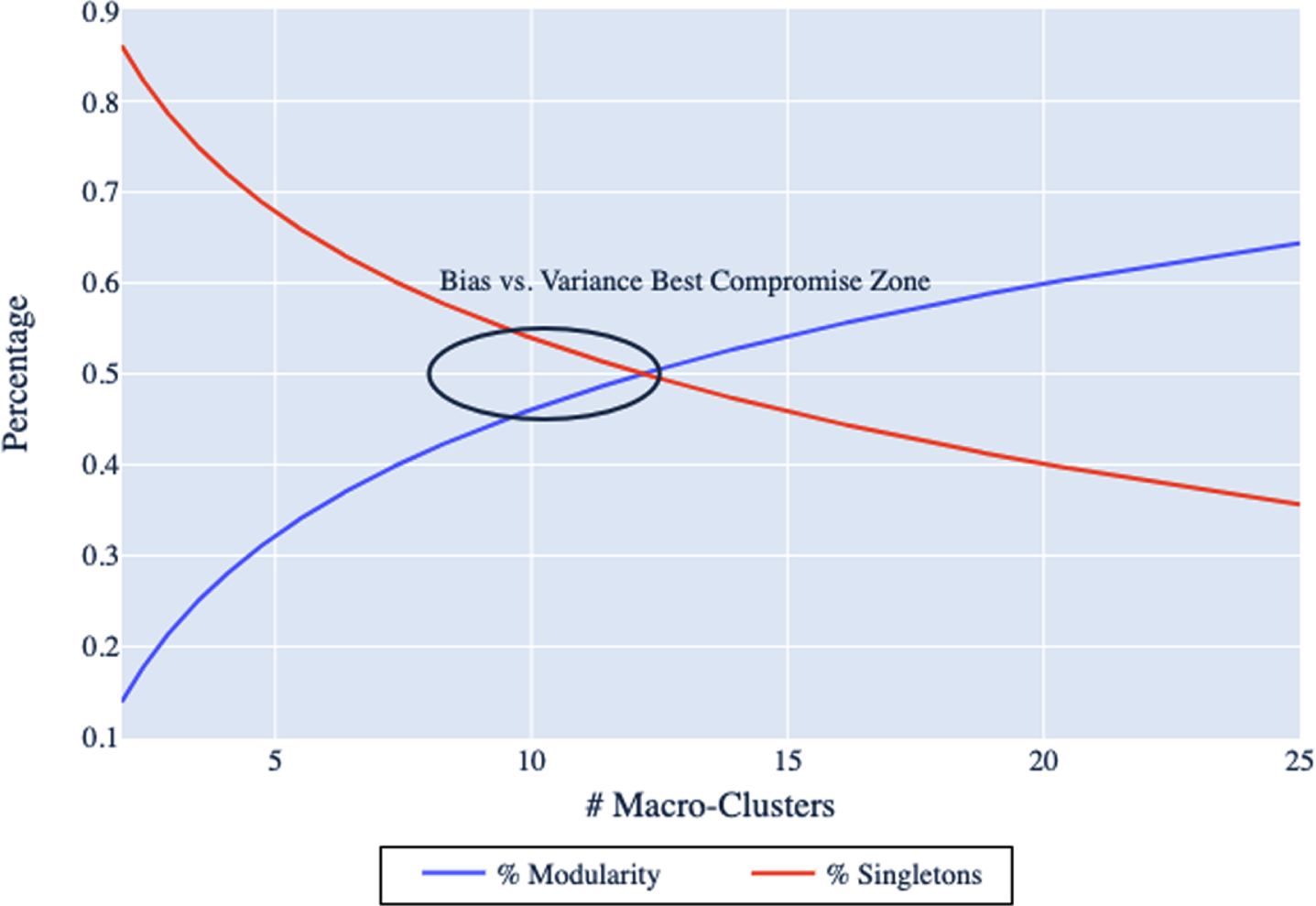
Example modularity frontier
We conceptualize bias as the over-simplification of player types into a small number of groups. In this way, the traditional five positions could be considered as being a biased assessment of actual player types. On the other hand, we conceptualize variance as the over-fitting of player types into a large number of individualized groups, where variance refers to the amount by which the results would change if a different training set (or group of players) was used (James et al. 2013). If each player were to be assigned to their own cluster, then the results would be highly individualized and therefore we would conclude that the variance of the model is high. For example, at an extreme case, if the value of k is equal to the number of players, then each micro-cluster would be of size one which would form a completely disconnected weighted network. Therefore, the community detection algorithm would result in as many macro-clusters as the number of players. These clusters would be completely distinct, but practically useless, as we could not draw any relationships among the group. On the opposite end, if the value of k is too small (e.g., two), then the likelihood that players appear in the same micro-clusters is very high. This would result in a dense weighted network and therefore would be difficult to perform any useful community detection.
To first demonstrate our methodology in depth, we use as a case study the 2019–2020 season. With any unsupervised clustering algorithm, the user must determine values of certain parameters to use. Thus, we first discuss how parameter values are chosen, then we discuss our results.
Parameters
In order to ensure that we have enough information on each player, we limit observations in all categories (except for the Clutch category) to players above the 25th percentile in minutes and games played. For all data sets except those in the Clutch category, this represents observations with at least 12.6 minutes and 29 games. There are fewer situations in which games are considered in a clutch scenario, and therefore, players are more selectively chosen. Due to this, for those in the Clutch category, we limit observations to players above the 50th percentile, which represents 2.6 minutes and 16 games, respectively. Thus, this results 336 players in the player set,
PCA dimensionality reduction results
PCA dimensionality reduction results
Note that other binning approaches (e.g., 0, 3, 5) are also explored, as well as using the raw values directly, and our experiments show that dividing the raw values into four bins provides adequate separation among groups. In addition, note that we keep k constant for all data sets within each experiment. This approach also avoids a combinatorial search of using different k-values for each data set. The interested reader is encouraged to experiment with different discretization approaches, k-values, and percent variability schemes that leads to the best results in their use case. The values we ultimately decide upon are a result of the best modularity frontiers. We aim for a modularity of greater than 50% after comparing with recent community detection research. Specifically, Newman & Girvan (2004) find that practical modularity values range between 0.3-0.7 (see references in Singh Ahuja & Singh (2016)). In a subsequent section, we explore different scenarios in which these decisions are altered to develop insights on their sensitivity.
Applying Algorithm \ref alg:cdkm,

2019–2020 CD-kM Modularity frontier
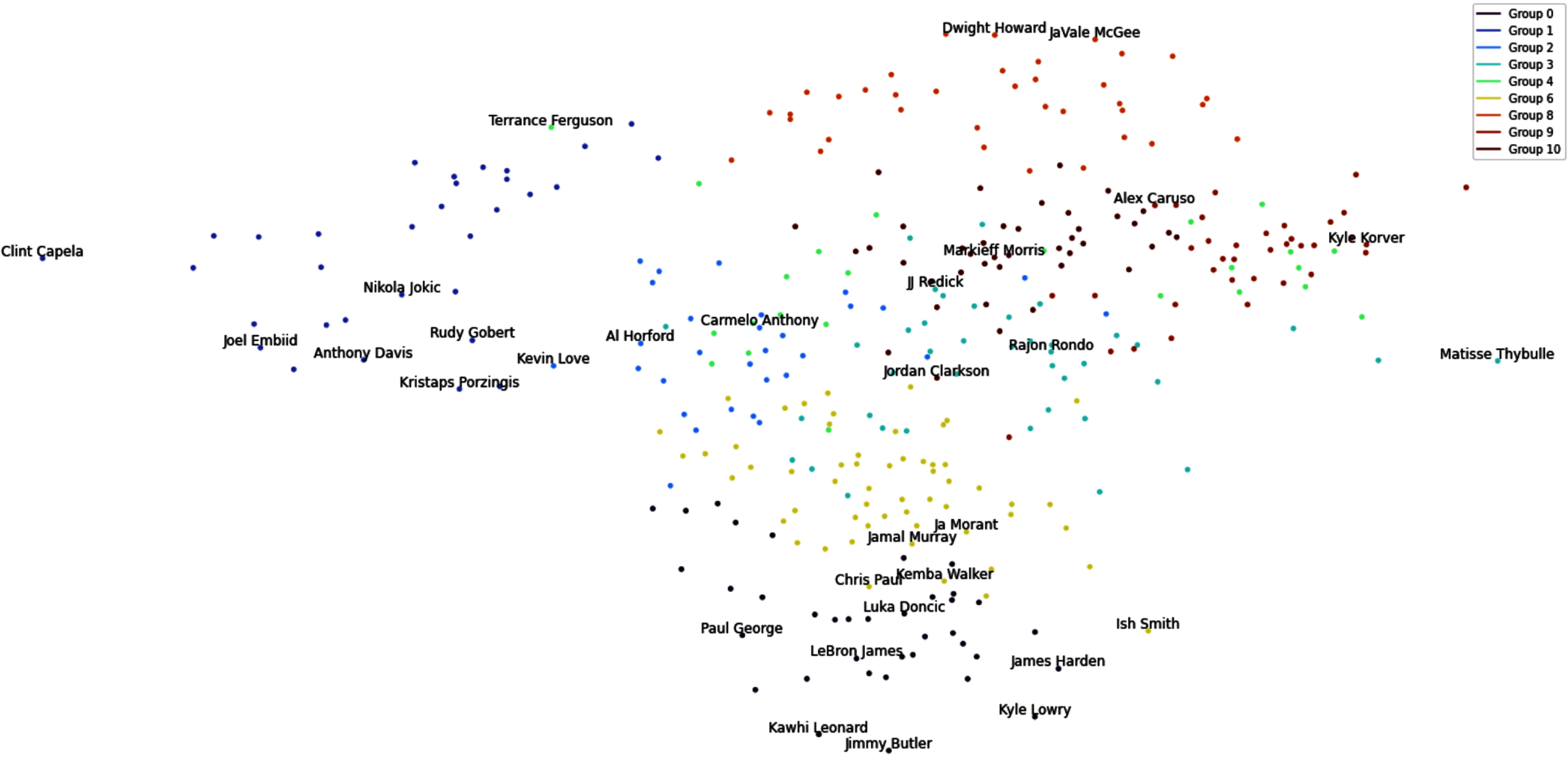
In this section, we examine macro-clusters (i.e., groups) obtained by the proposed methodology for the case study. Fig. 3 visualizes the macro-clusters in a scatter plot form. Specifically the plot shows the weighted network,
Macro cluster visualization
Note that we examine statistical averages of each macro-cluster, and characterize each of them according to their playing tendencies. Characteristics regarding the performance of players in each macro-cluster are summarized in Table 5 along with notable players in each group. Table 4 displays the size of and average performance metrics for each group and their standard deviations. Sizes of macro-clusters range from 24-57 players, in addition to the three singletons. This would reflect that bias-variance trade-off in choosing k* is managed, with no one single group dominating the others in size. The performance metrics are developed as an attempt to quantify the value of players. PER represents Player Efficiency Rating, which is a measure of per-minute production standardized in a way such that the league average is 15 (Hollinger 2007). Table 4 shows that Groups 0, 1, and 8 on average have a PER higher than the the league’s average. Offensive and Defensive Win Shares (OWS and DWS) are an estimate of the number of wins contributed by a player due to offense and defense, respectively, while Win Shares (WS) is the sum of these two values, and estimate the total number of wins contributed by a player (basketball reference.com/ (2021)). According to Table 4, Groups 0 and 1 dominate in all three of these categories. Comparing OWS and DWS would provide us an idea regarding the main role of each group. For example, all of the Groups 2, 4, 6, 9, and 10 have higher DWS than OWS that suggests that their role is more defensive than offensive. This is understandable, as Groups 0 and 1 seem to dominate the offensive role, while Group 3 are the 3-PT specialists, and Group 8 can score and create for their teammates and also play defense. Finally, USG% is an estimate of the percentage of team plays that a player is involved in while he is in the game (NBA.com/stats/help/glossary/). Groups 0 and 1 also dominate in this category, along with Group 6. These summary statistics match the characterizations in Table 5 and provide a deeper understanding of each group.
2019–2020 Group performance metrics: Mean (standard deviation)
2019–2020 Group summaries
The proposed methodology offers an improvement from both a topological data analysis approach and other traditional clustering approaches. In our approach, not only can different types of players be identified by utilizing community detection, but also the creation of a network allows one to better understand the groups and the relationships among them. For example, Fig. 3 and descriptions on Table 1 show that Groups 0 and 1 are more clearly delineated, being the high performing triple-double and double-double groups that they are, respectively. Results also reveal that while Group 0 and Group 6 are close, their main difference is that Group 0’s propensity to score and shoot more, while Group 6 are passers first, but still proficient scorers.
Note that in each cluster, there may exist some oddities due to the complexity of player types in the NBA. For example, Kyle Korver’s presence in Group 9 may not be considered as a good fit alongside Alex Caruso. However, Fig. 3 shows that while they are in the same group, their distance is not remarkably close. Specifically, Kyle Korver is located at the edge of his cluster, far from its centroid that represents that he may not fully embody all characteristics of his clusters. The network visualizations for each group in Fig. 6 in Appendix B also show that players cluster towards the center of the network more greatly, which embody the characteristics in Table 5. The further out they appear, the less strongly connected to the group they are.
Note that
We consider the micro-clusters underlying the creation of the macro-clusters. Recall that an arc between players i and j, shown in Fig. 6 in Appendix B, represents an occurrence of players i and j appearing in the same micro-cluster (k-Means with k* = 43) for at least one of the six master data sets. While these connections are examined between individual players, one can also examine the connections at group levels. To this end, we examine common connections that frequently occur between groups, in terms of categories. We first look at the distribution of categories of matches among each group as shown in Fig. 7 in Appendix C. Recall that the Clutch data set contains only a subset of the players, as these situations are more scarce, so there are fewer opportunities for matches. As shown in Fig. 7, Groups 4, 8, 9, and 10 have zero percent of their matches in the Clutch category. Since these groups are the generally low usage groups, as shown in Table 4, these players may not be involved in many clutch scenarios, in which the outcome of each possession is critical. In addition, our analysis reveals that among the other groups with matches in the Clutch category, Group 0 leads the way with nearly 10% of their matches. This would occur due to the fact that this group contains the high-usage All-Star level players, who may be the ones chosen to have the ball in their hand in a clutch situation.
As shown in Fig. 7 in Appendix C, a majority of the matches in Group 0 are in the Passing (Playmaking) category, followed by Scoring. Their similarity distribution is among the most consistent, with no one category dominating or lagging behind. Group 1 has nearly half of their matches in the Passing category, followed by Scoring and Defense. They contain the second highest percentage of Clutch matches, as this group contains the high-usage effective big men. Group 2’s matches are dominated by Scoring. Recall that these players are effective scoring inside from the point and paint. Group 3’s matches are also dominated by Scoring. Recall that these players are the 3-PT catch and shoot specialists. Group 4 also sees a majority of matches in Scoring, but Defense is a closer second, which would be expected, given that they are highlighted as quick players defensively. Group 6 sees matches in Scoring and Defense in nearly the same percentages, following by Passing. This group is highlighted as being efficient catch/shoot and pullup scorers, playmakers with high assist stats across the board, and the defensive hustlers. Group 8 sees the least matches in scoring (other than clutch in which they do not appear), but more consistent matches in Defense, Rebounding, Passing, and Miscellaneous (Hustle) to a lesser extent. This agrees with their description in Table 5, since this is the group of inside rebounders, who can score from the paint and post, and create assists off the screen and from the paint. Group 9 has a majority of their matches on Defense, and low elsewhere. Finally, a majority of their matches in Group 10 is in Miscellaneous. According to Table 5, it may be concluded that this is a negative match since this group has generally low hustle stats and low distance traveled on both ends of the court. Note that players assigned to clusters may not fully embody all characteristics of the generalizations such as those in Table 5. However, with further investigation into the network structure, the user can gain a better understanding of why clusters were chosen.
In the next section, we apply
Historical data
In the previous section, we explore the utilities of our approach on a single season (2019–2020). In this section, we summarize results from the prior five seasons (2014–2015 through 2018–2019) alongside the 2019–2020 results for validation, as far back as NBA tracking data is available for the entire league. Looking at historical data, we identify trends among the types of players in the league. This extends the utility of our approach beyond simply classifying players into groups. The ultimate aim is to be able to use these classifications in a practical sense. For coaches or general managers, the aim may be to build a team of the best combination of players, and these classifications of players provide a starting point. We summarize the results of
2014–2015 through 2019–2020 CD-kM results
2014–2015 through 2019–2020 CD-kM results
Table 6 shows that beginning with the 2014–2015 season,
With singletons removed, all seasons have a total of nine or ten macro-clusters. By inspecting the group averages for each of the six master data sets for each group and each year, we conclude that groups can be placed into one of eight general archetypes: Supporting Guards, Pass First Guards, Shoot First Guards, Versatile Forwards, Role Playing Bigs, Superstar Guards, and Superstar Bigs. These groups’ advanced statistics are summarized in Table 7.
Archetype advanced statistics: Mean (standard deviation)
Traditional role-playing guards are split into three archetypes: Supporting Guards, Pass First Guards, and Shoot First Guards. Supporting Guards, similar to Group 9 from 2019–2020, are not outstanding in any of the traditional guard roles, such as scoring and passing, and they are the generally lower usage guards. However, they rebound at a higher rate than their traditional role-playing guard counterparts on both offense and defense.
Pass First Guards, similar to Group 4 from 2019–2020, assist and subsequently turnover the ball at a higher rate than their traditional role-playing guard counterparts. In fact, their assist ratio (not shown in Table 7), or number of assists on average per 100 possessions, is higher than any other group’s.
Shoot First Guards, similar to Group 3 from 2019–2020, are the 3-point specialists of the guards. Not only do they shoot 3-pointers at the highest rate (3PAr), but their True Shooting Percentage (TS%, a shooting percentage that considers three-pointers and free throws values as well as the conventional two-pointers (NBA.com/stats/help/glossary/)) is the highest among the traditional role-playing guards groups. Among the traditional role-playing guard archetypes, they score the most catch-and-shoot, pull-up, and drive points per game. PER and WS both increase among these three traditional guard archetypes in order of Supporting Guards, Pass First Guards, and Shoot First Guards, although they are the lowest in both categories among all archetypes.
The traditional “bigs” (forwards and centers) are split into two archetypes: Versatile Forwards and Role-Playing Bigs. Versatile Forwards, similar to Group 2 from 2019–2020, can shoot from inside and outside the 3-PT arc, they rebound and block at rates higher than the traditional guards but lower than the traditional bigs, yet they assist and steal at rates higher than the traditional bigs but lower than the traditional guards. They excel in the catch-and-shoot scenarios from both 2- and 3-PT range but also get a fair amount of their point on second-chance opportunities and in the paint. Behind the Superstar groups that will be covered shortly, they lead all other groups in double-doubles. Among the traditional roles (both guards and bigs), Versatile Forwards have the highest WS.
Role-Playing Bigs, similar to Group 8 from 2019–2020, are characterized by their inside dominance. Their jobs are mainly to protect the paint, rebound, and create for their teammates in ways that are sometimes underappreciated. They rebound at the highest rates among the traditional roles (both guards and bigs), and aside from the Superstar Bigs, they have the highest block percentage (BLK%). Though their AST% is the smallest among all archetypes, not reflected is their ability to create assists from screens, which is a statistic in which they are second only to the Superstar Bigs. Among the traditional roles (both guards and bigs), Role-Playing Bigs have the highest PER.
For the traditional roles thus far, “bigs” may be viewed somewhat more valuable than guards in terms of PER and WS. This is compensated for in our two archetypes of Outstanding Guards: Superstar Guards and Scoring Guards. Superstar Guards, similar to Group 0 from 2019–2020, set themselves apart from all other guards in all categories. They have the highest usage percentage among all archetypes, which means they are involved in the highest percentage of team plays when they are on the court. In addition, they have the highest PER and WS among all other guard archetypes. They lead all guards in scoring, primarily off of drives and pull-up shots, but also off of second chance and fast break points, assists, and steals. Coupled with their ability to rebound, they tally the most triple-doubles of all archetypes.
Scoring Guards, similar to Group 6 from 2019–2020, separate themselves from traditional guards primarily in their ability to score, which is reflected in a higher USG% and WS in their advanced statistics. They average the second highest points per game behind the Superstar Guards. Their primary form of scoring is off the catch-and-shoot, in which they score the highest points per game among all archetypes. They also excel at scoring off of drives and pull-up shots, on the fastbreak and off of turnovers, second in all these categories only to Superstar Guards. In addition to their offensive ability, they exhibit hustle on defense and have the highest block percentage among guards and second highest steal percentage. Both Superstar and Scoring Guards set themselves apart from the traditional guards through their PER and WS ratings. Specifically, these are guards that are above and beyond the traditional guard roles with their respective characteristics.
Finally, one archetype of “bigs” set themselves apart from the traditional bigs: Superstar Bigs, similar to Group 1 from 2019–2020. These Superstar Bigs have the highest value in terms of both PER and WS. They dominate the paint with both boards and blocks. In addition, they create more for their teammates in terms of assists, as compared to the traditional big archetypes in elbow, post, and paint assists, as well as screen assists, they score efficiently and often from the elbow, post, and paint. They dominate other groups in terms of double-doubles due to their ability to score and rebound consistently.
Identifying these eight archetypes reveals a trend over the course of the past six seasons consistent with the evolution of professional basketball. The game has evolved over the past couple decades, from a post-dominated league with teams revolving around a star center (e.g., the Los Angeles Lakers with Shaquille O’Neal or San Antonio Spurs with Tim Duncan in the early 2000’s), to “Small Ball” (i.e., a style of play that trades size for speed, agility, and 3-PT shooting) teams dominating the league. This transition is apparent in a specific subset of two archetypes identified in Table 8 as two additional sets, since they do not fit into the original eight archetypes. The first archetype is a hybrid between Supporting Guards and Versatile Forwards. The players in this archetype are a near 50/50 split between guards and bigs which would represent a hybrid group. The second archetype is another group of players similar to Role Playing Bigs but that do not quite fit into the regular archetype. These groups appear in the first three seasons (2014–2015 through 2016–2017) where there is a post-dominated league. With two to three other groups of bigs (both Superstar and Role-Playing) in these seasons, these groups distinguish themselves in a sense that they are not good enough to fit the Role Playing Big archetype. In fact, they exhibit statistics below those of Role Playing Bigs in nearly every category, both in Table 8 and in the master data set averages.
Misfit archetype averages (standard deviation)
Note that there may exist overlap among group characteristics and therefore fluidity between players in groups throughout the years. For example, Scoring Guards and Superstar Guards have some overlap in characteristics, and players such as Chris Paul, James Harden, Jimmy Butler, and Kawhi Leonard fluctuate between the two over the six seasons examined. Similarly, Pass First Guards and Supporting Guards overlap, as players such as Vince Carter and Dante Exum fluctuate between the two over the years. Finally, Superstar Bigs share characteristics with both Role Playing Bigs and Versatile Forwards. Players such as Montrezl Harrell, Hassan Whiteside, and JaMychal Green are a few examples of players who fluctuate between Superstar Bigs and either of the similar groups mentioned.
As previously shown in Table 6,
Finally, we note that the majority of archetypes have an average PER below 15, which is a statistic designed to represent the league average per-minute production. The only groups above this threshold, in fact, are the Superstar Guards and Superstar Bigs. Therefore, our archetypes support the notion that the NBA is a Superstar-driven league (Kaplan et al. 2019). Just below the threshold are the Role Playing Bigs and Scoring Guards. This hints to the importance of having different combinations of (Superstar and/or Scoring) guards and (Superstar and/or Role Playing) bigs on a team.
In this section, we examine the relationship between the individual metric of WS and the archetypes. This metric has been developed to reasonably approximate a players’ value and is a “top down” metric, or one built upon the production of the whole lineup (Shea & Baker 2013). Table 9 presents the ordinary least squares (OLS) results when regressing the archetypes as categorical variables on WS. That is, we use the archetype and corresponding WS value for each player from the data for seasons 2014–2015 to 2019–2020 as the independent and dependent variables, respectively. We consider the same player in different seasons independently from each other. Furthermore, the comparison group (represented by the intercept) is the Misfit Role Playing Bigs.
Archetype ∼ WS OLS Results
Archetype ∼ WS OLS Results
All archetypes, less Misfit SG/VF and Pass First Guards, are statistically significant in the OLS regression model. The model has an adjusted-R2 of 34.9%, meaning archetype assignment explains over a third of variation in WS. Comparatively, using original positions as the independent variables in an analogous regression model corresponds to an adjusted-R2 of 5.1%.
Shea (2014) recognizes Alagappan (2012)’s work as the first to suggest the task of redefining player positions, however, he notes that his work is simply not reproducible since the details of his methods or data has not been released (Shea 2014). For this reason, we offer, as a further contribution of this research, access to all data and Python notebooks used to develop this research on Github. Although we cannot compare our work with Alagappan (2012), we compare our Archetypes with that of the fully reproducible work of Cheng (2017). The author uses data from the 2014–2017 seasons from basketball reference.com/ (2021). He uses Per-100 Possessions, Advanced and Shooting Metrics with a total of 56 features. He limits his data to players that played at least 40 games, which resulted in a total of 547 players. Similar to our methodology, he reduces dimensionality of his data using Linear Discriminant Analysis, as opposed to Principal Component Analysis, before performing k-Means clustering. His optimal clustering results in a total of eight groups: Offensive Centers, Combo Guards, Scoring Wings, Defensive Centers, Shooting Wings, Floor General, 3-and-D Wings, and Versatile Forwards. Limiting our data to the same seasons (and therefore to the same players) and regressing on WS, our archetypes have an adjusted-R2 of 36.8% as compared to Cheng (2017)’s of 4.4%. Notice that the R2 values displayed in clusters of Cheng (2017) are actually a reduction from the original positions. We conclude that incorporating Tracking data into clustering techniques using our methodology is an improvement from previous research and traditional clustering techniques alone.
Note that to visualize his groups, Cheng (2017) reduces his data to two principal components using PCA and plots one on each (x, y) axis. While the plots do show separation among the groups, the interpretation is difficult without knowing what the principal components represent. However, in our visualization of the clusters, such as those in Fig. 6 in Appendix B or Fig. 3, the interpretation is straightforward since it is a network of players with associated similarities distinguishing among them.
In this section, we perform a sensitivity analysis of the parameters. Specifically, we conduct two experiments using the 2019–2020 data. For the first, we run a full factorial experiment, varying the parameters shown in Table 10, where highlighted values are originally used ones in Case Study I. Figure 4 shows the distribution of modularity for the different binning schemes among all experiments where the resulting Macro-Cluster size,
Experimental design #1
Experimental design #1

Experiment #1 results
Thus, for the second experiment, we use five bins and examine hierarchical versus k-Means clustering separately. We also vary q
c
, the threshold of players appearing in clutch scenarios to drop, with two different instances: 0.1 and 0.5. Recall that 0.5 was the originally chosen parameter, so we aim to check if including more players into the clutch categories makes a difference. Recall that the value for q
r
, the threshold of players appearing in the regular data sets to drop, was previously 0.25. In these experiments this value is reduced to 0.10 to include more players. To vary the amount of variation kept in PCA, v = 0.70, 0.80, and 0.90 are used as opposed to the previously used value of 0.99. Note that k is still kept constant in the underlying micro-clusters in order to avoid a combinatorial search to tune k. It also keeps group sizes consistent among the micro-clusters for each data set. In Table 11, we present the results of each experiment and report the number of players in the sample size
Experiment #2 design and results
The last column of Table 11 shows that the run-time of Algorithm 1 grows as the sample size grows, and that hierarchical clustering performs faster. While typically faster run-time is preferred, we defend our use of k-Means due to the stability of its implementation. That is, the randomized seeding technique known as “k-means++” used was shown to obtain an algorithm that is O (log k), competitive with the optimal clustering (Arthur & Vassilvitskii 2007). There is no such guarantee in hierarchical clustering because it is a bottom up approach that requires tuning for the linkage criteria. Note that the run-time is directly related to the cardinality of
Although k is kept constant in these experiments, we do not just optimize k for each data set but instead, use the information from these results to inform the weighted network. Based on our investigation, it is found that if using traditional k-Means clustering on each data set, the optimal k value for each data set according to silhouette score is two. We refer back to Fig. 2 where using small values, less than five, results in poor modularity in the macro-clusters. To this end, rather than optimizing k for the micro-clusters, we tune the value of k by way of the modularity frontier to find comprimising k* that maximizes modularity and balances the bias/variance trade-off.
Table 11 reveals a few observations. First, the amount of variation v kept using PCA does not appear to have a significant affect on the results. Second, there is not a significant different between using k-Means and hierarchical clustering in terms of the results. Third, when there are more players in the data sets (i.e., when q c and q r are low), modularity ranges between 0.566-0.637 and consistently results in eight to nine groups with only one case of a singleton: Oshae Brissett who only averaged seven minutes in 19 games. The value of k* in these scenarios range from 37-49. However, when the sample size is smaller due to fewer clutch instances (i.e., q r is higher), modularity improves to range between 0.713-0.828 with k* ranging between 9-19 and the number of groups ranging from 7-13 with instances of smaller groups.
Recall that the data sets in Section 5 had 336 players. When we increase sample size, in both of these instances, the singletons are distinguished due to their lack of statistical impact. There were five players appearing in groups of three or less: Gary Payton II, Carsen Edwards, Javonte Green, Chris Clemens, and Oshae Brissett. Only Gary Payton II appears in the original case study. He averages nearly 15 minutes per game in 29 games and is classified as a Pass First Guards. The four other players average under 10 minutes per game. These five players, on average, had a VORP of 0.0 with a standard deviation of 0.158. Note, VORP is an estimate of the points per 100 team possessions that a player contributed above a replacement-level player, it acts as an estimate of each player’s overall contribution to the team (basketball reference.com/). Therefore, with more players, it is harder for the algorithm to determine outstanding singletons, such as Giannis Antetokounmpo and Ben Simmons.
Examining the macro-clusters resulting from each experiment reveals that, most of the time, players are consistently clustered in the same group. Figure 5 shows that 97.3% of players in the Superstar Guards are always grouped together in all our experiments given in Table 11, followed by Scoring Guards, Superstar Bigs, and Role Playing Bigs. This shows that the results for those groups are particularly robust, given their statistics are very distinct. For Versatile Forwards, Shoot First/Pass First/Supporting Guards, and the Misfits, the percentage of matches ranges from 29.3% to 56.7%; nearly a third of the players to just over half always appear in the same group in these experiments regardless of the parameters. This shows that due to the prominence in their statistics or style of play may be harder to distinguish.

Experimental results - proportion of players always grouped together
Overall, our sensitivity analysis shows that the number of players in the sample, which is affected by q r and q c , has an affect mostly on the outliers (i.e., singletons or group sizes of two to three). In general, the smaller the sample size, the better modularity the algorithm is able to achieve, which is largely influenced by the ability to detect outliers. Overall, with outlier groups removed, the experiments largely result in 8-12 groups, consistent both with previous research and those found in Sections 5 and 6.
In this section, we provide a brief comparison of the proposed methodology with a traditional clustering algorithm, k-Means. In particular, our aim is to show the benefits of the proposed methodology, and explain why we do not cluster players by simply combining all of the data into a single data set and performing one pass of a clustering algorithm. To address this, we first combine data sets into a single data set for the 2019–2020 season using the same 336 players and perform PCA retaining 99% of variation. We then perform k-Means clustering with several k values. The resulting optimal value of k suggests that it to be between 9 and 11. Given that the number of macro clusters in our methodology is 12, we note that this is similar to what our methodology suggested. Although it is hard to compare cluster strength of these methodologies since clustering is unsupervised, we observe that our methodology provides clusters with more consistent number of members when compared to k-Means clustering. Specifically, k-Means results in group sizes ranging from 12 to 60, with no singletons, while the proposed methodology yields those ranging from 24 to 57. This implies that k-Means is unable to identify players in a way that the proposed methodology does. For example, while we have two clusters; Superstar Guards and Scoring Guards, k-Means suggests a single cluster including players from both of these clusters. We believe that the most significant benefit of the proposed methodology is that it provides more opportunity to obtain deeper insights about players’ characterization. For instance, when k-Means clustering is performed on a single data set, the only information obtained is the centroid of each cluster. However, it does not provide any information about whether a cluster is assigned because they perform similarly in clutch instances, or in passing/playmaking instances, etc. In addition, it does not provide any information on a pairwise level (i.e., player to player), which similarities they carry (e.g., defensive similarities, hustle similarities). Our methodology, on the other hand, by using the master data sets independently, allows one to post-process the macro-clusters and examine their micro-clusters to observe, for example, which players ‘matched’ in clutch instances, or passing/playmaking instances, or defensive or hustle instances. We also note that since the single data set includes much larger dimensional space, it is possible that k-Means clustering leads to poor or misleading results or becomes computationally involved in certain cases.
Conclusion
In this paper, we develop a novel clustering approach in order to classify players in the NBA into different types by utilizing community detection on similarity graphs. The proposed approach would help decision-makers in making better decisions to invest on the “right” players they need in order to form successful teams.
In contrast to previous research, which uses a small set of simple statistics, we aim to leverage the vast amount of data provided by the NBA. To this end, we first use a set of six master data sets, which characterize six different aspects of how the game is played, namely, scoring, passing/playmaking, rebounding, defense, hustle/miscellaneous, and clutch. The dimension of each of these data sets is reduced by employing a PCA method. Then, on each of these data sets, we perform k-Means clustering to build, so-called “micro-clusters”. Based on the six obtained sets of micro-clusters, the number of times each pair of players appear in the same micro-cluster is counted. That informs weights on arcs of a weighted network which we further built. Since the nodes of the network represent players, the weight on each arc that connects a pair of players show “similarity” between these two players. Once the weighted network is built, we utilize the Louvain algorithm to perform community detection, which prescribes so-called “macro-clusters”, which is the final classification of players. Note that this approach is run multiple times with several k values for the k-Means clustering performed initially. Then based on the macro-clusters obtained from each experiment, we form a modularity frontier, which helps us in selecting the best k value that considers the bias-variance trade-off.
We first demonstrate our approach and its utility on the 2019–2020 season data. We show that not only the proposed approach can identify logical groups, but also it can identify outliers, at both the micro- and macro- group level, in both the positive (e.g., Giannis Antetokounmpo, 2019–2020) and negative direction (e.g., Marc Gasol, 2019–2020).
We also apply our methodology to the data of past six seasons in order to show that our approach captures the league trends. Our results show that in the past six seasons, one can identify a set of groups that are consistent in size. We show that players in each year fit into eight general categories: Supporting Guards, Pass First Guards, Shoot First Guards, Versatile Forwards, Role Playing Bigs, Superstar Guards, and Superstar Bigs. The trends in the changes in archetype makeup of each season reveals the evolution of the NBA from a center-dominated league to a guard-dominated league.
Our approach takes a more holistic approach to classifying players. We also explore many insights provided by the network structure, such as the strength and distribution of matches according to the six different categories of data sets. These insights can be of use to executives who may be considering different trade and free-agent acquisition decisions, in which they must evaluate which types of players they want to acquire. To that end, in a follow-on paper, these archetypes are used in an optimization model in order to decide on which players to acquire in a way that maximizes the total team value, including cumulative individual values and synergy among these archetypes (Muniz & Flamand 2022).
Note that when performing any type of unsupervised clustering, the decisions of the user may affect the results. To this end, we conduct a sensitivity analysis which shows that the results for most archetypes are robust to the parameters proposed in our Algorithm 1. Note that the outliers and less distinguished groups are more sensitive to the parameter settings.
Finally, we note that the proposed methodology,
Footnotes
Appendix A: Original Data Sets
Table 12 summarizes the raw data sets pulled from NBA.com used to create the master data sets.
Appendix B: 2019–2020 Group Networks
Figure 6 displays the network for each group identified by
Appendix C: 2019–2020 Group Similarity Distributions
Figure 7 shows the count of matches within each master data set for each group identified by