




Abstract
BACKGROUND:
Healthcare organizations are among high-risk organizations due to the nature of their work as well as structural, physical and technological complexities. Accordingly, it is important to use risk management and control programs in all departments of these organizations.
OBJECTIVE:
The present study was conducted for the first time to evaluate the risk management status of the operating room and laboratory departments of Hamadan hospitals in 2022.
METHODS:
In this descriptive-observational cross-sectional study, laboratory and operating room departments were selected as the research environment. To conduct this research, a valid and reliable questionnaire was used to collect data, and the data were analyzed using SPSS 22 statistical software.
RESULTS:
The findings of the present study showed that the overall mean score of risk management status for the laboratory and operating room departments was 2.66 ± 0.15 and 2.89 ± 0.13, respectively. Furthermore, there was no statistically significant difference in the mean scores of the research components based on work experience, education level, and gender.
CONCLUSION:
It is suggested that the laboratory and operating room departments should focus more on adopting policies and solutions to improve the position of risk management, training and budget allocation for risk management.
Introduction
Hospitals are one of the important institutions in the modern healthcare system. They deliver healthcare services with clear boundaries and responsibilities and play a very important role in providing, maintaining and promoting health [1,2]. Hospitals have huge resources of funds related to the health of the society as well as human, physical, financial and equipment resources [3]. Today, health is a major concern for most governments, and global changes have created new challenges in the healthcare domain, especially in hospitals [4]. In this regard, developing a strategy to improve the quality of care plays an important role in international health policies. There is evidence of variation in the quality of care delivered in most healthcare systems, which has made governments strive for improvement [5]. The quality of care depends on a variety of factors, one of which is patient safety. Patient safety is defined as the control and prevention of unintended damage resulting from mistakes during execution and due to negligence or those activities that decrease the risk of adverse events related to exposure to medical services [6,7]. The first goal in a medical institution is to prevent injury and damage to the patients and prevent them from endangering their safety as a result of delivering health services. In addition, hospital employees, due to the nature of their work, are exposed to various infectious diseases, chemical and biological toxins, carcinogens, ionizing and non-ionizing radiation, and ergonomic risks. Therefore, hospitals must make every effort to provide a safe environment for their patients and employees to reduce the risks [8,9].
Risk is an inevitable part of life that cannot be completely eliminated; however, it can be minimized. All aspects of health care are fraught with risk [10]. In a general sense, the risk is defined as the severity of the consequences of an incident multiplied by the probability of that incident occurring. Understanding the nature of risk, how to measure it, how to evaluate it, and how to react to its results is very important in order to make systems as safe as possible [11]. All organizations and societies, whether small or large, private or public, governmental or non-governmental, at any level of performance and at any time and place, are faced with diverse types of risks that may affect their performance and achieving their goals [12]. Therefore, organizations have to use procedures to identify and prevent the occurrence of possible risks and assess the damages caused by them. The systematic process of identifying, analyzing, and reacting to risk is known as risk management, which seeks to minimize the probability of occurrence and outcomes of negative events and maximize the probability of occurrence and outcomes of positive events in the organization [13].
Healthcare organizations are among high-risk organizations due to the nature of their work as well as structural, physical, and technological complexities. These organizations are faced with many risks and adverse events in the administrative, executive, and operative sectors. Furthermore, given the sensitivity of clinical occupations, even a seemingly simple error on the part of healthcare providers may lead to irreparable side effects for patients [14]. Accordingly, it is very important to use risk management and risk control programs in all departments of these organizations [15,16]. Risk management is a plan to reduce the occurrence and spread of preventable accidents in the hospital. Therefore, it should consist of a set of continuous and evolving processes that are applied throughout the hospital’s strategy and should address all risks in a systematic approach [17]. Risk management in the hospital environment is very important from economic, human, and moral aspects. Therefore, risk identification and management are used to strengthen and improve the effectiveness of this important organ. In this regard, the World Health Organization (WHO) considers the implementation of risk management in hospitals essential and one of the success factors of hospitals in achieving the slogan of health for all [18].
Some reasons for the necessity of implementing risk management in the health system, which are actually considered to be its benefits, include increasing patient safety, reducing internal costs, providing optimal services by hospitals, improving the quality of care, reducing treatment-related errors, establishing an effective communication between hospital staff and patients, and reducing complaints [19–21]. According to the functions and advantages mentioned for risk management in hospitals, it is necessary for hospitals to evaluate the level of knowledge of their employees in this field and for managers to be aware of the current situation of risk management in their hospitals. The present study was conducted to assess the status of risk management in selected departments of educational hospitals of Hamadan University of Medical Sciences from a comprehensive and scientific point of view.
Laboratory tests play a crucial role in medical decision-making and must be accurate and reliable. However, the possibility of errors occurring at different stages of laboratory processes and laboratory devices is inevitable. Therefore, laboratories are one of the most critical departments of hospitals that should be evaluated for possible conditions that can lead to errors in this department [22]. Also some studies have shown that the operating room section in the hospital is one of the most important sections of the hospital exposed to the greatest risks due to reasons such as infection, sharp object accidents, sterilization and medical waste in the operating room [23]. Therefore, considering the importance of laboratory and operating room departments in hospitals and that they are exposed to more risk, the status of risk management was evaluated from the viewpoints of the personnel and managers working in these departments. The innovation of the current research is that it was implemented for the first time in selected departments of educational hospitals at Hamadan University of Medical Sciences.
Methods
A descriptive-observational cross-sectional study was conducted in educational hospitals of Hamadan University of Medical Sciences. In this research, according to the predetermined priorities for assessing the risk management status by the members of the quality improvement and accreditation committee of the studied hospitals, the laboratory and operating room departments were selected as the research environment among all hospital departments. The study population comprised all the employees working in the laboratory (n = 150) and operating room (n = 210) departments (n = 360). Using the Cochrane sampling formula [24], 244 individuals were selected (laboratory (n = 108) and operating room (n = 136)). A valid and reliable questionnaire was used for data collection. In fact, this questionnaire was designed based on questionnaires previously used in similar studies [17,25].
In this study, face validity and content validity were used to investigate questionnaire validity. Determining face validity using a qualitative method was conducted in a 5-person specialized panel (expert panel) with the presence of members of the quality improvement and accreditation committees of the studied hospitals. Among the members of these committees, employees with at least 3 years’ operational experience in the field of accreditation and quality improvement in hospitals were selected. In this regard, the panel members were requested to provide their opinions regarding the level of difficulty of the questions, the common terms applied according to the purpose of the questionnaire, the relevance of the questions, the ambiguities of the phrases or the existence of inadequacies in the meanings of the words.
Qualitative and quantitative methods were employed to determine content validity. In the qualitative method, the expert panel members were to present their corrective views in writing by carefully reading the questionnaire. Also, it was emphasized that in the overall evaluation of the validity of the content, they should take into account factors such as the importance of the questions, the time required to complete the questionnaire, compliance with grammar and the placement of the questions in their proper place. After collecting experts’ opinions, the questionnaire was modified as needed.
After making minor changes to the questionnaire according to experts’ opinions, the Content Validity Ratio (CVR) and the Content Validity Index (CVI) were used to quantitatively evaluate the content’s validity. In this regard, the questionnaire was given to 10 members of the quality improvement and accreditation committee of the studied hospitals, and they were requested to answer each of the questions for calculating the CVR (including the three-option range of “1: unnecessary”, “2: useful but not necessary” and “3: necessary”) and CVI (including a range of four options: “1: an irrelevant item”, “2: relevant but needs serious revision”, “3: relevant but needs minor revision” and “4: extremely relevant item”) to provide their opinions. In addition, its reliability was calculated using Cronbach’s alpha coefficient. According to this method, the desired tool will have adequate reliability only when Cronbach’s alpha coefficient is greater than or equal to 0.7 [26].
According to the objectives of the research, the questionnaire included seven sections. At the beginning of the questionnaire, the importance of the research and its goals were mentioned for the participants. The first section of the questionnaire was related to the demographic information including gender, age, education level, and work experience. The second part of the questionnaire, as the main part of assessing the status of risk management, included 45 questions in 6 domains, including the level of the staff’s recognition of risk management (8 questions), the status of organizing risk management (7 questions), the status of policies and procedures in the field of risk management (7 questions), the status of risk management training (8 questions), the position of risk management (6 questions), and monitoring risk analysis, evaluation and control (9 questions). The closed-ended questions were answered based on a five-point Likert scale including very high (5), high (4), moderate (3), low (2) and very low (1). It should be noted that according to the frequency and score of each item in the questionnaire (1 to 5), the mean score of each item in the questionnaire was calculated in order to determine the status of risk management.
The SPSS software version 22 was used for data analysis. The data was analyzed using descriptive statistics (prevalence, mean and standard deviation) and inferential statistics (one-way ANOVA to evaluate the differences in the mean values of variables between different levels of work experience and education, and independent t-test to analyze the mean scores in different gender groups).
Results
As mentioned in the method section, face and content validity were used to evaluate the validity of the questionnaire in this study. Receiving experts’ opinions through the evaluation of the questionnaire face validity led to clearing the ambiguity of some questions. It also suggested the use of common terms in the questionnaire text. In order to quantitatively evaluate content validity, CVR and CVI were performed using the formulas 3.1 [27] and 3.2 [28], respectively. In the mentioned formulas, N is the total number of experts, Ne is the number of experts identifying an item as “necessary”, and Nr is the number of experts who identify an item as “relevant but needs minor revision” or “extremely relevant item”.
As mentioned earlier, the aim of the present study was to assess the status of risk management in the operating room and laboratory departments of educational hospitals of Hamadan University of Medical Sciences. A total of 87 and 103 completed questionnaires were returned from the laboratory and operating room departments of the hospitals, respectively. The number and percentage of participants in the laboratory and operating room departments by gender, age, work experience, and education level are presented in Table 1.
Demographic characteristics of the participants of the laboratory and operating room departments to assess the risk management status
The mean ± standard deviation (SD) of the participants’ age in the laboratory and operating room departments was 36.74 ± 10.04 and 33.22 ± 6.95 years respectively, and most of them were women in both departments. About half of the participants in both departments had more than 10 years of work experience, and most of them had a bachelor’s degree.
The results of the risk management assessment based on the participants’ responses in the laboratory and operating room departments are presented as the mean score of research variables in Table 2.
Mean scores of research variables in the studied departments
According to Table 2, the status of risk management training (2.55 ± 0.81) and the level of the employees’ recognition of risk management (2.80 ± 0.72) had the lowest and highest overall mean scores in the laboratory department, respectively. In addition, the position of risk management (2.81 ± 0.73) had the lowest and the status of organizing the risk management (2.99 ± 0.73) had the highest overall mean score in the operating room department, respectively. Figure 1 shows the lowest and highest mean scores for each part of the questionnaire.
According to Fig. 1, in both departments, question 5 in the first part, question 15 in the second part, question 16 in the third part, question 27 followed by question 26 in the fourth part, and question 35 in the fifth part had the lowest mean scores. In addition, in the first part of the questionnaire, question 3 had the highest mean score in both departments.
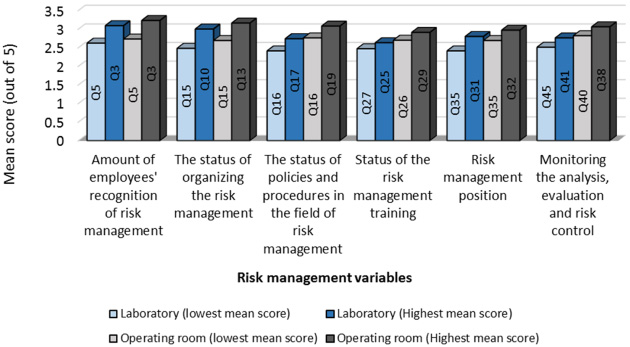
Lowest and highest average scores for each variables of the risk management.
The results of evaluating the differences in the mean of the research variables according to work experience, education level, and gender are presented in Table 3. To determine whether there is a statistically significant difference between the means in two independent groups, the independent t-test is used and the ANOVA test is used to compare the means between three groups or more than three groups.
The results of independent t-tests and one-way ANOVA for research variables at different levels of work experience, education and gender
The findings of the one-way ANOVA test revealed no significant difference in the mean values of the variables between different work experience and education levels (p > 0.05). The independent t-test also showed no significant difference in the mean score of research variables between male and female participants (p > 0.05).
Recognizing risk management as a strategy at all levels of the organization, including managerial and operational levels, has many advantages, upon which the success of organizations depends [32]. In this regard, several studies have evaluated the status of risk management in various departments of medical centers. The level of the employees’ recognition of risk management, including managers and operational staff, is one of the components examined in order to evaluate the status of risk management. The findings of the present study showed that the overall mean value of this domain according to the staff of operating room and laboratory departments was 2.80 and 2.91 respectively, indicating a medium level. In a study by Zaboli et al. that was conducted in selected departments of Tehran hospitals, the overall average score of this domain was 3.2 [25]. In the above study, among the items related to the level of the employees’ recognition of risk management, the highest mean score was related to the concept of risk and risk management in the ward and hospital. However, in the present study, among the items related to this domain, the highest mean value was related to the level of employees’ attention of risks and their management at their workplace in both departments.
Due to the nature of their work, healthcare organizations are considered as organizations that are exposed to many adverse risks; therefore, in order to reduce and prevent these risks, they should pay special attention to the organization of the risk management system [33]. However, as there are limitations in risk assessment and measurement, it is challenging to organize risk management in such a way that it plays its role properly [34]. Hence, since the total mean score of this component was average in the present study and other similar studies [17,25,35], these institutions should use mechanisms in line with the organization of risk management in different sectors, including enterprise risk management (ERM) [36]. Among the items related to the status of organizing the risk management, the knowledge level of the employees about practical methods for the selection and appointment of risk manager had the lowest mean score in the present study and a study by Zaboli et al. [25].
Formulation of practical methods and organizational policies will reduce incidents, minimize complications, and facilitate timely compensation of risks. Therefore, adopting and applying procedures and policies related to risk management is one of the main components in the field of risk management in organizations [37]. In this regard, the organization can take measures such as developing and distributing guidelines, protocols, and risk management manuals at different levels of the organization for managers and operational employees. However, these measures must be managed in a correct manner so as not to lead to disruptions in the performance of assigned tasks to employees, excessive burnout, and increased risks [38]. The overall mean score of the status of policies and procedures related to risk management for laboratory (2.65 out of 5) and operating room (2.86 out of 5) departments showed the average status of this component in the present study. Habibi et al. [9] conducted a study to evaluate risk management in the radiology department of Isfahan hospitals. In this study, according to the mean scores, the status of developing, communicating, and applying guidelines and policies related to risk management was estimated at a lower than average level. However, in a study by Mazloomi et al. [39] with the aim of evaluating the status of risk management from the view point of clinical governance team members in Tehran hospitals, the average score of this component was above average.
Various studies conducted in the field of risk management in healthcare environments have shown that in order to improve the implementation of risk management processes and increase employees’ awareness of existing risks, risk management training programs must be embedded in the risk management strategies of organizations and implemented practically [40–42]. The results of the present study in relation to the status of risk management training in the laboratory (2.55 out of 5) and operating room (2.84 out of 5) departments showed that the total mean score of this component was at a medium level. The findings of similar studies showed that the necessary training was not given in order to inform the personnel about the risks and how to prevent and deal with them. Therefore, employees apparently do not recognize the risks they are exposed to during their daily work, which is the reason why they do not use personal safety devices and equipment and do not comply with safety standards [9,43,44]. In a study conducted by Verbano et al. [45], the findings showed that there are different attitudes towards risks and their appropriate management measures. Therefore, it is better for healthcare institutions to hold comprehensive and short-term risk management training courses based on clinical governance policies and their risk management programs. In this regard, the results of several studies have shown that the implementation of risk management training programs reduces the risks, improves the employees’ attitude toward and understanding of risks, and increases their adherence to safety measures [43,46,47].
Risk managers in healthcare organizations have critical responsibilities for implementing risk management programs. Some of these responsibilities include paying attention to safety, tracking and monitoring incidents, identifying and proactively assessing the risks, financing the implementation of programs, and developing policies and training programs. Therefore, according to the experts’ opinions in the field of risk management, risk management in healthcare organizations should be placed at the top management levels [48]. The status of the risk position in the present study was at a medium level with a total mean score of 2.51 and 2.81 for the laboratory and operating room departments, respectively. In a study by Parivash et al. [49] that was conducted to evaluate the risk management status in the operating room of Namazi Hospital, Shiraz, the status of this domain was also estimated at a medium level. Furthermore, Zaboli et al. found that the position of risk management in selected departments of Tehran hospitals was at a medium level. Therefore, the researchers suggested that in order to provide a safe environment for patients and employees and to improve the quality of treatment, more attention should be paid to the position of risk management in the hospital [25].
The risk management process includes several steps, including risk identification, risk analysis, risk assessment, risk control, risk monitoring, and taking appropriate control measures. Therefore, after identifying the risks, they are evaluated, analyzed and prioritized. Finally, according to the severity and priority of the risk, appropriate control measures should be taken [50]. In this regard, since risk analysis, evaluation, and control are among the main components of risk management, in the present study, the status of these components was evaluated in the departments. The results showed that the status of this component was at a medium level. Similarly, the total mean score of this component was at a medium level in previous studies [9,25,35]. Among the items related to this component, the necessary facilities and tools that should be provided to the employees for risk assessment, analysis and control had the lowest average score. Similarly, this item had the lowest average score in a study by Zaboli et al. [25]. In order to carry out risk assessment analysis and control processes as best as possible, Faghisolouk et al. [35] suggested that the support of the senior managers of the organization should be obtained and the attitude of managers and personnel should be improved by providing the necessary training. In a study by Soheilinia et al. [51] with the aim of managing the risk reduction in operating room processes, the authors combined their primary approach with fuzzy theory to solve the problem of analyzing risk states and effects. In addition, in order to prioritize the identified risks correctly, they used a model based on TOPSIS logic. Their findings showed that the proper evaluation and prioritization of the risks that occur in the operating room helps managers to plan better and more optimally according to the limited resources for risk management. In another study, in order to improve the identification, evaluation and analysis of the organization’s risks, the researchers suggested that the relevant authorities should pay attention to the psychological safety of the employees so that individuals are supported in freely expressing their opinions and reporting incidents [39].
Faghisolouk et al. [35] conducted a study to investigate the status of risk management in Urmia hospitals from the perspectives of senior managers. The results showed no statistically significant difference in the total mean score of the research components based on gender, organizational status of managers, and their education level. Similarly, the findings of the present study showed no statistically significant difference in the mean scores of the research components based on work experience, education level, and gender. However, in a study of Zaboli et al., a significant difference was found in the overall mean score of the component of monitoring analysis, evaluation and risk control based on gender, which is in contrast to the results of the present study [25].
Limitations
As mentioned earlier, the present study was conducted to evaluate the risk management status in laboratory and operating room departments in public hospitals. Therefore, considering the difference between various hospital departments, as well as the difference between public and private hospitals, the generalization of the results to other departments and hospitals should be made with caution.
Conclusion
According to the state of risk management based on the findings of the current research in the laboratory and operating room departments, it is suggested that these departments should focus more on adopting policies and solutions in order to improve the position of risk management. In this regard, it is better to give much importance to the approval of risk management budgets and its amount. Since the lowest mean was related to the status of risk management training in the laboratory department, it is suggested to implement programs to familiarize employees with the risks encountered in their work environment. Also, organize continuing education programs for employees on how to prevent, face, control, analyze and evaluate risks.
Footnotes
Acknowledgements
The present study is a research project (research project no. 14010123245) approved by Hamadan University of Medical Sciences with ethics code no. IR.UMSHA.REC.1400.922.
Informed consent
Not applicable.
Conflict of interest
The authors certify that they have no conflicts of interest related to this manuscript.
Funding
The authors declare that they have no financial or personal relationships with other people or organizations that could inappropriately influence their work.
