




Abstract
BACKGROUND:
Reducing interpersonal contact has been one of the least expensive and most widely used COVID-19 control strategies.
OBJECTIVE:
This systematic review has been conducted with the aim of identifying social distancing strategies and policies and their impact on the COVID-19 pandemic.
METHODS:
In order to compile this systematic review, Google Scholar, PubMed, Scopus, Web of Science, Science Direct, Magiran, SID, and Irandoc databases were searched from the COVID-19 outbreak until March 2021. Keywords included “social”, “physical”, “distance”, “outbreak”, “incidence”, “prevalence”, “spread”, “new case”, “death*”, “mortality*”, “morbidity*” , “covid-19”, “coronavirus”, “sars-cov-2” and “time series*”. The articles were qualitatively evaluated by two researchers using the STROBE tool. Finally, the study data were divided into three conceptual categories by three researchers, who then agreed on one category. The practical suggestions were also categorized in the same way.
RESULTS:
The policies and strategies adopted to implement social distancing were included in five categories of restrictions, prohibitions, closures, incentives, and punishments. Transportation and travel restrictions, crowded places and schools closure, use of telecommunications and virtual communications, and financial and psychological support to society members were the main policies in this area.
CONCLUSION:
Rapid and complete vaccination of all people around the world is out of reach, therefore social distancing and the implementation of physical restraints, especially in crowded and densely populated environments, should be done extensively until COVID-19 is eradicated.
Introduction
Acute respiratory syndrome is an infectious disease caused by a new type of coronavirus known as COVID-19, which broke out in Wuhan in December 2019 [1–3]. COVID-19 is transmitted from human to human through respiratory droplets, cough, sneezing, and Surface contamination and has a high transmission rate; Asymptomatic patients can also be a source of infection [4,5]. The devastating effects of this pandemic on various aspects of the lives of societies, both economic and social, led the World Health Organization (WHO) to declare this crisis a Public Health Emergency of International Concern [6]. According to the WHO Situation Report, on 13 February 2021, 107,838,255 COVID-19 cases were confirmed and 2,373,398 COVID-19 deaths occurred worldwide. According to these statistics, COVID-19 confirmed cases and deaths are 48,021,725 and 1,127,620 in the United States, 36,436,128 and 809,441 in Europe, 13,165,612 and 202,222 in Southeast Asia, 5,976,060 and 139,129 in Africa [7]. The incubation period of this disease is 1–14 days and on average 5–6 days after exposure to the infected person, symptoms such as dry cough, fever, anorexia, body fatigue, and loss of smell and taste occur [3,8,9]. In the early strains of the virus, on average, people over the age of 60 and those with at least one underlying disease such as cardiovascular disease, hypertension, and diabetes were at higher risk for severe complications, approximately 65% of patients were male and 35% were female, and the mortality rate increased over the age of 80 years [2,3]. However, in the new mutations of COVID-19, the rate of infection and risk of serious complications and death is higher in all age groups, especially in youth and children [10]. In the early stages of the COVID-19 pandemic, due to the lack of effective medications and vaccines, many countries considered prevention to be the most effective way to control and inhibit COVID-19 [1]. Currently, the WHO has taken action for the equitable distribution and vaccine access for all people in the world, regardless of their country’s economic situation, through Kovacs due to the limited number of vaccines [11]. Since vaccine resources are limited and global vaccination is time-consuming, the importance of observing restrictions such as social distance alongside vaccination is still emphasized [12]. In this regard, the WHO introduced wearing a mask, quarantine, social distance, and 20-second hand-washing [8,13]. Many countries have adopted a policy of physical distancing to overcome this pandemic and mitigate its consequences [4]. Social distancing, continuous disinfecting, air conditioning, staying home, and hand washing are some of the policies that have reduced the prevalence of COVID-19 in South Korea [14]. Wearing masks in public places, canceling gatherings, controlling body temperature, maintaining social distance were enforced in Hangzhou, China to curb the pandemic, and every household had the right to leave home every two days to buy necessities, which ultimately reduced the prevalence of COVID-19 [15]. The United States also implemented a strategy to limit physical and social contact between individuals. The policies of various states included restricting restaurants, closing schools, ordering people to stay home, issuing emergency notices, canceling gatherings, and closing unnecessary businesses. These policies reduced the individual’s movement by 1–5% in the first five days and by 4.5–7% after 20 days [16]. A study in South Korea found that the prevalence of COVID-19 in workplaces with high population density was very high and these places could be a strong source of virus transmission, so the social distancing strategy in the workplace with appropriate guidelines is one of the most important ways to reduce the prevalence of COVID-19 [17]. A study in the United States found that public policies were able to reduce the average number of COVID-19 new cases by 0.08%; Therefore, in order to gain support for the social distancing policy, one must pay attention to public policies [18]. Non-pharmacological solutions, along with widespread global vaccination, are effective ways to curb COVID-19 and its complications. In this regard, social distancing strategies and policies are some of the most popular strategies adopted by various governments. It is also possible to apply different levels of this policy in most cities and societies with different structures. On the other hand, this policy overshadows the mental health of society’s individuals by isolating them. It indicates the need to examine the effectiveness of this policy to notice whether it is worth trading off with its consequences. Therefore, this systematic review aims to identify the social distancing strategies and policies adopted around the world and to examine their impact on the COVID-19 pandemic through time-series studies.
Materials and methods
Study design
This systematic review is based on a comprehensive examination of the Google Scholar, PubMed, Scopus, Web of Science, Science Direct, Magiran, SID, and Irandoc databases from the COVID-19 outbreak until March 2021. Preferred Reporting Items for Systematic Reviews and Meta-Analyses (PRISMA) was used as a literature review guide [19].
Research questions
In this review, the following questions were answered:
Question (1) What are the social distancing policies and strategies and what are the practical suggestions for its effective implementation?
Question (2) What effect has the social distancing policy had on the prevalence, incidence, spread, and new cases of COVID-19?
Search strategy
The following keywords were searched: “social”, “physical”, “distance”, “outbreak”, “incidence”, “prevalence”, “spread”, “new case”, “death*”, “mortality*”, “morbidity*”, “covid-19”, “coronavirus”, “sars-cov-2” and “time series*”. Some key journals were manually searched to identify all related articles. The search period was confined to the COVID-19 outbreak (2019 to March 2021) (Table 1).
Search strategy
Search strategy
Research articles, reviews, empirical researches, and book chapters on the social distancing policy during the COVID-19 outbreak, publications that examined the outbreak, incidence, prevalence, spread, and new cases of COVID-19 in Persian and English were included in this study. Meanwhile, secondary data, conference abstracts and editorials were removed. Studies on the effect of social distancing on other diseases were also not reviewed. In addition, studies on social distancing during the COVID-19 pandemic were screened with two major exclusion criteria: (1) Studies performed using non-time series methods, and (2) Studies that did not report desired indicators values before and after the intervention. The logic of such screening was that time-series studies include a set of statistical data that is collected at regular intervals. It is a widely used and valid method in analyzing patterns over time and analyzing interventions. It also reports the quantitative and objective impact of the intervention at several time points and its effectiveness trend [20].
Review process
First, the articles were entered into resource management software (EndNote X8) and duplicates were removed. In the next step, two researchers reviewed and screened the abstracts. Articles that answered the research questions were retained and their resources were added for further coverage. These articles were matched with inclusion and exclusion criteria and eligible articles were inclusion in the study.
Quality assessment
After reviewing the articles, three researchers conducted a qualitative assessment of the remaining studies. The STROBE checklist was used to assess the quality of observational studies. STROBE contains 22 components that cover different parts of the article [21]. Articles that showed more than 50% compliance with the checklist were included in the study.
Data extraction
After assessing the quality of the articles, 13 were selected and their related data including author/year of publication, study setting, study design, method, and a concise report of key findings were extracted in accordance with PRISMA provisions. Finally, the study data were divided into three conceptual categories by three researchers, and the researchers agreed on one category. The practical suggestions were also categorized in the same way.
Ethical approval
Ethical approval was obtained from the ethics committee of Qazvin University of Medical Sciences (ethics code IR. QUMS. REC. 1400. 201).
Results
1214 publication were found, which included 399 duplicates and were thus omitted. 725 studies was also rejected after reviewing the titles and abstracts. A full text review furthermore excluded 77 articles. Finally, 13 articles were included in the study to answer the research question (Fig. 1).
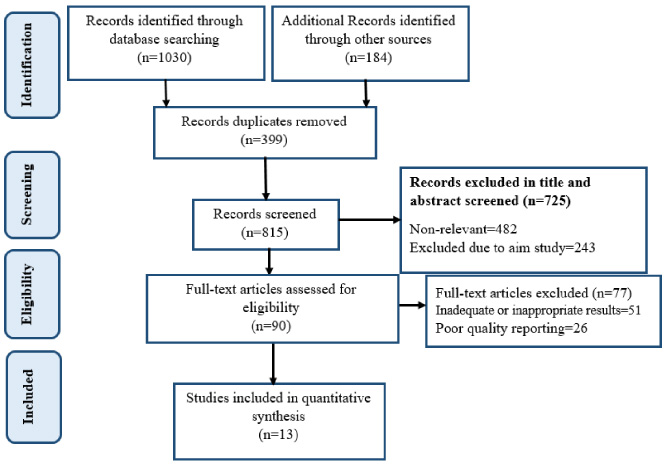
Flow diagram of the literature search.
Data related to the 13 articles were reviewed, including author name, publication year, statistical population, study purpose, type of study, and a summary of key findings (Table 2). A review of time series studies on social distancing has shown that this strategy has been effective in China, most European countries including Sweden, Norway, Italy and Spain, as well as the United States, Brazil, Australia, New Zealand and Iran. In Indonesia, social distance had no statistically significant effect on the COVID-19 pandemic.
Data of articles included in the review
A review of studies showed that the policies and strategies adopted to implement social distancing were included in five categories of restrictions. (1) Policies that control and restrict contact between people, prohibitions; (2) Policies that prohibit and cut off contact between people, closures; (3) Policies that completely prevent people from attending in places and contacting each other by closing places, incentives; (4) Policies that involve individuals in the implementation of preventive measures, through culture-building and economic supports, and punishments; (5) Policies that use coercion to force people to abide by protocols (Table 3).
Types of social distancing policies and strategies adopted in the studies under review
The most effective measures used in the studies under review, along with the authors’ points of view, are summarized in the form of practical suggestions for the effective implementation of social distancing in accordance with the above categories and are presented in Table 4.
Suggestions for the effective implementation of social distance
Numerous measures have been taken to reduce the burden of COVID-19 and its side effects, ranging from quarantine to wearing a mask. Due to the high prevalence of coronavirus, the severe burden of this disease on health systems, and the lack of financial and human resources, effective strategies should be adopted to reduce the prevalence of COVID-19 infection. One of the strategies that have been implemented in many countries so far is social distancing, which means reducing the contact rate of individuals. The present study, in the form of a systematic review, seeks to answer the question of whether social distance affects the prevalence of COVID-19 and what are its policies and strategies? In response to this question, it was found that social distance in the country where this new virus originated, China, as well as many other countries including the United States, Norway, Sweden, Brazil, Iran, Italy, Spain, Australia, and New Zealand has been effective. Therefore, in these countries, after the implementation of this strategy, a significant reduction in the prevalence of COVID-19 was observed.
Given that it takes time to complete vaccinations globally, especially in developing countries, the best approach now is to follow social distance policies along with extensive testing [37]. Many other studies agree with this finding; Thailand, China, New Zealand, and Hong Kong have introduced social distancing as an effective policy [38–40].
Policies and strategies for enforcing social distancing fall into five general categories: restrictions, prohibitions, closures, incentive, and punishment policies. In line with the closure policy, many studies stated that school closures were associated with a significant reduction in the prevalence of airborne infectious diseases incidence and mortality such as colds, gastroenteritis, bronchiolitis, and coronavirus [41,42]. Since population movements in public places are a major cause of human contact and transmission of the virus, the closure of these places could be one of the first measures that can be imposed. Closure of places and communities has different effects in different contexts. In developing countries, which often do not have a strong infrastructure for telecommunications and online classes and meetings, educational and work productivity declines. On the other hand, working at home while reducing social interactions may upset the balance of work and life.
Regarding restrictive policies, a study by Atalan et al. also highlighted that preventive social restriction could significantly reduce the prevalence of the virus. One of the policies they have introduced in this regard is to restrict crowded and unnecessary places. In Italy and Germany, social restrictions have reduced the COVID-19 incidence and mortality [43,44]. In contrast, some of these policies were not effective enough in Indonesia, Japan, and the United States [30,45,46], which was due to a lack of attention to complementary policies of social distancing. These policies, while not completely disrupting activities, can reduce the transmission of the virus by reducing the exposure of individuals. According to the experiences of countries such as Singapore [47] and South Korea [48] in this type of low-intensity restrictions, it is especially important to accompany other protective measures, including the use of masks.
Incentive policies include economic assistance to the people of society. One of the crucial reasons that lead people not to adhere to protocols is the economic concerns especially for self-employed businesses [49]. A systematic review by Faruque Ahmed et al. Showed that social distance policies related to the workplace reduced the prevalence of influenza by an average of 23%. It also reduces and delays virus attack peaks [50]. Also, a study in Saudi Arabia identified positive awareness and attitudes as a factor in people’s adherence to this policy [51]. If the path to compliance with protocols is paved by governments and policies are accepted in society, individuals’ commitment to adhere to protocols will increase. Incentive policies as support for other policies are essential to attracting people to participate. Providing livelihoods, communication infrastructure, informing people about the correct implementation of policies, and ensuring the effectiveness of social distance through campaigns and media are the minimum support measures that should be implemented. Aligning other government policies such as financial, educational, informational and job policies ith social distancing policies is necessary to avoid confusion and put pressure on the people.
In relation to punitive policies, Saez et al. point to the imposition of fines on offenders [27]. The involvement of non-governmental organizations, and the use of military oversight are also summaries of policies adopted in 149 European countries to stabilize social distance [26]. Prompt implementation of social distancing policies is essential to curb virus transmission as soon as possible. Also, due to the emergence of such policies, it is necessary to establish legal levers to ensure the adherence of the majority until the various aspects of these policies are fully explained to the public. Also, the fact that non-adherence to social distancing policies threatens both the health and life of the individual and society, confirms the need to implement coercive policies.
Ultimately, the correct implementation of each of these policies will lead to the proper advancement of social distancing. Achieving this will reduce the burden of disease, reduce the pressure on health facilities and human resources, and as a result, hospitalized patients will enjoy better and more efficient services [29]. On the other hand, due to the importance of time in controlling the virus spread and the fact that the widespread implementation of laws and policies is time-consuming, it is necessary to protect society by implementing classified policies from the cities to the national level [52]. According to the study by Ainslie et al., China was able to quickly implement restrictions-reduction strategies, which led to economic recovery [33]. Therefore, in order to mitigate as much as possible, the psychological, environmental, and economic harms of the above policies, it is necessary to respond quickly and early. This way, the disadvantages can be reduced and the benefits of these policies can be exploited more quickly.
On the other hand, some personal and urban characteristics suchlike demographic characteristics, economic and social status, racial and ethnic composition, population density, size, geographical distance, and health infrastructure affect the COVID-19 prevalence and mortality [53–55]. Therefore, preventing the unbridled prevalence and reducing the public vulnerability requires the vigilance of policymakers in the formulation and implementation of appropriate measures for each city and region. Also, developing policies with varying degrees of intensity and levels should be on the agenda.
Social distancing as a strategy to curb the COVID-19 pandemic should be considered by policymakers and decision-makers. There are currently various programs in many countries for early detection and control of the disease. Meanwhile, social distancing can be one of the surest ways to reduce the incidence and mortality of COVID-19. Therefore, the continuation of social distancing measures is necessary to reduce and prevent further COVID-19 peaks. Various vaccines have already been approved by the WHO, but vaccine resources are limited and it is time-consuming to vaccinate in a phased and prioritized manner. At the same time, new and diverse coronavirus mutations are spreading rapidly in different countries. Therefore, social distancing and implementation of physical restraints, especially in crowded and densely populated environments, should be done extensively and seriously until the end of vaccination worldwide or the eradication of COVID-19.
The effectiveness of all social distancing policies depend on their early implementation and based on a proper analysis of the situation because late action causes a wider virus prevalence and the social involvement with complex complications.
This research is not without limitations. First, due to the heterogeneity of the data reported in the studies, it was not possible to meta-analyze the results. Second, the studies examining quarantine and lockdown were not reviewed due to the absolute prohibition of all activities.
Conclusion
Since social distancing is an inclusive strategy with different levels. This study recommends the policymakers to use different levels and intensities of relevant policies according to the characteristics of each region. Therefore, a balance is created between the characteristics of different occupational, social and age groups, and the intensity and type of policies. This way, community adherence increases and, consequently, the effectiveness of the policy improves. On the other hand, in order to get out of the crisis as soon as possible, the early adoption of this type of preventive policy is of great importance in maintaining public health and society’s sustainability.
Footnotes
Conflict of interest
There are no conflicts of interest.