



Abstract

Patients with type 2 diabetes mellitus (T2DM) are expected to continue a healthy lifestyle during the coronavirus disease (COVID-19) pandemic. Digital health (DH) is reported to improve care of diabetes. 1 However, DH effectiveness in keeping an exercise routine during the pandemic is unknown.
The Japanese government announced the first state of emergency from April 7 to May 6, 2020, during the first wave of the pandemic; non-essential travel and activities decreased. 2 To examine how DH helped T2DM patients continue to exercise during the period, we evaluated daily steps among a portion of the participants who participated in a randomized controlled trial (UMIN000033261) conducted from October 2018 to April 2021 using a previously developed DH system for T2DM.3,4
Research Design and Methods
In total, 132 patients with T2DM and diabetic kidney disease participated in the trial, 70 in the DH group and 62 in the control group. The pandemic occurred during the last year of the trial period. We had to continue the trial with 22 participants left in the DH group. Four participants who did not record daily steps during the period were excluded from the analyses.
The mean or median of all parameters measured as well as data measured at home—blood glucose, blood pressure, body weight—and blood test results including fasting blood glucose and HbA1c during the first wave of the pandemic—April and May—were compared with previous measurements—February and March in 2020. A paired t test for parameters with a normal distribution and a Wilcoxon signed rank test for those with a non-normal distribution were used. P < .05 was deemed statistically significant.
Results
As shown in Table 1, the median daily steps during the first wave of the pandemic (5459.9 [IQR 3308.0-8346.8]) significantly decreased compared with before the pandemic (6556.0 (IQR 4388.1-12062.1) (P = .0002).
Clinical Characteristics of Patients With T2D and DKD at Baseline With Data Measured at Hospital Before and After the First Wave, and Data Measured at Home During the First Wave.
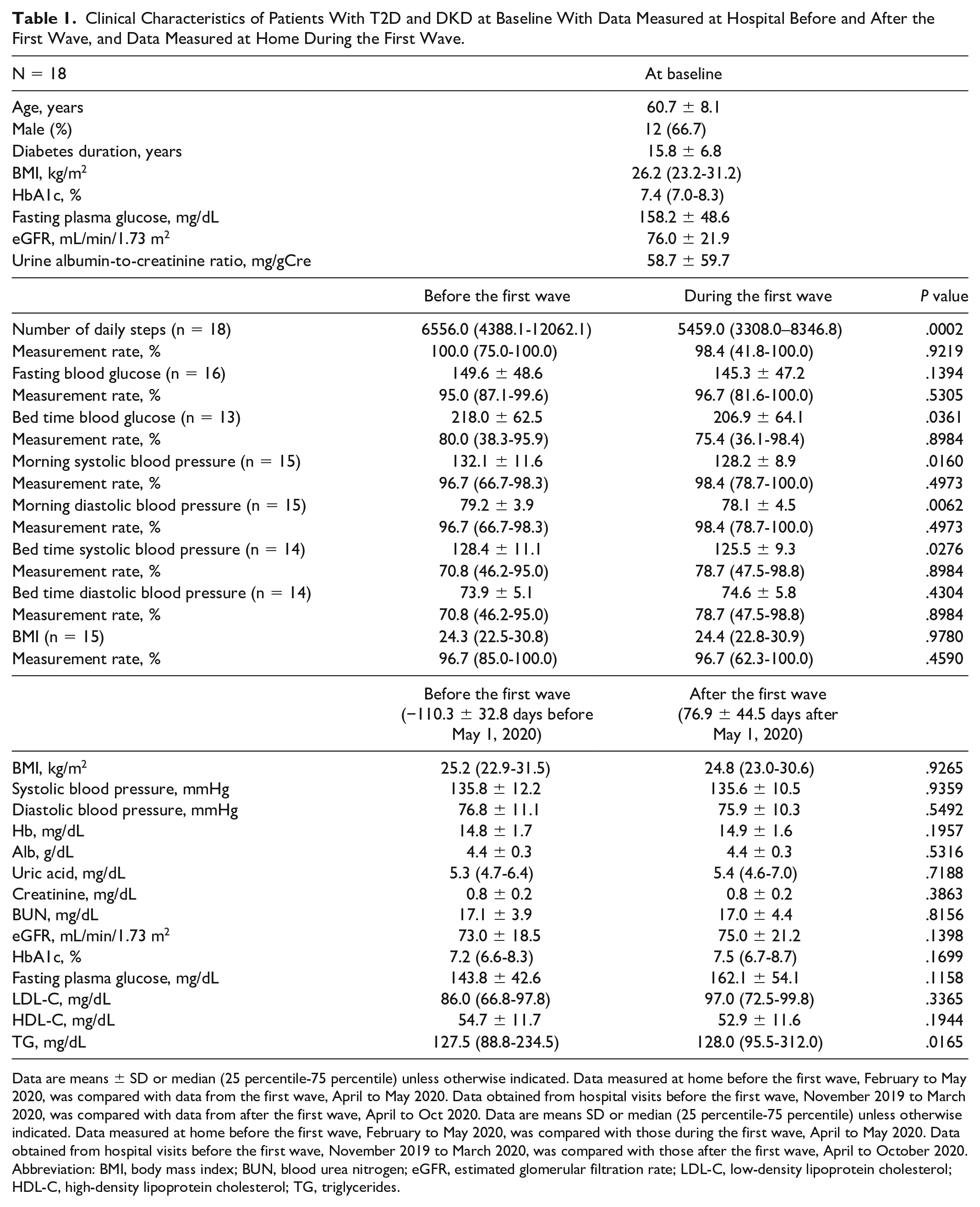
Data are means ± SD or median (25 percentile-75 percentile) unless otherwise indicated. Data measured at home before the first wave, February to May 2020, was compared with data from the first wave, April to May 2020. Data obtained from hospital visits before the first wave, November 2019 to March 2020, was compared with data from after the first wave, April to Oct 2020. Data are means SD or median (25 percentile-75 percentile) unless otherwise indicated. Data measured at home before the first wave, February to May 2020, was compared with those during the first wave, April to May 2020. Data obtained from hospital visits before the first wave, November 2019 to March 2020, was compared with those after the first wave, April to October 2020.
Abbreviation: BMI, body mass index; BUN, blood urea nitrogen; eGFR, estimated glomerular filtration rate; LDL-C, low-density lipoprotein cholesterol; HDL-C, high-density lipoprotein cholesterol; TG, triglycerides.
Conclusions
The median daily steps during the first wave decreased in the DH group.
The median daily steps during the same period in the previous year among the participants in the DH group, who completed the study before the pandemic and recorded daily steps between February and May in 2019 (n = 11), was stable, 10488 (IQR 8109-10965) in April and May vs 10654 (IQR 7535-10875) in February and March, P = .41. Those 11 participants were not significantly different from the current study participants in mean age, 60.1 years (SD, 7.6), P = .83, gender (81.8% of male, P = .37), mean years of diabetes duration, 13.0 years (SD, 9.5), P = .36, median HbA1c, 7.3 (IQR 6.9-7.5) %, P = .46, and mean fasting plasma glucose, 155.1 md/dL (SD, 34.8), P = .86, at baseline. The median step count during February and March was not significantly different between the current 18 participants in 2020 (7482.5 [IQR 5137-11954.63]) and 11 participants in 2019 (10754.5[ 7260-11729]) (P = .27). Although the observed decrease in daily steps might reflect random variation, it is reasonable to conclude that the decrease was due to the first wave of the COVID-19 pandemic.
In conclusion, positive effects of DH on exercise during the COVID-19 pandemic appear to be limited.
Footnotes
Acknowledgements
We thank the participants, physicians, and other health-care professionals at the eight participating institutions of J-ICT-DKD study. This research was supported by AMED (grant JP19ek0210095).
Abbreviations
COVID-19, coronavirus disease 2019; DH, digital health; T2DM, type 2 diabetes mellitus.
Author Contributions
A.S. and K.W. designed the study, analyzed and interpreted data, and wrote the manuscript. M.M. contributed to the statistical analysis. S.Y., M.N., T.Y., and K.O. supervised the study and critically reviewed the manuscript. All authors reviewed and approved the final version of the manuscript. K.W. is the guarantor of this work and, as such, had full access to all the data in the study and takes responsibility for the integrity of the data and the accuracy of the data analysis.
Declaration of Conflicting Interests
The author(s) declared the following potential conflicts of interest with respect to the research, authorship, and/or publication of this article: K.W. is an advisory of NIHON CHOUZAI Co., Ltd.
Funding
The author(s) disclosed receipt of the following financial support for the research, authorship, and/or publication of this article: This study is funded by NTT DOCOMO, INC. and NIHON CHOUZAI Co., Ltd. The funding source has no role in the study design, data collection, analyses, interpretation, or writing the manuscript.
